Difference Between Memory Loss and Dementia: A Guide

Your father forgets where he left his keys, asks the same question twice during dinner, and then remembers an old family story in perfect detail. You may find yourself wondering whether this is ordinary aging, mild cognitive impairment, or the beginning of dementia. That uncertainty is common, but the answer usually isn't found in one forgotten name or misplaced object.
The more useful question is whether the change is persistent, expanding beyond memory, and interfering with independence. The difference between memory loss and dementia depends less on an isolated lapse than on the pattern around it, including changes in reasoning, language, orientation, behavior, and familiar daily tasks.
Table of Contents
Understanding Memory Loss and Dementia
Underlying Mechanisms of Memory Loss and Dementia
Why the same complaint can mean different things
Causes and Risk Factors
Where mild cognitive impairment fits
Factors families can act on
Detailed Comparison of Memory Loss and Dementia
What the difference looks like at home
Recognizing Diagnostic Cues and When to Seek Evaluation
A caregiver's observation checklist
Why a screening score isn't the diagnosis
Practical Care Implications and Support Options
Match support to the task
Build a layered care plan
Recommendations and Decision Framework
Understanding Memory Loss and Dementia
A parent may forget a name, misplace glasses, or need extra time to recall an appointment. If they later remember, retrace their steps, or use a calendar effectively, the lapse may fit ordinary aging rather than dementia.
The pattern matters more than one mistake. Concern grows when forgetfulness keeps returning, becomes harder to manage, or disrupts familiar responsibilities. Someone who misses one appointment but checks a calendar and attends the next one is in a different situation from someone who repeatedly misses appointments, cannot explain them, and relies on another person to manage the schedule.
Between occasional forgetfulness and dementia lies a gray zone. Mild cognitive impairment may cause noticeable changes while the person still handles many daily activities independently. Tracking whether the change is stable, worsening, or spreading to planning, language, judgment, or routines can help caregivers describe what they observe. This broader context is also relevant to cognitive decline in older adults.
Dementia is a syndrome, not merely a memory complaint. The World Health Organization's explanation of dementia describes a condition that interferes with daily life and includes losses in thinking, remembering, learning, and reasoning. Memory loss may be one feature, while dementia generally involves wider cognitive and functional changes.
Practical rule: Judge a lapse by whether the person can still understand, organize, and complete familiar activities independently, not by how embarrassing or dramatic the moment appears.
Families can make two opposite errors. Dismissing repeated changes may delay evaluation, while treating every forgotten word as dementia can create fear, conflict, and unnecessary loss of autonomy. A short record of examples, including what happened, how often it occurs, and whether help was needed, gives a clinician more useful information than a general label. Evaluation is appropriate when the pattern persists or daily function starts to change.
Underlying Mechanisms of Memory Loss and Dementia
Memory relies on a sequence of brain processes: attention, registering information, storing it, and retrieving it later. Normal aging can slow recall, especially when attention is divided. The person may need more time, yet still learn new information and manage familiar tasks.
A caregiver's observation can reveal which step is affected. Someone who misses part of a conversation because of poor hearing or distraction may not store the information fully. Later, the forgotten detail can look like a memory problem, although attention was the first difficulty.
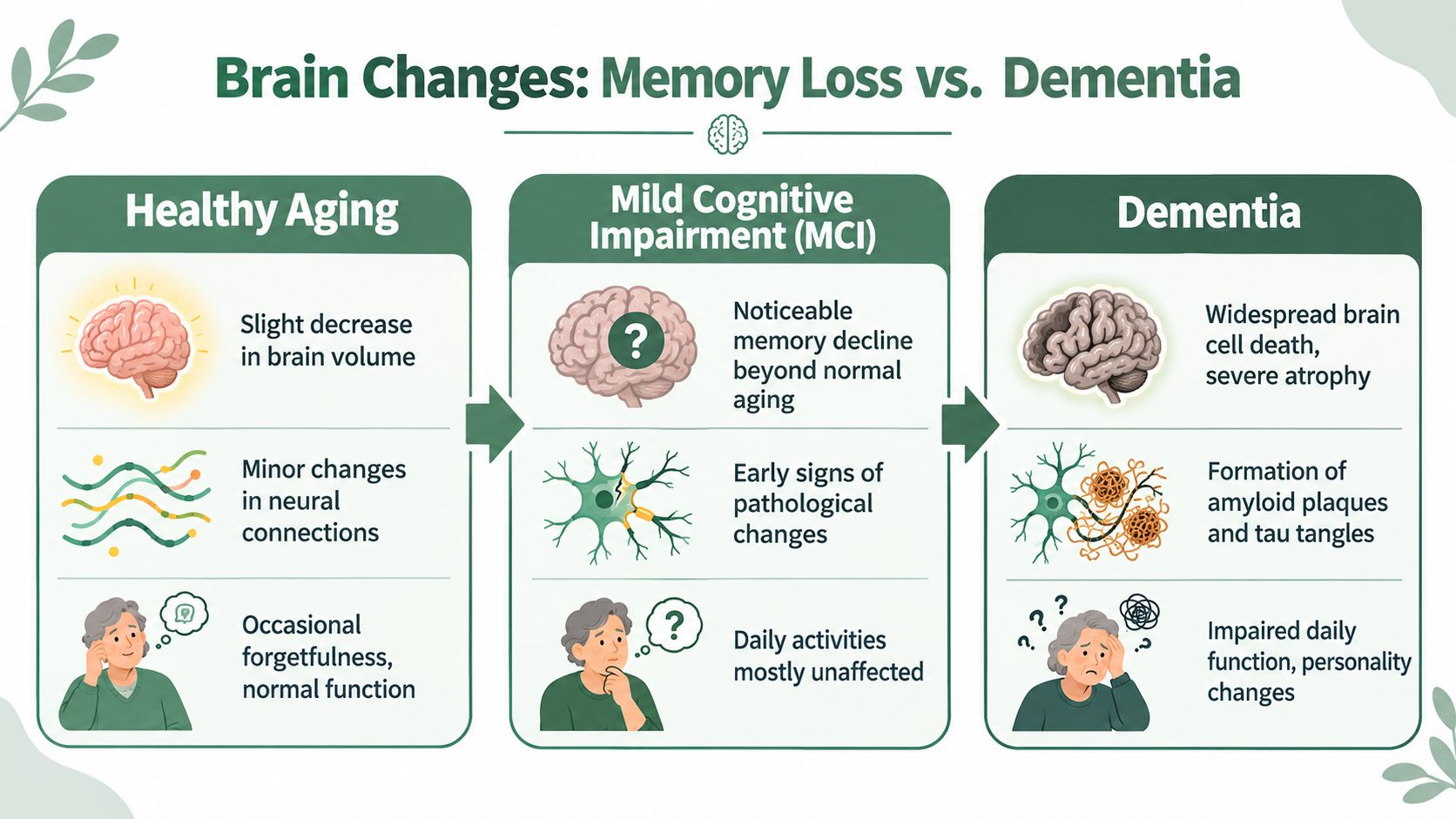
Dementia reflects disease-related changes that disrupt broader brain networks. In Alzheimer's disease, clinicians often discuss amyloid plaques and tau tangles. Vascular dementia involves injury associated with impaired blood flow or strokes. Depending on the affected networks, changes may involve memory, language, planning, visual-spatial abilities, mood, movement, or judgment.
The sequence is not identical for every person. Memory may change first, while someone else initially has difficulty with language, social behavior, mood, or orientation. A scoping review in BMJ Open describes memory decline followed by changes in performance, language, disorientation, personality, mood, and behavior in Alzheimer's disease, while emphasizing that individual trajectories vary.
Why the same complaint can mean different things
“I'm forgetting things” identifies a concern, not its cause. Poor sleep, low mood, stress, medication effects, hearing difficulty, and other health problems can reduce concentration and recall. The pattern, timing, and effect on daily activities help separate these possibilities.
Mild cognitive impairment occupies the gray zone between expected age-related change and dementia. The person, or someone close to them, notices a genuine decline, while everyday independence remains mostly intact. The National Institute on Aging's Alzheimer's disease fact sheet notes that MCI can progress, remain stable, or have other outcomes. It calls for follow-up, not an automatic dementia label.
A household filing system offers a useful comparison. Normal aging may mean locating a document more slowly. MCI may involve repeatedly misplacing important papers while the person can still manage the system. Dementia may prevent reliable organization or use of that system, even with familiar routines and reminders.
Causes and Risk Factors
Memory changes seldom have one cause. Age raises the likelihood of cognitive disorders, yet age alone does not establish dementia. A clinician looks at when symptoms began, which abilities changed, and how daily life is affected. Medical history, medications, mood, sleep, hearing and vision, vascular health, and past head injury can all shape the picture.
Some influences are difficult to change, including family history and inherited vulnerability. Others can be addressed. Blood pressure and other vascular conditions, smoking, inactivity, poor sleep, depression, and untreated hearing problems may affect cognitive performance or brain health. They do not prove that dementia will develop, and improving them cannot guarantee prevention. They do give families practical topics to review with a healthcare professional.
Where mild cognitive impairment fits
MCI is a recognized middle ground, not a shameful label. A person may have noticeable problems with memory, language, attention, executive skills, or several areas while retaining much of their independence. The course varies. MCI may remain stable, improve when a contributing problem is treated, or progress to dementia.
Families should watch the pattern rather than treat one forgotten detail as a diagnosis. Is your mother using more reminders but still managing her medications? Is she making mistakes with bills and correcting them herself? Has she begun avoiding activities because they feel confusing? These examples help a clinician distinguish an occasional difficulty from a change that is persistent and increasingly disruptive.
A filing system shows the difference. Normal aging may mean finding a document more slowly. MCI may involve repeatedly misplacing important papers while the person can still manage the system. Dementia may make familiar organization unreliable, even when routines and reminders are available.
Factors families can act on
Start with an accurate medication list, including over-the-counter products. Ask the prescribing clinician whether any medication could affect alertness, attention, or memory. Review sleep, mood, hearing, vision, alcohol use, and recent illnesses before assuming the brain is the only source of the problem.
Support cardiovascular health according to the person's medical advice. Regular movement, social contact, mentally engaging activities, and safe, consistent routines may support general health and make daily thinking easier. These measures do not replace an evaluation when function is declining. A gradual increase in help with medications, finances, cooking, or appointments is a practical reason to arrange one.
Detailed Comparison of Memory Loss and Dementia
A practical comparison starts with independence. Memory loss alone doesn't meet dementia criteria in an older adult. Dementia requires deficits in multiple cognitive domains and functional decline that reduces social or occupational independence, as explained in this clinical overview from the American Academy of Family Physicians.
Aspect | Memory Loss | Dementia |
|---|---|---|
Functional impact | The person remains independent, perhaps with calendars, lists, or extra time. | Cognitive changes interfere with familiar activities and independence. |
Cognitive domains | Memory may be the main concern. | Memory commonly occurs with problems in reasoning, language, planning, attention, or visual-spatial skills. |
Progression | Lapses may remain occasional or stable, and their effect can vary with stress, sleep, or attention. | Symptoms tend to form a persistent, worsening pattern, although the pace and presentation differ. |
Behavior and mood | Frustration or worry may follow an embarrassing lapse, while the person's usual personality remains recognizable. | Mood, personality, judgment, or social behavior may change alongside cognitive decline. |
Task management | The person may forget an appointment but recover by checking a calendar or calling for confirmation. | The person may repeatedly miss appointments, misunderstand instructions, or need another person to manage them. |
What the difference looks like at home
Misplacing keys is not automatically a warning sign. A person with ordinary forgetfulness may search, remember where they were, or follow a familiar habit to find them. Concern grows if objects regularly appear in inappropriate places, the person can't retrace their steps, and accusations or distress become part of the pattern.
The same principle applies to conversations. Forgetting a word and finding it later is different from losing the thread of familiar discussions, using increasingly unclear language, or failing to understand what others are saying. Language and comprehension changes may signal that the issue extends beyond memory storage.
Bills offer another useful test. Someone with mild memory difficulty may need a reminder or make an occasional error but understand the household system. Someone developing dementia may struggle to sequence the steps, recognize due dates, detect mistakes, or make safe financial decisions.
MCI occupies the gray zone. The person may forget important information more often than expected, yet still prepare meals, maintain personal care, use familiar appliances, and manage routine life with limited support. Families often benefit from reading more about Alzheimer's disease versus dementia, because the terms describe related but different concepts.
The dividing line isn't whether a person ever forgets. It's whether cognitive change is beginning to control the person's day.
Recognizing Diagnostic Cues and When to Seek Evaluation
Don't wait for a crisis to document cognitive change. Start with specific observations, dates, and examples. “She seems worse” is difficult for a clinician to interpret. “She missed two previously routine bill payments, repeated the same question during one conversation, and got confused on a familiar route” gives the clinician usable information.
A caregiver's observation checklist
Look for a pattern across different parts of life:
Recent information: Does the person repeatedly forget conversations, appointments, or instructions even after reminders?
Navigation: Have they become lost in familiar places or unsure how to return home?
Planning: Are finances, medication organization, cooking, or household decisions becoming unsafe?
Language: Do they struggle to follow conversations, name familiar objects, or express a straightforward idea?
Behavior: Are there new changes in mood, personality, judgment, withdrawal, or suspiciousness?
Recovery: Can they recognize the problem, retrace their steps, and use tools that previously worked?
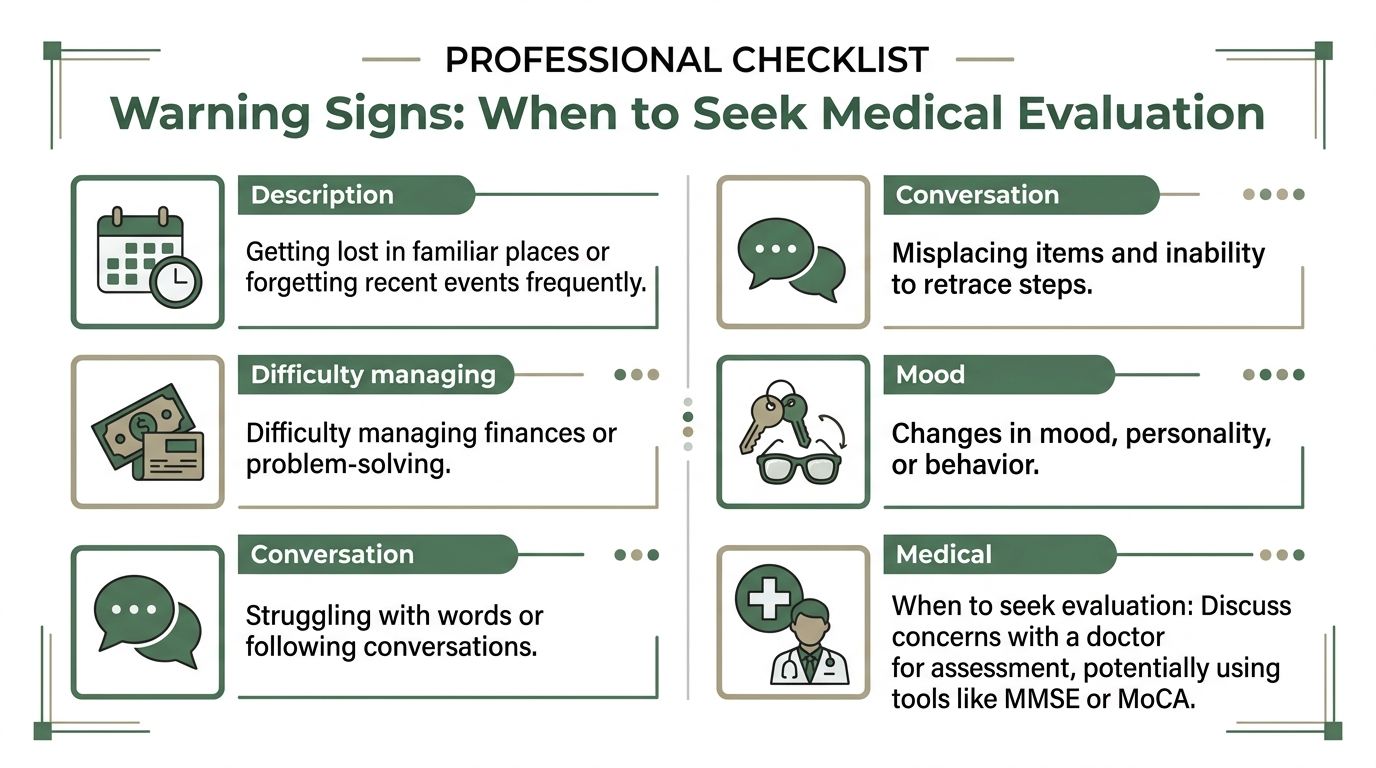
A primary care clinician may review medical history, medications, mood, sleep, hearing, and daily function, then use a brief cognitive screen. Common tools include the Mini-Mental State Examination, or MMSE, and the Montreal Cognitive Assessment, or MoCA. These tests support assessment, but they don't independently diagnose dementia.
Why a screening score isn't the diagnosis
Screening results depend on education, language, culture, sensory ability, test conditions, and the selected cutoff. A systematic review found combined sensitivity and specificity of 0.81 and 0.89 across cognitive tests, while MMSE performance at standard cutoffs was 88.3% sensitivity and 86.2% specificity, according to this review in JAMA Internal Medicine. Sensitivity reflects detection of true cases, while specificity reflects correct identification of people without the condition.
A score can therefore be reassuring without ending the evaluation, or concerning without proving dementia. Bring a medication list, examples of changed tasks, the person's usual abilities, and a timeline. If possible, attend the appointment with the person's consent, because caregivers often notice functional changes that the patient can't describe.
For a closer look at the intermediate stage, consult this guide to understanding mild cognitive impairment.
Seek prompt medical advice when confusion is sudden, severe, or accompanied by acute illness, injury, or a new safety concern. A gradual pattern also deserves an appointment, especially when familiar tasks, navigation, communication, or judgment are changing.
Practical Care Implications and Support Options
A daughter notices that her mother repeats questions, yet still prepares breakfast and manages familiar routines. Another week, the mother misses a payment and cannot follow a recipe she has used for years. These situations sit in a gray zone. Support should follow the person's actual function, progression, and safety needs, not a label alone.

Match support to the task
Sort activities into three groups: tasks the person completes alone, tasks completed with prompts, and tasks that require another person. This preserves independence while identifying where a small mistake could cause harm.
For isolated lapses: Use one visible calendar, a consistent place for keys, written appointment reminders, and simple labels. Keep instructions brief. Repeat them without criticism.
For MCI: Add medication organization, shared financial review, transportation planning, and regular check-ins. Invite the person into decisions, rather than presenting help as a loss of control.
For dementia-related decline: Consider supervision for cooking, medication, wandering risk, finances, and personal care. Simplify the environment and retain familiar routines as abilities change.
A routine reduces the number of decisions required each day. The same morning sequence, storage location for important items, and appointment-recording method can lower frustration. Technology helps some families, while a paper calendar or phone call may work better if an app causes confusion.
Build a layered care plan
One service rarely meets every need. Depending on the situation, families may combine primary care, neurology or geriatric assessment, home care, adult day programs, transportation assistance, occupational therapy, social work, and caregiver support groups. Remote check-ins can supplement visits, but they do not replace hands-on help when a person is unsafe alone.
The burden often falls across several relatives, and one person should not be expected to absorb every responsibility indefinitely. Respite care, shared calendars, written handoffs, and scheduled family check-ins can reduce missed information between caregivers.
Families considering a move or a change in living arrangements may find A Better Solution in Home Care's insights useful when considering how someone might adjust to a different care setting. A familiar object, predictable schedule, and gradual introduction to new caregivers can also make changes easier to tolerate.
Velma is one non-medical option for older adults with early to mid-stage memory loss. Its scheduled phone sessions combine guided conversation, cognitive exercises, orientation, routine support, and family updates. It can supplement medical care and in-person caregiving, but it is not a substitute for diagnosis, emergency help, or direct supervision.
Recommendations and Decision Framework
Use a four-part decision process.
First, record the pattern. Write down what changed, when it started, how often it happens, and whether the person can recover with a reminder. Include examples involving memory, language, planning, navigation, behavior, and daily activities.
Next, sort the concern by function. Occasional lapses with preserved independence call for monitoring and practical memory aids. Noticeable decline with mostly preserved routines suggests a clinical discussion about MCI or another cause. Repeated failures in familiar tasks, unsafe decisions, getting lost, or multi-domain changes justify a fuller evaluation.
Then, arrange the right level of assessment. Start with a primary care clinician, bring an informed family member when appropriate, and ask about medication review, mood, sleep, sensory problems, cognitive screening, and referral needs. Don't use a home test score as a diagnosis.
Finally, review support regularly. Keep the person involved in decisions, protect independence where it's safe, and increase help when prompts no longer work. Reassess after meaningful changes in medication, health, mood, living situation, or daily function.
The most reliable answer to the difference between memory loss and dementia comes from pattern, progression, and function, not from one symptom. Acting early doesn't mean assuming the worst. It means giving the person and family more time to identify treatable contributors, plan support, and respond safely as needs evolve.
Velma offers scheduled phone-based cognitive support for older adults experiencing early to mid-stage memory loss, with guided conversation, research-backed exercises, routine reminders, and family updates. If regular cognitive engagement and check-ins could complement your family's care plan, visit Velma to learn how the program works.
Your father forgets where he left his keys, asks the same question twice during dinner, and then remembers an old family story in perfect detail. You may find yourself wondering whether this is ordinary aging, mild cognitive impairment, or the beginning of dementia. That uncertainty is common, but the answer usually isn't found in one forgotten name or misplaced object.
The more useful question is whether the change is persistent, expanding beyond memory, and interfering with independence. The difference between memory loss and dementia depends less on an isolated lapse than on the pattern around it, including changes in reasoning, language, orientation, behavior, and familiar daily tasks.
Table of Contents
Understanding Memory Loss and Dementia
Underlying Mechanisms of Memory Loss and Dementia
Why the same complaint can mean different things
Causes and Risk Factors
Where mild cognitive impairment fits
Factors families can act on
Detailed Comparison of Memory Loss and Dementia
What the difference looks like at home
Recognizing Diagnostic Cues and When to Seek Evaluation
A caregiver's observation checklist
Why a screening score isn't the diagnosis
Practical Care Implications and Support Options
Match support to the task
Build a layered care plan
Recommendations and Decision Framework
Understanding Memory Loss and Dementia
A parent may forget a name, misplace glasses, or need extra time to recall an appointment. If they later remember, retrace their steps, or use a calendar effectively, the lapse may fit ordinary aging rather than dementia.
The pattern matters more than one mistake. Concern grows when forgetfulness keeps returning, becomes harder to manage, or disrupts familiar responsibilities. Someone who misses one appointment but checks a calendar and attends the next one is in a different situation from someone who repeatedly misses appointments, cannot explain them, and relies on another person to manage the schedule.
Between occasional forgetfulness and dementia lies a gray zone. Mild cognitive impairment may cause noticeable changes while the person still handles many daily activities independently. Tracking whether the change is stable, worsening, or spreading to planning, language, judgment, or routines can help caregivers describe what they observe. This broader context is also relevant to cognitive decline in older adults.
Dementia is a syndrome, not merely a memory complaint. The World Health Organization's explanation of dementia describes a condition that interferes with daily life and includes losses in thinking, remembering, learning, and reasoning. Memory loss may be one feature, while dementia generally involves wider cognitive and functional changes.
Practical rule: Judge a lapse by whether the person can still understand, organize, and complete familiar activities independently, not by how embarrassing or dramatic the moment appears.
Families can make two opposite errors. Dismissing repeated changes may delay evaluation, while treating every forgotten word as dementia can create fear, conflict, and unnecessary loss of autonomy. A short record of examples, including what happened, how often it occurs, and whether help was needed, gives a clinician more useful information than a general label. Evaluation is appropriate when the pattern persists or daily function starts to change.
Underlying Mechanisms of Memory Loss and Dementia
Memory relies on a sequence of brain processes: attention, registering information, storing it, and retrieving it later. Normal aging can slow recall, especially when attention is divided. The person may need more time, yet still learn new information and manage familiar tasks.
A caregiver's observation can reveal which step is affected. Someone who misses part of a conversation because of poor hearing or distraction may not store the information fully. Later, the forgotten detail can look like a memory problem, although attention was the first difficulty.
Dementia reflects disease-related changes that disrupt broader brain networks. In Alzheimer's disease, clinicians often discuss amyloid plaques and tau tangles. Vascular dementia involves injury associated with impaired blood flow or strokes. Depending on the affected networks, changes may involve memory, language, planning, visual-spatial abilities, mood, movement, or judgment.
The sequence is not identical for every person. Memory may change first, while someone else initially has difficulty with language, social behavior, mood, or orientation. A scoping review in BMJ Open describes memory decline followed by changes in performance, language, disorientation, personality, mood, and behavior in Alzheimer's disease, while emphasizing that individual trajectories vary.
Why the same complaint can mean different things
“I'm forgetting things” identifies a concern, not its cause. Poor sleep, low mood, stress, medication effects, hearing difficulty, and other health problems can reduce concentration and recall. The pattern, timing, and effect on daily activities help separate these possibilities.
Mild cognitive impairment occupies the gray zone between expected age-related change and dementia. The person, or someone close to them, notices a genuine decline, while everyday independence remains mostly intact. The National Institute on Aging's Alzheimer's disease fact sheet notes that MCI can progress, remain stable, or have other outcomes. It calls for follow-up, not an automatic dementia label.
A household filing system offers a useful comparison. Normal aging may mean locating a document more slowly. MCI may involve repeatedly misplacing important papers while the person can still manage the system. Dementia may prevent reliable organization or use of that system, even with familiar routines and reminders.
Causes and Risk Factors
Memory changes seldom have one cause. Age raises the likelihood of cognitive disorders, yet age alone does not establish dementia. A clinician looks at when symptoms began, which abilities changed, and how daily life is affected. Medical history, medications, mood, sleep, hearing and vision, vascular health, and past head injury can all shape the picture.
Some influences are difficult to change, including family history and inherited vulnerability. Others can be addressed. Blood pressure and other vascular conditions, smoking, inactivity, poor sleep, depression, and untreated hearing problems may affect cognitive performance or brain health. They do not prove that dementia will develop, and improving them cannot guarantee prevention. They do give families practical topics to review with a healthcare professional.
Where mild cognitive impairment fits
MCI is a recognized middle ground, not a shameful label. A person may have noticeable problems with memory, language, attention, executive skills, or several areas while retaining much of their independence. The course varies. MCI may remain stable, improve when a contributing problem is treated, or progress to dementia.
Families should watch the pattern rather than treat one forgotten detail as a diagnosis. Is your mother using more reminders but still managing her medications? Is she making mistakes with bills and correcting them herself? Has she begun avoiding activities because they feel confusing? These examples help a clinician distinguish an occasional difficulty from a change that is persistent and increasingly disruptive.
A filing system shows the difference. Normal aging may mean finding a document more slowly. MCI may involve repeatedly misplacing important papers while the person can still manage the system. Dementia may make familiar organization unreliable, even when routines and reminders are available.
Factors families can act on
Start with an accurate medication list, including over-the-counter products. Ask the prescribing clinician whether any medication could affect alertness, attention, or memory. Review sleep, mood, hearing, vision, alcohol use, and recent illnesses before assuming the brain is the only source of the problem.
Support cardiovascular health according to the person's medical advice. Regular movement, social contact, mentally engaging activities, and safe, consistent routines may support general health and make daily thinking easier. These measures do not replace an evaluation when function is declining. A gradual increase in help with medications, finances, cooking, or appointments is a practical reason to arrange one.
Detailed Comparison of Memory Loss and Dementia
A practical comparison starts with independence. Memory loss alone doesn't meet dementia criteria in an older adult. Dementia requires deficits in multiple cognitive domains and functional decline that reduces social or occupational independence, as explained in this clinical overview from the American Academy of Family Physicians.
Aspect | Memory Loss | Dementia |
|---|---|---|
Functional impact | The person remains independent, perhaps with calendars, lists, or extra time. | Cognitive changes interfere with familiar activities and independence. |
Cognitive domains | Memory may be the main concern. | Memory commonly occurs with problems in reasoning, language, planning, attention, or visual-spatial skills. |
Progression | Lapses may remain occasional or stable, and their effect can vary with stress, sleep, or attention. | Symptoms tend to form a persistent, worsening pattern, although the pace and presentation differ. |
Behavior and mood | Frustration or worry may follow an embarrassing lapse, while the person's usual personality remains recognizable. | Mood, personality, judgment, or social behavior may change alongside cognitive decline. |
Task management | The person may forget an appointment but recover by checking a calendar or calling for confirmation. | The person may repeatedly miss appointments, misunderstand instructions, or need another person to manage them. |
What the difference looks like at home
Misplacing keys is not automatically a warning sign. A person with ordinary forgetfulness may search, remember where they were, or follow a familiar habit to find them. Concern grows if objects regularly appear in inappropriate places, the person can't retrace their steps, and accusations or distress become part of the pattern.
The same principle applies to conversations. Forgetting a word and finding it later is different from losing the thread of familiar discussions, using increasingly unclear language, or failing to understand what others are saying. Language and comprehension changes may signal that the issue extends beyond memory storage.
Bills offer another useful test. Someone with mild memory difficulty may need a reminder or make an occasional error but understand the household system. Someone developing dementia may struggle to sequence the steps, recognize due dates, detect mistakes, or make safe financial decisions.
MCI occupies the gray zone. The person may forget important information more often than expected, yet still prepare meals, maintain personal care, use familiar appliances, and manage routine life with limited support. Families often benefit from reading more about Alzheimer's disease versus dementia, because the terms describe related but different concepts.
The dividing line isn't whether a person ever forgets. It's whether cognitive change is beginning to control the person's day.
Recognizing Diagnostic Cues and When to Seek Evaluation
Don't wait for a crisis to document cognitive change. Start with specific observations, dates, and examples. “She seems worse” is difficult for a clinician to interpret. “She missed two previously routine bill payments, repeated the same question during one conversation, and got confused on a familiar route” gives the clinician usable information.
A caregiver's observation checklist
Look for a pattern across different parts of life:
Recent information: Does the person repeatedly forget conversations, appointments, or instructions even after reminders?
Navigation: Have they become lost in familiar places or unsure how to return home?
Planning: Are finances, medication organization, cooking, or household decisions becoming unsafe?
Language: Do they struggle to follow conversations, name familiar objects, or express a straightforward idea?
Behavior: Are there new changes in mood, personality, judgment, withdrawal, or suspiciousness?
Recovery: Can they recognize the problem, retrace their steps, and use tools that previously worked?
A primary care clinician may review medical history, medications, mood, sleep, hearing, and daily function, then use a brief cognitive screen. Common tools include the Mini-Mental State Examination, or MMSE, and the Montreal Cognitive Assessment, or MoCA. These tests support assessment, but they don't independently diagnose dementia.
Why a screening score isn't the diagnosis
Screening results depend on education, language, culture, sensory ability, test conditions, and the selected cutoff. A systematic review found combined sensitivity and specificity of 0.81 and 0.89 across cognitive tests, while MMSE performance at standard cutoffs was 88.3% sensitivity and 86.2% specificity, according to this review in JAMA Internal Medicine. Sensitivity reflects detection of true cases, while specificity reflects correct identification of people without the condition.
A score can therefore be reassuring without ending the evaluation, or concerning without proving dementia. Bring a medication list, examples of changed tasks, the person's usual abilities, and a timeline. If possible, attend the appointment with the person's consent, because caregivers often notice functional changes that the patient can't describe.
For a closer look at the intermediate stage, consult this guide to understanding mild cognitive impairment.
Seek prompt medical advice when confusion is sudden, severe, or accompanied by acute illness, injury, or a new safety concern. A gradual pattern also deserves an appointment, especially when familiar tasks, navigation, communication, or judgment are changing.
Practical Care Implications and Support Options
A daughter notices that her mother repeats questions, yet still prepares breakfast and manages familiar routines. Another week, the mother misses a payment and cannot follow a recipe she has used for years. These situations sit in a gray zone. Support should follow the person's actual function, progression, and safety needs, not a label alone.
Match support to the task
Sort activities into three groups: tasks the person completes alone, tasks completed with prompts, and tasks that require another person. This preserves independence while identifying where a small mistake could cause harm.
For isolated lapses: Use one visible calendar, a consistent place for keys, written appointment reminders, and simple labels. Keep instructions brief. Repeat them without criticism.
For MCI: Add medication organization, shared financial review, transportation planning, and regular check-ins. Invite the person into decisions, rather than presenting help as a loss of control.
For dementia-related decline: Consider supervision for cooking, medication, wandering risk, finances, and personal care. Simplify the environment and retain familiar routines as abilities change.
A routine reduces the number of decisions required each day. The same morning sequence, storage location for important items, and appointment-recording method can lower frustration. Technology helps some families, while a paper calendar or phone call may work better if an app causes confusion.
Build a layered care plan
One service rarely meets every need. Depending on the situation, families may combine primary care, neurology or geriatric assessment, home care, adult day programs, transportation assistance, occupational therapy, social work, and caregiver support groups. Remote check-ins can supplement visits, but they do not replace hands-on help when a person is unsafe alone.
The burden often falls across several relatives, and one person should not be expected to absorb every responsibility indefinitely. Respite care, shared calendars, written handoffs, and scheduled family check-ins can reduce missed information between caregivers.
Families considering a move or a change in living arrangements may find A Better Solution in Home Care's insights useful when considering how someone might adjust to a different care setting. A familiar object, predictable schedule, and gradual introduction to new caregivers can also make changes easier to tolerate.
Velma is one non-medical option for older adults with early to mid-stage memory loss. Its scheduled phone sessions combine guided conversation, cognitive exercises, orientation, routine support, and family updates. It can supplement medical care and in-person caregiving, but it is not a substitute for diagnosis, emergency help, or direct supervision.
Recommendations and Decision Framework
Use a four-part decision process.
First, record the pattern. Write down what changed, when it started, how often it happens, and whether the person can recover with a reminder. Include examples involving memory, language, planning, navigation, behavior, and daily activities.
Next, sort the concern by function. Occasional lapses with preserved independence call for monitoring and practical memory aids. Noticeable decline with mostly preserved routines suggests a clinical discussion about MCI or another cause. Repeated failures in familiar tasks, unsafe decisions, getting lost, or multi-domain changes justify a fuller evaluation.
Then, arrange the right level of assessment. Start with a primary care clinician, bring an informed family member when appropriate, and ask about medication review, mood, sleep, sensory problems, cognitive screening, and referral needs. Don't use a home test score as a diagnosis.
Finally, review support regularly. Keep the person involved in decisions, protect independence where it's safe, and increase help when prompts no longer work. Reassess after meaningful changes in medication, health, mood, living situation, or daily function.
The most reliable answer to the difference between memory loss and dementia comes from pattern, progression, and function, not from one symptom. Acting early doesn't mean assuming the worst. It means giving the person and family more time to identify treatable contributors, plan support, and respond safely as needs evolve.
Velma offers scheduled phone-based cognitive support for older adults experiencing early to mid-stage memory loss, with guided conversation, research-backed exercises, routine reminders, and family updates. If regular cognitive engagement and check-ins could complement your family's care plan, visit Velma to learn how the program works.
Suggested Article: