8 Spatial Orientation Exercises for Dementia Care
You're on the phone with your mother when she pauses halfway through describing her morning. She knows the kitchen well, but suddenly can't remember whether the bathroom is past the bedroom or near the front door. She sounds embarrassed, so you reassure her, ask one gentle question, and resist the urge to turn the moment into a quiz.
Spatial orientation exercises can make these conversations safer and more useful. Personalized activities may support engagement, routine awareness, reminiscence, and observation of meaningful changes, especially when they're brief, familiar, and free from judgment. They aren't diagnostic tests, and they shouldn't replace medical care, supervision, medication review, or professional assessment. Spatial navigation problems can appear before more obvious memory difficulties, and a 2017 NIH-indexed study found that each 10-second increase on the Floor Maze Test was associated with a 25% higher risk of incident mild cognitive impairment and a 53% higher risk of incident motoric cognitive risk syndrome, after adjustment for several relevant factors (NIH-indexed research on spatial navigation and cognitive risk).
For a phone call, start by checking comfort, use familiar anchors, offer one prompt at a time, validate effort, and record meaningful changes rather than isolated mistakes. A program such as Velma may combine orientation, reminiscence, cognitive stimulation, and well-being check-ins through scheduled calls. The following eight exercises move from simple time and place anchors toward more demanding route planning and movement description.
Table of Contents
1. Clock Drawing Test with Guided Conversation
Keep the drawing encouraging
2. Landmark Navigation and Route Recall
Bring the exercise back home
3. Directional Orientation Exercises
Break every route into one move
4. Positional Memory Sequencing
Use several senses
5. Perspective-Taking and Viewpoint Rotation
Scale the mental load
6. Route Planning and Wayfinding Problem-Solving
Protect dignity while reducing risk
7. Map Reading and Spatial Representation Interpretation
Make the map personal
8. Sequencing and Body Awareness Exercises
Keep movement optional
8-Exercise Spatial Orientation Comparison
Turn Practice Into Safer Daily Support
Track patterns, not isolated mistakes
1. Clock Drawing Test with Guided Conversation
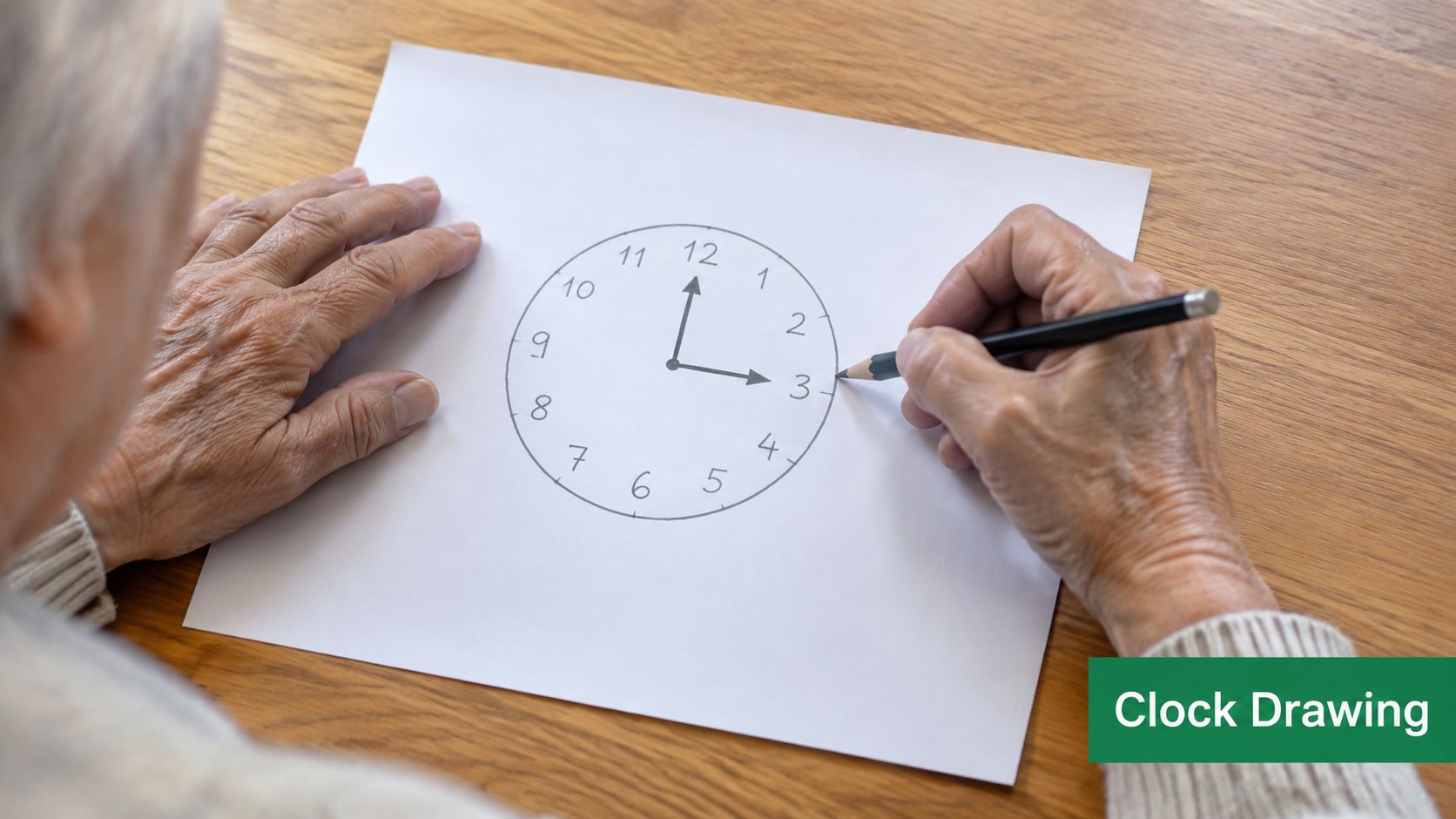
A clock drawing activity gives a person something concrete to do while opening a conversation about time, routine, and daily structure. During a call, ask the participant to draw a clock showing a familiar time, such as 3 o'clock. You won't see the drawing immediately unless a family member is present or the person shares a photograph, so focus first on the process and the conversation around it.
Ask, “What do you usually do around that time?” The answer may connect the clock to lunch, a television program, a medication routine, or a favorite activity. That personal association matters more than producing a perfect drawing. The exercise can also become a bridge to practical support, such as practicing a morning pill routine without presenting the activity as an examination.
Keep the drawing encouraging
Call it a fun thinking exercise, not a test. Praise specific effort, such as the participant's decision to place numbers around the face or to mark the hands, before discussing anything that seems difficult. If drawing is frustrating, invite the person to describe where the hands should go, fill in a pre-drawn clock face, or answer a simpler question: “It's afternoon now. Is that before or after lunch?”
A cognitive rehabilitation program for people with early-stage Alzheimer's disease used repeated paper-and-pencil tasks alongside practical aids including a calendar, personal memory notebook, and cellular phone. The experimental group improved on the orientation subscale of the Mini-Mental State Examination and also reported gains in occupation performance, satisfaction, and quality of life, while the control group didn't show comparable change (study of cognitive rehabilitation and orientation practice).
Practical rule: Use a drawing to start a supportive conversation, never to announce that someone is passing or failing.
If a family member can photograph drawings, care staff can document descriptions or images over time and share concerns with the appropriate clinician. A change across calls may justify discussing medication effects, illness, or disease progression with a medical professional, but one unusual clock shouldn't be treated as proof of anything.
For a gentle introduction to related cognitive engagement, caregivers can explore cognitive stimulation therapy.
2. Landmark Navigation and Route Recall
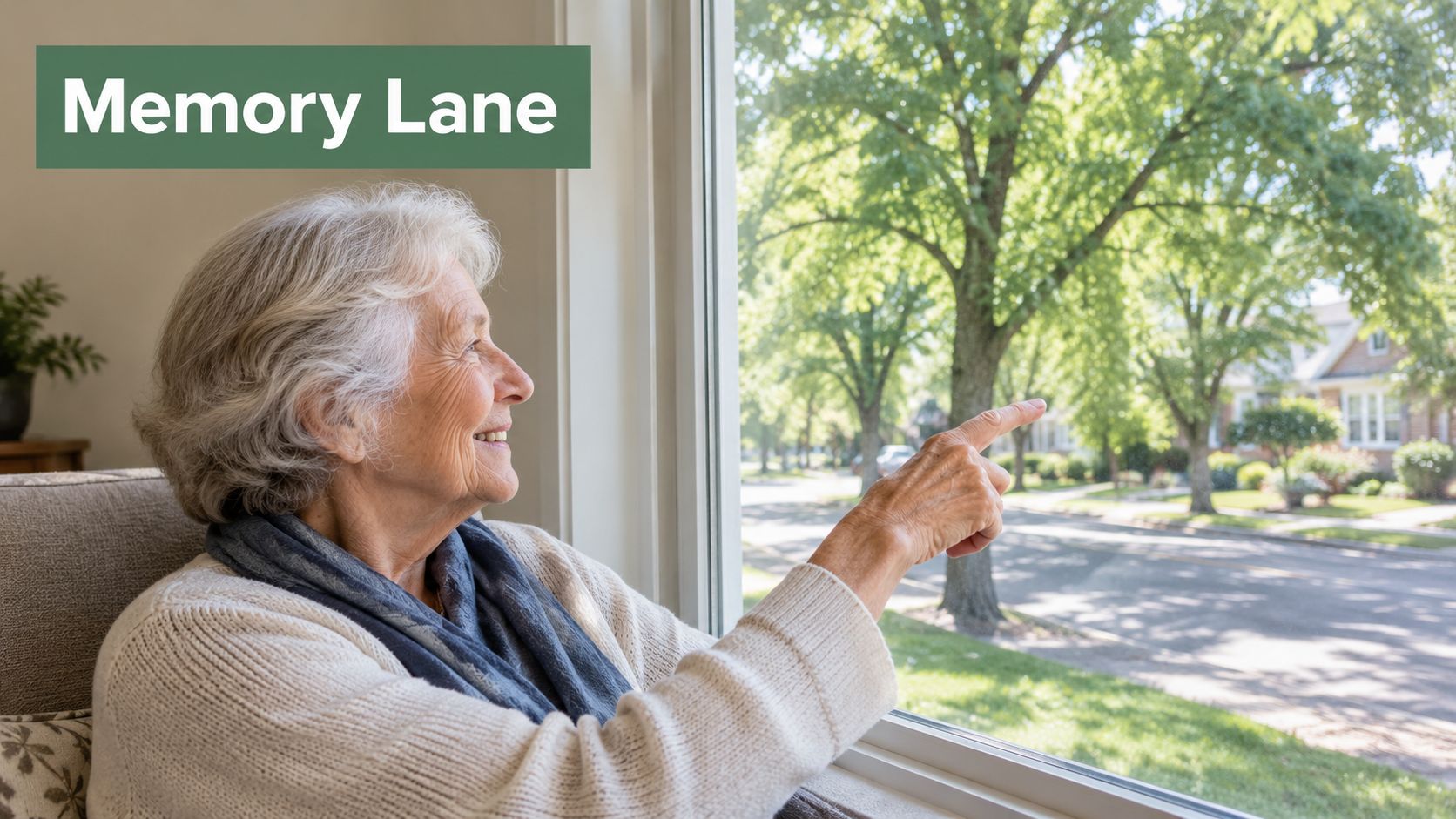
Ask the person to describe a route that carries emotional meaning. It might be the walk to school, the drive to a former workplace, the path to a favorite shop, or the route from the living room to the mailbox. These memories combine place, sequence, sensory detail, and personal identity, which often makes them easier and more enjoyable than abstract questions.
Begin with, “Tell me about the walk to the bakery.” Let the participant choose the landmarks. If details don't come, use neutral prompts such as, “What do you remember seeing next?” or “Was there a smell, sound, or building you noticed?” Avoid suggesting a red house or a particular tree unless the participant has already mentioned it. Leading questions can create pressure and may encourage agreement rather than genuine recall.
Bring the exercise back home
A cherished past route may be difficult to reconstruct, especially in mid-stage dementia. Move to a current, concrete space instead: “Walk me through your kitchen. Where's the stove? Where's the phone? Where do you usually sit?” This version can reveal practical concerns without sounding like an inspection.
Record the landmarks the participant names in care notes, including the order when it's clear. If the route becomes less detailed or increasingly confusing across conversations, share that pattern with family and the clinician involved in care. Don't correct every mixed-up turn. Say, “You remember the bakery's yellow awning really clearly,” or, “That sounds like a meaningful part of your morning.”
For someone who still travels independently, use a current familiar route to explore confidence rather than demand accuracy. A pause or vague answer is an invitation to ask whether the route still feels comfortable, not a reason to shame the person or impose an immediate restriction.
3. Directional Orientation Exercises
Directional language can be practiced in small steps. Start with left, right, forward, and backward, which can be easier to connect to a familiar room than north, south, east, and west. Ask, “If you're facing the front door, what room is on your left?” Once that feels comfortable, introduce cardinal directions only when the person has reliable environmental anchors.
For example, you might say, “The street with the shops is in front of your apartment. The park is behind you. Which direction would you face to look toward the park?” If the participant knows that a particular window faces east, use that fact as an anchor rather than asking for compass directions without context.
Break every route into one move
A question involving several turns can overload working memory. Ask, “What's the first turn?” Then pause. Follow with, “After that turn, what would you see?” Immediate, gentle feedback works better than a blunt correction: “Let's think about where the grocery store sits compared with your building.”
You can also connect directions to safety planning. Ask where the back exit is from the bedroom or which way the person would go toward a phone during an emergency. Keep the focus on awareness, not on proving emergency readiness. If the exercise reveals uncertainty about an exit, stove location, or route to a safe area, involve family and appropriate professionals rather than relying on repeated practice alone.
“Let's work that out together” is more productive than “That's wrong.”
Document the specific pattern. Someone may handle left and right but struggle with north and south, or manage a single turn but lose track during a multi-step route. Those distinctions help families make targeted decisions about labels, written directions, accompaniment, driving, and supervision.
For caregivers interested in pairing orientation work with structured environmental support, reality orientation therapy offers useful context.

4. Positional Memory Sequencing
Positional memory asks the participant to picture objects in a known space and describe how those objects relate to one another. Choose a room the person has occupied for years, such as the bedroom or kitchen. Say, “Picture yourself standing at the sink. What do you see nearby?” Then ask where the coffee maker, table, or favorite mug is located.
This exercise works best when it feels like a conversation about ordinary life. A person may recall that the pill organizer sits on the counter beside the window, then connect that location with checking medication after breakfast. The spatial anchor supports the routine without suggesting that the person has failed if the object has moved or the image is incomplete.
Use several senses
Visual imagery isn't easy for everyone. Invite other details: “What do you hear in that room?” “What does the kitchen smell like in the morning?” “What do you feel when you hold the counter?” Sensory prompts can support reminiscence and reduce the pressure to produce a precise floor plan.
Give the person time. “Take a moment. What's the first thing that comes to mind?” is more helpful than rapid-fire questioning. If the participant can't visualize the whole room, narrow the task to one relationship: “What's beside your chair?” or “Is the window behind you or in front of you when you sit down?”
A simple care note can record the participant's description of the room and the locations that remain consistent. Don't move household objects based only on a call exercise. If the participant repeatedly can't locate a needed item in real life, the family may need to improve labeling, lighting, storage, or supervision.
Caregiver observation: A clear description of a familiar room is encouraging, but it doesn't prove that the person can safely navigate that room at night.
Celebrate partial recall. “You remembered the window and the chair,” recognizes success without drawing attention to what was missing. If confusion produces anxiety, return to a reassuring topic, describe the actual room with the participant, or end the exercise.
5. Perspective-Taking and Viewpoint Rotation
Perspective-taking is more demanding because the participant must imagine the same room from another position. Use a favorite chair, a television, or a window as the starting point. Ask, “You're sitting in your chair facing the television. What's behind you?” If that goes well, ask the person to imagine turning toward the window and describe what's now in front of them.
This task can expose difficulty with mental rotation, spatial working memory, and changing viewpoints, but it should never feel like a formal assessment during a routine phone call. Make it collaborative: “Let's think through the room together.” One successful step is enough for a short conversation.
Scale the mental load
For someone in early-stage dementia, start with a single rotation and a room they can see. For someone in mid-stage dementia, use the actual environment as an anchor and ask only one position question at a time. If the participant struggles, return to left and right or ask what they can see from where they're sitting now.
Avoid giving several rotations in quick succession. The goal is engagement and useful observation, not exhaustion. Praise the process: “You worked out that turn carefully,” rather than praising only a correct answer.
This exercise can also prompt a safety conversation about nighttime movement. Ask, “When you're facing the closet, where's the bed?” Then ask whether the route to the bathroom is well lit and free of obstacles. Don't ask the person to walk in the dark to demonstrate the answer. If they report bumping into furniture, feeling lost, or becoming unsteady, involve family and a clinician.
A sudden change in viewpoint reasoning can be documented as a pattern for follow-up. It isn't a diagnosis, and it shouldn't independently determine whether someone can drive, live alone, or walk outside.
6. Route Planning and Wayfinding Problem-Solving
Route planning turns spatial orientation into a practical conversation about upcoming activities. Choose a route the participant uses, such as home to the doctor, grocery store, church, or a relative's house. Ask, “How would you get there?” Let the person explain the plan before you ask about the first turn, transportation, landmarks, or what they'd do if the usual entrance were closed.
This approach can reveal a real support need. Someone may describe the trip confidently but become unsure about getting home, crossing a busy road, finding the parking area, or remembering an appointment time. Treat those details as opportunities to plan, not evidence of incompetence.
Protect dignity while reducing risk
Ask, “Does that route still feel familiar and safe?” If the answer is uncertain, offer choices rather than issuing commands. A family member could accompany the participant, drive the route in advance, save the address in the phone, or provide written directions in large print. A GPS device or pre-programmed contact can preserve independence when it's appropriate, though technology shouldn't substitute for supervision when a person is at serious risk.
Practical rule: A route-planning call should end with a safer plan, not with a score.
Record which routes the person can describe and where confusion appears. Share repeated concerns with family and the relevant clinician, especially if the person is driving alone, getting lost, missing appointments, or unable to explain how to return home. New navigation problems can have several causes, including illness, medication effects, sensory changes, or cognitive decline, so professional review matters.
For broader ideas that pair planning with memory and attention activities, see these cognitive exercises for dementia.
7. Map Reading and Spatial Representation Interpretation
A simple map can connect a familiar place with an abstract visual representation. Use a clean, uncluttered drawing of the participant's neighborhood, apartment, or daily route. Ask the person to locate home, the grocery store, the doctor's office, or a church, then trace the route between two landmarks with a finger or explain it aloud.
Phone delivery requires preparation. A family member can hold a printed map during the call, or the care team can send or mail a large-print version beforehand. For someone with visual impairment, describe one feature at a time and confirm what the person can comfortably see. Don't rely on a busy commercial map with tiny labels, excessive roads, or unfamiliar symbols.
Make the map personal
A floor plan can show the person's chair, kitchen table, bedroom, and bathroom. A memory map can connect former homes, workplaces, schools, and meaningful community places. These materials support reminiscence as well as spatial thinking, so the conversation doesn't have to stop when route tracing becomes difficult.
Use a gradual sequence:
Find one landmark: Ask the participant to identify home before adding another location.
Compare positions: Ask whether the store is near, far, beside, or behind home.
Trace one route: Follow a single path and name what appears along it.
Explain the symbols: Use a clear key with pictures or familiar labels.
A person's difficulty with symbols may reflect vision, attention, unfamiliarity with maps, or spatial processing. Check lighting, glasses, hearing, and fatigue before interpreting the response. If the person repeatedly can't find familiar landmarks or becomes upset, put the map away and return to a known conversation.
This video can provide a visual starting point for caregivers, but any movement or map activity should be adapted to the participant rather than copied automatically.
8. Sequencing and Body Awareness Exercises
Spatial orientation also involves knowing how the body moves through a room. Begin with verbal rehearsal, not physical movement. Ask, “Think about getting from your chair to the kitchen. What do you do first? Which way do you turn? What do you pass?” This combines body awareness, procedural memory, sequence, and environmental landmarks in a familiar routine.
You can use personal care tasks as well. Invite the participant to describe brushing their teeth, preparing tea, or getting dressed. Ask where they reach, what comes next, and which parts of the bathroom feel crowded or difficult. The conversation may uncover a loose rug, poor lighting, a high shelf, or a confusing furniture arrangement.
Keep movement optional
Actual walking should happen only when the participant is stable, comfortable, and supervised by someone physically present. A phone provider can't spot a fall, catch a person who loses balance, or judge the room's hazards remotely. If a family member is there, that person should prioritize safety and stop the activity at the first sign of dizziness, fear, fatigue, or instability.
Use short instructions:
“Picture the path from your chair.”
“What obstacles do you notice?”
“Which way does the door open?”
“What do you see after the turn?”
If movement is appropriate, keep the route short and familiar. Don't ask the person to close their eyes while standing or to practice turning in a cluttered space. A participant who hesitates after a turn, reaches for furniture, or reports feeling unsteady needs practical review and possibly clinical assessment, not extra repetitions.
Document observations in plain language, such as difficulty naming objects after a turn or uncertainty about the bathroom route. Share new falls, near falls, dizziness, wandering, and household hazards promptly with family and appropriate clinicians.
8-Exercise Spatial Orientation Comparison
Method | Implementation Complexity 🔄 | Resource Requirements ⚡ | Expected Outcomes 📊 | Ideal Use Cases ⭐ | Key Advantages 💡 |
|---|---|---|---|---|---|
Clock Drawing Test (CDT) with Guided Conversation | Low, 3–5 min, simple script; small training for scoring | Very low, paper, pen, phone | Detects early visuospatial/executive decline; anchors time orientation; immediate feedback | Early screening, routine phone check-ins, longitudinal tracking | Sensitive to early change; non-threatening; integrates conversation with routine reminders |
Landmark Navigation and Route Recall | Medium, open-ended prompts; requires skilled, non-leading questioning | Very low, phone-only; no materials | Engages episodic/spatial memory; mood lift via reminiscence; qualitative flags for disorientation | Reminiscence therapy, mid-stage engagement, emotion-focused calls | Highly personalized; strengthens identity; safe, motivating engagement |
Directional Orientation Exercises (cardinal/relative) | Low–Medium, structured Qs, scalable difficulty | Low, phone and familiarity with participant's environment | Measurable directional competence; practical safety indicators | Wayfinding assessment, safety checks, monitoring directional decline | Specific, practical, easily tracked; directly supports safety planning |
Positional Memory Sequencing (Object Location Recall) | Low, verbal imagery tasks; brief and phone-friendly | Very low, phone-only | Reinforces spatial memory tied to routines; subjective consistency over time | Anchoring daily routines, medication/location prompts, confidence-building | Uses preserved capacities; links memory to practical tasks; low frustration |
Perspective-Taking & Viewpoint Rotation (Mental Rotation) | Medium–High, needs calibrated difficulty and training to avoid frustration | Low, phone-only verbal descriptions | Sensitive indicator of visuospatial and working-memory decline | Early detection of visuospatial deficits; engaging as a "thinking game" | Adjustable difficulty; sensitive to early decline; maintains cognitive flexibility |
Route Planning & Wayfinding Problem-Solving | Medium, multi-step prompts, safety discussion, may need neighborhood knowledge | Medium, phone, possible family input or maps | Reveals real-world navigation ability and independence risks | Assessing driving safety, planning events, identifying need for accompaniment or devices | Directly informs interventions; highly relevant to daily independence and safety |
Map Reading & Spatial Representation Interpretation | Medium, requires prepared visuals or careful verbalization | Medium, printed/mailed maps or caregiver-held materials preferred | Provides concrete artifacts for tracking visual-spatial processing | Participants comfortable with visuals; family-supported sessions; floor-plan reviews | Concrete visual support; objectively trackable over time; useful for environmental planning |
Sequencing & Body Awareness Exercises (Movement descriptions) | Medium, needs safety checks; verbal first, movement only if supervised | Low–Medium, phone; family supervision advised for physical components | Identifies movement-related disorientation and fall risk; assesses procedural memory | Fall-risk screening, assessing mobility-related daily tasks, rehab-informed checks | Directly ties cognition to physical safety; leverages procedural memory; actionable safety data |
Turn Practice Into Safer Daily Support
Start with one exercise that matches the person's interests and current abilities. A former gardener might enjoy mapping the path through a yard, while someone who prefers routine may respond better to a clock connected with breakfast or medication. Keep the conversation brief enough that the participant can finish feeling successful, and stop before frustration becomes the main experience.
Adjust the task by changing one feature at a time. Use a familiar room instead of an unfamiliar route, left and right instead of cardinal directions, one landmark instead of several, or verbal rehearsal instead of physical movement. A person with hearing loss may need slower speech and confirmation that they heard the prompt. Someone with vision problems may need larger print, stronger contrast, or a spoken alternative. Someone with mobility limitations can still practice route description and mental sequencing without walking.
Track patterns, not isolated mistakes
A single missed turn may reflect tiredness, pain, distraction, poor hearing, or an ordinary bad day. Record what happened, the prompt used, the participant's emotional response, and whether the difficulty repeats. Consistent notes help family members and clinicians distinguish a broader pattern from a one-time lapse.
Stop if the participant becomes distressed, angry, frightened, dizzy, or unusually fatigued. Validate the experience rather than insisting on completion: “That feels frustrating. We can leave it there.” Reassure the person, shift to a favorite topic, and consider whether the next call should use a simpler anchor.
Escalate new or worsening confusion, falls, wandering concerns, missed or unsafe medication use, driving uncertainty, or household risks such as stove problems to family and the appropriate clinicians. Spatial orientation exercises can support observation, but they can't establish a diagnosis or determine capacity on their own.
Consistent phone contact can combine cognitive engagement with companionship and practical check-ins. Velma, for example, uses scheduled calls, cognitive activities, mood support, safety conversations, and care-manager coordination to give families more visibility between visits. This kind of support complements medical treatment and in-person caregiving, rather than replacing either one. Families looking for broader guidance can also review this resource on caregiver support for elderly parents.
Choose one familiar activity for the next call, write down the person's response without grading it, and share any repeated safety concern promptly. A calm, regular conversation can preserve dignity while helping the care team notice when everyday support needs to change.
Velma provides scheduled phone calls for older adults experiencing memory loss, combining personalized spatial orientation exercises with reminiscence, cognitive stimulation, companionship, and practical safety check-ins. Visit Velma to learn how recurring calls and care-manager coordination can support your family's dementia care plan.
You're on the phone with your mother when she pauses halfway through describing her morning. She knows the kitchen well, but suddenly can't remember whether the bathroom is past the bedroom or near the front door. She sounds embarrassed, so you reassure her, ask one gentle question, and resist the urge to turn the moment into a quiz.
Spatial orientation exercises can make these conversations safer and more useful. Personalized activities may support engagement, routine awareness, reminiscence, and observation of meaningful changes, especially when they're brief, familiar, and free from judgment. They aren't diagnostic tests, and they shouldn't replace medical care, supervision, medication review, or professional assessment. Spatial navigation problems can appear before more obvious memory difficulties, and a 2017 NIH-indexed study found that each 10-second increase on the Floor Maze Test was associated with a 25% higher risk of incident mild cognitive impairment and a 53% higher risk of incident motoric cognitive risk syndrome, after adjustment for several relevant factors (NIH-indexed research on spatial navigation and cognitive risk).
For a phone call, start by checking comfort, use familiar anchors, offer one prompt at a time, validate effort, and record meaningful changes rather than isolated mistakes. A program such as Velma may combine orientation, reminiscence, cognitive stimulation, and well-being check-ins through scheduled calls. The following eight exercises move from simple time and place anchors toward more demanding route planning and movement description.
Table of Contents
1. Clock Drawing Test with Guided Conversation
Keep the drawing encouraging
2. Landmark Navigation and Route Recall
Bring the exercise back home
3. Directional Orientation Exercises
Break every route into one move
4. Positional Memory Sequencing
Use several senses
5. Perspective-Taking and Viewpoint Rotation
Scale the mental load
6. Route Planning and Wayfinding Problem-Solving
Protect dignity while reducing risk
7. Map Reading and Spatial Representation Interpretation
Make the map personal
8. Sequencing and Body Awareness Exercises
Keep movement optional
8-Exercise Spatial Orientation Comparison
Turn Practice Into Safer Daily Support
Track patterns, not isolated mistakes
1. Clock Drawing Test with Guided Conversation
A clock drawing activity gives a person something concrete to do while opening a conversation about time, routine, and daily structure. During a call, ask the participant to draw a clock showing a familiar time, such as 3 o'clock. You won't see the drawing immediately unless a family member is present or the person shares a photograph, so focus first on the process and the conversation around it.
Ask, “What do you usually do around that time?” The answer may connect the clock to lunch, a television program, a medication routine, or a favorite activity. That personal association matters more than producing a perfect drawing. The exercise can also become a bridge to practical support, such as practicing a morning pill routine without presenting the activity as an examination.
Keep the drawing encouraging
Call it a fun thinking exercise, not a test. Praise specific effort, such as the participant's decision to place numbers around the face or to mark the hands, before discussing anything that seems difficult. If drawing is frustrating, invite the person to describe where the hands should go, fill in a pre-drawn clock face, or answer a simpler question: “It's afternoon now. Is that before or after lunch?”
A cognitive rehabilitation program for people with early-stage Alzheimer's disease used repeated paper-and-pencil tasks alongside practical aids including a calendar, personal memory notebook, and cellular phone. The experimental group improved on the orientation subscale of the Mini-Mental State Examination and also reported gains in occupation performance, satisfaction, and quality of life, while the control group didn't show comparable change (study of cognitive rehabilitation and orientation practice).
Practical rule: Use a drawing to start a supportive conversation, never to announce that someone is passing or failing.
If a family member can photograph drawings, care staff can document descriptions or images over time and share concerns with the appropriate clinician. A change across calls may justify discussing medication effects, illness, or disease progression with a medical professional, but one unusual clock shouldn't be treated as proof of anything.
For a gentle introduction to related cognitive engagement, caregivers can explore cognitive stimulation therapy.
2. Landmark Navigation and Route Recall
Ask the person to describe a route that carries emotional meaning. It might be the walk to school, the drive to a former workplace, the path to a favorite shop, or the route from the living room to the mailbox. These memories combine place, sequence, sensory detail, and personal identity, which often makes them easier and more enjoyable than abstract questions.
Begin with, “Tell me about the walk to the bakery.” Let the participant choose the landmarks. If details don't come, use neutral prompts such as, “What do you remember seeing next?” or “Was there a smell, sound, or building you noticed?” Avoid suggesting a red house or a particular tree unless the participant has already mentioned it. Leading questions can create pressure and may encourage agreement rather than genuine recall.
Bring the exercise back home
A cherished past route may be difficult to reconstruct, especially in mid-stage dementia. Move to a current, concrete space instead: “Walk me through your kitchen. Where's the stove? Where's the phone? Where do you usually sit?” This version can reveal practical concerns without sounding like an inspection.
Record the landmarks the participant names in care notes, including the order when it's clear. If the route becomes less detailed or increasingly confusing across conversations, share that pattern with family and the clinician involved in care. Don't correct every mixed-up turn. Say, “You remember the bakery's yellow awning really clearly,” or, “That sounds like a meaningful part of your morning.”
For someone who still travels independently, use a current familiar route to explore confidence rather than demand accuracy. A pause or vague answer is an invitation to ask whether the route still feels comfortable, not a reason to shame the person or impose an immediate restriction.
3. Directional Orientation Exercises
Directional language can be practiced in small steps. Start with left, right, forward, and backward, which can be easier to connect to a familiar room than north, south, east, and west. Ask, “If you're facing the front door, what room is on your left?” Once that feels comfortable, introduce cardinal directions only when the person has reliable environmental anchors.
For example, you might say, “The street with the shops is in front of your apartment. The park is behind you. Which direction would you face to look toward the park?” If the participant knows that a particular window faces east, use that fact as an anchor rather than asking for compass directions without context.
Break every route into one move
A question involving several turns can overload working memory. Ask, “What's the first turn?” Then pause. Follow with, “After that turn, what would you see?” Immediate, gentle feedback works better than a blunt correction: “Let's think about where the grocery store sits compared with your building.”
You can also connect directions to safety planning. Ask where the back exit is from the bedroom or which way the person would go toward a phone during an emergency. Keep the focus on awareness, not on proving emergency readiness. If the exercise reveals uncertainty about an exit, stove location, or route to a safe area, involve family and appropriate professionals rather than relying on repeated practice alone.
“Let's work that out together” is more productive than “That's wrong.”
Document the specific pattern. Someone may handle left and right but struggle with north and south, or manage a single turn but lose track during a multi-step route. Those distinctions help families make targeted decisions about labels, written directions, accompaniment, driving, and supervision.
For caregivers interested in pairing orientation work with structured environmental support, reality orientation therapy offers useful context.
4. Positional Memory Sequencing
Positional memory asks the participant to picture objects in a known space and describe how those objects relate to one another. Choose a room the person has occupied for years, such as the bedroom or kitchen. Say, “Picture yourself standing at the sink. What do you see nearby?” Then ask where the coffee maker, table, or favorite mug is located.
This exercise works best when it feels like a conversation about ordinary life. A person may recall that the pill organizer sits on the counter beside the window, then connect that location with checking medication after breakfast. The spatial anchor supports the routine without suggesting that the person has failed if the object has moved or the image is incomplete.
Use several senses
Visual imagery isn't easy for everyone. Invite other details: “What do you hear in that room?” “What does the kitchen smell like in the morning?” “What do you feel when you hold the counter?” Sensory prompts can support reminiscence and reduce the pressure to produce a precise floor plan.
Give the person time. “Take a moment. What's the first thing that comes to mind?” is more helpful than rapid-fire questioning. If the participant can't visualize the whole room, narrow the task to one relationship: “What's beside your chair?” or “Is the window behind you or in front of you when you sit down?”
A simple care note can record the participant's description of the room and the locations that remain consistent. Don't move household objects based only on a call exercise. If the participant repeatedly can't locate a needed item in real life, the family may need to improve labeling, lighting, storage, or supervision.
Caregiver observation: A clear description of a familiar room is encouraging, but it doesn't prove that the person can safely navigate that room at night.
Celebrate partial recall. “You remembered the window and the chair,” recognizes success without drawing attention to what was missing. If confusion produces anxiety, return to a reassuring topic, describe the actual room with the participant, or end the exercise.
5. Perspective-Taking and Viewpoint Rotation
Perspective-taking is more demanding because the participant must imagine the same room from another position. Use a favorite chair, a television, or a window as the starting point. Ask, “You're sitting in your chair facing the television. What's behind you?” If that goes well, ask the person to imagine turning toward the window and describe what's now in front of them.
This task can expose difficulty with mental rotation, spatial working memory, and changing viewpoints, but it should never feel like a formal assessment during a routine phone call. Make it collaborative: “Let's think through the room together.” One successful step is enough for a short conversation.
Scale the mental load
For someone in early-stage dementia, start with a single rotation and a room they can see. For someone in mid-stage dementia, use the actual environment as an anchor and ask only one position question at a time. If the participant struggles, return to left and right or ask what they can see from where they're sitting now.
Avoid giving several rotations in quick succession. The goal is engagement and useful observation, not exhaustion. Praise the process: “You worked out that turn carefully,” rather than praising only a correct answer.
This exercise can also prompt a safety conversation about nighttime movement. Ask, “When you're facing the closet, where's the bed?” Then ask whether the route to the bathroom is well lit and free of obstacles. Don't ask the person to walk in the dark to demonstrate the answer. If they report bumping into furniture, feeling lost, or becoming unsteady, involve family and a clinician.
A sudden change in viewpoint reasoning can be documented as a pattern for follow-up. It isn't a diagnosis, and it shouldn't independently determine whether someone can drive, live alone, or walk outside.
6. Route Planning and Wayfinding Problem-Solving
Route planning turns spatial orientation into a practical conversation about upcoming activities. Choose a route the participant uses, such as home to the doctor, grocery store, church, or a relative's house. Ask, “How would you get there?” Let the person explain the plan before you ask about the first turn, transportation, landmarks, or what they'd do if the usual entrance were closed.
This approach can reveal a real support need. Someone may describe the trip confidently but become unsure about getting home, crossing a busy road, finding the parking area, or remembering an appointment time. Treat those details as opportunities to plan, not evidence of incompetence.
Protect dignity while reducing risk
Ask, “Does that route still feel familiar and safe?” If the answer is uncertain, offer choices rather than issuing commands. A family member could accompany the participant, drive the route in advance, save the address in the phone, or provide written directions in large print. A GPS device or pre-programmed contact can preserve independence when it's appropriate, though technology shouldn't substitute for supervision when a person is at serious risk.
Practical rule: A route-planning call should end with a safer plan, not with a score.
Record which routes the person can describe and where confusion appears. Share repeated concerns with family and the relevant clinician, especially if the person is driving alone, getting lost, missing appointments, or unable to explain how to return home. New navigation problems can have several causes, including illness, medication effects, sensory changes, or cognitive decline, so professional review matters.
For broader ideas that pair planning with memory and attention activities, see these cognitive exercises for dementia.
7. Map Reading and Spatial Representation Interpretation
A simple map can connect a familiar place with an abstract visual representation. Use a clean, uncluttered drawing of the participant's neighborhood, apartment, or daily route. Ask the person to locate home, the grocery store, the doctor's office, or a church, then trace the route between two landmarks with a finger or explain it aloud.
Phone delivery requires preparation. A family member can hold a printed map during the call, or the care team can send or mail a large-print version beforehand. For someone with visual impairment, describe one feature at a time and confirm what the person can comfortably see. Don't rely on a busy commercial map with tiny labels, excessive roads, or unfamiliar symbols.
Make the map personal
A floor plan can show the person's chair, kitchen table, bedroom, and bathroom. A memory map can connect former homes, workplaces, schools, and meaningful community places. These materials support reminiscence as well as spatial thinking, so the conversation doesn't have to stop when route tracing becomes difficult.
Use a gradual sequence:
Find one landmark: Ask the participant to identify home before adding another location.
Compare positions: Ask whether the store is near, far, beside, or behind home.
Trace one route: Follow a single path and name what appears along it.
Explain the symbols: Use a clear key with pictures or familiar labels.
A person's difficulty with symbols may reflect vision, attention, unfamiliarity with maps, or spatial processing. Check lighting, glasses, hearing, and fatigue before interpreting the response. If the person repeatedly can't find familiar landmarks or becomes upset, put the map away and return to a known conversation.
This video can provide a visual starting point for caregivers, but any movement or map activity should be adapted to the participant rather than copied automatically.
8. Sequencing and Body Awareness Exercises
Spatial orientation also involves knowing how the body moves through a room. Begin with verbal rehearsal, not physical movement. Ask, “Think about getting from your chair to the kitchen. What do you do first? Which way do you turn? What do you pass?” This combines body awareness, procedural memory, sequence, and environmental landmarks in a familiar routine.
You can use personal care tasks as well. Invite the participant to describe brushing their teeth, preparing tea, or getting dressed. Ask where they reach, what comes next, and which parts of the bathroom feel crowded or difficult. The conversation may uncover a loose rug, poor lighting, a high shelf, or a confusing furniture arrangement.
Keep movement optional
Actual walking should happen only when the participant is stable, comfortable, and supervised by someone physically present. A phone provider can't spot a fall, catch a person who loses balance, or judge the room's hazards remotely. If a family member is there, that person should prioritize safety and stop the activity at the first sign of dizziness, fear, fatigue, or instability.
Use short instructions:
“Picture the path from your chair.”
“What obstacles do you notice?”
“Which way does the door open?”
“What do you see after the turn?”
If movement is appropriate, keep the route short and familiar. Don't ask the person to close their eyes while standing or to practice turning in a cluttered space. A participant who hesitates after a turn, reaches for furniture, or reports feeling unsteady needs practical review and possibly clinical assessment, not extra repetitions.
Document observations in plain language, such as difficulty naming objects after a turn or uncertainty about the bathroom route. Share new falls, near falls, dizziness, wandering, and household hazards promptly with family and appropriate clinicians.
8-Exercise Spatial Orientation Comparison
Method | Implementation Complexity 🔄 | Resource Requirements ⚡ | Expected Outcomes 📊 | Ideal Use Cases ⭐ | Key Advantages 💡 |
|---|---|---|---|---|---|
Clock Drawing Test (CDT) with Guided Conversation | Low, 3–5 min, simple script; small training for scoring | Very low, paper, pen, phone | Detects early visuospatial/executive decline; anchors time orientation; immediate feedback | Early screening, routine phone check-ins, longitudinal tracking | Sensitive to early change; non-threatening; integrates conversation with routine reminders |
Landmark Navigation and Route Recall | Medium, open-ended prompts; requires skilled, non-leading questioning | Very low, phone-only; no materials | Engages episodic/spatial memory; mood lift via reminiscence; qualitative flags for disorientation | Reminiscence therapy, mid-stage engagement, emotion-focused calls | Highly personalized; strengthens identity; safe, motivating engagement |
Directional Orientation Exercises (cardinal/relative) | Low–Medium, structured Qs, scalable difficulty | Low, phone and familiarity with participant's environment | Measurable directional competence; practical safety indicators | Wayfinding assessment, safety checks, monitoring directional decline | Specific, practical, easily tracked; directly supports safety planning |
Positional Memory Sequencing (Object Location Recall) | Low, verbal imagery tasks; brief and phone-friendly | Very low, phone-only | Reinforces spatial memory tied to routines; subjective consistency over time | Anchoring daily routines, medication/location prompts, confidence-building | Uses preserved capacities; links memory to practical tasks; low frustration |
Perspective-Taking & Viewpoint Rotation (Mental Rotation) | Medium–High, needs calibrated difficulty and training to avoid frustration | Low, phone-only verbal descriptions | Sensitive indicator of visuospatial and working-memory decline | Early detection of visuospatial deficits; engaging as a "thinking game" | Adjustable difficulty; sensitive to early decline; maintains cognitive flexibility |
Route Planning & Wayfinding Problem-Solving | Medium, multi-step prompts, safety discussion, may need neighborhood knowledge | Medium, phone, possible family input or maps | Reveals real-world navigation ability and independence risks | Assessing driving safety, planning events, identifying need for accompaniment or devices | Directly informs interventions; highly relevant to daily independence and safety |
Map Reading & Spatial Representation Interpretation | Medium, requires prepared visuals or careful verbalization | Medium, printed/mailed maps or caregiver-held materials preferred | Provides concrete artifacts for tracking visual-spatial processing | Participants comfortable with visuals; family-supported sessions; floor-plan reviews | Concrete visual support; objectively trackable over time; useful for environmental planning |
Sequencing & Body Awareness Exercises (Movement descriptions) | Medium, needs safety checks; verbal first, movement only if supervised | Low–Medium, phone; family supervision advised for physical components | Identifies movement-related disorientation and fall risk; assesses procedural memory | Fall-risk screening, assessing mobility-related daily tasks, rehab-informed checks | Directly ties cognition to physical safety; leverages procedural memory; actionable safety data |
Turn Practice Into Safer Daily Support
Start with one exercise that matches the person's interests and current abilities. A former gardener might enjoy mapping the path through a yard, while someone who prefers routine may respond better to a clock connected with breakfast or medication. Keep the conversation brief enough that the participant can finish feeling successful, and stop before frustration becomes the main experience.
Adjust the task by changing one feature at a time. Use a familiar room instead of an unfamiliar route, left and right instead of cardinal directions, one landmark instead of several, or verbal rehearsal instead of physical movement. A person with hearing loss may need slower speech and confirmation that they heard the prompt. Someone with vision problems may need larger print, stronger contrast, or a spoken alternative. Someone with mobility limitations can still practice route description and mental sequencing without walking.
Track patterns, not isolated mistakes
A single missed turn may reflect tiredness, pain, distraction, poor hearing, or an ordinary bad day. Record what happened, the prompt used, the participant's emotional response, and whether the difficulty repeats. Consistent notes help family members and clinicians distinguish a broader pattern from a one-time lapse.
Stop if the participant becomes distressed, angry, frightened, dizzy, or unusually fatigued. Validate the experience rather than insisting on completion: “That feels frustrating. We can leave it there.” Reassure the person, shift to a favorite topic, and consider whether the next call should use a simpler anchor.
Escalate new or worsening confusion, falls, wandering concerns, missed or unsafe medication use, driving uncertainty, or household risks such as stove problems to family and the appropriate clinicians. Spatial orientation exercises can support observation, but they can't establish a diagnosis or determine capacity on their own.
Consistent phone contact can combine cognitive engagement with companionship and practical check-ins. Velma, for example, uses scheduled calls, cognitive activities, mood support, safety conversations, and care-manager coordination to give families more visibility between visits. This kind of support complements medical treatment and in-person caregiving, rather than replacing either one. Families looking for broader guidance can also review this resource on caregiver support for elderly parents.
Choose one familiar activity for the next call, write down the person's response without grading it, and share any repeated safety concern promptly. A calm, regular conversation can preserve dignity while helping the care team notice when everyday support needs to change.
Velma provides scheduled phone calls for older adults experiencing memory loss, combining personalized spatial orientation exercises with reminiscence, cognitive stimulation, companionship, and practical safety check-ins. Visit Velma to learn how recurring calls and care-manager coordination can support your family's dementia care plan.
Suggested Article: