Medicare Coverage for Dementia Care: A Family Guide

A new dementia diagnosis changes the whole tone of a family's week. One minute you're trying to absorb the doctor's explanation, and the next you're standing at checkout wondering what Medicare will pay for, who needs to call which office, and whether your parent's home care will be covered or denied.
The short answer is that Medicare coverage for dementia care is real, but narrow. It pays for specific medical moments, such as diagnosis, hospital care, certain rehab, some home health, and prescription drugs, yet it does not become the long-term daily care system most families eventually need. The families who do best are usually the ones who learn that distinction early and start building around it.
Table of Contents
When the Diagnosis Changes Every Insurance Question
How Medicare Is Actually Built Around Dementia Care
Part A and the hospital to rehab window
Part B and the outpatient care engine
Part C and how bundled plans change the rules
Part D and dementia medications
What Each Part Covers for Dementia Services
Original Medicare Compared to Medicare Advantage for Dementia
Original Medicare and the add-on pieces
Medicare Advantage and the managed-care tradeoff
A simple decision filter
What Medicare Will Not Pay For and How to Fill the Gaps
The most common ways families fill the gap
Documentation, Billing, and Appeals When Coverage Is Denied
What to keep in the folder
How the appeal path usually works
Putting Together a Family Action Plan Around Medicare
When the Diagnosis Changes Every Insurance Question
The visit ends, and your parent is holding a paper folder they can barely keep straight. The neurologist has said the word dementia, maybe Alzheimer's, and now you are trying to sort out whether the next appointment, the medication, the home nurse, and the memory care question all go through the same insurance card. They do not.
That is the first shift families need to understand. Medicare is not built like a broad long-term care policy. It pays for specific medical episodes, not for the full day-to-day supervision that dementia gradually requires. Under Original Medicare, the dedicated cognitive assessment and care-plan visit is one of the clearest dementia-specific benefits, because it lets a clinician review cognition, confirm or clarify the diagnosis, and build a care plan. Medicare also allows cognitive screening during the annual wellness visit, but that is not the same service. Medicare's dedicated cognitive assessment and care-plan visit is the place to start when the diagnosis is still being sorted out.
Practical rule: If the service is about diagnosis, treatment, rehab, or another medical need, Medicare may help. If the service is about ongoing supervision, bathing, dressing, or keeping someone safe all day, Medicare usually stops there.
That difference explains why so many families feel whiplash after a diagnosis. The coverage can be strong for a medical moment and weak for a caregiving reality. A hospital stay can be covered, a short rehab window can be covered, and a doctor visit can be covered. The same plan will not automatically pay for the hands-on help your parent now needs at breakfast, at bedtime, or every time they wander toward the front door.
Families often ask the same question in different forms, whether they are speaking to a social worker, a discharge planner, or an insurance rep. What they really mean is, “Which parts of dementia care are medical, and which parts are just life now?” That is the lens to keep in mind through every Medicare decision that follows. If the plan starts to feel tangled, families can also ask about healthcare directive help from Law Office of https://texastrustadministration.com/healthcare-directives-and-living-wills/ while they sort out the care picture and the paperwork.
How Medicare Is Actually Built Around Dementia Care
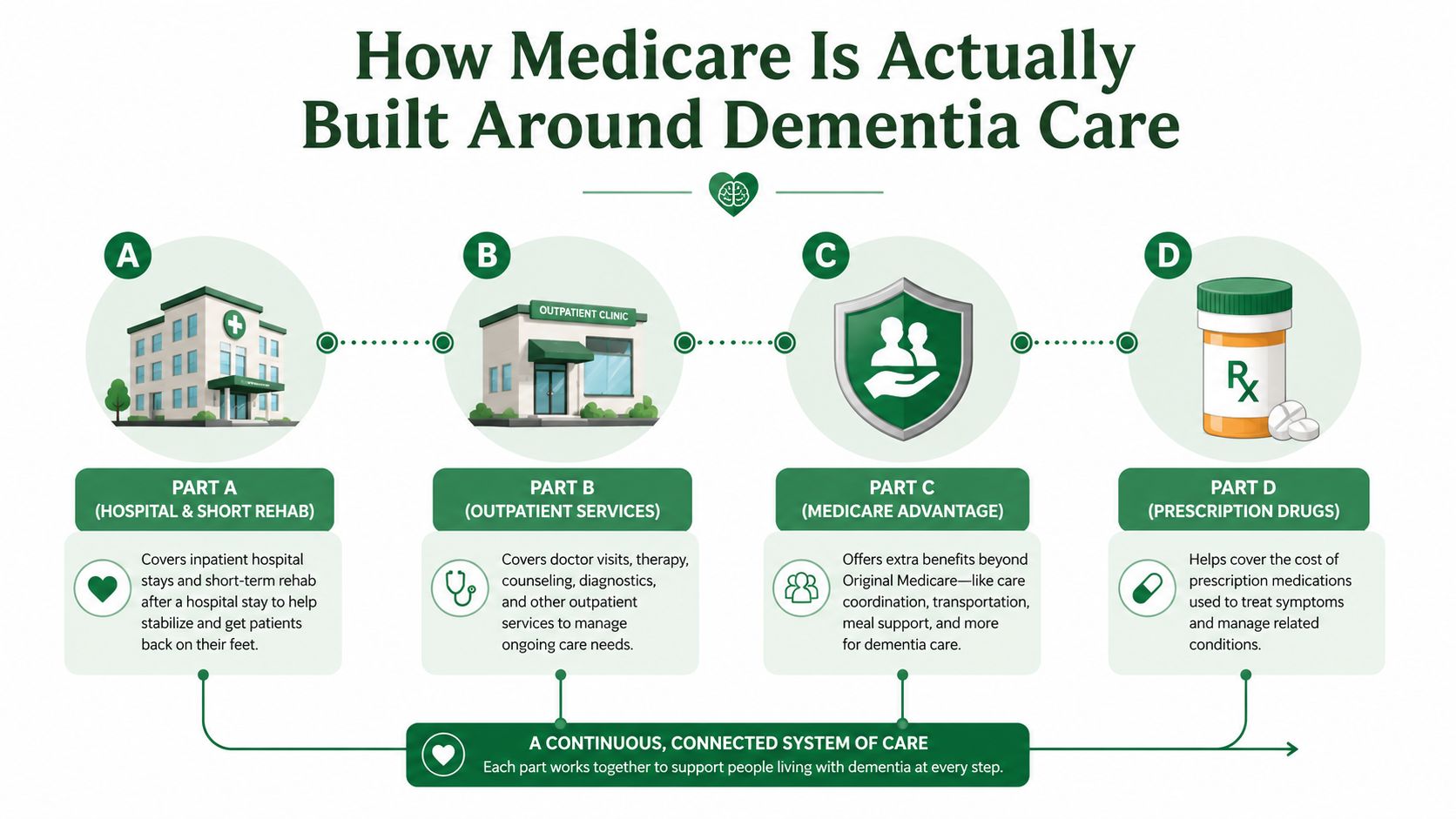
Think of Medicare as four different tools in one box, not one all-purpose coverage plan. Part A handles hospital and post-hospital care. Part B handles outpatient medical care and the dementia-specific office visit. Part C is the private Medicare Advantage version that bundles those benefits. Part D pays for prescription drugs.
Part A and the hospital to rehab window
Part A usually enters the picture when a person with dementia lands in the hospital after a fall, an infection, dehydration, or a behavior crisis that turned medical. If the discharge team says a skilled nursing facility stay is covered after a qualifying hospital stay, that's Part A territory, and it can extend for up to 100 days when the eligibility rules are met. That benefit matters because many families don't have a safe discharge plan ready on day one.
Part B and the outpatient care engine
Part B is the part most families touch again and again. It pays for office visits, the cognitive assessment and care-plan visit, physician follow-up, therapy, and medically necessary home health when the person qualifies as homebound and needs skilled services. If you need plain-language guidance on organizing medical instructions alongside legal documents, healthcare directive help from Law Office of Bryan Fagan, PLLC can be useful background reading for the planning side of the conversation.
Part C and how bundled plans change the rules
Medicare Advantage plans still have to cover the Medicare services people expect, but they package them through a private insurer. That changes how families experience care, because network rules, plan approvals, and service logistics can be different from Original Medicare. The benefit is convenience for some households. The tradeoff is less freedom in choosing providers.
Part D and dementia medications
Part D is the prescription layer. If a doctor prescribes a dementia medication or a related drug for symptoms, Part D is where families look first for coverage. The exact formulary matters, so a prescription that looks straightforward on paper may still need a plan review before the pharmacy fills it.
That four-part structure is the backbone. Once you know which part owns which service, the rest of the Medicare conversation gets much less confusing.
What Each Part Covers for Dementia Services
A first dementia diagnosis can make every insurance question feel tangled. The easiest way to sort it out is to ask a simple question for each service, where is the care happening, and is it medical treatment, medication, or hands-on daily help? That answer usually points to the right Medicare part faster than the diagnosis label does.
Medicare Part | Dementia Services Covered | Care Setting | Key Eligibility Condition |
|---|---|---|---|
Part A | Hospital care, short rehab in a skilled nursing facility | Inpatient or post-hospital setting | A qualifying hospital stay and medical need |
Part B | Doctor visits, the dedicated cognitive assessment, outpatient therapy, mental health, limited home health | Clinic, home, outpatient setting | Medical necessity, and for home health, intermittent skilled care |
Part C | Same Medicare-covered services through a private plan | Network-based plan structure | Enrollment in the plan and plan rules |
Part D | Prescription drugs related to dementia care | Pharmacy benefit | Medication must be on the plan's formulary |
Some services sound broader than they are. Home health only fits when a provider orders it, the person qualifies as homebound, and a Medicare-certified agency provides skilled care. It is intermittent and skilled, which means it helps with medical needs for a limited stretch, not with round-the-clock supervision, meal prep, or full-day companionship. Families often discover this gap only after safety concerns start at home, which is why many pair Medicare's narrow coverage with private help, Medicaid supports, or a service such as companion care for older adults when daily oversight is needed.
Part B carries the clinical work families usually need right after the diagnosis starts changing routines. The dedicated cognitive assessment visit gives the doctor a chance to review symptoms, confirm the diagnosis, talk through medications, and document a care plan. It can also lead to therapy referrals, home health orders, or notes that explain why a change in support is medically necessary. WellCare's dementia coverage summary is useful because it lays out how limited that kind of coverage can be in plain language.
For families, the practical move is to sort each need into the right lane. A doctor visit, a brief rehab stay, or a prescription question goes through one part. Ongoing bathing help, supervision, and room-and-board costs usually fall outside Medicare and need another layer of support.
Original Medicare Compared to Medicare Advantage for Dementia

Families usually face this choice when the diagnosis is already on the chart, not before. That timing matters, because dementia changes what “good coverage” looks like. The easiest plan on paper isn't always the easiest plan for a caregiver trying to line up specialists, home services, and follow-up visits.
Original Medicare and the add-on pieces
Original Medicare gives you Part A and Part B, then you can pair it with Part D for drugs and sometimes a Medigap policy to help with cost-sharing. The advantage here is flexibility. Families can often work with a wider range of providers, which matters when a neurologist, geriatrician, or home health agency is already in the mix.
Medicare Advantage and the managed-care tradeoff
Medicare Advantage wraps hospital, outpatient, and usually drug coverage into one private plan. Some plans add extra benefits that families like, such as transportation or limited caregiver supports, but those extras vary. The catch is that dementia care often becomes more complicated when the plan requires network use or prior authorization for services like therapy or home health.
A family should read the provider directory before it reads the marketing brochure.
That one habit can prevent a lot of frustration. If the memory clinic, the hospital, or the home health agency isn't in network, the plan may send the family through a different approval path than expected. If the doctor recommends a care-plan visit, the service may still be covered, but the logistics can differ a lot from one plan to another.
A simple decision filter
Choose flexibility first if your parent already sees multiple specialists and you want fewer network surprises.
Choose bundled convenience first if your family can stay inside one plan network and wants one insurer handling most claims.
Check the drug list early if the prescription side of dementia care is already active.
Compare home-health rules closely if your parent is likely to need intermittent skilled services after a hospitalization.
The decision isn't about which plan is “better” in the abstract. It's about which one will be easiest to live with when dementia care gets messy, because it usually does.
What Medicare Will Not Pay For and How to Fill the Gaps
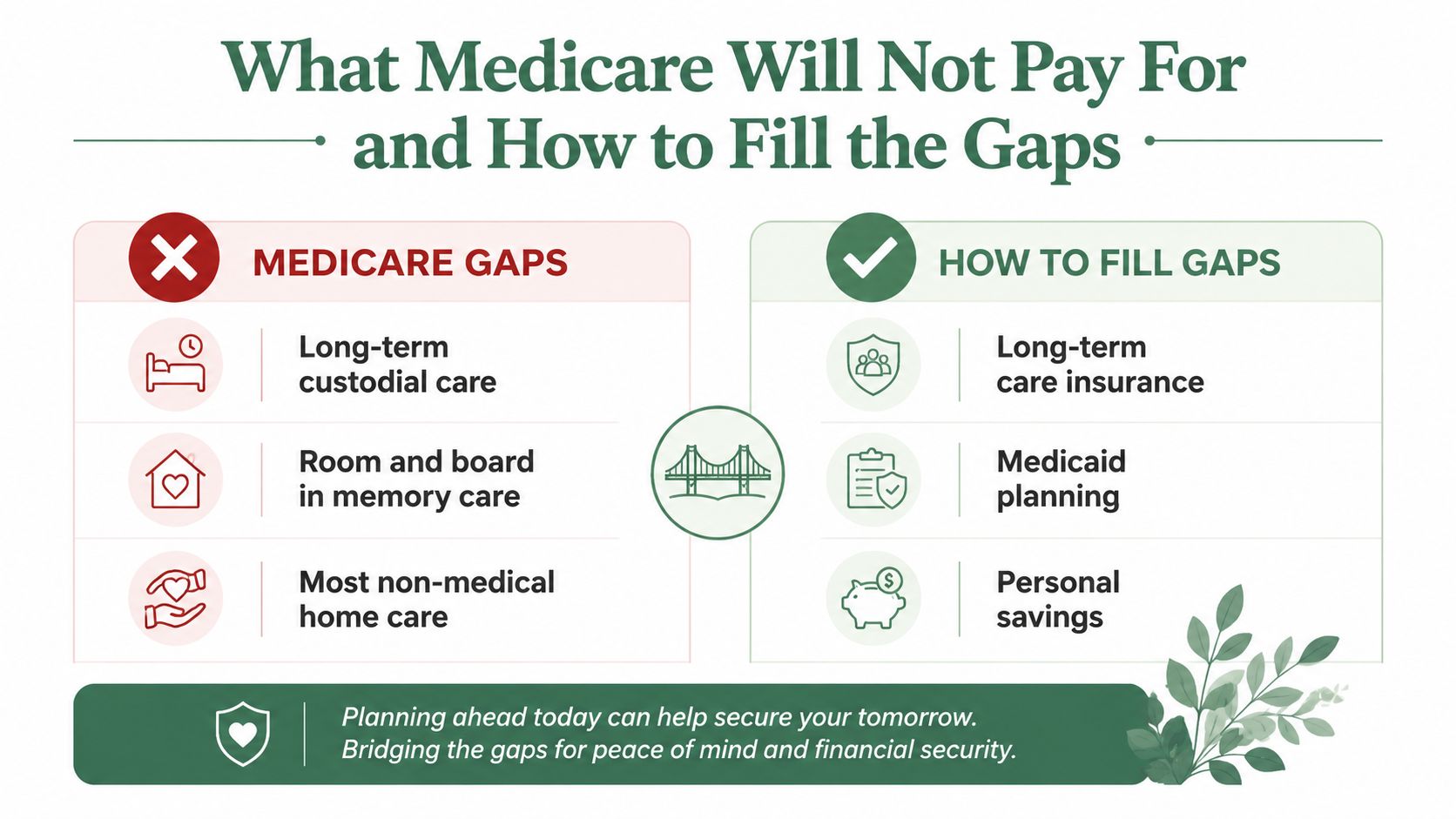
This is the part that catches most families off guard. Medicare can help with medical care, but it does not pay for long-term custodial care, room and board in memory care or assisted living, or adult day care when that is the only support needed. It also does not cover ongoing non-medical home help, even when the family is exhausted.
The financial pressure is real. The Alzheimer's Association reports that Medicare beneficiaries age 65+ living with Alzheimer's or other dementias paid $10,877 out of pocket annually for health care and long-term care services not covered by other sources, and that their average annual out-of-pocket costs were $10,289 versus $2,529 for beneficiaries without the condition. The Alzheimer's Association's 2024 facts and figures make clear why families feel the gap so sharply.
The most common ways families fill the gap
Medicaid: For people who qualify financially and medically, Medicaid long-term services and supports can become the main payer for nursing-home level care.
VA benefits: Veterans and some surviving spouses may have access to additional help through the VA, especially when dementia care overlaps with other service-connected needs.
Long-term care insurance: Some policies are designed to pay for the custodial side of care that Medicare excludes.
Personal savings and family planning: Many households use private funds to bridge the time before another benefit starts.
If you're comparing facility options, dementia care facilities guidance from Hey Velma can help you think through the difference between a medical benefit and a placement decision. The important point is that coverage and location are not the same problem. A place may be ideal clinically and still be unaffordable without a second funding source.
Families do best when they separate the question “What does Medicare pay?” from “How will we pay for everything else?” Once those are distinct questions, the planning gets less emotionally overwhelming and more practical.
Documentation, Billing, and Appeals When Coverage Is Denied
A denial doesn't always mean the service is uncovered. Sometimes it means the file doesn't show medical necessity clearly enough, or the plan never got the right note. In dementia care, the paper trail matters because memory loss, safety concerns, and changing function need to be translated into clinical language.
What to keep in the folder
The cognitive assessment note that records the diagnosis, symptoms, and care-plan discussion.
Orders for home health or therapy that explain why the service is needed.
Face-to-face encounter documentation when a service requires it.
Discharge summaries and specialist notes if the need started in the hospital.
Medicare Summary Notices and plan letters that show what was denied and why.
If the denial is for prior authorization or a service request inside a managed plan, resources like how Simbie AI cuts denials can help families understand the kinds of process errors that trigger rejection, even though the appeals steps themselves still need a human hand on the wheel.
How the appeal path usually works
Start by reading the denial carefully. Then match the denial reason to the missing document, the wrong code, or the service description that wasn't specific enough. If the problem is an Original Medicare claim, families can request a redetermination and then move up through the later appeal levels if needed. If the problem is a Medicare Advantage denial, the plan has its own internal appeal process first, followed by review from an independent entity if the denial stands.
Keep every phone call in a simple log, date, time, name, and what was promised.
That log becomes useful fast, especially when multiple offices are involved. A caregiver doesn't need to sound like a billing specialist. They just need to be organized, persistent, and specific about the service the doctor ordered.
One sentence can do a lot in an appeal letter. “The patient has a documented cognitive decline, safety concerns at home, and a provider order for this service.” That kind of language keeps the focus on medical need instead of general frustration. It also gives the reviewer something concrete to compare against the plan's written criteria.
Putting Together a Family Action Plan Around Medicare
The best way to use Medicare for dementia care is to treat it like a tool kit, not a promise of full coverage. The first step is to schedule or confirm the cognitive assessment and care-plan visit so the diagnosis, medications, and safety needs are documented in one place. That note becomes the anchor for later claims and referrals.
From there, review the hospital and rehab rules before a crisis makes the decision for you. If your parent has a fall, infection, or sudden decline, Part A may matter immediately, and the discharge planner will move quickly. If prescriptions are already part of care, check the Part D formulary now, not at the pharmacy counter.
A practical weekly checklist looks like this:
Confirm the medical file: Keep the diagnosis note, care plan, and specialist reports together.
Check the drug plan: Make sure the current medications still fit the formulary.
Compare plan structure: Look at Original Medicare versus Medicare Advantage before the next enrollment decision.
Map the gap coverage: Screen for Medicaid and VA eligibility early, because those programs can change the whole picture.
Non-medical supports can sit beside Medicare without replacing it. A structured phone-based cognitive support program can help with routine, reassurance, and day-to-day engagement between appointments, which is especially useful when the family is trying to stretch the time between clinic visits. If you're coordinating multiple people, the planning tools at Hey Velma's care coordination platform guide can help you think about how communication and follow-through fit into the care plan.
The big lesson is simple. Medicare is one layer of dementia care, not the whole plan. Families who pair the covered medical pieces with the right long-term supports usually feel less blindsided and more in control.
If you're trying to sort a new diagnosis into a real plan, Velma can help you think through the care calendar, the coverage gaps, and the daily supports that sit between doctor visits. Visit Velma to see how a phone-based cognitive support program can fit alongside Medicare, family caregiving, and the rest of your dementia care plan.
A new dementia diagnosis changes the whole tone of a family's week. One minute you're trying to absorb the doctor's explanation, and the next you're standing at checkout wondering what Medicare will pay for, who needs to call which office, and whether your parent's home care will be covered or denied.
The short answer is that Medicare coverage for dementia care is real, but narrow. It pays for specific medical moments, such as diagnosis, hospital care, certain rehab, some home health, and prescription drugs, yet it does not become the long-term daily care system most families eventually need. The families who do best are usually the ones who learn that distinction early and start building around it.
Table of Contents
When the Diagnosis Changes Every Insurance Question
How Medicare Is Actually Built Around Dementia Care
Part A and the hospital to rehab window
Part B and the outpatient care engine
Part C and how bundled plans change the rules
Part D and dementia medications
What Each Part Covers for Dementia Services
Original Medicare Compared to Medicare Advantage for Dementia
Original Medicare and the add-on pieces
Medicare Advantage and the managed-care tradeoff
A simple decision filter
What Medicare Will Not Pay For and How to Fill the Gaps
The most common ways families fill the gap
Documentation, Billing, and Appeals When Coverage Is Denied
What to keep in the folder
How the appeal path usually works
Putting Together a Family Action Plan Around Medicare
When the Diagnosis Changes Every Insurance Question
The visit ends, and your parent is holding a paper folder they can barely keep straight. The neurologist has said the word dementia, maybe Alzheimer's, and now you are trying to sort out whether the next appointment, the medication, the home nurse, and the memory care question all go through the same insurance card. They do not.
That is the first shift families need to understand. Medicare is not built like a broad long-term care policy. It pays for specific medical episodes, not for the full day-to-day supervision that dementia gradually requires. Under Original Medicare, the dedicated cognitive assessment and care-plan visit is one of the clearest dementia-specific benefits, because it lets a clinician review cognition, confirm or clarify the diagnosis, and build a care plan. Medicare also allows cognitive screening during the annual wellness visit, but that is not the same service. Medicare's dedicated cognitive assessment and care-plan visit is the place to start when the diagnosis is still being sorted out.
Practical rule: If the service is about diagnosis, treatment, rehab, or another medical need, Medicare may help. If the service is about ongoing supervision, bathing, dressing, or keeping someone safe all day, Medicare usually stops there.
That difference explains why so many families feel whiplash after a diagnosis. The coverage can be strong for a medical moment and weak for a caregiving reality. A hospital stay can be covered, a short rehab window can be covered, and a doctor visit can be covered. The same plan will not automatically pay for the hands-on help your parent now needs at breakfast, at bedtime, or every time they wander toward the front door.
Families often ask the same question in different forms, whether they are speaking to a social worker, a discharge planner, or an insurance rep. What they really mean is, “Which parts of dementia care are medical, and which parts are just life now?” That is the lens to keep in mind through every Medicare decision that follows. If the plan starts to feel tangled, families can also ask about healthcare directive help from Law Office of https://texastrustadministration.com/healthcare-directives-and-living-wills/ while they sort out the care picture and the paperwork.
How Medicare Is Actually Built Around Dementia Care
Think of Medicare as four different tools in one box, not one all-purpose coverage plan. Part A handles hospital and post-hospital care. Part B handles outpatient medical care and the dementia-specific office visit. Part C is the private Medicare Advantage version that bundles those benefits. Part D pays for prescription drugs.
Part A and the hospital to rehab window
Part A usually enters the picture when a person with dementia lands in the hospital after a fall, an infection, dehydration, or a behavior crisis that turned medical. If the discharge team says a skilled nursing facility stay is covered after a qualifying hospital stay, that's Part A territory, and it can extend for up to 100 days when the eligibility rules are met. That benefit matters because many families don't have a safe discharge plan ready on day one.
Part B and the outpatient care engine
Part B is the part most families touch again and again. It pays for office visits, the cognitive assessment and care-plan visit, physician follow-up, therapy, and medically necessary home health when the person qualifies as homebound and needs skilled services. If you need plain-language guidance on organizing medical instructions alongside legal documents, healthcare directive help from Law Office of Bryan Fagan, PLLC can be useful background reading for the planning side of the conversation.
Part C and how bundled plans change the rules
Medicare Advantage plans still have to cover the Medicare services people expect, but they package them through a private insurer. That changes how families experience care, because network rules, plan approvals, and service logistics can be different from Original Medicare. The benefit is convenience for some households. The tradeoff is less freedom in choosing providers.
Part D and dementia medications
Part D is the prescription layer. If a doctor prescribes a dementia medication or a related drug for symptoms, Part D is where families look first for coverage. The exact formulary matters, so a prescription that looks straightforward on paper may still need a plan review before the pharmacy fills it.
That four-part structure is the backbone. Once you know which part owns which service, the rest of the Medicare conversation gets much less confusing.
What Each Part Covers for Dementia Services
A first dementia diagnosis can make every insurance question feel tangled. The easiest way to sort it out is to ask a simple question for each service, where is the care happening, and is it medical treatment, medication, or hands-on daily help? That answer usually points to the right Medicare part faster than the diagnosis label does.
Medicare Part | Dementia Services Covered | Care Setting | Key Eligibility Condition |
|---|---|---|---|
Part A | Hospital care, short rehab in a skilled nursing facility | Inpatient or post-hospital setting | A qualifying hospital stay and medical need |
Part B | Doctor visits, the dedicated cognitive assessment, outpatient therapy, mental health, limited home health | Clinic, home, outpatient setting | Medical necessity, and for home health, intermittent skilled care |
Part C | Same Medicare-covered services through a private plan | Network-based plan structure | Enrollment in the plan and plan rules |
Part D | Prescription drugs related to dementia care | Pharmacy benefit | Medication must be on the plan's formulary |
Some services sound broader than they are. Home health only fits when a provider orders it, the person qualifies as homebound, and a Medicare-certified agency provides skilled care. It is intermittent and skilled, which means it helps with medical needs for a limited stretch, not with round-the-clock supervision, meal prep, or full-day companionship. Families often discover this gap only after safety concerns start at home, which is why many pair Medicare's narrow coverage with private help, Medicaid supports, or a service such as companion care for older adults when daily oversight is needed.
Part B carries the clinical work families usually need right after the diagnosis starts changing routines. The dedicated cognitive assessment visit gives the doctor a chance to review symptoms, confirm the diagnosis, talk through medications, and document a care plan. It can also lead to therapy referrals, home health orders, or notes that explain why a change in support is medically necessary. WellCare's dementia coverage summary is useful because it lays out how limited that kind of coverage can be in plain language.
For families, the practical move is to sort each need into the right lane. A doctor visit, a brief rehab stay, or a prescription question goes through one part. Ongoing bathing help, supervision, and room-and-board costs usually fall outside Medicare and need another layer of support.
Original Medicare Compared to Medicare Advantage for Dementia
Families usually face this choice when the diagnosis is already on the chart, not before. That timing matters, because dementia changes what “good coverage” looks like. The easiest plan on paper isn't always the easiest plan for a caregiver trying to line up specialists, home services, and follow-up visits.
Original Medicare and the add-on pieces
Original Medicare gives you Part A and Part B, then you can pair it with Part D for drugs and sometimes a Medigap policy to help with cost-sharing. The advantage here is flexibility. Families can often work with a wider range of providers, which matters when a neurologist, geriatrician, or home health agency is already in the mix.
Medicare Advantage and the managed-care tradeoff
Medicare Advantage wraps hospital, outpatient, and usually drug coverage into one private plan. Some plans add extra benefits that families like, such as transportation or limited caregiver supports, but those extras vary. The catch is that dementia care often becomes more complicated when the plan requires network use or prior authorization for services like therapy or home health.
A family should read the provider directory before it reads the marketing brochure.
That one habit can prevent a lot of frustration. If the memory clinic, the hospital, or the home health agency isn't in network, the plan may send the family through a different approval path than expected. If the doctor recommends a care-plan visit, the service may still be covered, but the logistics can differ a lot from one plan to another.
A simple decision filter
Choose flexibility first if your parent already sees multiple specialists and you want fewer network surprises.
Choose bundled convenience first if your family can stay inside one plan network and wants one insurer handling most claims.
Check the drug list early if the prescription side of dementia care is already active.
Compare home-health rules closely if your parent is likely to need intermittent skilled services after a hospitalization.
The decision isn't about which plan is “better” in the abstract. It's about which one will be easiest to live with when dementia care gets messy, because it usually does.
What Medicare Will Not Pay For and How to Fill the Gaps
This is the part that catches most families off guard. Medicare can help with medical care, but it does not pay for long-term custodial care, room and board in memory care or assisted living, or adult day care when that is the only support needed. It also does not cover ongoing non-medical home help, even when the family is exhausted.
The financial pressure is real. The Alzheimer's Association reports that Medicare beneficiaries age 65+ living with Alzheimer's or other dementias paid $10,877 out of pocket annually for health care and long-term care services not covered by other sources, and that their average annual out-of-pocket costs were $10,289 versus $2,529 for beneficiaries without the condition. The Alzheimer's Association's 2024 facts and figures make clear why families feel the gap so sharply.
The most common ways families fill the gap
Medicaid: For people who qualify financially and medically, Medicaid long-term services and supports can become the main payer for nursing-home level care.
VA benefits: Veterans and some surviving spouses may have access to additional help through the VA, especially when dementia care overlaps with other service-connected needs.
Long-term care insurance: Some policies are designed to pay for the custodial side of care that Medicare excludes.
Personal savings and family planning: Many households use private funds to bridge the time before another benefit starts.
If you're comparing facility options, dementia care facilities guidance from Hey Velma can help you think through the difference between a medical benefit and a placement decision. The important point is that coverage and location are not the same problem. A place may be ideal clinically and still be unaffordable without a second funding source.
Families do best when they separate the question “What does Medicare pay?” from “How will we pay for everything else?” Once those are distinct questions, the planning gets less emotionally overwhelming and more practical.
Documentation, Billing, and Appeals When Coverage Is Denied
A denial doesn't always mean the service is uncovered. Sometimes it means the file doesn't show medical necessity clearly enough, or the plan never got the right note. In dementia care, the paper trail matters because memory loss, safety concerns, and changing function need to be translated into clinical language.
What to keep in the folder
The cognitive assessment note that records the diagnosis, symptoms, and care-plan discussion.
Orders for home health or therapy that explain why the service is needed.
Face-to-face encounter documentation when a service requires it.
Discharge summaries and specialist notes if the need started in the hospital.
Medicare Summary Notices and plan letters that show what was denied and why.
If the denial is for prior authorization or a service request inside a managed plan, resources like how Simbie AI cuts denials can help families understand the kinds of process errors that trigger rejection, even though the appeals steps themselves still need a human hand on the wheel.
How the appeal path usually works
Start by reading the denial carefully. Then match the denial reason to the missing document, the wrong code, or the service description that wasn't specific enough. If the problem is an Original Medicare claim, families can request a redetermination and then move up through the later appeal levels if needed. If the problem is a Medicare Advantage denial, the plan has its own internal appeal process first, followed by review from an independent entity if the denial stands.
Keep every phone call in a simple log, date, time, name, and what was promised.
That log becomes useful fast, especially when multiple offices are involved. A caregiver doesn't need to sound like a billing specialist. They just need to be organized, persistent, and specific about the service the doctor ordered.
One sentence can do a lot in an appeal letter. “The patient has a documented cognitive decline, safety concerns at home, and a provider order for this service.” That kind of language keeps the focus on medical need instead of general frustration. It also gives the reviewer something concrete to compare against the plan's written criteria.
Putting Together a Family Action Plan Around Medicare
The best way to use Medicare for dementia care is to treat it like a tool kit, not a promise of full coverage. The first step is to schedule or confirm the cognitive assessment and care-plan visit so the diagnosis, medications, and safety needs are documented in one place. That note becomes the anchor for later claims and referrals.
From there, review the hospital and rehab rules before a crisis makes the decision for you. If your parent has a fall, infection, or sudden decline, Part A may matter immediately, and the discharge planner will move quickly. If prescriptions are already part of care, check the Part D formulary now, not at the pharmacy counter.
A practical weekly checklist looks like this:
Confirm the medical file: Keep the diagnosis note, care plan, and specialist reports together.
Check the drug plan: Make sure the current medications still fit the formulary.
Compare plan structure: Look at Original Medicare versus Medicare Advantage before the next enrollment decision.
Map the gap coverage: Screen for Medicaid and VA eligibility early, because those programs can change the whole picture.
Non-medical supports can sit beside Medicare without replacing it. A structured phone-based cognitive support program can help with routine, reassurance, and day-to-day engagement between appointments, which is especially useful when the family is trying to stretch the time between clinic visits. If you're coordinating multiple people, the planning tools at Hey Velma's care coordination platform guide can help you think about how communication and follow-through fit into the care plan.
The big lesson is simple. Medicare is one layer of dementia care, not the whole plan. Families who pair the covered medical pieces with the right long-term supports usually feel less blindsided and more in control.
If you're trying to sort a new diagnosis into a real plan, Velma can help you think through the care calendar, the coverage gaps, and the daily supports that sit between doctor visits. Visit Velma to see how a phone-based cognitive support program can fit alongside Medicare, family caregiving, and the rest of your dementia care plan.
Suggested Article: