Proactive Intervention Strategies for Dementia Care

You're on the phone with your mother again, and the call starts the same way it did last week. She says she's fine, then asks the same question twice, then mentions an appointment she already missed. That's often the moment adult children realize they need more than occasional help, they need proactive intervention strategies that catch problems early, keep daily life steadier, and lower the odds that a small slip turns into a bigger crisis.
The right kind of support doesn't wait for a fall, a medication mistake, or a frightening call from a neighbor. It builds a routine that notices patterns, offers calm reminders, and gives families a clearer read on what's changing. For people in the early to mid stages of dementia, that can mean structured phone outreach, practical cueing, and a consistent relationship with a care manager who knows what to look for and how to respond.
Table of Contents
What Proactive Intervention Strategies Mean in Dementia Care
Why phone-based support fits this model
The Evidence Behind Prevention Over Reaction
What families should measure instead of hoping for a miracle
The Four Categories of Proactive Intervention
Cognitive stimulation
Routine and risk reduction
Emotional support
Caregiver coordination
How a Phone-Based Program Puts These Strategies to Work
What a tailored call looks like
Why structured documentation changes the value of each call
Conversation Scripts Families and Care Managers Can Use
Scripts for the hardest moments
One line families can borrow tonight
Monitoring Progress Across Calls
What to watch for
A cadence families can ask for
Balancing Proactive Support with Autonomy and Dignity
Signs the balance has tipped too far
What Proactive Intervention Strategies Mean in Dementia Care
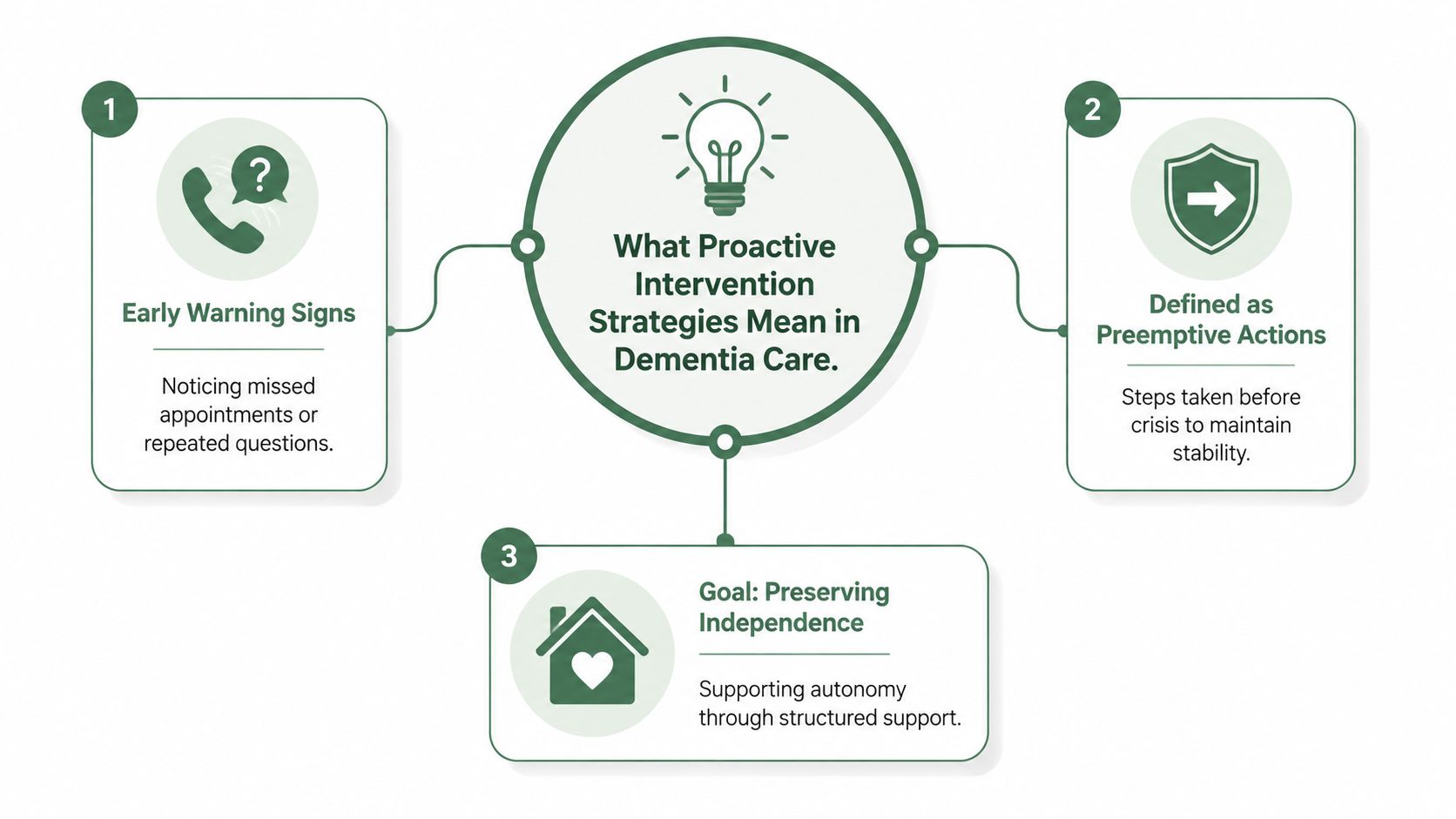
The first clue is usually ordinary. A parent forgets an appointment, repeats a question three times in one conversation, or sounds slightly more confused on the phone than last month. Proactive intervention strategies mean you don't wait for those moments to become emergencies, you respond with structured support before the situation gets worse.
That is different from reactive care. Reactive help shows up after something goes wrong, after the missed medication, after the wandering episode, after the family panic call. Proactive care tries to reduce the chance of those events by using routine contact, reminders, orientation, and safety checks while the person still has enough independence for those prompts to work.
Why phone-based support fits this model
Phone outreach works well because it's low friction. There's no app to learn, no password to remember, and no device to keep charged. A dedicated care manager can use the call itself to notice confusion, reinforce orientation, and check whether a routine still feels manageable, while a generic wellness app usually waits for the person to log in and a companion call may not build a consistent care relationship.
This matters for families who are already juggling doctor visits, meals, transportation, and safety concerns. If you're also thinking about home risks, resources like fall prevention for older adults can help you connect the dots between memory loss, mobility, and the home environment.
Practical rule: if the person can still follow a conversation, structured check-ins can often reinforce independence before the need becomes urgent.
A helpful way to think about it is simple. Proactive support does not replace the person's choices, it supports the parts of memory and planning that are getting unreliable. That's why this approach tends to work best while the person is still living at home and can benefit from regular cueing.
The Evidence Behind Prevention Over Reaction
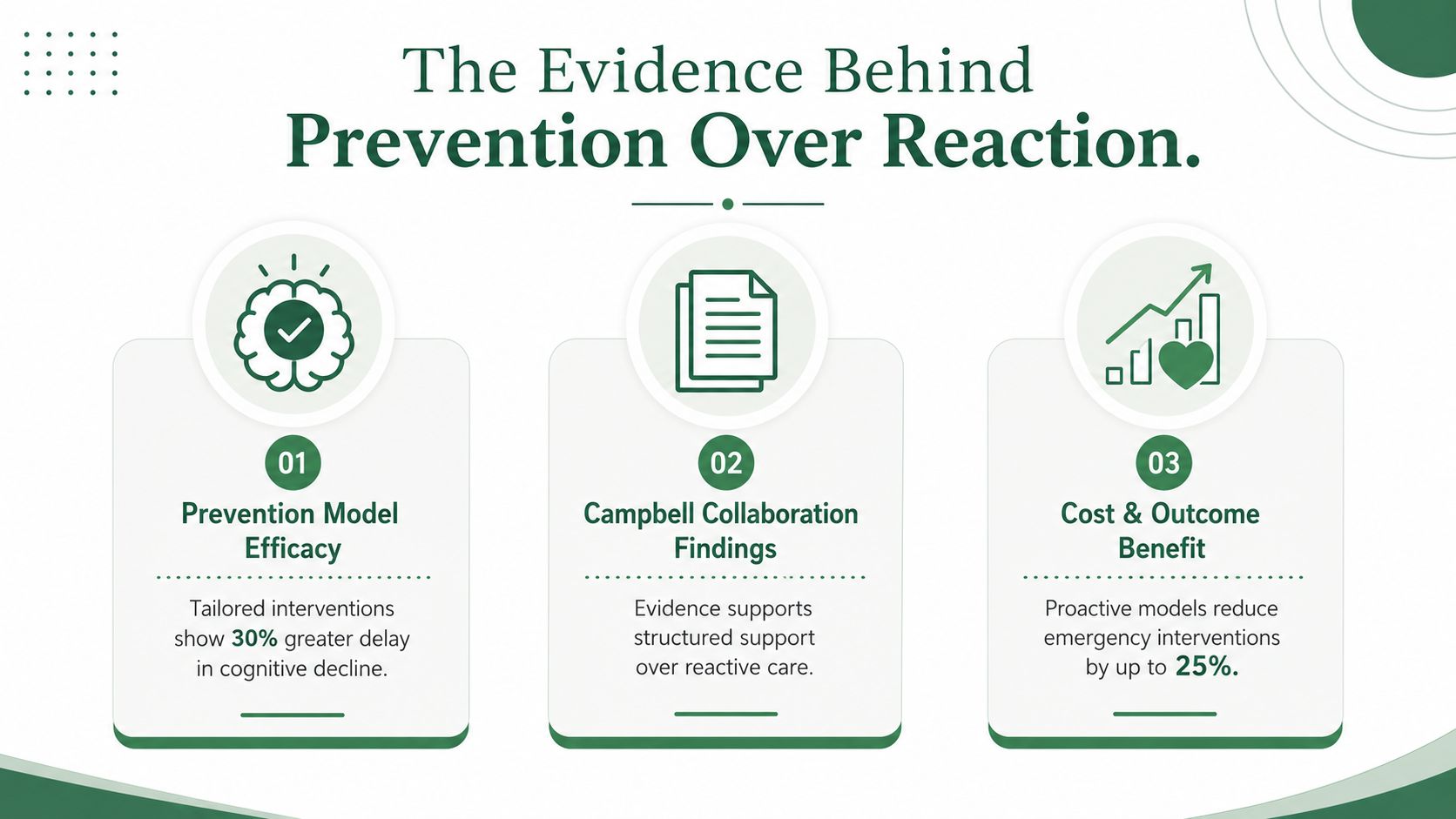
The evidence base favors prevention-focused, problem-specific intervention over one-size-fits-all reaction. A major Campbell Collaboration review of problem-oriented policing found that prevention was associated with a statistically significant 34% reduction in crime and disorder across a wide variety of outcomes, which matters here because the logic is the same, recurring patterns improve when agencies intervene before harm escalates. The same review also pointed to benefits in strategies aimed at both problem places and problem people, which reinforces the idea that support works best when it targets the source of risk, not just the surface symptom. Campbell Collaboration plain-language summary
In aging care, a randomized trial of a proactive multicomponent program followed independently living older adults for 12 months and found no meaningful change in overall disability at one year. The adjusted odds ratio was 0.96 with a 95% CI of 0.39–2.35 and p = 0.92, so the broad disability score didn't move much. But the same trial did show improvement in more specific functional measures within the intervention group, including activities of daily living, walking speed, and functional capacity, and grip strength improved immediately after the intervention. 2019 PRoactive multicomponent trial
What families should measure instead of hoping for a miracle
That combination of findings is useful because it sets a realistic expectation. Don't look for a dramatic reversal. Look for preserved routine, safer function, earlier detection, and fewer surprises. Those are the kinds of gains that matter when someone is trying to stay at home.
The point of proactive care is not to prove the disease disappeared. It's to catch decline early enough that daily life stays steadier for longer.
Repeated contact also gives you better signal quality than a sporadic family call. One conversation can miss a lot. A structured pattern of calls makes it easier to see if confusion is getting worse, if mood is shifting, or if missed routines are becoming a trend instead of a one-off. That's why prevention models rely on documentation over time, not just a single reassuring check-in.
The Four Categories of Proactive Intervention
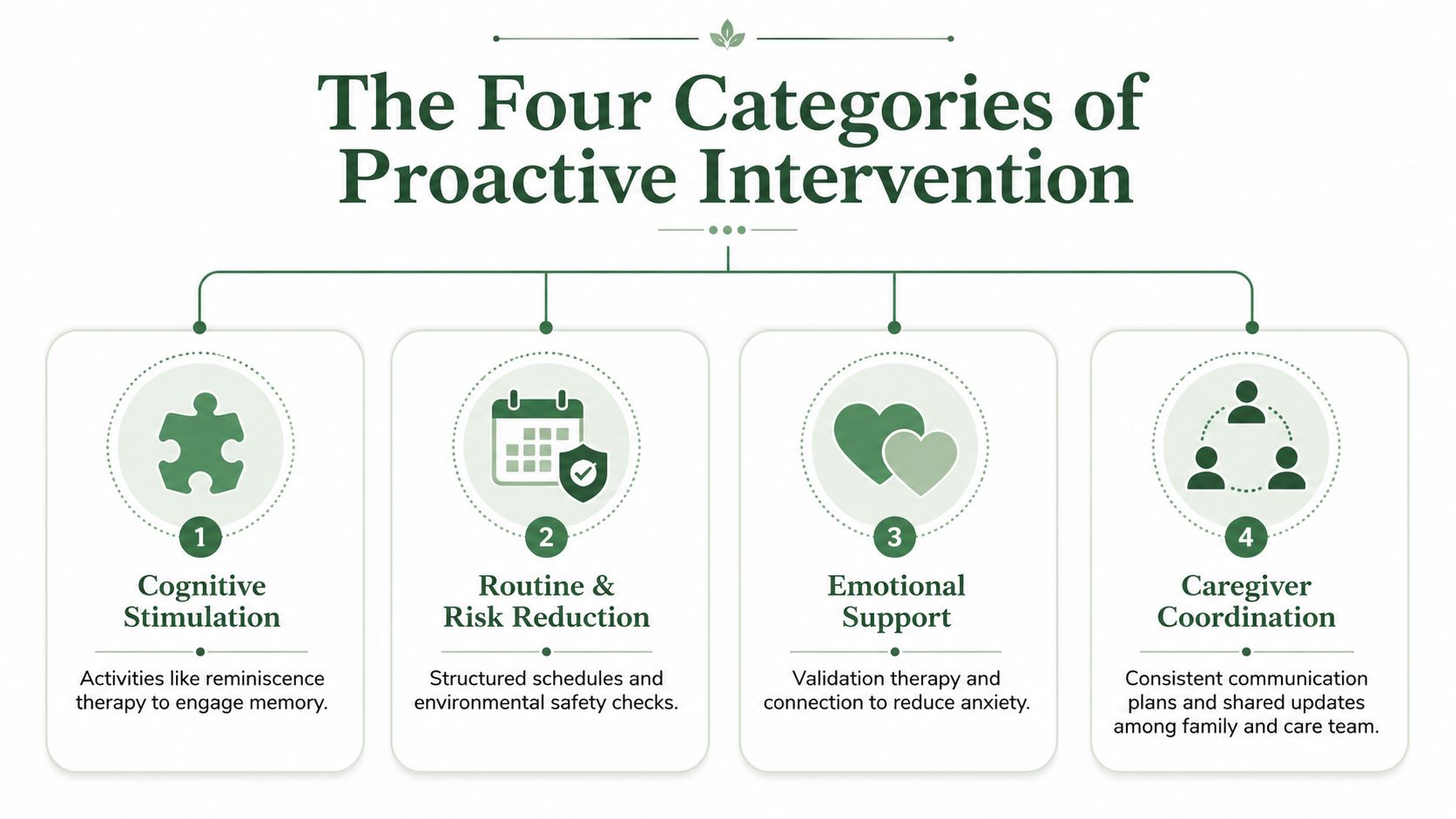
The easiest way to make proactive care usable is to sort it into four boxes. That way, every call has a purpose, and nobody has to guess whether the conversation is meant to calm, cue, observe, or coordinate.
Cognitive stimulation
This is the part of the call that keeps the mind engaged without turning the exchange into a test. A care manager might ask about a favorite job, a neighborhood memory, or a recent meal, then gently anchor the person in time and place with simple orientation cues. Tasks should match ability, so if language is slipping, the goal is not performance, it's successful participation.
Routine and risk reduction
This category covers the practical stuff people forget when memory starts to fade. Medication reminders, appointment reminders, questions about the stove, the freezer, or expired food, and basic fall-risk conversations all belong here. If you want a framework for organizing those prompts into a broader care plan, the examples on cognitive care plan examples are a useful reference point.
A phone call in this category might sound like, “Did you take the morning pill yet?” followed by a pause, not a lecture. The purpose is to externalize memory so the person doesn't have to rely on the same failing recall every day.
Emotional support
Many families underestimate how often anxiety sits underneath repetition, refusal, or fixating on a lost object. Emotional support uses validation, reassurance, and redirection to lower distress before it grows. A calm voice, short questions, and predictable phrasing can make the person feel safer without arguing with their emotions.
Caregiver coordination
The last box is easy to overlook, but it matters just as much as the conversation itself. Someone has to notice patterns, share updates, and make sure the family and clinician are looking at the same information. That is where a dedicated care manager makes a difference, because coordination turns scattered observations into a shared plan instead of a pile of disconnected worries.
If you're comparing support models, a good question is whether the program only talks to the older adult or also helps the rest of the care circle stay aligned. That distinction becomes especially important when routines change, medications shift, or a new safety concern shows up.
For a related look at how environment affects cognition, the air quality cognition study is a helpful reminder that memory support doesn't exist in a vacuum. The surroundings matter too.
How a Phone-Based Program Puts These Strategies to Work
A phone-based program works because it removes the barrier that stops many older adults from engaging with newer tools. Some people won't use apps, some won't wear devices, and some get overwhelmed by anything that feels like setup. A scheduled call avoids that friction and creates something more reliable, a recurring relationship with a person who knows the participant's history and can tailor each check-in.
What a tailored call looks like
A trained care team member doesn't read from a generic script. The conversation changes based on the participant's interests, cognitive profile, and daily routine. That might mean starting with a familiar topic, slipping in a time-and-place orientation cue, then checking whether lunch happened, whether the walker is near the chair, or whether tomorrow's appointment is still on the calendar.
The protocol matters too. Calls shaped by dementia stage and common comorbidities are less likely to feel random or too demanding. That's where clinically vetted frameworks help, because the call stays in the zone where the person can succeed instead of failing at an exercise that's too hard.
Why structured documentation changes the value of each call
A single good call feels nice. A series of well-documented calls creates a pattern the family can use. Notes about confusion, anxiety, missed routines, or fall concerns help a care manager spot trends and decide when something needs escalation, and that's why structured documentation is more useful than casual reassurance.
Useful phone care doesn't just ask, “How are you today?” It asks enough the same way each time to notice what's changing.
Velma is one example of this model in practice. It uses scheduled phone calls led by trained care team members, with family-visible summaries and coordination built into the process. If you're comparing how recurring check-ins are delivered, daily check-in calls for seniors shows why consistency matters more than occasional contact.
The biggest advantage is still simplicity. Phone delivery keeps the burden low for the older adult while preserving a steady point of contact for the family, which is exactly what proactive intervention should do.
Conversation Scripts Families and Care Managers Can Use
A lot of families want the strategy but freeze when it's time to speak. The words matter because the wrong question can make someone defensive, while the right phrase can lower tension and get you useful information. Good scripts are short, predictable, and easy to repeat.
Situation | Suggested Opener | Principle |
|---|---|---|
Starting the call | “Hi, it's [name]. I'm glad to talk with you this morning. What's been going well since we last spoke?” | Predictability and warmth |
Misplaced item fixation | “Let's pause on the keys for a minute. Tell me what you were doing before you noticed they were missing.” | Redirection without arguing |
Medication reminder | “Before lunch, did you already take the blue pill, or is that still waiting?” | External cueing |
Appointment anxiety | “It makes sense to feel uneasy about tomorrow's visit. Let's go over the time and the ride together.” | Validation plus structure |
Fall or mobility concern | “I want to check on your walking today. Have you felt steadier, or more unsteady than usual?” | Safety screening without alarm |
Scripts for the hardest moments
If the person is hyper-focused on a missing object, don't quiz them about where they left it. Use a statement that narrows the topic and offers a next step. Try, “We can look for it after we finish this call. First, tell me whether you ate breakfast.”
For a spouse, the tone can be more familiar. For an adult child, it often helps to be practical and brief. A care manager can sound slightly more structured, since the role gives permission to be organized and consistent rather than emotionally loaded.
A few habits make these scripts work better:
Keep questions short: one idea at a time is easier to process.
Use choices, not open-ended tests: “morning or afternoon” is easier than “what time was the appointment?”
Pause after asking: retrieval takes time, and rushing usually makes recall worse.
Avoid repeated correcting: if the date is off, gently anchor it instead of debating it.
Don't turn the call into a quiz: the aim is support, not proof of memory.
One line families can borrow tonight
“I'm not checking your memory, I'm helping keep the day steady.”
That sentence works because it removes shame. It also matches the purpose of proactive intervention, which is to support function before confusion turns into a bigger problem.
Monitoring Progress Across Calls
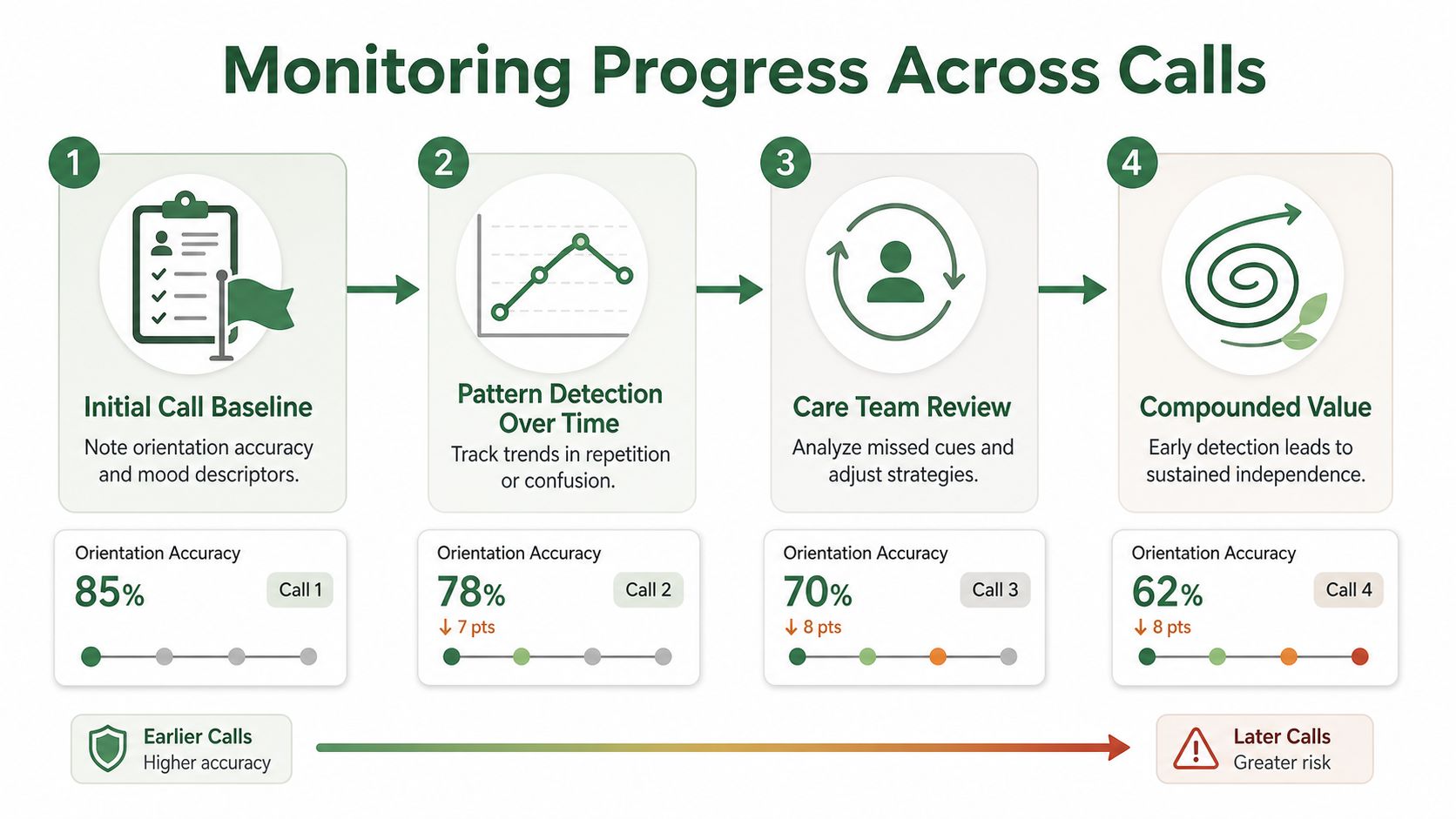
The value of proactive care shows up in the second, third, and fourth call. That's where patterns become visible. A care team should track a few simple signals over time, not just whether the person sounded pleasant on a given day.
What to watch for
Orientation accuracy for time, place, and upcoming events
Mood descriptors like calm, worried, irritable, or withdrawn
Missed medications or appointments that come up during the call
Household safety mentions such as the stove, food storage, or leaving doors open
Mobility or fall signals like unsteadiness, hesitation, or recent near-falls
Engagement level meaning whether the person answers, drifts, resists, or needs more prompting
The point is not to turn every call into a clinical exam. The point is to make small changes visible before they become obvious emergencies.
A cadence families can ask for
A good program should be able to provide a weekly summary, a monthly trend review, and a clear escalation rule for sudden change. If a person suddenly sounds more confused, more anxious, or less steady, the care manager should know when to alert the family rather than waiting for the next scheduled check-in. For an example of what organized coordination can look like behind the scenes, care coordination platform is a useful model to review.
When documentation is structured, each call stops being a standalone conversation and becomes part of a continuous dataset. That is what gives families better signal quality, and better signal quality leads to faster care-plan adjustments. For adult children who can't be in the home every day, that kind of visibility reduces a lot of uncertainty.
Balancing Proactive Support with Autonomy and Dignity
Families often worry that frequent check-ins will feel controlling, and that concern is valid. A call meant to help can start to feel like pressure if it asks too many questions, repeats the same correction, or leaves the person with no room to speak for themselves.
Proactive support should feel like a steady hand, not a spotlight. The call is there to help the person stay oriented, keep routines moving, and make safe choices they can still make for themselves. That means the support should fit the person's goals and habits, rather than overriding small preferences or treating every lapse as a sign of failure.
Signs the balance has tipped too far
Repeated quizzing is a warning sign. So is correcting every minor error, talking over the person, or taking over decisions that the person can still handle safely. If the call leaves someone embarrassed, irritated, or passive, the burden may be too high.
The better response is to lower the intensity, simplify the language, or narrow the focus to the risks that matter most. External cueing should make up for unreliable recall, not silence the person's voice. A call that keeps someone oriented while still letting them choose lunch, clothing, or the order of the morning routine is doing its job well.
A useful way to judge the balance is to ask whether the call leaves room for choice. If the person can still answer in their own words and make safe everyday decisions, the support is staying in the right lane.
That balance is easier to maintain when a dedicated care manager documents patterns and shares them in a way the family can see. Then the cadence can shift as needs change instead of staying fixed. Some days call for more structure, some call for less, and the right program should allow that adjustment while protecting the person's independence.
You're on the phone with your mother again, and the call starts the same way it did last week. She says she's fine, then asks the same question twice, then mentions an appointment she already missed. That's often the moment adult children realize they need more than occasional help, they need proactive intervention strategies that catch problems early, keep daily life steadier, and lower the odds that a small slip turns into a bigger crisis.
The right kind of support doesn't wait for a fall, a medication mistake, or a frightening call from a neighbor. It builds a routine that notices patterns, offers calm reminders, and gives families a clearer read on what's changing. For people in the early to mid stages of dementia, that can mean structured phone outreach, practical cueing, and a consistent relationship with a care manager who knows what to look for and how to respond.
Table of Contents
What Proactive Intervention Strategies Mean in Dementia Care
Why phone-based support fits this model
The Evidence Behind Prevention Over Reaction
What families should measure instead of hoping for a miracle
The Four Categories of Proactive Intervention
Cognitive stimulation
Routine and risk reduction
Emotional support
Caregiver coordination
How a Phone-Based Program Puts These Strategies to Work
What a tailored call looks like
Why structured documentation changes the value of each call
Conversation Scripts Families and Care Managers Can Use
Scripts for the hardest moments
One line families can borrow tonight
Monitoring Progress Across Calls
What to watch for
A cadence families can ask for
Balancing Proactive Support with Autonomy and Dignity
Signs the balance has tipped too far
What Proactive Intervention Strategies Mean in Dementia Care
The first clue is usually ordinary. A parent forgets an appointment, repeats a question three times in one conversation, or sounds slightly more confused on the phone than last month. Proactive intervention strategies mean you don't wait for those moments to become emergencies, you respond with structured support before the situation gets worse.
That is different from reactive care. Reactive help shows up after something goes wrong, after the missed medication, after the wandering episode, after the family panic call. Proactive care tries to reduce the chance of those events by using routine contact, reminders, orientation, and safety checks while the person still has enough independence for those prompts to work.
Why phone-based support fits this model
Phone outreach works well because it's low friction. There's no app to learn, no password to remember, and no device to keep charged. A dedicated care manager can use the call itself to notice confusion, reinforce orientation, and check whether a routine still feels manageable, while a generic wellness app usually waits for the person to log in and a companion call may not build a consistent care relationship.
This matters for families who are already juggling doctor visits, meals, transportation, and safety concerns. If you're also thinking about home risks, resources like fall prevention for older adults can help you connect the dots between memory loss, mobility, and the home environment.
Practical rule: if the person can still follow a conversation, structured check-ins can often reinforce independence before the need becomes urgent.
A helpful way to think about it is simple. Proactive support does not replace the person's choices, it supports the parts of memory and planning that are getting unreliable. That's why this approach tends to work best while the person is still living at home and can benefit from regular cueing.
The Evidence Behind Prevention Over Reaction
The evidence base favors prevention-focused, problem-specific intervention over one-size-fits-all reaction. A major Campbell Collaboration review of problem-oriented policing found that prevention was associated with a statistically significant 34% reduction in crime and disorder across a wide variety of outcomes, which matters here because the logic is the same, recurring patterns improve when agencies intervene before harm escalates. The same review also pointed to benefits in strategies aimed at both problem places and problem people, which reinforces the idea that support works best when it targets the source of risk, not just the surface symptom. Campbell Collaboration plain-language summary
In aging care, a randomized trial of a proactive multicomponent program followed independently living older adults for 12 months and found no meaningful change in overall disability at one year. The adjusted odds ratio was 0.96 with a 95% CI of 0.39–2.35 and p = 0.92, so the broad disability score didn't move much. But the same trial did show improvement in more specific functional measures within the intervention group, including activities of daily living, walking speed, and functional capacity, and grip strength improved immediately after the intervention. 2019 PRoactive multicomponent trial
What families should measure instead of hoping for a miracle
That combination of findings is useful because it sets a realistic expectation. Don't look for a dramatic reversal. Look for preserved routine, safer function, earlier detection, and fewer surprises. Those are the kinds of gains that matter when someone is trying to stay at home.
The point of proactive care is not to prove the disease disappeared. It's to catch decline early enough that daily life stays steadier for longer.
Repeated contact also gives you better signal quality than a sporadic family call. One conversation can miss a lot. A structured pattern of calls makes it easier to see if confusion is getting worse, if mood is shifting, or if missed routines are becoming a trend instead of a one-off. That's why prevention models rely on documentation over time, not just a single reassuring check-in.
The Four Categories of Proactive Intervention
The easiest way to make proactive care usable is to sort it into four boxes. That way, every call has a purpose, and nobody has to guess whether the conversation is meant to calm, cue, observe, or coordinate.
Cognitive stimulation
This is the part of the call that keeps the mind engaged without turning the exchange into a test. A care manager might ask about a favorite job, a neighborhood memory, or a recent meal, then gently anchor the person in time and place with simple orientation cues. Tasks should match ability, so if language is slipping, the goal is not performance, it's successful participation.
Routine and risk reduction
This category covers the practical stuff people forget when memory starts to fade. Medication reminders, appointment reminders, questions about the stove, the freezer, or expired food, and basic fall-risk conversations all belong here. If you want a framework for organizing those prompts into a broader care plan, the examples on cognitive care plan examples are a useful reference point.
A phone call in this category might sound like, “Did you take the morning pill yet?” followed by a pause, not a lecture. The purpose is to externalize memory so the person doesn't have to rely on the same failing recall every day.
Emotional support
Many families underestimate how often anxiety sits underneath repetition, refusal, or fixating on a lost object. Emotional support uses validation, reassurance, and redirection to lower distress before it grows. A calm voice, short questions, and predictable phrasing can make the person feel safer without arguing with their emotions.
Caregiver coordination
The last box is easy to overlook, but it matters just as much as the conversation itself. Someone has to notice patterns, share updates, and make sure the family and clinician are looking at the same information. That is where a dedicated care manager makes a difference, because coordination turns scattered observations into a shared plan instead of a pile of disconnected worries.
If you're comparing support models, a good question is whether the program only talks to the older adult or also helps the rest of the care circle stay aligned. That distinction becomes especially important when routines change, medications shift, or a new safety concern shows up.
For a related look at how environment affects cognition, the air quality cognition study is a helpful reminder that memory support doesn't exist in a vacuum. The surroundings matter too.
How a Phone-Based Program Puts These Strategies to Work
A phone-based program works because it removes the barrier that stops many older adults from engaging with newer tools. Some people won't use apps, some won't wear devices, and some get overwhelmed by anything that feels like setup. A scheduled call avoids that friction and creates something more reliable, a recurring relationship with a person who knows the participant's history and can tailor each check-in.
What a tailored call looks like
A trained care team member doesn't read from a generic script. The conversation changes based on the participant's interests, cognitive profile, and daily routine. That might mean starting with a familiar topic, slipping in a time-and-place orientation cue, then checking whether lunch happened, whether the walker is near the chair, or whether tomorrow's appointment is still on the calendar.
The protocol matters too. Calls shaped by dementia stage and common comorbidities are less likely to feel random or too demanding. That's where clinically vetted frameworks help, because the call stays in the zone where the person can succeed instead of failing at an exercise that's too hard.
Why structured documentation changes the value of each call
A single good call feels nice. A series of well-documented calls creates a pattern the family can use. Notes about confusion, anxiety, missed routines, or fall concerns help a care manager spot trends and decide when something needs escalation, and that's why structured documentation is more useful than casual reassurance.
Useful phone care doesn't just ask, “How are you today?” It asks enough the same way each time to notice what's changing.
Velma is one example of this model in practice. It uses scheduled phone calls led by trained care team members, with family-visible summaries and coordination built into the process. If you're comparing how recurring check-ins are delivered, daily check-in calls for seniors shows why consistency matters more than occasional contact.
The biggest advantage is still simplicity. Phone delivery keeps the burden low for the older adult while preserving a steady point of contact for the family, which is exactly what proactive intervention should do.
Conversation Scripts Families and Care Managers Can Use
A lot of families want the strategy but freeze when it's time to speak. The words matter because the wrong question can make someone defensive, while the right phrase can lower tension and get you useful information. Good scripts are short, predictable, and easy to repeat.
Situation | Suggested Opener | Principle |
|---|---|---|
Starting the call | “Hi, it's [name]. I'm glad to talk with you this morning. What's been going well since we last spoke?” | Predictability and warmth |
Misplaced item fixation | “Let's pause on the keys for a minute. Tell me what you were doing before you noticed they were missing.” | Redirection without arguing |
Medication reminder | “Before lunch, did you already take the blue pill, or is that still waiting?” | External cueing |
Appointment anxiety | “It makes sense to feel uneasy about tomorrow's visit. Let's go over the time and the ride together.” | Validation plus structure |
Fall or mobility concern | “I want to check on your walking today. Have you felt steadier, or more unsteady than usual?” | Safety screening without alarm |
Scripts for the hardest moments
If the person is hyper-focused on a missing object, don't quiz them about where they left it. Use a statement that narrows the topic and offers a next step. Try, “We can look for it after we finish this call. First, tell me whether you ate breakfast.”
For a spouse, the tone can be more familiar. For an adult child, it often helps to be practical and brief. A care manager can sound slightly more structured, since the role gives permission to be organized and consistent rather than emotionally loaded.
A few habits make these scripts work better:
Keep questions short: one idea at a time is easier to process.
Use choices, not open-ended tests: “morning or afternoon” is easier than “what time was the appointment?”
Pause after asking: retrieval takes time, and rushing usually makes recall worse.
Avoid repeated correcting: if the date is off, gently anchor it instead of debating it.
Don't turn the call into a quiz: the aim is support, not proof of memory.
One line families can borrow tonight
“I'm not checking your memory, I'm helping keep the day steady.”
That sentence works because it removes shame. It also matches the purpose of proactive intervention, which is to support function before confusion turns into a bigger problem.
Monitoring Progress Across Calls
The value of proactive care shows up in the second, third, and fourth call. That's where patterns become visible. A care team should track a few simple signals over time, not just whether the person sounded pleasant on a given day.
What to watch for
Orientation accuracy for time, place, and upcoming events
Mood descriptors like calm, worried, irritable, or withdrawn
Missed medications or appointments that come up during the call
Household safety mentions such as the stove, food storage, or leaving doors open
Mobility or fall signals like unsteadiness, hesitation, or recent near-falls
Engagement level meaning whether the person answers, drifts, resists, or needs more prompting
The point is not to turn every call into a clinical exam. The point is to make small changes visible before they become obvious emergencies.
A cadence families can ask for
A good program should be able to provide a weekly summary, a monthly trend review, and a clear escalation rule for sudden change. If a person suddenly sounds more confused, more anxious, or less steady, the care manager should know when to alert the family rather than waiting for the next scheduled check-in. For an example of what organized coordination can look like behind the scenes, care coordination platform is a useful model to review.
When documentation is structured, each call stops being a standalone conversation and becomes part of a continuous dataset. That is what gives families better signal quality, and better signal quality leads to faster care-plan adjustments. For adult children who can't be in the home every day, that kind of visibility reduces a lot of uncertainty.
Balancing Proactive Support with Autonomy and Dignity
Families often worry that frequent check-ins will feel controlling, and that concern is valid. A call meant to help can start to feel like pressure if it asks too many questions, repeats the same correction, or leaves the person with no room to speak for themselves.
Proactive support should feel like a steady hand, not a spotlight. The call is there to help the person stay oriented, keep routines moving, and make safe choices they can still make for themselves. That means the support should fit the person's goals and habits, rather than overriding small preferences or treating every lapse as a sign of failure.
Signs the balance has tipped too far
Repeated quizzing is a warning sign. So is correcting every minor error, talking over the person, or taking over decisions that the person can still handle safely. If the call leaves someone embarrassed, irritated, or passive, the burden may be too high.
The better response is to lower the intensity, simplify the language, or narrow the focus to the risks that matter most. External cueing should make up for unreliable recall, not silence the person's voice. A call that keeps someone oriented while still letting them choose lunch, clothing, or the order of the morning routine is doing its job well.
A useful way to judge the balance is to ask whether the call leaves room for choice. If the person can still answer in their own words and make safe everyday decisions, the support is staying in the right lane.
That balance is easier to maintain when a dedicated care manager documents patterns and shares them in a way the family can see. Then the cadence can shift as needs change instead of staying fixed. Some days call for more structure, some call for less, and the right program should allow that adjustment while protecting the person's independence.
Suggested Article: