What Is Cognitive Conditioning: A Practical Guide

Your parent repeats the same question three times before breakfast, then forgets why the kettle is on. You answer patiently, but later you notice the same thing again, a familiar object is missing, and a small sound in the house seems to set off a wave of anxiety. For many families, that's the daily reality of memory loss, and it's exactly where cognitive conditioning starts to matter.
At its simplest, cognitive conditioning is about how the brain learns to connect a cue with what usually follows. For caregivers, that means a voice, a time of day, a routine, or a familiar object can become part of the support itself. That matters because memory loss doesn't erase learning, it changes how learning happens.
Table of Contents
When Everyday Cues Stop Working
Why the same moments keep happening
The Core Idea Behind Cognitive Conditioning
A simple way to think about it
How It Differs From Cognitive Training and Stimulation
How to read the difference
What It Looks Like During a Real Cognitive Support Call
What the call is doing
Simple Conditioning-Based Exercises for Caregivers
Five low-effort ways to build stronger cue-response links
Why Early and Consistent Support Matters
Why timing changes the outcome
How Velma Puts These Principles into Practice
Where the model is strong
A Long-Game Approach for Families
When Everyday Cues Stop Working
A daughter walks into her mother's kitchen and sees the usual signs. The purse is on the counter, the tea mug is half-full, and her mother is standing still, trying to remember why she came into the room. Then a blender starts in the next apartment, and her mother flinches, as if the sound itself asked too much of her.
That scene is frustrating because it looks random. It isn't random, though. In dementia care, the problem is often not that a person can't learn anything new, it's that the cues around them no longer reliably lead to the right next step.
Why the same moments keep happening
A person may forget a task but still respond to a voice, a routine, or the order of a familiar sequence. That's where cognitive conditioning gives caregivers a useful frame. It doesn't ask you to treat memory like a test score. It asks you to notice which cues calm, orient, or trigger action, then use them on purpose.
Practical rule: If a routine keeps failing, look at the cue, not just the task.
That shift helps families stop blaming themselves for every missed pill, misplaced object, or anxious reaction. It also gives you something concrete to do. You can pair the same phrase with the same action, use the same phone call time each day, or anchor a hard task to a stable routine.
This way of thinking fits the realities of caregiving because it's small and repeatable. You're not trying to rebuild a whole memory system in one conversation. You're shaping what happens right before and right after a familiar moment, so the brain has a better chance of linking them together.
The Core Idea Behind Cognitive Conditioning
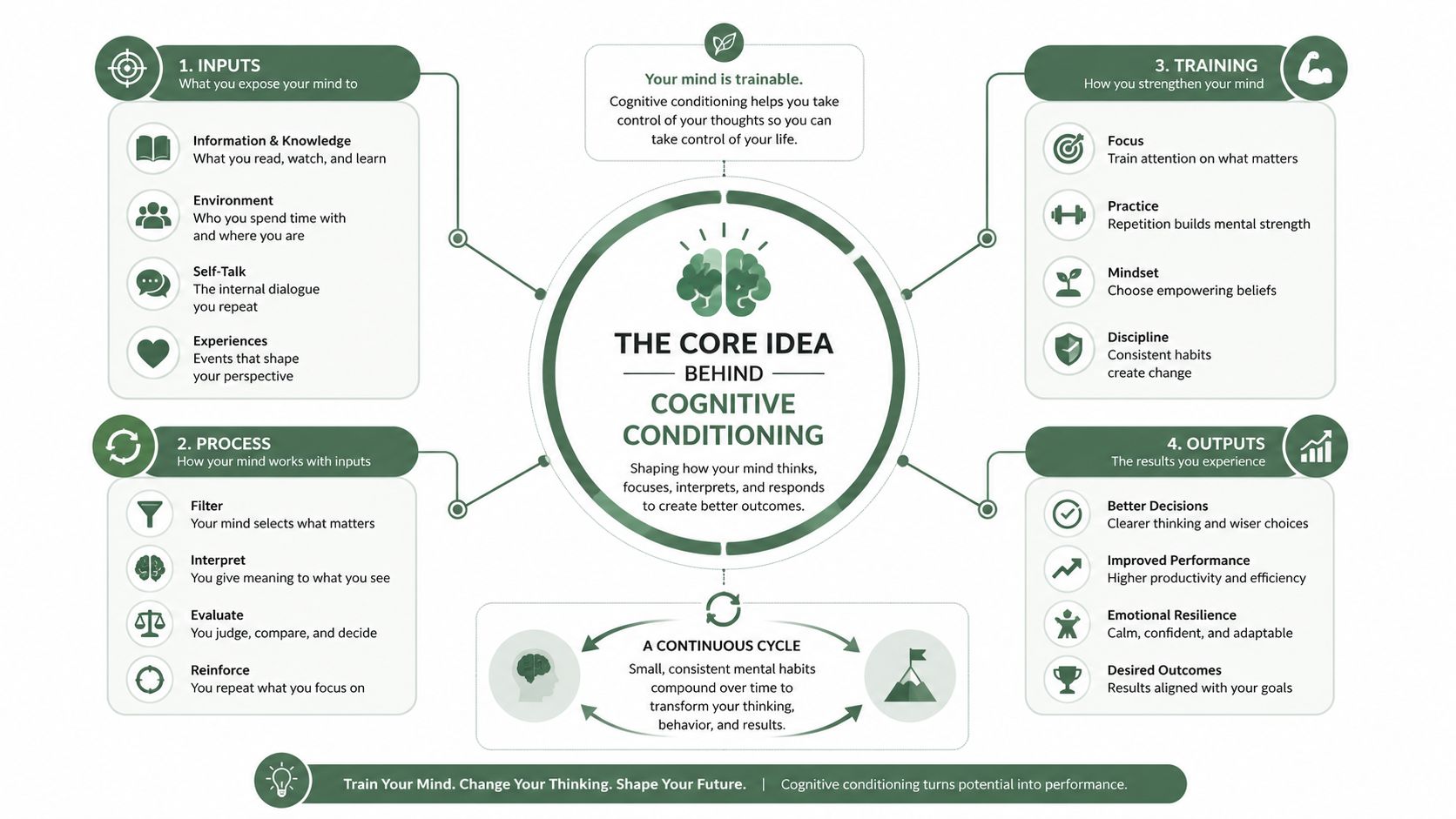
Cognitive conditioning is learning in which a neutral cue starts to carry meaning because it has been paired, again and again, with something important. A phone ring, a morning check-in, or a familiar voice can begin to predict comfort, direction, or a completed task. Over time, the cue itself can prompt the response.
A simple way to think about it
Coffee helps make the idea concrete. For many people, the smell of coffee doesn't just mean “there's coffee nearby.” It means the morning is starting, energy is coming, and a routine is underway. The smell has picked up meaning through repetition.
That's different from a reflex, and it's different from a reward alone. Classical conditioning is the older learning pattern where one cue comes to predict another outcome. Operant conditioning is about consequences, reward, or relief making a behavior more likely. Cognitive conditioning sits on top of both, because people also form expectations, beliefs, and mental links about what a cue means.
A cue becomes powerful when the brain starts expecting what comes next.
That's why a caregiver's steady script can help. If you always say, “Let's take your pills together after breakfast,” the words, the timing, and the meal begin to work as one package. The person isn't just hearing instructions. They're learning a pattern.
The key point is that cognitive conditioning isn't about forcing a reaction. It's about building dependable meaning through repetition. That's why one-off reminders usually fade, while repeated, familiar pairings have a better chance of sticking in daily life.
How It Differs From Cognitive Training and Stimulation
The terms get mixed up online, but they're not the same thing. Cognitive conditioning is the learning process itself. Cognitive training is structured practice on specific mental tasks. Cognitive stimulation is broader engagement through conversation, activities, and enrichment.
The distinction matters because the evidence for broad transfer is weak. A 2023 review in PMC reported that far-transfer effect sizes were very small, ranging from 0.04 to 0.19, and in some analyses they were zero, from -0.03 to 0.02. The review also concluded there's little to no true far transfer across studied cognitive-training domains, which is why generic brain-game promises deserve caution. The review on far transfer in cognitive training is a useful reality check.
How to read the difference
Concept | Core Mechanism | Typical Use | Transfer to Daily Life |
|---|---|---|---|
Cognitive Conditioning | Cue, meaning, repetition, expectation | Building reliable responses in real contexts | Strongest when tied to the same people, places, and routines |
Cognitive Training | Repeated practice on a specific task | Worksheets, apps, structured drills | Often limited to the trained skill |
Cognitive Stimulation | Enriching conversation and activity | Reminiscence, discussion, shared engagement | Helpful for mood and engagement, especially when personalized |
A practical example helps. A person might do a memory app every morning, but still struggle to remember medication time. That doesn't mean the app is useless. It means the skill practiced on the app doesn't automatically spread to every other part of life.
If you want a related look at structured engagement, this guide on what cognitive stimulation therapy is helps separate a specific program from broader support.
Bottom line: Repetition in the right context matters more than novelty.
That's why families often get more mileage from a familiar routine, a repeated voice, or a predictable call than from an impressive-looking app that never connects to daily life.
What It Looks Like During a Real Cognitive Support Call
On a scheduled call, the care manager opens the same way each time. The voice is familiar, the timing is predictable, and the conversation starts with something the person can answer easily, like the day, the weather, or a recent routine. That consistency matters because the call itself becomes a cue.
What the call is doing
A good support call is not random chat. It blends orientation cues, reminiscence, light language practice, and mood support into a structure the person can recognize. The care manager may ask about meals, medications, or a planned appointment, then shift into a memory prompt that feels comfortable rather than tested.
The important part is that the response is predictable. The caller listens, validates, and guides the next step without rushing. Over time, the person can start to associate that specific call with calm, attention, and a successful interaction.
A dedicated care manager also notices patterns. If confusion is worse at a certain time of day, if anxiety rises around a household change, or if a fall concern keeps coming up, those notes help the family catch shifts earlier. That's especially useful when the person living with memory loss doesn't always describe what changed.
Here's how the mechanism translates into practice:
Same timing, same voice: The call itself becomes a reliable cue.
Same tone, same pacing: The interaction feels safe instead of demanding.
Same kind of follow-through: The person learns that the call leads to help, not pressure.
The result isn't magical. It's repetition with purpose. When a phone-based program keeps the cue stable and the response emotionally steady, it gives the brain more chances to link the moment with what should happen next.
Simple Conditioning-Based Exercises for Caregivers
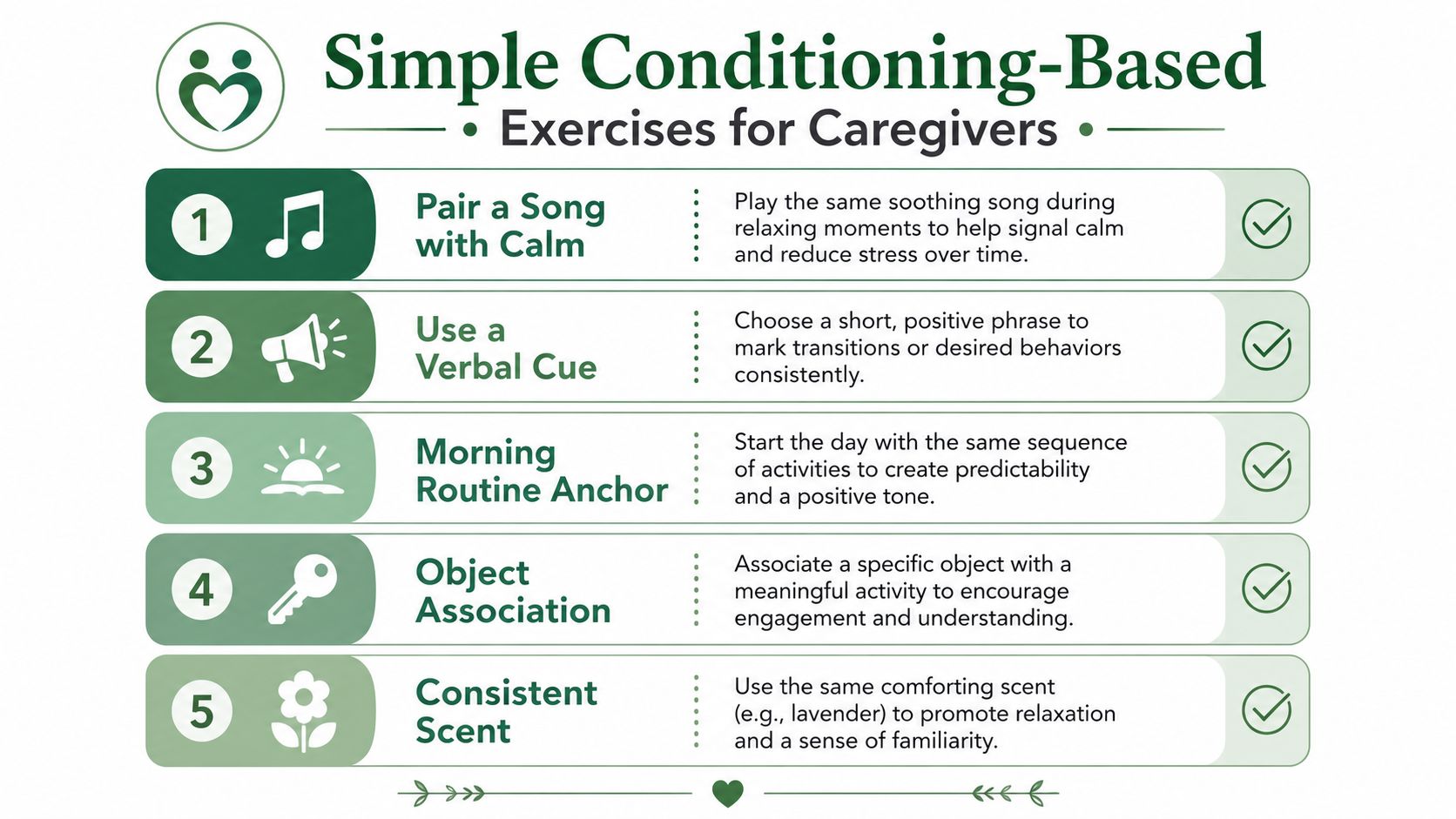
The easiest place to start is not with a program. It's with one habit you already have. A cue works best when it fits a routine that's already happening, because you're adding structure instead of adding burden.
Five low-effort ways to build stronger cue-response links
Pair a song with calm. Play the same short song before bathing, bedtime, or a phone call. The music starts to predict safety and can soften resistance.
Use one verbal cue every time. Say the same short phrase before a transition, like “Time for tea” or “Let's sit together.” Repeated wording helps the brain recognize what comes next.
Anchor a routine to breakfast or lunch. Tie medication, a walk, or a check-in to a meal the person already expects. The routine carries the new habit.
Put one object in one place. Keep keys, glasses, or a remote in the same spot and name that spot out loud. Repetition helps the object become easier to find and easier to remember.
Use a familiar scent for a specific moment. A scent can become part of a calming ritual if it's always paired with the same quiet time. That works best when the scent stays consistent.
Keep reminiscence prompts short. Ask about one photo, one song, or one place rather than opening a broad conversation. A focused cue is easier to follow.
A practical caregiver tool can also help with nighttime safety. If wandering or getting out of bed is a concern, the article on benefits of bed alarms for dementia is worth reading alongside routine-based support.
If you want more activity ideas that fit memory loss care, this resource on cognitive exercises for dementia offers a useful companion list.
The goal isn't perfection. It's consistency. If the cue stays the same and the follow-up stays calm, the person has a better chance of learning the pattern, even when memory is uneven.
Why Early and Consistent Support Matters
Memory and thinking problems aren't rare, and they're becoming more visible. A 2025 PubMed study using Behavioral Risk Factor Surveillance System data found age-adjusted self-reported cognitive disability in the United States rose from 5.3% in 2013 to 7.4% in 2023, with statistically significant increases beginning in 2016. The increase was especially pronounced in adults aged 18–39, where prevalence nearly doubled from 5.1% to 9.7% over the decade, and it rose more steeply among lower-income adults as well. The PubMed study on rising cognitive disability shows why support can't be treated as a rare extra.
Why timing changes the outcome
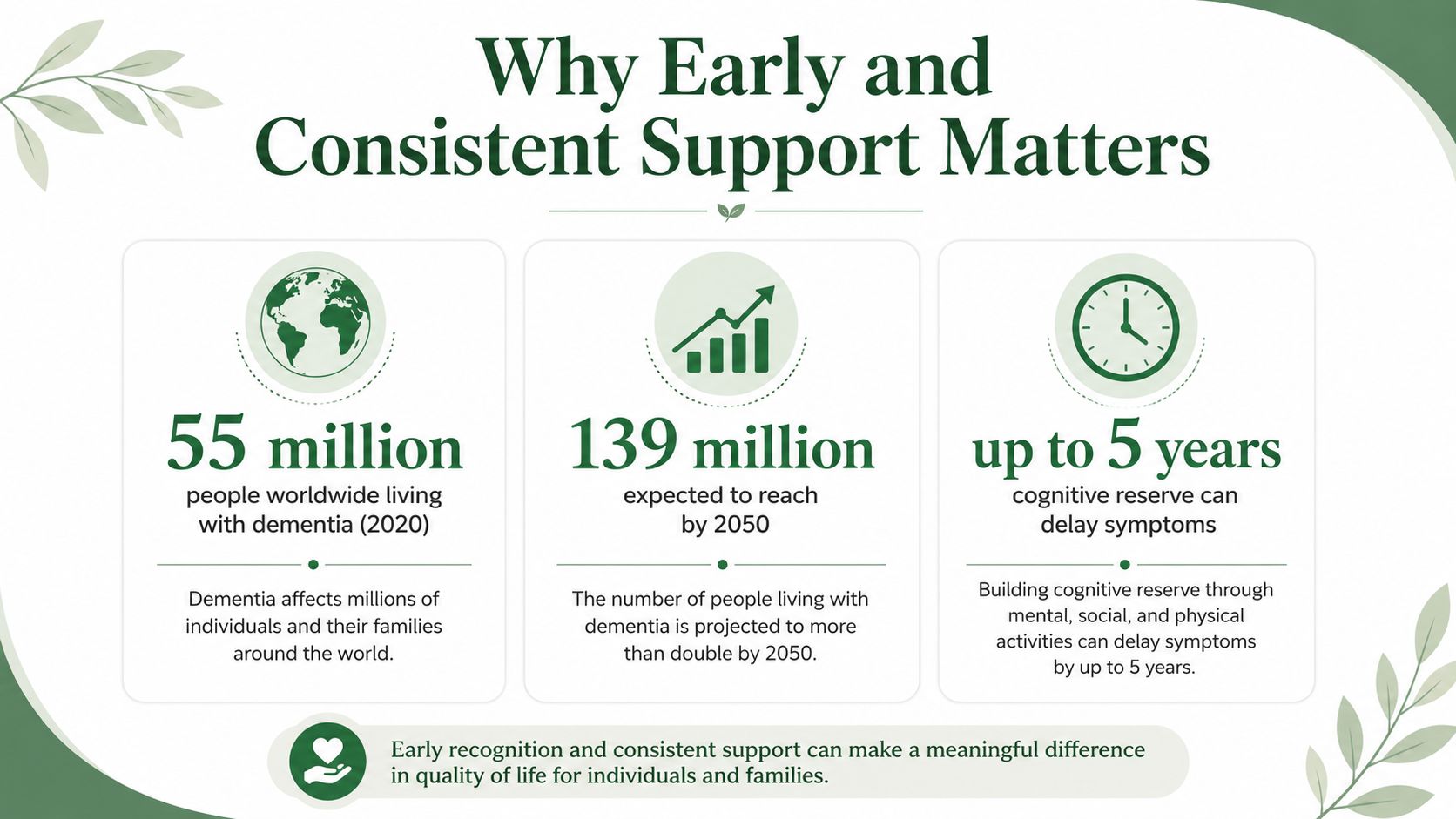
There's also a useful contrarian point from dementia research. Brain-health organizations note that cognitive reserve built through lifelong enrichment is linked to better cognition in healthy adults and early-stage Alzheimer's disease, but not advanced disease. That means support is more likely to help when it starts earlier and stays steady, not when a family is already in crisis.
The everyday work of caregiving and public health meet. People from underserved groups, including Black communities, LGBTQ+ individuals, and Native Americans/Alaska Natives, face real gaps in access to dementia assessment and intervention, and culturally sensitive support matters. A family's background should never be a barrier to understanding, dignity, or usable care.
Early support is easier to build than late-stage repair.
That doesn't mean families failed if they started late. It means the brain tends to respond better when routines, cues, and supportive contact are put in place before every day feels like an emergency. The more stable the pattern, the more room there is for learning and comfort to take hold.
How Velma Puts These Principles into Practice
Velma uses scheduled phone calls to create the same cue repeatedly, which is exactly what this kind of learning depends on. A familiar voice at a predictable time can turn the call itself into part of the routine, so support arrives in a form the person can recognize without needing an app or a device. For families who want a deeper look at the workflow, how Velma works lays out the family-facing side of the process.
The structure also fits the way cognitive conditioning works in daily life. Calls can combine conversation, orientation, reminiscence, and simple language or attention exercises, while the care manager tracks mood, confusion, safety concerns, and day-to-day patterns across time. That matters because the support isn't just a one-time prompt. It's a recurring relationship with a stable format.
Where the model is strong
Velma's phone-based design lowers the barrier for older adults who don't want to manage another device. It also gives families a steady touchpoint between visits, which can reduce uncertainty about how the person is doing day to day. The program's protocols are vetted by a licensed neurologist, and each family is matched with a dedicated care manager, so the support stays coordinated rather than improvised.
There's a limit worth stating plainly. Phone-based cognitive support complements medical care and in-person caregiving, it doesn't replace either one. It works best as part of a larger plan that can include clinicians, family routines, and safety tools.
If you're comparing options, the key question isn't whether a program sounds impressive. It's whether it creates a dependable cue, uses a consistent response, and gives your family usable visibility. Velma is built around those conditions, which is why it fits the learning science discussed here.
A Long-Game Approach for Families
A good way to think about cognitive conditioning is as a family habit, not a single technique. The brain learns from repeated pairings, so the most helpful support is usually small, familiar, and emotionally steady. That's true whether you're helping with breakfast, a phone call, or bedtime.
Three shifts make the difference. First, move from brain games to mechanism-based practice. Second, move from one-off prompts to consistent cue-response pairings. Third, move from crisis-only help to early, sustained support.
If you're starting today, pick one cue and one routine. Use the same wording, the same timing, and the same calm tone for a week. Keep notes on what seems easier, what still triggers anxiety, and what the person responds to without friction.
For busy families, even a simple system for managing family health records can make these routines easier to keep track of. When the details are visible, you're less likely to lose the pattern in the noise of daily caregiving.
You're probably doing more of this already than you realize. Every repeated reassurance, every familiar bedtime phrase, and every predictable check-in is part of the learning environment. The job is to make those moments more intentional, not to make them perfect.
Velma helps families turn those small, repeated moments into a steadier daily support system for a parent with memory loss. If you want a phone-based way to build consistency without adding app fatigue or complicated setup, visit Velma and see how scheduled cognitive support can fit into your care routine.
Your parent repeats the same question three times before breakfast, then forgets why the kettle is on. You answer patiently, but later you notice the same thing again, a familiar object is missing, and a small sound in the house seems to set off a wave of anxiety. For many families, that's the daily reality of memory loss, and it's exactly where cognitive conditioning starts to matter.
At its simplest, cognitive conditioning is about how the brain learns to connect a cue with what usually follows. For caregivers, that means a voice, a time of day, a routine, or a familiar object can become part of the support itself. That matters because memory loss doesn't erase learning, it changes how learning happens.
Table of Contents
When Everyday Cues Stop Working
Why the same moments keep happening
The Core Idea Behind Cognitive Conditioning
A simple way to think about it
How It Differs From Cognitive Training and Stimulation
How to read the difference
What It Looks Like During a Real Cognitive Support Call
What the call is doing
Simple Conditioning-Based Exercises for Caregivers
Five low-effort ways to build stronger cue-response links
Why Early and Consistent Support Matters
Why timing changes the outcome
How Velma Puts These Principles into Practice
Where the model is strong
A Long-Game Approach for Families
When Everyday Cues Stop Working
A daughter walks into her mother's kitchen and sees the usual signs. The purse is on the counter, the tea mug is half-full, and her mother is standing still, trying to remember why she came into the room. Then a blender starts in the next apartment, and her mother flinches, as if the sound itself asked too much of her.
That scene is frustrating because it looks random. It isn't random, though. In dementia care, the problem is often not that a person can't learn anything new, it's that the cues around them no longer reliably lead to the right next step.
Why the same moments keep happening
A person may forget a task but still respond to a voice, a routine, or the order of a familiar sequence. That's where cognitive conditioning gives caregivers a useful frame. It doesn't ask you to treat memory like a test score. It asks you to notice which cues calm, orient, or trigger action, then use them on purpose.
Practical rule: If a routine keeps failing, look at the cue, not just the task.
That shift helps families stop blaming themselves for every missed pill, misplaced object, or anxious reaction. It also gives you something concrete to do. You can pair the same phrase with the same action, use the same phone call time each day, or anchor a hard task to a stable routine.
This way of thinking fits the realities of caregiving because it's small and repeatable. You're not trying to rebuild a whole memory system in one conversation. You're shaping what happens right before and right after a familiar moment, so the brain has a better chance of linking them together.
The Core Idea Behind Cognitive Conditioning
Cognitive conditioning is learning in which a neutral cue starts to carry meaning because it has been paired, again and again, with something important. A phone ring, a morning check-in, or a familiar voice can begin to predict comfort, direction, or a completed task. Over time, the cue itself can prompt the response.
A simple way to think about it
Coffee helps make the idea concrete. For many people, the smell of coffee doesn't just mean “there's coffee nearby.” It means the morning is starting, energy is coming, and a routine is underway. The smell has picked up meaning through repetition.
That's different from a reflex, and it's different from a reward alone. Classical conditioning is the older learning pattern where one cue comes to predict another outcome. Operant conditioning is about consequences, reward, or relief making a behavior more likely. Cognitive conditioning sits on top of both, because people also form expectations, beliefs, and mental links about what a cue means.
A cue becomes powerful when the brain starts expecting what comes next.
That's why a caregiver's steady script can help. If you always say, “Let's take your pills together after breakfast,” the words, the timing, and the meal begin to work as one package. The person isn't just hearing instructions. They're learning a pattern.
The key point is that cognitive conditioning isn't about forcing a reaction. It's about building dependable meaning through repetition. That's why one-off reminders usually fade, while repeated, familiar pairings have a better chance of sticking in daily life.
How It Differs From Cognitive Training and Stimulation
The terms get mixed up online, but they're not the same thing. Cognitive conditioning is the learning process itself. Cognitive training is structured practice on specific mental tasks. Cognitive stimulation is broader engagement through conversation, activities, and enrichment.
The distinction matters because the evidence for broad transfer is weak. A 2023 review in PMC reported that far-transfer effect sizes were very small, ranging from 0.04 to 0.19, and in some analyses they were zero, from -0.03 to 0.02. The review also concluded there's little to no true far transfer across studied cognitive-training domains, which is why generic brain-game promises deserve caution. The review on far transfer in cognitive training is a useful reality check.
How to read the difference
Concept | Core Mechanism | Typical Use | Transfer to Daily Life |
|---|---|---|---|
Cognitive Conditioning | Cue, meaning, repetition, expectation | Building reliable responses in real contexts | Strongest when tied to the same people, places, and routines |
Cognitive Training | Repeated practice on a specific task | Worksheets, apps, structured drills | Often limited to the trained skill |
Cognitive Stimulation | Enriching conversation and activity | Reminiscence, discussion, shared engagement | Helpful for mood and engagement, especially when personalized |
A practical example helps. A person might do a memory app every morning, but still struggle to remember medication time. That doesn't mean the app is useless. It means the skill practiced on the app doesn't automatically spread to every other part of life.
If you want a related look at structured engagement, this guide on what cognitive stimulation therapy is helps separate a specific program from broader support.
Bottom line: Repetition in the right context matters more than novelty.
That's why families often get more mileage from a familiar routine, a repeated voice, or a predictable call than from an impressive-looking app that never connects to daily life.
What It Looks Like During a Real Cognitive Support Call
On a scheduled call, the care manager opens the same way each time. The voice is familiar, the timing is predictable, and the conversation starts with something the person can answer easily, like the day, the weather, or a recent routine. That consistency matters because the call itself becomes a cue.
What the call is doing
A good support call is not random chat. It blends orientation cues, reminiscence, light language practice, and mood support into a structure the person can recognize. The care manager may ask about meals, medications, or a planned appointment, then shift into a memory prompt that feels comfortable rather than tested.
The important part is that the response is predictable. The caller listens, validates, and guides the next step without rushing. Over time, the person can start to associate that specific call with calm, attention, and a successful interaction.
A dedicated care manager also notices patterns. If confusion is worse at a certain time of day, if anxiety rises around a household change, or if a fall concern keeps coming up, those notes help the family catch shifts earlier. That's especially useful when the person living with memory loss doesn't always describe what changed.
Here's how the mechanism translates into practice:
Same timing, same voice: The call itself becomes a reliable cue.
Same tone, same pacing: The interaction feels safe instead of demanding.
Same kind of follow-through: The person learns that the call leads to help, not pressure.
The result isn't magical. It's repetition with purpose. When a phone-based program keeps the cue stable and the response emotionally steady, it gives the brain more chances to link the moment with what should happen next.
Simple Conditioning-Based Exercises for Caregivers
The easiest place to start is not with a program. It's with one habit you already have. A cue works best when it fits a routine that's already happening, because you're adding structure instead of adding burden.
Five low-effort ways to build stronger cue-response links
Pair a song with calm. Play the same short song before bathing, bedtime, or a phone call. The music starts to predict safety and can soften resistance.
Use one verbal cue every time. Say the same short phrase before a transition, like “Time for tea” or “Let's sit together.” Repeated wording helps the brain recognize what comes next.
Anchor a routine to breakfast or lunch. Tie medication, a walk, or a check-in to a meal the person already expects. The routine carries the new habit.
Put one object in one place. Keep keys, glasses, or a remote in the same spot and name that spot out loud. Repetition helps the object become easier to find and easier to remember.
Use a familiar scent for a specific moment. A scent can become part of a calming ritual if it's always paired with the same quiet time. That works best when the scent stays consistent.
Keep reminiscence prompts short. Ask about one photo, one song, or one place rather than opening a broad conversation. A focused cue is easier to follow.
A practical caregiver tool can also help with nighttime safety. If wandering or getting out of bed is a concern, the article on benefits of bed alarms for dementia is worth reading alongside routine-based support.
If you want more activity ideas that fit memory loss care, this resource on cognitive exercises for dementia offers a useful companion list.
The goal isn't perfection. It's consistency. If the cue stays the same and the follow-up stays calm, the person has a better chance of learning the pattern, even when memory is uneven.
Why Early and Consistent Support Matters
Memory and thinking problems aren't rare, and they're becoming more visible. A 2025 PubMed study using Behavioral Risk Factor Surveillance System data found age-adjusted self-reported cognitive disability in the United States rose from 5.3% in 2013 to 7.4% in 2023, with statistically significant increases beginning in 2016. The increase was especially pronounced in adults aged 18–39, where prevalence nearly doubled from 5.1% to 9.7% over the decade, and it rose more steeply among lower-income adults as well. The PubMed study on rising cognitive disability shows why support can't be treated as a rare extra.
Why timing changes the outcome
There's also a useful contrarian point from dementia research. Brain-health organizations note that cognitive reserve built through lifelong enrichment is linked to better cognition in healthy adults and early-stage Alzheimer's disease, but not advanced disease. That means support is more likely to help when it starts earlier and stays steady, not when a family is already in crisis.
The everyday work of caregiving and public health meet. People from underserved groups, including Black communities, LGBTQ+ individuals, and Native Americans/Alaska Natives, face real gaps in access to dementia assessment and intervention, and culturally sensitive support matters. A family's background should never be a barrier to understanding, dignity, or usable care.
Early support is easier to build than late-stage repair.
That doesn't mean families failed if they started late. It means the brain tends to respond better when routines, cues, and supportive contact are put in place before every day feels like an emergency. The more stable the pattern, the more room there is for learning and comfort to take hold.
How Velma Puts These Principles into Practice
Velma uses scheduled phone calls to create the same cue repeatedly, which is exactly what this kind of learning depends on. A familiar voice at a predictable time can turn the call itself into part of the routine, so support arrives in a form the person can recognize without needing an app or a device. For families who want a deeper look at the workflow, how Velma works lays out the family-facing side of the process.
The structure also fits the way cognitive conditioning works in daily life. Calls can combine conversation, orientation, reminiscence, and simple language or attention exercises, while the care manager tracks mood, confusion, safety concerns, and day-to-day patterns across time. That matters because the support isn't just a one-time prompt. It's a recurring relationship with a stable format.
Where the model is strong
Velma's phone-based design lowers the barrier for older adults who don't want to manage another device. It also gives families a steady touchpoint between visits, which can reduce uncertainty about how the person is doing day to day. The program's protocols are vetted by a licensed neurologist, and each family is matched with a dedicated care manager, so the support stays coordinated rather than improvised.
There's a limit worth stating plainly. Phone-based cognitive support complements medical care and in-person caregiving, it doesn't replace either one. It works best as part of a larger plan that can include clinicians, family routines, and safety tools.
If you're comparing options, the key question isn't whether a program sounds impressive. It's whether it creates a dependable cue, uses a consistent response, and gives your family usable visibility. Velma is built around those conditions, which is why it fits the learning science discussed here.
A Long-Game Approach for Families
A good way to think about cognitive conditioning is as a family habit, not a single technique. The brain learns from repeated pairings, so the most helpful support is usually small, familiar, and emotionally steady. That's true whether you're helping with breakfast, a phone call, or bedtime.
Three shifts make the difference. First, move from brain games to mechanism-based practice. Second, move from one-off prompts to consistent cue-response pairings. Third, move from crisis-only help to early, sustained support.
If you're starting today, pick one cue and one routine. Use the same wording, the same timing, and the same calm tone for a week. Keep notes on what seems easier, what still triggers anxiety, and what the person responds to without friction.
For busy families, even a simple system for managing family health records can make these routines easier to keep track of. When the details are visible, you're less likely to lose the pattern in the noise of daily caregiving.
You're probably doing more of this already than you realize. Every repeated reassurance, every familiar bedtime phrase, and every predictable check-in is part of the learning environment. The job is to make those moments more intentional, not to make them perfect.
Velma helps families turn those small, repeated moments into a steadier daily support system for a parent with memory loss. If you want a phone-based way to build consistency without adding app fatigue or complicated setup, visit Velma and see how scheduled cognitive support can fit into your care routine.
Suggested Article: