Fire Safety Check in the Home for Older Adults Made Simple

You arrive at your parent's house and notice the saucepan still on the hob, a tea towel hanging beside the burner, and the portable heater pushed close to an armchair. Your parent says everything is fine. The smoke alarm has a light, the exits are familiar, and there hasn't been an incident. Yet the question isn't whether the home contains safety equipment. It's whether your parent can recognise a danger, respond to an alarm, and leave safely when memory, hearing, or mobility gets in the way.
A useful fire safety check in the home tests those real-world abilities. It should feel like supportive problem-solving, not an inspection designed to catch someone out. The approach below helps families protect independence while identifying the point at which another person needs to step in.
Table of Contents
Why a Home Fire Safety Check Matters More as Memory Changes
Look for ability, not just equipment
How Often to Check and What to Have Ready Before You Start
Prepare a small checking kit
Room by Room Fire Safety Walkthrough You Can Follow Today
Kitchen
Living room and heating areas
Bedrooms
Hallways, exits, and utility spaces
Adapting the Check When Memory Hearing or Mobility Is Limited
Ask the questions ordinary checklists miss
Match safeguards to the person
Watch behaviours across ordinary days
Phone Check Scripts for Families Monitoring From a Distance
Listen for patterns
Turning What You Found Into a Safer Next Week
Why a Home Fire Safety Check Matters More as Memory Changes
A parent with early memory loss may still manage familiar routines well, which can make fire risks easy to dismiss. They may cook the same breakfast, use the same heater, and move around the same rooms every day. The change is often subtle. A pan gets left on the hob, food stays in the microwave too long, or a warning sound is ignored because the person doesn't remember what it means.
That's why alarm ownership isn't the same as fire readiness. In England, 95% of households, about 21.8 million, reported having a smoke alarm in 2016–17, while 90%, or 20.8 million households, had at least one working alarm. Still, 8% had no smoke alarm or no working alarm, and another 2% didn't know whether theirs worked, according to the English fire and fire safety household data. A device on the ceiling only helps if it operates and the resident acts on its warning.
The practical test: Don't ask only, “Are there smoke alarms?” Ask, “What would happen in this home if one sounded at night?”

Look for ability, not just equipment
During a visit, notice whether your parent can locate the alarm, explain its sound, and describe where they'd go. Check whether they can reach the front door, handle the lock, and move around furniture without losing balance. Someone may know the escape plan in conversation but freeze or become confused during an emergency.
Families supporting someone with cognitive decline in older adults should also track changes in everyday behaviour. A new difficulty managing the cooker, repeated forgotten meals, or uncertainty about familiar appliances can signal that the current safety arrangement needs review.
Fire prevention also includes protecting the home financially after practical hazards are addressed. Renters may find a renters insurance California guide useful when reviewing what a policy covers, what documentation to keep, and how household circumstances affect protection. Insurance can't make an unsafe routine safe, but it can form part of a wider household plan.
How Often to Check and What to Have Ready Before You Start
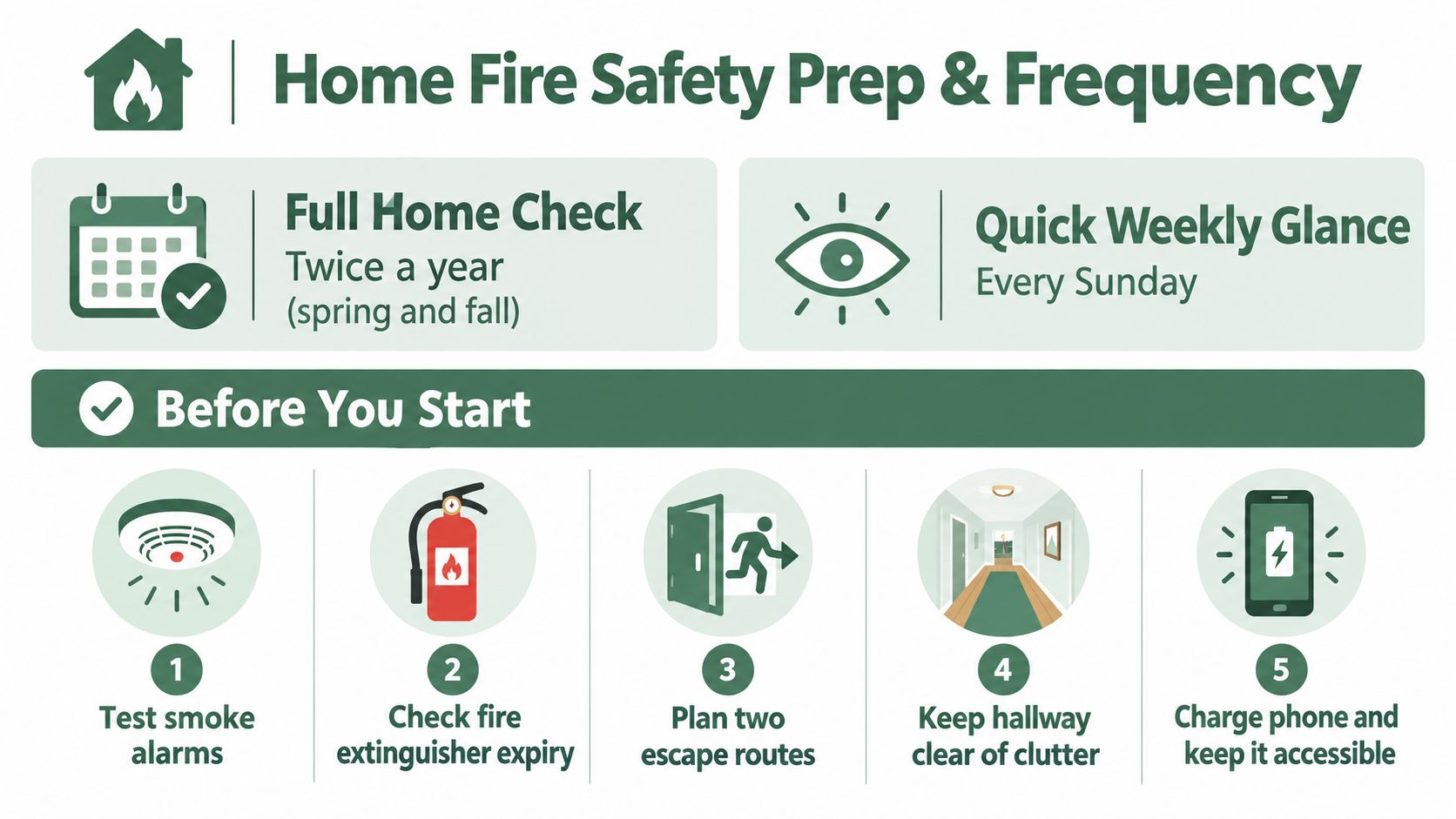
A full home check works best when it becomes part of an existing routine rather than a crisis response. Do a careful walkthrough twice a year, ideally in spring and autumn, and add a brief weekly glance at the hazards most likely to change. If your parent lives alone, has recently become more forgetful, or has started using a new heater or appliance, check more often.
The full review should happen when your parent is rested and calm. Don't arrive immediately after an argument or announce an inspection at the door. Try, “I'm checking a few things so the house stays easy and safe for you. Can we walk through it together?” That wording preserves choice and makes cooperation more likely.
Prepare a small checking kit
Bring a phone, a notepad or shared digital document, a torch, and the instructions for the specific alarm model. You'll need the manufacturer's guidance for battery replacement, reset procedures, and any connected features. Don't remove batteries or open equipment you can't identify.
Before walking room to room, write down:
Who's present: Record the names of family members, carers, or neighbours who may need to know about changes.
What changed: Note new appliances, recent falls, altered mobility, hearing changes, or forgotten routines.
What needs proof: Mark each alarm, exit, heater, and cooker habit that must be observed rather than assumed.
What needs follow-up: Separate an immediate fix from a repair, professional assessment, or family discussion.
A concise checklist can help you compare your routine with a broader 2025 fire safety inspection guide, but don't let a generic list replace person-specific questions. The most important record is behavioural: “Left hob on twice,” “didn't hear alarm from bedroom,” or “needed help with front-door lock.” Those notes show whether support needs are changing.
Share the findings with other caregivers after every full check. One person may notice kitchen risks while another hears concerns about night-time confusion. A shared record prevents everyone from assuming somebody else dealt with the issue.
Room by Room Fire Safety Walkthrough You Can Follow Today
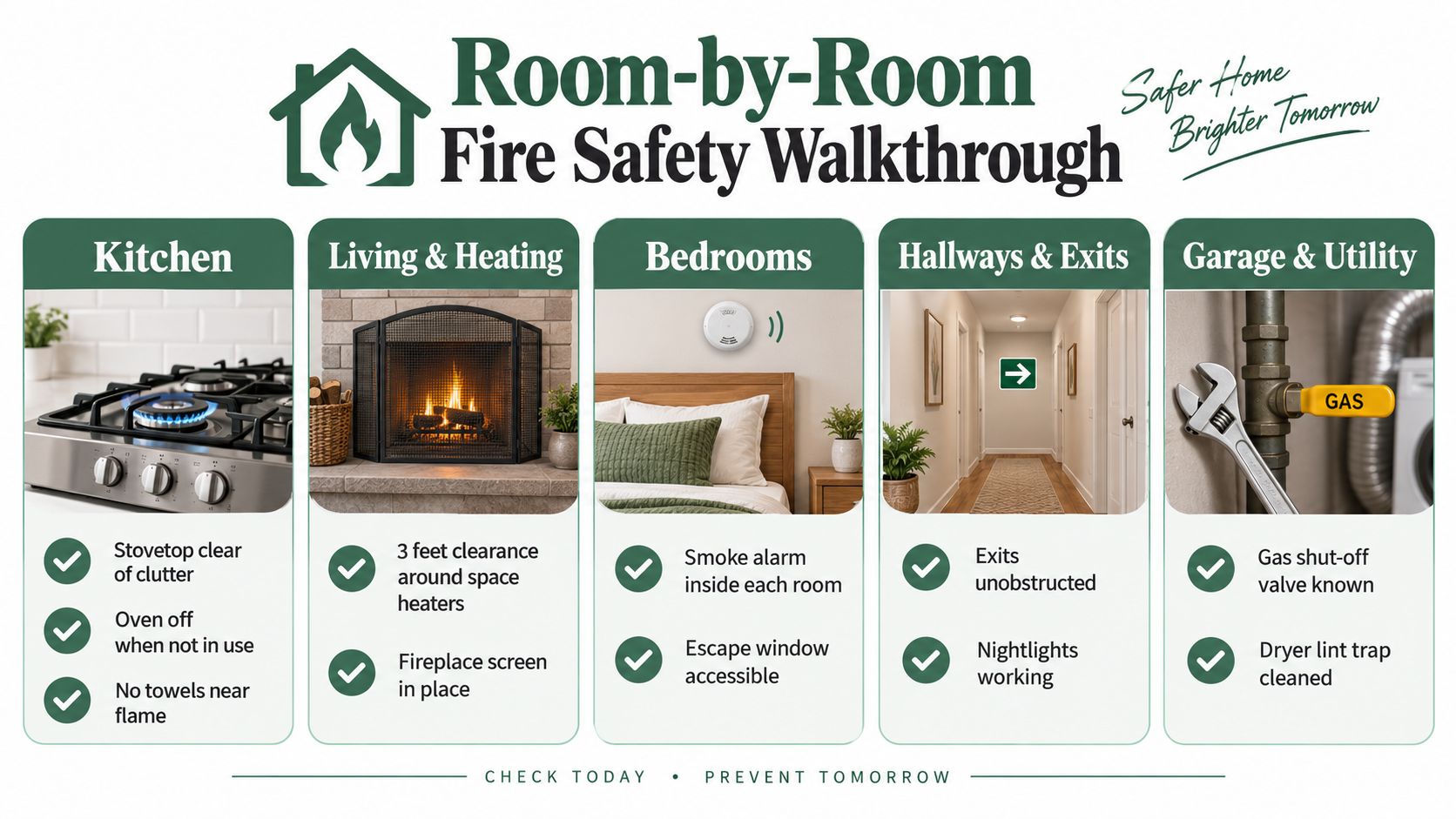
Start at the kitchen, then move through heating areas, bedrooms, hallways, and exits. Look first, ask second, and fix only what you can address safely. Don't turn the walkthrough into a debate about competence.
Kitchen
Check every cooker knob, oven control, kettle, toaster, and microwave. Confirm the hob and oven are fully off. Look for tea towels, paper packaging, oven gloves, or shopping bags close to heat. Check whether the microwave has scorch marks or whether your parent has been reheating food without remembering it.
Cooking deserves priority because it causes 44% of reported home fires in the United States, with an average of 158,400 reported home structure fires per year, according to NFPA's home cooking fire data. Smoke alarms were present in 88% of reported home cooking fires, but an alarm doesn't stop ignition. Source control matters.
Use language that avoids blame: “Let's make the cooker easier to check before you leave the kitchen.” Consider a visual cue beside the hob, an automatic shut-off device assessed by a qualified professional, or a change to meals that require less active cooking. For more targeted guidance, review this resource on stove safety for seniors.
Living room and heating areas
Inspect portable heaters, electric blankets, fireplaces, candles, and smoking materials. Keep furniture, curtains, throws, newspapers, and clothing away from heat. Confirm the heater is stable and that its cable isn't crossing a walking route. If your parent smokes, check where ash is emptied and whether cigarettes are used when tired or in a chair.
Don't rely on memory alone. Ask your parent to show you what they do before leaving the room. Their explanation may sound correct while their actual routine reveals the hazard.
Bedrooms
Test the alarm according to the manufacturer's instructions and confirm the sound can be heard from the bed. Check that the route from the bed to the door is clear, glasses and mobility aids are reachable, and clothing doesn't create a trip hazard. If your parent uses oxygen, heating equipment, or an electric blanket, ask the relevant clinician or supplier for specific safety instructions.
Hallways, exits, and utility spaces
Walk both escape routes. Remove baskets, shoes, small tables, and stored boxes from the path. Make sure keys are easy to find and that locks can be operated without confusion. UK fire guidance also recommends closing internal doors at night to slow fire spread and keeping exits and keys clear.
Use this table to decide what deserves attention first:
Hazard area | What to check | Priority action |
|---|---|---|
Hob and oven | Controls fully off, no combustible items nearby | Fix immediately if a burner is left on or clutter is touching heat |
Portable heater | Stable position, safe clearance, clear cable route | Move hazards now, then review whether supervision is needed |
Smoking and ash | Safe location, no smoking in bed or near upholstery, ash fully contained | Change the routine immediately if smoking happens when drowsy |
Alarms | Test button works and sound is audible from sleeping areas | Arrange repair or replacement promptly if the alarm fails or can't be heard |
Exits | Doors, keys, hallways, and mobility routes accessible | Clear the route now and practise the actual movement |
Record unresolved items with an owner and a date. “Family to arrange electrician” is useful. “Sort kitchen later” isn't.
Adapting the Check When Memory Hearing or Mobility Is Limited
Standard advice assumes a person will hear an alarm, understand its meaning, remember the escape plan, and act quickly. Dementia, hearing loss, poor vision, balance problems, and reduced strength can interrupt every part of that chain. A check must therefore test the response, not confirm that the equipment exists.
Ask the questions ordinary checklists miss
Dementia-focused guidance highlights three practical issues: whether the person would leave when an alarm sounds, whether a telecare-linked alarm or caregiver notification is needed, and whether cooking, smoking, heating, or microwave use has become unsafe because of memory loss. The dementia and fire safety guidance supports asking these questions directly.
Ask your parent to explain what they'd do if the alarm sounded during the night. Then ask them to demonstrate where they'd go, without turning it into a drill that causes distress. If they say they'd investigate the smoke, collect belongings, or wait for someone to tell them what to do, the plan needs adapting.
Match safeguards to the person
For someone with hearing loss, verify audibility from the bed and consider specialist alarm options through local fire services, telecare providers, or occupational therapy advice. For someone with mobility limitations, check whether the person can rise, use a frame, open the door, and reach the meeting point. A plan that depends on stairs may be unrealistic if the person struggles with transfers.
For cognitive impairment, reduce decisions. Label the main exit, keep the route uncluttered, and place emergency contact information where it can be seen. A connected system may help notify a caregiver, but it should support a tested plan rather than substitute for one.
Respectful intervention sounds like: “I want you to keep using your kitchen. Let's change the setup so one forgotten step doesn't become a dangerous one.”
Watch behaviours across ordinary days
The strongest evidence may appear outside the formal check. Notice whether your parent:
Leaves cooking unattended: They start food, answer the phone, and forget the hob is on.
Misuses the microwave: They overcook food, heat unsuitable containers, or don't recognise smoke.
Handles smoking unsafely: They smoke in bed, fall asleep with a cigarette, or discard ash before it's cool.
Places objects on heaters: Clothing, papers, or blankets cover the unit.
Trips near heating equipment: A cable or portable heater blocks a walking route.
Don't remove independence before you understand the pattern. First alter the environment, simplify the task, and add oversight. If unsafe behaviour repeats despite reminders, involve the care team, occupational therapist, clinician, or local fire service. Repeated failure is a support signal, not a character flaw.
Phone Check Scripts for Families Monitoring From a Distance
A remote call can identify changes, but only if the questions sound natural. “Did you leave the stove on?” may produce reassurance rather than useful information. Ask about the routine and request a small action you can verify.
Use a regular call time and keep the sequence familiar:
Opening the call
“Hi, how's your morning going? Are you in the kitchen, living room, or bedroom?”
This gives you context without sounding like surveillance. If your parent says they're in the kitchen, continue with, “What are you having today?” Then ask, “Is the cooker on right now, or is everything switched off?”
Checking cooking
“Before we talk about lunch, can you look at the hob and tell me what each knob is showing?”
If the answer is vague, don't argue. Say, “Would you check once more while I stay on the phone?” Listen for searching, confusion, or irritation. A parent who usually answers easily but now can't locate the controls may need an in-person check.
Checking alarms
“Can you hear the smoke alarm from where you're sitting?” Follow with, “Do you remember what you'd do if it sounded?” Don't ask your parent to trigger an alarm unnecessarily. You're checking understanding and audibility, while physical testing follows the manufacturer's instructions during an in-person visit.
Checking heaters and exits
“Is the heater on today? What's beside it?” Then ask, “Can you walk to the front door and tell me whether the path is clear?” If walking is difficult, ask a nearby caregiver to verify the route rather than asking your parent to take a risk.
Use the communication techniques in this guide to stay in touch with an older adult without making every call feel like an assessment.
Listen for patterns
Pay attention to repeated phrases, long pauses, uncertainty about the day, or a sudden change in the order of familiar tasks. One unusual answer may mean little. Several calls showing the same missed step deserve follow-up.
End warmly: “Thank you for checking that with me. I'll make sure we sort the heater position when I visit.” Keep notes factual, not judgemental. Write “needed two prompts to check hob,” not “was careless.”
Turning What You Found Into a Safer Next Week
Sort every finding into three groups:
Fix now: A cooker left on, blocked exit, failed alarm, unsafe smoking habit, or heater touching combustible material needs immediate action.
Arrange soon: Repeated forgotten tasks, a difficult lock, poor alarm audibility, or a mobility barrier calls for family coordination or professional advice.
Monitor: A minor change in routine can be logged and reviewed across calls and visits, provided no immediate hazard exists.
Give each action one person responsible and one realistic deadline. If the alarm needs attention, name who will contact the installer. If meals are becoming unsafe, decide who will provide food, supervise cooking, or discuss alternatives with the parent's care team.
Escalate when the person can't reliably respond to warnings, leaves ignition sources unattended repeatedly, can't reach an exit, or becomes distressed and confused during basic safety tasks. A care manager, home-care provider, occupational therapist, clinician, or local fire service may help you design safeguards that preserve dignity instead of imposing blanket restrictions.
The best fire safety check in the home is repeatable. Walk the same route, ask the same key questions, document changes, and revisit the plan whenever memory, hearing, or mobility shifts. Small, consistent actions give families a clearer picture of risk and give older adults a safer way to remain independent.
Velma provides scheduled phone calls that combine cognitive support, companionship, and practical check-ins about everyday risks such as stove use and household routines. Visit Velma to learn how its care team can help families stay connected between in-person visits and notice changes sooner.
You arrive at your parent's house and notice the saucepan still on the hob, a tea towel hanging beside the burner, and the portable heater pushed close to an armchair. Your parent says everything is fine. The smoke alarm has a light, the exits are familiar, and there hasn't been an incident. Yet the question isn't whether the home contains safety equipment. It's whether your parent can recognise a danger, respond to an alarm, and leave safely when memory, hearing, or mobility gets in the way.
A useful fire safety check in the home tests those real-world abilities. It should feel like supportive problem-solving, not an inspection designed to catch someone out. The approach below helps families protect independence while identifying the point at which another person needs to step in.
Table of Contents
Why a Home Fire Safety Check Matters More as Memory Changes
Look for ability, not just equipment
How Often to Check and What to Have Ready Before You Start
Prepare a small checking kit
Room by Room Fire Safety Walkthrough You Can Follow Today
Kitchen
Living room and heating areas
Bedrooms
Hallways, exits, and utility spaces
Adapting the Check When Memory Hearing or Mobility Is Limited
Ask the questions ordinary checklists miss
Match safeguards to the person
Watch behaviours across ordinary days
Phone Check Scripts for Families Monitoring From a Distance
Listen for patterns
Turning What You Found Into a Safer Next Week
Why a Home Fire Safety Check Matters More as Memory Changes
A parent with early memory loss may still manage familiar routines well, which can make fire risks easy to dismiss. They may cook the same breakfast, use the same heater, and move around the same rooms every day. The change is often subtle. A pan gets left on the hob, food stays in the microwave too long, or a warning sound is ignored because the person doesn't remember what it means.
That's why alarm ownership isn't the same as fire readiness. In England, 95% of households, about 21.8 million, reported having a smoke alarm in 2016–17, while 90%, or 20.8 million households, had at least one working alarm. Still, 8% had no smoke alarm or no working alarm, and another 2% didn't know whether theirs worked, according to the English fire and fire safety household data. A device on the ceiling only helps if it operates and the resident acts on its warning.
The practical test: Don't ask only, “Are there smoke alarms?” Ask, “What would happen in this home if one sounded at night?”
Look for ability, not just equipment
During a visit, notice whether your parent can locate the alarm, explain its sound, and describe where they'd go. Check whether they can reach the front door, handle the lock, and move around furniture without losing balance. Someone may know the escape plan in conversation but freeze or become confused during an emergency.
Families supporting someone with cognitive decline in older adults should also track changes in everyday behaviour. A new difficulty managing the cooker, repeated forgotten meals, or uncertainty about familiar appliances can signal that the current safety arrangement needs review.
Fire prevention also includes protecting the home financially after practical hazards are addressed. Renters may find a renters insurance California guide useful when reviewing what a policy covers, what documentation to keep, and how household circumstances affect protection. Insurance can't make an unsafe routine safe, but it can form part of a wider household plan.
How Often to Check and What to Have Ready Before You Start
A full home check works best when it becomes part of an existing routine rather than a crisis response. Do a careful walkthrough twice a year, ideally in spring and autumn, and add a brief weekly glance at the hazards most likely to change. If your parent lives alone, has recently become more forgetful, or has started using a new heater or appliance, check more often.
The full review should happen when your parent is rested and calm. Don't arrive immediately after an argument or announce an inspection at the door. Try, “I'm checking a few things so the house stays easy and safe for you. Can we walk through it together?” That wording preserves choice and makes cooperation more likely.
Prepare a small checking kit
Bring a phone, a notepad or shared digital document, a torch, and the instructions for the specific alarm model. You'll need the manufacturer's guidance for battery replacement, reset procedures, and any connected features. Don't remove batteries or open equipment you can't identify.
Before walking room to room, write down:
Who's present: Record the names of family members, carers, or neighbours who may need to know about changes.
What changed: Note new appliances, recent falls, altered mobility, hearing changes, or forgotten routines.
What needs proof: Mark each alarm, exit, heater, and cooker habit that must be observed rather than assumed.
What needs follow-up: Separate an immediate fix from a repair, professional assessment, or family discussion.
A concise checklist can help you compare your routine with a broader 2025 fire safety inspection guide, but don't let a generic list replace person-specific questions. The most important record is behavioural: “Left hob on twice,” “didn't hear alarm from bedroom,” or “needed help with front-door lock.” Those notes show whether support needs are changing.
Share the findings with other caregivers after every full check. One person may notice kitchen risks while another hears concerns about night-time confusion. A shared record prevents everyone from assuming somebody else dealt with the issue.
Room by Room Fire Safety Walkthrough You Can Follow Today
Start at the kitchen, then move through heating areas, bedrooms, hallways, and exits. Look first, ask second, and fix only what you can address safely. Don't turn the walkthrough into a debate about competence.
Kitchen
Check every cooker knob, oven control, kettle, toaster, and microwave. Confirm the hob and oven are fully off. Look for tea towels, paper packaging, oven gloves, or shopping bags close to heat. Check whether the microwave has scorch marks or whether your parent has been reheating food without remembering it.
Cooking deserves priority because it causes 44% of reported home fires in the United States, with an average of 158,400 reported home structure fires per year, according to NFPA's home cooking fire data. Smoke alarms were present in 88% of reported home cooking fires, but an alarm doesn't stop ignition. Source control matters.
Use language that avoids blame: “Let's make the cooker easier to check before you leave the kitchen.” Consider a visual cue beside the hob, an automatic shut-off device assessed by a qualified professional, or a change to meals that require less active cooking. For more targeted guidance, review this resource on stove safety for seniors.
Living room and heating areas
Inspect portable heaters, electric blankets, fireplaces, candles, and smoking materials. Keep furniture, curtains, throws, newspapers, and clothing away from heat. Confirm the heater is stable and that its cable isn't crossing a walking route. If your parent smokes, check where ash is emptied and whether cigarettes are used when tired or in a chair.
Don't rely on memory alone. Ask your parent to show you what they do before leaving the room. Their explanation may sound correct while their actual routine reveals the hazard.
Bedrooms
Test the alarm according to the manufacturer's instructions and confirm the sound can be heard from the bed. Check that the route from the bed to the door is clear, glasses and mobility aids are reachable, and clothing doesn't create a trip hazard. If your parent uses oxygen, heating equipment, or an electric blanket, ask the relevant clinician or supplier for specific safety instructions.
Hallways, exits, and utility spaces
Walk both escape routes. Remove baskets, shoes, small tables, and stored boxes from the path. Make sure keys are easy to find and that locks can be operated without confusion. UK fire guidance also recommends closing internal doors at night to slow fire spread and keeping exits and keys clear.
Use this table to decide what deserves attention first:
Hazard area | What to check | Priority action |
|---|---|---|
Hob and oven | Controls fully off, no combustible items nearby | Fix immediately if a burner is left on or clutter is touching heat |
Portable heater | Stable position, safe clearance, clear cable route | Move hazards now, then review whether supervision is needed |
Smoking and ash | Safe location, no smoking in bed or near upholstery, ash fully contained | Change the routine immediately if smoking happens when drowsy |
Alarms | Test button works and sound is audible from sleeping areas | Arrange repair or replacement promptly if the alarm fails or can't be heard |
Exits | Doors, keys, hallways, and mobility routes accessible | Clear the route now and practise the actual movement |
Record unresolved items with an owner and a date. “Family to arrange electrician” is useful. “Sort kitchen later” isn't.
Adapting the Check When Memory Hearing or Mobility Is Limited
Standard advice assumes a person will hear an alarm, understand its meaning, remember the escape plan, and act quickly. Dementia, hearing loss, poor vision, balance problems, and reduced strength can interrupt every part of that chain. A check must therefore test the response, not confirm that the equipment exists.
Ask the questions ordinary checklists miss
Dementia-focused guidance highlights three practical issues: whether the person would leave when an alarm sounds, whether a telecare-linked alarm or caregiver notification is needed, and whether cooking, smoking, heating, or microwave use has become unsafe because of memory loss. The dementia and fire safety guidance supports asking these questions directly.
Ask your parent to explain what they'd do if the alarm sounded during the night. Then ask them to demonstrate where they'd go, without turning it into a drill that causes distress. If they say they'd investigate the smoke, collect belongings, or wait for someone to tell them what to do, the plan needs adapting.
Match safeguards to the person
For someone with hearing loss, verify audibility from the bed and consider specialist alarm options through local fire services, telecare providers, or occupational therapy advice. For someone with mobility limitations, check whether the person can rise, use a frame, open the door, and reach the meeting point. A plan that depends on stairs may be unrealistic if the person struggles with transfers.
For cognitive impairment, reduce decisions. Label the main exit, keep the route uncluttered, and place emergency contact information where it can be seen. A connected system may help notify a caregiver, but it should support a tested plan rather than substitute for one.
Respectful intervention sounds like: “I want you to keep using your kitchen. Let's change the setup so one forgotten step doesn't become a dangerous one.”
Watch behaviours across ordinary days
The strongest evidence may appear outside the formal check. Notice whether your parent:
Leaves cooking unattended: They start food, answer the phone, and forget the hob is on.
Misuses the microwave: They overcook food, heat unsuitable containers, or don't recognise smoke.
Handles smoking unsafely: They smoke in bed, fall asleep with a cigarette, or discard ash before it's cool.
Places objects on heaters: Clothing, papers, or blankets cover the unit.
Trips near heating equipment: A cable or portable heater blocks a walking route.
Don't remove independence before you understand the pattern. First alter the environment, simplify the task, and add oversight. If unsafe behaviour repeats despite reminders, involve the care team, occupational therapist, clinician, or local fire service. Repeated failure is a support signal, not a character flaw.
Phone Check Scripts for Families Monitoring From a Distance
A remote call can identify changes, but only if the questions sound natural. “Did you leave the stove on?” may produce reassurance rather than useful information. Ask about the routine and request a small action you can verify.
Use a regular call time and keep the sequence familiar:
Opening the call
“Hi, how's your morning going? Are you in the kitchen, living room, or bedroom?”
This gives you context without sounding like surveillance. If your parent says they're in the kitchen, continue with, “What are you having today?” Then ask, “Is the cooker on right now, or is everything switched off?”
Checking cooking
“Before we talk about lunch, can you look at the hob and tell me what each knob is showing?”
If the answer is vague, don't argue. Say, “Would you check once more while I stay on the phone?” Listen for searching, confusion, or irritation. A parent who usually answers easily but now can't locate the controls may need an in-person check.
Checking alarms
“Can you hear the smoke alarm from where you're sitting?” Follow with, “Do you remember what you'd do if it sounded?” Don't ask your parent to trigger an alarm unnecessarily. You're checking understanding and audibility, while physical testing follows the manufacturer's instructions during an in-person visit.
Checking heaters and exits
“Is the heater on today? What's beside it?” Then ask, “Can you walk to the front door and tell me whether the path is clear?” If walking is difficult, ask a nearby caregiver to verify the route rather than asking your parent to take a risk.
Use the communication techniques in this guide to stay in touch with an older adult without making every call feel like an assessment.
Listen for patterns
Pay attention to repeated phrases, long pauses, uncertainty about the day, or a sudden change in the order of familiar tasks. One unusual answer may mean little. Several calls showing the same missed step deserve follow-up.
End warmly: “Thank you for checking that with me. I'll make sure we sort the heater position when I visit.” Keep notes factual, not judgemental. Write “needed two prompts to check hob,” not “was careless.”
Turning What You Found Into a Safer Next Week
Sort every finding into three groups:
Fix now: A cooker left on, blocked exit, failed alarm, unsafe smoking habit, or heater touching combustible material needs immediate action.
Arrange soon: Repeated forgotten tasks, a difficult lock, poor alarm audibility, or a mobility barrier calls for family coordination or professional advice.
Monitor: A minor change in routine can be logged and reviewed across calls and visits, provided no immediate hazard exists.
Give each action one person responsible and one realistic deadline. If the alarm needs attention, name who will contact the installer. If meals are becoming unsafe, decide who will provide food, supervise cooking, or discuss alternatives with the parent's care team.
Escalate when the person can't reliably respond to warnings, leaves ignition sources unattended repeatedly, can't reach an exit, or becomes distressed and confused during basic safety tasks. A care manager, home-care provider, occupational therapist, clinician, or local fire service may help you design safeguards that preserve dignity instead of imposing blanket restrictions.
The best fire safety check in the home is repeatable. Walk the same route, ask the same key questions, document changes, and revisit the plan whenever memory, hearing, or mobility shifts. Small, consistent actions give families a clearer picture of risk and give older adults a safer way to remain independent.
Velma provides scheduled phone calls that combine cognitive support, companionship, and practical check-ins about everyday risks such as stove use and household routines. Visit Velma to learn how its care team can help families stay connected between in-person visits and notice changes sooner.
Suggested Article: