Stove Safety for Seniors: Practical Tips for Families

You arrive at your mother's home before lunch and smell something hot. In the kitchen, an empty pan is sitting over a burner set to high. She's in the living room, certain she turned the stove off. Nothing caught fire this time, but the close call changes the question. You're no longer asking whether she can still cook. You're asking whether the current routine is safe enough to continue.
Stove safety for seniors is rarely solved by buying one device. The effective solution combines a safer kitchen, repeatable habits, appropriate supervision, and a clear decision about when independent stove use has ended. Cooking fires account for about 47% of residential fires, and adults age 65 and older are about 2.5 times more likely to die in a fire than the total population, according to the American Burn Association's cooking-safety guidance for older adults.
The goal isn't to frighten your parent or strip away independence too early. It's to match the cooking setup to what your parent can reliably remember, see, reach, and do under pressure.
Table of Contents
Why the Kitchen Is the Highest-Risk Room
Memory changes create the first opening
Mobility and vision change the physical response
The room concentrates hazards
Slow response turns a mistake into an emergency
A Room-by-Room Stove Safety Assessment
Zone one, the stove itself
Zone two, the counter and surrounding area
Zone three, the path through the kitchen
Equipment and Modifications Worth Considering
Compare the main options
Daily Habits and Routines That Reduce Risk
Before cooking
During cooking
After cooking
Phone Check-Ins and Ongoing Monitoring
A useful check-in script
Combine calls with alerts
When to Move From Reminders to Supervision
Emergency Plan and Family Communication Checklist
If a stovetop fire starts
Assign family roles before an emergency
Questions families ask
Why the Kitchen Is the Highest-Risk Room
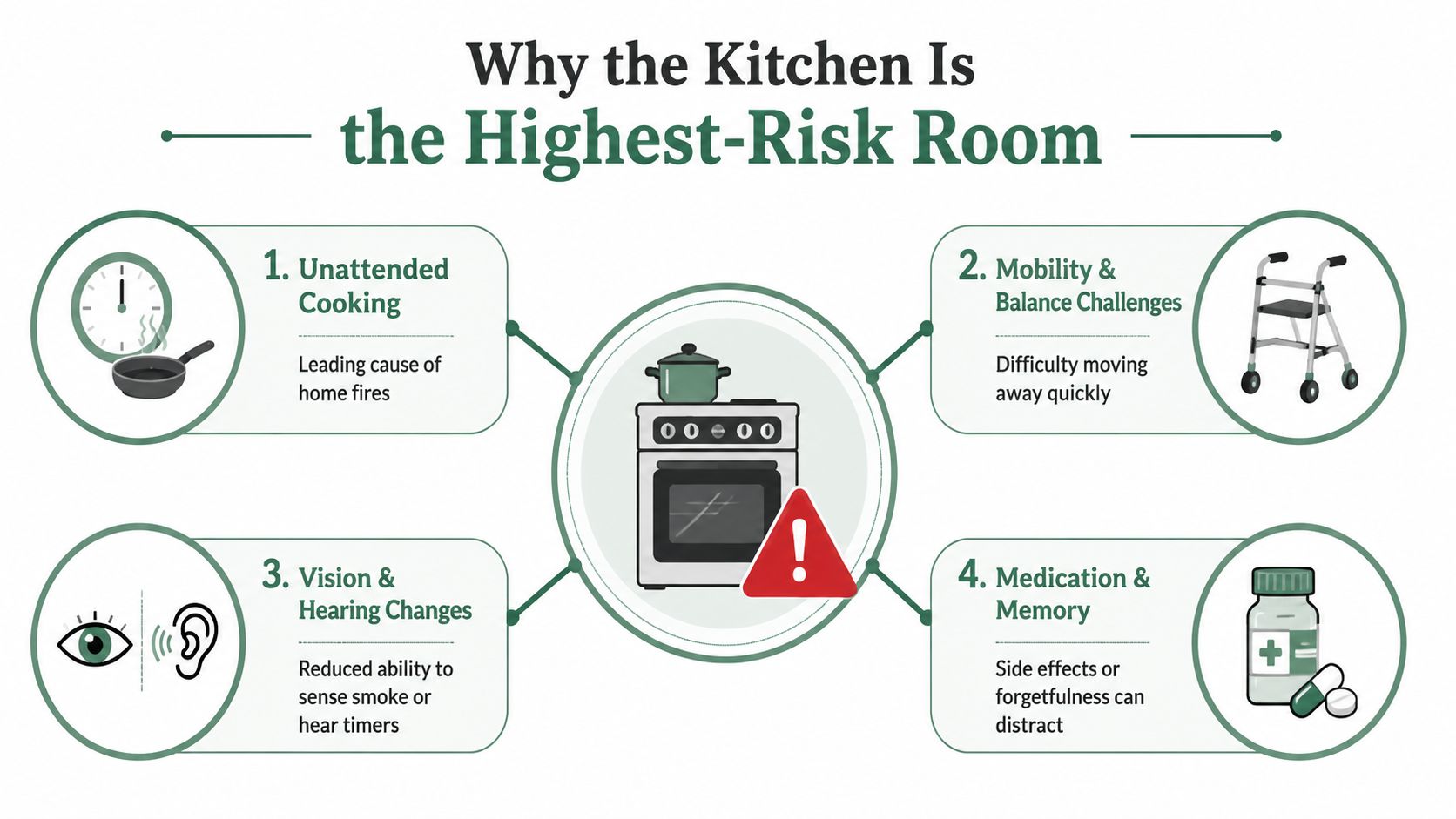
A kitchen becomes dangerous when several small failures occur together: memory, mobility, environment, and response time. A timer may help with one forgotten task, but it cannot correct poor balance, unclear controls, nearby combustibles, or a delayed response. Treat stove safety as a routine-and-supervision problem first, and a hardware problem second.
Memory changes create the first opening
Memory loss can lead someone to forget a heating pan, miss a timer, or misread a control position. Your parent may start lunch, answer the phone, and lose any memory that the burner is still on. A reminder after the fact will not reliably prevent that failure.
Multi-step cooking raises the risk. Someone may remember putting food in a pan but forget turning off the burner, or confuse an oven setting with the off position. If food spoilage is also becoming a concern, use a separate food spoilage prevention routine to reduce another memory-related household hazard.
Repeated reminders work only while the person can consistently notice, understand, and act on them. If forgotten burners, repeated walk-aways, or unsafe cooking sequences continue, disable the stove or move cooking out of the home. Preserving independence does not require preserving unsupervised access to a dangerous appliance.
Mobility and vision change the physical response
Reduced balance, arthritis, weakness, or walker use can make stepping away from a hot pan difficult. Reaching across a burner can cause a fall, and lifting a heavy pot can produce a spill or burn. A person who once reacted quickly may now need more time than a flare-up allows.
Vision and hearing changes add risk. Glare can hide knob labels, smoke may be harder to notice, and a timer or alarm may go unheard. Aging skin is also thinner, so heat contact can cause a more serious injury. The American Burn Association explains these age-related factors in its older-adult cooking-safety material.
The room concentrates hazards
The stove places heat, flame, grease, cookware, towels, paper, and clothing close together. A loose sleeve can touch a burner. A towel can fall onto a hot surface. A pan handle can catch on a walker or be struck while someone turns.
Practical rule: Make the cooking area forgiving. Remove anything that can burn, spill, snag, or block an exit before relying on reminders.
Slow response turns a mistake into an emergency
Fire-service guidance identifies unattended stove use as a major trigger behind kitchen incidents, and the Erie County kitchen fire safety guide cites roughly 164,500 residential cooking fires annually in the United States. A small flare-up can become a room fire before an older adult can recognize it, find an extinguisher, move safely, or call for help.
That combination makes generic safety lists inadequate. Families need a system that reduces forgotten burners, awkward movement, nearby combustibles, and delayed escape. Equipment can support the plan, but it cannot replace a reliable routine or appropriate supervision.
A Room-by-Room Stove Safety Assessment
Don't wait for another close call to inspect the kitchen. Walk through it with your parent during an ordinary cooking period, because a calm, empty kitchen can hide problems that appear when they're carrying a hot pan or following a recipe.
Zone one, the stove itself
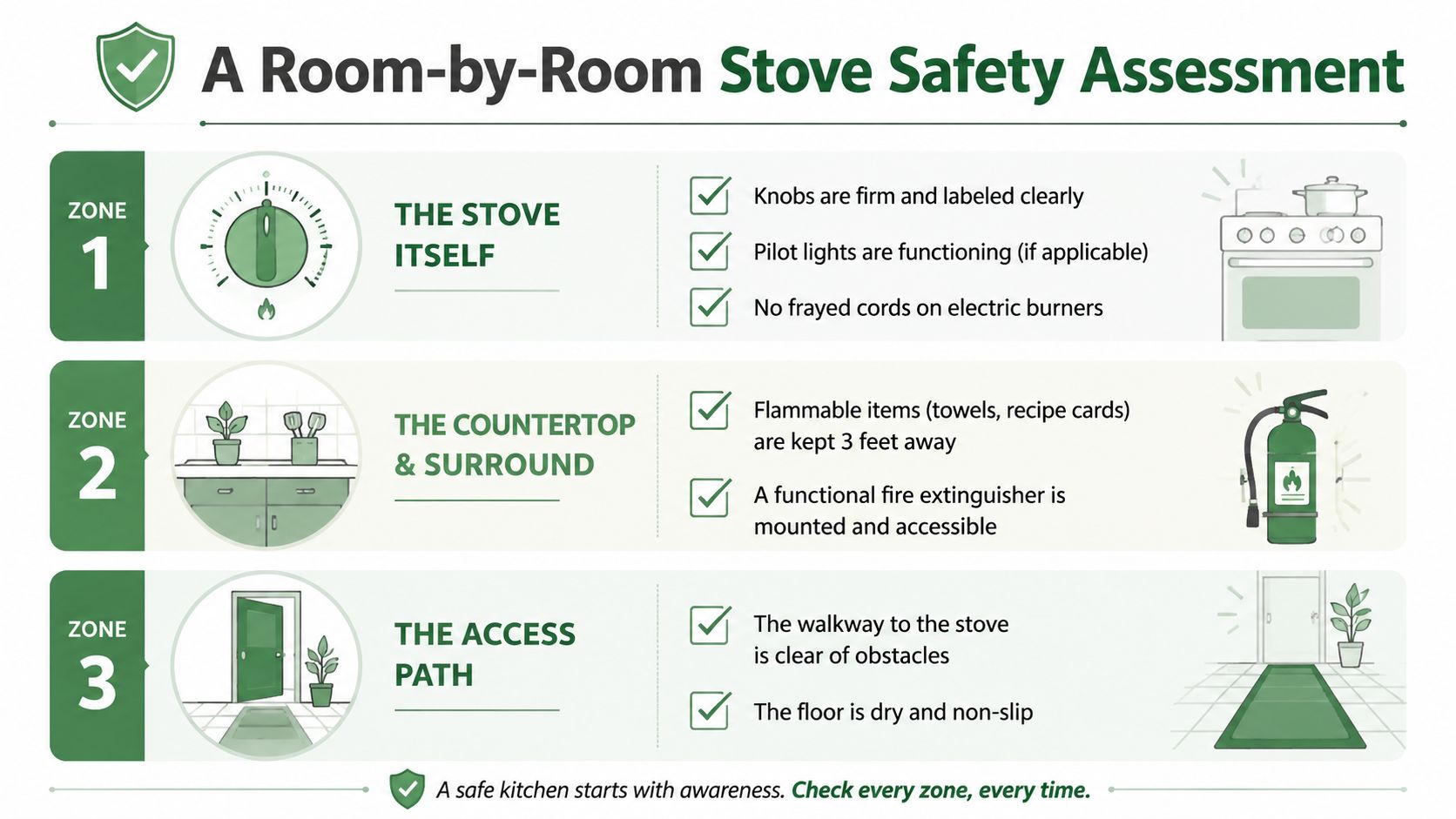
Start with the controls. Turn every knob slowly and check whether the markings are clear, intact, and easy to distinguish under the kitchen lighting. A senior should be able to identify off, low, and high without leaning over the burners or guessing from memory.
Check whether knobs are loose, unusually stiff, or easy to brush against. If the stove has pilot lights, confirm they're functioning as intended and arrange professional service for any gas odor or irregular flame. Electric burners need intact surfaces and cords without fraying. Don't ask your parent to repair a gas or electrical problem.
Zone two, the counter and surrounding area
Stand beside the stove and look outward. Move towels, paper, recipe cards, mail, packaging, curtains, potholders, and plastic containers away from heat. The infographic guidance uses a three-foot separation rule for flammable items, so treat that distance as a firm household boundary rather than a suggestion.
Check the extinguisher next. It should be functional, accessible, and mounted where a person can reach it without leaning across the stove. A Class K extinguisher is intended for cooking-oil fires, while an ABC extinguisher is a common household option. The senior must be physically and cognitively able to use it. If not, evacuation is the priority.
Zone three, the path through the kitchen
Walk the route from the refrigerator to the sink to the stove. Remove loose mats, electrical cords, boxes, chairs, and clutter. Keep the floor dry, and make sure a walker can turn without striking a counter or hot handle.
Look above and behind the burners for shadows and glare. Improve lighting if labels disappear at certain times of day. Place smoke alarms according to local fire guidance, with one close enough to detect a kitchen fire without being so close that normal cooking causes constant nuisance alarms. The USFA cooking safety guidance is a useful reference for household fire precautions, but follow local placement requirements and never disable an alarm because it's inconvenient.
Finally, confirm that the escape route is open and that a phone is within reach from the kitchen and exit path. Mark the assessment pass, watch, or fail for each item, then date it. A new failure, such as increasingly unclear controls or more clutter around the stove, can reveal decline before a serious incident.
Use the video below as a visual reminder when you review the setup with relatives or a home aide.
Equipment and Modifications Worth Considering
Hardware can close a safety gap, but every device creates its own task. For a person with dementia, a product that requires remembering an app, sequence, reset button, or unusual alarm may become a new source of confusion.
Compare the main options
Equipment | How It Works | Best For | Limitation |
|---|---|---|---|
Knob covers or guards | Blocks accidental turning of stove controls | People who still cook safely but brush against knobs | Can frustrate users who can no longer operate the cover and may encourage unsafe workarounds |
Automatic shut-off devices and timers | Turns the stove off after inactivity or a set period | Forgotten burners, especially when someone remains nearby | It may assume the cook is conscious, present, and able to respond |
Induction cooktops | Heats compatible cookware while keeping the surrounding surface cooler and removing open flame | Families willing to replace cookware and retrain the user | Requires suitable pans, new habits, and reliable understanding of controls |
Smart plugs or stove monitors | Tracks use and can send alerts to a family phone | Families coordinating care from a distance | Monitoring doesn't guarantee a safe response or prevent every misuse |
Knob covers work best when accidental activation is the concern, not when the senior is already confused by the stove. Test one with your parent before installing a full set. If they can't operate it comfortably, the cover may preserve the appliance while destroying practical independence.
Automatic shutoff is useful as a backup, not as permission to leave cooking unattended. Some systems detect inactivity, while others use timers or sensors. The family still needs to know what happens after shutoff, whether the senior can restart it safely, and whether the device creates confusion.
Induction removes open flame and reduces residual surface heat, but it isn't automatically dementia-friendly. New cookware, touch controls, unfamiliar sounds, and different heating behavior can lead to mistakes. Introduce it only when someone can practice alongside the senior.
Smart monitoring can help a distant family member see whether the stove is being used or left on. It can't replace a person who must evacuate, call emergency services, or intervene during a fire. For broader aging-in-place changes, families may also benefit from Trademaster Construction's aging-in-place home modification resource, especially when the kitchen needs physical redesign rather than another gadget.
The strongest recommendation is simple: match one modification to the observed failure. Don't buy a collection of devices and assume the problem is solved.
A 2025 review found that assistive technologies, including stove shut-off devices, can be difficult for people living with dementia to use and may create additional risks, as discussed in this peer-reviewed review of assistive technology and dementia. If your parent bypasses, ignores, or becomes distressed by a device, treat that as safety data. Change the system instead of blaming the user.
Daily Habits and Routines That Reduce Risk
A parent may agree to “remember to turn off the stove” and still forget moments later. That warning depends on the memory skill already failing. A visible, repeated routine gives the senior one sequence to follow and gives caregivers something specific to observe.
Post this checklist at eye level near the stove. Review it daily during the first two weeks. If your parent skips steps, changes the order, or leaves the kitchen, increase supervision instead of adding more reminders.
Before cooking
Choose one simple recipe: Prepare one dish at a time.
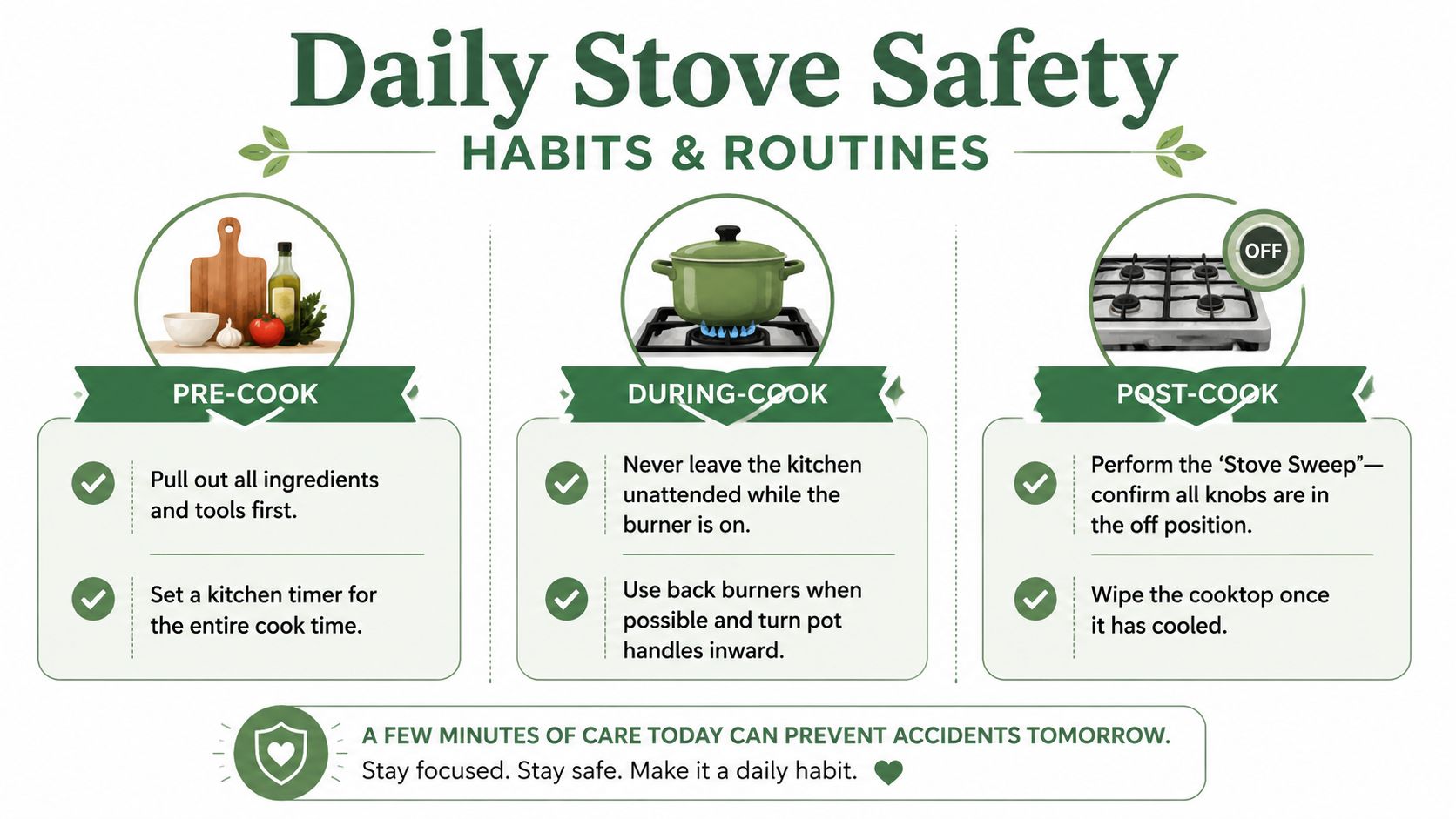
Gather ingredients and tools: Place the pan, utensils, food, and seasonings on the counter before turning on heat.
Set a visible timer: Use a large kitchen timer with a clear display. A phone alarm may be missed or interrupted by another notification.
Clear the work area: Move towels, packaging, paper, and loose clothing away from the burners.
Tell someone the plan: If a caregiver is present, state what is being cooked and how long it should take.
During cooking
The cook stays in the kitchen for every minute a burner is on. Do not leave to answer the door, take a call, check laundry, or use the bathroom. If your parent cannot remain in the kitchen reliably, cooking requires direct supervision or a different method. Repeated reminders are no longer enough.
Use short, close-fitting sleeves. Turn pot handles inward. Use back burners when doing so does not require reaching across another hot surface. Keep a lid nearby for a small pan fire, but never carry a burning pan.
After cooking
Complete a stove sweep every time:
Turn the oven and burner knobs fully to off.
Look at each control and say “off” aloud.
Confirm that heating has stopped without touching a hot surface.
Unplug small appliances when they are no longer needed.
Wipe the cooktop only after it has cooled.
Routines work better than memory-based warnings because they reduce decisions and make skipped steps visible. The American Burn Association's cooking recommendations support controls such as avoiding unattended cooking, wearing short or tight sleeves, keeping an appropriate extinguisher nearby, and checking that the stove is off before leaving.
Families can also review daily routines for seniors with early memory loss for ways to structure repeated tasks. Keep the language calm and neutral. The checklist supports the senior. It is not a test.
Phone Check-Ins and Ongoing Monitoring
A scheduled call can fill the gap between in-person visits, but it has to be structured. A casual “How are you?” may miss the fact that your parent cooked, forgot the meal, and walked away.
A Velma-style support call is a friendly conversation at a consistent time, typically lasting about ten minutes. It combines social contact with practical verification, so the senior isn't treated like someone being interrogated. The caller can ask about the meal, confirm the stove is off, listen for confusion or hesitation, and record patterns for the family.
A useful check-in script
Ask the same questions in the same order:
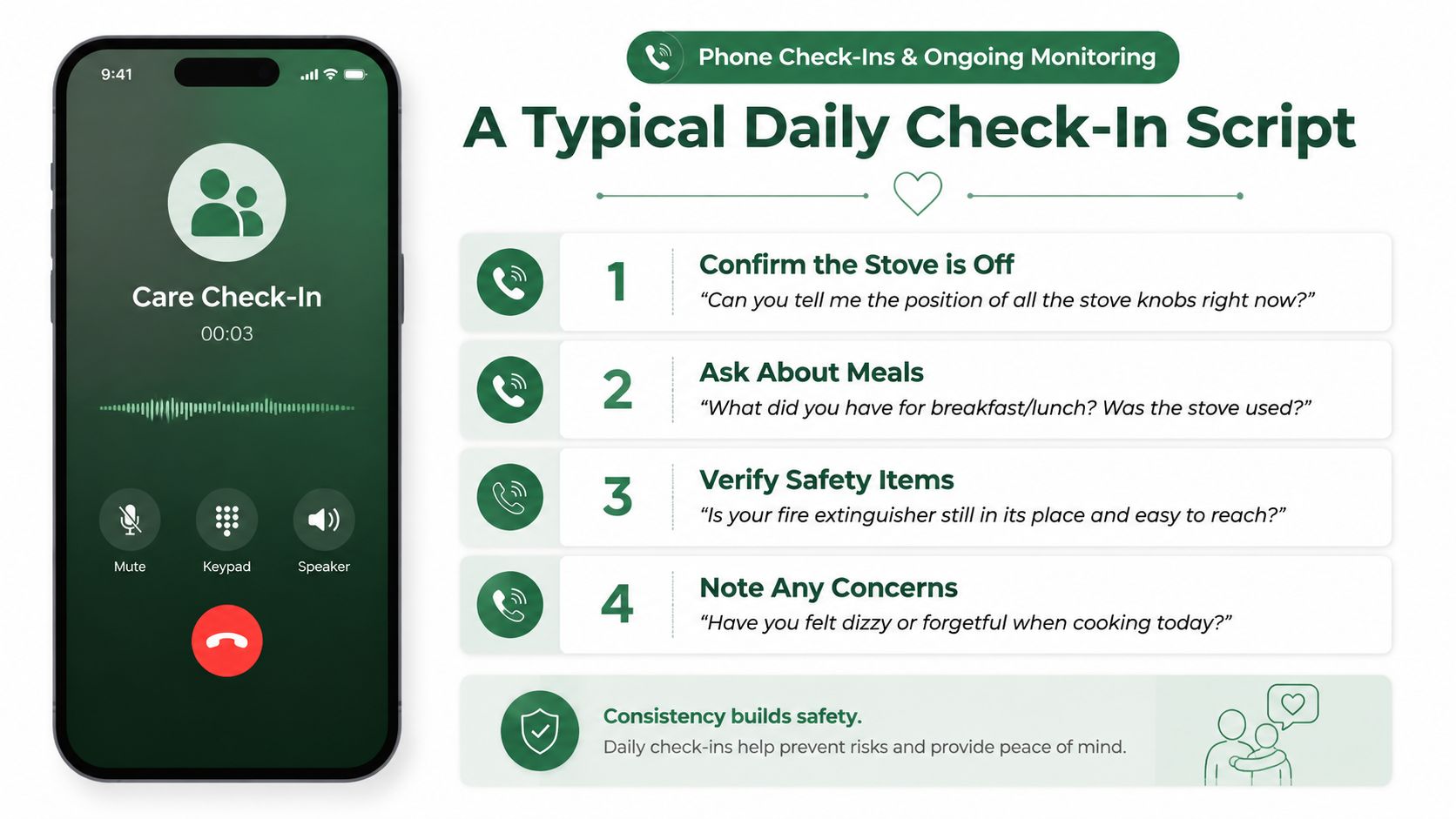
Confirm the stove: “Can you tell me where all the stove knobs are right now?”
Ask about food: “What did you have for breakfast or lunch? Did you use the stove?”
Check the room: “Is the extinguisher in its usual place and easy to reach?”
Listen for change: “Did you feel dizzy, confused, or unusually forgetful while cooking?”
Close with the next step: “What will you eat next, and will that require the stove?”
Don't turn the call into a memory exam. If your parent says they don't remember cooking, don't argue. Record the response, ask whether anything is hot now, and follow the escalation plan.
Combine calls with alerts
Remote tools can complement, but not replace, human contact. A stove shutoff sensor may detect extended use. A smart smoke detector may alert a family member's phone. A stove-use timer can show patterns that deserve review.
Ask any phone-support service specific questions before enrolling:
Safety scope: Does the caller discuss household risks such as stove use, meals, medications, or falls?
Consistency: Will the same care team or care manager review recurring concerns?
Escalation: What happens after a missed call or repeated statement such as “I don't remember cooking”?
Family contact: Who receives updates, and how quickly?
Limits: Does the service complement, rather than replace, emergency response and in-person care?
A missed check-in should trigger a call back and then contact with the designated family member or neighbor. A repeated missed call, an active stove alert, or signs of acute confusion should move directly into the family's escalation plan.
Families can also use daily check-in calls for seniors as a model for building consistent contact around safety and well-being.
When to Move From Reminders to Supervision
Families often wait for a fire because they want to respect independence. That standard is too high. Repeated near-misses are already evidence that the current arrangement has failed.
Use three stages, and advance when behavior shows that the present stage no longer protects the person.
Stage | Trigger to Advance | Action to Take |
|---|---|---|
Reminders and routine | The senior follows the checklist and consistently turns the stove off | Keep the routine visible, assess the kitchen regularly, and use scheduled check-ins |
Reminders plus supervision | A burner is left on, a meal is forgotten, cookware is scorched, or smoke alarms activate | Require someone to remain present during every stove use, in person or through an agreed care arrangement |
Disable the stove or remove cooking access | Near-misses repeat, the senior resists necessary help, or supervision cannot be dependable | Disconnect or disable the stove through a qualified professional, and move meals to a microwave-first or no-cook setup |
A forgotten burner means supervision is no longer optional for stove use. A forgotten meal that scorches cookware means the cooking sequence itself has become unreliable. Smoke detector activations require an immediate reassessment, even if no one was injured.
Resistance also matters. If your parent repeatedly refuses help, bypasses a safety device, or insists on cooking while confused, don't interpret that as proof that they can manage independently. It may mean they don't recognize the danger.
Independence means having choices that remain safe. It doesn't mean preserving access to an appliance that repeatedly creates emergencies.
Supervision can come from rotating family visits, an in-home aide, a neighbor, or a meal arrangement that removes the need for daily stove use. A microwave-first kitchen can preserve choices through prepared meals, reheating, and simple cold food. Later-stage dementia may require removing the stove from daily life altogether.
The Alzheimer's Association home-safety guidance discusses options such as kitchen signs, automatic shutoff switches, and removing knobs when needed. If the triggers repeat, disconnect the gas line or disable the appliance through qualified help. Waiting for a bigger warning puts your parent in the position of having to survive the next mistake.
Emergency Plan and Family Communication Checklist
Every household needs a plan that works when someone is frightened. Keep it short, post it visibly, and practice it without turning the exercise into a confrontation.
If a stovetop fire starts
Never use water on grease: Water can spread burning oil.
Cover a small pan fire: If it can be done without reaching across flames, slide a lid over the pan and turn off the heat.
Use baking soda only for a small, contained grease flare-up: Don't throw flour or other combustible powders onto a fire.
Use the extinguisher only if escape remains clear: A Class K or ABC extinguisher should be accessible, but an older adult who can't operate it safely should leave.
Leave and call 911: If the fire grows, smoke fills the room, the senior is uncertain, or the exit route is threatened, evacuate immediately.
Never carry a burning pan outside or toward another room. Close the door behind you if possible, alert others, and wait for firefighters. Smoke and carbon monoxide detectors should be maintained according to their manufacturer and local fire-service guidance, and the path to an exit must remain clear.
Assign family roles before an emergency
Write down one person for each responsibility:
Primary caregiver: Makes the immediate safety decision.
Backup contact: Takes over if the primary caregiver can't respond.
Neighbor with a key: Checks the home when requested or when a scheduled check-in is missed.
Physician: Receives relevant changes in cognition, balance, or medication concerns.
Pharmacy: Helps the family maintain an accurate medication list.
Post an emergency information sheet on the refrigerator and give a copy to first responders. Include:
Senior's full name and address
Medication list and dosing notes
Allergies
Primary doctor's name and phone number
Emergency contacts
Preferred hospital
Mobility limitations
Communication needs
Questions families ask
How often should we practice? Practice when the senior is calm and repeat the exit route and call-for-help steps regularly. Update the plan whenever mobility, memory, or household staffing changes.
Should we call 911 before or after containing a small fire? If there is any uncertainty, leave first and call 911. Don't delay an emergency call while trying to manage flames.
What should we say during a drill? Use plain, reassuring language: “We're practicing how to get outside safely.” Don't describe the drill as a test or focus on past mistakes.
How should siblings coordinate from different cities? Keep one shared written plan, name one decision-maker, and give every sibling the same escalation triggers. Distance doesn't justify ambiguity.
Velma provides scheduled phone calls that combine conversation, cognitive support, and practical check-ins about daily safety concerns such as stove use, meals, medications, and confusion. Visit Velma to see whether recurring phone support can strengthen the routine between family visits and help you notice changes before a kitchen emergency occurs.
You arrive at your mother's home before lunch and smell something hot. In the kitchen, an empty pan is sitting over a burner set to high. She's in the living room, certain she turned the stove off. Nothing caught fire this time, but the close call changes the question. You're no longer asking whether she can still cook. You're asking whether the current routine is safe enough to continue.
Stove safety for seniors is rarely solved by buying one device. The effective solution combines a safer kitchen, repeatable habits, appropriate supervision, and a clear decision about when independent stove use has ended. Cooking fires account for about 47% of residential fires, and adults age 65 and older are about 2.5 times more likely to die in a fire than the total population, according to the American Burn Association's cooking-safety guidance for older adults.
The goal isn't to frighten your parent or strip away independence too early. It's to match the cooking setup to what your parent can reliably remember, see, reach, and do under pressure.
Table of Contents
Why the Kitchen Is the Highest-Risk Room
Memory changes create the first opening
Mobility and vision change the physical response
The room concentrates hazards
Slow response turns a mistake into an emergency
A Room-by-Room Stove Safety Assessment
Zone one, the stove itself
Zone two, the counter and surrounding area
Zone three, the path through the kitchen
Equipment and Modifications Worth Considering
Compare the main options
Daily Habits and Routines That Reduce Risk
Before cooking
During cooking
After cooking
Phone Check-Ins and Ongoing Monitoring
A useful check-in script
Combine calls with alerts
When to Move From Reminders to Supervision
Emergency Plan and Family Communication Checklist
If a stovetop fire starts
Assign family roles before an emergency
Questions families ask
Why the Kitchen Is the Highest-Risk Room
A kitchen becomes dangerous when several small failures occur together: memory, mobility, environment, and response time. A timer may help with one forgotten task, but it cannot correct poor balance, unclear controls, nearby combustibles, or a delayed response. Treat stove safety as a routine-and-supervision problem first, and a hardware problem second.
Memory changes create the first opening
Memory loss can lead someone to forget a heating pan, miss a timer, or misread a control position. Your parent may start lunch, answer the phone, and lose any memory that the burner is still on. A reminder after the fact will not reliably prevent that failure.
Multi-step cooking raises the risk. Someone may remember putting food in a pan but forget turning off the burner, or confuse an oven setting with the off position. If food spoilage is also becoming a concern, use a separate food spoilage prevention routine to reduce another memory-related household hazard.
Repeated reminders work only while the person can consistently notice, understand, and act on them. If forgotten burners, repeated walk-aways, or unsafe cooking sequences continue, disable the stove or move cooking out of the home. Preserving independence does not require preserving unsupervised access to a dangerous appliance.
Mobility and vision change the physical response
Reduced balance, arthritis, weakness, or walker use can make stepping away from a hot pan difficult. Reaching across a burner can cause a fall, and lifting a heavy pot can produce a spill or burn. A person who once reacted quickly may now need more time than a flare-up allows.
Vision and hearing changes add risk. Glare can hide knob labels, smoke may be harder to notice, and a timer or alarm may go unheard. Aging skin is also thinner, so heat contact can cause a more serious injury. The American Burn Association explains these age-related factors in its older-adult cooking-safety material.
The room concentrates hazards
The stove places heat, flame, grease, cookware, towels, paper, and clothing close together. A loose sleeve can touch a burner. A towel can fall onto a hot surface. A pan handle can catch on a walker or be struck while someone turns.
Practical rule: Make the cooking area forgiving. Remove anything that can burn, spill, snag, or block an exit before relying on reminders.
Slow response turns a mistake into an emergency
Fire-service guidance identifies unattended stove use as a major trigger behind kitchen incidents, and the Erie County kitchen fire safety guide cites roughly 164,500 residential cooking fires annually in the United States. A small flare-up can become a room fire before an older adult can recognize it, find an extinguisher, move safely, or call for help.
That combination makes generic safety lists inadequate. Families need a system that reduces forgotten burners, awkward movement, nearby combustibles, and delayed escape. Equipment can support the plan, but it cannot replace a reliable routine or appropriate supervision.
A Room-by-Room Stove Safety Assessment
Don't wait for another close call to inspect the kitchen. Walk through it with your parent during an ordinary cooking period, because a calm, empty kitchen can hide problems that appear when they're carrying a hot pan or following a recipe.
Zone one, the stove itself
Start with the controls. Turn every knob slowly and check whether the markings are clear, intact, and easy to distinguish under the kitchen lighting. A senior should be able to identify off, low, and high without leaning over the burners or guessing from memory.
Check whether knobs are loose, unusually stiff, or easy to brush against. If the stove has pilot lights, confirm they're functioning as intended and arrange professional service for any gas odor or irregular flame. Electric burners need intact surfaces and cords without fraying. Don't ask your parent to repair a gas or electrical problem.
Zone two, the counter and surrounding area
Stand beside the stove and look outward. Move towels, paper, recipe cards, mail, packaging, curtains, potholders, and plastic containers away from heat. The infographic guidance uses a three-foot separation rule for flammable items, so treat that distance as a firm household boundary rather than a suggestion.
Check the extinguisher next. It should be functional, accessible, and mounted where a person can reach it without leaning across the stove. A Class K extinguisher is intended for cooking-oil fires, while an ABC extinguisher is a common household option. The senior must be physically and cognitively able to use it. If not, evacuation is the priority.
Zone three, the path through the kitchen
Walk the route from the refrigerator to the sink to the stove. Remove loose mats, electrical cords, boxes, chairs, and clutter. Keep the floor dry, and make sure a walker can turn without striking a counter or hot handle.
Look above and behind the burners for shadows and glare. Improve lighting if labels disappear at certain times of day. Place smoke alarms according to local fire guidance, with one close enough to detect a kitchen fire without being so close that normal cooking causes constant nuisance alarms. The USFA cooking safety guidance is a useful reference for household fire precautions, but follow local placement requirements and never disable an alarm because it's inconvenient.
Finally, confirm that the escape route is open and that a phone is within reach from the kitchen and exit path. Mark the assessment pass, watch, or fail for each item, then date it. A new failure, such as increasingly unclear controls or more clutter around the stove, can reveal decline before a serious incident.
Use the video below as a visual reminder when you review the setup with relatives or a home aide.
Equipment and Modifications Worth Considering
Hardware can close a safety gap, but every device creates its own task. For a person with dementia, a product that requires remembering an app, sequence, reset button, or unusual alarm may become a new source of confusion.
Compare the main options
Equipment | How It Works | Best For | Limitation |
|---|---|---|---|
Knob covers or guards | Blocks accidental turning of stove controls | People who still cook safely but brush against knobs | Can frustrate users who can no longer operate the cover and may encourage unsafe workarounds |
Automatic shut-off devices and timers | Turns the stove off after inactivity or a set period | Forgotten burners, especially when someone remains nearby | It may assume the cook is conscious, present, and able to respond |
Induction cooktops | Heats compatible cookware while keeping the surrounding surface cooler and removing open flame | Families willing to replace cookware and retrain the user | Requires suitable pans, new habits, and reliable understanding of controls |
Smart plugs or stove monitors | Tracks use and can send alerts to a family phone | Families coordinating care from a distance | Monitoring doesn't guarantee a safe response or prevent every misuse |
Knob covers work best when accidental activation is the concern, not when the senior is already confused by the stove. Test one with your parent before installing a full set. If they can't operate it comfortably, the cover may preserve the appliance while destroying practical independence.
Automatic shutoff is useful as a backup, not as permission to leave cooking unattended. Some systems detect inactivity, while others use timers or sensors. The family still needs to know what happens after shutoff, whether the senior can restart it safely, and whether the device creates confusion.
Induction removes open flame and reduces residual surface heat, but it isn't automatically dementia-friendly. New cookware, touch controls, unfamiliar sounds, and different heating behavior can lead to mistakes. Introduce it only when someone can practice alongside the senior.
Smart monitoring can help a distant family member see whether the stove is being used or left on. It can't replace a person who must evacuate, call emergency services, or intervene during a fire. For broader aging-in-place changes, families may also benefit from Trademaster Construction's aging-in-place home modification resource, especially when the kitchen needs physical redesign rather than another gadget.
The strongest recommendation is simple: match one modification to the observed failure. Don't buy a collection of devices and assume the problem is solved.
A 2025 review found that assistive technologies, including stove shut-off devices, can be difficult for people living with dementia to use and may create additional risks, as discussed in this peer-reviewed review of assistive technology and dementia. If your parent bypasses, ignores, or becomes distressed by a device, treat that as safety data. Change the system instead of blaming the user.
Daily Habits and Routines That Reduce Risk
A parent may agree to “remember to turn off the stove” and still forget moments later. That warning depends on the memory skill already failing. A visible, repeated routine gives the senior one sequence to follow and gives caregivers something specific to observe.
Post this checklist at eye level near the stove. Review it daily during the first two weeks. If your parent skips steps, changes the order, or leaves the kitchen, increase supervision instead of adding more reminders.
Before cooking
Choose one simple recipe: Prepare one dish at a time.
Gather ingredients and tools: Place the pan, utensils, food, and seasonings on the counter before turning on heat.
Set a visible timer: Use a large kitchen timer with a clear display. A phone alarm may be missed or interrupted by another notification.
Clear the work area: Move towels, packaging, paper, and loose clothing away from the burners.
Tell someone the plan: If a caregiver is present, state what is being cooked and how long it should take.
During cooking
The cook stays in the kitchen for every minute a burner is on. Do not leave to answer the door, take a call, check laundry, or use the bathroom. If your parent cannot remain in the kitchen reliably, cooking requires direct supervision or a different method. Repeated reminders are no longer enough.
Use short, close-fitting sleeves. Turn pot handles inward. Use back burners when doing so does not require reaching across another hot surface. Keep a lid nearby for a small pan fire, but never carry a burning pan.
After cooking
Complete a stove sweep every time:
Turn the oven and burner knobs fully to off.
Look at each control and say “off” aloud.
Confirm that heating has stopped without touching a hot surface.
Unplug small appliances when they are no longer needed.
Wipe the cooktop only after it has cooled.
Routines work better than memory-based warnings because they reduce decisions and make skipped steps visible. The American Burn Association's cooking recommendations support controls such as avoiding unattended cooking, wearing short or tight sleeves, keeping an appropriate extinguisher nearby, and checking that the stove is off before leaving.
Families can also review daily routines for seniors with early memory loss for ways to structure repeated tasks. Keep the language calm and neutral. The checklist supports the senior. It is not a test.
Phone Check-Ins and Ongoing Monitoring
A scheduled call can fill the gap between in-person visits, but it has to be structured. A casual “How are you?” may miss the fact that your parent cooked, forgot the meal, and walked away.
A Velma-style support call is a friendly conversation at a consistent time, typically lasting about ten minutes. It combines social contact with practical verification, so the senior isn't treated like someone being interrogated. The caller can ask about the meal, confirm the stove is off, listen for confusion or hesitation, and record patterns for the family.
A useful check-in script
Ask the same questions in the same order:
Confirm the stove: “Can you tell me where all the stove knobs are right now?”
Ask about food: “What did you have for breakfast or lunch? Did you use the stove?”
Check the room: “Is the extinguisher in its usual place and easy to reach?”
Listen for change: “Did you feel dizzy, confused, or unusually forgetful while cooking?”
Close with the next step: “What will you eat next, and will that require the stove?”
Don't turn the call into a memory exam. If your parent says they don't remember cooking, don't argue. Record the response, ask whether anything is hot now, and follow the escalation plan.
Combine calls with alerts
Remote tools can complement, but not replace, human contact. A stove shutoff sensor may detect extended use. A smart smoke detector may alert a family member's phone. A stove-use timer can show patterns that deserve review.
Ask any phone-support service specific questions before enrolling:
Safety scope: Does the caller discuss household risks such as stove use, meals, medications, or falls?
Consistency: Will the same care team or care manager review recurring concerns?
Escalation: What happens after a missed call or repeated statement such as “I don't remember cooking”?
Family contact: Who receives updates, and how quickly?
Limits: Does the service complement, rather than replace, emergency response and in-person care?
A missed check-in should trigger a call back and then contact with the designated family member or neighbor. A repeated missed call, an active stove alert, or signs of acute confusion should move directly into the family's escalation plan.
Families can also use daily check-in calls for seniors as a model for building consistent contact around safety and well-being.
When to Move From Reminders to Supervision
Families often wait for a fire because they want to respect independence. That standard is too high. Repeated near-misses are already evidence that the current arrangement has failed.
Use three stages, and advance when behavior shows that the present stage no longer protects the person.
Stage | Trigger to Advance | Action to Take |
|---|---|---|
Reminders and routine | The senior follows the checklist and consistently turns the stove off | Keep the routine visible, assess the kitchen regularly, and use scheduled check-ins |
Reminders plus supervision | A burner is left on, a meal is forgotten, cookware is scorched, or smoke alarms activate | Require someone to remain present during every stove use, in person or through an agreed care arrangement |
Disable the stove or remove cooking access | Near-misses repeat, the senior resists necessary help, or supervision cannot be dependable | Disconnect or disable the stove through a qualified professional, and move meals to a microwave-first or no-cook setup |
A forgotten burner means supervision is no longer optional for stove use. A forgotten meal that scorches cookware means the cooking sequence itself has become unreliable. Smoke detector activations require an immediate reassessment, even if no one was injured.
Resistance also matters. If your parent repeatedly refuses help, bypasses a safety device, or insists on cooking while confused, don't interpret that as proof that they can manage independently. It may mean they don't recognize the danger.
Independence means having choices that remain safe. It doesn't mean preserving access to an appliance that repeatedly creates emergencies.
Supervision can come from rotating family visits, an in-home aide, a neighbor, or a meal arrangement that removes the need for daily stove use. A microwave-first kitchen can preserve choices through prepared meals, reheating, and simple cold food. Later-stage dementia may require removing the stove from daily life altogether.
The Alzheimer's Association home-safety guidance discusses options such as kitchen signs, automatic shutoff switches, and removing knobs when needed. If the triggers repeat, disconnect the gas line or disable the appliance through qualified help. Waiting for a bigger warning puts your parent in the position of having to survive the next mistake.
Emergency Plan and Family Communication Checklist
Every household needs a plan that works when someone is frightened. Keep it short, post it visibly, and practice it without turning the exercise into a confrontation.
If a stovetop fire starts
Never use water on grease: Water can spread burning oil.
Cover a small pan fire: If it can be done without reaching across flames, slide a lid over the pan and turn off the heat.
Use baking soda only for a small, contained grease flare-up: Don't throw flour or other combustible powders onto a fire.
Use the extinguisher only if escape remains clear: A Class K or ABC extinguisher should be accessible, but an older adult who can't operate it safely should leave.
Leave and call 911: If the fire grows, smoke fills the room, the senior is uncertain, or the exit route is threatened, evacuate immediately.
Never carry a burning pan outside or toward another room. Close the door behind you if possible, alert others, and wait for firefighters. Smoke and carbon monoxide detectors should be maintained according to their manufacturer and local fire-service guidance, and the path to an exit must remain clear.
Assign family roles before an emergency
Write down one person for each responsibility:
Primary caregiver: Makes the immediate safety decision.
Backup contact: Takes over if the primary caregiver can't respond.
Neighbor with a key: Checks the home when requested or when a scheduled check-in is missed.
Physician: Receives relevant changes in cognition, balance, or medication concerns.
Pharmacy: Helps the family maintain an accurate medication list.
Post an emergency information sheet on the refrigerator and give a copy to first responders. Include:
Senior's full name and address
Medication list and dosing notes
Allergies
Primary doctor's name and phone number
Emergency contacts
Preferred hospital
Mobility limitations
Communication needs
Questions families ask
How often should we practice? Practice when the senior is calm and repeat the exit route and call-for-help steps regularly. Update the plan whenever mobility, memory, or household staffing changes.
Should we call 911 before or after containing a small fire? If there is any uncertainty, leave first and call 911. Don't delay an emergency call while trying to manage flames.
What should we say during a drill? Use plain, reassuring language: “We're practicing how to get outside safely.” Don't describe the drill as a test or focus on past mistakes.
How should siblings coordinate from different cities? Keep one shared written plan, name one decision-maker, and give every sibling the same escalation triggers. Distance doesn't justify ambiguity.
Velma provides scheduled phone calls that combine conversation, cognitive support, and practical check-ins about daily safety concerns such as stove use, meals, medications, and confusion. Visit Velma to see whether recurring phone support can strengthen the routine between family visits and help you notice changes before a kitchen emergency occurs.
Suggested Article: