Expired Food Safety: A Caregiver's Guide for Older Adults

You open your parent's refrigerator on a Tuesday and find a yogurt dated last month beside milk bought last week. Leftovers sit in containers with no labels, fruit is softening in the back, and nobody can say when the chicken was cooked. The moment feels alarming, but it isn't evidence of neglect. Memory changes, reduced appetite, altered smell, weaker vision, and disrupted routines can make an ordinary refrigerator difficult to manage.
For older adults, expired food safety is a caregiving question, not merely a kitchen question. The date printed on a package is rarely the safety question by itself. You also need to consider the type of date, the food category, storage temperature, packaging, and whether the person who's eating it can reliably notice spoilage or remember when it was opened.
This guide offers an item-by-item decision process. You'll learn how to interpret labels, recognize spoilage, organize a safer refrigerator, complete a brief caregiver check, and identify the foods and symptoms that require a firm response.
Table of Contents
When the Fridge Becomes a Caregiver Question
A better caregiving lens
What Food Date Labels Really Mean
The four labels caregivers see most often
How to Tell If Food Has Actually Gone Bad
Dairy and eggs
Cooked leftovers
Meat, poultry, and fish
Pantry foods and produce
Safe Storage Rules That Decide the Outcome
Give each food a predictable place
A Two-Minute Expired Food Check for Caregivers
Look first
Smell carefully
Touch, then decide
When the Printed Date Is a Hard Stop
Use a firm discard rule for these categories
When Expired Food Means Calling for Help
Seek emergency help for serious warning signs
Give the clinician a useful timeline
When the Fridge Becomes a Caregiver Question
A caregiver may open the refrigerator and find two cartons of the same milk, leftovers in an unlabeled bowl, and a cooked meal whose preparation date no one remembers. For an older adult with memory loss, this can happen during an ordinary week. Reduced appetite, changes in smell or vision, and disrupted routines can turn food storage into a safety problem without anyone intending neglect.
The package date is only one clue. A safe decision also depends on whether the food was opened, how long it stayed cold, whether it was moved between containers, and whether the person eating it can recognize spoilage or recall what happened to it.
Dementia can make those last checks unreliable. Subtle odors may go unnoticed, small print may be difficult to read, and a person may give a sincere answer about when food was opened that is not accurate. A normal-looking surface does not confirm safe handling.
Practical rule: If the older adult cannot reliably track dates or recognize spoilage, the caregiver must provide the safety system.
Begin without blame. Say that you are making the refrigerator easier to use, then work one shelf at a time. Remove obvious waste, group similar foods, and label anything you keep with its name and the date it was cooked or opened. Keep the labels large and visible. The goal is a routine that remains usable when memory, vision, or appetite changes from day to day.
A better caregiving lens
The useful question is, “Can I verify that this food was handled safely, and can the person eating it make a safe decision?” That question prevents two errors: discarding every product past a quality date and keeping questionable food because its packaging still looks normal.
Food waste also places pressure on the household budget and meal routine. Confusing date labels contribute to unnecessary waste, so families can reduce it by separating quality concerns from safety concerns and setting a predictable refrigerator reset. A weekly check can identify food that should be used soon, frozen, or discarded before it becomes another memory task.
A simple meal routine supports that system. If you coordinate groceries, portions, and preferences, a senior nutrition meal plan can help set an intentional order for using food and reduce duplicate purchases.
By the end of the process, the refrigerator should offer fewer decisions, not more. Caregivers can then focus on the printed label, the food's handling history, and the older adult's ability to judge it safely.
What Food Date Labels Really Mean
A caregiver opens the refrigerator and finds a yogurt marked “best before,” cooked chicken marked “use by,” and a carton carrying “sell by.” The dates look similar, but they answer different questions. For an older adult living with memory loss, the safest decision starts by identifying the label category, then checking how the food was stored and handled.
A package marked best before usually describes quality. A highly perishable food marked use by may carry a safety warning, while sell by mainly helps a store manage inventory. The printed date is therefore a prompt for assessment, not a universal answer about whether food belongs in the bin.
U.S. FDA and USDA guidance generally treats consumer date labels, apart from infant formula dating, as indicators of quality rather than federal safety deadlines. Properly stored food can remain wholesome after a quality date, although unpleasant odor, flavor, or texture may signal spoilage. Food Standards Australia New Zealand's date-label explanation similarly distinguishes “best before,” which marks quality, from “use by,” which applies when food may present a microbiological safety risk after a short period.
The four labels caregivers see most often
Use by deserves the strongest caution. It is used for foods that can become unsafe as microbes multiply, even when the food still looks ordinary. In some markets, selling or eating food after a safety-related use-by date is prohibited. For a vulnerable older adult, treat this date as a stopping point rather than asking the person with memory impairment to decide whether the food “seems fine.”
Best by or best before generally marks expected quality. Cereal may lose its crispness, crackers may taste stale, and sauce may lose brightness without becoming dangerous solely because the date has passed. Storage conditions, opened packaging, and spoilage signs still determine the practical choice.
Sell by helps a retailer rotate stock and manage display timing. It does not necessarily identify the moment a household must discard the food. After purchase, refrigerator temperature, opening, handling, and food type provide more useful safety information.
Expires on has no single meaning across every market or product. It may describe quality, or it may relate to safety or nutritional stability. Read the product category and manufacturer's instructions instead of assuming every “expires” statement carries the same weight.
Label Type | Who Sets It | What It Controls | Caregiver Response |
|---|---|---|---|
Use by | Manufacturer or regulator, depending on the market and product | Safety boundary for certain highly perishable foods | Treat as a hard stop when the product is safety-dated |
Best by or best before | Usually the manufacturer | Expected quality, such as taste or texture | Assess storage, packaging, and condition |
Sell by | Usually the producer or retailer | Store rotation and display timing | Don't use it alone to judge household safety |
Expires on | Varies by product and jurisdiction | May indicate quality, safety, or nutritional stability | Check the product category and official guidance |
Caregivers should separate two decisions: whether the food has lost quality and whether it could cause illness. Older adults can face more serious consequences from foodborne illness, so foods that support microbial growth require stricter judgment. Stable foods past a quality date may not need automatic disposal, but a person with memory loss, reduced appetite, or sensory changes should not be asked to make that call alone. The caregiver's job is to verify the label, handling history, and condition, then choose the safer option when those details cannot be confirmed.
How to Tell If Food Has Actually Gone Bad
A date can prompt an inspection, but the food itself provides the next evidence. Look at the package, smell the food when appropriate, and notice changes in texture or appearance. For someone with reduced sensory awareness, the caregiver should perform this check rather than asking the older adult to make the final call.
Dairy and eggs
Milk that smells sour, barn-like, or sharply unpleasant should go. Yogurt naturally has a tang, so distinguish its normal fermented smell from a new sourness, gas, or unusual separation. Cheese with a slimy film, unexpected wetness, or mold that doesn't belong to its variety should be discarded, especially when you're dealing with a soft cheese.
Eggs deserve caution because appearance and smell aren't perfect safety tests. A yolk that spreads widely and won't hold its shape can indicate an older egg, but a normal-looking egg isn't proof that it's safe. If the carton's history is unclear, avoid using the egg for an older adult at increased risk.
Cooked leftovers
Watch for off odors, visible mold of any color, unusual bubbling, or a container that has bulged from gas production. Don't assume reheating will rescue questionable food. Some toxins produced during spoilage may not be reliably eliminated by ordinary cooking.
Meat, poultry, and fish
Raw meat or poultry that feels sticky, tacky, or slimy is a discard. Gray or green discoloration is also concerning, particularly when it appears with an unpleasant odor. Fish may develop a sharp ammonia-like smell, which isn't the normal fresh ocean scent you'd expect.
Pantry foods and produce
Bread with any visible mold should be discarded rather than trimmed for an older adult. Rice or pasta with a musty odor may have absorbed moisture or developed spoilage. Crackers, seeds, and nuts can develop a greasy or paint-like smell when their fats turn rancid.
Produce requires a little more interpretation. A single soft spot on a tomato may be an overripe area that you can cut away for immediate use, while a leaking bag with liquid pooling inside suggests a broader spoilage problem. Mushy, slimy, or foul-smelling produce belongs in the bin.
If the package is swollen, leaking, broken, or contaminated, don't taste the food to investigate it.
For an older adult with reduced smell or vision, favor texture, appearance, and packaging integrity over reassurance. If you're uncertain about a high-risk food, discarding it is the safer caregiver decision.
Safe Storage Rules That Decide the Outcome
Storage history can change the answer long after a package date has passed. A carton kept consistently cold is different from one left on a warm counter, crowded into an overfilled refrigerator, or repeatedly removed during meals. For an older adult with memory loss, the safest routine is one a caregiver can see and repeat.
Keep the refrigerator at or below 40°F (4°C) and the freezer at 0°F (-18°C). An appliance thermometer is more dependable than the dial. Place it where you will notice it during a routine check, then review it weekly. Stable temperatures slow spoilage, while repeated warming gives bacteria more opportunity to multiply.

Give each food a predictable place
Raw meat and poultry: Store them on the lowest shelf in a tray or sealed container. Leaking juices should never reach ready-to-eat food.
Eggs: Keep them in the original carton on a middle shelf. The carton protects the eggs and keeps the printed date visible.
Produce: Use crisper drawers, and remove spoiled pieces promptly so moisture and mold do not spread.
Condiments: Door shelves warm and cool more often. Put foods needing steadier cold storage inside the refrigerator.
Leftovers: Use shallow, airtight containers, label the cooking date, and discard them after three to four days. Reheat to 165°F, checking with a food thermometer when possible.
A dementia-friendly refrigerator makes the safe choice obvious. Put frequently used items at the front, use see-through containers instead of opaque bins, and remove duplicates during a weekly reset. Store cleaning chemicals separately and securely, especially if they are near the kitchen.
A caregiver's routine should account for reduced smell, vision changes, and confusion after meals. The guide to senior nutrition safety offers further food-handling context for older adults. For a repeatable labeling and refrigerator-scan routine, use this food spoilage prevention guidance.
The date starts the question. Storage conditions, food condition, and the older adult's ability to judge it decide what happens next.
A Two-Minute Expired Food Check for Caregivers
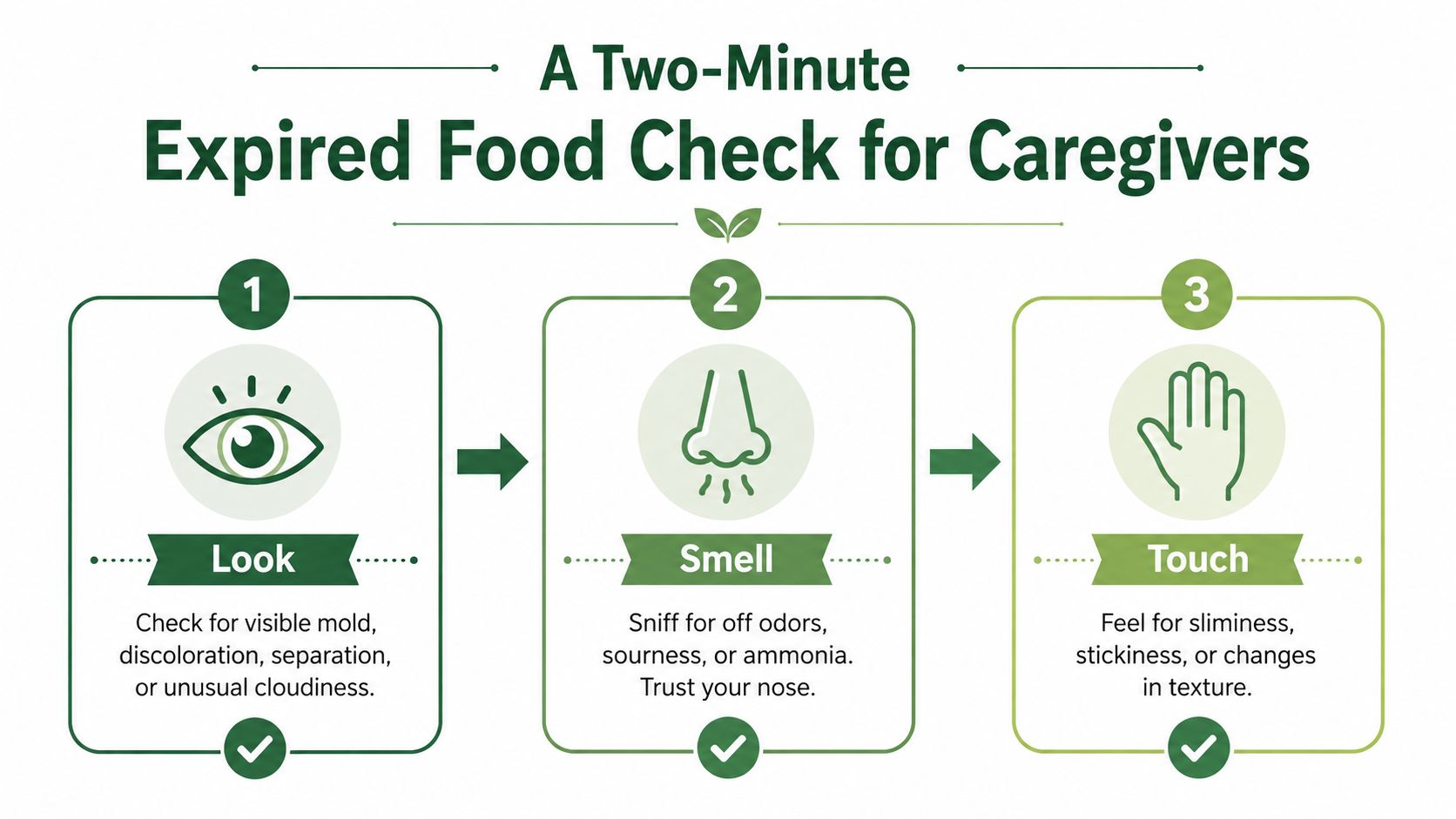
A caregiver may open the refrigerator and find an older yogurt, a leftover container, or a can with a date that has passed. The printed date starts the review, but it rarely answers the safety question by itself. Memory loss, reduced smell, and an interrupted routine can make an ordinary food check harder for the person eating it, so use the same short sequence each time.
Look first
Check the food and its package. Mold, unexpected discoloration, separation, leaking, unusual cloudiness, a swollen lid, broken seal, cracked carton, or leaking wrapper is a reason to discard it without further testing. A damaged package can change the safety question even when the food itself looks normal.
For canned goods, reject cans with bulging ends, damaged seals, or serious rust or dents that affect the container's integrity. Commercially canned food is not automatically unsafe because it is old. Many low-acid canned foods can remain usable for 2 to 5 years, while high-acid canned foods may last 12 to 18 months, provided the can and storage conditions remain suitable. Age alone is only one part of the decision.
Smell carefully
Smell only food that has passed the visual check and is appropriate to inspect. Sour, yeasty, chemical, musty, or ammonia-like odors suggest a problem. Normal yogurt tang or the familiar smell of aged cheese is not automatically spoilage, but a new, harsh, or unusual odor means stop.
Smell cannot clear safety-dated foods, raw animal products, or food being served to someone who cannot detect odors reliably. Harmful organisms may be present without changing the smell.
Touch, then decide
Notice sliminess, stickiness, unexpected softness, or another texture change. Use clean hands or a utensil, then wash them. Never taste meat, poultry, fish, dairy, eggs, soft cheese, or cooked leftovers to test safety.
For a low-risk, shelf-stable item, tasting may be considered only after it passes the look and smell checks. Discard it if the flavor is wrong. A taste test cannot replace storage records or advice from a qualified professional.
Caregiver accommodation: Tape a card inside the refrigerator that says, “Look. Smell. Touch. Toss if unsure.”
Make the decision when memory loss affects judgment. Asking an older adult to defend food they want to keep can turn a safety check into an argument. Use one question: Does it look normal, smell normal, and have the expected texture? If any answer is uncertain, discard the food.
Photograph the checklist, keep it beside the refrigerator, or pair the check with a daily check-in routine for seniors. Repeating the steps during an ordinary call or visit helps food safety become part of the routine instead of a problem discovered only during a crisis.
A short video can reinforce the visual sequence for family members sharing the task:
When the Printed Date Is a Hard Stop
Not every date is negotiable. The hard-stop category includes products where safety or nutritional adequacy depends on the expiration date, and foods that are especially vulnerable to pathogen growth when stored too long.
Infant formula is the clearest example. Canadian rules require expiration dates on infant formula, formulated liquid diets, meal replacements, nutritional supplements, and similar controlled-diet products, and the Canadian Food Inspection Agency's date-label guidance says these products shouldn't be bought, sold, or eaten after expiration. U.S. guidance also identifies infant formula as the notable federal exception to the general quality-date rule.
Use a firm discard rule for these categories
Infant formula and medically specialized nutrition: Discard after the expiration date. The concern includes loss of intended nutrient profile or product stability, not just visible spoilage.
Highly perishable foods with a use-by date: Don't serve them past that date when the label is explicitly safety-related.
Raw or ready-to-eat animal foods with uncertain handling: Deli meats, prepared salads, smoked fish, pâté, soft cheeses, and refrigerated meat products deserve a conservative decision when dates or storage history are unclear.
Products with damaged packaging: A broken seal, leaking container, or swollen package is a hard stop regardless of the printed date.
By contrast, commercially canned goods, dried pasta, rice, dried beans, condiments, and many shelf-stable foods are often quality questions when they've been stored properly and the packaging remains sound. The European Commission's food date-label guidance describes “best before” as a quality date and “use by” as a safety date for foods likely to become an immediate microbiological danger after a short period.
Food Category | Date Type | Caregiver Action |
|---|---|---|
Infant formula and controlled-diet products | Expiration date | Discard after the date |
Highly perishable food | Use by or safety-related expiration | Treat as a hard stop |
Dried grains, beans, pasta, and canned goods | Usually best before or quality-oriented date | Inspect storage and package condition |
Condiments and shelf-stable products | Often quality-oriented | Check opening history, appearance, smell, and packaging |
Any leaking, swollen, or broken package | Date becomes secondary | Discard without tasting |
Your job isn't to memorize every package rule. It's to protect the hard boundaries and use judgment everywhere else. A weekly review of regulated nutrition products and highly perishable foods is manageable, especially when the refrigerator is organized so those items are easy to see.
When Expired Food Means Calling for Help
Foodborne illness can begin with stomach upset, but an older adult may not describe nausea, cramps, dizziness, or weakness clearly. A person with dementia may stop eating, become more confused, walk differently, fall, or seem unusually sleepy after a meal. Treat a sudden change from the person's usual pattern as information.
Call the primary care clinician or nurse line promptly when diarrhea persists, fever develops, or dehydration may be starting. Follow the clinician's advice about timing, because older adults can deteriorate faster and may have medical conditions or medications that change the risk.
Seek emergency help for serious warning signs
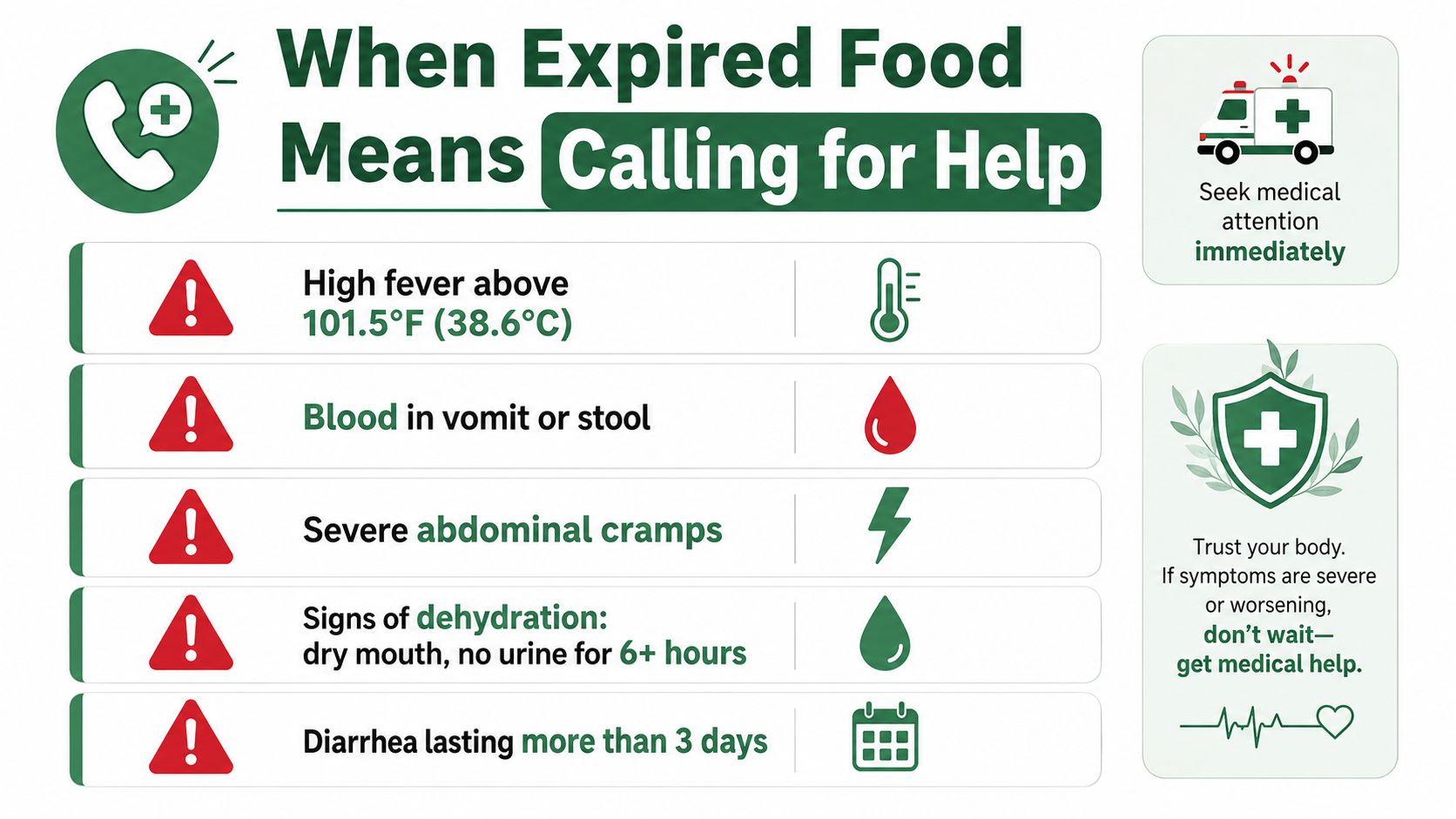
Call emergency services immediately for blood in vomit or stool, severe confusion, profound lethargy, difficulty breathing, or signs of significant dehydration in someone who can't drink independently. A high fever is also concerning. The Centers for Disease Control and Prevention food safety information provides symptom guidance, while the exact response should reflect the person's health history and local medical advice.
The supplied caregiver infographic lists a high fever above 101.5°F (38.6°C), blood in vomit or stool, severe abdominal cramps, dry mouth with no urine for 6 or more hours, and diarrhea lasting more than 3 days as warning signs requiring medical attention. For a person who uses a diaper, no wet diaper for 8 hours is a practical reason to seek urgent clinical guidance. If the person can't keep water down for 4 hours, don't wait for the situation to resolve on its own.
Give the clinician a useful timeline
Write down what the person ate, when they ate it, when symptoms began, and whether anyone else became ill. Mention high-risk foods such as deli meats, soft cheeses, refrigerated prepared salads, smoked fish, undercooked eggs, raw meat, poultry, and seafood. These categories can be associated with pathogens such as Listeria, Salmonella, and Clostridium, but a clinician needs the full context rather than a guess about the exact cause.
A simple call script can reduce panic:
“My parent has memory loss and ate [food] at approximately [time]. They now have [symptoms]. They have had [fluid intake and urine changes], and their usual behavior has changed in this way: [specific change].”
If feasible, seal and refrigerate the suspected food in its original container. Don't serve it to anyone else, and don't delay emergency care while trying to preserve it.
Families often need support beyond a single refrigerator cleanout. A care manager responsibilities guide can help clarify who tracks changes, coordinates appointments, and communicates observations across family members.
Velma offers scheduled phone calls with trained care team members, cognitive activities, routine prompts, and practical check-ins that can include everyday risks such as missed medications or expired food. If your parent lives alone or your family needs a consistent way to notice changes between visits, visit Velma to learn how its phone-based cognitive support program can fit alongside in-person and clinical care.
You open your parent's refrigerator on a Tuesday and find a yogurt dated last month beside milk bought last week. Leftovers sit in containers with no labels, fruit is softening in the back, and nobody can say when the chicken was cooked. The moment feels alarming, but it isn't evidence of neglect. Memory changes, reduced appetite, altered smell, weaker vision, and disrupted routines can make an ordinary refrigerator difficult to manage.
For older adults, expired food safety is a caregiving question, not merely a kitchen question. The date printed on a package is rarely the safety question by itself. You also need to consider the type of date, the food category, storage temperature, packaging, and whether the person who's eating it can reliably notice spoilage or remember when it was opened.
This guide offers an item-by-item decision process. You'll learn how to interpret labels, recognize spoilage, organize a safer refrigerator, complete a brief caregiver check, and identify the foods and symptoms that require a firm response.
Table of Contents
When the Fridge Becomes a Caregiver Question
A better caregiving lens
What Food Date Labels Really Mean
The four labels caregivers see most often
How to Tell If Food Has Actually Gone Bad
Dairy and eggs
Cooked leftovers
Meat, poultry, and fish
Pantry foods and produce
Safe Storage Rules That Decide the Outcome
Give each food a predictable place
A Two-Minute Expired Food Check for Caregivers
Look first
Smell carefully
Touch, then decide
When the Printed Date Is a Hard Stop
Use a firm discard rule for these categories
When Expired Food Means Calling for Help
Seek emergency help for serious warning signs
Give the clinician a useful timeline
When the Fridge Becomes a Caregiver Question
A caregiver may open the refrigerator and find two cartons of the same milk, leftovers in an unlabeled bowl, and a cooked meal whose preparation date no one remembers. For an older adult with memory loss, this can happen during an ordinary week. Reduced appetite, changes in smell or vision, and disrupted routines can turn food storage into a safety problem without anyone intending neglect.
The package date is only one clue. A safe decision also depends on whether the food was opened, how long it stayed cold, whether it was moved between containers, and whether the person eating it can recognize spoilage or recall what happened to it.
Dementia can make those last checks unreliable. Subtle odors may go unnoticed, small print may be difficult to read, and a person may give a sincere answer about when food was opened that is not accurate. A normal-looking surface does not confirm safe handling.
Practical rule: If the older adult cannot reliably track dates or recognize spoilage, the caregiver must provide the safety system.
Begin without blame. Say that you are making the refrigerator easier to use, then work one shelf at a time. Remove obvious waste, group similar foods, and label anything you keep with its name and the date it was cooked or opened. Keep the labels large and visible. The goal is a routine that remains usable when memory, vision, or appetite changes from day to day.
A better caregiving lens
The useful question is, “Can I verify that this food was handled safely, and can the person eating it make a safe decision?” That question prevents two errors: discarding every product past a quality date and keeping questionable food because its packaging still looks normal.
Food waste also places pressure on the household budget and meal routine. Confusing date labels contribute to unnecessary waste, so families can reduce it by separating quality concerns from safety concerns and setting a predictable refrigerator reset. A weekly check can identify food that should be used soon, frozen, or discarded before it becomes another memory task.
A simple meal routine supports that system. If you coordinate groceries, portions, and preferences, a senior nutrition meal plan can help set an intentional order for using food and reduce duplicate purchases.
By the end of the process, the refrigerator should offer fewer decisions, not more. Caregivers can then focus on the printed label, the food's handling history, and the older adult's ability to judge it safely.
What Food Date Labels Really Mean
A caregiver opens the refrigerator and finds a yogurt marked “best before,” cooked chicken marked “use by,” and a carton carrying “sell by.” The dates look similar, but they answer different questions. For an older adult living with memory loss, the safest decision starts by identifying the label category, then checking how the food was stored and handled.
A package marked best before usually describes quality. A highly perishable food marked use by may carry a safety warning, while sell by mainly helps a store manage inventory. The printed date is therefore a prompt for assessment, not a universal answer about whether food belongs in the bin.
U.S. FDA and USDA guidance generally treats consumer date labels, apart from infant formula dating, as indicators of quality rather than federal safety deadlines. Properly stored food can remain wholesome after a quality date, although unpleasant odor, flavor, or texture may signal spoilage. Food Standards Australia New Zealand's date-label explanation similarly distinguishes “best before,” which marks quality, from “use by,” which applies when food may present a microbiological safety risk after a short period.
The four labels caregivers see most often
Use by deserves the strongest caution. It is used for foods that can become unsafe as microbes multiply, even when the food still looks ordinary. In some markets, selling or eating food after a safety-related use-by date is prohibited. For a vulnerable older adult, treat this date as a stopping point rather than asking the person with memory impairment to decide whether the food “seems fine.”
Best by or best before generally marks expected quality. Cereal may lose its crispness, crackers may taste stale, and sauce may lose brightness without becoming dangerous solely because the date has passed. Storage conditions, opened packaging, and spoilage signs still determine the practical choice.
Sell by helps a retailer rotate stock and manage display timing. It does not necessarily identify the moment a household must discard the food. After purchase, refrigerator temperature, opening, handling, and food type provide more useful safety information.
Expires on has no single meaning across every market or product. It may describe quality, or it may relate to safety or nutritional stability. Read the product category and manufacturer's instructions instead of assuming every “expires” statement carries the same weight.
Label Type | Who Sets It | What It Controls | Caregiver Response |
|---|---|---|---|
Use by | Manufacturer or regulator, depending on the market and product | Safety boundary for certain highly perishable foods | Treat as a hard stop when the product is safety-dated |
Best by or best before | Usually the manufacturer | Expected quality, such as taste or texture | Assess storage, packaging, and condition |
Sell by | Usually the producer or retailer | Store rotation and display timing | Don't use it alone to judge household safety |
Expires on | Varies by product and jurisdiction | May indicate quality, safety, or nutritional stability | Check the product category and official guidance |
Caregivers should separate two decisions: whether the food has lost quality and whether it could cause illness. Older adults can face more serious consequences from foodborne illness, so foods that support microbial growth require stricter judgment. Stable foods past a quality date may not need automatic disposal, but a person with memory loss, reduced appetite, or sensory changes should not be asked to make that call alone. The caregiver's job is to verify the label, handling history, and condition, then choose the safer option when those details cannot be confirmed.
How to Tell If Food Has Actually Gone Bad
A date can prompt an inspection, but the food itself provides the next evidence. Look at the package, smell the food when appropriate, and notice changes in texture or appearance. For someone with reduced sensory awareness, the caregiver should perform this check rather than asking the older adult to make the final call.
Dairy and eggs
Milk that smells sour, barn-like, or sharply unpleasant should go. Yogurt naturally has a tang, so distinguish its normal fermented smell from a new sourness, gas, or unusual separation. Cheese with a slimy film, unexpected wetness, or mold that doesn't belong to its variety should be discarded, especially when you're dealing with a soft cheese.
Eggs deserve caution because appearance and smell aren't perfect safety tests. A yolk that spreads widely and won't hold its shape can indicate an older egg, but a normal-looking egg isn't proof that it's safe. If the carton's history is unclear, avoid using the egg for an older adult at increased risk.
Cooked leftovers
Watch for off odors, visible mold of any color, unusual bubbling, or a container that has bulged from gas production. Don't assume reheating will rescue questionable food. Some toxins produced during spoilage may not be reliably eliminated by ordinary cooking.
Meat, poultry, and fish
Raw meat or poultry that feels sticky, tacky, or slimy is a discard. Gray or green discoloration is also concerning, particularly when it appears with an unpleasant odor. Fish may develop a sharp ammonia-like smell, which isn't the normal fresh ocean scent you'd expect.
Pantry foods and produce
Bread with any visible mold should be discarded rather than trimmed for an older adult. Rice or pasta with a musty odor may have absorbed moisture or developed spoilage. Crackers, seeds, and nuts can develop a greasy or paint-like smell when their fats turn rancid.
Produce requires a little more interpretation. A single soft spot on a tomato may be an overripe area that you can cut away for immediate use, while a leaking bag with liquid pooling inside suggests a broader spoilage problem. Mushy, slimy, or foul-smelling produce belongs in the bin.
If the package is swollen, leaking, broken, or contaminated, don't taste the food to investigate it.
For an older adult with reduced smell or vision, favor texture, appearance, and packaging integrity over reassurance. If you're uncertain about a high-risk food, discarding it is the safer caregiver decision.
Safe Storage Rules That Decide the Outcome
Storage history can change the answer long after a package date has passed. A carton kept consistently cold is different from one left on a warm counter, crowded into an overfilled refrigerator, or repeatedly removed during meals. For an older adult with memory loss, the safest routine is one a caregiver can see and repeat.
Keep the refrigerator at or below 40°F (4°C) and the freezer at 0°F (-18°C). An appliance thermometer is more dependable than the dial. Place it where you will notice it during a routine check, then review it weekly. Stable temperatures slow spoilage, while repeated warming gives bacteria more opportunity to multiply.
Give each food a predictable place
Raw meat and poultry: Store them on the lowest shelf in a tray or sealed container. Leaking juices should never reach ready-to-eat food.
Eggs: Keep them in the original carton on a middle shelf. The carton protects the eggs and keeps the printed date visible.
Produce: Use crisper drawers, and remove spoiled pieces promptly so moisture and mold do not spread.
Condiments: Door shelves warm and cool more often. Put foods needing steadier cold storage inside the refrigerator.
Leftovers: Use shallow, airtight containers, label the cooking date, and discard them after three to four days. Reheat to 165°F, checking with a food thermometer when possible.
A dementia-friendly refrigerator makes the safe choice obvious. Put frequently used items at the front, use see-through containers instead of opaque bins, and remove duplicates during a weekly reset. Store cleaning chemicals separately and securely, especially if they are near the kitchen.
A caregiver's routine should account for reduced smell, vision changes, and confusion after meals. The guide to senior nutrition safety offers further food-handling context for older adults. For a repeatable labeling and refrigerator-scan routine, use this food spoilage prevention guidance.
The date starts the question. Storage conditions, food condition, and the older adult's ability to judge it decide what happens next.
A Two-Minute Expired Food Check for Caregivers
A caregiver may open the refrigerator and find an older yogurt, a leftover container, or a can with a date that has passed. The printed date starts the review, but it rarely answers the safety question by itself. Memory loss, reduced smell, and an interrupted routine can make an ordinary food check harder for the person eating it, so use the same short sequence each time.
Look first
Check the food and its package. Mold, unexpected discoloration, separation, leaking, unusual cloudiness, a swollen lid, broken seal, cracked carton, or leaking wrapper is a reason to discard it without further testing. A damaged package can change the safety question even when the food itself looks normal.
For canned goods, reject cans with bulging ends, damaged seals, or serious rust or dents that affect the container's integrity. Commercially canned food is not automatically unsafe because it is old. Many low-acid canned foods can remain usable for 2 to 5 years, while high-acid canned foods may last 12 to 18 months, provided the can and storage conditions remain suitable. Age alone is only one part of the decision.
Smell carefully
Smell only food that has passed the visual check and is appropriate to inspect. Sour, yeasty, chemical, musty, or ammonia-like odors suggest a problem. Normal yogurt tang or the familiar smell of aged cheese is not automatically spoilage, but a new, harsh, or unusual odor means stop.
Smell cannot clear safety-dated foods, raw animal products, or food being served to someone who cannot detect odors reliably. Harmful organisms may be present without changing the smell.
Touch, then decide
Notice sliminess, stickiness, unexpected softness, or another texture change. Use clean hands or a utensil, then wash them. Never taste meat, poultry, fish, dairy, eggs, soft cheese, or cooked leftovers to test safety.
For a low-risk, shelf-stable item, tasting may be considered only after it passes the look and smell checks. Discard it if the flavor is wrong. A taste test cannot replace storage records or advice from a qualified professional.
Caregiver accommodation: Tape a card inside the refrigerator that says, “Look. Smell. Touch. Toss if unsure.”
Make the decision when memory loss affects judgment. Asking an older adult to defend food they want to keep can turn a safety check into an argument. Use one question: Does it look normal, smell normal, and have the expected texture? If any answer is uncertain, discard the food.
Photograph the checklist, keep it beside the refrigerator, or pair the check with a daily check-in routine for seniors. Repeating the steps during an ordinary call or visit helps food safety become part of the routine instead of a problem discovered only during a crisis.
A short video can reinforce the visual sequence for family members sharing the task:
When the Printed Date Is a Hard Stop
Not every date is negotiable. The hard-stop category includes products where safety or nutritional adequacy depends on the expiration date, and foods that are especially vulnerable to pathogen growth when stored too long.
Infant formula is the clearest example. Canadian rules require expiration dates on infant formula, formulated liquid diets, meal replacements, nutritional supplements, and similar controlled-diet products, and the Canadian Food Inspection Agency's date-label guidance says these products shouldn't be bought, sold, or eaten after expiration. U.S. guidance also identifies infant formula as the notable federal exception to the general quality-date rule.
Use a firm discard rule for these categories
Infant formula and medically specialized nutrition: Discard after the expiration date. The concern includes loss of intended nutrient profile or product stability, not just visible spoilage.
Highly perishable foods with a use-by date: Don't serve them past that date when the label is explicitly safety-related.
Raw or ready-to-eat animal foods with uncertain handling: Deli meats, prepared salads, smoked fish, pâté, soft cheeses, and refrigerated meat products deserve a conservative decision when dates or storage history are unclear.
Products with damaged packaging: A broken seal, leaking container, or swollen package is a hard stop regardless of the printed date.
By contrast, commercially canned goods, dried pasta, rice, dried beans, condiments, and many shelf-stable foods are often quality questions when they've been stored properly and the packaging remains sound. The European Commission's food date-label guidance describes “best before” as a quality date and “use by” as a safety date for foods likely to become an immediate microbiological danger after a short period.
Food Category | Date Type | Caregiver Action |
|---|---|---|
Infant formula and controlled-diet products | Expiration date | Discard after the date |
Highly perishable food | Use by or safety-related expiration | Treat as a hard stop |
Dried grains, beans, pasta, and canned goods | Usually best before or quality-oriented date | Inspect storage and package condition |
Condiments and shelf-stable products | Often quality-oriented | Check opening history, appearance, smell, and packaging |
Any leaking, swollen, or broken package | Date becomes secondary | Discard without tasting |
Your job isn't to memorize every package rule. It's to protect the hard boundaries and use judgment everywhere else. A weekly review of regulated nutrition products and highly perishable foods is manageable, especially when the refrigerator is organized so those items are easy to see.
When Expired Food Means Calling for Help
Foodborne illness can begin with stomach upset, but an older adult may not describe nausea, cramps, dizziness, or weakness clearly. A person with dementia may stop eating, become more confused, walk differently, fall, or seem unusually sleepy after a meal. Treat a sudden change from the person's usual pattern as information.
Call the primary care clinician or nurse line promptly when diarrhea persists, fever develops, or dehydration may be starting. Follow the clinician's advice about timing, because older adults can deteriorate faster and may have medical conditions or medications that change the risk.
Seek emergency help for serious warning signs
Call emergency services immediately for blood in vomit or stool, severe confusion, profound lethargy, difficulty breathing, or signs of significant dehydration in someone who can't drink independently. A high fever is also concerning. The Centers for Disease Control and Prevention food safety information provides symptom guidance, while the exact response should reflect the person's health history and local medical advice.
The supplied caregiver infographic lists a high fever above 101.5°F (38.6°C), blood in vomit or stool, severe abdominal cramps, dry mouth with no urine for 6 or more hours, and diarrhea lasting more than 3 days as warning signs requiring medical attention. For a person who uses a diaper, no wet diaper for 8 hours is a practical reason to seek urgent clinical guidance. If the person can't keep water down for 4 hours, don't wait for the situation to resolve on its own.
Give the clinician a useful timeline
Write down what the person ate, when they ate it, when symptoms began, and whether anyone else became ill. Mention high-risk foods such as deli meats, soft cheeses, refrigerated prepared salads, smoked fish, undercooked eggs, raw meat, poultry, and seafood. These categories can be associated with pathogens such as Listeria, Salmonella, and Clostridium, but a clinician needs the full context rather than a guess about the exact cause.
A simple call script can reduce panic:
“My parent has memory loss and ate [food] at approximately [time]. They now have [symptoms]. They have had [fluid intake and urine changes], and their usual behavior has changed in this way: [specific change].”
If feasible, seal and refrigerate the suspected food in its original container. Don't serve it to anyone else, and don't delay emergency care while trying to preserve it.
Families often need support beyond a single refrigerator cleanout. A care manager responsibilities guide can help clarify who tracks changes, coordinates appointments, and communicates observations across family members.
Velma offers scheduled phone calls with trained care team members, cognitive activities, routine prompts, and practical check-ins that can include everyday risks such as missed medications or expired food. If your parent lives alone or your family needs a consistent way to notice changes between visits, visit Velma to learn how its phone-based cognitive support program can fit alongside in-person and clinical care.
Suggested Article: