Dementia and Medication Management: A Caregiver's Guide

You're halfway through breakfast when you find the opened blister pack on the counter. One tablet is still sitting in last night's water cup. Your parent insists nothing is wrong, and you're late for work. You're left trying to decide whether the dose was taken, whether giving another tablet is dangerous, and how to ask for help without turning breakfast into a confrontation.
That's the daily reality behind dementia and medication management. The problem isn't remembering pills. It's keeping a safe system running when memory, judgment, vision, swallowing, behavior, and the caregiver's available time are all changing. In a review of older patients with dementia, adherence ranged from 17% to 42%, while treatment discontinuation ranged from 37% to 80%. Non-adherence was associated with increased risk of hospitalization or death (systematic review of medication adherence in dementia).
Here's my direct advice: stop treating medication as a private task your parent should manage alone. Treat it as a shared care process with five failure points, review, system, administration, side effects, and communication. Each clinical problem creates work for someone. The right plan reduces that workload instead of adding more reminders.
Table of Contents
Why Medication Management Gets Harder as Dementia Progresses
The caregiver workload hidden inside each problem
Starting With a Real Medication Review
The brown-bag method catches what the chart misses
Choosing an Adherence System That Actually Fits
Use a staged decision rule
Administering Medications Safely Day to Day
Spotting Side Effects Before They Become Emergencies
When Less Is More and Deprescribing Matters
Targets worth putting on the agenda
Make a short appointment do useful work
How Phone-Based Cognitive Support Fits Into the Routine
Build the week around review points
Why Medication Management Gets Harder as Dementia Progresses
Medication independence usually doesn't disappear in one dramatic moment. It frays around the edges. A person may remember that pills belong with breakfast but forget whether breakfast happened, recognize a familiar bottle but not understand a changed label, or open a pill organizer and take several compartments because the sequence no longer makes sense.
The morning problem can also be visual and physical. A tablet may look like yesterday's tablet even when the dose differs. A person may struggle to line up a blister pack, misread the day, or drop medication without noticing. Later, swallowing changes, fatigue, and evening confusion can make a previously reliable routine unsafe.
The medication list itself often grows as clinicians treat blood pressure, pain, sleep, diabetes, heart disease, mood, and other conditions. A 2023 systematic review and meta-analysis covering 4,813,226 older patients with dementia found pooled polypharmacy prevalence of 62% and pooled potentially inappropriate medication prevalence of 43% (review of polypharmacy and potentially inappropriate medications). More prescriptions mean more timing rules, refill dates, side effects, and opportunities for confusion.
The caregiver workload hidden inside each problem
A missed dose means someone must investigate. A new refusal means someone must decide whether to wait, call, or escalate. A fall may require reconstructing which medicines were given and at what time. These aren't separate administrative tasks. They interrupt sleep, employment, meals, appointments, and the caregiver's ability to leave the house.
A community study found medication-management difficulty in 13.12% of people with dementia, compared with 5.80% of people with cognitive impairment without dementia and 1.96% of people with intact cognition. Only the dementia group showed a significant association between medication-management difficulty and later hospitalization, with an odds ratio of 1.71 and a 95% confidence interval of 1.08 to 2.70 (community study of medication-management capacity).
If you're also searching for broader principles around safe, organized medication routines, this practical guide to medication management for mental health offers useful general structure, although dementia requires additional supervision as cognition changes.
Start by noticing where the system breaks. The next sections address the five points that matter most: review every product, choose a system that matches ability, administer doses safely, catch side effects early, and communicate clearly with clinicians and family. For a plain-language overview of how abilities can change over time, use this guide to dementia progression stages.
Starting With a Real Medication Review
A medication review should happen before you buy another organizer. Ask the primary-care clinician or pharmacist for a structured review, and make it a working appointment, not a quick question at the end of a visit.
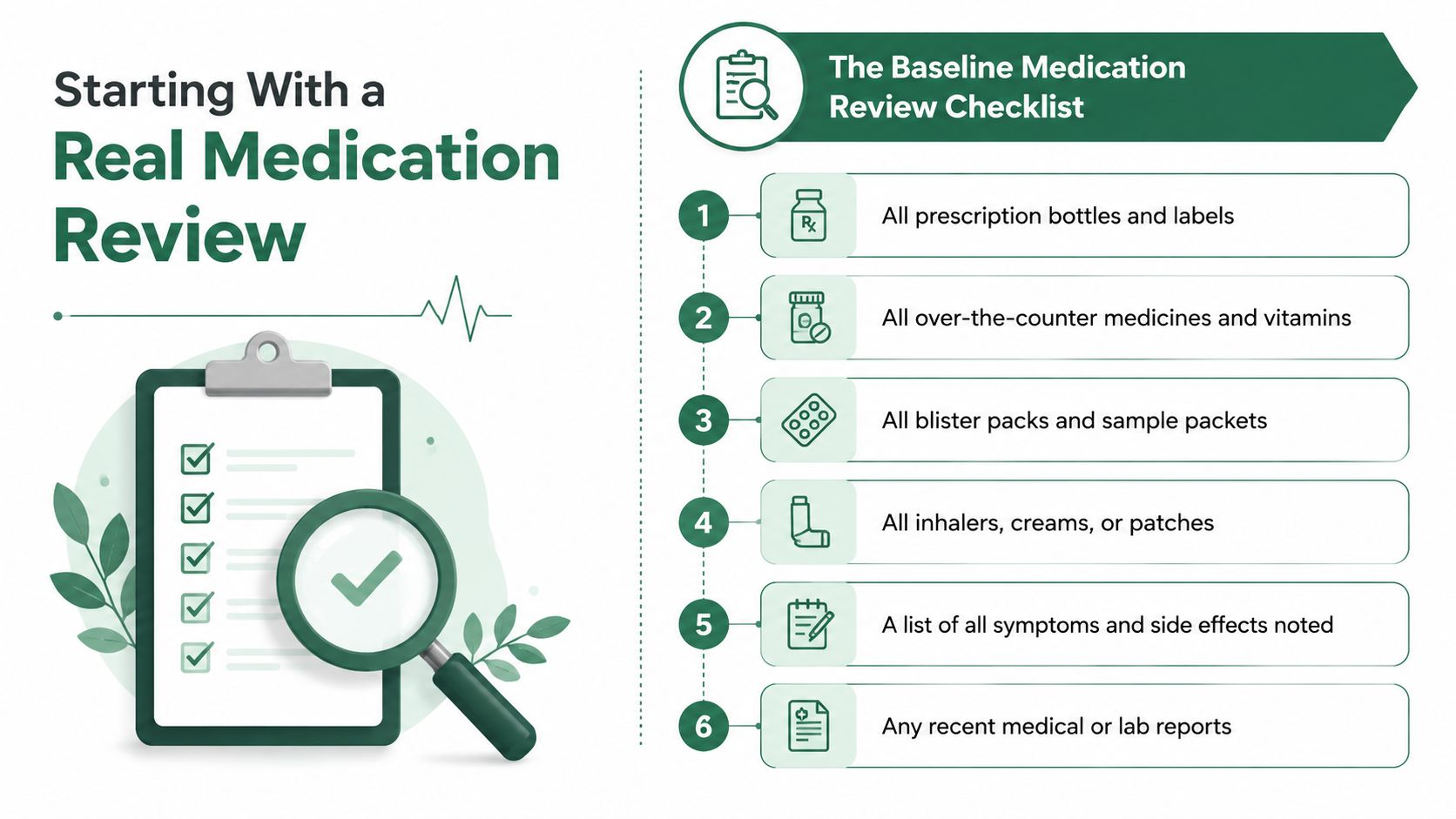
Bring one bag containing:
Prescription medicines: Include every bottle, even old or rarely used prescriptions.
Pharmacy packaging: Bring blister packs, compliance packs, sample packets, and refill paperwork.
Nonprescription products: Include pain relievers, allergy medicines, laxatives, antacids, sleep products, and cold remedies.
Supplements: Vitamins, minerals, herbal products, powders, and topical products belong in the bag too.
Delivery devices: Bring inhalers, creams, patches, drops, syringes, and anything used to deliver medication.
Recent information: Add pharmacy printouts, prior medication lists, hospital discharge papers, and relevant medical or lab reports.
Observed problems: Write down missed doses, refusals, falls, sleep changes, appetite changes, constipation, dizziness, and confusion.
The brown-bag method catches what the chart misses
Electronic records may omit a medication prescribed by another clinician. A pharmacy list may not show an over-the-counter sleep aid. Your parent may have stopped one drug but continue using an old bottle because it's still in the kitchen drawer. Putting every product on the table lets the pharmacist identify duplicates, outdated instructions, and combinations that aren't obvious from one chart.
Ask direct questions:
Is each medication still indicated?
What symptom, diagnosis, or goal is it meant to address?
What benefit should we expect, and how will we know it's working?
Which side effects require a call, and which require urgent care?
Can doses be consolidated or the schedule simplified?
Are any medicines anticholinergic or sedating, including products listed in Beers criteria?
Which medicines must never be stopped suddenly?
Leave with a written schedule using plain language, the purpose of each medication, and clear instructions for missed doses. Request a pharmacist medication therapy management visit if one is available. Then put a recurring review on the calendar, at least annually and whenever there's a hospitalization, new diagnosis, fall, or noticeable behavior change.
The review removes caregiver work later. Every unclear bottle you resolve now is one less phone call, argument, and emergency decision during a rushed morning.
Choosing an Adherence System That Actually Fits
The best adherence system is the one your parent can use safely and you can maintain consistently. A device that nobody checks is less useful than a basic system with clear ownership.
System | Workload effect | Error protection | Best fit |
|---|---|---|---|
Weekly pill organizer | Reduces daily sorting, but someone must fill and verify it | Moderate when the user understands compartments | Early dementia with reliable oversight |
Pharmacy-filled blister packs | Removes much of the sorting and labeling work | Stronger against wrong-day dosing and duplicate filling | Early to moderate dementia, especially with caregiver checks |
Phone reminders or calls | Reduces repeated verbal prompting | Helps recall, but doesn't prove the dose was taken | Mild dementia and people who respond to prompts |
Caregiver-administered dosing | Adds direct daily work but removes decision-making from the person with dementia | Strongest when documented carefully | Moderate to advanced dementia or after a medication error |
A pill organizer fails when the person can't sequence the task. They may open tomorrow's compartment, empty several sections, or refill a used compartment without recognizing the mistake. A blister pack reduces preparation work, but it doesn't solve timing. Someone still needs to open the correct pocket, confirm the dose was swallowed, and respond when the person refuses.
Phone reminders extend independence only while the person can understand the prompt and act on it. They're useful for a person who says, “I've taken it,” and can reliably show an empty compartment. They're not a substitute for supervision once the person can't confirm what happened.
Use a staged decision rule
Start with a pill organizer and phone-based reminders when memory loss is mild, the person understands the routine, and a caregiver can verify supplies. Shift to pharmacy-filled blister packs plus scheduled check-ins when errors begin around refills, timing, or dose recognition. Move to caregiver-administered medication with a written log after a missed-dose incident, double dose, unsafe self-adjustment, or repeated refusal.
The home setup matters too. If your parent lives alone, has multiple prescribers, or can't reliably answer a reminder, choose the more supervised option earlier. This guide to medication reminders for seniors can help you think through reminder design, but the reminder should sit inside a human-owned process.
Practical rule: Choose the least complicated system that prevents the next predictable error, not the system that looks most independent.
Administering Medications Safely Day to Day
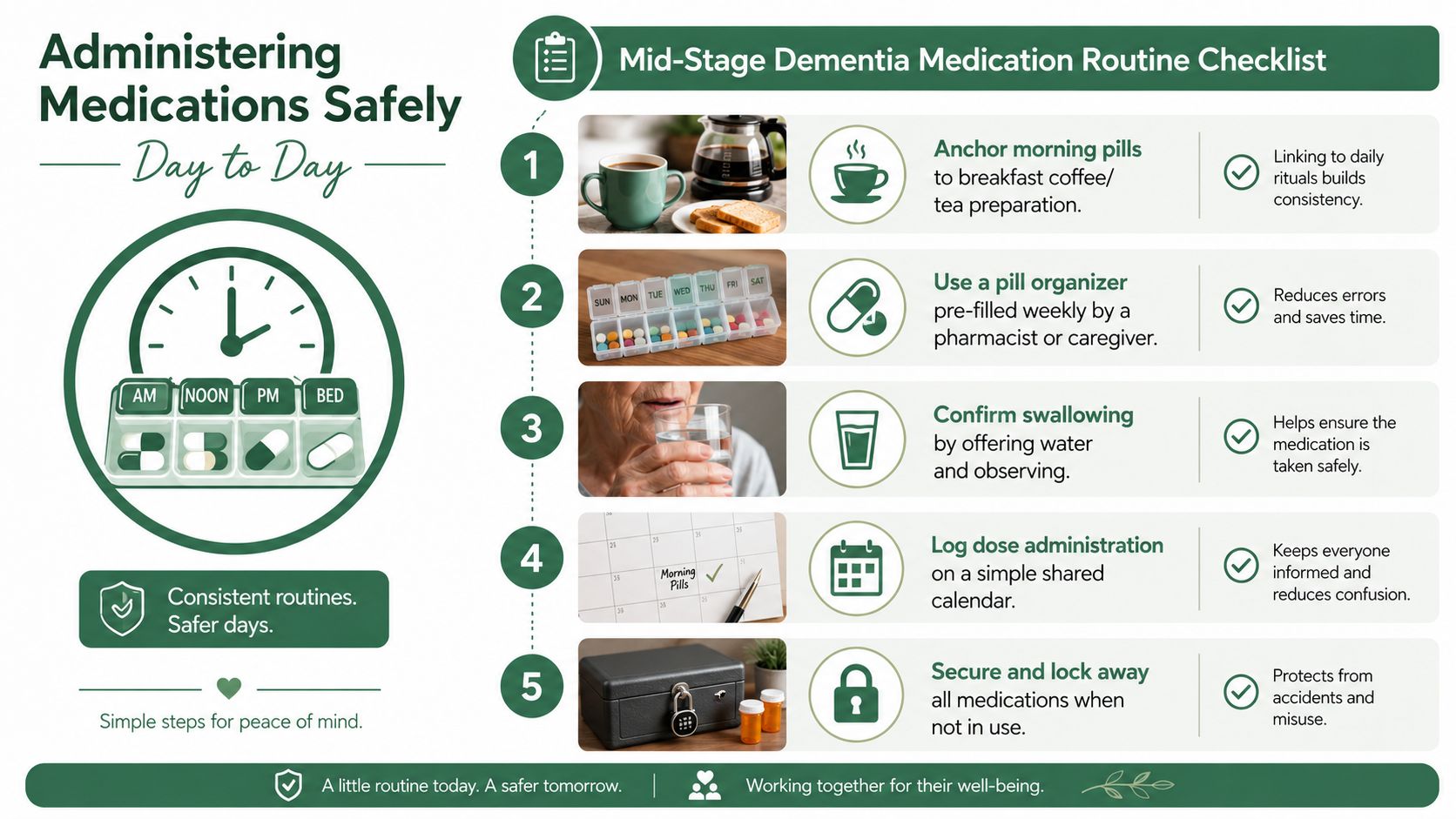
Safe administration means confirming the right medication reaches the right person at the right time, by the right route, and in the right dose. In mid-stage dementia, don't rely on a clock alone. Attach medication to a ritual your parent already recognizes, such as pills after breakfast or after a familiar television program, while preserving the prescriber's timing instructions.
Keep the preparation consistent:
Read the label every time: Confirm the person's name, medicine, strength, directions, and expiration information.
Prepare one dose at a time: Don't place several unsupervised doses within reach.
Protect the formulation: Never split, crush, or open a capsule until a pharmacist confirms it's safe. Extended-release and enteric-coated products may become unsafe when altered.
Address swallowing problems: Ask the pharmacist about liquid forms, suitable foods, or thickeners. Don't improvise.
Record administration: Mark the dose immediately on a shared paper calendar, medication log, or approved digital record.
Store securely: Lock medications away when they aren't being administered, especially if the person may repeat a dose.
Don't hide medication in food without consent and professional guidance. It can damage trust, create uncertain dosing, and turn meals into a battleground. If your parent refuses, pause and lower the pressure. Offer the medication again later if the medication's instructions allow it, document the refusal, and call the pharmacist or prescriber when a dose is important or refusals repeat.
A missed or doubled dose isn't solved by guessing. Check the medication instructions, then contact the pharmacist or prescriber for specific advice. Call promptly for medicines where timing can be critical, including anticoagulants, seizure medications, insulin, and Parkinson's medications. Seek emergency help for severe symptoms such as collapse, difficulty breathing, seizure, severe confusion, or inability to wake.
Use this short routine before you walk away:
Name, drug, dose, time, route, person, record.
The record protects your parent and the next caregiver. It also reduces the exhausting uncertainty that makes families give unnecessary replacement doses.
Spotting Side Effects Before They Become Emergencies
In dementia care, behavior change is often the first warning sign. Don't wait for a lab result if your parent suddenly becomes unsteady, refuses food, sleeps through the day, or seems markedly more confused.
Watch the pattern, not just the medication name:
Anticholinergic medicines: New confusion, urinary retention, constipation, dry mouth, blurred vision, or falls should prompt a call to the prescriber or pharmacist. These products can be hidden in bladder, allergy, sleep, and gastrointestinal treatments.
Antipsychotics: New sedation, stiffness, worsened swallowing, or a sudden decline in movement needs prompt clinical review. Fever with severe rigidity or profound altered awareness is an emergency.
Dementia medicines: Nausea, fainting, unusually slow pulse, vivid dreams, or a sudden appetite change should be reported. A collapse or repeated fainting needs urgent assessment.
Opioids and sedatives: Excessive sleepiness, a new unsteady gait, slowed breathing, or unusual agitation requires immediate attention. Trouble breathing or inability to wake is an emergency.
Diuretics: Dizziness, weakness, poor intake, dehydration, or sudden confusion should trigger a call, particularly after illness or hot weather.
Anticoagulants: Report unexplained bruising, nosebleeds, black stool, blood in urine, or a severe headache urgently. Major bleeding, a severe headache after a fall, or sudden neurological symptoms requires emergency care.
Keep a simple behavior and medication log. Write the date, dose, sleep, eating, mood, falls, bowel changes, and the time a new symptom appeared. Your observations give the clinician a usable timeline and can prevent the response from becoming another prescription added to an already crowded list.
When Less Is More and Deprescribing Matters
Adding a medicine is not always the answer. In moderate and advanced dementia, the burden of swallowing, refusing, sorting, timing, monitoring, and paying attention to side effects can outweigh a preventive benefit that may no longer match the person's goals.
That doesn't mean stopping medicines casually. It means asking whether each medicine still earns its place. A 2025 deprescribing roadmap argues for decisions guided by patient goals, tapering plans, and close follow-up, particularly because people with dementia are often exposed to polypharmacy and potentially inappropriate medications (deprescribing roadmap for dementia). Some medicines require tapering. Others have withdrawal risks or can destabilize a serious condition if stopped abruptly.
Targets worth putting on the agenda
Ask the prescriber to review:
Preventive medicines: A statin may deserve reassessment when the care goal has shifted toward comfort and day-to-day function.
Glucose-lowering treatment: Tight control can create hypoglycemia, which may look like confusion, weakness, sweating, or a fall.
Blood-pressure treatment: An aggressive target may no longer be sensible if dizziness and falls are becoming daily threats.
Dementia medicines: Review whether the current stage, observed benefit, appetite, sleep, nausea, pulse, or fainting history supports continuation.
Long-term proton pump inhibitors: Ask whether the original reason remains active or whether the medicine continued after the problem resolved.
Sleep aids and sedatives: Reconsider them when morning sedation, falls, or delirium risk is increasing.
The conversation works better when you bring observations instead of a general request to “take something off.” Open with one sentence that names the concern: “I'm worried about the new fall risk since starting the higher dose.”
Then use this script:
“Since the dose changed, I've noticed [behavior change]. On [date], there was [specific example], and on [date], there was [second example]. We've already tried [what you changed]. What is the safest way to test whether we can reduce or stop this medicine, and what should we monitor?”
Ask for a time-limited trial only when the clinician agrees, with explicit instructions about dose reduction, symptoms to watch, and when to restart or call. “Let's see how it goes” isn't a plan. You need to know what improvement would look like and what deterioration would mean.
Make a short appointment do useful work
Send a brief medication and behavior summary through the patient portal before the visit. Put the same information on one page on the fridge:
Medication name and dose
Original purpose, if known
Date and time given
Sleep and mood
Appetite and bowel changes
Falls, refusals, dizziness, or unusual confusion
Questions for the clinician
Bring the page to every appointment. Ask the pharmacist for an annual brown-bag review, and name which clinician manages each condition. Confusion grows when the primary-care clinician assumes the specialist is reviewing the list and the specialist assumes primary care is doing it.
Ask this every time: “What is the goal of this medication now, and does that goal still fit the way my parent is living?”
Deprescribing is not abandonment. It's an attempt to make treatment serve the person rather than make the person serve the treatment schedule. The correct outcome isn't the fewest pills. It's fewer avoidable burdens, safer days, better alertness, and a routine the caregiver can sustain.
How Phone-Based Cognitive Support Fits Into the Routine
Phone-based cognitive support works best as a layer over a caregiver-owned medication plan. It can provide a scheduled voice reminder, ask whether the dose was taken, and alert a caregiver when the person doesn't confirm. It can't administer the pill, verify swallowing, assess a side effect, or replace a pharmacist.
That distinction matters. A reminder reduces the number of times you must call and repeat yourself. It doesn't transfer clinical responsibility to a device or service. The caregiver still sets the schedule, confirms changes with the care team, and decides what to do when the pattern shifts.
Build the week around review points
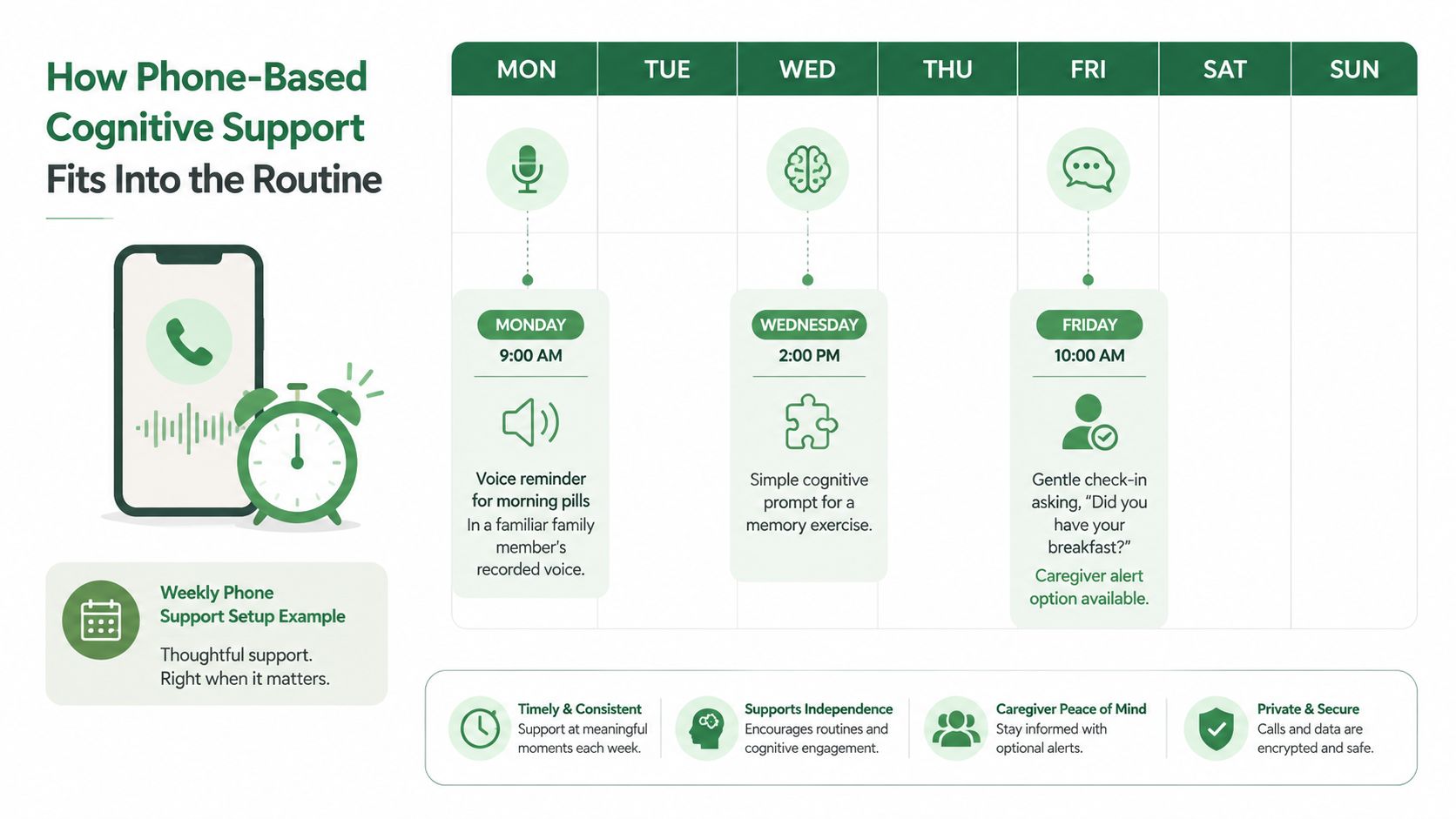
A workable setup might look like this:
Monday: A familiar voice delivers the morning medication reminder at the agreed routine time.
Tuesday and Wednesday: The caller reinforces the same wording and asks for a simple confirmation.
Thursday: The caregiver reviews the adherence log for missed confirmations or confusing responses.
Friday: A check-in asks about breakfast, appetite, dizziness, or other changes that may affect medication safety.
Sunday evening: The caregiver confirms the coming week's schedule and adjusts reminder timing only after checking the medication instructions.
Keep the language short. “Good morning, it's time to take the morning medicines that are in today's breakfast compartment. Please tell me when you've taken them.” A familiar voice and repeated routine can be easier to follow than a changing app notification.
Services such as Velma's phone-based cognitive support use scheduled calls, conversational check-ins, and caregiver visibility to support routine reinforcement. For medication management, use that type of support to catch missed confirmations early and reduce repeated prompting, while leaving medication decisions and side-effect assessment to caregivers and clinicians.
The point is sustainability. A well-designed phone layer can give the caregiver a reliable signal that something needs attention, instead of requiring constant surveillance. It should make your week more manageable, not create another dashboard you must monitor all day.
Velma offers scheduled phone calls that can reinforce medication routines, check in about daily well-being, and flag changes for family awareness. If you need practical support between in-person visits, visit Velma to see how its phone-based cognitive support can fit into your dementia care plan.
You're halfway through breakfast when you find the opened blister pack on the counter. One tablet is still sitting in last night's water cup. Your parent insists nothing is wrong, and you're late for work. You're left trying to decide whether the dose was taken, whether giving another tablet is dangerous, and how to ask for help without turning breakfast into a confrontation.
That's the daily reality behind dementia and medication management. The problem isn't remembering pills. It's keeping a safe system running when memory, judgment, vision, swallowing, behavior, and the caregiver's available time are all changing. In a review of older patients with dementia, adherence ranged from 17% to 42%, while treatment discontinuation ranged from 37% to 80%. Non-adherence was associated with increased risk of hospitalization or death (systematic review of medication adherence in dementia).
Here's my direct advice: stop treating medication as a private task your parent should manage alone. Treat it as a shared care process with five failure points, review, system, administration, side effects, and communication. Each clinical problem creates work for someone. The right plan reduces that workload instead of adding more reminders.
Table of Contents
Why Medication Management Gets Harder as Dementia Progresses
The caregiver workload hidden inside each problem
Starting With a Real Medication Review
The brown-bag method catches what the chart misses
Choosing an Adherence System That Actually Fits
Use a staged decision rule
Administering Medications Safely Day to Day
Spotting Side Effects Before They Become Emergencies
When Less Is More and Deprescribing Matters
Targets worth putting on the agenda
Make a short appointment do useful work
How Phone-Based Cognitive Support Fits Into the Routine
Build the week around review points
Why Medication Management Gets Harder as Dementia Progresses
Medication independence usually doesn't disappear in one dramatic moment. It frays around the edges. A person may remember that pills belong with breakfast but forget whether breakfast happened, recognize a familiar bottle but not understand a changed label, or open a pill organizer and take several compartments because the sequence no longer makes sense.
The morning problem can also be visual and physical. A tablet may look like yesterday's tablet even when the dose differs. A person may struggle to line up a blister pack, misread the day, or drop medication without noticing. Later, swallowing changes, fatigue, and evening confusion can make a previously reliable routine unsafe.
The medication list itself often grows as clinicians treat blood pressure, pain, sleep, diabetes, heart disease, mood, and other conditions. A 2023 systematic review and meta-analysis covering 4,813,226 older patients with dementia found pooled polypharmacy prevalence of 62% and pooled potentially inappropriate medication prevalence of 43% (review of polypharmacy and potentially inappropriate medications). More prescriptions mean more timing rules, refill dates, side effects, and opportunities for confusion.
The caregiver workload hidden inside each problem
A missed dose means someone must investigate. A new refusal means someone must decide whether to wait, call, or escalate. A fall may require reconstructing which medicines were given and at what time. These aren't separate administrative tasks. They interrupt sleep, employment, meals, appointments, and the caregiver's ability to leave the house.
A community study found medication-management difficulty in 13.12% of people with dementia, compared with 5.80% of people with cognitive impairment without dementia and 1.96% of people with intact cognition. Only the dementia group showed a significant association between medication-management difficulty and later hospitalization, with an odds ratio of 1.71 and a 95% confidence interval of 1.08 to 2.70 (community study of medication-management capacity).
If you're also searching for broader principles around safe, organized medication routines, this practical guide to medication management for mental health offers useful general structure, although dementia requires additional supervision as cognition changes.
Start by noticing where the system breaks. The next sections address the five points that matter most: review every product, choose a system that matches ability, administer doses safely, catch side effects early, and communicate clearly with clinicians and family. For a plain-language overview of how abilities can change over time, use this guide to dementia progression stages.
Starting With a Real Medication Review
A medication review should happen before you buy another organizer. Ask the primary-care clinician or pharmacist for a structured review, and make it a working appointment, not a quick question at the end of a visit.
Bring one bag containing:
Prescription medicines: Include every bottle, even old or rarely used prescriptions.
Pharmacy packaging: Bring blister packs, compliance packs, sample packets, and refill paperwork.
Nonprescription products: Include pain relievers, allergy medicines, laxatives, antacids, sleep products, and cold remedies.
Supplements: Vitamins, minerals, herbal products, powders, and topical products belong in the bag too.
Delivery devices: Bring inhalers, creams, patches, drops, syringes, and anything used to deliver medication.
Recent information: Add pharmacy printouts, prior medication lists, hospital discharge papers, and relevant medical or lab reports.
Observed problems: Write down missed doses, refusals, falls, sleep changes, appetite changes, constipation, dizziness, and confusion.
The brown-bag method catches what the chart misses
Electronic records may omit a medication prescribed by another clinician. A pharmacy list may not show an over-the-counter sleep aid. Your parent may have stopped one drug but continue using an old bottle because it's still in the kitchen drawer. Putting every product on the table lets the pharmacist identify duplicates, outdated instructions, and combinations that aren't obvious from one chart.
Ask direct questions:
Is each medication still indicated?
What symptom, diagnosis, or goal is it meant to address?
What benefit should we expect, and how will we know it's working?
Which side effects require a call, and which require urgent care?
Can doses be consolidated or the schedule simplified?
Are any medicines anticholinergic or sedating, including products listed in Beers criteria?
Which medicines must never be stopped suddenly?
Leave with a written schedule using plain language, the purpose of each medication, and clear instructions for missed doses. Request a pharmacist medication therapy management visit if one is available. Then put a recurring review on the calendar, at least annually and whenever there's a hospitalization, new diagnosis, fall, or noticeable behavior change.
The review removes caregiver work later. Every unclear bottle you resolve now is one less phone call, argument, and emergency decision during a rushed morning.
Choosing an Adherence System That Actually Fits
The best adherence system is the one your parent can use safely and you can maintain consistently. A device that nobody checks is less useful than a basic system with clear ownership.
System | Workload effect | Error protection | Best fit |
|---|---|---|---|
Weekly pill organizer | Reduces daily sorting, but someone must fill and verify it | Moderate when the user understands compartments | Early dementia with reliable oversight |
Pharmacy-filled blister packs | Removes much of the sorting and labeling work | Stronger against wrong-day dosing and duplicate filling | Early to moderate dementia, especially with caregiver checks |
Phone reminders or calls | Reduces repeated verbal prompting | Helps recall, but doesn't prove the dose was taken | Mild dementia and people who respond to prompts |
Caregiver-administered dosing | Adds direct daily work but removes decision-making from the person with dementia | Strongest when documented carefully | Moderate to advanced dementia or after a medication error |
A pill organizer fails when the person can't sequence the task. They may open tomorrow's compartment, empty several sections, or refill a used compartment without recognizing the mistake. A blister pack reduces preparation work, but it doesn't solve timing. Someone still needs to open the correct pocket, confirm the dose was swallowed, and respond when the person refuses.
Phone reminders extend independence only while the person can understand the prompt and act on it. They're useful for a person who says, “I've taken it,” and can reliably show an empty compartment. They're not a substitute for supervision once the person can't confirm what happened.
Use a staged decision rule
Start with a pill organizer and phone-based reminders when memory loss is mild, the person understands the routine, and a caregiver can verify supplies. Shift to pharmacy-filled blister packs plus scheduled check-ins when errors begin around refills, timing, or dose recognition. Move to caregiver-administered medication with a written log after a missed-dose incident, double dose, unsafe self-adjustment, or repeated refusal.
The home setup matters too. If your parent lives alone, has multiple prescribers, or can't reliably answer a reminder, choose the more supervised option earlier. This guide to medication reminders for seniors can help you think through reminder design, but the reminder should sit inside a human-owned process.
Practical rule: Choose the least complicated system that prevents the next predictable error, not the system that looks most independent.
Administering Medications Safely Day to Day
Safe administration means confirming the right medication reaches the right person at the right time, by the right route, and in the right dose. In mid-stage dementia, don't rely on a clock alone. Attach medication to a ritual your parent already recognizes, such as pills after breakfast or after a familiar television program, while preserving the prescriber's timing instructions.
Keep the preparation consistent:
Read the label every time: Confirm the person's name, medicine, strength, directions, and expiration information.
Prepare one dose at a time: Don't place several unsupervised doses within reach.
Protect the formulation: Never split, crush, or open a capsule until a pharmacist confirms it's safe. Extended-release and enteric-coated products may become unsafe when altered.
Address swallowing problems: Ask the pharmacist about liquid forms, suitable foods, or thickeners. Don't improvise.
Record administration: Mark the dose immediately on a shared paper calendar, medication log, or approved digital record.
Store securely: Lock medications away when they aren't being administered, especially if the person may repeat a dose.
Don't hide medication in food without consent and professional guidance. It can damage trust, create uncertain dosing, and turn meals into a battleground. If your parent refuses, pause and lower the pressure. Offer the medication again later if the medication's instructions allow it, document the refusal, and call the pharmacist or prescriber when a dose is important or refusals repeat.
A missed or doubled dose isn't solved by guessing. Check the medication instructions, then contact the pharmacist or prescriber for specific advice. Call promptly for medicines where timing can be critical, including anticoagulants, seizure medications, insulin, and Parkinson's medications. Seek emergency help for severe symptoms such as collapse, difficulty breathing, seizure, severe confusion, or inability to wake.
Use this short routine before you walk away:
Name, drug, dose, time, route, person, record.
The record protects your parent and the next caregiver. It also reduces the exhausting uncertainty that makes families give unnecessary replacement doses.
Spotting Side Effects Before They Become Emergencies
In dementia care, behavior change is often the first warning sign. Don't wait for a lab result if your parent suddenly becomes unsteady, refuses food, sleeps through the day, or seems markedly more confused.
Watch the pattern, not just the medication name:
Anticholinergic medicines: New confusion, urinary retention, constipation, dry mouth, blurred vision, or falls should prompt a call to the prescriber or pharmacist. These products can be hidden in bladder, allergy, sleep, and gastrointestinal treatments.
Antipsychotics: New sedation, stiffness, worsened swallowing, or a sudden decline in movement needs prompt clinical review. Fever with severe rigidity or profound altered awareness is an emergency.
Dementia medicines: Nausea, fainting, unusually slow pulse, vivid dreams, or a sudden appetite change should be reported. A collapse or repeated fainting needs urgent assessment.
Opioids and sedatives: Excessive sleepiness, a new unsteady gait, slowed breathing, or unusual agitation requires immediate attention. Trouble breathing or inability to wake is an emergency.
Diuretics: Dizziness, weakness, poor intake, dehydration, or sudden confusion should trigger a call, particularly after illness or hot weather.
Anticoagulants: Report unexplained bruising, nosebleeds, black stool, blood in urine, or a severe headache urgently. Major bleeding, a severe headache after a fall, or sudden neurological symptoms requires emergency care.
Keep a simple behavior and medication log. Write the date, dose, sleep, eating, mood, falls, bowel changes, and the time a new symptom appeared. Your observations give the clinician a usable timeline and can prevent the response from becoming another prescription added to an already crowded list.
When Less Is More and Deprescribing Matters
Adding a medicine is not always the answer. In moderate and advanced dementia, the burden of swallowing, refusing, sorting, timing, monitoring, and paying attention to side effects can outweigh a preventive benefit that may no longer match the person's goals.
That doesn't mean stopping medicines casually. It means asking whether each medicine still earns its place. A 2025 deprescribing roadmap argues for decisions guided by patient goals, tapering plans, and close follow-up, particularly because people with dementia are often exposed to polypharmacy and potentially inappropriate medications (deprescribing roadmap for dementia). Some medicines require tapering. Others have withdrawal risks or can destabilize a serious condition if stopped abruptly.
Targets worth putting on the agenda
Ask the prescriber to review:
Preventive medicines: A statin may deserve reassessment when the care goal has shifted toward comfort and day-to-day function.
Glucose-lowering treatment: Tight control can create hypoglycemia, which may look like confusion, weakness, sweating, or a fall.
Blood-pressure treatment: An aggressive target may no longer be sensible if dizziness and falls are becoming daily threats.
Dementia medicines: Review whether the current stage, observed benefit, appetite, sleep, nausea, pulse, or fainting history supports continuation.
Long-term proton pump inhibitors: Ask whether the original reason remains active or whether the medicine continued after the problem resolved.
Sleep aids and sedatives: Reconsider them when morning sedation, falls, or delirium risk is increasing.
The conversation works better when you bring observations instead of a general request to “take something off.” Open with one sentence that names the concern: “I'm worried about the new fall risk since starting the higher dose.”
Then use this script:
“Since the dose changed, I've noticed [behavior change]. On [date], there was [specific example], and on [date], there was [second example]. We've already tried [what you changed]. What is the safest way to test whether we can reduce or stop this medicine, and what should we monitor?”
Ask for a time-limited trial only when the clinician agrees, with explicit instructions about dose reduction, symptoms to watch, and when to restart or call. “Let's see how it goes” isn't a plan. You need to know what improvement would look like and what deterioration would mean.
Make a short appointment do useful work
Send a brief medication and behavior summary through the patient portal before the visit. Put the same information on one page on the fridge:
Medication name and dose
Original purpose, if known
Date and time given
Sleep and mood
Appetite and bowel changes
Falls, refusals, dizziness, or unusual confusion
Questions for the clinician
Bring the page to every appointment. Ask the pharmacist for an annual brown-bag review, and name which clinician manages each condition. Confusion grows when the primary-care clinician assumes the specialist is reviewing the list and the specialist assumes primary care is doing it.
Ask this every time: “What is the goal of this medication now, and does that goal still fit the way my parent is living?”
Deprescribing is not abandonment. It's an attempt to make treatment serve the person rather than make the person serve the treatment schedule. The correct outcome isn't the fewest pills. It's fewer avoidable burdens, safer days, better alertness, and a routine the caregiver can sustain.
How Phone-Based Cognitive Support Fits Into the Routine
Phone-based cognitive support works best as a layer over a caregiver-owned medication plan. It can provide a scheduled voice reminder, ask whether the dose was taken, and alert a caregiver when the person doesn't confirm. It can't administer the pill, verify swallowing, assess a side effect, or replace a pharmacist.
That distinction matters. A reminder reduces the number of times you must call and repeat yourself. It doesn't transfer clinical responsibility to a device or service. The caregiver still sets the schedule, confirms changes with the care team, and decides what to do when the pattern shifts.
Build the week around review points
A workable setup might look like this:
Monday: A familiar voice delivers the morning medication reminder at the agreed routine time.
Tuesday and Wednesday: The caller reinforces the same wording and asks for a simple confirmation.
Thursday: The caregiver reviews the adherence log for missed confirmations or confusing responses.
Friday: A check-in asks about breakfast, appetite, dizziness, or other changes that may affect medication safety.
Sunday evening: The caregiver confirms the coming week's schedule and adjusts reminder timing only after checking the medication instructions.
Keep the language short. “Good morning, it's time to take the morning medicines that are in today's breakfast compartment. Please tell me when you've taken them.” A familiar voice and repeated routine can be easier to follow than a changing app notification.
Services such as Velma's phone-based cognitive support use scheduled calls, conversational check-ins, and caregiver visibility to support routine reinforcement. For medication management, use that type of support to catch missed confirmations early and reduce repeated prompting, while leaving medication decisions and side-effect assessment to caregivers and clinicians.
The point is sustainability. A well-designed phone layer can give the caregiver a reliable signal that something needs attention, instead of requiring constant surveillance. It should make your week more manageable, not create another dashboard you must monitor all day.
Velma offers scheduled phone calls that can reinforce medication routines, check in about daily well-being, and flag changes for family awareness. If you need practical support between in-person visits, visit Velma to see how its phone-based cognitive support can fit into your dementia care plan.
Suggested Article: