Visuospatial Abilities in Aging: A Caregiver's Guide

Your father takes the wrong exit on a road he has driven for years. At home, your mother searches for her glasses while they're resting beside her plate. Later, she pours water beside the glass instead of into it. None of these moments looks exactly like forgetting a name or missing an appointment, but each may involve the brain's ability to understand where things are, how far away they are, and how they fit together.
These are visuospatial abilities. They help a person find their way, judge distance, recognize layouts, position objects, and mentally manipulate shapes. When they change, the effects can reach driving, walking, dressing, cooking, medication routines, and independent living.
Visuospatial changes can also appear alongside, or sometimes before, more familiar memory problems. Families who track these everyday patterns can give clinicians more useful information than a general statement such as “they seem confused.” The broader context of cognitive decline in older adults becomes clearer when caregivers look at memory, attention, language, and spatial functioning together.
Table of Contents
When the Map in the Mind Starts to Fade
A measurable cognitive domain
What Visuospatial Abilities Actually Are
The inner ruler
The mental rotating hand
The internal map
How Aging and Dementia Affect These Skills
When the pattern becomes clinically important
Different dementia patterns
Everyday Signs Caregivers Can Notice at Home
The home as an observation setting
How Clinicians Assess Visuospatial Function
Brief screening compared with fuller testing
Activities and Strategies That Support Visuospatial Skills
Mental imagery and orientation
Construction and movement
How Phone-Based Cognitive Support Fits In
When to Seek Professional Evaluation
When the Map in the Mind Starts to Fade
Your mother leaves the grocery store and turns toward home. She knows the neighborhood, recognizes the shopping center, and remembers that the house is near a park. Yet she takes the wrong exit, becomes uncertain about which lane to use, and can't explain why the familiar route suddenly feels unfamiliar.
That experience may involve more than memory. The brain has to hold a mental map, connect landmarks to directions, judge distances, understand turns, and update the route as the car moves. Those operations depend on visuospatial abilities.
The same system helps someone find a black wallet on a dark countertop, place a saucepan on the correct burner, step over a threshold, or line up a key with a lock. A person may remember what an object is but struggle to understand where it is in relation to other objects. They may know that a chair is present but misjudge its position when sitting down.
A measurable cognitive domain
Visuospatial ability has a long history as a distinct area of cognitive study. By 1880 to 1940, researchers had increasingly defined it as an independent mental ability, and later work divided it into subtypes such as spatial perception, visualization, mental rotation, spatial relations, and spatial orientation in this historical review.
A 2014 meta-analysis examined 137 effect sizes from 80 samples and found a large average age-related difference in spatial performance, with Cohen's d = 1.01, when comparing older adults aged roughly 63 to 79.5 with younger adults aged roughly 17 to 28.6. Response-time measures showed larger age effects than accuracy measures, which suggests that slowing may be a central part of age-related change rather than every task producing immediate, obvious errors as reported in the analysis.
That distinction matters. A loved one may complete a task correctly but take much longer, need more prompting, or become overwhelmed when the environment changes. Careful observation can reveal whether a difficulty is occasional and manageable or part of a growing pattern that affects safety and independence.
What Visuospatial Abilities Actually Are
Think of visuospatial abilities as the brain's internal navigation system. It works like a map, ruler, camera, and rotating hand at the same time. You use it even when you aren't consciously thinking about space.
The domain isn't one isolated skill. It's a group of related abilities that work together, and a person can have difficulty with one while performing reasonably well on another.
The inner ruler
Spatial perception helps a person judge distance, depth, size, and position. It supports stepping off a curb, reaching for a cup, pouring liquid, and deciding whether a car can fit through a space. A change here may look like bumping into doorframes or placing objects too close to an edge.
Spatial relations describe how objects sit in relation to one another and to the person observing them. Setting a table requires knowing where the plate belongs relative to the fork, glass, and chair. Following “place the box to the left of the lamp” also relies on this ability.
The mental rotating hand
Mental rotation allows someone to imagine an object turned in space. It helps with inserting a key, orienting a piece of clothing, fitting luggage into a trunk, or understanding an object from a different viewpoint.
Spatial visualization is more complex. It involves mentally assembling, folding, or rearranging parts into a whole. A person uses it when following furniture instructions, imagining how a drawer fits, or determining which way a folded towel should be turned.
The internal map
Spatial orientation helps a person understand their own position in an environment. Topographical memory supports remembering routes, landmarks, and layouts. These skills work together when someone walks from a bedroom to the bathroom at night or travels to a familiar store.
A caregiver might label the signs this way:
Perception: The person misjudges the step down from a porch.
Relations: The person puts the plate too close to the table edge.
Rotation: The person can't turn a shirt around to put it on.
Visualization: The person struggles to fit familiar containers into a cupboard.
Orientation: The person loses the route from a familiar room to the kitchen.
This classification isn't a diagnosis. It gives you clearer language for describing what you've seen. Modern research treats visuospatial abilities as a set of measurable subskills, not as a single vague capacity.
How Aging and Dementia Affect These Skills
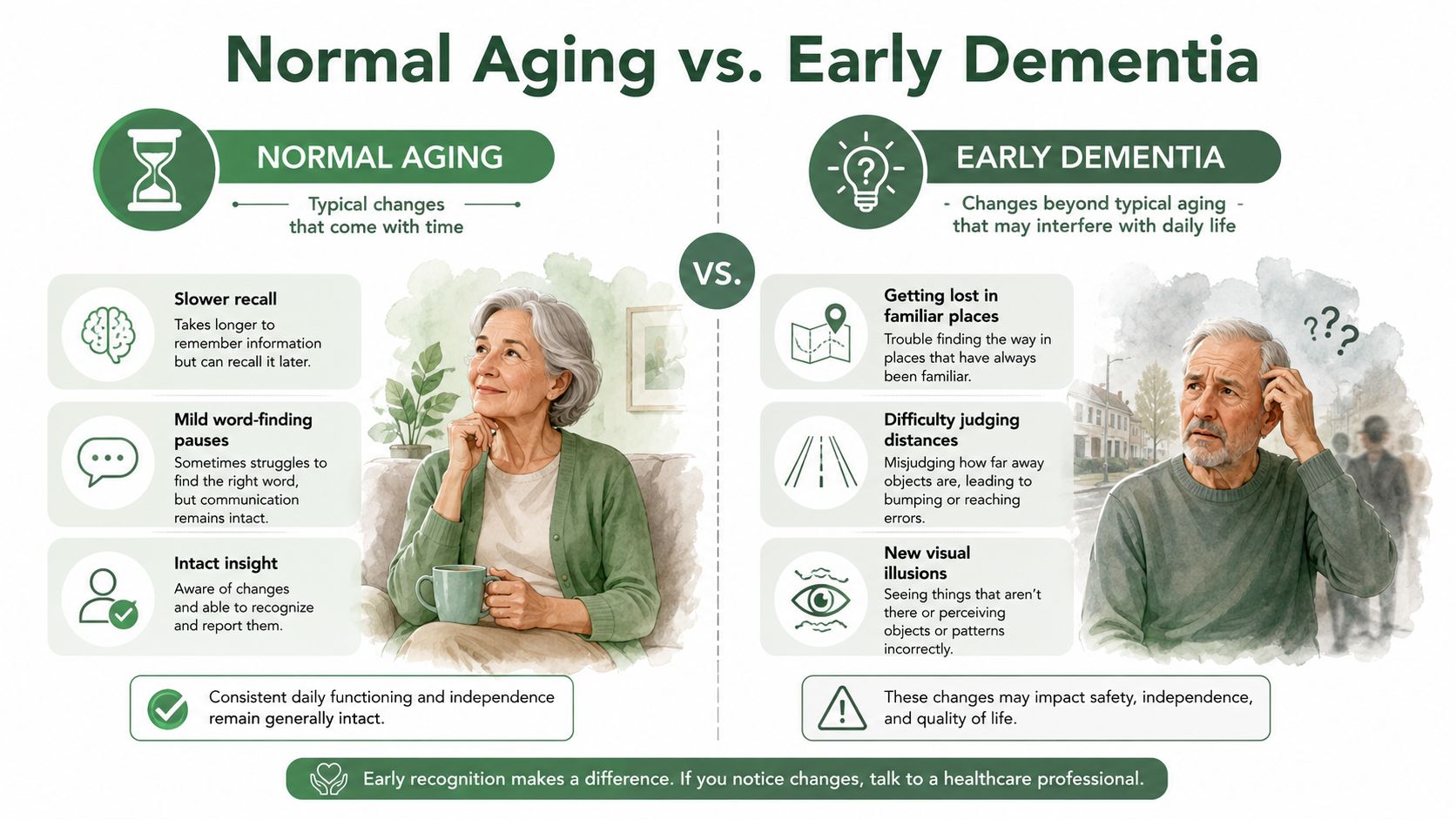
Normal aging and dementia can both affect spatial performance, but they don't produce the same pattern. Age often brings slower processing, while accuracy and specific spatial abilities may remain relatively stable. A healthy older adult might take longer to find a target in a busy scene or rotate an object mentally, yet still reach the correct answer.
The earlier meta-analysis found a large overall age effect, but it also showed that response time was more sensitive to age than accuracy. A 2023 adult lifespan study offered a more refined view, describing visuospatial abilities as largely preserved across adulthood, with general processing speed accounting for much of the cost. These findings mean that one low score shouldn't be treated as a complete description of a person's spatial functioning.
When the pattern becomes clinically important
Dementia-related change may be more disruptive, inconsistent, or progressive. A person may get lost in a familiar place, misjudge distances repeatedly, fail to recognize how objects fit together, or struggle with visual organization even when a memory conversation seems reassuring.
A 2026 nationally representative U.S. study found that about 11.33% of adults aged 65 and older had visuospatial impairment. Roughly half met criteria for mild cognitive impairment, and visuospatial impairment was often the only affected cognitive domain in the study's findings.
That result answers an important caregiver question: yes, meaningful visuospatial problems can exist even when memory tests look relatively okay. A person may recall a recent conversation but still have trouble finding the bathroom, judging a curb, or organizing objects on a counter.
Different dementia patterns
Visuospatial dysfunction can appear in Alzheimer's disease, dementia with Lewy bodies, vascular dementia, and posterior cortical atrophy. The combination of symptoms matters. Route-learning difficulties, visual hallucinations, problems taking another person's perspective, and prominent construction errors may point clinicians toward different diagnostic possibilities.
In dementia with Lewy bodies, poor baseline visuospatial performance has been associated with faster cognitive decline over a later follow-up period than in Alzheimer's disease, according to the reviewed clinical literature. This doesn't mean a single spatial mistake predicts a particular diagnosis. It means clinicians should consider which spatial skills are changing, when they changed, and what other symptoms appear with them.
Everyday Signs Caregivers Can Notice at Home
You don't need to give a formal test to notice meaningful changes. Watch what happens during ordinary routines, especially when the task requires placement, distance, direction, or navigation.
A single mistake is usually not enough to interpret. Look for repetition, increasing effort, new dependence, or a safety consequence.
Visuospatial subskill | Everyday sign to watch for | Safety implication |
|---|---|---|
Spatial perception | Missing the cup, pouring beside it, or misjudging a step | Spills, burns, and falls |
Spatial relations | Placing objects in the wrong location or confusing left and right | Medication, cooking, and household errors |
Mental rotation | Turning clothing, keys, or tools repeatedly without success | Frustration and loss of independence |
Spatial visualization | Struggling to fit familiar items into a drawer or bag | Clutter, dropped objects, and unsafe storage |
Spatial orientation | Taking a wrong turn on a familiar route | Getting lost while driving or walking |
Visual construction | Drawing a clock with misplaced numbers or hands | A signal to discuss broader assessment |
Depth and distance judgment | Sitting beside a chair, clipping a curb, or reaching too short | Near-falls and collisions |
The home as an observation setting
The kitchen often reveals subtle changes. A person may leave a pot on the wrong burner, place food on an unsteady surface, or struggle to arrange ingredients in the order needed for a familiar recipe. These moments can involve spatial organization, visual attention, or a combination of both.
Dressing offers another window. Trouble identifying the front and back of clothing, orienting sleeves, or sequencing garments may reflect more than forgetfulness. In the bathroom, a person might misjudge the position of the toilet or shower threshold, particularly in low light.
Driving and walking deserve careful attention. A driver may park unusually far from a curb, misjudge the width of a parking space, or need repeated prompts about left and right. A walker may hesitate at stairs, trip on changes in floor level, or step off a curb without judging the drop accurately.
Observation rule: Record the task, the exact error, the setting, and whether anyone needed to intervene. “Had trouble with stairs in dim light” gives a clinician more useful information than “seems spatially confused.”
For practical communication and dementia care approaches, The CNA Guide care strategies can help caregivers describe behaviors without turning every observation into an argument. Use calm prompts, avoid rushing, and protect dignity while you collect a clearer pattern.
How Clinicians Assess Visuospatial Function
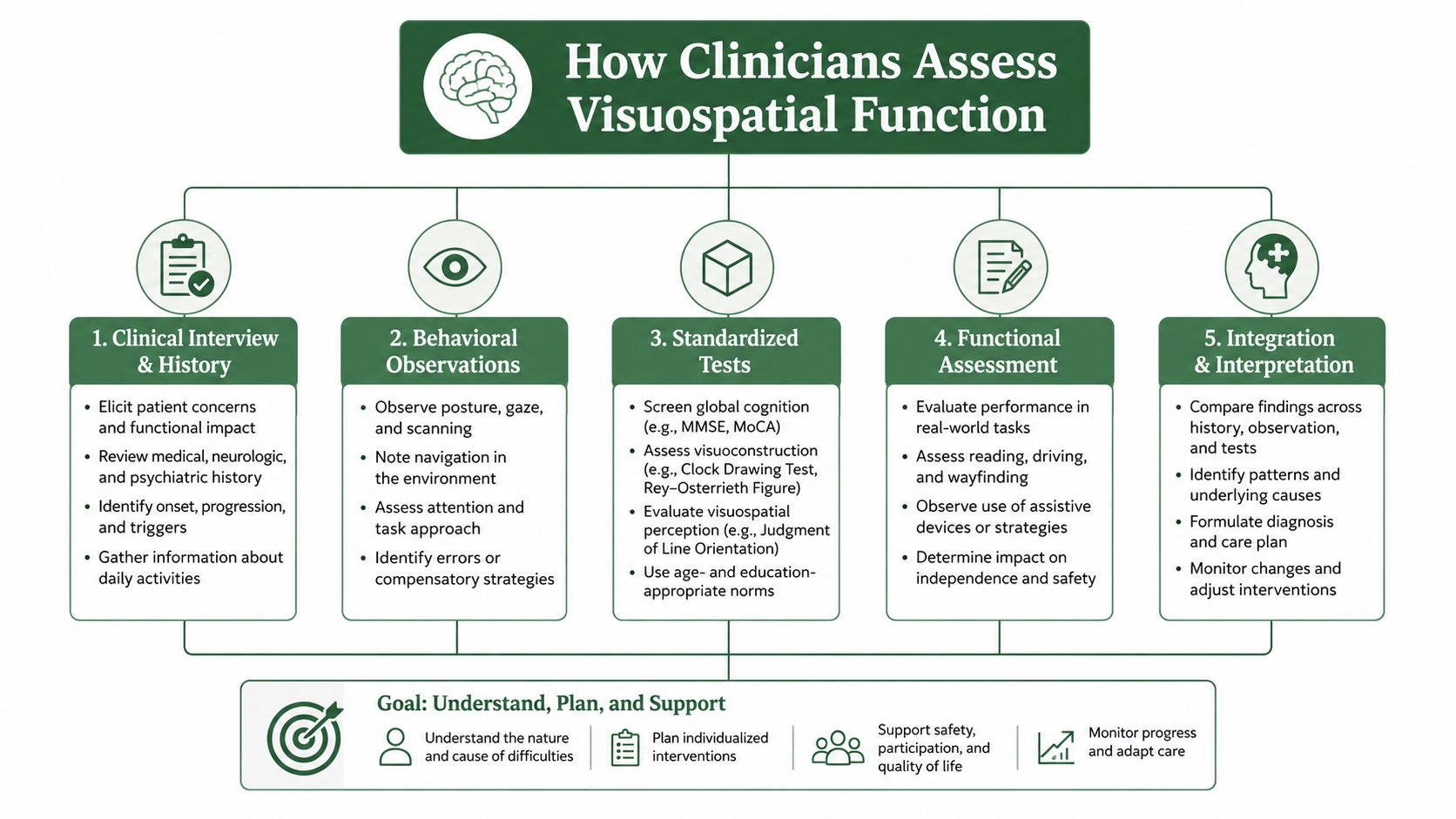
A clinician may begin with history rather than a test. Tell them where the difficulty occurs, whether it is new, whether it changes with lighting or fatigue, and whether it has affected driving, walking, cooking, dressing, or medication routines.
Brief screening tools can include clock drawing, construction tasks, and visual items included in broader cognitive screens. Clinicians may ask a person to copy shapes, place numbers and hands on a clock, or reproduce intersecting figures. These tasks are quick, but they don't explain every reason someone may struggle.
Brief screening compared with fuller testing
Assessment setting | What it can show | What it may miss |
|---|---|---|
Primary care screening | A possible construction or orientation problem | Detailed subskill differences |
Memory clinic evaluation | A broader cognitive pattern and functional context | Some real-world difficulties outside the appointment |
Neuropsychological assessment | Detailed comparison of spatial perception, memory, construction, and processing | The results still require functional interpretation |
Vision and mobility review | Depth, contrast, balance, and environmental contributors | Cognitive causes without cognitive testing |
A full neuropsychological battery may include Block Design, the Rey-Osterrieth Complex Figure copy and recall, Benton Visual Retention, Judgment of Line Orientation, and Doors and People. In dementia research, construction tasks such as Block Design and Clock Drawing have strong diagnostic utility, while Rey-Osterrieth recall and topographical tasks assess visuospatial memory. Benton Visual Retention and Doors and People have shown prognostic potential in the research review.
Testing should account for eyesight, hearing, education, language, motor limitations, anxiety, and familiarity with writing or drawing. A poor drawing doesn't automatically prove dementia, just as a good drawing doesn't rule it out. Families can also review practical mobility concerns through a structured fall risk assessment for older adults, especially when spatial errors occur alongside trips or near-falls.
Activities and Strategies That Support Visuospatial Skills
Support should combine practice with compensation. Activities may encourage attention to space, but environmental changes reduce risk immediately.
A familiar route can become a voice-based exercise. Ask the person to describe the trip to the grocery store, including landmarks, turns, and what comes after the pharmacy. If they get stuck, offer one cue rather than supplying the entire route. This can be done during a phone call without requiring an app or screen.
Mental imagery and orientation
Try prompts that use the internal map:
Route description: “What do you see after you leave the driveway?”
Room mapping: “Which room is next to the kitchen?”
Object rotation: “If the handle points left, how would you turn the mug to point right?”
Recipe preview: “What will you need before you begin cooking?”
Use consistent environmental cues as well. Keep keys and glasses in one visible location. Label drawers with words or pictures. Use contrasting placemats so a plate stands out from the table, turn the labeled side of a pill bottle toward the user, and add nightlights where shadows make steps harder to judge.
Construction and movement
Simple jigsaw puzzles, folding laundry into matched sets, arranging table settings, copying a clock face, and sorting objects by location can engage construction and spatial relations. Choose familiar activities that feel purposeful rather than childish. Stop when frustration rises, and praise the strategy used, not just the result.
Visual construction is also tied to falls risk. A population-based study found that visual construction remained independently associated with falls after adjustment for executive function, attention, and memory. The study also identified problems with depth perception and fine spatial resolution, including stereoacuity worse than 85 arcseconds and reduced contrast sensitivity at 18 cycles per degree, as relevant visual risk factors in the reported findings.
Safety first: Don't use puzzles or mental exercises to justify continued driving, unsupervised stair use, or independent medication management when real-world errors are increasing.
For people who need more structured wayfinding support, the Waymap accessibility product guide offers examples of tools designed around accessible navigation. Technology can assist, but a clinician should assess sudden or worsening spatial problems.
How Phone-Based Cognitive Support Fits In
Phone-based support can provide a regular observation layer between family visits and medical appointments. A trained caller might ask about the date and location, invite the older adult to describe a familiar route, or discuss whether a recent trip involved confusion, a missed turn, or an unexpected need for help.
A useful call can also include practical questions:
Wayfinding: “Did you go anywhere today, and how did you get there?”
Household safety: “Did you use the stove, and did everything get turned off?”
Medication routine: “Where do you keep your medications, and what helps you remember them?”
Mobility: “Have you tripped, felt unsteady, or avoided a step because it looked unsafe?”
Well-being: “Have you felt worried or alone today?”

The value comes from consistency and pattern recognition, not from treating a phone conversation as a diagnosis. A dedicated care manager can coordinate observations, while protocols reviewed by a licensed neurologist can help keep activities appropriate to a person's cognitive stage and health needs. Families may also find practical tools through resources about senior caregiver apps for medication safety, while remembering that reminders don't replace supervision when risk is high.
A dementia-specific clock test has also been used to distinguish groups with different fall risks, with the higher-risk group reported to be about three times more likely to fall than the lower-risk group in the study findings. If calls repeatedly surface falls, hallucinations, getting lost, stove concerns, or a sharp change in spatial responses, the care team should notify the family and recommend clinical follow-up.
For a broader explanation of how recurring calls can support daily cognitive care, see how Velma works as daily cognitive support.
When to Seek Professional Evaluation
Arrange a clinical evaluation if someone gets lost in familiar places, has a fall or repeated near-falls, misjudges depth suddenly, struggles with everyday tools, develops visual hallucinations, or shows a noticeable decline in clock drawing or construction tasks over weeks or months. One missed turn alone doesn't establish a problem, but a repeated pattern does deserve attention.
Visuospatial problems can appear before obvious memory decline, and they don't point to only one dementia type. Phone-based support can document patterns and prompt escalation, but it can't diagnose the cause. Bring concrete examples, medication information, vision concerns, and recent safety events to the appointment.
Velma offers scheduled phone calls with cognitive exercises, orientation prompts, companionship, and practical safety check-ins for older adults experiencing memory loss. Visit Velma to learn how consistent phone-based support can help your family notice visuospatial changes earlier and maintain safer daily routines.
Your father takes the wrong exit on a road he has driven for years. At home, your mother searches for her glasses while they're resting beside her plate. Later, she pours water beside the glass instead of into it. None of these moments looks exactly like forgetting a name or missing an appointment, but each may involve the brain's ability to understand where things are, how far away they are, and how they fit together.
These are visuospatial abilities. They help a person find their way, judge distance, recognize layouts, position objects, and mentally manipulate shapes. When they change, the effects can reach driving, walking, dressing, cooking, medication routines, and independent living.
Visuospatial changes can also appear alongside, or sometimes before, more familiar memory problems. Families who track these everyday patterns can give clinicians more useful information than a general statement such as “they seem confused.” The broader context of cognitive decline in older adults becomes clearer when caregivers look at memory, attention, language, and spatial functioning together.
Table of Contents
When the Map in the Mind Starts to Fade
A measurable cognitive domain
What Visuospatial Abilities Actually Are
The inner ruler
The mental rotating hand
The internal map
How Aging and Dementia Affect These Skills
When the pattern becomes clinically important
Different dementia patterns
Everyday Signs Caregivers Can Notice at Home
The home as an observation setting
How Clinicians Assess Visuospatial Function
Brief screening compared with fuller testing
Activities and Strategies That Support Visuospatial Skills
Mental imagery and orientation
Construction and movement
How Phone-Based Cognitive Support Fits In
When to Seek Professional Evaluation
When the Map in the Mind Starts to Fade
Your mother leaves the grocery store and turns toward home. She knows the neighborhood, recognizes the shopping center, and remembers that the house is near a park. Yet she takes the wrong exit, becomes uncertain about which lane to use, and can't explain why the familiar route suddenly feels unfamiliar.
That experience may involve more than memory. The brain has to hold a mental map, connect landmarks to directions, judge distances, understand turns, and update the route as the car moves. Those operations depend on visuospatial abilities.
The same system helps someone find a black wallet on a dark countertop, place a saucepan on the correct burner, step over a threshold, or line up a key with a lock. A person may remember what an object is but struggle to understand where it is in relation to other objects. They may know that a chair is present but misjudge its position when sitting down.
A measurable cognitive domain
Visuospatial ability has a long history as a distinct area of cognitive study. By 1880 to 1940, researchers had increasingly defined it as an independent mental ability, and later work divided it into subtypes such as spatial perception, visualization, mental rotation, spatial relations, and spatial orientation in this historical review.
A 2014 meta-analysis examined 137 effect sizes from 80 samples and found a large average age-related difference in spatial performance, with Cohen's d = 1.01, when comparing older adults aged roughly 63 to 79.5 with younger adults aged roughly 17 to 28.6. Response-time measures showed larger age effects than accuracy measures, which suggests that slowing may be a central part of age-related change rather than every task producing immediate, obvious errors as reported in the analysis.
That distinction matters. A loved one may complete a task correctly but take much longer, need more prompting, or become overwhelmed when the environment changes. Careful observation can reveal whether a difficulty is occasional and manageable or part of a growing pattern that affects safety and independence.
What Visuospatial Abilities Actually Are
Think of visuospatial abilities as the brain's internal navigation system. It works like a map, ruler, camera, and rotating hand at the same time. You use it even when you aren't consciously thinking about space.
The domain isn't one isolated skill. It's a group of related abilities that work together, and a person can have difficulty with one while performing reasonably well on another.
The inner ruler
Spatial perception helps a person judge distance, depth, size, and position. It supports stepping off a curb, reaching for a cup, pouring liquid, and deciding whether a car can fit through a space. A change here may look like bumping into doorframes or placing objects too close to an edge.
Spatial relations describe how objects sit in relation to one another and to the person observing them. Setting a table requires knowing where the plate belongs relative to the fork, glass, and chair. Following “place the box to the left of the lamp” also relies on this ability.
The mental rotating hand
Mental rotation allows someone to imagine an object turned in space. It helps with inserting a key, orienting a piece of clothing, fitting luggage into a trunk, or understanding an object from a different viewpoint.
Spatial visualization is more complex. It involves mentally assembling, folding, or rearranging parts into a whole. A person uses it when following furniture instructions, imagining how a drawer fits, or determining which way a folded towel should be turned.
The internal map
Spatial orientation helps a person understand their own position in an environment. Topographical memory supports remembering routes, landmarks, and layouts. These skills work together when someone walks from a bedroom to the bathroom at night or travels to a familiar store.
A caregiver might label the signs this way:
Perception: The person misjudges the step down from a porch.
Relations: The person puts the plate too close to the table edge.
Rotation: The person can't turn a shirt around to put it on.
Visualization: The person struggles to fit familiar containers into a cupboard.
Orientation: The person loses the route from a familiar room to the kitchen.
This classification isn't a diagnosis. It gives you clearer language for describing what you've seen. Modern research treats visuospatial abilities as a set of measurable subskills, not as a single vague capacity.
How Aging and Dementia Affect These Skills
Normal aging and dementia can both affect spatial performance, but they don't produce the same pattern. Age often brings slower processing, while accuracy and specific spatial abilities may remain relatively stable. A healthy older adult might take longer to find a target in a busy scene or rotate an object mentally, yet still reach the correct answer.
The earlier meta-analysis found a large overall age effect, but it also showed that response time was more sensitive to age than accuracy. A 2023 adult lifespan study offered a more refined view, describing visuospatial abilities as largely preserved across adulthood, with general processing speed accounting for much of the cost. These findings mean that one low score shouldn't be treated as a complete description of a person's spatial functioning.
When the pattern becomes clinically important
Dementia-related change may be more disruptive, inconsistent, or progressive. A person may get lost in a familiar place, misjudge distances repeatedly, fail to recognize how objects fit together, or struggle with visual organization even when a memory conversation seems reassuring.
A 2026 nationally representative U.S. study found that about 11.33% of adults aged 65 and older had visuospatial impairment. Roughly half met criteria for mild cognitive impairment, and visuospatial impairment was often the only affected cognitive domain in the study's findings.
That result answers an important caregiver question: yes, meaningful visuospatial problems can exist even when memory tests look relatively okay. A person may recall a recent conversation but still have trouble finding the bathroom, judging a curb, or organizing objects on a counter.
Different dementia patterns
Visuospatial dysfunction can appear in Alzheimer's disease, dementia with Lewy bodies, vascular dementia, and posterior cortical atrophy. The combination of symptoms matters. Route-learning difficulties, visual hallucinations, problems taking another person's perspective, and prominent construction errors may point clinicians toward different diagnostic possibilities.
In dementia with Lewy bodies, poor baseline visuospatial performance has been associated with faster cognitive decline over a later follow-up period than in Alzheimer's disease, according to the reviewed clinical literature. This doesn't mean a single spatial mistake predicts a particular diagnosis. It means clinicians should consider which spatial skills are changing, when they changed, and what other symptoms appear with them.
Everyday Signs Caregivers Can Notice at Home
You don't need to give a formal test to notice meaningful changes. Watch what happens during ordinary routines, especially when the task requires placement, distance, direction, or navigation.
A single mistake is usually not enough to interpret. Look for repetition, increasing effort, new dependence, or a safety consequence.
Visuospatial subskill | Everyday sign to watch for | Safety implication |
|---|---|---|
Spatial perception | Missing the cup, pouring beside it, or misjudging a step | Spills, burns, and falls |
Spatial relations | Placing objects in the wrong location or confusing left and right | Medication, cooking, and household errors |
Mental rotation | Turning clothing, keys, or tools repeatedly without success | Frustration and loss of independence |
Spatial visualization | Struggling to fit familiar items into a drawer or bag | Clutter, dropped objects, and unsafe storage |
Spatial orientation | Taking a wrong turn on a familiar route | Getting lost while driving or walking |
Visual construction | Drawing a clock with misplaced numbers or hands | A signal to discuss broader assessment |
Depth and distance judgment | Sitting beside a chair, clipping a curb, or reaching too short | Near-falls and collisions |
The home as an observation setting
The kitchen often reveals subtle changes. A person may leave a pot on the wrong burner, place food on an unsteady surface, or struggle to arrange ingredients in the order needed for a familiar recipe. These moments can involve spatial organization, visual attention, or a combination of both.
Dressing offers another window. Trouble identifying the front and back of clothing, orienting sleeves, or sequencing garments may reflect more than forgetfulness. In the bathroom, a person might misjudge the position of the toilet or shower threshold, particularly in low light.
Driving and walking deserve careful attention. A driver may park unusually far from a curb, misjudge the width of a parking space, or need repeated prompts about left and right. A walker may hesitate at stairs, trip on changes in floor level, or step off a curb without judging the drop accurately.
Observation rule: Record the task, the exact error, the setting, and whether anyone needed to intervene. “Had trouble with stairs in dim light” gives a clinician more useful information than “seems spatially confused.”
For practical communication and dementia care approaches, The CNA Guide care strategies can help caregivers describe behaviors without turning every observation into an argument. Use calm prompts, avoid rushing, and protect dignity while you collect a clearer pattern.
How Clinicians Assess Visuospatial Function
A clinician may begin with history rather than a test. Tell them where the difficulty occurs, whether it is new, whether it changes with lighting or fatigue, and whether it has affected driving, walking, cooking, dressing, or medication routines.
Brief screening tools can include clock drawing, construction tasks, and visual items included in broader cognitive screens. Clinicians may ask a person to copy shapes, place numbers and hands on a clock, or reproduce intersecting figures. These tasks are quick, but they don't explain every reason someone may struggle.
Brief screening compared with fuller testing
Assessment setting | What it can show | What it may miss |
|---|---|---|
Primary care screening | A possible construction or orientation problem | Detailed subskill differences |
Memory clinic evaluation | A broader cognitive pattern and functional context | Some real-world difficulties outside the appointment |
Neuropsychological assessment | Detailed comparison of spatial perception, memory, construction, and processing | The results still require functional interpretation |
Vision and mobility review | Depth, contrast, balance, and environmental contributors | Cognitive causes without cognitive testing |
A full neuropsychological battery may include Block Design, the Rey-Osterrieth Complex Figure copy and recall, Benton Visual Retention, Judgment of Line Orientation, and Doors and People. In dementia research, construction tasks such as Block Design and Clock Drawing have strong diagnostic utility, while Rey-Osterrieth recall and topographical tasks assess visuospatial memory. Benton Visual Retention and Doors and People have shown prognostic potential in the research review.
Testing should account for eyesight, hearing, education, language, motor limitations, anxiety, and familiarity with writing or drawing. A poor drawing doesn't automatically prove dementia, just as a good drawing doesn't rule it out. Families can also review practical mobility concerns through a structured fall risk assessment for older adults, especially when spatial errors occur alongside trips or near-falls.
Activities and Strategies That Support Visuospatial Skills
Support should combine practice with compensation. Activities may encourage attention to space, but environmental changes reduce risk immediately.
A familiar route can become a voice-based exercise. Ask the person to describe the trip to the grocery store, including landmarks, turns, and what comes after the pharmacy. If they get stuck, offer one cue rather than supplying the entire route. This can be done during a phone call without requiring an app or screen.
Mental imagery and orientation
Try prompts that use the internal map:
Route description: “What do you see after you leave the driveway?”
Room mapping: “Which room is next to the kitchen?”
Object rotation: “If the handle points left, how would you turn the mug to point right?”
Recipe preview: “What will you need before you begin cooking?”
Use consistent environmental cues as well. Keep keys and glasses in one visible location. Label drawers with words or pictures. Use contrasting placemats so a plate stands out from the table, turn the labeled side of a pill bottle toward the user, and add nightlights where shadows make steps harder to judge.
Construction and movement
Simple jigsaw puzzles, folding laundry into matched sets, arranging table settings, copying a clock face, and sorting objects by location can engage construction and spatial relations. Choose familiar activities that feel purposeful rather than childish. Stop when frustration rises, and praise the strategy used, not just the result.
Visual construction is also tied to falls risk. A population-based study found that visual construction remained independently associated with falls after adjustment for executive function, attention, and memory. The study also identified problems with depth perception and fine spatial resolution, including stereoacuity worse than 85 arcseconds and reduced contrast sensitivity at 18 cycles per degree, as relevant visual risk factors in the reported findings.
Safety first: Don't use puzzles or mental exercises to justify continued driving, unsupervised stair use, or independent medication management when real-world errors are increasing.
For people who need more structured wayfinding support, the Waymap accessibility product guide offers examples of tools designed around accessible navigation. Technology can assist, but a clinician should assess sudden or worsening spatial problems.
How Phone-Based Cognitive Support Fits In
Phone-based support can provide a regular observation layer between family visits and medical appointments. A trained caller might ask about the date and location, invite the older adult to describe a familiar route, or discuss whether a recent trip involved confusion, a missed turn, or an unexpected need for help.
A useful call can also include practical questions:
Wayfinding: “Did you go anywhere today, and how did you get there?”
Household safety: “Did you use the stove, and did everything get turned off?”
Medication routine: “Where do you keep your medications, and what helps you remember them?”
Mobility: “Have you tripped, felt unsteady, or avoided a step because it looked unsafe?”
Well-being: “Have you felt worried or alone today?”
The value comes from consistency and pattern recognition, not from treating a phone conversation as a diagnosis. A dedicated care manager can coordinate observations, while protocols reviewed by a licensed neurologist can help keep activities appropriate to a person's cognitive stage and health needs. Families may also find practical tools through resources about senior caregiver apps for medication safety, while remembering that reminders don't replace supervision when risk is high.
A dementia-specific clock test has also been used to distinguish groups with different fall risks, with the higher-risk group reported to be about three times more likely to fall than the lower-risk group in the study findings. If calls repeatedly surface falls, hallucinations, getting lost, stove concerns, or a sharp change in spatial responses, the care team should notify the family and recommend clinical follow-up.
For a broader explanation of how recurring calls can support daily cognitive care, see how Velma works as daily cognitive support.
When to Seek Professional Evaluation
Arrange a clinical evaluation if someone gets lost in familiar places, has a fall or repeated near-falls, misjudges depth suddenly, struggles with everyday tools, develops visual hallucinations, or shows a noticeable decline in clock drawing or construction tasks over weeks or months. One missed turn alone doesn't establish a problem, but a repeated pattern does deserve attention.
Visuospatial problems can appear before obvious memory decline, and they don't point to only one dementia type. Phone-based support can document patterns and prompt escalation, but it can't diagnose the cause. Bring concrete examples, medication information, vision concerns, and recent safety events to the appointment.
Velma offers scheduled phone calls with cognitive exercises, orientation prompts, companionship, and practical safety check-ins for older adults experiencing memory loss. Visit Velma to learn how consistent phone-based support can help your family notice visuospatial changes earlier and maintain safer daily routines.
Suggested Article: