A Guide to Fall Risk Assessment for Elderly Adults

A fall risk assessment is much more than a one-time checkup. It’s a proactive strategy to figure out why an older adult might fall and, more importantly, what we can do to prevent it.
Think of it less like a single exam and more like an ongoing conversation between a person, their family, and their healthcare team.
Table of Contents
What Is a Fall Risk Assessment and Why It Matters
Screening Versus Comprehensive Assessment
Comparison: Screening Versus Comprehensive Assessment
Practical Screening Steps for Caregivers
A Simple Home-Safety Checklist
Understanding Fall Risks Unique to Dementia
When Behavior Signals Matter
Simple Home and Caregiver Checks
Home Safety Checklist for Dementia
When to Escalate and How to Monitor Ongoing Risk
Practical Screening Tools You Can Use at Home
Timed Up And Go And Other Quick Tests
Medication And Sensory Screening
Home Safety And Communication Plan
When To Seek Professional Evaluation
How to Create a Dementia-Friendly Safe Home
Using Phone Check-Ins For Ongoing Monitoring
How Calls Spot Risk Early
Simple Phone Screening Steps Caregivers Can Use
Patterns, Documentation, and Escalation
Practical Integration with Family Care
Turning Your Assessment into a Coordinated Care Plan
Communicating With Doctors and Families
Home Safety Checklist and Conversation Tips
When to Seek Professional Help
Ongoing Phone Monitoring and Coordination
Common Questions About Fall Prevention and Dementia
How often should we reassess fall risk for someone with dementia?
My parent resists using their walker. What can I do?
What is the difference between normal aging and dementia-related fall risk?
Which simple caregiver-friendly screens work at home?
How do I make a usable home-safety checklist?
When should we call a professional?
How can phone-based monitoring help detect risks early?
What Is a Fall Risk Assessment and Why It Matters
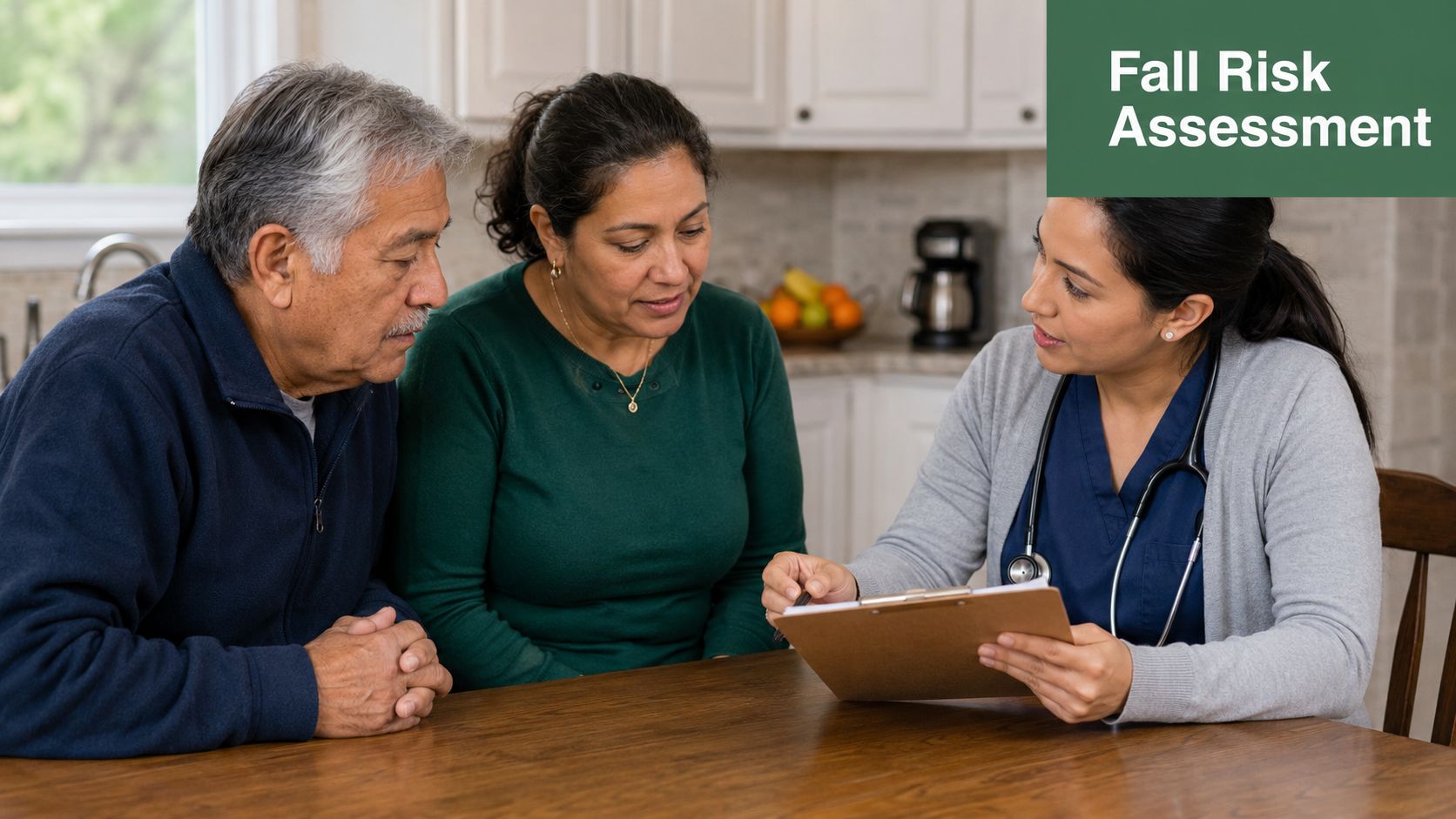
A good fall risk assessment builds a complete picture of an individual's risk by looking at their medical history, mobility, cognitive function, medications, and home environment all at once. It’s like putting together a puzzle where each piece—blurry vision, a slight shuffle in their walk, a new blood pressure pill, or a loose rug—adds to the final image.
This really matters. Falls are a leading cause of serious injury and loss of independence among older adults. In fact, they are the second leading cause of unintentional injury deaths worldwide, with an estimated 684,000 fatal falls each year. You can get the full picture from the World Health Organization's report on falls.
So, what does a practical assessment actually look for? It usually covers these key areas:
Medical Review: This flags conditions that can affect stability, like arthritis, Parkinson’s, or low blood pressure. It also takes into account any recent hospitalizations, which can temporarily weaken a person.
Mobility and Balance Checks: Simple observations can reveal a lot, such as how steady someone is on their feet, how quickly they walk, or if they struggle to get up from a chair.
Cognitive Screening: Changes in memory, attention, or spatial awareness can make it harder to spot and react to potential hazards in the environment.
Medication Audit: Many common drugs can cause side effects like dizziness, drowsiness, or sudden drops in blood pressure, all of which increase fall risk.
Home Environment Review: This is a physical check of the living space to find and fix common trip hazards like poor lighting, cluttered walkways, or a lack of handrails.
Screening Versus Comprehensive Assessment
It's important to understand the difference between a quick check and a deep dive. A quick screening is great for catching obvious red flags, while a full assessment is designed to uncover the complex, interconnected causes of fall risk.
A quick screen helps decide if there's a problem. A multifactorial assessment explains why there's a problem and how to fix it.
Here’s a simple breakdown of the two approaches.
Comparison: Screening Versus Comprehensive Assessment
Feature | Quick Screening | Multifactorial Assessment |
|---|---|---|
Time | 1–10 minutes | 30–90 minutes |
Who Can Do It | Caregiver or clinician | An interdisciplinary team (e.g., doctor, physical therapist) |
Focus | Fall history, basic mobility observation | In-depth gait analysis, medication review, vision tests, and often a home visit |
Outcome | Decides if a full assessment is needed | A personalized prevention plan with specific actions |
A comprehensive assessment provides the detailed, customized plan needed for truly effective fall prevention.
Practical Screening Steps for Caregivers
You don’t have to be a doctor to spot potential warning signs. Here are a few simple things any caregiver can do:
Timed Up and Go (TUG) Test: Ask the person to stand up from a chair, walk 10 feet (about 3 meters), turn around, walk back, and sit down. If it takes them more than 12–13 seconds, it could indicate an increased fall risk.
Observe Their Gait and Balance: Watch for subtle cues when they walk. Are they shuffling their feet, not swinging their arms, taking uneven steps, or hesitating when they turn?
Review Their Medications: Make a list of all their prescriptions and over-the-counter drugs. Pay special attention to anything that causes sleepiness (sedatives) or dizziness (like some blood pressure meds).
Check on Vision and Hearing: Simply ask if they’ve noticed any recent changes. When sight and hearing are impaired, it's much harder to notice hazards.
A Simple Home-Safety Checklist
Creating a safer home environment is one of the most effective ways to prevent falls. Here’s where to start:
Remove loose rugs, cords, and general clutter from all walking paths.
Install grab bars in the bathroom and make sure all stair railings are secure.
Improve lighting, especially for nighttime trips to the bathroom, and use contrast tape on the edges of steps.
Keep frequently used items (like the remote or a favorite cup) within easy reach to prevent stretching or climbing.
Once you’ve identified risks, the next step is to talk about them. Share your findings with family members and the person’s doctor. If you've spotted multiple risk factors, it's time to schedule a professional assessment. From there, regular phone check-ins can help you monitor for any new changes, allowing you to catch subtle declines before they lead to a fall.
Understanding Fall Risks Unique to Dementia
Dementia reshapes how someone perceives and navigates the world around them. That means a standard fall risk assessment won't cut it — you need a different approach entirely.
Memory loss can cause someone to forget they own a walker, or forget why they need one. It's like having a map that keeps getting folded the wrong way — the information is there, but it's not accessible when it matters. This leads to repeated near-misses that never get reported, so caregivers have to watch behavior patterns instead of waiting for someone to admit they're struggling.
Visuospatial changes alter how a person sees depth, distance, and spatial relationships. A cluttered room they've known for years might feel perfectly safe, while a freshly cleared space suddenly feels unfamiliar and threatening. This is exactly why well-meaning efforts to "declutter" can backfire and actually increase fall risk.
Medications used to manage dementia and other conditions frequently cause dizziness or drowsiness. A medication review matters just as much as a mobility check — a simple pill change can turn someone who was walking steadily into someone who's suddenly unsteady. In clinical practice, assessment often starts with three straightforward questions about falls, unsteadiness, or fear of falling, then moves into a multifactorial review of gait, balance, medications, vision, and home hazards. For broader context on fall screening, the World Health Organization has published detailed findings Read more about falls and screening on WHO.
When Behavior Signals Matter
Behavioral cues often serve as the earliest warning system. Pacing at sundown, suddenly refusing to use mobility aids, or obsessively repeating the same routes can all precede actual physical slips.
Watch for changes in routine that increase exposure to hazards.
Note hesitation during transitions, like standing up from a chair.
Track repeated "near-falls" that the person forgets to mention.
Observing patterns over days is often more revealing than a single mobility test.
Simple Home and Caregiver Checks
Use caregiver-friendly screenings that mirror what clinicians do in a home setting.
Timed Up and Go (TUG) — a quick mobility snapshot; over 12–13 seconds suggests concern.
Gait and balance cues — look for shuffling, asymmetry, or limited arm swing.
Medication review — list all drugs and flag sedatives or blood pressure medicines.
Vision and hearing checks — ask whether seeing or hearing has changed recently.
Here's a real-world example: Mrs. L forgot her cane three times in one week and started pacing more at dusk. A TUG that took 15 seconds, combined with a new sleep medication, pointed to an immediate medication review and better nighttime lighting as the first steps.
Home Safety Checklist for Dementia
Improve lighting along the most-used paths with night lights and consistent bulbs.
Secure rugs and mark step edges with contrasting tape to help depth perception.
Keep frequently used items within reach to reduce risky stretching or climbing.
Maintain familiar layouts where possible; small, incremental changes work better than big reorganizations.
When to Escalate and How to Monitor Ongoing Risk
Seek professional evaluation when you notice a sudden gait change, repeated falls, or rapid cognitive decline. Ongoing phone-based monitoring adds another layer — regular check-ins can surface mood shifts, confusion about medications, or reports of near-misses. These calls help detect patterns, alert a care manager, and prompt timely interventions before a crisis develops.
You might be interested in learning practical caregiving techniques in our training resource Learn more about dementia care training at Velma.
Practical Screening Tools You Can Use at Home
You don't need clinical training to start a meaningful fall risk assessment for an elderly loved one. Simple, evidence-informed checks give you a working snapshot of mobility, balance, cognition, medications, and the home environment. Think of them as a compass — they won't map every detail, but they'll point you toward areas that deserve a closer look.
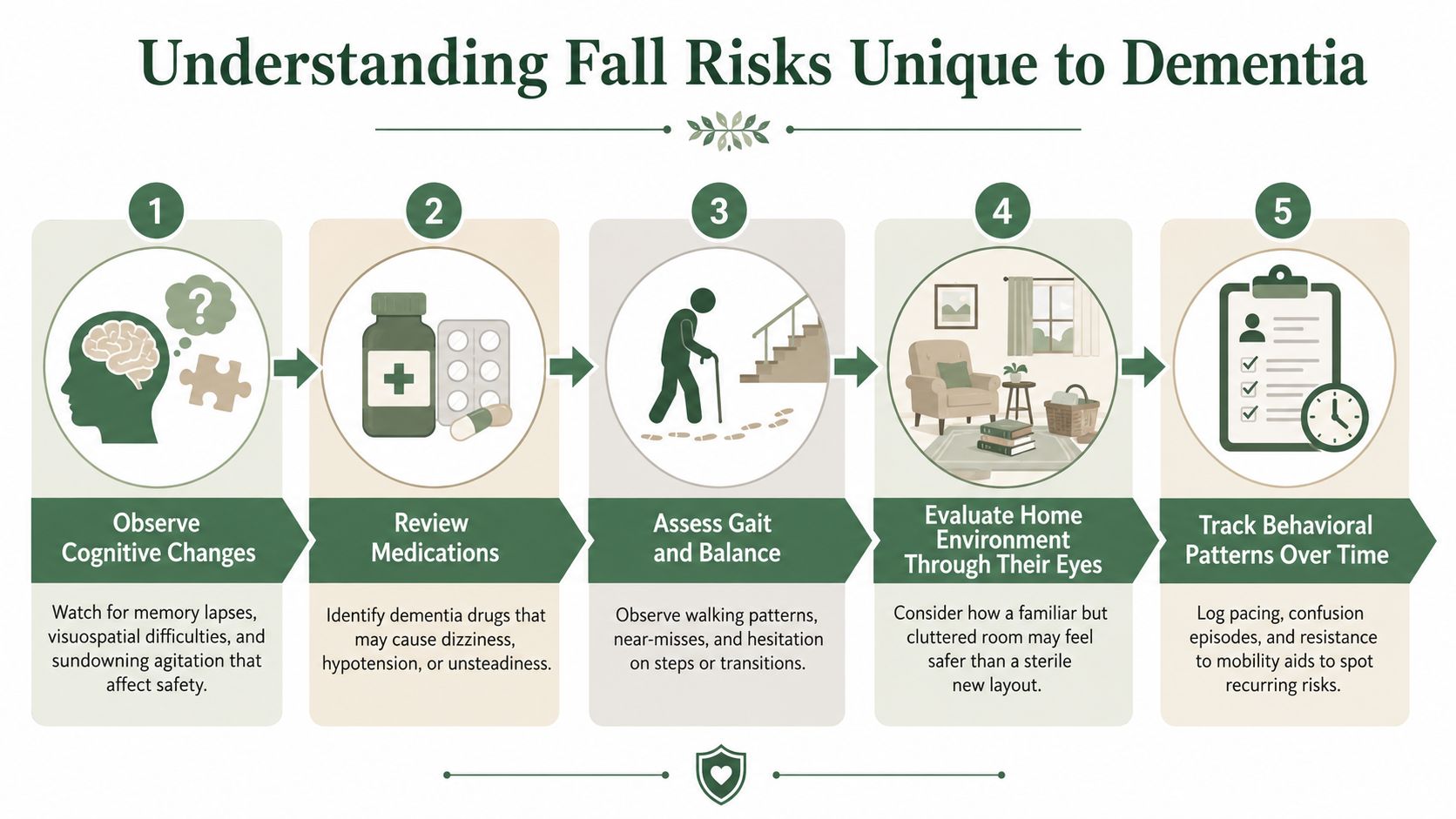
This infographic lays out a dementia-aware assessment flow — cognitive observation, medication review, gait checks, environmental evaluation, and pattern tracking — that surfaces risks the person may not report on their own.
What the visualization really drives home is how cognition, medications, movement, environment, and behavior interact and shift risk over time. Small, repeated observations often tell you far more than any single in-person test ever could.
Timed Up And Go And Other Quick Tests
Timed Up and Go (TUG) is a natural place to start. Ask the person to rise from a chair, walk about 10 feet, turn around, walk back, and sit down. If it takes longer than 12–13 seconds, flag that as a concern and pair it with other observations you're making. When working with someone who has dementia, keep your prompts short and calm, and demonstrate each step once before asking them to try.
A few other quick checks worth trying:
5-times sit-to-stand to get a feel for lower-body strength and endurance.
Single-leg or tandem stance held briefly to catch balance deficits early.
Observe arm swing and protective reactions — watch how they respond during a small intentional nudge or when catching their balance unexpectedly.
Quick tests act like spot-checks for balance systems. Mismatches between strength, reaction time, and confidence are the red flags you're watching for.
Medication And Sensory Screening
Medications deserve serious attention here. A surprisingly large number of common drugs cause dizziness or drowsiness, so list every prescription and over-the-counter medication, then flag anything sedative-related, any antihypertensives, and any recent dose changes.
Pair that medication review with straightforward vision and hearing questions. Something as simple as "Has reading gotten harder lately?" or "Are you turning the TV up more than you used to?" can reveal sensory declines that quietly increase fall risk.
For deeper guidance on activity and balance recommendations — including how exercise ties directly into risk reduction — check out this resource on recommended activity and balance training from NCBI.
A few activity benchmarks worth keeping in mind:
Aim for 150 minutes of moderate aerobic activity per week, plus muscle-strengthening twice weekly.
Add balance training on three or more days for those already at elevated risk.
Home Safety And Communication Plan
Keep a short, repeatable home checklist handy:
Clear primary walking paths and remove loose rugs or clutter.
Improve lighting along routes used at night, especially between the bedroom and bathroom.
Add grab bars near toilets and showers.
Keep frequently used items within easy reach so nobody has to stretch or climb.
When something catches your eye, jot it down briefly and share it with family or the clinician. A simple three-step format keeps things clear: 1) what you saw, 2) when it happened, and 3) your suggested next step — whether that's a medication review, a physical therapy referral, or a quick home fix.
When To Seek Professional Evaluation
Repeated near-misses, a TUG result over 13 seconds, a sudden change in how someone walks, or multiple medication concerns all warrant a professional multifactorial assessment. From there, physical therapy can target balance and strength work specifically.
Phone-based monitoring through regular check-ins adds another layer. These conversations can pick up on shifts in mood, confusion around medications, or new hesitancy when walking — early signals that prompt timely action and better coordination with care managers.
How to Create a Dementia-Friendly Safe Home

Making a home safe for someone living with dementia is a lot like tuning a familiar instrument — you make small adjustments that bring out the best in something already known, without changing the melody they've always relied on.
Start by walking through the home the way they do. Think of this as a practical pathway audit: follow their usual routes from bedroom to bathroom, kitchen to living room, and pay attention to awkward transitions, dim corners, or spots where they pause or turn slowly. This reveals real hazards instead of theoretical ones you might guess at.
Lighting is one of the highest-impact changes you can make. Boost consistent, glare-free light along corridors and near doorways to help with depth perception. Place night lights along the most-used paths so that midnight bathroom trips don't become disorienting or frightening.
Rugs and floor coverings need a close look. Secure or remove loose rugs along common walking routes. A strip of contrast tape on step edges acts like a visual marker, helping the brain judge depth and changes in level more accurately.
Bathrooms tend to be the riskiest room in the house. Install grab bars near the toilet and in the shower, positioned to match the person's reach and standing patterns. Add a non-slip mat and a simple visual cue — like a brightly colored towel on a contrasting hook — to reduce confusion about where to sit or hold on.
Keep furniture where it's always been. Major reorganization can feel disorienting, so make incremental changes that preserve familiar landmarks. If a favorite chair and lamp have sat in the same spot for years, leave them there. Then add a small, stable side table to keep essentials within reach.
Small, familiar cues reduce confusion and support independence far better than sweeping, impersonal overhauls.
Simple environmental controls work best when paired with regular caregiver attention. Try running through a short weekly checklist:
Scan primary walking routes for new clutter and clear it out.
Test night lighting and swap out burnt bulbs right away.
Give grab bars and railings a firm pull to confirm they're still secure.
Keep frequently used items within easy reach so nobody has to stretch or climb.
Practical screening steps can go hand in hand with home modifications. If it's safe to do so, run a quick Timed Up and Go test and watch for gait cues like shuffling feet, reduced arm swing, or hesitation on turns. Review medications for sedatives or blood pressure changes that could worsen balance. Check vision and hearing regularly — even a straightforward question like "Have you been reading more slowly lately?" can surface sensory decline early.
Real examples make this tangible. When Mrs. K started hesitating at her hallway threshold, her family added a soft night light, secured a rug runner, and flagged a new sleep medication for her doctor. Within two weeks, her near-misses dropped noticeably.
When the situation calls for more than small fixes, bring in a professional. If gait worsens, near-falls become more frequent, or confusion spikes after environmental changes, a physical therapist or geriatrician can conduct a multifactorial fall risk assessment.
For more practical home modification tips and early recommendations, you might find our resource helpful: Learn more about basic home safety recommendations at Velma.
Using Phone Check-Ins For Ongoing Monitoring
Think of regular phone check-ins as a neighborhood watch for the subtle shifts that often precede a fall. A friendly, structured call can catch changes in mood, speech patterns, or daily routines that an annual clinic visit simply won't pick up.
Trained callers pick up on hints like someone forgetting whether they took their morning pills, expressing new anxiety about walking to the mailbox, or taking noticeably longer to describe a short walk they've done a thousand times. This conversational data often flags early trouble that signals a more thorough fall risk assessment might be warranted.
"Small changes in conversation can point to big changes in safety" — noticing hesitation, repetition, or confusion matters.
How Calls Spot Risk Early
Brief orientation questions can surface confusion about time or place that wasn't there last month.
Asking directly about recent walking, wobbles, or steadiness uncovers mobility shifts before they become serious.
Hearing about dizziness, a new medication added to the mix, or persistent sleep problems hints at physiological causes worth investigating.
Here's what this looks like in practice: Someone who used to casually mention their daily bus trip to the store starts saying things like they "just nap instead" or "missed the bus again." That withdrawal often stems from fear of falling. Reduced activity leads to muscle loss, which raises fall probability — a cycle that call data helps interrupt before it spirals.
Simple Phone Screening Steps Caregivers Can Use
Open with friendly orientation prompts and check on their mood.
Ask three quick fall-related questions — whether they've fallen recently, feel unsteady, or worry about falling.
Note any medication changes, vision or hearing complaints, and new hesitancy in movement.
British Columbia's fall prevention guidance recommends screening annually, or sooner when there's a meaningful change in physical condition, cognition, behavior, mobility, medications, social circumstances, or home environment. Their three-question screen takes roughly a minute. Read the full guidance on fall prevention from the BC health site. https://www2.gov.bc.ca/gov/content/health/practitioner-professional-resources/bc-guidelines/fall-prevention
Patterns, Documentation, and Escalation
Keep a brief log of each call noting red flags and how often concerns surface. Watch for patterns — growing confusion, repeated close calls, or a steady slowing of responses. Escalate to a clinician or physical therapist if gait worsens, falls become more frequent, or cognition noticeably declines.
Practical Integration with Family Care
Share concise call summaries with family or the care team using a three-line format: observation, date, and suggested next step. Use scheduled calls as prompts for medication reviews, vision checks, or doing a Timed Up and Go test at home.
You might be interested in learning how daily check-ins work in practice in our guide to phone-based monitoring at Velma: Learn more about daily check-in calls for seniors in our guide (https://heyvelma.com/articles/daily-check-in-calls-for-seniors).
Phone-based monitoring transforms isolated incidents into a timeline, giving families actionable insight to prevent falls before they happen.
Turning Your Assessment into a Coordinated Care Plan
A fall risk assessment only matters if it leads to action. The real work begins when you translate what you've observed into a plan that everyone—family, doctors, caregivers—can actually follow. Start by writing down what you noticed, when it happened, and what you think triggered it. Keep it simple. Plain language helps clinicians move faster and keeps family discussions from spiraling into arguments.
Try a three-part format for each concern you want to raise:
Observation with a date and brief detail
Why it matters in one sentence
Suggested next step like a medication review or physical therapy referral
This structure works well when you're emailing a doctor's office or reading notes aloud during an appointment. It respects everyone's time and avoids burying the important stuff under medical jargon.
Communicating With Doctors and Families
Here's something I've learned from years of working with families: how you frame a recommendation changes everything. Instead of presenting a walker as a restriction, position it as a tool that preserves independence. Say something like, "Using the walker helps keep Mom walking to the garden safely," rather than "You have to use the walker now." That small shift in language reduces pushback and protects dignity.
When you talk to clinicians, bring objective data. A Timed Up and Go result over 13 seconds, a pattern of near-misses, or a new dizzy spell that started after a medication change—these concrete details help doctors prioritize referrals to a geriatrician or physical therapist. Vague concerns get deprioritized. Specific observations get action.
A short, dated log of near-misses often reveals trends faster than memory alone
Home Safety Checklist and Conversation Tips
Small environmental changes make a big difference. Focus on the routes your loved one actually uses:
Improve lighting on nighttime paths and add motion-sensor night lights for bathroom trips
Secure loose rugs and install grab bars positioned for the person's actual reach
Keep everyday items within easy access so nobody has to stretch or climb
When describing concerns to others, be specific. "He bumped the hallway threshold twice this week" paints a clearer picture than "He's unsteady." The first version gives someone something to work with. The second just creates worry.
When to Seek Professional Help
Some signs warrant immediate professional attention. Sudden changes in how someone walks, repeated falls, or rapid cognitive decline all need evaluation. A physical therapist can assess balance, strengthen key muscles—including shoulder work to improve protective arm reactions—and prescribe targeted exercises. Research shows this kind of intervention can reduce falls by up to 37%.
Ongoing Phone Monitoring and Coordination
Regular phone check-ins function as an early-warning system. Short weekly or monthly calls can catch mood shifts, medication confusion, or growing hesitancy about walking to familiar places. Document what you notice and send concise summaries to the care manager.
If you spot a pattern, follow these escalation steps:
Record the incident with date and context
Notify family and care manager within 24–48 hours
Request a formal multifactorial assessment if the pattern continues
The goal is to turn your assessment into a living safety plan—one that adapts as needs change and helps keep your loved one safer at home.
Common Questions About Fall Prevention and Dementia
How often should we reassess fall risk for someone with dementia?
For someone with dementia, risk changes more quickly than many expect. Formally reassess every 6 months, but watch daily for new hesitation, near-misses, or medication changes. Reassess immediately after hospitalization or new prescriptions to catch sudden shifts.
My parent resists using their walker. What can I do?
Resistance usually masks fear of losing independence or discomfort from an ill-fitting device. Try positive framing like “let’s use this so your walks stay safe,” model its use, and involve a physical therapist to check fit and gait. Small, practical fixes often reduce resistance quickly.
What is the difference between normal aging and dementia-related fall risk?
Normal aging often shows as slower gait or weaker legs. Dementia adds cognitive layers—poor depth perception, impaired judgment, and forgetting safety rules—that create different, harder-to-see hazards. This means assessments must combine mobility checks with cognitive and behavioral observations.
Which simple caregiver-friendly screens work at home?
Timed Up and Go (TUG) is a great start—over 12–13 seconds flags concern. Watch gait cues like shuffling, decreased arm swing, or hesitation turning. Do a quick medication audit for sedatives or blood pressure changes and ask about recent vision or hearing decline.
How do I make a usable home-safety checklist?
Focus on the routes they actually use. Remove loose rugs, add grab bars where they stand, boost night lighting, and keep frequently used items within reach. Mark step edges with contrast tape and keep layouts familiar to avoid disorientation.
When should we call a professional?
Seek a multifactorial assessment when falls are repeated, a TUG exceeds 13 seconds, gait changes suddenly, or cognition declines rapidly. A PT can reduce falls by up to 37% through strength and balance work.
How can phone-based monitoring help detect risks early?
Regular check-ins surface patterns—new worries about walking, missed meds, or slower speech. Those trends, logged and shared with family or a care manager, prompt timely medication reviews, home fixes, or therapy referrals before a fall occurs.
For ongoing support and structured phone check-ins, learn how Velma can help at https://heyvelma.com
A fall risk assessment is much more than a one-time checkup. It’s a proactive strategy to figure out why an older adult might fall and, more importantly, what we can do to prevent it.
Think of it less like a single exam and more like an ongoing conversation between a person, their family, and their healthcare team.
Table of Contents
What Is a Fall Risk Assessment and Why It Matters
Screening Versus Comprehensive Assessment
Comparison: Screening Versus Comprehensive Assessment
Practical Screening Steps for Caregivers
A Simple Home-Safety Checklist
Understanding Fall Risks Unique to Dementia
When Behavior Signals Matter
Simple Home and Caregiver Checks
Home Safety Checklist for Dementia
When to Escalate and How to Monitor Ongoing Risk
Practical Screening Tools You Can Use at Home
Timed Up And Go And Other Quick Tests
Medication And Sensory Screening
Home Safety And Communication Plan
When To Seek Professional Evaluation
How to Create a Dementia-Friendly Safe Home
Using Phone Check-Ins For Ongoing Monitoring
How Calls Spot Risk Early
Simple Phone Screening Steps Caregivers Can Use
Patterns, Documentation, and Escalation
Practical Integration with Family Care
Turning Your Assessment into a Coordinated Care Plan
Communicating With Doctors and Families
Home Safety Checklist and Conversation Tips
When to Seek Professional Help
Ongoing Phone Monitoring and Coordination
Common Questions About Fall Prevention and Dementia
How often should we reassess fall risk for someone with dementia?
My parent resists using their walker. What can I do?
What is the difference between normal aging and dementia-related fall risk?
Which simple caregiver-friendly screens work at home?
How do I make a usable home-safety checklist?
When should we call a professional?
How can phone-based monitoring help detect risks early?
What Is a Fall Risk Assessment and Why It Matters
A good fall risk assessment builds a complete picture of an individual's risk by looking at their medical history, mobility, cognitive function, medications, and home environment all at once. It’s like putting together a puzzle where each piece—blurry vision, a slight shuffle in their walk, a new blood pressure pill, or a loose rug—adds to the final image.
This really matters. Falls are a leading cause of serious injury and loss of independence among older adults. In fact, they are the second leading cause of unintentional injury deaths worldwide, with an estimated 684,000 fatal falls each year. You can get the full picture from the World Health Organization's report on falls.
So, what does a practical assessment actually look for? It usually covers these key areas:
Medical Review: This flags conditions that can affect stability, like arthritis, Parkinson’s, or low blood pressure. It also takes into account any recent hospitalizations, which can temporarily weaken a person.
Mobility and Balance Checks: Simple observations can reveal a lot, such as how steady someone is on their feet, how quickly they walk, or if they struggle to get up from a chair.
Cognitive Screening: Changes in memory, attention, or spatial awareness can make it harder to spot and react to potential hazards in the environment.
Medication Audit: Many common drugs can cause side effects like dizziness, drowsiness, or sudden drops in blood pressure, all of which increase fall risk.
Home Environment Review: This is a physical check of the living space to find and fix common trip hazards like poor lighting, cluttered walkways, or a lack of handrails.
Screening Versus Comprehensive Assessment
It's important to understand the difference between a quick check and a deep dive. A quick screening is great for catching obvious red flags, while a full assessment is designed to uncover the complex, interconnected causes of fall risk.
A quick screen helps decide if there's a problem. A multifactorial assessment explains why there's a problem and how to fix it.
Here’s a simple breakdown of the two approaches.
Comparison: Screening Versus Comprehensive Assessment
Feature | Quick Screening | Multifactorial Assessment |
|---|---|---|
Time | 1–10 minutes | 30–90 minutes |
Who Can Do It | Caregiver or clinician | An interdisciplinary team (e.g., doctor, physical therapist) |
Focus | Fall history, basic mobility observation | In-depth gait analysis, medication review, vision tests, and often a home visit |
Outcome | Decides if a full assessment is needed | A personalized prevention plan with specific actions |
A comprehensive assessment provides the detailed, customized plan needed for truly effective fall prevention.
Practical Screening Steps for Caregivers
You don’t have to be a doctor to spot potential warning signs. Here are a few simple things any caregiver can do:
Timed Up and Go (TUG) Test: Ask the person to stand up from a chair, walk 10 feet (about 3 meters), turn around, walk back, and sit down. If it takes them more than 12–13 seconds, it could indicate an increased fall risk.
Observe Their Gait and Balance: Watch for subtle cues when they walk. Are they shuffling their feet, not swinging their arms, taking uneven steps, or hesitating when they turn?
Review Their Medications: Make a list of all their prescriptions and over-the-counter drugs. Pay special attention to anything that causes sleepiness (sedatives) or dizziness (like some blood pressure meds).
Check on Vision and Hearing: Simply ask if they’ve noticed any recent changes. When sight and hearing are impaired, it's much harder to notice hazards.
A Simple Home-Safety Checklist
Creating a safer home environment is one of the most effective ways to prevent falls. Here’s where to start:
Remove loose rugs, cords, and general clutter from all walking paths.
Install grab bars in the bathroom and make sure all stair railings are secure.
Improve lighting, especially for nighttime trips to the bathroom, and use contrast tape on the edges of steps.
Keep frequently used items (like the remote or a favorite cup) within easy reach to prevent stretching or climbing.
Once you’ve identified risks, the next step is to talk about them. Share your findings with family members and the person’s doctor. If you've spotted multiple risk factors, it's time to schedule a professional assessment. From there, regular phone check-ins can help you monitor for any new changes, allowing you to catch subtle declines before they lead to a fall.
Understanding Fall Risks Unique to Dementia
Dementia reshapes how someone perceives and navigates the world around them. That means a standard fall risk assessment won't cut it — you need a different approach entirely.
Memory loss can cause someone to forget they own a walker, or forget why they need one. It's like having a map that keeps getting folded the wrong way — the information is there, but it's not accessible when it matters. This leads to repeated near-misses that never get reported, so caregivers have to watch behavior patterns instead of waiting for someone to admit they're struggling.
Visuospatial changes alter how a person sees depth, distance, and spatial relationships. A cluttered room they've known for years might feel perfectly safe, while a freshly cleared space suddenly feels unfamiliar and threatening. This is exactly why well-meaning efforts to "declutter" can backfire and actually increase fall risk.
Medications used to manage dementia and other conditions frequently cause dizziness or drowsiness. A medication review matters just as much as a mobility check — a simple pill change can turn someone who was walking steadily into someone who's suddenly unsteady. In clinical practice, assessment often starts with three straightforward questions about falls, unsteadiness, or fear of falling, then moves into a multifactorial review of gait, balance, medications, vision, and home hazards. For broader context on fall screening, the World Health Organization has published detailed findings Read more about falls and screening on WHO.
When Behavior Signals Matter
Behavioral cues often serve as the earliest warning system. Pacing at sundown, suddenly refusing to use mobility aids, or obsessively repeating the same routes can all precede actual physical slips.
Watch for changes in routine that increase exposure to hazards.
Note hesitation during transitions, like standing up from a chair.
Track repeated "near-falls" that the person forgets to mention.
Observing patterns over days is often more revealing than a single mobility test.
Simple Home and Caregiver Checks
Use caregiver-friendly screenings that mirror what clinicians do in a home setting.
Timed Up and Go (TUG) — a quick mobility snapshot; over 12–13 seconds suggests concern.
Gait and balance cues — look for shuffling, asymmetry, or limited arm swing.
Medication review — list all drugs and flag sedatives or blood pressure medicines.
Vision and hearing checks — ask whether seeing or hearing has changed recently.
Here's a real-world example: Mrs. L forgot her cane three times in one week and started pacing more at dusk. A TUG that took 15 seconds, combined with a new sleep medication, pointed to an immediate medication review and better nighttime lighting as the first steps.
Home Safety Checklist for Dementia
Improve lighting along the most-used paths with night lights and consistent bulbs.
Secure rugs and mark step edges with contrasting tape to help depth perception.
Keep frequently used items within reach to reduce risky stretching or climbing.
Maintain familiar layouts where possible; small, incremental changes work better than big reorganizations.
When to Escalate and How to Monitor Ongoing Risk
Seek professional evaluation when you notice a sudden gait change, repeated falls, or rapid cognitive decline. Ongoing phone-based monitoring adds another layer — regular check-ins can surface mood shifts, confusion about medications, or reports of near-misses. These calls help detect patterns, alert a care manager, and prompt timely interventions before a crisis develops.
You might be interested in learning practical caregiving techniques in our training resource Learn more about dementia care training at Velma.
Practical Screening Tools You Can Use at Home
You don't need clinical training to start a meaningful fall risk assessment for an elderly loved one. Simple, evidence-informed checks give you a working snapshot of mobility, balance, cognition, medications, and the home environment. Think of them as a compass — they won't map every detail, but they'll point you toward areas that deserve a closer look.
This infographic lays out a dementia-aware assessment flow — cognitive observation, medication review, gait checks, environmental evaluation, and pattern tracking — that surfaces risks the person may not report on their own.
What the visualization really drives home is how cognition, medications, movement, environment, and behavior interact and shift risk over time. Small, repeated observations often tell you far more than any single in-person test ever could.
Timed Up And Go And Other Quick Tests
Timed Up and Go (TUG) is a natural place to start. Ask the person to rise from a chair, walk about 10 feet, turn around, walk back, and sit down. If it takes longer than 12–13 seconds, flag that as a concern and pair it with other observations you're making. When working with someone who has dementia, keep your prompts short and calm, and demonstrate each step once before asking them to try.
A few other quick checks worth trying:
5-times sit-to-stand to get a feel for lower-body strength and endurance.
Single-leg or tandem stance held briefly to catch balance deficits early.
Observe arm swing and protective reactions — watch how they respond during a small intentional nudge or when catching their balance unexpectedly.
Quick tests act like spot-checks for balance systems. Mismatches between strength, reaction time, and confidence are the red flags you're watching for.
Medication And Sensory Screening
Medications deserve serious attention here. A surprisingly large number of common drugs cause dizziness or drowsiness, so list every prescription and over-the-counter medication, then flag anything sedative-related, any antihypertensives, and any recent dose changes.
Pair that medication review with straightforward vision and hearing questions. Something as simple as "Has reading gotten harder lately?" or "Are you turning the TV up more than you used to?" can reveal sensory declines that quietly increase fall risk.
For deeper guidance on activity and balance recommendations — including how exercise ties directly into risk reduction — check out this resource on recommended activity and balance training from NCBI.
A few activity benchmarks worth keeping in mind:
Aim for 150 minutes of moderate aerobic activity per week, plus muscle-strengthening twice weekly.
Add balance training on three or more days for those already at elevated risk.
Home Safety And Communication Plan
Keep a short, repeatable home checklist handy:
Clear primary walking paths and remove loose rugs or clutter.
Improve lighting along routes used at night, especially between the bedroom and bathroom.
Add grab bars near toilets and showers.
Keep frequently used items within easy reach so nobody has to stretch or climb.
When something catches your eye, jot it down briefly and share it with family or the clinician. A simple three-step format keeps things clear: 1) what you saw, 2) when it happened, and 3) your suggested next step — whether that's a medication review, a physical therapy referral, or a quick home fix.
When To Seek Professional Evaluation
Repeated near-misses, a TUG result over 13 seconds, a sudden change in how someone walks, or multiple medication concerns all warrant a professional multifactorial assessment. From there, physical therapy can target balance and strength work specifically.
Phone-based monitoring through regular check-ins adds another layer. These conversations can pick up on shifts in mood, confusion around medications, or new hesitancy when walking — early signals that prompt timely action and better coordination with care managers.
How to Create a Dementia-Friendly Safe Home
Making a home safe for someone living with dementia is a lot like tuning a familiar instrument — you make small adjustments that bring out the best in something already known, without changing the melody they've always relied on.
Start by walking through the home the way they do. Think of this as a practical pathway audit: follow their usual routes from bedroom to bathroom, kitchen to living room, and pay attention to awkward transitions, dim corners, or spots where they pause or turn slowly. This reveals real hazards instead of theoretical ones you might guess at.
Lighting is one of the highest-impact changes you can make. Boost consistent, glare-free light along corridors and near doorways to help with depth perception. Place night lights along the most-used paths so that midnight bathroom trips don't become disorienting or frightening.
Rugs and floor coverings need a close look. Secure or remove loose rugs along common walking routes. A strip of contrast tape on step edges acts like a visual marker, helping the brain judge depth and changes in level more accurately.
Bathrooms tend to be the riskiest room in the house. Install grab bars near the toilet and in the shower, positioned to match the person's reach and standing patterns. Add a non-slip mat and a simple visual cue — like a brightly colored towel on a contrasting hook — to reduce confusion about where to sit or hold on.
Keep furniture where it's always been. Major reorganization can feel disorienting, so make incremental changes that preserve familiar landmarks. If a favorite chair and lamp have sat in the same spot for years, leave them there. Then add a small, stable side table to keep essentials within reach.
Small, familiar cues reduce confusion and support independence far better than sweeping, impersonal overhauls.
Simple environmental controls work best when paired with regular caregiver attention. Try running through a short weekly checklist:
Scan primary walking routes for new clutter and clear it out.
Test night lighting and swap out burnt bulbs right away.
Give grab bars and railings a firm pull to confirm they're still secure.
Keep frequently used items within easy reach so nobody has to stretch or climb.
Practical screening steps can go hand in hand with home modifications. If it's safe to do so, run a quick Timed Up and Go test and watch for gait cues like shuffling feet, reduced arm swing, or hesitation on turns. Review medications for sedatives or blood pressure changes that could worsen balance. Check vision and hearing regularly — even a straightforward question like "Have you been reading more slowly lately?" can surface sensory decline early.
Real examples make this tangible. When Mrs. K started hesitating at her hallway threshold, her family added a soft night light, secured a rug runner, and flagged a new sleep medication for her doctor. Within two weeks, her near-misses dropped noticeably.
When the situation calls for more than small fixes, bring in a professional. If gait worsens, near-falls become more frequent, or confusion spikes after environmental changes, a physical therapist or geriatrician can conduct a multifactorial fall risk assessment.
For more practical home modification tips and early recommendations, you might find our resource helpful: Learn more about basic home safety recommendations at Velma.
Using Phone Check-Ins For Ongoing Monitoring
Think of regular phone check-ins as a neighborhood watch for the subtle shifts that often precede a fall. A friendly, structured call can catch changes in mood, speech patterns, or daily routines that an annual clinic visit simply won't pick up.
Trained callers pick up on hints like someone forgetting whether they took their morning pills, expressing new anxiety about walking to the mailbox, or taking noticeably longer to describe a short walk they've done a thousand times. This conversational data often flags early trouble that signals a more thorough fall risk assessment might be warranted.
"Small changes in conversation can point to big changes in safety" — noticing hesitation, repetition, or confusion matters.
How Calls Spot Risk Early
Brief orientation questions can surface confusion about time or place that wasn't there last month.
Asking directly about recent walking, wobbles, or steadiness uncovers mobility shifts before they become serious.
Hearing about dizziness, a new medication added to the mix, or persistent sleep problems hints at physiological causes worth investigating.
Here's what this looks like in practice: Someone who used to casually mention their daily bus trip to the store starts saying things like they "just nap instead" or "missed the bus again." That withdrawal often stems from fear of falling. Reduced activity leads to muscle loss, which raises fall probability — a cycle that call data helps interrupt before it spirals.
Simple Phone Screening Steps Caregivers Can Use
Open with friendly orientation prompts and check on their mood.
Ask three quick fall-related questions — whether they've fallen recently, feel unsteady, or worry about falling.
Note any medication changes, vision or hearing complaints, and new hesitancy in movement.
British Columbia's fall prevention guidance recommends screening annually, or sooner when there's a meaningful change in physical condition, cognition, behavior, mobility, medications, social circumstances, or home environment. Their three-question screen takes roughly a minute. Read the full guidance on fall prevention from the BC health site. https://www2.gov.bc.ca/gov/content/health/practitioner-professional-resources/bc-guidelines/fall-prevention
Patterns, Documentation, and Escalation
Keep a brief log of each call noting red flags and how often concerns surface. Watch for patterns — growing confusion, repeated close calls, or a steady slowing of responses. Escalate to a clinician or physical therapist if gait worsens, falls become more frequent, or cognition noticeably declines.
Practical Integration with Family Care
Share concise call summaries with family or the care team using a three-line format: observation, date, and suggested next step. Use scheduled calls as prompts for medication reviews, vision checks, or doing a Timed Up and Go test at home.
You might be interested in learning how daily check-ins work in practice in our guide to phone-based monitoring at Velma: Learn more about daily check-in calls for seniors in our guide (https://heyvelma.com/articles/daily-check-in-calls-for-seniors).
Phone-based monitoring transforms isolated incidents into a timeline, giving families actionable insight to prevent falls before they happen.
Turning Your Assessment into a Coordinated Care Plan
A fall risk assessment only matters if it leads to action. The real work begins when you translate what you've observed into a plan that everyone—family, doctors, caregivers—can actually follow. Start by writing down what you noticed, when it happened, and what you think triggered it. Keep it simple. Plain language helps clinicians move faster and keeps family discussions from spiraling into arguments.
Try a three-part format for each concern you want to raise:
Observation with a date and brief detail
Why it matters in one sentence
Suggested next step like a medication review or physical therapy referral
This structure works well when you're emailing a doctor's office or reading notes aloud during an appointment. It respects everyone's time and avoids burying the important stuff under medical jargon.
Communicating With Doctors and Families
Here's something I've learned from years of working with families: how you frame a recommendation changes everything. Instead of presenting a walker as a restriction, position it as a tool that preserves independence. Say something like, "Using the walker helps keep Mom walking to the garden safely," rather than "You have to use the walker now." That small shift in language reduces pushback and protects dignity.
When you talk to clinicians, bring objective data. A Timed Up and Go result over 13 seconds, a pattern of near-misses, or a new dizzy spell that started after a medication change—these concrete details help doctors prioritize referrals to a geriatrician or physical therapist. Vague concerns get deprioritized. Specific observations get action.
A short, dated log of near-misses often reveals trends faster than memory alone
Home Safety Checklist and Conversation Tips
Small environmental changes make a big difference. Focus on the routes your loved one actually uses:
Improve lighting on nighttime paths and add motion-sensor night lights for bathroom trips
Secure loose rugs and install grab bars positioned for the person's actual reach
Keep everyday items within easy access so nobody has to stretch or climb
When describing concerns to others, be specific. "He bumped the hallway threshold twice this week" paints a clearer picture than "He's unsteady." The first version gives someone something to work with. The second just creates worry.
When to Seek Professional Help
Some signs warrant immediate professional attention. Sudden changes in how someone walks, repeated falls, or rapid cognitive decline all need evaluation. A physical therapist can assess balance, strengthen key muscles—including shoulder work to improve protective arm reactions—and prescribe targeted exercises. Research shows this kind of intervention can reduce falls by up to 37%.
Ongoing Phone Monitoring and Coordination
Regular phone check-ins function as an early-warning system. Short weekly or monthly calls can catch mood shifts, medication confusion, or growing hesitancy about walking to familiar places. Document what you notice and send concise summaries to the care manager.
If you spot a pattern, follow these escalation steps:
Record the incident with date and context
Notify family and care manager within 24–48 hours
Request a formal multifactorial assessment if the pattern continues
The goal is to turn your assessment into a living safety plan—one that adapts as needs change and helps keep your loved one safer at home.
Common Questions About Fall Prevention and Dementia
How often should we reassess fall risk for someone with dementia?
For someone with dementia, risk changes more quickly than many expect. Formally reassess every 6 months, but watch daily for new hesitation, near-misses, or medication changes. Reassess immediately after hospitalization or new prescriptions to catch sudden shifts.
My parent resists using their walker. What can I do?
Resistance usually masks fear of losing independence or discomfort from an ill-fitting device. Try positive framing like “let’s use this so your walks stay safe,” model its use, and involve a physical therapist to check fit and gait. Small, practical fixes often reduce resistance quickly.
What is the difference between normal aging and dementia-related fall risk?
Normal aging often shows as slower gait or weaker legs. Dementia adds cognitive layers—poor depth perception, impaired judgment, and forgetting safety rules—that create different, harder-to-see hazards. This means assessments must combine mobility checks with cognitive and behavioral observations.
Which simple caregiver-friendly screens work at home?
Timed Up and Go (TUG) is a great start—over 12–13 seconds flags concern. Watch gait cues like shuffling, decreased arm swing, or hesitation turning. Do a quick medication audit for sedatives or blood pressure changes and ask about recent vision or hearing decline.
How do I make a usable home-safety checklist?
Focus on the routes they actually use. Remove loose rugs, add grab bars where they stand, boost night lighting, and keep frequently used items within reach. Mark step edges with contrast tape and keep layouts familiar to avoid disorientation.
When should we call a professional?
Seek a multifactorial assessment when falls are repeated, a TUG exceeds 13 seconds, gait changes suddenly, or cognition declines rapidly. A PT can reduce falls by up to 37% through strength and balance work.
How can phone-based monitoring help detect risks early?
Regular check-ins surface patterns—new worries about walking, missed meds, or slower speech. Those trends, logged and shared with family or a care manager, prompt timely medication reviews, home fixes, or therapy referrals before a fall occurs.
For ongoing support and structured phone check-ins, learn how Velma can help at https://heyvelma.com
Suggested Article: