8 Attention Span Exercises for Older Adults

Your parent answers the phone, recognizes your voice, and starts telling you about the garden. A few minutes later, the story breaks apart. The television is loud, a worry about misplaced keys takes over, and your parent asks why you called. Tomorrow, the same conversation may go smoothly.
That variability is common in early to mid-stage dementia, but it doesn't mean every call should become a memory quiz. Effective attention span exercises should feel brief, familiar, useful, and emotionally safe. The aim is supported engagement, not exposing mistakes or forcing performance.
The eight activities below use real phone-caregiving situations. They include scripts, easier and harder adaptations, consent and safety guidance, and simple observations you can track without turning calls into tests. Evidence supports realistic expectations. A selective meta-analysis of 15 studies, 17 independent samples, and 630 participants found modest attention improvements from structured training, with a near-transfer Hedges g of 0.25 and far-transfer g of 0.24, not a universal transformation of attention (the 2016 attention-training meta-analysis).
Before calling, check consent, hearing needs, fatigue, privacy, background noise, and mood. Ask whether now is a good time. Encourage hearing aids or glasses if used, move to a quieter room when possible, and stop if the person sounds distressed, unusually confused, breathless, dizzy, or exhausted. These exercises complement medical care and hands-on support. They don't diagnose or treat dementia.
Table of Contents
1. Reminiscence Therapy and Life Review
Make the call easier or richer
2. Orientation to Time, Place, and Person
A flexible orientation script
3. Conversation-Based Attention Training
Grade the conversation without making it a test
4. Naming and Language Tasks
Adjust the language demand
5. Sequential Tasks and Instruction Following
Use practical scaffolding
6. Selective Attention and Distraction Management
Grade the environment, not the person's worth
7. Structured Problem-Solving and Decision-Making
A phone script for an everyday concern
8. Integrated Cognitive-Emotional Engagement
Let mood set the level
Comparison of 8 Attention-Span Exercises
Build a Gentle Practice, Not a Passing Test
1. Reminiscence Therapy and Life Review
A familiar memory can hold attention more naturally than an abstract drill. Ask about the bakery where your parent worked, the first home they shared with a spouse, a favorite holiday meal, or the hobby that filled weekends. Long-term memories may remain personally meaningful even when recent details are difficult, so life history gives the conversation an emotional anchor.
Start with an open prompt rather than a fact check: “Tell me about the first job you really enjoyed.” If your parent pauses, offer a gentle cue such as, “Was that before or after you moved to the coast?” Avoid treating a minor inconsistency as an error. The purpose is connection and engagement, not reconstructing a perfect record.
Practical rule: Follow the emotion in the story, not just the accuracy of the detail.
A caregiver can prepare a small set of notes before recurring calls. Include names, relationships, occupations, favorite places, celebrations, recipes, and topics that cause discomfort. Family members can contribute prompts, but the older adult should decide what they want to discuss.
Make the call easier or richer
For a person who tires quickly, choose one object or image and ask for a description. A family member might place a photo album nearby and say, “What do you notice in this picture?” On a phone-only call, use sensory prompts: “What did the kitchen smell like?” or “What music played at family dances?”
If attention is steady, build a life-review thread across calls. One call might focus on work, another on friendships, and another on family traditions. Keep the structure flexible. If a topic brings grief, embarrassment, or agitation, acknowledge the feeling and change direction.
Track the topic, observable engagement, and mood, not the number of memories recalled. A note such as “talked warmly about gardening, needed one prompt, ended calm” is more useful than a score.
2. Orientation to Time, Place, and Person
Orientation works best as a calm conversational frame, not an interrogation. Begin each call with a consistent greeting: “Good morning, Sarah. It's Thursday, and I'm calling from Velma. How are you feeling today?” You can connect the day to something observable, such as the weather, a season, lunch, a favorite television program, or an upcoming family visit.
The information should support the person, not test them. If your parent says it's Tuesday when it's Thursday, a blunt correction may increase anxiety without improving attention. Try, “It feels like a busy week. Today is Thursday, and your appointment is later this week.” If the person becomes frustrated, move back to companionship or a familiar topic.
Use environmental supports when someone is physically present with the older adult. A large calendar, an easy-to-read clock, family photographs, and written appointment reminders can provide external anchors. During a phone call, ask a relative or home-care worker to point to the calendar only if that feels helpful.
A flexible orientation script
Person: “What day is it?”
Caregiver: “It's Thursday morning. You've had breakfast, and your daughter is calling after lunch.”
Person: “I thought she was here.”
Caregiver: “You're thinking about her. She isn't there right now, but we can talk about when she'll call.”
The easier version uses only the person's name, time of day, and immediate activity. A more demanding version adds the season, weather, or a planned event. Don't add detail just because you can. Too many facts can compete for attention.
Observe whether orientation reduces confusion, supports conversation, or increases distress. Coordinate with family about which corrections are useful and which only prolong an argument. Gentle repetition can create cognitive scaffolding, but it can't replace assessment when confusion changes suddenly.
3. Conversation-Based Attention Training
A focused conversation has a beginning, a middle, and an ending. Instead of jumping between news, medication reminders, and family updates, choose one meaningful subject. You might ask about a grandchild's school year, a favorite recipe, a former workplace, or plans for an upcoming gathering.
Use a short opening prompt, then follow the person's answers. “What did you enjoy most about gardening?” can become “Which plants were easiest to care for?” and then “Who taught you how to grow tomatoes?” Reflective listening keeps the person oriented to the thread: “You felt proud when the garden finally produced enough for the neighbors.”
A 2024 quasi-experiment delivered online attention training across four sessions over four weeks to 73 adults, with 32 in the intervention group and 41 in the control group. Attention increased across training, and boredom proneness fell significantly by the program's end (the 2024 online attention-training study. The study doesn't prove that every phone conversation will produce the same result, but it supports a practical principle: short, structured formats can be easier to sustain than demanding sessions.
Grade the conversation without making it a test
Begin with a topic the person already enjoys. If they lose the thread, say, “We were talking about your rose garden. Would you like to tell me about the flowers, or should we take a break?” If they remain comfortable, add one follow-up question or return to the topic on another call.
Record the topic, approximate time engaged, prompts needed, and mood afterward. Don't announce the duration as a target or compare it with another person. Praise participation specifically: “You stayed with that family story and helped me understand why it mattered to you.”
For additional guidance on phrasing, pacing, and redirection, see these dementia communication strategies. The strongest conversation is one in which the older adult feels heard, not examined.

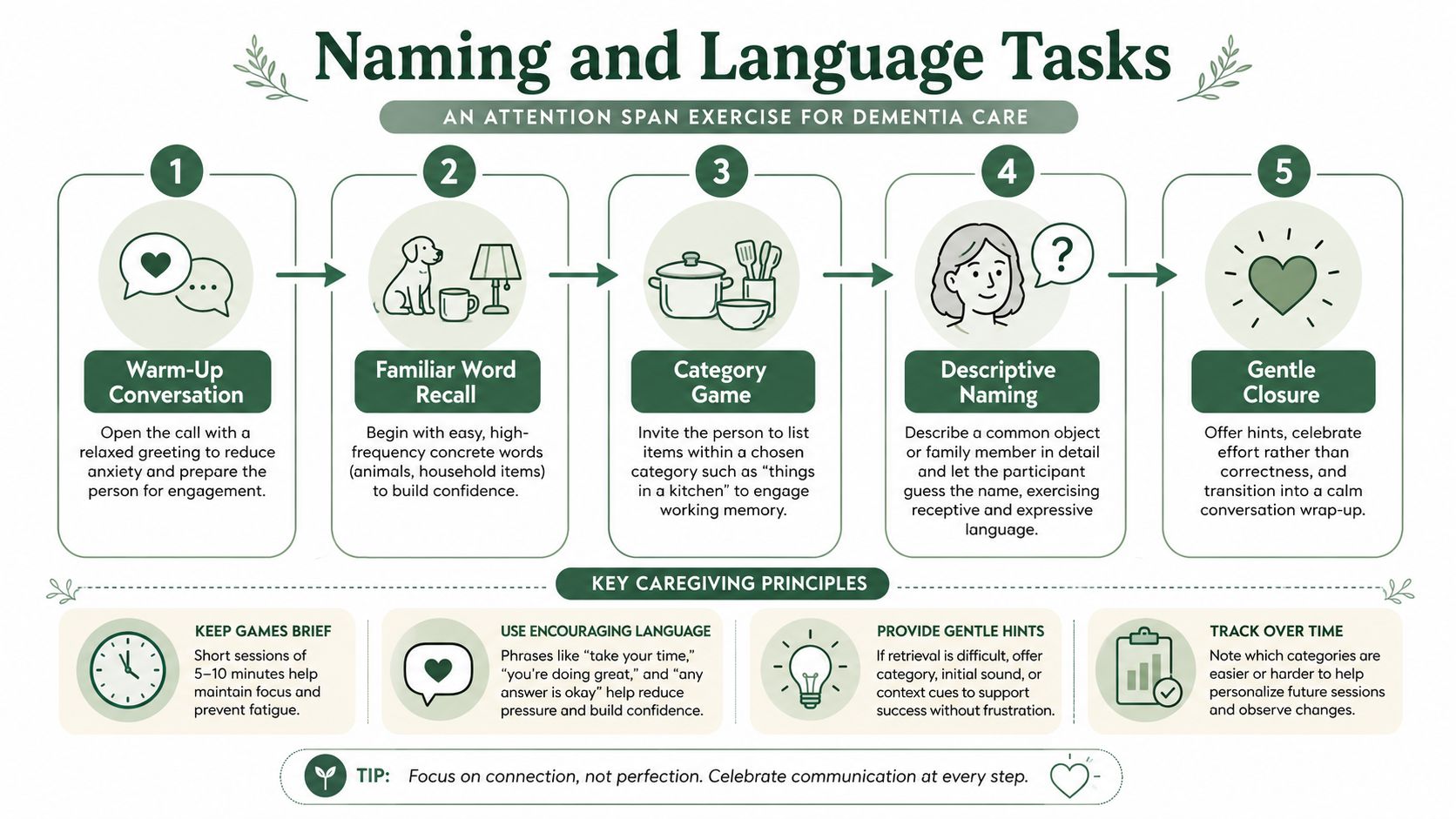
4. Naming and Language Tasks
Language games can give a phone call a clear focal point without requiring an app or screen. Describe a familiar object and invite the person to name it: “You use it to stir soup, and it has a long handle.” If the answer doesn't come, offer a category cue, such as “It's something you keep in the kitchen.”
Keep the activity playful and brief. Try categories, associations, or descriptions:
Kitchen category: “Name things you might find in a kitchen.”
Seasonal association: “What comes to mind when you hear the word summer?”
Family guessing: “I'm thinking of someone who loves fishing. Who could that be?”
Descriptive naming: “What would you use to open a letter?”
A successful response isn't the only useful outcome. The person may describe the object, laugh at the prompt, or connect it to a memory. Say, “Take your time,” rather than “That's wrong.” If the task becomes humiliating, stop and return to ordinary conversation.
Adjust the language demand
For an easier call, use concrete objects, familiar names, and two choices. “Was it a spoon or a plate?” can restore momentum without pretending the person answered independently. For a harder call, ask for a category with several examples or invite a short description of how an object is used.
Mix accessible prompts with more challenging ones so the activity doesn't become a sequence of failures. Track which subjects invite spontaneous speech and which require repeated cues. This can help family members choose better prompts, but it shouldn't be treated as a clinical language assessment.
A person who can't name “thermometer” may still explain that it tells you whether you have a fever. That response shows engagement with meaning even when the word itself is unavailable. Focus on the person's effort, communication, and emotional response, not only on exact vocabulary.
5. Sequential Tasks and Instruction Following
Daily routines provide some of the most useful attention span exercises because they connect thinking with an activity that matters. Ask your parent to describe how to make tea, prepare a sandwich, water a plant, or get ready for a family call. The conversation can remain phone-based, or a trusted person nearby can support the physical steps.
Start with two or three actions. “What would you do first to make tea?” After the answer, ask, “What comes next?” If the person hesitates, offer one cue rather than delivering the whole sequence. “You have the cup ready. What would you add now?”
Break instructions into single actions and repeat them without impatience. If the person is handling an object, confirm that it's safe and appropriate. Don't use a phone exercise to direct someone toward a stove, medication change, outdoor walking, or another safety-critical task without suitable supervision.
Use practical scaffolding
An easier adaptation asks the person to name the next step in a familiar routine. A more demanding adaptation asks them to organize the steps or explain what supplies are needed. If a sequence becomes confusing, shorten it and affirm what was completed.
Observe whether the person follows spoken directions, repeats them accurately, or needs a visual or physical cue. These observations may help caregivers support daily routines, but they don't establish independence or capacity on their own. For related guidance, read how to help a dementia parent with daily tasks.
A controlled attention-training study reported strong usability and willingness-to-use responses, with mean ratings around 3.56 to 4.15 on a 5-point scale for liking the program, willingness to use it, recommending it, and user friendliness (the controlled usability study). That finding supports keeping activities short and clear, but it doesn't mean a person should be pushed to continue when a practical task feels tiring.
6. Selective Attention and Distraction Management
Sometimes the exercise isn't adding a harder task. It's removing competition for attention. Before a call, ask whether the television, radio, hallway traffic, or another conversation is making it difficult to listen. A family member might lower the volume or move the phone to a quieter room, but ask permission before changing the environment.
Distraction management also helps when worry captures the conversation. If your parent repeatedly says, “Where is my wallet?” respond to the concern before redirecting: “I understand that you're worried about it. Let's decide who can help look after the call. For now, tell me what you planted in the garden this year.”
That approach doesn't dismiss the worry. It gives the worry a place, then offers a safer focal point. A sensory anchor can help: “What can you see beside you?” or “Can you feel the chair beneath you?” Use a calm voice and allow time for the person to shift attention.
A redirect works better when it validates the concern first.
Grade the environment, not the person's worth
Begin in a quiet setting with one conversational topic. If that feels easy, allow a mild, familiar distraction and practice returning to the subject. Don't deliberately introduce loud noise, confusing instructions, or distressing material to make the exercise harder.
You can also use a simple two-part call. Spend a little time acknowledging the anxiety, then move to music, a family story, or a pleasant routine. Stop if redirection increases agitation. The aim is recovery and comfort, not proving that the person can ignore every distraction.
For a broader explanation of structured cognitive support, see what cognitive conditioning means. Record the distraction trigger, the strategy used, and whether the person returned to the topic. Those notes can reveal that the main barrier is hearing, fatigue, pain, or anxiety rather than a lack of effort.

7. Structured Problem-Solving and Decision-Making
A low-stakes choice can exercise attention while protecting autonomy. Ask, “Would you prefer soup or pasta for lunch?” If the person chooses pasta, continue with one practical question: “What would you like with it?” You can then reflect the decision back, rather than taking control: “Pasta with vegetables sounds good to you.”
Keep the choices limited. Two or three options may be enough, especially when the person is tired or anxious. Avoid decisions involving medication changes, financial commitments, leaving the home alone, cooking without supervision, or other safety-critical matters. The caregiver can support the thinking process without presenting a hidden correct answer.
A phone script for an everyday concern
“Your appointment is coming up, and you're worried you'll forget it. Would you rather write it on the calendar or ask your daughter to call with a reminder?”
“What would make that plan easier?”
“Let's choose the option that feels most comfortable.”
This script acknowledges the emotion, offers manageable alternatives, and keeps the older adult involved. If the person can't decide, reduce the demand. Say, “We can pause and revisit it later,” or ask a trusted family member to help.
An easier adaptation asks for a preference between two familiar items. A more demanding version asks the person to explain what they would need for the choice. Track whether the person expresses a preference, stays with the discussion, and appears comfortable afterward. Don't score the quality of the decision or use a single conversation to judge capacity.
The value lies in agency as much as attention. A person who chooses the music, meal, or call time is practicing engagement in a way that respects identity.
8. Integrated Cognitive-Emotional Engagement
Attention is harder to access when a person feels frightened, lonely, rushed, or misunderstood. Combine a cognitive prompt with emotional validation instead of separating “brain work” from companionship. For example, if your parent worries about an appointment, say, “That sounds stressful. Let's think through what would help you feel prepared.”
You can then move into a simple planning task, reminiscence prompt, or language activity. If a family story brings sadness, acknowledge it: “That loss still matters to you.” Only continue with questions if the person wants to. Emotional safety isn't a reward after the exercise. It is part of the conditions that make engagement possible.
A North American survey of 497 respondents found that almost half had used computerized cognitive training, and respondents generally viewed it as somewhat effective for cognition and mood. People with self-reported psychological or neurological disorders were more likely to have used it, while people with more age and fewer years of education tended to rate it as more effective (the survey of computerized cognitive-training use). These perceptions show why accessible programs attract interest, but they aren't proof that a particular activity treats dementia.
Let mood set the level
Ask at the beginning, “Would you like company, a conversation, or a small activity today?” If the person sounds low, confused, or tired, choose reminiscence or music rather than a demanding sequence. If they're engaged, add one gentle follow-up question. Offer breaks without framing them as failure.
Track both sides of the interaction:
Emotional response: calmer, neutral, worried, frustrated, or cheerful.
Engagement: spontaneous conversation, responses to prompts, or withdrawal.
Recovery: how easily the person returns after a pause or distraction.
Hearing access deserves attention. If calls frequently involve “What?” or incorrect responses, address hearing needs rather than increasing cognitive difficulty. A summary of hearing loss and cognitive decline evidence can help families identify why communication changes may require an audiology conversation.
Comparison of 8 Attention-Span Exercises
Approach | Implementation 🔄 (complexity) | Resources & Speed ⚡ | Expected outcomes 📊⭐ | Ideal use cases 💡 | Key advantages ⭐ |
|---|---|---|---|---|---|
Reminiscence Therapy & Life Review | Low–Medium; conversational setup; requires personal history | Minimal materials/tech; low training; moderate prep time ⚡ | ⭐⭐⭐ Improved mood, sustained engagement, identity reinforcement 📊 | Early–mid dementia; rapport building; mood/agitation reduction | Highly motivating; personally relevant; minimal equipment |
Orientation to Time, Place, and Person | Low; routine script integrated into conversation | Calendars/clocks; consistent greeting; very efficient ⚡ | ⭐⭐ Reduced confusion/anxiety; supports safety and routine 📊 | Daily calls; safety monitoring; moments of disorientation | Easy to implement; reduces agitation; supports orientation |
Conversation-Based Attention Training | Medium–High; structured arc; requires skilled facilitation | Low tech; needs staff training and tracking; moderate session time ⚡ | ⭐⭐⭐ Measurable gains in sustained attention; companionship benefits 📊 | Targeted attention rehabilitation; progressive skill building | Directly targets attention; natural conversation; documentable progress |
Naming and Language Tasks | Low–Medium; game-like and adaptable | Minimal materials; short (5–10 min) sessions; time-efficient ⚡ | ⭐⭐ Maintains language skills, improves retrieval confidence 📊 | Short phone games; language stimulation in early–mid stages | Engaging, low-pressure, repeatable; easy to track performance |
Sequential Task & Instruction Following | Medium; stepwise instructions and pacing needed | No/low tech; task prep required; moderate time per task ⚡ | ⭐⭐ Supports ADLs and executive function; provides safety insights 📊 | Practicing daily routines; ADL support; safety assessments | Practical relevance; clear feedback; supports independence |
Selective Attention & Distraction Management | Medium; requires environmental coordination and timing | Caregiver coordination; situational setup; modest time investment ⚡ | ⭐⭐ Improved focus amid distractions; reduced rumination/anxiety 📊 | Noisy environments; anxiety-driven attention lapses; call preparation | Addresses real-world distractions; calming redirection techniques |
Structured Problem-Solving & Decision-Making | Medium; scaffolded choices with caregiver support | Low tech; requires patience and documentation; moderate ⚡ | ⭐⭐⭐ Preserves autonomy, improves mood, practices decision skills 📊 | Low-stakes daily choices; maintaining agency; collaborative planning | Supports autonomy and confidence; directly relevant to daily life |
Integrated Cognitive-Emotional Engagement | High; combines methods and emotional validation | High training and time investment; less time-efficient ⚡ | ⭐⭐⭐⭐ Stronger attention when emotional safety is present; reduced behaviors 📊 | Complex care needs; when emotion impairs cognition; long-term programs | Holistic, evidence-aligned; maximizes engagement and well‑being |
Build a Gentle Practice, Not a Passing Test
A useful routine can be simple. Choose one personally meaningful activity, ask permission, begin at a comfortable duration, and note what you observe. The best starting point might be a story about a former job, a choice between two lunches, or a quiet conversation after the television is turned off.
Use the same broad structure across calls, but don't demand identical performance. Attention can change with mood, fatigue, hearing, pain, sleep, mobility, medication effects, and cognitive changes. A person who needs many prompts today may engage freely tomorrow. That variation is information, not a reason for criticism.
Caregivers can record:
Minutes engaged: how long the person participated comfortably.
Prompts needed: whether they needed occasional, frequent, or continuous redirection.
Task participation: what they completed, described, chose, or discussed.
Mood before and after: whether the call seemed calming, neutral, or upsetting.
Distraction triggers: television, worry, noise, pain, or another identifiable factor.
Recovery after a break: whether the person returned comfortably or needed to end the call.
These notes can improve care coordination, but they aren't diagnostic scores. Don't compare your parent with another person, compare one activity with a standardized test, or treat a longer call as automatic evidence of cognitive improvement. A 2022 review of 37 studies found that cognitive attention training didn't reliably improve sustained attention and showed very weak transfer to other cognition or behavior. Physical activity and mindfulness appeared more promising, but the review described that evidence as preliminary and needing stronger replication (the 2022 review of attention-training transfer).
Stop when distress, pain, unusual confusion, breathlessness, dizziness, or significant fatigue appears. Escalate new safety concerns, sudden changes, falls, medication problems, or major shifts in behavior to the appropriate family member or clinician. An exercise can't explain a sudden change in mental status.
Phone-based support can help when recurring, person-centered calls and care coordination fit the family's needs. Velma uses scheduled calls, guided cognitive activities, mood and companionship support, practical check-ins, and care-manager coordination. That kind of program complements medical treatment and in-person caregiving. It doesn't replace clinical assessment, supervision, or hands-on help.
The most valuable measure is whether the person feels respected and connected while participating. Consistency matters, but perfect answers don't. A gentle prompt, a familiar story, and a calm ending may do more for the next call than a difficult exercise that leaves someone discouraged.
Velma provides scheduled phone calls with trained care team members, combining personalized conversation, attention and language activities, orientation cues, and supportive check-ins for older adults experiencing memory loss. Visit Velma to learn how recurring, person-centered calls can support attention practice and caregiver coordination without requiring an app or device.
Your parent answers the phone, recognizes your voice, and starts telling you about the garden. A few minutes later, the story breaks apart. The television is loud, a worry about misplaced keys takes over, and your parent asks why you called. Tomorrow, the same conversation may go smoothly.
That variability is common in early to mid-stage dementia, but it doesn't mean every call should become a memory quiz. Effective attention span exercises should feel brief, familiar, useful, and emotionally safe. The aim is supported engagement, not exposing mistakes or forcing performance.
The eight activities below use real phone-caregiving situations. They include scripts, easier and harder adaptations, consent and safety guidance, and simple observations you can track without turning calls into tests. Evidence supports realistic expectations. A selective meta-analysis of 15 studies, 17 independent samples, and 630 participants found modest attention improvements from structured training, with a near-transfer Hedges g of 0.25 and far-transfer g of 0.24, not a universal transformation of attention (the 2016 attention-training meta-analysis).
Before calling, check consent, hearing needs, fatigue, privacy, background noise, and mood. Ask whether now is a good time. Encourage hearing aids or glasses if used, move to a quieter room when possible, and stop if the person sounds distressed, unusually confused, breathless, dizzy, or exhausted. These exercises complement medical care and hands-on support. They don't diagnose or treat dementia.
Table of Contents
1. Reminiscence Therapy and Life Review
Make the call easier or richer
2. Orientation to Time, Place, and Person
A flexible orientation script
3. Conversation-Based Attention Training
Grade the conversation without making it a test
4. Naming and Language Tasks
Adjust the language demand
5. Sequential Tasks and Instruction Following
Use practical scaffolding
6. Selective Attention and Distraction Management
Grade the environment, not the person's worth
7. Structured Problem-Solving and Decision-Making
A phone script for an everyday concern
8. Integrated Cognitive-Emotional Engagement
Let mood set the level
Comparison of 8 Attention-Span Exercises
Build a Gentle Practice, Not a Passing Test
1. Reminiscence Therapy and Life Review
A familiar memory can hold attention more naturally than an abstract drill. Ask about the bakery where your parent worked, the first home they shared with a spouse, a favorite holiday meal, or the hobby that filled weekends. Long-term memories may remain personally meaningful even when recent details are difficult, so life history gives the conversation an emotional anchor.
Start with an open prompt rather than a fact check: “Tell me about the first job you really enjoyed.” If your parent pauses, offer a gentle cue such as, “Was that before or after you moved to the coast?” Avoid treating a minor inconsistency as an error. The purpose is connection and engagement, not reconstructing a perfect record.
Practical rule: Follow the emotion in the story, not just the accuracy of the detail.
A caregiver can prepare a small set of notes before recurring calls. Include names, relationships, occupations, favorite places, celebrations, recipes, and topics that cause discomfort. Family members can contribute prompts, but the older adult should decide what they want to discuss.
Make the call easier or richer
For a person who tires quickly, choose one object or image and ask for a description. A family member might place a photo album nearby and say, “What do you notice in this picture?” On a phone-only call, use sensory prompts: “What did the kitchen smell like?” or “What music played at family dances?”
If attention is steady, build a life-review thread across calls. One call might focus on work, another on friendships, and another on family traditions. Keep the structure flexible. If a topic brings grief, embarrassment, or agitation, acknowledge the feeling and change direction.
Track the topic, observable engagement, and mood, not the number of memories recalled. A note such as “talked warmly about gardening, needed one prompt, ended calm” is more useful than a score.
2. Orientation to Time, Place, and Person
Orientation works best as a calm conversational frame, not an interrogation. Begin each call with a consistent greeting: “Good morning, Sarah. It's Thursday, and I'm calling from Velma. How are you feeling today?” You can connect the day to something observable, such as the weather, a season, lunch, a favorite television program, or an upcoming family visit.
The information should support the person, not test them. If your parent says it's Tuesday when it's Thursday, a blunt correction may increase anxiety without improving attention. Try, “It feels like a busy week. Today is Thursday, and your appointment is later this week.” If the person becomes frustrated, move back to companionship or a familiar topic.
Use environmental supports when someone is physically present with the older adult. A large calendar, an easy-to-read clock, family photographs, and written appointment reminders can provide external anchors. During a phone call, ask a relative or home-care worker to point to the calendar only if that feels helpful.
A flexible orientation script
Person: “What day is it?”
Caregiver: “It's Thursday morning. You've had breakfast, and your daughter is calling after lunch.”
Person: “I thought she was here.”
Caregiver: “You're thinking about her. She isn't there right now, but we can talk about when she'll call.”
The easier version uses only the person's name, time of day, and immediate activity. A more demanding version adds the season, weather, or a planned event. Don't add detail just because you can. Too many facts can compete for attention.
Observe whether orientation reduces confusion, supports conversation, or increases distress. Coordinate with family about which corrections are useful and which only prolong an argument. Gentle repetition can create cognitive scaffolding, but it can't replace assessment when confusion changes suddenly.
3. Conversation-Based Attention Training
A focused conversation has a beginning, a middle, and an ending. Instead of jumping between news, medication reminders, and family updates, choose one meaningful subject. You might ask about a grandchild's school year, a favorite recipe, a former workplace, or plans for an upcoming gathering.
Use a short opening prompt, then follow the person's answers. “What did you enjoy most about gardening?” can become “Which plants were easiest to care for?” and then “Who taught you how to grow tomatoes?” Reflective listening keeps the person oriented to the thread: “You felt proud when the garden finally produced enough for the neighbors.”
A 2024 quasi-experiment delivered online attention training across four sessions over four weeks to 73 adults, with 32 in the intervention group and 41 in the control group. Attention increased across training, and boredom proneness fell significantly by the program's end (the 2024 online attention-training study. The study doesn't prove that every phone conversation will produce the same result, but it supports a practical principle: short, structured formats can be easier to sustain than demanding sessions.
Grade the conversation without making it a test
Begin with a topic the person already enjoys. If they lose the thread, say, “We were talking about your rose garden. Would you like to tell me about the flowers, or should we take a break?” If they remain comfortable, add one follow-up question or return to the topic on another call.
Record the topic, approximate time engaged, prompts needed, and mood afterward. Don't announce the duration as a target or compare it with another person. Praise participation specifically: “You stayed with that family story and helped me understand why it mattered to you.”
For additional guidance on phrasing, pacing, and redirection, see these dementia communication strategies. The strongest conversation is one in which the older adult feels heard, not examined.
4. Naming and Language Tasks
Language games can give a phone call a clear focal point without requiring an app or screen. Describe a familiar object and invite the person to name it: “You use it to stir soup, and it has a long handle.” If the answer doesn't come, offer a category cue, such as “It's something you keep in the kitchen.”
Keep the activity playful and brief. Try categories, associations, or descriptions:
Kitchen category: “Name things you might find in a kitchen.”
Seasonal association: “What comes to mind when you hear the word summer?”
Family guessing: “I'm thinking of someone who loves fishing. Who could that be?”
Descriptive naming: “What would you use to open a letter?”
A successful response isn't the only useful outcome. The person may describe the object, laugh at the prompt, or connect it to a memory. Say, “Take your time,” rather than “That's wrong.” If the task becomes humiliating, stop and return to ordinary conversation.
Adjust the language demand
For an easier call, use concrete objects, familiar names, and two choices. “Was it a spoon or a plate?” can restore momentum without pretending the person answered independently. For a harder call, ask for a category with several examples or invite a short description of how an object is used.
Mix accessible prompts with more challenging ones so the activity doesn't become a sequence of failures. Track which subjects invite spontaneous speech and which require repeated cues. This can help family members choose better prompts, but it shouldn't be treated as a clinical language assessment.
A person who can't name “thermometer” may still explain that it tells you whether you have a fever. That response shows engagement with meaning even when the word itself is unavailable. Focus on the person's effort, communication, and emotional response, not only on exact vocabulary.
5. Sequential Tasks and Instruction Following
Daily routines provide some of the most useful attention span exercises because they connect thinking with an activity that matters. Ask your parent to describe how to make tea, prepare a sandwich, water a plant, or get ready for a family call. The conversation can remain phone-based, or a trusted person nearby can support the physical steps.
Start with two or three actions. “What would you do first to make tea?” After the answer, ask, “What comes next?” If the person hesitates, offer one cue rather than delivering the whole sequence. “You have the cup ready. What would you add now?”
Break instructions into single actions and repeat them without impatience. If the person is handling an object, confirm that it's safe and appropriate. Don't use a phone exercise to direct someone toward a stove, medication change, outdoor walking, or another safety-critical task without suitable supervision.
Use practical scaffolding
An easier adaptation asks the person to name the next step in a familiar routine. A more demanding adaptation asks them to organize the steps or explain what supplies are needed. If a sequence becomes confusing, shorten it and affirm what was completed.
Observe whether the person follows spoken directions, repeats them accurately, or needs a visual or physical cue. These observations may help caregivers support daily routines, but they don't establish independence or capacity on their own. For related guidance, read how to help a dementia parent with daily tasks.
A controlled attention-training study reported strong usability and willingness-to-use responses, with mean ratings around 3.56 to 4.15 on a 5-point scale for liking the program, willingness to use it, recommending it, and user friendliness (the controlled usability study). That finding supports keeping activities short and clear, but it doesn't mean a person should be pushed to continue when a practical task feels tiring.
6. Selective Attention and Distraction Management
Sometimes the exercise isn't adding a harder task. It's removing competition for attention. Before a call, ask whether the television, radio, hallway traffic, or another conversation is making it difficult to listen. A family member might lower the volume or move the phone to a quieter room, but ask permission before changing the environment.
Distraction management also helps when worry captures the conversation. If your parent repeatedly says, “Where is my wallet?” respond to the concern before redirecting: “I understand that you're worried about it. Let's decide who can help look after the call. For now, tell me what you planted in the garden this year.”
That approach doesn't dismiss the worry. It gives the worry a place, then offers a safer focal point. A sensory anchor can help: “What can you see beside you?” or “Can you feel the chair beneath you?” Use a calm voice and allow time for the person to shift attention.
A redirect works better when it validates the concern first.
Grade the environment, not the person's worth
Begin in a quiet setting with one conversational topic. If that feels easy, allow a mild, familiar distraction and practice returning to the subject. Don't deliberately introduce loud noise, confusing instructions, or distressing material to make the exercise harder.
You can also use a simple two-part call. Spend a little time acknowledging the anxiety, then move to music, a family story, or a pleasant routine. Stop if redirection increases agitation. The aim is recovery and comfort, not proving that the person can ignore every distraction.
For a broader explanation of structured cognitive support, see what cognitive conditioning means. Record the distraction trigger, the strategy used, and whether the person returned to the topic. Those notes can reveal that the main barrier is hearing, fatigue, pain, or anxiety rather than a lack of effort.
7. Structured Problem-Solving and Decision-Making
A low-stakes choice can exercise attention while protecting autonomy. Ask, “Would you prefer soup or pasta for lunch?” If the person chooses pasta, continue with one practical question: “What would you like with it?” You can then reflect the decision back, rather than taking control: “Pasta with vegetables sounds good to you.”
Keep the choices limited. Two or three options may be enough, especially when the person is tired or anxious. Avoid decisions involving medication changes, financial commitments, leaving the home alone, cooking without supervision, or other safety-critical matters. The caregiver can support the thinking process without presenting a hidden correct answer.
A phone script for an everyday concern
“Your appointment is coming up, and you're worried you'll forget it. Would you rather write it on the calendar or ask your daughter to call with a reminder?”
“What would make that plan easier?”
“Let's choose the option that feels most comfortable.”
This script acknowledges the emotion, offers manageable alternatives, and keeps the older adult involved. If the person can't decide, reduce the demand. Say, “We can pause and revisit it later,” or ask a trusted family member to help.
An easier adaptation asks for a preference between two familiar items. A more demanding version asks the person to explain what they would need for the choice. Track whether the person expresses a preference, stays with the discussion, and appears comfortable afterward. Don't score the quality of the decision or use a single conversation to judge capacity.
The value lies in agency as much as attention. A person who chooses the music, meal, or call time is practicing engagement in a way that respects identity.
8. Integrated Cognitive-Emotional Engagement
Attention is harder to access when a person feels frightened, lonely, rushed, or misunderstood. Combine a cognitive prompt with emotional validation instead of separating “brain work” from companionship. For example, if your parent worries about an appointment, say, “That sounds stressful. Let's think through what would help you feel prepared.”
You can then move into a simple planning task, reminiscence prompt, or language activity. If a family story brings sadness, acknowledge it: “That loss still matters to you.” Only continue with questions if the person wants to. Emotional safety isn't a reward after the exercise. It is part of the conditions that make engagement possible.
A North American survey of 497 respondents found that almost half had used computerized cognitive training, and respondents generally viewed it as somewhat effective for cognition and mood. People with self-reported psychological or neurological disorders were more likely to have used it, while people with more age and fewer years of education tended to rate it as more effective (the survey of computerized cognitive-training use). These perceptions show why accessible programs attract interest, but they aren't proof that a particular activity treats dementia.
Let mood set the level
Ask at the beginning, “Would you like company, a conversation, or a small activity today?” If the person sounds low, confused, or tired, choose reminiscence or music rather than a demanding sequence. If they're engaged, add one gentle follow-up question. Offer breaks without framing them as failure.
Track both sides of the interaction:
Emotional response: calmer, neutral, worried, frustrated, or cheerful.
Engagement: spontaneous conversation, responses to prompts, or withdrawal.
Recovery: how easily the person returns after a pause or distraction.
Hearing access deserves attention. If calls frequently involve “What?” or incorrect responses, address hearing needs rather than increasing cognitive difficulty. A summary of hearing loss and cognitive decline evidence can help families identify why communication changes may require an audiology conversation.
Comparison of 8 Attention-Span Exercises
Approach | Implementation 🔄 (complexity) | Resources & Speed ⚡ | Expected outcomes 📊⭐ | Ideal use cases 💡 | Key advantages ⭐ |
|---|---|---|---|---|---|
Reminiscence Therapy & Life Review | Low–Medium; conversational setup; requires personal history | Minimal materials/tech; low training; moderate prep time ⚡ | ⭐⭐⭐ Improved mood, sustained engagement, identity reinforcement 📊 | Early–mid dementia; rapport building; mood/agitation reduction | Highly motivating; personally relevant; minimal equipment |
Orientation to Time, Place, and Person | Low; routine script integrated into conversation | Calendars/clocks; consistent greeting; very efficient ⚡ | ⭐⭐ Reduced confusion/anxiety; supports safety and routine 📊 | Daily calls; safety monitoring; moments of disorientation | Easy to implement; reduces agitation; supports orientation |
Conversation-Based Attention Training | Medium–High; structured arc; requires skilled facilitation | Low tech; needs staff training and tracking; moderate session time ⚡ | ⭐⭐⭐ Measurable gains in sustained attention; companionship benefits 📊 | Targeted attention rehabilitation; progressive skill building | Directly targets attention; natural conversation; documentable progress |
Naming and Language Tasks | Low–Medium; game-like and adaptable | Minimal materials; short (5–10 min) sessions; time-efficient ⚡ | ⭐⭐ Maintains language skills, improves retrieval confidence 📊 | Short phone games; language stimulation in early–mid stages | Engaging, low-pressure, repeatable; easy to track performance |
Sequential Task & Instruction Following | Medium; stepwise instructions and pacing needed | No/low tech; task prep required; moderate time per task ⚡ | ⭐⭐ Supports ADLs and executive function; provides safety insights 📊 | Practicing daily routines; ADL support; safety assessments | Practical relevance; clear feedback; supports independence |
Selective Attention & Distraction Management | Medium; requires environmental coordination and timing | Caregiver coordination; situational setup; modest time investment ⚡ | ⭐⭐ Improved focus amid distractions; reduced rumination/anxiety 📊 | Noisy environments; anxiety-driven attention lapses; call preparation | Addresses real-world distractions; calming redirection techniques |
Structured Problem-Solving & Decision-Making | Medium; scaffolded choices with caregiver support | Low tech; requires patience and documentation; moderate ⚡ | ⭐⭐⭐ Preserves autonomy, improves mood, practices decision skills 📊 | Low-stakes daily choices; maintaining agency; collaborative planning | Supports autonomy and confidence; directly relevant to daily life |
Integrated Cognitive-Emotional Engagement | High; combines methods and emotional validation | High training and time investment; less time-efficient ⚡ | ⭐⭐⭐⭐ Stronger attention when emotional safety is present; reduced behaviors 📊 | Complex care needs; when emotion impairs cognition; long-term programs | Holistic, evidence-aligned; maximizes engagement and well‑being |
Build a Gentle Practice, Not a Passing Test
A useful routine can be simple. Choose one personally meaningful activity, ask permission, begin at a comfortable duration, and note what you observe. The best starting point might be a story about a former job, a choice between two lunches, or a quiet conversation after the television is turned off.
Use the same broad structure across calls, but don't demand identical performance. Attention can change with mood, fatigue, hearing, pain, sleep, mobility, medication effects, and cognitive changes. A person who needs many prompts today may engage freely tomorrow. That variation is information, not a reason for criticism.
Caregivers can record:
Minutes engaged: how long the person participated comfortably.
Prompts needed: whether they needed occasional, frequent, or continuous redirection.
Task participation: what they completed, described, chose, or discussed.
Mood before and after: whether the call seemed calming, neutral, or upsetting.
Distraction triggers: television, worry, noise, pain, or another identifiable factor.
Recovery after a break: whether the person returned comfortably or needed to end the call.
These notes can improve care coordination, but they aren't diagnostic scores. Don't compare your parent with another person, compare one activity with a standardized test, or treat a longer call as automatic evidence of cognitive improvement. A 2022 review of 37 studies found that cognitive attention training didn't reliably improve sustained attention and showed very weak transfer to other cognition or behavior. Physical activity and mindfulness appeared more promising, but the review described that evidence as preliminary and needing stronger replication (the 2022 review of attention-training transfer).
Stop when distress, pain, unusual confusion, breathlessness, dizziness, or significant fatigue appears. Escalate new safety concerns, sudden changes, falls, medication problems, or major shifts in behavior to the appropriate family member or clinician. An exercise can't explain a sudden change in mental status.
Phone-based support can help when recurring, person-centered calls and care coordination fit the family's needs. Velma uses scheduled calls, guided cognitive activities, mood and companionship support, practical check-ins, and care-manager coordination. That kind of program complements medical treatment and in-person caregiving. It doesn't replace clinical assessment, supervision, or hands-on help.
The most valuable measure is whether the person feels respected and connected while participating. Consistency matters, but perfect answers don't. A gentle prompt, a familiar story, and a calm ending may do more for the next call than a difficult exercise that leaves someone discouraged.
Velma provides scheduled phone calls with trained care team members, combining personalized conversation, attention and language activities, orientation cues, and supportive check-ins for older adults experiencing memory loss. Visit Velma to learn how recurring, person-centered calls can support attention practice and caregiver coordination without requiring an app or device.
Suggested Article: