10 Calming Techniques for Anxiety in Dementia Care

A parent with dementia becomes distressed because a favorite sweater is missing. They're certain someone took it, and reassurance alone doesn't settle the fear. Or perhaps an appointment is approaching, a spouse has stepped out, or the person believes they're alone even though help is nearby. In these moments, the anxiety is real to them, even when the facts have become confused.
Effective calming techniques for anxiety in dementia care aren't built around one universal exercise. They combine emotional validation, sensory and environmental support, predictable structure, simple physical actions, and practical reassurance matched to the person's abilities. A technique that helps someone in the early stages of dementia may frustrate someone with more advanced memory or attention difficulties.
Phone support adds another layer. A trained care-team member can use a familiar voice, repeated prompts, orientation, and scheduled contact, while family members or in-person caregivers address the surroundings and immediate safety. These strategies complement medical treatment, professional assessment, emergency services, and hands-on caregiving. They shouldn't replace them when anxiety is sudden, severe, medically unusual, or connected to immediate danger.
Table of Contents
1. Reminiscence Therapy and Life Review
Build prompts around the person
2. Structured Breathing and Progressive Muscle Relaxation
Keep the sequence familiar
3. Validation Therapy and Emotional Acknowledgment
Validate before redirecting
4. Guided Mindfulness and Present-Moment Grounding
Adapt the exercise to attention
5. Cognitive Reframing and Gentle Problem-Solving
Turn worry into a small plan
6. Structured Routine and Predictability Anchoring
Make the next contact visible
7. Distraction and Redirection Through Engaging Activities
Offer a small choice
8. Sensory Stimulation and Environmental Comfort Optimization
Observe before you add
9. Social Connection and Companionship Continuity
Make the relationship dependable
10. Orientation Reinforcement and Safety Reassurance
Pair facts with emotional safety
10 Calming Techniques Comparison
Build a Calming Plan, Not a Single Trick
Use a simple response sequence
1. Reminiscence Therapy and Life Review
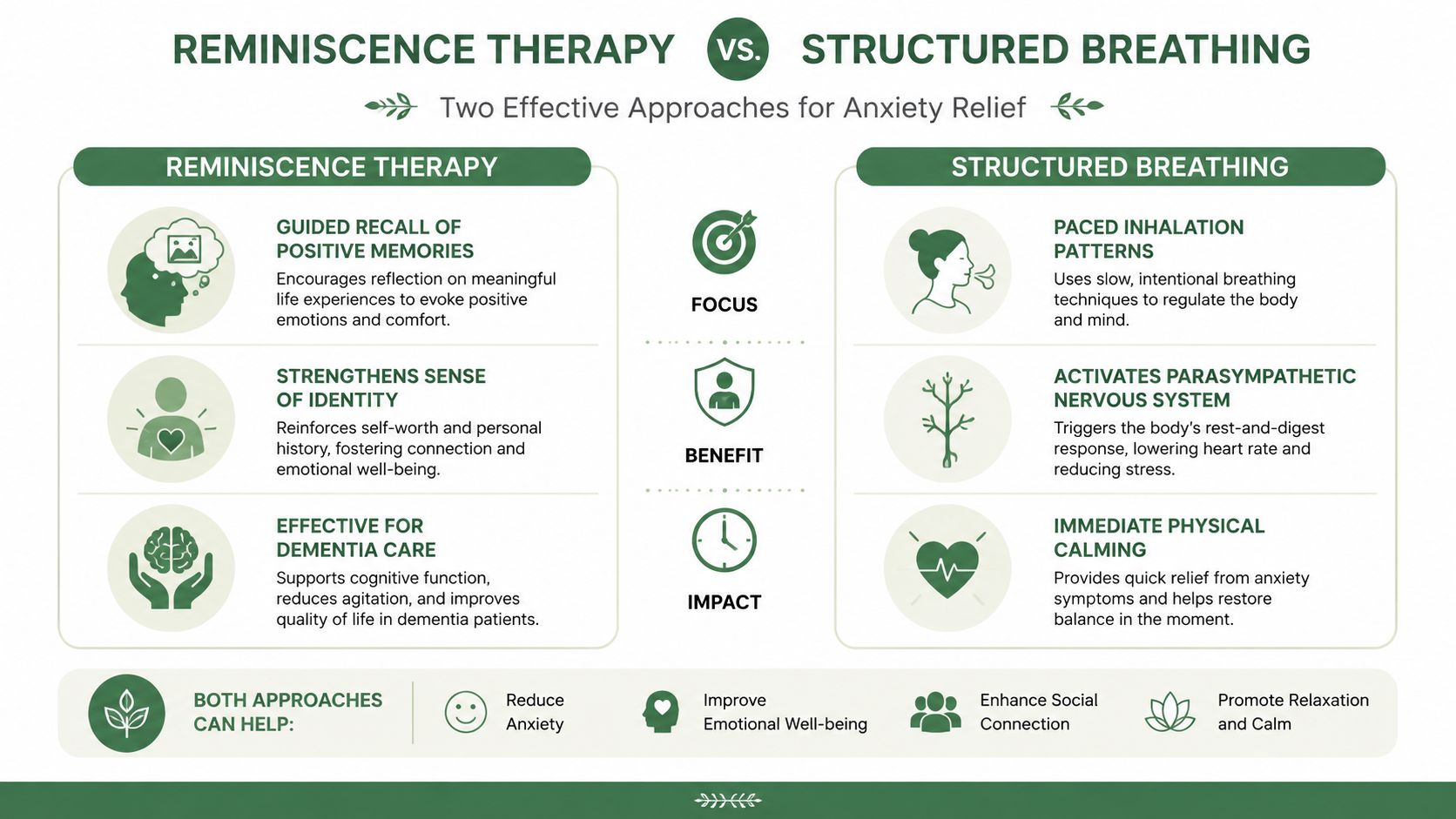
Reminiscence therapy uses meaningful memories to restore a sense of identity and continuity. A conversation about a former career, family tradition, favorite trip, or lifelong hobby can shift attention away from immediate fear while allowing the person to feel capable and known.
This approach often fits people in the early to mid stages of dementia, when older autobiographical memories may remain easier to access than recent events. It works best when the caregiver brings specific prompts rather than asking broad questions such as, “What do you remember?” A discussion about a particular workplace, holiday meal, garden, or familiar song gives the person something concrete to hold onto.
Build prompts around the person
Ask relatives to identify life chapters that usually bring comfort. A former engineer might enjoy describing a project or explaining how a machine worked. Someone who loved travel may respond to questions about a hotel, scenic view, or meal, while another person may feel safest discussing family celebrations and familiar routines.
Use names, places, objects, and photographs when available. Don't turn the call into a memory test, and don't insist on correcting details. The value comes from connection and emotional safety, not perfect recall.
Practical rule: Follow the person's emotional direction. If a memory becomes painful, acknowledge that shift and move toward a different story without making them defend or explain it.
For someone with more advanced dementia, shorten the conversation and rely on sensory cues, music, photographs, or a familiar object. End with present-day orientation, such as explaining who is nearby and what will happen next. Keep notes about topics that consistently soothe or distress the person so future calls can begin with a well-chosen prompt.
2. Structured Breathing and Progressive Muscle Relaxation
During a phone call, a person with dementia may become distressed because a ride is late or a plan feels uncertain. Structured breathing and progressive muscle relaxation give them a simple physical task while a caregiver provides steady guidance. Neither requires equipment, but both work best when the instructions match the person's abilities and current level of alertness.
Evidence for breathing exercises varies by technique and study design. A 2024 systematic review screened 309 studies and included 19. Within those studies, 12 reported significant anxiety improvements and 9 reported significant stress improvements (the 2024 breathing-exercise review). These findings support trying paced breathing, while leaving room to stop if it increases distress.
Keep the sequence familiar
Introduce the exercise during a calm call, then repeat the same brief sequence during difficult moments. Speak slowly and give one instruction at a time: “Breathe in gently. Let the breath out slowly. Feel your feet on the floor.” Do not demand a particular pace. Some people become more anxious when asked to control breathing closely, so quiet companionship may be the better choice.
Progressive muscle relaxation can start with the hands, shoulders, or jaw. Invite the person to gently tense and release one accessible area, or lower the shoulders. Stop if they report pain, dizziness, shortness of breath, or confusion. In later-stage dementia, one movement is usually easier to follow than a full-body sequence. Early-stage adults may manage several steps if the routine is already familiar.
A caregiver using Velma by phone can model the timing with a calm voice, pause for responses, and offer permission to stop. Guidance about anxiety in dementia patients can help caregivers keep the exercise supportive rather than demanding. Repetition, reassurance, and emotional safety matter more than perfect technique.
The progressive muscle relaxation guidance from Be Your Best Self & Thrive Counseling can help caregivers learn the method before guiding someone else.
A demonstration can help caregivers recognize the pacing. Breathing exercises do not replace clinical help when anxiety is new, severe, persistent, or accompanied by concerning physical symptoms.
3. Validation Therapy and Emotional Acknowledgment
Correction often intensifies dementia-related anxiety. When a person says a deceased spouse is coming home, insists a belonging was stolen, or fears an appointment has been forgotten, arguing about the facts can make them feel dismissed and less safe.
Validation therapy starts with the emotion. The caregiver listens for fear, grief, urgency, loneliness, or a need for control, then reflects that experience in respectful language. “You want to be ready for them” may be more calming than “They died years ago.” “That missing item is upsetting” creates cooperation without confirming an accusation.
Validate before redirecting
A useful response has three parts: recognize the feeling, communicate presence, and offer one manageable next step. For example, say, “It sounds frightening not to know where your purse is. I'm here with you. Let's check the usual place together.”
Use short sentences and a low, unhurried tone. If the person repeats the same concern, repeat the emotional acknowledgment without showing irritation. Dementia can impair the ability to retain a previous explanation, so a logically complete answer may not remain available to them.
For early-stage dementia, you can ask a simple question about what would help. For moderate or advanced dementia, reduce choices and rely more on tone, facial expression when in person, and familiar reassurance by phone. A caregiver might say, “You're safe. We'll take this one step at a time.”
“You don't have to win the argument to reduce the distress.”
Validation doesn't mean agreeing with every belief. It means accepting that the person's emotional experience is genuine, then gently guiding them toward safety, support, or a different activity. Family members should use similar language so the person doesn't encounter conflicting responses from each caregiver.
4. Guided Mindfulness and Present-Moment Grounding
Mindfulness can be too abstract when someone is frightened or struggling to follow instructions. In dementia care, it usually works better as a brief grounding conversation focused on immediate sensory information rather than a long silent meditation.
A care provider might ask, “What can you see from the window?” or “Can you feel the chair supporting your back?” The person can notice a cup in their hand, the sound of a familiar clock, the temperature of the room, or the texture of a blanket. These prompts bring attention away from an imagined future problem and toward something available now.
Adapt the exercise to attention
Start with one sense and one question. If the person remains engaged, add another. A five-senses exercise can be useful for someone in the early stages, while a single tactile anchor may suit someone with more limited attention. Keep the voice steady and avoid presenting grounding as a test.
For early-stage dementia, invite description: “Tell me three things you notice in the room.” For moderate dementia, offer choices: “Do you feel the soft blanket or the chair more clearly?” For advanced dementia, the caregiver may need to provide the anchor verbally and pair it with reassurance.

Grounding shouldn't be forced. Some people become more distressed when asked to close their eyes, focus inward, or sit with anxious thoughts. Let the person keep their eyes open, use ordinary conversation, or shift to a familiar activity if mindfulness increases agitation.
Caregivers can prepare a comfortable setting before a scheduled call. A favorite chair, soft lighting, warm drink, or familiar sound may make it easier to stay engaged. A meditation-space guide from SouthShore Fine Linens offers environmental ideas, but dementia care still requires individual adjustment.
5. Cognitive Reframing and Gentle Problem-Solving
An anxious statement often contains a practical concern. “I'm going to miss my appointment” may mean the person can't remember the plan. “Someone took my keys” may reflect uncertainty about where they were placed. “My daughter isn't safe” may signal a need for contact or reassurance.
Cognitive reframing in dementia care should stay concrete. The caregiver doesn't need to debate probability, identify complex thinking errors, or demand independent reasoning. First find the concern beneath the words, then offer one or two steps that address it.
Turn worry into a small plan
Try this sequence:
Name the concern: “You're worried the appointment might be missed.”
Offer known support: “Your daughter has it on her calendar.”
Choose one action: “Let's write it on the calendar by the phone.”
Close the loop: “We'll check the note again tomorrow.”
For a missing belonging, ask where the person usually keeps it, then search one familiar location together. Don't open every drawer or offer a long list of possibilities. Too many options can increase confusion and reinforce the sense that the situation is out of control.
Early-stage dementia may allow a collaborative plan, such as setting a reminder or calling a family member. With more advanced dementia, use fewer questions and more direct reassurance. If the same worry returns repeatedly, stop expanding the discussion. Validate, repeat the plan, and redirect to a calming activity.
A phone-based program can document the trigger, the wording that helped, and whether a family follow-up was needed. That record supports consistency across calls, but it doesn't replace clinical evaluation when anxiety represents a new or worsening change.
6. Structured Routine and Predictability Anchoring
Uncertainty can make ordinary events feel threatening. A reliable routine gives the person external support when memory no longer provides a dependable sense of what comes next. Scheduled phone calls, familiar greetings, and consistent transitions can become part of that structure.
The call itself should follow a recognizable rhythm. A care-team member might greet the person, identify themselves, orient them to the day and purpose of the call, ask about immediate well-being, complete a familiar activity, and explain what will happen after the conversation.
Make the next contact visible
A calendar beside the phone can show the call day. A family member can mention the call during the morning routine, while the care provider ends with a clear statement such as, “We'll speak again next Tuesday.” The exact schedule should reflect the household's capacity and the person's preferences, not an arbitrary template.
For early-stage dementia, invite the person to participate in planning. They may help choose a conversation topic or mark the calendar. For moderate dementia, repeat the same orientation wording and use visual cues. For advanced dementia, the emotional predictability of the voice and sequence may matter more than whether the person understands the date.
Routine isn't the same as rigidity. A missed call, appointment change, or caregiver absence can itself trigger anxiety, so families should prepare a backup message or alternate contact plan. Explain changes clearly and avoid promising a call that cannot reliably happen.
Predictability works through repetition, not through a single reassuring conversation.
Velma's scheduled phone calls can support this rhythm by giving families a consistent contact point, while care managers coordinate updates with family preferences and clinician guidance. The program remains an adjunct to in-person supervision and medical care, especially when the person needs physical assistance.
7. Distraction and Redirection Through Engaging Activities
Redirection works when it leads somewhere meaningful. Telling a distressed person to “forget about it” can feel dismissive, but inviting them into a familiar activity can reduce the grip of repetitive worry while preserving dignity.
Choose activities that match the person's interests and current abilities. A gardening enthusiast might discuss favorite plants and seasonal tasks. Someone who enjoys language may answer simple word clues. Another person may prefer local weather, family news, music, or a guessing game that creates a sense of participation without pressure.
Offer a small choice
Prepare two or three options before a call, then offer one at a time. “Would you like to talk about your garden or listen to a favorite song?” is easier to process than a long menu of activities. If the person rejects an option, don't turn the choice into a negotiation. Try a different familiar topic or sit with the emotion through conversation.
For early-stage dementia, word games, trivia, and problem-solving may remain enjoyable. In moderate dementia, use shorter activities with clear turns and frequent encouragement. In advanced dementia, familiar songs, rhythmic conversation, or sensory discussion may be more appropriate than questions requiring recall.
The activity should never become a hidden test. Praise effort and interest, not correctness. If a puzzle causes frustration, stop promptly and say, “That one feels like too much right now. We can do something easier.”
Redirection is supportive when it follows validation. First acknowledge the worry, then offer a path toward engagement. Care providers should note which subjects produce relaxed speech, laughter, sustained attention, or agitation so future calls can begin with the right level of challenge.
8. Sensory Stimulation and Environmental Comfort Optimization
The environment can either lower anxiety or keep the person's alarm system activated. Loud television, glare, clutter, uncomfortable seating, unfamiliar smells, and temperature discomfort may be interpreted as threats, especially when dementia makes it harder to identify the source of distress.
Caregivers can make the call setting calmer by reducing background noise, simplifying the visual field, using steady lighting, and placing a familiar comfort item within reach. Music may help one person and overwhelm another. A blanket, family photograph, favorite scent, or well-known chair may create reassurance when words don't.
Observe before you add
Sensory support should be individualized. Ask relatives what music, textures, scents, and objects have been comforting throughout the person's life. During a call, listen for changes in speech, breathing, restlessness, or engagement when the environment changes. Keep the volume low enough that the person can hear the caller clearly.
Early-stage dementia may allow the person to describe preferences and choose between options. With moderate dementia, caregivers can offer one familiar item and observe the response. With advanced dementia, simple comfort, reduced stimulation, and a trusted voice may be more useful than introducing new sensory experiences.
Pets can also provide familiar companionship for some older adults, but safety, allergies, mobility, and the animal's temperament must be considered. See guidance on pet therapy for elderly people before treating an animal interaction as a calming intervention.
Avoid using scent, music, or touch to override an expressed refusal. Comfort isn't effective when it removes the person's control. Document what settles the person and what escalates agitation, then share that information with everyone involved in care.
9. Social Connection and Companionship Continuity
Loneliness can magnify confusion. A person who isn't sure what is happening may also fear that nobody is available to help. A dependable relationship gives the person more than conversation. It provides evidence that support returns and that someone remembers what matters to them.
Continuity is particularly valuable. The same care provider can remember a grandson's activities, a favorite recipe, a former job, or a concern discussed during the last call. That memory communicates respect and reduces the effort required for the person to explain themselves again.
Make the relationship dependable
A warm opening matters: “It's good to hear your voice. How has your morning been?” Follow-up matters too: “You mentioned your daughter's birthday. How did the visit go?” These questions shouldn't feel like an interrogation. They should sound like genuine interest in the person's life.
For early-stage dementia, conversation can include opinions, stories, and choices. For moderate dementia, use familiar topics and gentle repetition. For advanced dementia, companionship may rely on tone, rhythm, music, and simple shared attention rather than extended verbal exchange.
Professional warmth still requires boundaries. Don't promise secrecy, constant availability, or services the program can't provide. If a provider changes, tell the family and participant clearly, allow time for transition when possible, and share useful background with the new caller.
Regular contact also creates opportunities to notice patterns in mood, confusion, or safety concerns. A daily check-in call approach for seniors can complement family visits, but phone companionship can't physically assess a fall, provide medication, or replace supervision when someone is unsafe alone.
10. Orientation Reinforcement and Safety Reassurance
Confusion about place, time, people, or events can create fear that feels urgent. Orientation helps when it gives the person a clear, reassuring frame for what is happening. It works poorly when it sounds like a quiz or an attempt to prove they're wrong.
Begin naturally. “Hello, Margaret. This is Ana from Velma. It's Tuesday morning, and I'm calling to check in. You're at home, and your daughter plans to visit later.” This combines identity, time, place, purpose, and support without asking the person to perform.
Pair facts with emotional safety
If someone hears a noise and fears an intruder, acknowledge the fear before explaining the likely source. “That sound startled you. It's the delivery person outside, and you're inside your home with the door closed.” If the explanation doesn't settle the concern, involve an in-person caregiver or emergency support rather than repeating facts more forcefully.
Early-stage dementia may allow the person to use a clock, calendar, written schedule, or phone note. Moderate dementia often requires the same wording at the start of each call. Advanced dementia may benefit most from immediate reassurance, familiar names, and statements about who is nearby.
Use concrete references such as a visible calendar, window, clock, or labeled room. Avoid piling on dates and details if they increase confusion. Orientation should support the person, not overwhelm them.
Safety reassurance must be truthful. Don't say someone is nearby unless that person really is available. If the person reports a fall, breathing difficulty, injury, immediate danger, or a sudden severe change in behavior, move from calming conversation to appropriate medical or emergency assistance.
10 Calming Techniques Comparison
Technique | Implementation Complexity 🔄 | Resource Requirements ⚡ | Expected Effectiveness & Impact ⭐📊 | Ideal Use Cases | Key Advantages 💡 |
|---|---|---|---|---|---|
Reminiscence Therapy and Life Review | 🔄🔄 (structured conversational skill) | ⚡⚡ (trained callers, family history inputs) | ⭐⭐⭐⭐, 📊 Improves mood, engagement, identity continuity; lowers anxiety in early–mid dementia | Older adults with preserved autobiographical memory; calls focused on life history | Strengthens sense of self; natural conversation flow; family insight |
Structured Breathing & Progressive Muscle Relaxation | 🔄 (simple guided protocol) | ⚡ (minimal training, phone delivery) | ⭐⭐⭐⭐, 📊 Immediate physiological calming; reduces acute physical anxiety symptoms | Acute anxiety episodes; phone-guided regulation and teachable skills | Rapid, no equipment, teachable for independent use |
Validation Therapy & Emotional Acknowledgment | 🔄🔄🔄 (attitude shift; reflective skill) | ⚡⚡ (substantial training, emotional labor) | ⭐⭐⭐⭐, 📊 Reduces agitation and anxiety-driven behaviors; builds trust | Emotional distress where reality correction escalates anxiety | Addresses emotional root causes; improves cooperation |
Guided Mindfulness & Present-Moment Grounding | 🔄🔄 (verbal guidance, brief exercises) | ⚡ (low-tech; consistent coaching) | ⭐⭐⭐, 📊 Interrupts rumination; shifts attention to present, reduces worry | Mild–moderate anxiety; when sensory anchoring is possible via phone | Portable, adaptable, non-judgmental attention anchor |
Cognitive Reframing & Gentle Problem-Solving | 🔄🔄🔄 (skillful, simplified reasoning) | ⚡⚡ (trained callers; follow-up coordination) | ⭐⭐⭐⭐, 📊 Reduces rumination by addressing solvable concerns; increases agency | Concerns with actionable steps (appointments, belongings); early-stage dementia | Practical, empowers decision-making; surfaces safety issues |
Structured Routine & Predictability Anchoring | 🔄🔄 (operational consistency) | ⚡⚡⚡ (scheduling systems, family coordination) | ⭐⭐⭐⭐, 📊 Lowers baseline anxiety via predictability and orientation | Individuals sensitive to unpredictability; ongoing scheduled support | Predictability reduces uncertainty; improves daily orientation |
Distraction & Redirection Through Engaging Activities | 🔄🔄 (preparation of personalized activities) | ⚡ (minimal materials; interest knowledge) | ⭐⭐⭐, 📊 Interrupts rumination and improves mood temporarily; boosts engagement | Short-term anxious episodes; calls to maintain cognitive stimulation | Engaging, enjoyable distraction; builds positive call associations |
Sensory Stimulation & Environmental Comfort Optimization | 🔄🔄 (assessment + coaching) | ⚡⚡ (environmental items, family implementation) | ⭐⭐⭐⭐, 📊 Physiological calming; improves baseline well‑being across the day | When sensory preferences known and family can modify environment | Low-cost, leverages sensory memory; supports comfort between calls |
Social Connection & Companionship Continuity | 🔄🔄 (relational skill + consistency) | ⚡⚡⚡ (stable, trained care providers; low turnover) | ⭐⭐⭐⭐⭐, 📊 Reduces loneliness and existential anxiety; enables other interventions | Isolated seniors; long-term emotional support and monitoring | Builds trust and security; human connection not substitutable by meds |
Orientation Reinforcement & Safety Reassurance | 🔄🔄 (repeated, gentle framing) | ⚡ (consistent caller scripts; documentation) | ⭐⭐⭐⭐, 📊 Reduces confusion‑based anxiety; prevents catastrophic misinterpretation | Episodes of disorientation; safety‑focused calls | Clarifies current reality; enhances perceived safety and cooperation |
Build a Calming Plan, Not a Single Trick
The most useful calming plan is repeatable. It gives family members and care providers a shared response when anxiety appears, rather than asking someone to improvise while the person is already distressed.
Start with immediate safety. Check whether there has been a fall, injury, breathing problem, chest discomfort, sudden confusion, medication issue, unsafe wandering, or another urgent concern. If danger is possible, contact appropriate medical or emergency services. A phone exercise should never delay necessary care.
Next, validate the emotion. Use a short sentence that reflects what the person is experiencing: “You're worried because you can't find your purse.” Don't begin with correction, fact-checking, or a lengthy explanation. The person needs to feel accompanied before they can use a breathing exercise, answer questions, or consider a plan.
Then choose one brief calming action. The best option depends on the trigger and the person's abilities. Breathing may help when physical tension dominates. A familiar memory may help when the person needs identity and comfort. Grounding may help when attention is caught in future fear. Music, a blanket, or a trusted voice may be better when instructions create frustration.
Use a simple response sequence
Check safety: Identify urgent medical, physical, or environmental risks.
Name the feeling: Reflect fear, grief, frustration, or loneliness without arguing.
Calm the body: Try one familiar breath, grounding, sensory, or relaxation prompt.
Address the trigger: Search one place, confirm one appointment detail, or contact one trusted person.
Record the response: Note what happened, what language helped, and what follow-up is needed.
After the person settles, address the practical issue with a small plan. If an appointment caused the anxiety, write it on the calendar and confirm who will provide transportation. If a belonging is missing, search the usual location and create a consistent storage place. If loneliness triggered the distress, arrange the next reliable contact rather than offering vague reassurance.
Velma can reinforce this plan through scheduled phone calls, personalized reminiscence and orientation prompts, mood and companionship support, practical safety check-ins, and care-manager coordination. Its phone-based format reduces technology barriers, while documented patterns can help families decide when routines or clinical guidance need to change. It still complements, rather than replaces, in-person caregiving and medical treatment.
Evidence supports structured repetition, but it doesn't make every technique suitable for every person. A ten-year systematic review of relaxation training found a weighted between-group effect of Cohen's d = 0.51 across 19 randomized controlled trials, with a within-group effect of 0.57 across 25 studies involving 748 participants (the systematic review of relaxation training). The same review reported stronger results for meditation and longer treatment duration, supporting regular guided practice rather than one-off advice. Dementia-specific evidence remains limited, and a scoping meta-review found no positive anxiety findings for people with dementia in the talking-therapy evidence it examined, while psychoeducation helped carers and mindfulness-based interventions reduced carer anxiety (the dementia talking-therapies meta-review).
That uncertainty is a reason to personalize, not to abandon support. A 2025 review found physical activity promising for reducing anxiety symptoms in older adults, while a large trial-based review found guided CBT self-help effective for generalized anxiety in older adults with sustained improvement. A separate review of ACT found only a small, non-significant anxiety effect in older adults, showing why caregivers shouldn't present mindfulness-based or acceptance-based approaches as universally effective (the 2025 older-adult anxiety evidence review). Choose the least demanding intervention that fits the person, monitor the response, and seek professional input when anxiety persists, worsens, disrupts sleep or eating, causes repeated unsafe behavior, or represents a change from baseline.
Caregivers can also look at practical environmental calming principles in this guide to helping dogs with storm anxiety, while remembering that dementia care requires person-centered communication, cognitive adaptation, and medical awareness. Sudden or severe anxiety, breathing difficulty, injury, immediate danger, or urgent safety concerns require appropriate medical or emergency assistance, not a phone calming exercise alone.
Velma provides scheduled phone calls with trained care-team members who can use reminiscence, orientation, conversation, and personalized cognitive exercises to support emotional well-being in early to mid-stage dementia. Visit Velma to explore how recurring calls and care-manager coordination can complement your family's calming plan.
A parent with dementia becomes distressed because a favorite sweater is missing. They're certain someone took it, and reassurance alone doesn't settle the fear. Or perhaps an appointment is approaching, a spouse has stepped out, or the person believes they're alone even though help is nearby. In these moments, the anxiety is real to them, even when the facts have become confused.
Effective calming techniques for anxiety in dementia care aren't built around one universal exercise. They combine emotional validation, sensory and environmental support, predictable structure, simple physical actions, and practical reassurance matched to the person's abilities. A technique that helps someone in the early stages of dementia may frustrate someone with more advanced memory or attention difficulties.
Phone support adds another layer. A trained care-team member can use a familiar voice, repeated prompts, orientation, and scheduled contact, while family members or in-person caregivers address the surroundings and immediate safety. These strategies complement medical treatment, professional assessment, emergency services, and hands-on caregiving. They shouldn't replace them when anxiety is sudden, severe, medically unusual, or connected to immediate danger.
Table of Contents
1. Reminiscence Therapy and Life Review
Build prompts around the person
2. Structured Breathing and Progressive Muscle Relaxation
Keep the sequence familiar
3. Validation Therapy and Emotional Acknowledgment
Validate before redirecting
4. Guided Mindfulness and Present-Moment Grounding
Adapt the exercise to attention
5. Cognitive Reframing and Gentle Problem-Solving
Turn worry into a small plan
6. Structured Routine and Predictability Anchoring
Make the next contact visible
7. Distraction and Redirection Through Engaging Activities
Offer a small choice
8. Sensory Stimulation and Environmental Comfort Optimization
Observe before you add
9. Social Connection and Companionship Continuity
Make the relationship dependable
10. Orientation Reinforcement and Safety Reassurance
Pair facts with emotional safety
10 Calming Techniques Comparison
Build a Calming Plan, Not a Single Trick
Use a simple response sequence
1. Reminiscence Therapy and Life Review
Reminiscence therapy uses meaningful memories to restore a sense of identity and continuity. A conversation about a former career, family tradition, favorite trip, or lifelong hobby can shift attention away from immediate fear while allowing the person to feel capable and known.
This approach often fits people in the early to mid stages of dementia, when older autobiographical memories may remain easier to access than recent events. It works best when the caregiver brings specific prompts rather than asking broad questions such as, “What do you remember?” A discussion about a particular workplace, holiday meal, garden, or familiar song gives the person something concrete to hold onto.
Build prompts around the person
Ask relatives to identify life chapters that usually bring comfort. A former engineer might enjoy describing a project or explaining how a machine worked. Someone who loved travel may respond to questions about a hotel, scenic view, or meal, while another person may feel safest discussing family celebrations and familiar routines.
Use names, places, objects, and photographs when available. Don't turn the call into a memory test, and don't insist on correcting details. The value comes from connection and emotional safety, not perfect recall.
Practical rule: Follow the person's emotional direction. If a memory becomes painful, acknowledge that shift and move toward a different story without making them defend or explain it.
For someone with more advanced dementia, shorten the conversation and rely on sensory cues, music, photographs, or a familiar object. End with present-day orientation, such as explaining who is nearby and what will happen next. Keep notes about topics that consistently soothe or distress the person so future calls can begin with a well-chosen prompt.
2. Structured Breathing and Progressive Muscle Relaxation
During a phone call, a person with dementia may become distressed because a ride is late or a plan feels uncertain. Structured breathing and progressive muscle relaxation give them a simple physical task while a caregiver provides steady guidance. Neither requires equipment, but both work best when the instructions match the person's abilities and current level of alertness.
Evidence for breathing exercises varies by technique and study design. A 2024 systematic review screened 309 studies and included 19. Within those studies, 12 reported significant anxiety improvements and 9 reported significant stress improvements (the 2024 breathing-exercise review). These findings support trying paced breathing, while leaving room to stop if it increases distress.
Keep the sequence familiar
Introduce the exercise during a calm call, then repeat the same brief sequence during difficult moments. Speak slowly and give one instruction at a time: “Breathe in gently. Let the breath out slowly. Feel your feet on the floor.” Do not demand a particular pace. Some people become more anxious when asked to control breathing closely, so quiet companionship may be the better choice.
Progressive muscle relaxation can start with the hands, shoulders, or jaw. Invite the person to gently tense and release one accessible area, or lower the shoulders. Stop if they report pain, dizziness, shortness of breath, or confusion. In later-stage dementia, one movement is usually easier to follow than a full-body sequence. Early-stage adults may manage several steps if the routine is already familiar.
A caregiver using Velma by phone can model the timing with a calm voice, pause for responses, and offer permission to stop. Guidance about anxiety in dementia patients can help caregivers keep the exercise supportive rather than demanding. Repetition, reassurance, and emotional safety matter more than perfect technique.
The progressive muscle relaxation guidance from Be Your Best Self & Thrive Counseling can help caregivers learn the method before guiding someone else.
A demonstration can help caregivers recognize the pacing. Breathing exercises do not replace clinical help when anxiety is new, severe, persistent, or accompanied by concerning physical symptoms.
3. Validation Therapy and Emotional Acknowledgment
Correction often intensifies dementia-related anxiety. When a person says a deceased spouse is coming home, insists a belonging was stolen, or fears an appointment has been forgotten, arguing about the facts can make them feel dismissed and less safe.
Validation therapy starts with the emotion. The caregiver listens for fear, grief, urgency, loneliness, or a need for control, then reflects that experience in respectful language. “You want to be ready for them” may be more calming than “They died years ago.” “That missing item is upsetting” creates cooperation without confirming an accusation.
Validate before redirecting
A useful response has three parts: recognize the feeling, communicate presence, and offer one manageable next step. For example, say, “It sounds frightening not to know where your purse is. I'm here with you. Let's check the usual place together.”
Use short sentences and a low, unhurried tone. If the person repeats the same concern, repeat the emotional acknowledgment without showing irritation. Dementia can impair the ability to retain a previous explanation, so a logically complete answer may not remain available to them.
For early-stage dementia, you can ask a simple question about what would help. For moderate or advanced dementia, reduce choices and rely more on tone, facial expression when in person, and familiar reassurance by phone. A caregiver might say, “You're safe. We'll take this one step at a time.”
“You don't have to win the argument to reduce the distress.”
Validation doesn't mean agreeing with every belief. It means accepting that the person's emotional experience is genuine, then gently guiding them toward safety, support, or a different activity. Family members should use similar language so the person doesn't encounter conflicting responses from each caregiver.
4. Guided Mindfulness and Present-Moment Grounding
Mindfulness can be too abstract when someone is frightened or struggling to follow instructions. In dementia care, it usually works better as a brief grounding conversation focused on immediate sensory information rather than a long silent meditation.
A care provider might ask, “What can you see from the window?” or “Can you feel the chair supporting your back?” The person can notice a cup in their hand, the sound of a familiar clock, the temperature of the room, or the texture of a blanket. These prompts bring attention away from an imagined future problem and toward something available now.
Adapt the exercise to attention
Start with one sense and one question. If the person remains engaged, add another. A five-senses exercise can be useful for someone in the early stages, while a single tactile anchor may suit someone with more limited attention. Keep the voice steady and avoid presenting grounding as a test.
For early-stage dementia, invite description: “Tell me three things you notice in the room.” For moderate dementia, offer choices: “Do you feel the soft blanket or the chair more clearly?” For advanced dementia, the caregiver may need to provide the anchor verbally and pair it with reassurance.
Grounding shouldn't be forced. Some people become more distressed when asked to close their eyes, focus inward, or sit with anxious thoughts. Let the person keep their eyes open, use ordinary conversation, or shift to a familiar activity if mindfulness increases agitation.
Caregivers can prepare a comfortable setting before a scheduled call. A favorite chair, soft lighting, warm drink, or familiar sound may make it easier to stay engaged. A meditation-space guide from SouthShore Fine Linens offers environmental ideas, but dementia care still requires individual adjustment.
5. Cognitive Reframing and Gentle Problem-Solving
An anxious statement often contains a practical concern. “I'm going to miss my appointment” may mean the person can't remember the plan. “Someone took my keys” may reflect uncertainty about where they were placed. “My daughter isn't safe” may signal a need for contact or reassurance.
Cognitive reframing in dementia care should stay concrete. The caregiver doesn't need to debate probability, identify complex thinking errors, or demand independent reasoning. First find the concern beneath the words, then offer one or two steps that address it.
Turn worry into a small plan
Try this sequence:
Name the concern: “You're worried the appointment might be missed.”
Offer known support: “Your daughter has it on her calendar.”
Choose one action: “Let's write it on the calendar by the phone.”
Close the loop: “We'll check the note again tomorrow.”
For a missing belonging, ask where the person usually keeps it, then search one familiar location together. Don't open every drawer or offer a long list of possibilities. Too many options can increase confusion and reinforce the sense that the situation is out of control.
Early-stage dementia may allow a collaborative plan, such as setting a reminder or calling a family member. With more advanced dementia, use fewer questions and more direct reassurance. If the same worry returns repeatedly, stop expanding the discussion. Validate, repeat the plan, and redirect to a calming activity.
A phone-based program can document the trigger, the wording that helped, and whether a family follow-up was needed. That record supports consistency across calls, but it doesn't replace clinical evaluation when anxiety represents a new or worsening change.
6. Structured Routine and Predictability Anchoring
Uncertainty can make ordinary events feel threatening. A reliable routine gives the person external support when memory no longer provides a dependable sense of what comes next. Scheduled phone calls, familiar greetings, and consistent transitions can become part of that structure.
The call itself should follow a recognizable rhythm. A care-team member might greet the person, identify themselves, orient them to the day and purpose of the call, ask about immediate well-being, complete a familiar activity, and explain what will happen after the conversation.
Make the next contact visible
A calendar beside the phone can show the call day. A family member can mention the call during the morning routine, while the care provider ends with a clear statement such as, “We'll speak again next Tuesday.” The exact schedule should reflect the household's capacity and the person's preferences, not an arbitrary template.
For early-stage dementia, invite the person to participate in planning. They may help choose a conversation topic or mark the calendar. For moderate dementia, repeat the same orientation wording and use visual cues. For advanced dementia, the emotional predictability of the voice and sequence may matter more than whether the person understands the date.
Routine isn't the same as rigidity. A missed call, appointment change, or caregiver absence can itself trigger anxiety, so families should prepare a backup message or alternate contact plan. Explain changes clearly and avoid promising a call that cannot reliably happen.
Predictability works through repetition, not through a single reassuring conversation.
Velma's scheduled phone calls can support this rhythm by giving families a consistent contact point, while care managers coordinate updates with family preferences and clinician guidance. The program remains an adjunct to in-person supervision and medical care, especially when the person needs physical assistance.
7. Distraction and Redirection Through Engaging Activities
Redirection works when it leads somewhere meaningful. Telling a distressed person to “forget about it” can feel dismissive, but inviting them into a familiar activity can reduce the grip of repetitive worry while preserving dignity.
Choose activities that match the person's interests and current abilities. A gardening enthusiast might discuss favorite plants and seasonal tasks. Someone who enjoys language may answer simple word clues. Another person may prefer local weather, family news, music, or a guessing game that creates a sense of participation without pressure.
Offer a small choice
Prepare two or three options before a call, then offer one at a time. “Would you like to talk about your garden or listen to a favorite song?” is easier to process than a long menu of activities. If the person rejects an option, don't turn the choice into a negotiation. Try a different familiar topic or sit with the emotion through conversation.
For early-stage dementia, word games, trivia, and problem-solving may remain enjoyable. In moderate dementia, use shorter activities with clear turns and frequent encouragement. In advanced dementia, familiar songs, rhythmic conversation, or sensory discussion may be more appropriate than questions requiring recall.
The activity should never become a hidden test. Praise effort and interest, not correctness. If a puzzle causes frustration, stop promptly and say, “That one feels like too much right now. We can do something easier.”
Redirection is supportive when it follows validation. First acknowledge the worry, then offer a path toward engagement. Care providers should note which subjects produce relaxed speech, laughter, sustained attention, or agitation so future calls can begin with the right level of challenge.
8. Sensory Stimulation and Environmental Comfort Optimization
The environment can either lower anxiety or keep the person's alarm system activated. Loud television, glare, clutter, uncomfortable seating, unfamiliar smells, and temperature discomfort may be interpreted as threats, especially when dementia makes it harder to identify the source of distress.
Caregivers can make the call setting calmer by reducing background noise, simplifying the visual field, using steady lighting, and placing a familiar comfort item within reach. Music may help one person and overwhelm another. A blanket, family photograph, favorite scent, or well-known chair may create reassurance when words don't.
Observe before you add
Sensory support should be individualized. Ask relatives what music, textures, scents, and objects have been comforting throughout the person's life. During a call, listen for changes in speech, breathing, restlessness, or engagement when the environment changes. Keep the volume low enough that the person can hear the caller clearly.
Early-stage dementia may allow the person to describe preferences and choose between options. With moderate dementia, caregivers can offer one familiar item and observe the response. With advanced dementia, simple comfort, reduced stimulation, and a trusted voice may be more useful than introducing new sensory experiences.
Pets can also provide familiar companionship for some older adults, but safety, allergies, mobility, and the animal's temperament must be considered. See guidance on pet therapy for elderly people before treating an animal interaction as a calming intervention.
Avoid using scent, music, or touch to override an expressed refusal. Comfort isn't effective when it removes the person's control. Document what settles the person and what escalates agitation, then share that information with everyone involved in care.
9. Social Connection and Companionship Continuity
Loneliness can magnify confusion. A person who isn't sure what is happening may also fear that nobody is available to help. A dependable relationship gives the person more than conversation. It provides evidence that support returns and that someone remembers what matters to them.
Continuity is particularly valuable. The same care provider can remember a grandson's activities, a favorite recipe, a former job, or a concern discussed during the last call. That memory communicates respect and reduces the effort required for the person to explain themselves again.
Make the relationship dependable
A warm opening matters: “It's good to hear your voice. How has your morning been?” Follow-up matters too: “You mentioned your daughter's birthday. How did the visit go?” These questions shouldn't feel like an interrogation. They should sound like genuine interest in the person's life.
For early-stage dementia, conversation can include opinions, stories, and choices. For moderate dementia, use familiar topics and gentle repetition. For advanced dementia, companionship may rely on tone, rhythm, music, and simple shared attention rather than extended verbal exchange.
Professional warmth still requires boundaries. Don't promise secrecy, constant availability, or services the program can't provide. If a provider changes, tell the family and participant clearly, allow time for transition when possible, and share useful background with the new caller.
Regular contact also creates opportunities to notice patterns in mood, confusion, or safety concerns. A daily check-in call approach for seniors can complement family visits, but phone companionship can't physically assess a fall, provide medication, or replace supervision when someone is unsafe alone.
10. Orientation Reinforcement and Safety Reassurance
Confusion about place, time, people, or events can create fear that feels urgent. Orientation helps when it gives the person a clear, reassuring frame for what is happening. It works poorly when it sounds like a quiz or an attempt to prove they're wrong.
Begin naturally. “Hello, Margaret. This is Ana from Velma. It's Tuesday morning, and I'm calling to check in. You're at home, and your daughter plans to visit later.” This combines identity, time, place, purpose, and support without asking the person to perform.
Pair facts with emotional safety
If someone hears a noise and fears an intruder, acknowledge the fear before explaining the likely source. “That sound startled you. It's the delivery person outside, and you're inside your home with the door closed.” If the explanation doesn't settle the concern, involve an in-person caregiver or emergency support rather than repeating facts more forcefully.
Early-stage dementia may allow the person to use a clock, calendar, written schedule, or phone note. Moderate dementia often requires the same wording at the start of each call. Advanced dementia may benefit most from immediate reassurance, familiar names, and statements about who is nearby.
Use concrete references such as a visible calendar, window, clock, or labeled room. Avoid piling on dates and details if they increase confusion. Orientation should support the person, not overwhelm them.
Safety reassurance must be truthful. Don't say someone is nearby unless that person really is available. If the person reports a fall, breathing difficulty, injury, immediate danger, or a sudden severe change in behavior, move from calming conversation to appropriate medical or emergency assistance.
10 Calming Techniques Comparison
Technique | Implementation Complexity 🔄 | Resource Requirements ⚡ | Expected Effectiveness & Impact ⭐📊 | Ideal Use Cases | Key Advantages 💡 |
|---|---|---|---|---|---|
Reminiscence Therapy and Life Review | 🔄🔄 (structured conversational skill) | ⚡⚡ (trained callers, family history inputs) | ⭐⭐⭐⭐, 📊 Improves mood, engagement, identity continuity; lowers anxiety in early–mid dementia | Older adults with preserved autobiographical memory; calls focused on life history | Strengthens sense of self; natural conversation flow; family insight |
Structured Breathing & Progressive Muscle Relaxation | 🔄 (simple guided protocol) | ⚡ (minimal training, phone delivery) | ⭐⭐⭐⭐, 📊 Immediate physiological calming; reduces acute physical anxiety symptoms | Acute anxiety episodes; phone-guided regulation and teachable skills | Rapid, no equipment, teachable for independent use |
Validation Therapy & Emotional Acknowledgment | 🔄🔄🔄 (attitude shift; reflective skill) | ⚡⚡ (substantial training, emotional labor) | ⭐⭐⭐⭐, 📊 Reduces agitation and anxiety-driven behaviors; builds trust | Emotional distress where reality correction escalates anxiety | Addresses emotional root causes; improves cooperation |
Guided Mindfulness & Present-Moment Grounding | 🔄🔄 (verbal guidance, brief exercises) | ⚡ (low-tech; consistent coaching) | ⭐⭐⭐, 📊 Interrupts rumination; shifts attention to present, reduces worry | Mild–moderate anxiety; when sensory anchoring is possible via phone | Portable, adaptable, non-judgmental attention anchor |
Cognitive Reframing & Gentle Problem-Solving | 🔄🔄🔄 (skillful, simplified reasoning) | ⚡⚡ (trained callers; follow-up coordination) | ⭐⭐⭐⭐, 📊 Reduces rumination by addressing solvable concerns; increases agency | Concerns with actionable steps (appointments, belongings); early-stage dementia | Practical, empowers decision-making; surfaces safety issues |
Structured Routine & Predictability Anchoring | 🔄🔄 (operational consistency) | ⚡⚡⚡ (scheduling systems, family coordination) | ⭐⭐⭐⭐, 📊 Lowers baseline anxiety via predictability and orientation | Individuals sensitive to unpredictability; ongoing scheduled support | Predictability reduces uncertainty; improves daily orientation |
Distraction & Redirection Through Engaging Activities | 🔄🔄 (preparation of personalized activities) | ⚡ (minimal materials; interest knowledge) | ⭐⭐⭐, 📊 Interrupts rumination and improves mood temporarily; boosts engagement | Short-term anxious episodes; calls to maintain cognitive stimulation | Engaging, enjoyable distraction; builds positive call associations |
Sensory Stimulation & Environmental Comfort Optimization | 🔄🔄 (assessment + coaching) | ⚡⚡ (environmental items, family implementation) | ⭐⭐⭐⭐, 📊 Physiological calming; improves baseline well‑being across the day | When sensory preferences known and family can modify environment | Low-cost, leverages sensory memory; supports comfort between calls |
Social Connection & Companionship Continuity | 🔄🔄 (relational skill + consistency) | ⚡⚡⚡ (stable, trained care providers; low turnover) | ⭐⭐⭐⭐⭐, 📊 Reduces loneliness and existential anxiety; enables other interventions | Isolated seniors; long-term emotional support and monitoring | Builds trust and security; human connection not substitutable by meds |
Orientation Reinforcement & Safety Reassurance | 🔄🔄 (repeated, gentle framing) | ⚡ (consistent caller scripts; documentation) | ⭐⭐⭐⭐, 📊 Reduces confusion‑based anxiety; prevents catastrophic misinterpretation | Episodes of disorientation; safety‑focused calls | Clarifies current reality; enhances perceived safety and cooperation |
Build a Calming Plan, Not a Single Trick
The most useful calming plan is repeatable. It gives family members and care providers a shared response when anxiety appears, rather than asking someone to improvise while the person is already distressed.
Start with immediate safety. Check whether there has been a fall, injury, breathing problem, chest discomfort, sudden confusion, medication issue, unsafe wandering, or another urgent concern. If danger is possible, contact appropriate medical or emergency services. A phone exercise should never delay necessary care.
Next, validate the emotion. Use a short sentence that reflects what the person is experiencing: “You're worried because you can't find your purse.” Don't begin with correction, fact-checking, or a lengthy explanation. The person needs to feel accompanied before they can use a breathing exercise, answer questions, or consider a plan.
Then choose one brief calming action. The best option depends on the trigger and the person's abilities. Breathing may help when physical tension dominates. A familiar memory may help when the person needs identity and comfort. Grounding may help when attention is caught in future fear. Music, a blanket, or a trusted voice may be better when instructions create frustration.
Use a simple response sequence
Check safety: Identify urgent medical, physical, or environmental risks.
Name the feeling: Reflect fear, grief, frustration, or loneliness without arguing.
Calm the body: Try one familiar breath, grounding, sensory, or relaxation prompt.
Address the trigger: Search one place, confirm one appointment detail, or contact one trusted person.
Record the response: Note what happened, what language helped, and what follow-up is needed.
After the person settles, address the practical issue with a small plan. If an appointment caused the anxiety, write it on the calendar and confirm who will provide transportation. If a belonging is missing, search the usual location and create a consistent storage place. If loneliness triggered the distress, arrange the next reliable contact rather than offering vague reassurance.
Velma can reinforce this plan through scheduled phone calls, personalized reminiscence and orientation prompts, mood and companionship support, practical safety check-ins, and care-manager coordination. Its phone-based format reduces technology barriers, while documented patterns can help families decide when routines or clinical guidance need to change. It still complements, rather than replaces, in-person caregiving and medical treatment.
Evidence supports structured repetition, but it doesn't make every technique suitable for every person. A ten-year systematic review of relaxation training found a weighted between-group effect of Cohen's d = 0.51 across 19 randomized controlled trials, with a within-group effect of 0.57 across 25 studies involving 748 participants (the systematic review of relaxation training). The same review reported stronger results for meditation and longer treatment duration, supporting regular guided practice rather than one-off advice. Dementia-specific evidence remains limited, and a scoping meta-review found no positive anxiety findings for people with dementia in the talking-therapy evidence it examined, while psychoeducation helped carers and mindfulness-based interventions reduced carer anxiety (the dementia talking-therapies meta-review).
That uncertainty is a reason to personalize, not to abandon support. A 2025 review found physical activity promising for reducing anxiety symptoms in older adults, while a large trial-based review found guided CBT self-help effective for generalized anxiety in older adults with sustained improvement. A separate review of ACT found only a small, non-significant anxiety effect in older adults, showing why caregivers shouldn't present mindfulness-based or acceptance-based approaches as universally effective (the 2025 older-adult anxiety evidence review). Choose the least demanding intervention that fits the person, monitor the response, and seek professional input when anxiety persists, worsens, disrupts sleep or eating, causes repeated unsafe behavior, or represents a change from baseline.
Caregivers can also look at practical environmental calming principles in this guide to helping dogs with storm anxiety, while remembering that dementia care requires person-centered communication, cognitive adaptation, and medical awareness. Sudden or severe anxiety, breathing difficulty, injury, immediate danger, or urgent safety concerns require appropriate medical or emergency assistance, not a phone calming exercise alone.
Velma provides scheduled phone calls with trained care-team members who can use reminiscence, orientation, conversation, and personalized cognitive exercises to support emotional well-being in early to mid-stage dementia. Visit Velma to explore how recurring calls and care-manager coordination can complement your family's calming plan.
Suggested Article: