Staying in Touch Communication Guide for Dementia Care

Your mother misses the call again. When she finally answers, she sounds irritated and asks why you're checking on her. You explain that you only wanted to know whether she took her medication, and within a minute you're both tense. Later, you wonder whether an app, a video visit, or a smarter reminder system would make things easier.
Usually, the answer is less complicated. A familiar voice, arriving at a predictable time, can do more for dementia support than another device your parent has to learn. Effective in touch communication depends less on technological features than on reducing friction, preserving dignity, and noticing meaningful changes before they become emergencies.
Table of Contents
Why the Phone Still Matters in Dementia Care
Consistency matters more than novelty
A Simple Communication Framework That Actually Works
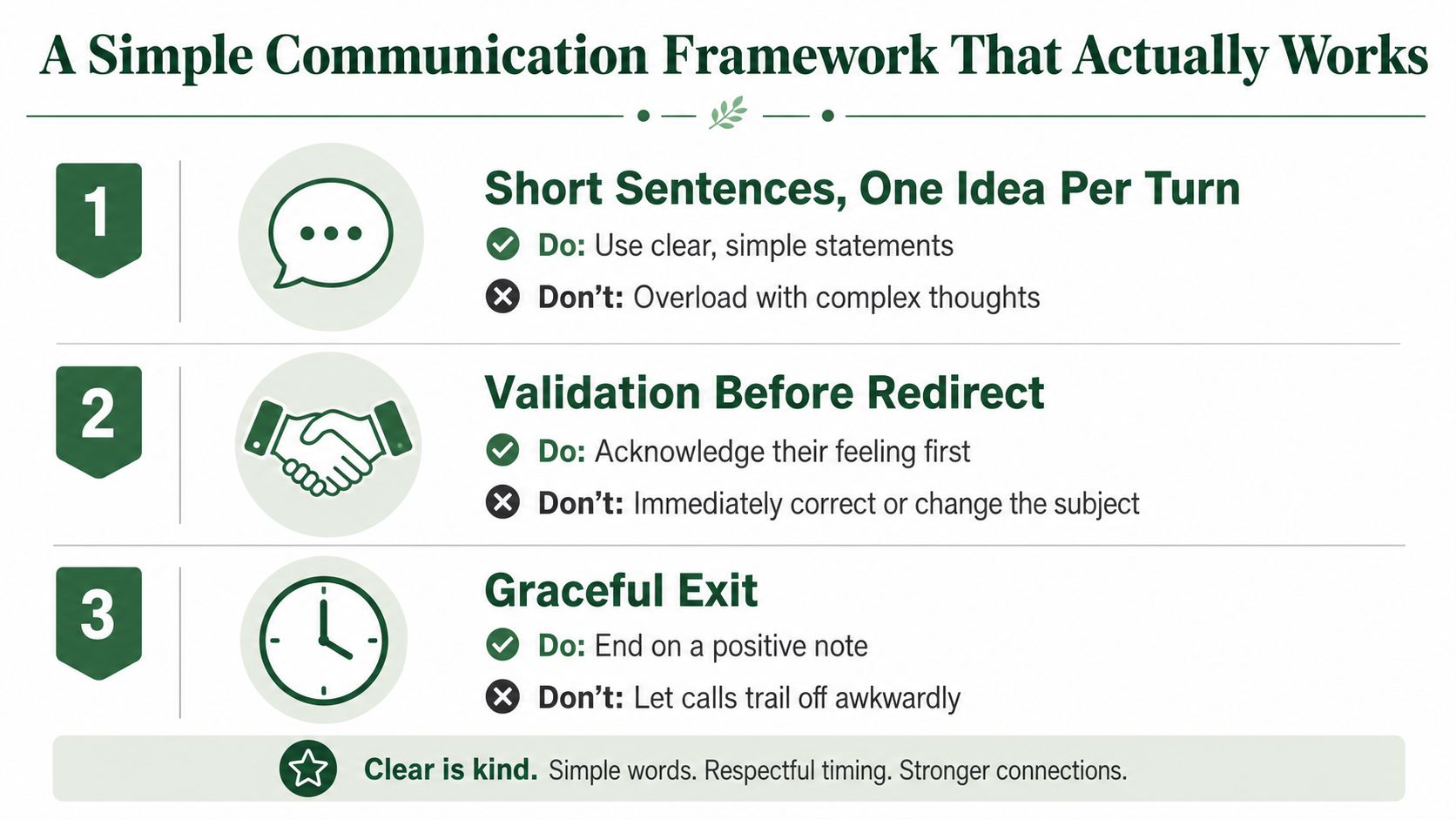
Use short sentences and one idea per turn
Validate before you redirect
End before the call becomes strained
Setting the Schedule and Opening the Call
Build predictable windows
Protect the first moments
What to Listen for on Every Call
Mood and energy
Orientation
Comfort and health
Engagement and connection
When to Add a Program Like Velma to the Mix
Compare the models honestly
Putting It All Together This Week
Know when calls aren't enough
Why the Phone Still Matters in Dementia Care
Adult children often reach for technology first. They set up a medication app, create a video-call account, or install a tablet with large icons. Then the password is forgotten, the screen is too bright, a notification causes anxiety, or the device gets left in another room. The family has built a system that looks efficient from a distance but asks the person with memory loss to handle too many steps.
A phone call asks for much less. The person hears a known voice and presses one button, or answers when the phone rings. That simplicity matters in early and middle stages of dementia, when a person may still want connection but struggle with menus, passwords, small text, and unfamiliar routines.
Phone contact also has a serious social role. A peer-reviewed study of older adults noted that, before the pandemic, 25% of adults aged 65 and older were socially isolated and 43% of adults aged 60 and older reported loneliness. In the same older-adult cohort, participants made a median of 2 phone calls per day and received a median of 2 per day, for a median total of 5 calls daily, with an average UCLA Loneliness score of 35.3 ± 7.6. These findings appear in the peer-reviewed study on phone communication and loneliness among older adults.
Consistency matters more than novelty
I've sat at kitchen tables with families who keep searching for the perfect tool while missing the reliable habit in front of them. The parent doesn't need a clever interface. They need to know who's calling, roughly when the call will come, and what kind of conversation to expect.
That doesn't make phone-only care complete. A call can't show you an empty refrigerator, a new bruise, or a person struggling to stand. It can't replace an in-person visit, medical assessment, or home support. But regular conversation can reveal changes in mood, orientation, appetite, confidence, and daily functioning.
Practical rule: Use technology to support the relationship, not to create another task for the person with dementia.
A structured call should have a deliberate cadence, a calm opening, and named escalation cues. Families can also learn from operational approaches used in professional settings. DialNexa's healthcare call center guide offers useful context on how trained callers can organize consistent healthcare communication without making every interaction feel mechanical.
A Simple Communication Framework That Actually Works
Dementia changes the way a person processes language, but it doesn't remove their need for respect. Your job isn't to win an argument about the date or force a correct answer. Your job is to make the exchange understandable, emotionally safe, and easy to leave.
Use short sentences and one idea per turn
Say, “Sam visited on Tuesday. She brought cookies.” Don't ask, “Do you remember who came yesterday?” The question sounds harmless, but it turns the call into a memory test and creates an opportunity for failure.
Give one piece of information, then wait. If you need to discuss lunch and an appointment, handle them separately. Avoid stacking several questions together, because the person may answer only the last one or become quiet.
Do:
“It's raining today.”
“I'm calling to hear how your morning is going.”
“Your appointment is tomorrow.”
Don't:
“Did you sleep well, eat breakfast, take your pills, and remember the nurse is coming?”
“You know this already.”
“I just told you that.”
Validate before you redirect
If your parent says, “I need to go home,” correcting them may make the distress worse. Start with the feeling: “You're missing home. That sounds upsetting.” Once the emotion has been acknowledged, offer a gentle redirect: “Let's have some tea while we talk about what you miss.”
Validation doesn't mean agreeing with every factual detail. It means responding to the emotional truth before introducing a different subject. The dementia communication strategies guide provides further practical guidance for keeping these exchanges respectful and manageable.
End before the call becomes strained
A graceful exit is part of good communication. Say, “I'm glad we talked. I'm going to let you have lunch now, and I'll call tomorrow.” Don't wait until both of you have run out of patience or allow the conversation to trail into silence.
A short exchange might sound like this:
“Hi, Dad. It's Tuesday morning, and I'm thinking about you.”
“I don't know what day it is.”
“That's okay. The morning feels confusing today. I'm here with you. Did you have tea or coffee?”
The caller doesn't challenge the confusion. They name it, reassure him, and move to a simple sensory prompt.
Practice these phrases before you need them. Hesitation, over-explanation, and a nervous rush can all sound like pressure. The framework works when it becomes natural enough that you can use it while your parent is upset.
Setting the Schedule and Opening the Call
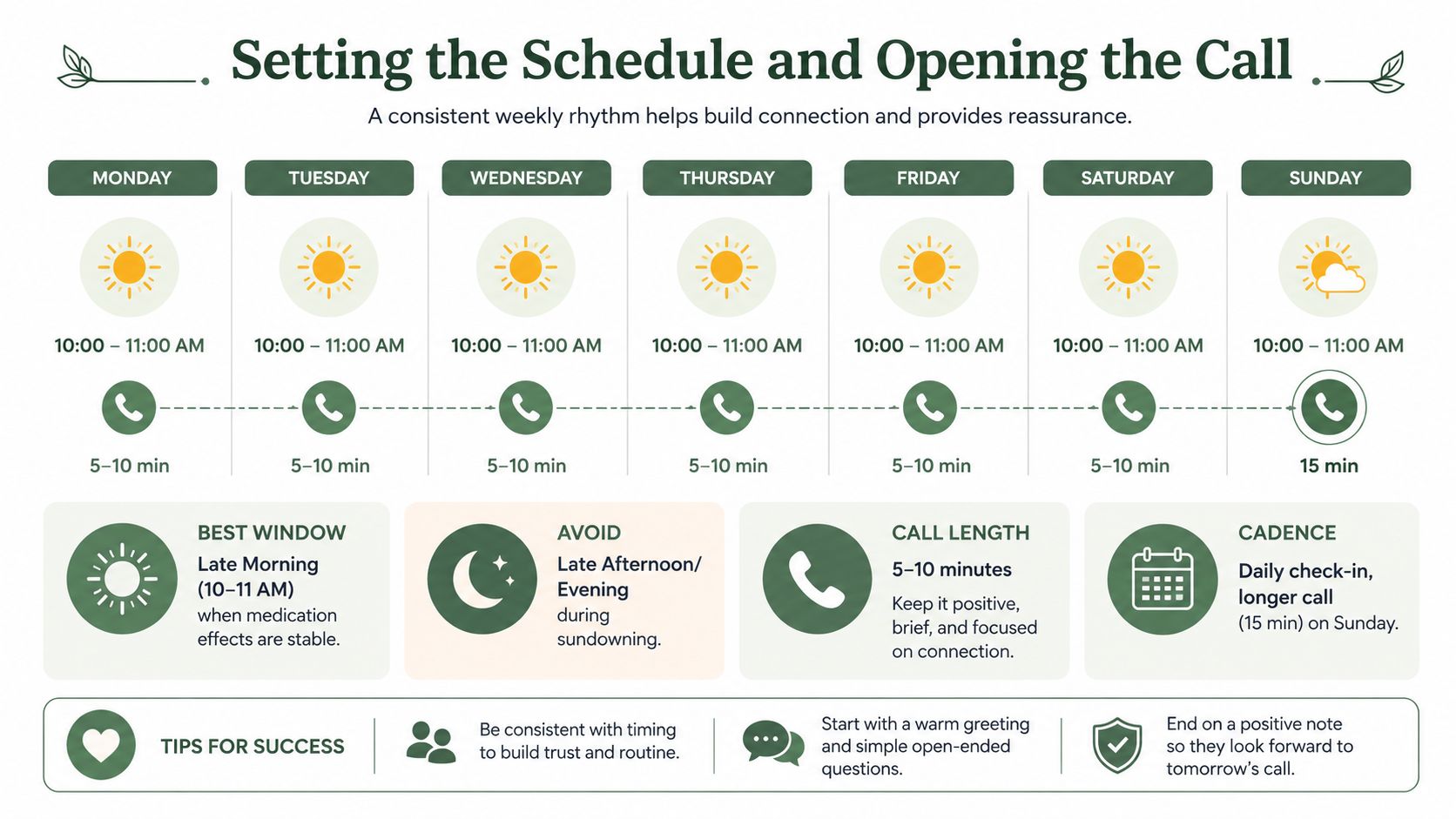
A call schedule should fit the person's daily pattern, not the family's ideal calendar. Many people with dementia are clearer earlier in the day and more unsettled later, particularly as fatigue builds. Watch your parent's actual rhythm for several days, then choose a window when medication effects seem stable and the person is least likely to be sleepy, rushed, or distressed.
A workable pattern is a primary morning check-in, a brief social call in the middle of the afternoon, and a lighter evening touch when that later call remains calming. Keep difficult days shorter. A successful five-minute conversation is better than a twenty-minute call that ends in agitation.
Build predictable windows
The call doesn't need to happen at the exact minute, but the pattern should be recognizable. Put it on the family calendar, assign a backup caller, and use the same opening whenever possible.
Try these openings:
Morning: “Good morning, Mum. It's me, Alex. I'm calling while I have my coffee. How does your tea taste today?”
Afternoon: “Hi, Dad. I was thinking about your garden. Have you noticed what's flowering?”
Evening: “Hi, it's Sam. I wanted to wish you a peaceful evening. Are you sitting comfortably?”
These lines give the person an anchor without asking them to prove what they remember. Weather, food, music, a pet, a long-held hobby, and a grandchild's name usually travel well from one call to the next.
Keep a small prompt list, but don't interrogate. Ask about a favorite song, describe what you can see from your window, or invite an opinion about a familiar recipe. If the answer is brief, accept it. A quiet, warm call still counts.
Protect the first moments
The opening fifteen seconds often determines whether the person feels welcomed or examined. State your name, identify the relationship, use a calm pace, and pause after the first sentence.
Families looking for a practical routine can use this daily check-in calls guide for seniors as a starting point, then adjust the schedule to the person's sleep, medication, and energy patterns. Don't call repeatedly during a difficult window because the schedule says you should. Move the call and record what happened.
What to Listen for on Every Call
A friendly conversation can also be a useful observation point. You don't need to turn every call into an assessment, and your parent shouldn't feel monitored. Listen for changes across familiar topics, then write down what you heard while the details are fresh.
Mood and energy
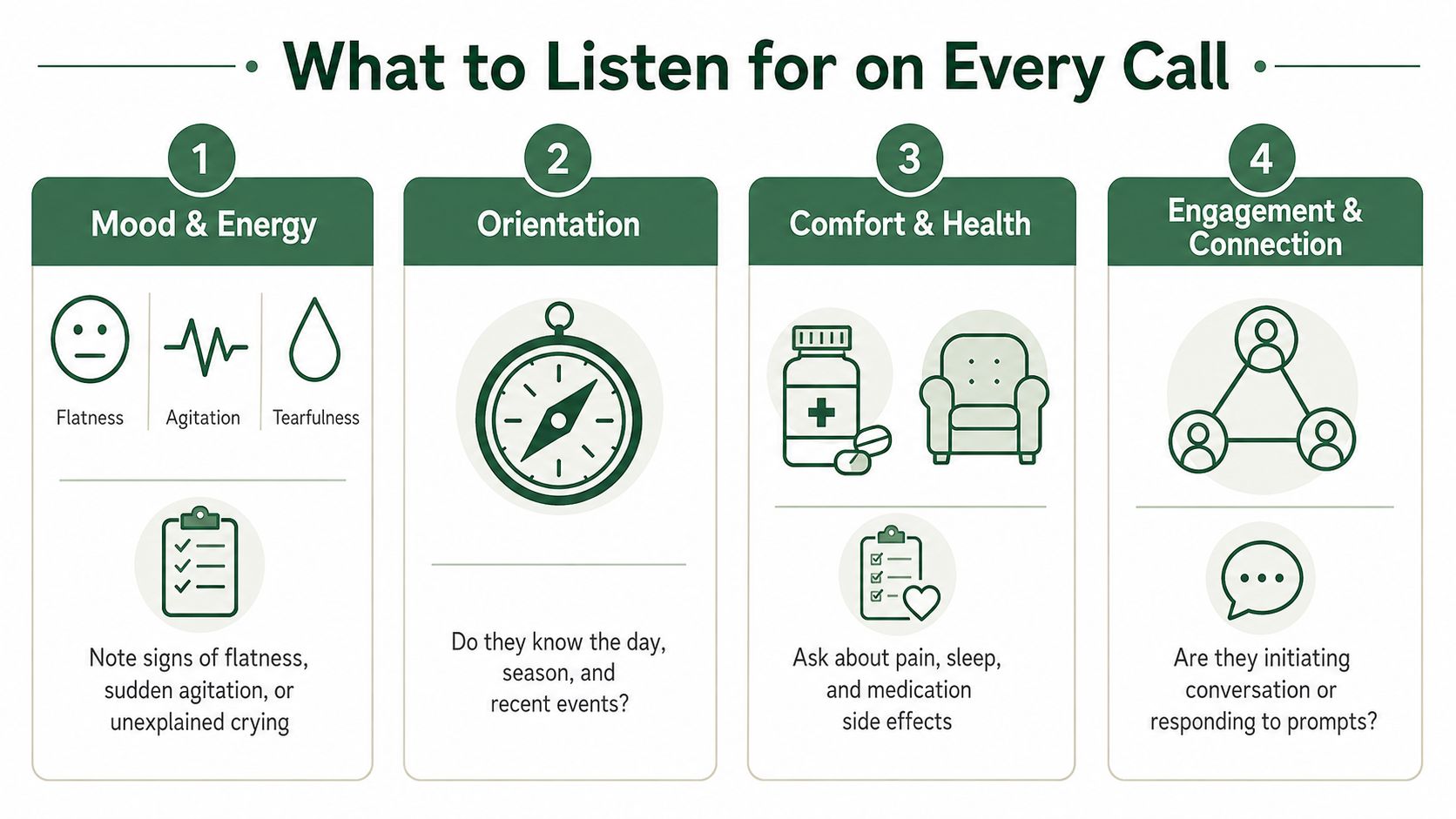
Notice whether the voice sounds unusually flat, agitated, frightened, or tearful. A person who normally jokes but suddenly gives clipped answers may be having a harder day, even if they insist everything is fine.
Use a natural prompt: “What has your energy been like this morning?” If distress is intense, new, or continues after reassurance, contact family or a relevant professional rather than waiting for the next scheduled call.
Orientation
You're not administering a test. You're listening for a meaningful change in how the person understands the day and recent events.
Try, “Is it feeling like a weekday or a weekend?” or “What have you been doing since breakfast?” If the person is suddenly unable to follow a familiar conversation, repeatedly misidentifies people, or sounds markedly more confused than usual, arrange family follow-up within 24 hours, or sooner if there are urgent safety concerns.
Comfort and health
Mention ordinary daily details: “Have you been comfortable in your chair?” “How did you sleep?” “Has anything been bothering your body today?” Listen for pain, dizziness, unusual sleepiness, medication side effects, missed meals, or trouble moving around the home.
A reference to a fall, a new injury, severe pain, or inability to get up should not be handled with another friendly call. Ask someone nearby to check in and involve medical support when needed.
Engagement and connection
Notice whether your parent initiates anything, responds to familiar prompts, or closes down with repeated “I'm fine.” Withdrawal can sound polite. It may appear as declining every topic, refusing usual activities, or showing no interest in people who normally matter.
Ask, “Who have you spoken with today?” A sudden break from usual contact deserves family follow-up, especially when it appears alongside mood or orientation changes.
Log each call in two sentences: one about what the person said or did, and one about any action needed. For example, “Mum sounded calm and discussed breakfast. She mentioned forgetting an appointment, so I'll confirm the details with my brother.” A record gives the family a pattern instead of a collection of uneasy impressions.
When to Add a Program Like Velma to the Mix
Family calling works when one or more relatives can reliably keep the routine, communicate observations, and respond when something changes. It becomes fragile when the primary caller travels, works unpredictable hours, feels burned out, or keeps postponing calls because each conversation has become emotionally difficult.
A dedicated phone-based program such as Velma can add scheduled calls led by trained care team members. Its stated model combines conversation, cognitive stimulation, orientation, emotional support, practical check-ins, documentation, and care-manager coordination. That makes it a complementary layer, not a replacement for family, clinicians, or in-home care.
Compare the models honestly
Criterion | Family-Only Calling | Velma + Family |
|---|---|---|
Consistency | Depends on relatives' availability and energy | Adds recurring calls through a dedicated care team |
Communication skills | Family members learn through practice and experience | Calls use dementia-focused communication frameworks |
Documentation | Families must record observations themselves | Structured updates can give relatives visibility between visits |
Care coordination | Usually managed by the family | A care manager can help organize updates and plan adjustments |
Escalation | Relatives decide when to involve others | The program can surface concerns for family follow-up |
Emotional role | Deep personal familiarity and family history | Reliable companionship that supplements personal contact |
Choose family-only calling when the schedule is already dependable and your parent responds well to relatives. Choose a mixed model when the family wants to remain closely involved but needs someone else to cover regular weekday contact. A common practical arrangement is program calls during the working week and longer family conversations at the weekend.
Phone support has a boundary. If your parent is falling, leaving the stove on, missing essential medication repeatedly, wandering, or unable to manage basic needs, more calls aren't the answer. In that situation, involve the clinician, assess home support, and consider whether the person needs direct supervision.
Families considering a structured option can review how Velma works for daily cognitive support and compare its model with the support they can sustain. Don't buy a service to avoid a difficult family conversation. Add one because the current arrangement leaves predictable gaps.
Putting It All Together This Week
Start on Monday with one dependable caller, one familiar opening, and one observation note. Don't launch a complicated family rota that nobody can maintain. Same caller, same time, same opener is the habit that does the most work.
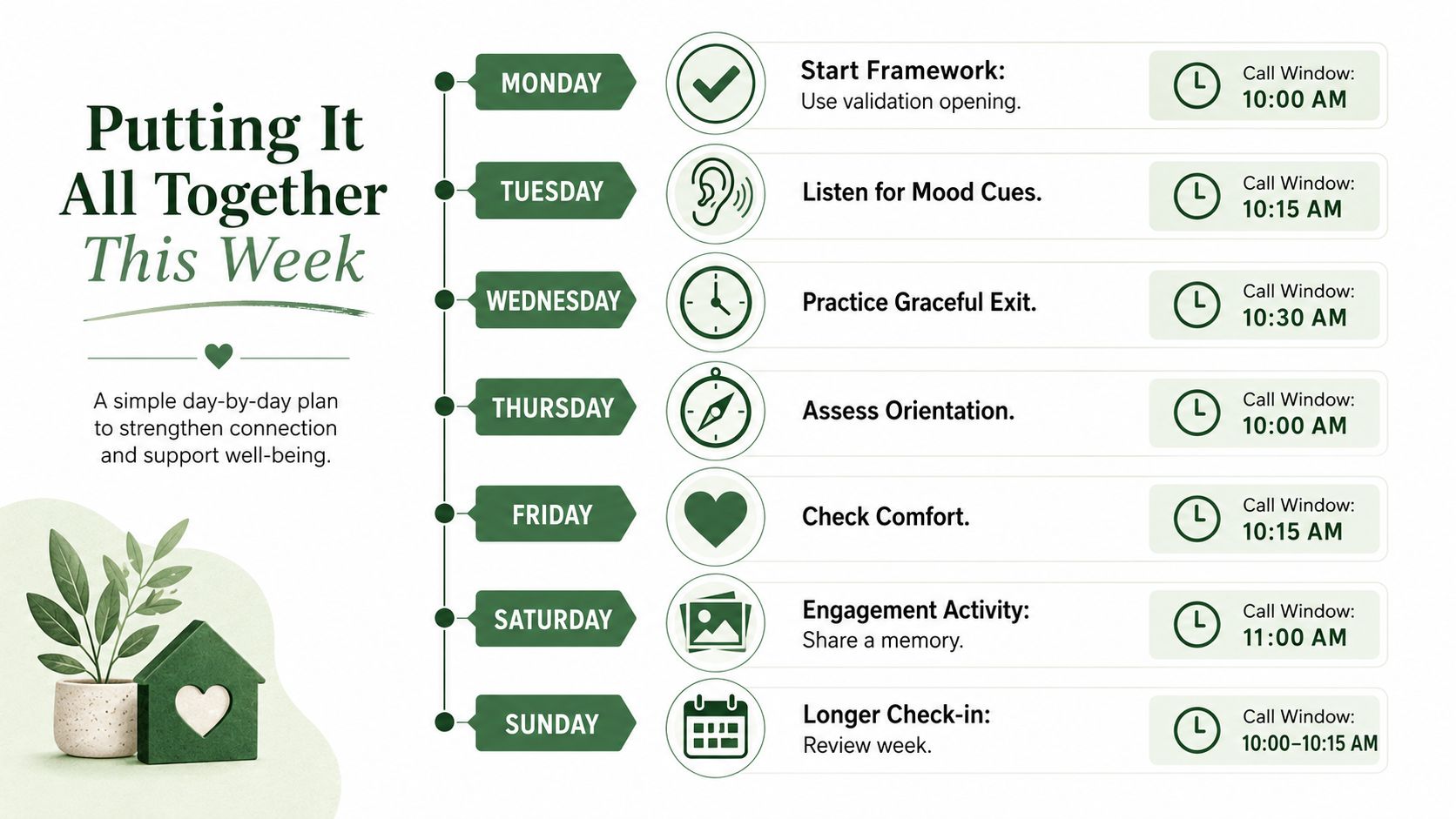
Use this starter rhythm:
Monday at 10:00 AM: Open with validation and warmth. Ask how the morning feels.
Tuesday at 10:15 AM: Listen for mood and energy. Ask what your parent has enjoyed today.
Wednesday at 10:30 AM: Practice a graceful exit. End while the call is still comfortable.
Thursday at 10:00 AM: Listen for orientation through a casual question about the day or recent activity.
Friday at 10:15 AM: Check comfort, sleep, food, pain, and medication concerns without sounding like an inspection.
Saturday at 11:00 AM: Share a memory, song, photograph, recipe, or familiar hobby.
Sunday at 10:00 to 10:15 AM: Hold a longer check-in and review the week with the family record nearby.
The goal isn't to make every call cheerful. The goal is to make contact reliable enough that changes become visible. A phone program can add structure when family availability is inconsistent, but it still needs clear information from relatives about preferences, routines, and risks.
Know when calls aren't enough
Escalate beyond phone support if you hear repeated missed medication mentions, two consecutive calls with unusual disorientation, any reference to a fall, sudden social withdrawal, severe distress, new pain, or an inability to manage ordinary daily tasks. Contact the person's clinician, ask a trusted relative or neighbor to visit, and discuss in-home support rather than only increasing call frequency.
The evidence supports taking structured phone contact seriously, but it also argues against overselling it. A 6-month proactive phone program reported loneliness falling from 46% to 28%, anxiety from 63% to 43%, and depression from 36% to 25%, while unhealthy mental days declined from 14 to 8 and unhealthy physical days from 15 to 11, as reported in the peer-reviewed study of a proactive phone program for older adults. For dementia care specifically, a telephone caregiver intervention reported a 27% net improvement in caregiver depressive symptoms and a 29% net improvement in reactions to care-recipient depressive behaviors, with statistical results reported in the FITT-C telephone intervention study.
Velma offers scheduled phone calls that combine warm conversation with cognitive stimulation, orientation, emotional support, and practical well-being checks for older adults experiencing memory loss. If your family needs dependable in touch communication between personal visits, visit Velma to explore whether its phone-based support can fit your parent's routine.
Your mother misses the call again. When she finally answers, she sounds irritated and asks why you're checking on her. You explain that you only wanted to know whether she took her medication, and within a minute you're both tense. Later, you wonder whether an app, a video visit, or a smarter reminder system would make things easier.
Usually, the answer is less complicated. A familiar voice, arriving at a predictable time, can do more for dementia support than another device your parent has to learn. Effective in touch communication depends less on technological features than on reducing friction, preserving dignity, and noticing meaningful changes before they become emergencies.
Table of Contents
Why the Phone Still Matters in Dementia Care
Consistency matters more than novelty
A Simple Communication Framework That Actually Works
Use short sentences and one idea per turn
Validate before you redirect
End before the call becomes strained
Setting the Schedule and Opening the Call
Build predictable windows
Protect the first moments
What to Listen for on Every Call
Mood and energy
Orientation
Comfort and health
Engagement and connection
When to Add a Program Like Velma to the Mix
Compare the models honestly
Putting It All Together This Week
Know when calls aren't enough
Why the Phone Still Matters in Dementia Care
Adult children often reach for technology first. They set up a medication app, create a video-call account, or install a tablet with large icons. Then the password is forgotten, the screen is too bright, a notification causes anxiety, or the device gets left in another room. The family has built a system that looks efficient from a distance but asks the person with memory loss to handle too many steps.
A phone call asks for much less. The person hears a known voice and presses one button, or answers when the phone rings. That simplicity matters in early and middle stages of dementia, when a person may still want connection but struggle with menus, passwords, small text, and unfamiliar routines.
Phone contact also has a serious social role. A peer-reviewed study of older adults noted that, before the pandemic, 25% of adults aged 65 and older were socially isolated and 43% of adults aged 60 and older reported loneliness. In the same older-adult cohort, participants made a median of 2 phone calls per day and received a median of 2 per day, for a median total of 5 calls daily, with an average UCLA Loneliness score of 35.3 ± 7.6. These findings appear in the peer-reviewed study on phone communication and loneliness among older adults.
Consistency matters more than novelty
I've sat at kitchen tables with families who keep searching for the perfect tool while missing the reliable habit in front of them. The parent doesn't need a clever interface. They need to know who's calling, roughly when the call will come, and what kind of conversation to expect.
That doesn't make phone-only care complete. A call can't show you an empty refrigerator, a new bruise, or a person struggling to stand. It can't replace an in-person visit, medical assessment, or home support. But regular conversation can reveal changes in mood, orientation, appetite, confidence, and daily functioning.
Practical rule: Use technology to support the relationship, not to create another task for the person with dementia.
A structured call should have a deliberate cadence, a calm opening, and named escalation cues. Families can also learn from operational approaches used in professional settings. DialNexa's healthcare call center guide offers useful context on how trained callers can organize consistent healthcare communication without making every interaction feel mechanical.
A Simple Communication Framework That Actually Works
Dementia changes the way a person processes language, but it doesn't remove their need for respect. Your job isn't to win an argument about the date or force a correct answer. Your job is to make the exchange understandable, emotionally safe, and easy to leave.
Use short sentences and one idea per turn
Say, “Sam visited on Tuesday. She brought cookies.” Don't ask, “Do you remember who came yesterday?” The question sounds harmless, but it turns the call into a memory test and creates an opportunity for failure.
Give one piece of information, then wait. If you need to discuss lunch and an appointment, handle them separately. Avoid stacking several questions together, because the person may answer only the last one or become quiet.
Do:
“It's raining today.”
“I'm calling to hear how your morning is going.”
“Your appointment is tomorrow.”
Don't:
“Did you sleep well, eat breakfast, take your pills, and remember the nurse is coming?”
“You know this already.”
“I just told you that.”
Validate before you redirect
If your parent says, “I need to go home,” correcting them may make the distress worse. Start with the feeling: “You're missing home. That sounds upsetting.” Once the emotion has been acknowledged, offer a gentle redirect: “Let's have some tea while we talk about what you miss.”
Validation doesn't mean agreeing with every factual detail. It means responding to the emotional truth before introducing a different subject. The dementia communication strategies guide provides further practical guidance for keeping these exchanges respectful and manageable.
End before the call becomes strained
A graceful exit is part of good communication. Say, “I'm glad we talked. I'm going to let you have lunch now, and I'll call tomorrow.” Don't wait until both of you have run out of patience or allow the conversation to trail into silence.
A short exchange might sound like this:
“Hi, Dad. It's Tuesday morning, and I'm thinking about you.”
“I don't know what day it is.”
“That's okay. The morning feels confusing today. I'm here with you. Did you have tea or coffee?”
The caller doesn't challenge the confusion. They name it, reassure him, and move to a simple sensory prompt.
Practice these phrases before you need them. Hesitation, over-explanation, and a nervous rush can all sound like pressure. The framework works when it becomes natural enough that you can use it while your parent is upset.
Setting the Schedule and Opening the Call
A call schedule should fit the person's daily pattern, not the family's ideal calendar. Many people with dementia are clearer earlier in the day and more unsettled later, particularly as fatigue builds. Watch your parent's actual rhythm for several days, then choose a window when medication effects seem stable and the person is least likely to be sleepy, rushed, or distressed.
A workable pattern is a primary morning check-in, a brief social call in the middle of the afternoon, and a lighter evening touch when that later call remains calming. Keep difficult days shorter. A successful five-minute conversation is better than a twenty-minute call that ends in agitation.
Build predictable windows
The call doesn't need to happen at the exact minute, but the pattern should be recognizable. Put it on the family calendar, assign a backup caller, and use the same opening whenever possible.
Try these openings:
Morning: “Good morning, Mum. It's me, Alex. I'm calling while I have my coffee. How does your tea taste today?”
Afternoon: “Hi, Dad. I was thinking about your garden. Have you noticed what's flowering?”
Evening: “Hi, it's Sam. I wanted to wish you a peaceful evening. Are you sitting comfortably?”
These lines give the person an anchor without asking them to prove what they remember. Weather, food, music, a pet, a long-held hobby, and a grandchild's name usually travel well from one call to the next.
Keep a small prompt list, but don't interrogate. Ask about a favorite song, describe what you can see from your window, or invite an opinion about a familiar recipe. If the answer is brief, accept it. A quiet, warm call still counts.
Protect the first moments
The opening fifteen seconds often determines whether the person feels welcomed or examined. State your name, identify the relationship, use a calm pace, and pause after the first sentence.
Families looking for a practical routine can use this daily check-in calls guide for seniors as a starting point, then adjust the schedule to the person's sleep, medication, and energy patterns. Don't call repeatedly during a difficult window because the schedule says you should. Move the call and record what happened.
What to Listen for on Every Call
A friendly conversation can also be a useful observation point. You don't need to turn every call into an assessment, and your parent shouldn't feel monitored. Listen for changes across familiar topics, then write down what you heard while the details are fresh.
Mood and energy
Notice whether the voice sounds unusually flat, agitated, frightened, or tearful. A person who normally jokes but suddenly gives clipped answers may be having a harder day, even if they insist everything is fine.
Use a natural prompt: “What has your energy been like this morning?” If distress is intense, new, or continues after reassurance, contact family or a relevant professional rather than waiting for the next scheduled call.
Orientation
You're not administering a test. You're listening for a meaningful change in how the person understands the day and recent events.
Try, “Is it feeling like a weekday or a weekend?” or “What have you been doing since breakfast?” If the person is suddenly unable to follow a familiar conversation, repeatedly misidentifies people, or sounds markedly more confused than usual, arrange family follow-up within 24 hours, or sooner if there are urgent safety concerns.
Comfort and health
Mention ordinary daily details: “Have you been comfortable in your chair?” “How did you sleep?” “Has anything been bothering your body today?” Listen for pain, dizziness, unusual sleepiness, medication side effects, missed meals, or trouble moving around the home.
A reference to a fall, a new injury, severe pain, or inability to get up should not be handled with another friendly call. Ask someone nearby to check in and involve medical support when needed.
Engagement and connection
Notice whether your parent initiates anything, responds to familiar prompts, or closes down with repeated “I'm fine.” Withdrawal can sound polite. It may appear as declining every topic, refusing usual activities, or showing no interest in people who normally matter.
Ask, “Who have you spoken with today?” A sudden break from usual contact deserves family follow-up, especially when it appears alongside mood or orientation changes.
Log each call in two sentences: one about what the person said or did, and one about any action needed. For example, “Mum sounded calm and discussed breakfast. She mentioned forgetting an appointment, so I'll confirm the details with my brother.” A record gives the family a pattern instead of a collection of uneasy impressions.
When to Add a Program Like Velma to the Mix
Family calling works when one or more relatives can reliably keep the routine, communicate observations, and respond when something changes. It becomes fragile when the primary caller travels, works unpredictable hours, feels burned out, or keeps postponing calls because each conversation has become emotionally difficult.
A dedicated phone-based program such as Velma can add scheduled calls led by trained care team members. Its stated model combines conversation, cognitive stimulation, orientation, emotional support, practical check-ins, documentation, and care-manager coordination. That makes it a complementary layer, not a replacement for family, clinicians, or in-home care.
Compare the models honestly
Criterion | Family-Only Calling | Velma + Family |
|---|---|---|
Consistency | Depends on relatives' availability and energy | Adds recurring calls through a dedicated care team |
Communication skills | Family members learn through practice and experience | Calls use dementia-focused communication frameworks |
Documentation | Families must record observations themselves | Structured updates can give relatives visibility between visits |
Care coordination | Usually managed by the family | A care manager can help organize updates and plan adjustments |
Escalation | Relatives decide when to involve others | The program can surface concerns for family follow-up |
Emotional role | Deep personal familiarity and family history | Reliable companionship that supplements personal contact |
Choose family-only calling when the schedule is already dependable and your parent responds well to relatives. Choose a mixed model when the family wants to remain closely involved but needs someone else to cover regular weekday contact. A common practical arrangement is program calls during the working week and longer family conversations at the weekend.
Phone support has a boundary. If your parent is falling, leaving the stove on, missing essential medication repeatedly, wandering, or unable to manage basic needs, more calls aren't the answer. In that situation, involve the clinician, assess home support, and consider whether the person needs direct supervision.
Families considering a structured option can review how Velma works for daily cognitive support and compare its model with the support they can sustain. Don't buy a service to avoid a difficult family conversation. Add one because the current arrangement leaves predictable gaps.
Putting It All Together This Week
Start on Monday with one dependable caller, one familiar opening, and one observation note. Don't launch a complicated family rota that nobody can maintain. Same caller, same time, same opener is the habit that does the most work.
Use this starter rhythm:
Monday at 10:00 AM: Open with validation and warmth. Ask how the morning feels.
Tuesday at 10:15 AM: Listen for mood and energy. Ask what your parent has enjoyed today.
Wednesday at 10:30 AM: Practice a graceful exit. End while the call is still comfortable.
Thursday at 10:00 AM: Listen for orientation through a casual question about the day or recent activity.
Friday at 10:15 AM: Check comfort, sleep, food, pain, and medication concerns without sounding like an inspection.
Saturday at 11:00 AM: Share a memory, song, photograph, recipe, or familiar hobby.
Sunday at 10:00 to 10:15 AM: Hold a longer check-in and review the week with the family record nearby.
The goal isn't to make every call cheerful. The goal is to make contact reliable enough that changes become visible. A phone program can add structure when family availability is inconsistent, but it still needs clear information from relatives about preferences, routines, and risks.
Know when calls aren't enough
Escalate beyond phone support if you hear repeated missed medication mentions, two consecutive calls with unusual disorientation, any reference to a fall, sudden social withdrawal, severe distress, new pain, or an inability to manage ordinary daily tasks. Contact the person's clinician, ask a trusted relative or neighbor to visit, and discuss in-home support rather than only increasing call frequency.
The evidence supports taking structured phone contact seriously, but it also argues against overselling it. A 6-month proactive phone program reported loneliness falling from 46% to 28%, anxiety from 63% to 43%, and depression from 36% to 25%, while unhealthy mental days declined from 14 to 8 and unhealthy physical days from 15 to 11, as reported in the peer-reviewed study of a proactive phone program for older adults. For dementia care specifically, a telephone caregiver intervention reported a 27% net improvement in caregiver depressive symptoms and a 29% net improvement in reactions to care-recipient depressive behaviors, with statistical results reported in the FITT-C telephone intervention study.
Velma offers scheduled phone calls that combine warm conversation with cognitive stimulation, orientation, emotional support, and practical well-being checks for older adults experiencing memory loss. If your family needs dependable in touch communication between personal visits, visit Velma to explore whether its phone-based support can fit your parent's routine.
Suggested Article: