8 Cognitive Stimulation Therapy Activities for Dementia Care

More than 55 million people live with dementia worldwide, making practical ways to preserve connection, communication, and daily independence essential. Cognitive stimulation therapy activities can help by combining conversation, orientation, language practice, attention tasks, memory support, and meaningful problem-solving. Delivered through an ordinary phone call, these activities can reach older adults who can't attend a group or use an app, while giving caregivers regular opportunities to notice changes in mood, confidence, and everyday functioning.
Cognitive stimulation therapy, or CST, has a substantial evidence base. A Cochrane review of standardized CST found a small but consistent cognition benefit, with probable improvements in communication, social interaction, well-being, and day-to-day activities. A modern systematic review and meta-analysis of randomized trials also found benefits across cognition, memory, activities of daily living, depressive symptoms, and dementia ratings.
The strongest CST programs are structured, but they still feel personal. The following eight activities adapt that principle for phone-based care across early to mid-stage dementia.
Table of Contents
1. Reminiscence Therapy
A simple call script
2. Orientation Therapy
Keep the cue conversational
3. Language and Word-Finding Exercises
Use graduated cues
4. Attention and Concentration Exercises
5. Memory Cuing and Retrieval Practice
Create a practical memory map
6. Meaningful Activities and Purpose-Driven Engagement
Build the call around one familiar role
7. Mood Monitoring and Emotional Validation Techniques
8. Practical Life Skills and Daily Functioning Coaching
Coach the task, not just the answer
Comparison of 8 Cognitive Stimulation Activities
Putting It into Practice Phone-Based Cognitive Stimulation
Use safety checks every time
1. Reminiscence Therapy
Reminiscence works best when it starts with the person, not a generic list of memory questions. A care coordinator might ask a former teacher about a classroom she remembers fondly, invite a lifelong gardener to describe a favorite planting season, or explore the sounds and smells associated with a family holiday. These prompts use meaningful autobiographical material while reinforcing identity and emotional connection.
A phone call doesn't provide photographs or objects automatically, so preparation matters. Gather personal history from the participant and family, then build a short record of important jobs, relationships, hobbies, places, music, and celebrations. Specific prompts are easier to answer than broad questions. “Tell me about the garden you mentioned” usually gives the conversation more direction than “What did you do in the past?”
A simple call script
“Last time, you told me about your years teaching. What did you enjoy most about preparing a lesson?”
If the participant gives an uncertain answer, don't turn the exchange into a memory test. Respond to the feeling and story rather than correcting every detail. “That sounds like it was rewarding” keeps the person engaged even when the chronology or facts aren't exact.
Use the following safeguards:
Begin with positive, familiar material: Start with well-established memories before discussing grief, conflict, or other emotionally complex periods.
Follow recurring themes: Note favorite topics, stories, and sensory details so future calls feel continuous.
Redirect distress gently: If a memory causes sadness or agitation, acknowledge it and move toward a safer subject.
Share useful notes: Document names, interests, and preferred prompts so every care team member can maintain consistency.
For a deeper framework that complements phone conversations, see this guide to life review therapy for dementia.

2. Orientation Therapy
Orientation should reduce uncertainty, not create another test the participant can fail. During a warm check-in, mention the day, season, weather, location, and events that affect daily life. A coordinator might say, “Good morning. It's Tuesday, and your daughter is visiting later this week. How are you feeling about her visit?”
The most useful cues relate to functioning. Appointments, medication routines, family visits, meals, and changes in daylight matter more than demanding exact recall of a date. If the participant doesn't know the day, offer the information calmly and continue the conversation.
Keep the cue conversational
A standard greeting can provide a reliable anchor:
“Good morning, it's Tuesday. You're at home, and we're having our usual call. Have you had breakfast yet?”
That sentence combines time, place, routine, and a concrete daily event without sounding clinical. Follow it with an open question about the participant's experience, such as what they can see outside or what they plan to do next.
A visible calendar near the phone can support the call. Family members can mark appointments and visits in large writing, then refer to the same calendar when they arrive. Consistent wording also helps. If one person says “the doctor is soon” and another gives a different timeframe, the participant may become more confused.
Practical rule: Orient people to information that helps them act safely today. Don't repeatedly quiz them about facts that have no immediate purpose.
Watch for frustration, embarrassment, or withdrawal. Those reactions indicate that the task is too demanding or poorly timed. Acknowledge the feeling, provide the answer without pressure, and shift to a more engaging topic such as the weather, breakfast, or a planned visit.
3. Language and Word-Finding Exercises
Word-finding practice should feel like a conversation game, not an examination. A coordinator can invite the participant to name vegetables, connect words by association, solve a flexible riddle, or tell a short story about cooking, travel, work, or family traditions. The activity exercises language while preserving confidence.
Begin with familiar categories linked to the participant's interests. Someone who enjoys gardening may find “name flowers” easier and more engaging than an abstract vocabulary exercise. Someone who follows sports may respond well to team names, equipment, or memorable games.
Use graduated cues
If a word doesn't come immediately, allow processing time before helping. Then offer the smallest cue likely to work:
Semantic cue: “It's something you wear in winter.”
Phonemic cue: “It starts with a G.”
Choice cue: “Could it be glove or garden?”
Model and move on: Supply the word warmly if the struggle continues.
Accept related words and approximations. The participant may say “hand warmer” when searching for “glove,” and that contribution still shows meaningful communication. Correcting every response can make the person avoid speaking.
Try this script:
“Let's name vegetables together. I'll start with tomato and carrot. What else comes to mind?”
When the participant contributes, respond to effort and content: “Great, you thought of seven vegetables,” or “I like that you included squash. Do you ever cook it?” The follow-up conversation turns retrieval into a social exchange.
For practical support beyond the exercise itself, use these dementia communication strategies.

4. Attention and Concentration Exercises
Phone-based attention activities work best when they respond to the person's condition that day. Poor sleep, pain, medication changes, or an upsetting event can reduce concentration, even if the participant managed a longer task recently. The coordinator should listen for these changes and adjust the activity without presenting the change as failure.
Open with one instruction and a manageable challenge:
“I'll say three numbers slowly. When I finish, repeat them in the same order: seven, three, nine.”
Pause after speaking. If the participant manages that comfortably, try listening for a target word, following a short sequence of actions, or deciding whether numbers are rising or falling. Familiar language and one step at a time usually work better than lengthy explanations.
Use the person's responses as a safety check. Shorten or change the activity if they:
Stop responding: They may be tired, distracted, or unable to hold the instruction.
Ask for repeated directions: Give one step, then wait.
Sound tense or embarrassed: Present the exercise as a shared brain game rather than a test.
Lose interest quickly: Change the format or connect it with a preferred topic.
Accuracy is only one outcome. Say “Good listening” or “You caught that quickly” when the participant stays engaged. After an error, keep your tone neutral and offer an easier version:
“Let's make this one simpler. We can do it together.”
Repeat selected activities across calls, recording whether attention was steady, variable, or reduced. This pattern can help caregivers notice fatigue and decide when a session needs to be shorter. Informal phone performance is not a clinical assessment. A sudden, marked change in attention, speech, alertness, or behavior should be reported to the family and discussed with an appropriate clinician.
5. Memory Cuing and Retrieval Practice
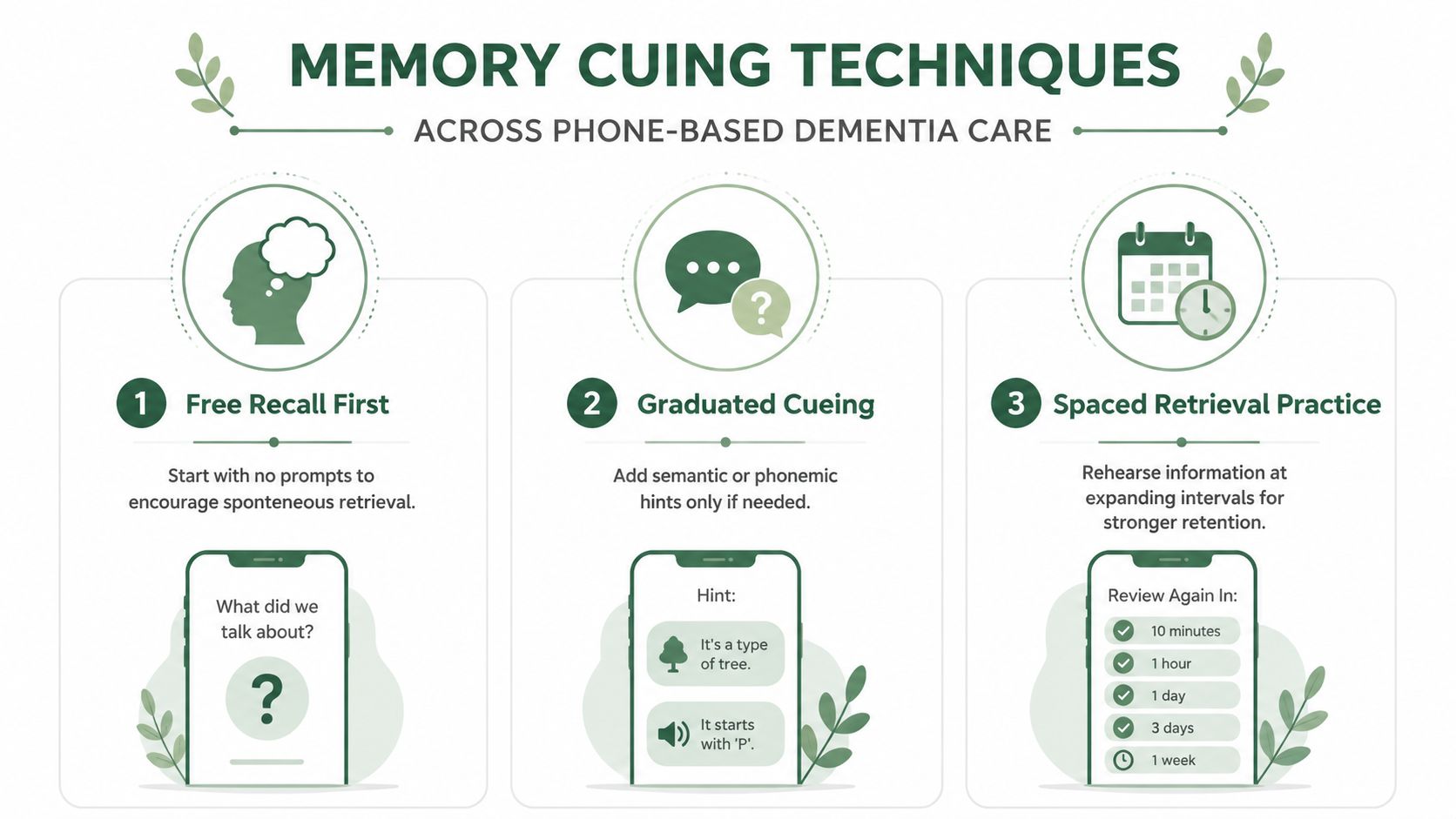
Memory cuing helps a person retrieve information that remains familiar but is difficult to access spontaneously. Begin with free recall, then offer one cue at a time, such as a category, first sound, related person, or familiar setting. This graded support protects confidence while still giving retrieval practice.
For example, ask about a grandchild's name: “Your daughter has a child. Do you remember her name?” If recall stalls, add, “It starts with E.” If the name still does not come, provide it naturally and continue the conversation. Extended struggle can turn a useful exercise into an upsetting phone call.
Create a practical memory map
During onboarding, record details that support relationships and everyday planning:
People: Names of relatives, friends, neighbors, and care contacts.
Routines: Usual meals, appointments, preferred call times, and regular visits.
Places: Former homes, workplaces, favorite shops, and meaningful travel locations.
Priorities: Medication discussions, safety details, and events the participant wants to remember.
Use these details for spaced retrieval. Mention an upcoming appointment, ask about it during a later call, and offer a cue if recall is difficult. Set the interval according to the care plan and the participant's ability. Repeated questioning should never become a rigid test.
A collaborative script keeps the task supportive:
“Help me remember what we planned for Tuesday.”
Start with the least assistance that works, acknowledge successful retrieval, and record which prompts helped. The practical goal is participation, confidence, and easier access to information that supports daily independence.
If recall fails, give the answer warmly: “Your appointment is next Tuesday at two o'clock. I'll remind you again.” During phone sessions, caregivers can also note whether the person needed a category cue, a first sound, or the full answer. A rising need for cues across calls may justify shorter sessions or review with the care team. Phone performance is an informal observation, not a clinical assessment.
6. Meaningful Activities and Purpose-Driven Engagement
Purpose gives a phone session direction. Choose an activity that reflects the person's identity, past roles, and current abilities, then use it to invite conversation rather than test performance. A former teacher might work through a grandchild's school question. A gardener might describe what to plant in spring. A home cook could plan a family meal, while a lifelong reader might choose a book to hear next.
The task should fit the participant, not the diagnosis. Someone who managed a household may enjoy planning a menu or arranging a weekly routine. A former volunteer may prefer discussing ways to stay connected through letters or calls. Passive interests also count. Listening to a favorite program and sharing an opinion may work better than completing a difficult puzzle.
Build the call around one familiar role
Use open prompts that allow several correct answers:
“What would you include in a meal for your family?”
“Which part of gardening did you enjoy most, choosing plants or caring for them?”
“What made a book worth recommending to a friend?”
“What advice would you give someone learning the work you used to do?”
These prompts combine recall, language, reasoning, and choice without turning the conversation into a quiz. They also show caregivers which interests remain enjoyable and which types of support feel respectful. If the person hesitates, offer two options, add a familiar detail, or change the topic. A successful activity may be shorter than planned.
The best activity is one the person recognizes as theirs.
Review engagement after the call. Record what led to sustained attention, laughter, curiosity, or a wish to continue. Note whether the person initiated ideas, answered with support, or became tired or frustrated. Those observations guide later phone sessions and help family members choose activities that support connection at home.
A coordinator can also turn the participant's interests into a small follow-up task, such as selecting music for the next call or deciding which family recipe to discuss. Keep the choice manageable, and stop while participation remains comfortable.
7. Mood Monitoring and Emotional Validation Techniques
Mood determines whether a phone session will help. Start by asking, “How are you feeling today?” Listen for anxiety about an appointment, sadness linked to reduced mobility, or agitation after misplacing something. If fear, loneliness, anger, or overload is prominent, shorten the cognitive activity or focus on reassurance.
Use emotional validation to acknowledge the feeling behind the person's words. Validation does not require agreeing with an inaccurate belief. If they cannot find their glasses, say, “You're worried about finding them. Let's think together about where you last used them.” For anxiety about a medical visit, try, “It makes sense to feel nervous. What would you like the appointment to help with?” This approach is consistent with validation therapy for dementia.
During and after calls, track patterns rather than judging one difficult conversation:
Tone and pace: Unusual slowness, tension, or distress may indicate a need for follow-up.
Repeated worries: Use consistent reassurance and wording when the same concern returns.
Time of day: Fatigue, confusion, or a disrupted routine can change mood.
Social contact: Missed visits and long periods alone may reduce engagement.
Replace “There's nothing to worry about” with immediate grounding: “You're at home, and you're safe. I'm here with you on the phone. Tell me what you can hear around you.” The caregiver can then decide whether to continue, pause, or involve family.
Persistent sadness, suicidal thoughts, hallucinations, or sudden behavioral worsening require prompt contact with family and professional support. Phone-based stimulation supports clinical care, but it does not replace assessment when risk is present.
Sleep and physical comfort can also shape mood. Families reviewing the home environment may consider mattress effects on mood alongside the person's sleep pattern and daily emotional cues.
8. Practical Life Skills and Daily Functioning Coaching
A phone session becomes practical when it improves the next meal, appointment, or medication routine. Begin by asking how the person handles the task now, then identify the specific barrier. This preserves dignity and shows whether the difficulty involves memory, sequencing, mobility, or confidence.
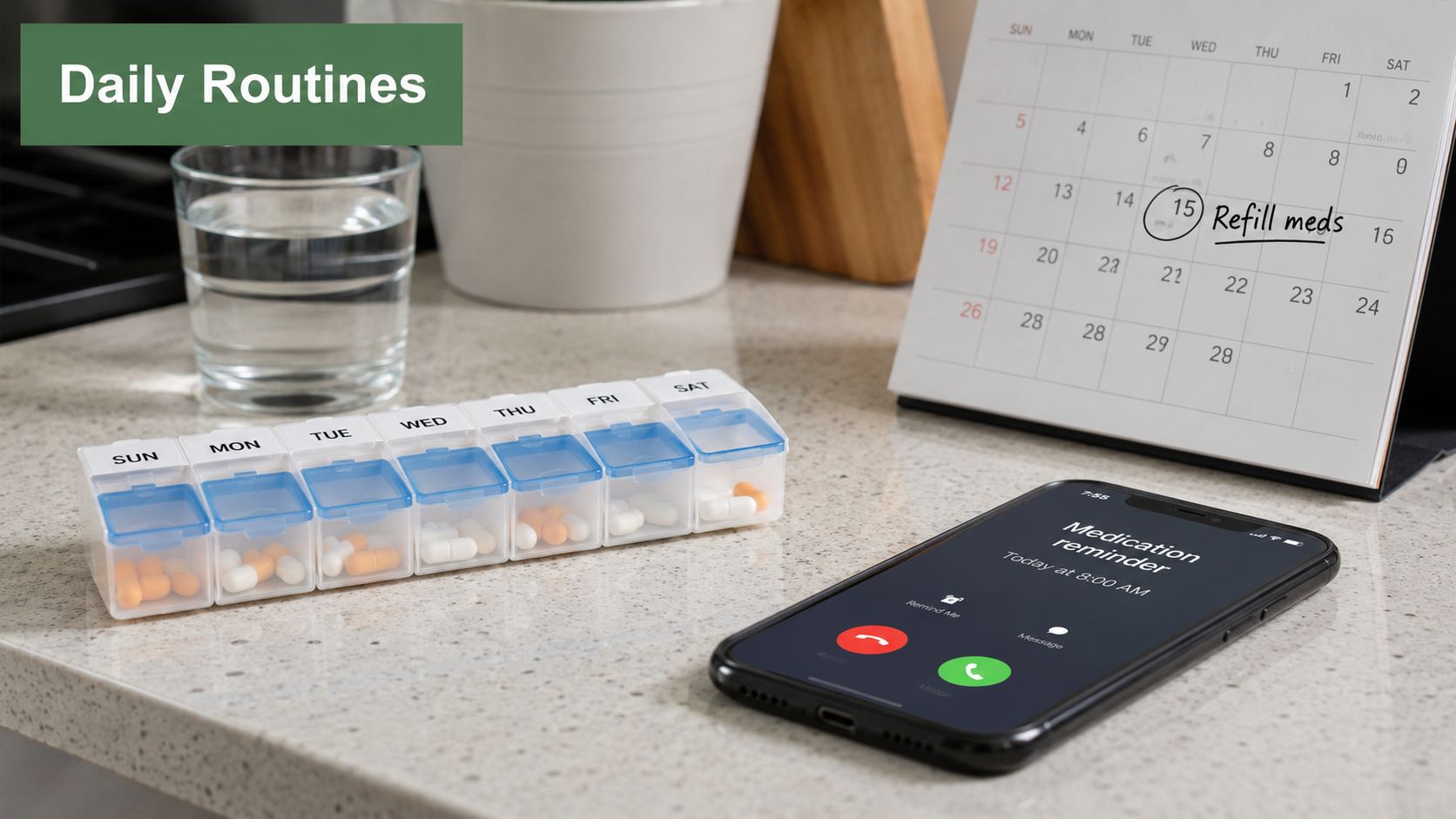
For medication routines, ask, “How do you remember your medications?” Discuss a visible calendar, pill organizer, family call, or another agreed system. For appointments, review the week, mark the event on a calendar, and arrange a reminder with family. The aim is supported independence, not automatic replacement of the person's own routine.
Coach the task, not just the answer
Use a concrete planning script:
“What sounds good for lunch this week? What ingredients do you already have? Is there any part of shopping or cooking where you'd like your daughter's help?”
Pause after each question. If the person cannot answer, offer two choices rather than taking over. Confirm the agreed next step before ending the call, such as checking the refrigerator or asking family to help with shopping.
Safety checks should remain direct and respectful. Ask how the person remembers turning off the stove, whether food has spoiled, and whether moving around the home feels steady. Share new concerns with family and, when appropriate, clinicians or home care professionals.
Build the plan around five practices:
Protect choice: Prioritize tasks the person values, not only basic self-care.
Externalize memory: Use posted schedules, labeled items, pill organizers, and agreed reminders.
Review systems: Ask whether the plan worked and adjust it when it did not.
Increase help gradually: Add direct support as risk rises while preserving safe participation.
Coordinate consistently: Family and care staff should use the same plan and wording.
A short educational video can help families consider how reminders and daily support fit into the person's routine.
Comparison of 8 Cognitive Stimulation Activities
Approach | Implementation Complexity 🔄 | Resource Requirements ⚡ | Expected Outcomes ⭐ | Ideal Use Cases 💡 | Key Advantages 📊 |
|---|---|---|---|---|---|
Reminiscence Therapy | 🔄 Moderate, needs skilled facilitators and detailed personal history | ⚡ Low tech; moderate prep time (history collection, prompts) | ⭐⭐⭐⭐, improves mood, engagement, sense of identity | 💡 Early–mid dementia; phone calls leveraging life stories; socially isolated people | 📊 High personal meaning; rapport-building; adaptable to phone |
Orientation Therapy (Reality Orientation) | 🔄 Low, routine integration but requires consistency across contacts | ⚡ Very low, brief prompts embedded in calls; consistent staff practice | ⭐⭐⭐, reduces confusion, supports scheduling and safety | 💡 People with disorientation or appointment/medication adherence needs | 📊 Enhances predictability and safety; easy to scale |
Language & Word‑Finding Exercises | 🔄 Moderate, requires SLP-informed tasks and difficulty calibration | ⚡ Low tech; facilitator training and varied activity bank | ⭐⭐⭐, maintains verbal skills, boosts retrieval confidence | 💡 Those with anomia or who enjoy word play and storytelling | 📊 Targets expressive language; provides measurable practice; engaging |
Attention & Concentration Exercises | 🔄 Moderate, needs live adjustment for fatigue/alertness | ⚡ Low tech; requires timing tools and facilitator skill | ⭐⭐, modest gains in attention/processing speed when practiced | 💡 Mid-stage cognitive slowing; short focused sessions during calls | 📊 Trains executive attention; quick, trackable activities |
Memory Cuing & Retrieval Practice | 🔄 Moderate–High, needs a memory map and consistent cueing strategy | ⚡ Low tech but intensive documentation and spaced-rehearsal planning | ⭐⭐⭐⭐, strong for retaining functional information (names, meds) | 💡 Early–mid dementia needing functional recall (appointments, names) | 📊 Leverages preserved knowledge; reduces retrieval frustration; practical |
Meaningful Activities & Purpose‑Driven Engagement | 🔄 High, highly individualized planning and flexible delivery | ⚡ Moderate, detailed life-history, family input, tailored activity design | ⭐⭐⭐⭐⭐, high engagement, improved mood and sustained participation | 💡 Individuals motivated by identity/roles (gardener, teacher, cook) | 📊 Produces intrinsic motivation; better mood and adherence than abstract tasks |
Mood Monitoring & Emotional Validation | 🔄 Moderate, requires training in de‑escalation and empathetic listening | ⚡ Low tech; high staff emotional training and documentation burden | ⭐⭐⭐⭐, reduces depression/anxiety; improves perceived support | 💡 Those with isolation, anxiety, mood changes or risk of deterioration | 📊 Early detection of mood shifts; non‑pharmacological relief; builds trust |
Practical Life Skills & Daily Functioning Coaching | 🔄 High, comprehensive ADL/IADL assessment and coordination required | ⚡ Moderate, involves family coordination, tools (calendars, pillboxes) | ⭐⭐⭐⭐, extends independence, reduces caregiver burden, improves safety | 💡 People at risk of ADL/IADL decline; safety concerns; transitional planning | 📊 Direct real‑world benefits; problem‑solving focus; system building for independence |
Putting It into Practice Phone-Based Cognitive Stimulation
A phone-based plan works when it is consistent, personal, and adjustable. Standard CST is commonly delivered in 14 sessions of 45 minutes, twice weekly over seven weeks, often in small groups of five to eight people, with activities such as current-events discussion, word games, reminiscence, orientation, and practical tasks, as described in the Modem dementia care toolkit's CST guidance. A phone program doesn't need to copy every group feature, but it should preserve the core principles: structured stimulation, social engagement, appropriate challenge, and careful observation.
For home delivery, schedule calls when the participant is usually most alert. Open with a mood and safety check, provide orientation, then choose one or two activities based on energy and interest. A person in early dementia may manage more open-ended storytelling, multi-step planning, or word retrieval. Someone in mid-stage dementia may respond better to shorter prompts, familiar categories, graduated cues, and practical conversation.
Keep a simple call log. Record the activity, level of prompting, mood before and after, attention, notable communication changes, and any daily-life concern. Don't reduce progress to correct answers alone. A participant who speaks longer, initiates a topic, laughs, accepts reassurance, or completes a familiar task with less support is giving meaningful feedback.
Use safety checks every time
Ask whether the participant is safe at home, has eaten and taken essential medication according to their established plan, feels steady when moving, and has any urgent concern. These questions aren't a substitute for medical advice or emergency services. If there is sudden confusion, severe distress, a fall, a medication danger, suicidal thinking, or another immediate risk, contact the appropriate emergency or clinical support.
The evidence supports CST as more than casual conversation. The Cochrane evidence review found benefits in cognition alongside communication, social interaction, well-being, and daily activities, while newer reviews show that outcomes vary by activity and participant. The research supports the overall structured program more strongly than any single “best” exercise, so don't keep forcing memory games when reminiscence, orientation, music, or practical planning produces better engagement.
Phone delivery also addresses an important access gap. The 2026 review of digital CST describes this area as early and focused largely on feasibility, leaving low-tech formats particularly relevant for people who can't attend groups or use digital tools. Regular calls can provide a practical bridge, provided families document changes and keep the program aligned with clinician guidance.
Velma offers scheduled phone calls for older adults with early to mid-stage memory loss, combining personalized conversation, cognitive stimulation, mood support, and practical check-ins. Families can use the service alongside in-person caregiving and medical treatment, not as a replacement for either.
Velma provides scheduled phone-based cognitive support based on a participant's history, interests, routines, and ability, with care team members documenting patterns that matter to families. Visit Velma to explore whether recurring calls could support cognitive engagement, emotional well-being, and safer daily independence for someone you care about.
More than 55 million people live with dementia worldwide, making practical ways to preserve connection, communication, and daily independence essential. Cognitive stimulation therapy activities can help by combining conversation, orientation, language practice, attention tasks, memory support, and meaningful problem-solving. Delivered through an ordinary phone call, these activities can reach older adults who can't attend a group or use an app, while giving caregivers regular opportunities to notice changes in mood, confidence, and everyday functioning.
Cognitive stimulation therapy, or CST, has a substantial evidence base. A Cochrane review of standardized CST found a small but consistent cognition benefit, with probable improvements in communication, social interaction, well-being, and day-to-day activities. A modern systematic review and meta-analysis of randomized trials also found benefits across cognition, memory, activities of daily living, depressive symptoms, and dementia ratings.
The strongest CST programs are structured, but they still feel personal. The following eight activities adapt that principle for phone-based care across early to mid-stage dementia.
Table of Contents
1. Reminiscence Therapy
A simple call script
2. Orientation Therapy
Keep the cue conversational
3. Language and Word-Finding Exercises
Use graduated cues
4. Attention and Concentration Exercises
5. Memory Cuing and Retrieval Practice
Create a practical memory map
6. Meaningful Activities and Purpose-Driven Engagement
Build the call around one familiar role
7. Mood Monitoring and Emotional Validation Techniques
8. Practical Life Skills and Daily Functioning Coaching
Coach the task, not just the answer
Comparison of 8 Cognitive Stimulation Activities
Putting It into Practice Phone-Based Cognitive Stimulation
Use safety checks every time
1. Reminiscence Therapy
Reminiscence works best when it starts with the person, not a generic list of memory questions. A care coordinator might ask a former teacher about a classroom she remembers fondly, invite a lifelong gardener to describe a favorite planting season, or explore the sounds and smells associated with a family holiday. These prompts use meaningful autobiographical material while reinforcing identity and emotional connection.
A phone call doesn't provide photographs or objects automatically, so preparation matters. Gather personal history from the participant and family, then build a short record of important jobs, relationships, hobbies, places, music, and celebrations. Specific prompts are easier to answer than broad questions. “Tell me about the garden you mentioned” usually gives the conversation more direction than “What did you do in the past?”
A simple call script
“Last time, you told me about your years teaching. What did you enjoy most about preparing a lesson?”
If the participant gives an uncertain answer, don't turn the exchange into a memory test. Respond to the feeling and story rather than correcting every detail. “That sounds like it was rewarding” keeps the person engaged even when the chronology or facts aren't exact.
Use the following safeguards:
Begin with positive, familiar material: Start with well-established memories before discussing grief, conflict, or other emotionally complex periods.
Follow recurring themes: Note favorite topics, stories, and sensory details so future calls feel continuous.
Redirect distress gently: If a memory causes sadness or agitation, acknowledge it and move toward a safer subject.
Share useful notes: Document names, interests, and preferred prompts so every care team member can maintain consistency.
For a deeper framework that complements phone conversations, see this guide to life review therapy for dementia.
2. Orientation Therapy
Orientation should reduce uncertainty, not create another test the participant can fail. During a warm check-in, mention the day, season, weather, location, and events that affect daily life. A coordinator might say, “Good morning. It's Tuesday, and your daughter is visiting later this week. How are you feeling about her visit?”
The most useful cues relate to functioning. Appointments, medication routines, family visits, meals, and changes in daylight matter more than demanding exact recall of a date. If the participant doesn't know the day, offer the information calmly and continue the conversation.
Keep the cue conversational
A standard greeting can provide a reliable anchor:
“Good morning, it's Tuesday. You're at home, and we're having our usual call. Have you had breakfast yet?”
That sentence combines time, place, routine, and a concrete daily event without sounding clinical. Follow it with an open question about the participant's experience, such as what they can see outside or what they plan to do next.
A visible calendar near the phone can support the call. Family members can mark appointments and visits in large writing, then refer to the same calendar when they arrive. Consistent wording also helps. If one person says “the doctor is soon” and another gives a different timeframe, the participant may become more confused.
Practical rule: Orient people to information that helps them act safely today. Don't repeatedly quiz them about facts that have no immediate purpose.
Watch for frustration, embarrassment, or withdrawal. Those reactions indicate that the task is too demanding or poorly timed. Acknowledge the feeling, provide the answer without pressure, and shift to a more engaging topic such as the weather, breakfast, or a planned visit.
3. Language and Word-Finding Exercises
Word-finding practice should feel like a conversation game, not an examination. A coordinator can invite the participant to name vegetables, connect words by association, solve a flexible riddle, or tell a short story about cooking, travel, work, or family traditions. The activity exercises language while preserving confidence.
Begin with familiar categories linked to the participant's interests. Someone who enjoys gardening may find “name flowers” easier and more engaging than an abstract vocabulary exercise. Someone who follows sports may respond well to team names, equipment, or memorable games.
Use graduated cues
If a word doesn't come immediately, allow processing time before helping. Then offer the smallest cue likely to work:
Semantic cue: “It's something you wear in winter.”
Phonemic cue: “It starts with a G.”
Choice cue: “Could it be glove or garden?”
Model and move on: Supply the word warmly if the struggle continues.
Accept related words and approximations. The participant may say “hand warmer” when searching for “glove,” and that contribution still shows meaningful communication. Correcting every response can make the person avoid speaking.
Try this script:
“Let's name vegetables together. I'll start with tomato and carrot. What else comes to mind?”
When the participant contributes, respond to effort and content: “Great, you thought of seven vegetables,” or “I like that you included squash. Do you ever cook it?” The follow-up conversation turns retrieval into a social exchange.
For practical support beyond the exercise itself, use these dementia communication strategies.
4. Attention and Concentration Exercises
Phone-based attention activities work best when they respond to the person's condition that day. Poor sleep, pain, medication changes, or an upsetting event can reduce concentration, even if the participant managed a longer task recently. The coordinator should listen for these changes and adjust the activity without presenting the change as failure.
Open with one instruction and a manageable challenge:
“I'll say three numbers slowly. When I finish, repeat them in the same order: seven, three, nine.”
Pause after speaking. If the participant manages that comfortably, try listening for a target word, following a short sequence of actions, or deciding whether numbers are rising or falling. Familiar language and one step at a time usually work better than lengthy explanations.
Use the person's responses as a safety check. Shorten or change the activity if they:
Stop responding: They may be tired, distracted, or unable to hold the instruction.
Ask for repeated directions: Give one step, then wait.
Sound tense or embarrassed: Present the exercise as a shared brain game rather than a test.
Lose interest quickly: Change the format or connect it with a preferred topic.
Accuracy is only one outcome. Say “Good listening” or “You caught that quickly” when the participant stays engaged. After an error, keep your tone neutral and offer an easier version:
“Let's make this one simpler. We can do it together.”
Repeat selected activities across calls, recording whether attention was steady, variable, or reduced. This pattern can help caregivers notice fatigue and decide when a session needs to be shorter. Informal phone performance is not a clinical assessment. A sudden, marked change in attention, speech, alertness, or behavior should be reported to the family and discussed with an appropriate clinician.
5. Memory Cuing and Retrieval Practice
Memory cuing helps a person retrieve information that remains familiar but is difficult to access spontaneously. Begin with free recall, then offer one cue at a time, such as a category, first sound, related person, or familiar setting. This graded support protects confidence while still giving retrieval practice.
For example, ask about a grandchild's name: “Your daughter has a child. Do you remember her name?” If recall stalls, add, “It starts with E.” If the name still does not come, provide it naturally and continue the conversation. Extended struggle can turn a useful exercise into an upsetting phone call.
Create a practical memory map
During onboarding, record details that support relationships and everyday planning:
People: Names of relatives, friends, neighbors, and care contacts.
Routines: Usual meals, appointments, preferred call times, and regular visits.
Places: Former homes, workplaces, favorite shops, and meaningful travel locations.
Priorities: Medication discussions, safety details, and events the participant wants to remember.
Use these details for spaced retrieval. Mention an upcoming appointment, ask about it during a later call, and offer a cue if recall is difficult. Set the interval according to the care plan and the participant's ability. Repeated questioning should never become a rigid test.
A collaborative script keeps the task supportive:
“Help me remember what we planned for Tuesday.”
Start with the least assistance that works, acknowledge successful retrieval, and record which prompts helped. The practical goal is participation, confidence, and easier access to information that supports daily independence.
If recall fails, give the answer warmly: “Your appointment is next Tuesday at two o'clock. I'll remind you again.” During phone sessions, caregivers can also note whether the person needed a category cue, a first sound, or the full answer. A rising need for cues across calls may justify shorter sessions or review with the care team. Phone performance is an informal observation, not a clinical assessment.
6. Meaningful Activities and Purpose-Driven Engagement
Purpose gives a phone session direction. Choose an activity that reflects the person's identity, past roles, and current abilities, then use it to invite conversation rather than test performance. A former teacher might work through a grandchild's school question. A gardener might describe what to plant in spring. A home cook could plan a family meal, while a lifelong reader might choose a book to hear next.
The task should fit the participant, not the diagnosis. Someone who managed a household may enjoy planning a menu or arranging a weekly routine. A former volunteer may prefer discussing ways to stay connected through letters or calls. Passive interests also count. Listening to a favorite program and sharing an opinion may work better than completing a difficult puzzle.
Build the call around one familiar role
Use open prompts that allow several correct answers:
“What would you include in a meal for your family?”
“Which part of gardening did you enjoy most, choosing plants or caring for them?”
“What made a book worth recommending to a friend?”
“What advice would you give someone learning the work you used to do?”
These prompts combine recall, language, reasoning, and choice without turning the conversation into a quiz. They also show caregivers which interests remain enjoyable and which types of support feel respectful. If the person hesitates, offer two options, add a familiar detail, or change the topic. A successful activity may be shorter than planned.
The best activity is one the person recognizes as theirs.
Review engagement after the call. Record what led to sustained attention, laughter, curiosity, or a wish to continue. Note whether the person initiated ideas, answered with support, or became tired or frustrated. Those observations guide later phone sessions and help family members choose activities that support connection at home.
A coordinator can also turn the participant's interests into a small follow-up task, such as selecting music for the next call or deciding which family recipe to discuss. Keep the choice manageable, and stop while participation remains comfortable.
7. Mood Monitoring and Emotional Validation Techniques
Mood determines whether a phone session will help. Start by asking, “How are you feeling today?” Listen for anxiety about an appointment, sadness linked to reduced mobility, or agitation after misplacing something. If fear, loneliness, anger, or overload is prominent, shorten the cognitive activity or focus on reassurance.
Use emotional validation to acknowledge the feeling behind the person's words. Validation does not require agreeing with an inaccurate belief. If they cannot find their glasses, say, “You're worried about finding them. Let's think together about where you last used them.” For anxiety about a medical visit, try, “It makes sense to feel nervous. What would you like the appointment to help with?” This approach is consistent with validation therapy for dementia.
During and after calls, track patterns rather than judging one difficult conversation:
Tone and pace: Unusual slowness, tension, or distress may indicate a need for follow-up.
Repeated worries: Use consistent reassurance and wording when the same concern returns.
Time of day: Fatigue, confusion, or a disrupted routine can change mood.
Social contact: Missed visits and long periods alone may reduce engagement.
Replace “There's nothing to worry about” with immediate grounding: “You're at home, and you're safe. I'm here with you on the phone. Tell me what you can hear around you.” The caregiver can then decide whether to continue, pause, or involve family.
Persistent sadness, suicidal thoughts, hallucinations, or sudden behavioral worsening require prompt contact with family and professional support. Phone-based stimulation supports clinical care, but it does not replace assessment when risk is present.
Sleep and physical comfort can also shape mood. Families reviewing the home environment may consider mattress effects on mood alongside the person's sleep pattern and daily emotional cues.
8. Practical Life Skills and Daily Functioning Coaching
A phone session becomes practical when it improves the next meal, appointment, or medication routine. Begin by asking how the person handles the task now, then identify the specific barrier. This preserves dignity and shows whether the difficulty involves memory, sequencing, mobility, or confidence.
For medication routines, ask, “How do you remember your medications?” Discuss a visible calendar, pill organizer, family call, or another agreed system. For appointments, review the week, mark the event on a calendar, and arrange a reminder with family. The aim is supported independence, not automatic replacement of the person's own routine.
Coach the task, not just the answer
Use a concrete planning script:
“What sounds good for lunch this week? What ingredients do you already have? Is there any part of shopping or cooking where you'd like your daughter's help?”
Pause after each question. If the person cannot answer, offer two choices rather than taking over. Confirm the agreed next step before ending the call, such as checking the refrigerator or asking family to help with shopping.
Safety checks should remain direct and respectful. Ask how the person remembers turning off the stove, whether food has spoiled, and whether moving around the home feels steady. Share new concerns with family and, when appropriate, clinicians or home care professionals.
Build the plan around five practices:
Protect choice: Prioritize tasks the person values, not only basic self-care.
Externalize memory: Use posted schedules, labeled items, pill organizers, and agreed reminders.
Review systems: Ask whether the plan worked and adjust it when it did not.
Increase help gradually: Add direct support as risk rises while preserving safe participation.
Coordinate consistently: Family and care staff should use the same plan and wording.
A short educational video can help families consider how reminders and daily support fit into the person's routine.
Comparison of 8 Cognitive Stimulation Activities
Approach | Implementation Complexity 🔄 | Resource Requirements ⚡ | Expected Outcomes ⭐ | Ideal Use Cases 💡 | Key Advantages 📊 |
|---|---|---|---|---|---|
Reminiscence Therapy | 🔄 Moderate, needs skilled facilitators and detailed personal history | ⚡ Low tech; moderate prep time (history collection, prompts) | ⭐⭐⭐⭐, improves mood, engagement, sense of identity | 💡 Early–mid dementia; phone calls leveraging life stories; socially isolated people | 📊 High personal meaning; rapport-building; adaptable to phone |
Orientation Therapy (Reality Orientation) | 🔄 Low, routine integration but requires consistency across contacts | ⚡ Very low, brief prompts embedded in calls; consistent staff practice | ⭐⭐⭐, reduces confusion, supports scheduling and safety | 💡 People with disorientation or appointment/medication adherence needs | 📊 Enhances predictability and safety; easy to scale |
Language & Word‑Finding Exercises | 🔄 Moderate, requires SLP-informed tasks and difficulty calibration | ⚡ Low tech; facilitator training and varied activity bank | ⭐⭐⭐, maintains verbal skills, boosts retrieval confidence | 💡 Those with anomia or who enjoy word play and storytelling | 📊 Targets expressive language; provides measurable practice; engaging |
Attention & Concentration Exercises | 🔄 Moderate, needs live adjustment for fatigue/alertness | ⚡ Low tech; requires timing tools and facilitator skill | ⭐⭐, modest gains in attention/processing speed when practiced | 💡 Mid-stage cognitive slowing; short focused sessions during calls | 📊 Trains executive attention; quick, trackable activities |
Memory Cuing & Retrieval Practice | 🔄 Moderate–High, needs a memory map and consistent cueing strategy | ⚡ Low tech but intensive documentation and spaced-rehearsal planning | ⭐⭐⭐⭐, strong for retaining functional information (names, meds) | 💡 Early–mid dementia needing functional recall (appointments, names) | 📊 Leverages preserved knowledge; reduces retrieval frustration; practical |
Meaningful Activities & Purpose‑Driven Engagement | 🔄 High, highly individualized planning and flexible delivery | ⚡ Moderate, detailed life-history, family input, tailored activity design | ⭐⭐⭐⭐⭐, high engagement, improved mood and sustained participation | 💡 Individuals motivated by identity/roles (gardener, teacher, cook) | 📊 Produces intrinsic motivation; better mood and adherence than abstract tasks |
Mood Monitoring & Emotional Validation | 🔄 Moderate, requires training in de‑escalation and empathetic listening | ⚡ Low tech; high staff emotional training and documentation burden | ⭐⭐⭐⭐, reduces depression/anxiety; improves perceived support | 💡 Those with isolation, anxiety, mood changes or risk of deterioration | 📊 Early detection of mood shifts; non‑pharmacological relief; builds trust |
Practical Life Skills & Daily Functioning Coaching | 🔄 High, comprehensive ADL/IADL assessment and coordination required | ⚡ Moderate, involves family coordination, tools (calendars, pillboxes) | ⭐⭐⭐⭐, extends independence, reduces caregiver burden, improves safety | 💡 People at risk of ADL/IADL decline; safety concerns; transitional planning | 📊 Direct real‑world benefits; problem‑solving focus; system building for independence |
Putting It into Practice Phone-Based Cognitive Stimulation
A phone-based plan works when it is consistent, personal, and adjustable. Standard CST is commonly delivered in 14 sessions of 45 minutes, twice weekly over seven weeks, often in small groups of five to eight people, with activities such as current-events discussion, word games, reminiscence, orientation, and practical tasks, as described in the Modem dementia care toolkit's CST guidance. A phone program doesn't need to copy every group feature, but it should preserve the core principles: structured stimulation, social engagement, appropriate challenge, and careful observation.
For home delivery, schedule calls when the participant is usually most alert. Open with a mood and safety check, provide orientation, then choose one or two activities based on energy and interest. A person in early dementia may manage more open-ended storytelling, multi-step planning, or word retrieval. Someone in mid-stage dementia may respond better to shorter prompts, familiar categories, graduated cues, and practical conversation.
Keep a simple call log. Record the activity, level of prompting, mood before and after, attention, notable communication changes, and any daily-life concern. Don't reduce progress to correct answers alone. A participant who speaks longer, initiates a topic, laughs, accepts reassurance, or completes a familiar task with less support is giving meaningful feedback.
Use safety checks every time
Ask whether the participant is safe at home, has eaten and taken essential medication according to their established plan, feels steady when moving, and has any urgent concern. These questions aren't a substitute for medical advice or emergency services. If there is sudden confusion, severe distress, a fall, a medication danger, suicidal thinking, or another immediate risk, contact the appropriate emergency or clinical support.
The evidence supports CST as more than casual conversation. The Cochrane evidence review found benefits in cognition alongside communication, social interaction, well-being, and daily activities, while newer reviews show that outcomes vary by activity and participant. The research supports the overall structured program more strongly than any single “best” exercise, so don't keep forcing memory games when reminiscence, orientation, music, or practical planning produces better engagement.
Phone delivery also addresses an important access gap. The 2026 review of digital CST describes this area as early and focused largely on feasibility, leaving low-tech formats particularly relevant for people who can't attend groups or use digital tools. Regular calls can provide a practical bridge, provided families document changes and keep the program aligned with clinician guidance.
Velma offers scheduled phone calls for older adults with early to mid-stage memory loss, combining personalized conversation, cognitive stimulation, mood support, and practical check-ins. Families can use the service alongside in-person caregiving and medical treatment, not as a replacement for either.
Velma provides scheduled phone-based cognitive support based on a participant's history, interests, routines, and ability, with care team members documenting patterns that matter to families. Visit Velma to explore whether recurring calls could support cognitive engagement, emotional well-being, and safer daily independence for someone you care about.
Suggested Article: