How to Help Lonely Elderly: A Practical Guide

You visit your mother every Sunday. She smiles, makes tea, and tells you she's fine. You leave reassured, without realizing she hasn't spoken to another person since your last visit.
That situation is common because loneliness rarely announces itself clearly. A senior may have groceries, a clean home, and regular family texts while still feeling forgotten, purposeless, or unsafe. Learning how to help lonely elderly relatives starts with identifying what kind of support they need, then building a reliable plan around it.
Table of Contents
Why Loneliness in Older Adults Is Harder to Solve Than It Looks
Recognizing the Different Types of Loneliness and Isolation
Building a Multi-Component Support Plan
Start with an honest contact audit
Layer different forms of connection
Assign ownership and create rhythm
Making Phone Calls Actually Work for Cognitive and Emotional Health
Prepare conversation anchors
Rotate the purpose across the week
Handling Resistance and Overlooked Safety Concerns
When to Bring in Professional Support
Use a simple escalation path
Why Loneliness in Older Adults Is Harder to Solve Than It Looks
A quick visit can create a misleading sense of security. Your parent may conserve conversation for the one weekly interaction, smile because they're glad to see you, and avoid admitting how quiet the rest of the week feels. Pride plays a role too. Many older adults won't say, “I'm lonely,” because they hear the statement as an admission of weakness or dependence.
Loneliness also develops through several small losses rather than one dramatic event. Driving may become uncomfortable, hearing may make group conversations exhausting, friends may move away or die, and mobility limitations may turn an ordinary outing into a major undertaking. Retirement can remove daily purpose, while bereavement can eliminate the person who provided emotional intimacy.
A grocery delivery solves hunger. It doesn't necessarily solve the absence of conversation, reassurance, or shared meaning. A text message confirms that someone remembered your parent, but it may not provide the sustained attention they need. Even a pleasant visit can miss the problem if the person needs help with anxiety, memory changes, or rebuilding a daily routine.
Practical rule: Treat loneliness as a care need that requires assessment, not as a character flaw or a scheduling inconvenience.
The growing number of elderly people makes this issue harder to ignore. Families supporting older relatives are already navigating changing living arrangements, health needs, and shrinking informal support networks, concerns reflected in the discussion of the silver tsunami. The answer isn't to force constant activity. It's to determine whether the person lacks contact, lacks closeness, lacks purpose, or needs structured support related to cognitive change.
Start by observing rather than interrogating. Ask who your parent spoke with today, what they're looking forward to this week, and whether there's someone they can call when they're worried. Notice whether they want company, practical help, emotional reassurance, or a predictable check-in. The right intervention becomes much clearer once you stop treating every quiet senior as having the same problem.
Recognizing the Different Types of Loneliness and Isolation
Social isolation describes a lack of meaningful contact, regardless of whether the person says they feel lonely. A socially isolated older adult may spend long stretches alone, stop answering the door, cancel activities because transportation is difficult, or have no regular contact outside a caregiver. The issue is the size and reliability of the person's social network.
Emotional loneliness is different. Someone may speak with neighbors, attend appointments, or exchange messages with family yet still lack a trusted confidant. They may call repeatedly, prolong conversations, or say that nobody really listens. Adding more casual contact won't fix the absence of emotional intimacy.
Existential loneliness involves feeling unseen, unnecessary, or disconnected from purpose. It often follows retirement, bereavement, a move away from a familiar community, or the loss of responsibilities that once shaped daily life. The person may not ask for more visitors. They may need meaningful roles, opportunities to contribute, or conversations that recognize their identity beyond their age or diagnosis.
The World Health Organization estimates that around 1 in 10 older people experience loneliness globally, while 1 in 4 are socially isolated. A 2025 global meta-analysis found loneliness among older adults at 27.6%, with higher prevalence in North America at 30.5%, among older women at 30.9%, and among institutionalized older adults at 50.7%, as reported in the WHO overview of social isolation and loneliness among older people. These figures describe a broad public-health concern, but they don't tell you which response will help your parent.
Loneliness Type | Key Indicators | Common Triggers | Example Scenario |
|---|---|---|---|
Social isolation | Few contacts, quiet days, missed activities, limited transport | Mobility loss, relocation, bereavement, inaccessible community spaces | A parent spends most days alone and has no dependable weekly activity |
Emotional loneliness | Frequent calls, feeling unheard, persistent sadness despite acquaintances | Loss of a spouse, strained relationships, hearing difficulty, unresolved grief | A parent attends a club but says nobody knows them well |
Existential loneliness | Loss of motivation, purposelessness, withdrawal from meaningful roles | Retirement, grief, loss of independence, illness | A former teacher says there's no reason to plan for tomorrow |
Dementia-adjacent support need | Repetition, confusion, missed routines, anxiety, safety concerns | Memory loss, disorientation, cognitive decline | A parent wants contact but also needs orientation and practical monitoring |
These categories can overlap. Someone who lost a spouse may be socially isolated, emotionally bereaved, and struggling with purpose at the same time. Use this guide to social isolation in seniors as a prompt for observation, then ask a primary care clinician to assess concerning changes rather than assuming more social activity will resolve them.
Building a Multi-Component Support Plan
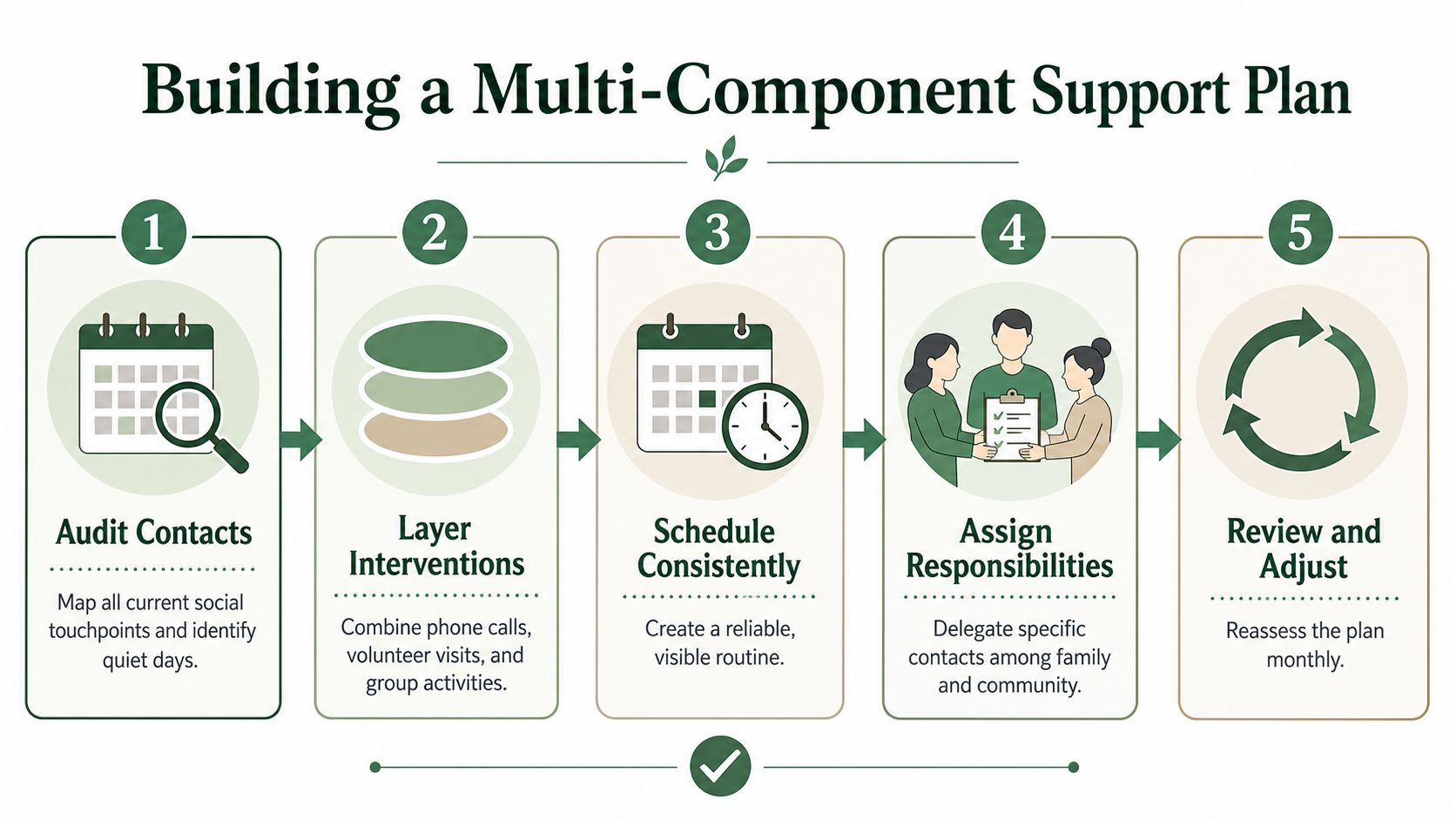
A dependable plan combines social contact, emotional support, practical assistance, and follow-up. A single weekly visit may be valuable, but it leaves too much room for long quiet periods and places too much responsibility on one family member.
Start with an honest contact audit
Write down every meaningful contact during a typical week. Include family visits, phone calls, neighbors, religious or community activities, medical appointments, transportation support, and paid care. Then mark the days with no real conversation.
Don't count an automated reminder or a doorstep delivery as equivalent to a conversation. The audit should show whether your parent has companionship, a trusted listener, purposeful activity, and safety coverage. It may reveal that Sunday is full while the rest of the week is empty.
Layer different forms of connection
A strong plan doesn't make every contact identical. Combine:
In-person time: Use visits for meals, walks, errands, hobbies, or shared household tasks.
Scheduled calls: Give the older adult a predictable voice connection, not a series of improvised check-ins.
Community participation: Consider a senior center, faith community, library group, volunteer opportunity, or adult day program.
Low-tech support: Use a familiar landline or basic mobile phone when apps, passwords, and video platforms create frustration.
Practical companionship: Pair safety tasks with human connection, such as reviewing the pantry while preparing lunch together.
Evidence favors this layered approach. A global systematic review covering 19 reviews, 101 unique primary studies, and 21 nations found 63% of tested interventions were judged effective or partially effective. Programs targeting multiple objectives, including social support, social opportunities, skills, and maladaptive social cognition, outperformed single-focus approaches. The findings are summarized in the systematic review of interventions for loneliness in older adults.
Assign ownership and create rhythm
Write down who handles each contact. One person might make a Tuesday call, a neighbor might share a Thursday errand, and another family member might visit on Saturday. If a community organization can provide a regular activity, add it to the same calendar.
The exact days matter less than the predictability. Put the schedule where your parent can see it, and avoid promising contact that family members can't sustain. A smaller routine that happens reliably is better than enthusiastic plans that disappear after a few weeks.
Families looking for structured local options can explore programs designed to build community connection, especially when relatives live far away or can't provide every visit themselves. Review the plan monthly. Ask which contacts feel helpful, which feel tiring, and what your parent wants more or less of. Then adjust the mix instead of defending a routine that isn't working.
Making Phone Calls Actually Work for Cognitive and Emotional Health
A call that follows the script “How are you?” “Fine.” “Did you eat?” “Yes.” may confirm basic facts, but it rarely creates a meaningful exchange. Phone support works better when the caller arrives with a purpose, listens for changes, and gives the older adult room to tell stories, make choices, and express opinions.
Structured psychosocial telephone support has outperformed non-therapeutic befriending in a randomized trial of community-dwelling older adults. The structured intervention produced significant reductions in loneliness at 12 months compared with calls focused on friendly conversation without psychosocial skills, as reported in the randomized trial of telephone psychosocial support.
Prepare conversation anchors
Before dialing, choose one or two prompts that invite more than a yes-or-no response:
Ask about a favorite meal from childhood and what made it memorable.
Request advice on a recipe, family decision, or household choice.
Bring up a photograph and ask what was happening before and after the moment captured.
Discuss an upcoming appointment or visit and ask what would make it easier.
Invite an opinion about a local story, book, radio program, or family event.
Don't turn the call into an examination. If your parent struggles to answer, offer choices and gentle prompts. If they repeat a story, respond to the emotion first, then redirect without embarrassment: “That memory still matters to you. After we talk about it, I'd like your advice about the meal I'm planning.”
Rotate the purpose across the week
One call can focus on reminiscence and identity. Another can involve problem-solving, such as asking the person to explain a recipe or help plan a family event. A third can look ahead to an upcoming visit, appointment, or activity.
Call when your parent is usually alert and comfortable, rather than assuming the evening is best. People with memory loss or fatigue may communicate better at a consistent time earlier in the day. Pause after asking a question. Silence may mean the person is thinking, searching for a word, or deciding whether they feel safe enough to answer.
Keep a short private record after each call. Note mood, energy, confusion, repeated concerns, appetite comments, missed appointments, medication uncertainty, and any mention of falls. Don't diagnose from one conversation. Patterns across recurring calls are more useful and can help a family decide when to contact a clinician.
For practical ideas on making recurring calls more purposeful, see this guide to daily check-in calls for seniors. The aim isn't to keep someone talking for a fixed length of time. It's to create a dependable interaction that supports connection, thinking, confidence, and awareness of daily needs.
Handling Resistance and Overlooked Safety Concerns
Resistance usually protects something important. “I don't need anyone” may mean, “I'm afraid you'll take control.” “Stop checking on me” may mean, “I hate feeling monitored.” “I'm fine alone” may reflect a genuine wish to remain independent, even when daily tasks are becoming harder.
Don't argue about whether your parent is lonely. Offer choices within clear boundaries. Ask whether they'd prefer a morning or afternoon call, a neighbor or family visitor, or an errand together rather than a formal “care visit.” Frame a new arrangement as a short trial, then ask for feedback. Shared tasks often work better than announcing that you're intervening because someone seems lonely.
What They Say | What It Often Means | Effective Response Strategy |
|---|---|---|
“I don't need anyone.” | Fear of dependence or loss of control | Offer two choices and preserve their decision-making |
“Stop checking on me.” | Contact feels like surveillance | Explain the purpose, ask how the check-in should work, and keep it brief |
“I'm fine alone.” | They may value privacy or minimize changes | Agree that independence matters, then add support around specific tasks |
“Nobody needs to visit.” | Shame, grief, or low expectations | Invite them to a shared activity rather than labeling it a visit |
“I can handle my medicines.” | Concern about being judged | Ask them to show how they organize medications, without taking over immediately |
Loneliness can also hide safety problems. Watch for unopened medication packaging, inconsistent refill timing, repeated claims that meals were eaten, spoiled food, unexplained bruises, or a stove that's been left on. Use ordinary conversation and shared routines to notice these issues. Preparing lunch together can reveal nutrition problems without turning the kitchen into an inspection.
Social hunger can increase vulnerability to strangers who offer attention. Discuss scam safety without blaming your parent, and create a rule that unusual requests for money or personal information receive a family callback before any action. A trusted contact system protects autonomy better than secret surveillance.
A friendly call is not a safety plan unless someone knows what to listen for and what action follows a concerning change.
Proactive support doesn't mean assuming incapacity. It means creating enough regular contact to notice gradual deterioration before a fall, medication error, nutritional decline, or crisis forces the family to react under pressure. If you observe a sudden or serious change, contact the person's clinician or emergency services as appropriate rather than trying to manage the situation through social visits alone.
When to Bring in Professional Support
Loneliness and early cognitive decline can look alike. Withdrawal, apathy, poor sleep, loss of interest, and repetitive conversations may reflect grief or isolation, but they may also signal depression, mild cognitive impairment, dementia, medication effects, or another health problem.
Bring in professional support when the pattern persists despite consistent contact, worsens across daily routines, or creates safety concerns. Pay particular attention to an inability to maintain previously enjoyed activities, paranoid beliefs about neighbors or caregivers, significant weight change, or stories that contain repeated confabulation. One unusual call doesn't establish a diagnosis. A documented pattern gives a clinician something useful to evaluate.
Use a simple escalation path
Observe symptoms: Record specific behaviors rather than labels such as “acting strange.”
Document changes: Note dates, missed routines, mood shifts, confusion, sleep concerns, eating changes, and safety incidents.
Contact primary care: Ask for a medical review and discuss depression, medication effects, hearing or vision problems, and cognitive concerns.
Request a broader assessment: If problems continue, ask about geriatric assessment, dementia evaluation, or appropriate community services.

Match the service to the need. A geriatric care manager can help coordinate a complex plan. An adult day program may provide structure and social engagement. Companion care can add in-person presence, while telehealth therapy may suit grief, anxiety, or depression when travel is difficult. Community social prescribing programs can connect someone with activities, groups, and practical resources.
For an older adult with early to mid-stage memory loss who needs recurring phone contact, cognitive exercises, companionship, and practical check-ins, Velma is one phone-based option families can consider. Its trained care team uses scheduled calls, cognitive stimulation, mood support, and documented observations, while a care manager coordinates updates with the family. It complements medical care and in-person support, rather than replacing either.
Use calm, autonomy-preserving language when raising outside help: “I want to make your week easier, and I'd like us to test one extra support for a short time. You can tell me what feels useful, what doesn't, and what you want changed.” That approach treats professional care as an added resource, not a step toward losing control.
If your parent is experiencing loneliness alongside memory loss, Velma provides scheduled phone sessions with cognitive engagement, companionship, and practical daily-living check-ins. Visit Velma to learn how its care team can add consistent support while keeping family members informed.
You visit your mother every Sunday. She smiles, makes tea, and tells you she's fine. You leave reassured, without realizing she hasn't spoken to another person since your last visit.
That situation is common because loneliness rarely announces itself clearly. A senior may have groceries, a clean home, and regular family texts while still feeling forgotten, purposeless, or unsafe. Learning how to help lonely elderly relatives starts with identifying what kind of support they need, then building a reliable plan around it.
Table of Contents
Why Loneliness in Older Adults Is Harder to Solve Than It Looks
Recognizing the Different Types of Loneliness and Isolation
Building a Multi-Component Support Plan
Start with an honest contact audit
Layer different forms of connection
Assign ownership and create rhythm
Making Phone Calls Actually Work for Cognitive and Emotional Health
Prepare conversation anchors
Rotate the purpose across the week
Handling Resistance and Overlooked Safety Concerns
When to Bring in Professional Support
Use a simple escalation path
Why Loneliness in Older Adults Is Harder to Solve Than It Looks
A quick visit can create a misleading sense of security. Your parent may conserve conversation for the one weekly interaction, smile because they're glad to see you, and avoid admitting how quiet the rest of the week feels. Pride plays a role too. Many older adults won't say, “I'm lonely,” because they hear the statement as an admission of weakness or dependence.
Loneliness also develops through several small losses rather than one dramatic event. Driving may become uncomfortable, hearing may make group conversations exhausting, friends may move away or die, and mobility limitations may turn an ordinary outing into a major undertaking. Retirement can remove daily purpose, while bereavement can eliminate the person who provided emotional intimacy.
A grocery delivery solves hunger. It doesn't necessarily solve the absence of conversation, reassurance, or shared meaning. A text message confirms that someone remembered your parent, but it may not provide the sustained attention they need. Even a pleasant visit can miss the problem if the person needs help with anxiety, memory changes, or rebuilding a daily routine.
Practical rule: Treat loneliness as a care need that requires assessment, not as a character flaw or a scheduling inconvenience.
The growing number of elderly people makes this issue harder to ignore. Families supporting older relatives are already navigating changing living arrangements, health needs, and shrinking informal support networks, concerns reflected in the discussion of the silver tsunami. The answer isn't to force constant activity. It's to determine whether the person lacks contact, lacks closeness, lacks purpose, or needs structured support related to cognitive change.
Start by observing rather than interrogating. Ask who your parent spoke with today, what they're looking forward to this week, and whether there's someone they can call when they're worried. Notice whether they want company, practical help, emotional reassurance, or a predictable check-in. The right intervention becomes much clearer once you stop treating every quiet senior as having the same problem.
Recognizing the Different Types of Loneliness and Isolation
Social isolation describes a lack of meaningful contact, regardless of whether the person says they feel lonely. A socially isolated older adult may spend long stretches alone, stop answering the door, cancel activities because transportation is difficult, or have no regular contact outside a caregiver. The issue is the size and reliability of the person's social network.
Emotional loneliness is different. Someone may speak with neighbors, attend appointments, or exchange messages with family yet still lack a trusted confidant. They may call repeatedly, prolong conversations, or say that nobody really listens. Adding more casual contact won't fix the absence of emotional intimacy.
Existential loneliness involves feeling unseen, unnecessary, or disconnected from purpose. It often follows retirement, bereavement, a move away from a familiar community, or the loss of responsibilities that once shaped daily life. The person may not ask for more visitors. They may need meaningful roles, opportunities to contribute, or conversations that recognize their identity beyond their age or diagnosis.
The World Health Organization estimates that around 1 in 10 older people experience loneliness globally, while 1 in 4 are socially isolated. A 2025 global meta-analysis found loneliness among older adults at 27.6%, with higher prevalence in North America at 30.5%, among older women at 30.9%, and among institutionalized older adults at 50.7%, as reported in the WHO overview of social isolation and loneliness among older people. These figures describe a broad public-health concern, but they don't tell you which response will help your parent.
Loneliness Type | Key Indicators | Common Triggers | Example Scenario |
|---|---|---|---|
Social isolation | Few contacts, quiet days, missed activities, limited transport | Mobility loss, relocation, bereavement, inaccessible community spaces | A parent spends most days alone and has no dependable weekly activity |
Emotional loneliness | Frequent calls, feeling unheard, persistent sadness despite acquaintances | Loss of a spouse, strained relationships, hearing difficulty, unresolved grief | A parent attends a club but says nobody knows them well |
Existential loneliness | Loss of motivation, purposelessness, withdrawal from meaningful roles | Retirement, grief, loss of independence, illness | A former teacher says there's no reason to plan for tomorrow |
Dementia-adjacent support need | Repetition, confusion, missed routines, anxiety, safety concerns | Memory loss, disorientation, cognitive decline | A parent wants contact but also needs orientation and practical monitoring |
These categories can overlap. Someone who lost a spouse may be socially isolated, emotionally bereaved, and struggling with purpose at the same time. Use this guide to social isolation in seniors as a prompt for observation, then ask a primary care clinician to assess concerning changes rather than assuming more social activity will resolve them.
Building a Multi-Component Support Plan
A dependable plan combines social contact, emotional support, practical assistance, and follow-up. A single weekly visit may be valuable, but it leaves too much room for long quiet periods and places too much responsibility on one family member.
Start with an honest contact audit
Write down every meaningful contact during a typical week. Include family visits, phone calls, neighbors, religious or community activities, medical appointments, transportation support, and paid care. Then mark the days with no real conversation.
Don't count an automated reminder or a doorstep delivery as equivalent to a conversation. The audit should show whether your parent has companionship, a trusted listener, purposeful activity, and safety coverage. It may reveal that Sunday is full while the rest of the week is empty.
Layer different forms of connection
A strong plan doesn't make every contact identical. Combine:
In-person time: Use visits for meals, walks, errands, hobbies, or shared household tasks.
Scheduled calls: Give the older adult a predictable voice connection, not a series of improvised check-ins.
Community participation: Consider a senior center, faith community, library group, volunteer opportunity, or adult day program.
Low-tech support: Use a familiar landline or basic mobile phone when apps, passwords, and video platforms create frustration.
Practical companionship: Pair safety tasks with human connection, such as reviewing the pantry while preparing lunch together.
Evidence favors this layered approach. A global systematic review covering 19 reviews, 101 unique primary studies, and 21 nations found 63% of tested interventions were judged effective or partially effective. Programs targeting multiple objectives, including social support, social opportunities, skills, and maladaptive social cognition, outperformed single-focus approaches. The findings are summarized in the systematic review of interventions for loneliness in older adults.
Assign ownership and create rhythm
Write down who handles each contact. One person might make a Tuesday call, a neighbor might share a Thursday errand, and another family member might visit on Saturday. If a community organization can provide a regular activity, add it to the same calendar.
The exact days matter less than the predictability. Put the schedule where your parent can see it, and avoid promising contact that family members can't sustain. A smaller routine that happens reliably is better than enthusiastic plans that disappear after a few weeks.
Families looking for structured local options can explore programs designed to build community connection, especially when relatives live far away or can't provide every visit themselves. Review the plan monthly. Ask which contacts feel helpful, which feel tiring, and what your parent wants more or less of. Then adjust the mix instead of defending a routine that isn't working.
Making Phone Calls Actually Work for Cognitive and Emotional Health
A call that follows the script “How are you?” “Fine.” “Did you eat?” “Yes.” may confirm basic facts, but it rarely creates a meaningful exchange. Phone support works better when the caller arrives with a purpose, listens for changes, and gives the older adult room to tell stories, make choices, and express opinions.
Structured psychosocial telephone support has outperformed non-therapeutic befriending in a randomized trial of community-dwelling older adults. The structured intervention produced significant reductions in loneliness at 12 months compared with calls focused on friendly conversation without psychosocial skills, as reported in the randomized trial of telephone psychosocial support.
Prepare conversation anchors
Before dialing, choose one or two prompts that invite more than a yes-or-no response:
Ask about a favorite meal from childhood and what made it memorable.
Request advice on a recipe, family decision, or household choice.
Bring up a photograph and ask what was happening before and after the moment captured.
Discuss an upcoming appointment or visit and ask what would make it easier.
Invite an opinion about a local story, book, radio program, or family event.
Don't turn the call into an examination. If your parent struggles to answer, offer choices and gentle prompts. If they repeat a story, respond to the emotion first, then redirect without embarrassment: “That memory still matters to you. After we talk about it, I'd like your advice about the meal I'm planning.”
Rotate the purpose across the week
One call can focus on reminiscence and identity. Another can involve problem-solving, such as asking the person to explain a recipe or help plan a family event. A third can look ahead to an upcoming visit, appointment, or activity.
Call when your parent is usually alert and comfortable, rather than assuming the evening is best. People with memory loss or fatigue may communicate better at a consistent time earlier in the day. Pause after asking a question. Silence may mean the person is thinking, searching for a word, or deciding whether they feel safe enough to answer.
Keep a short private record after each call. Note mood, energy, confusion, repeated concerns, appetite comments, missed appointments, medication uncertainty, and any mention of falls. Don't diagnose from one conversation. Patterns across recurring calls are more useful and can help a family decide when to contact a clinician.
For practical ideas on making recurring calls more purposeful, see this guide to daily check-in calls for seniors. The aim isn't to keep someone talking for a fixed length of time. It's to create a dependable interaction that supports connection, thinking, confidence, and awareness of daily needs.
Handling Resistance and Overlooked Safety Concerns
Resistance usually protects something important. “I don't need anyone” may mean, “I'm afraid you'll take control.” “Stop checking on me” may mean, “I hate feeling monitored.” “I'm fine alone” may reflect a genuine wish to remain independent, even when daily tasks are becoming harder.
Don't argue about whether your parent is lonely. Offer choices within clear boundaries. Ask whether they'd prefer a morning or afternoon call, a neighbor or family visitor, or an errand together rather than a formal “care visit.” Frame a new arrangement as a short trial, then ask for feedback. Shared tasks often work better than announcing that you're intervening because someone seems lonely.
What They Say | What It Often Means | Effective Response Strategy |
|---|---|---|
“I don't need anyone.” | Fear of dependence or loss of control | Offer two choices and preserve their decision-making |
“Stop checking on me.” | Contact feels like surveillance | Explain the purpose, ask how the check-in should work, and keep it brief |
“I'm fine alone.” | They may value privacy or minimize changes | Agree that independence matters, then add support around specific tasks |
“Nobody needs to visit.” | Shame, grief, or low expectations | Invite them to a shared activity rather than labeling it a visit |
“I can handle my medicines.” | Concern about being judged | Ask them to show how they organize medications, without taking over immediately |
Loneliness can also hide safety problems. Watch for unopened medication packaging, inconsistent refill timing, repeated claims that meals were eaten, spoiled food, unexplained bruises, or a stove that's been left on. Use ordinary conversation and shared routines to notice these issues. Preparing lunch together can reveal nutrition problems without turning the kitchen into an inspection.
Social hunger can increase vulnerability to strangers who offer attention. Discuss scam safety without blaming your parent, and create a rule that unusual requests for money or personal information receive a family callback before any action. A trusted contact system protects autonomy better than secret surveillance.
A friendly call is not a safety plan unless someone knows what to listen for and what action follows a concerning change.
Proactive support doesn't mean assuming incapacity. It means creating enough regular contact to notice gradual deterioration before a fall, medication error, nutritional decline, or crisis forces the family to react under pressure. If you observe a sudden or serious change, contact the person's clinician or emergency services as appropriate rather than trying to manage the situation through social visits alone.
When to Bring in Professional Support
Loneliness and early cognitive decline can look alike. Withdrawal, apathy, poor sleep, loss of interest, and repetitive conversations may reflect grief or isolation, but they may also signal depression, mild cognitive impairment, dementia, medication effects, or another health problem.
Bring in professional support when the pattern persists despite consistent contact, worsens across daily routines, or creates safety concerns. Pay particular attention to an inability to maintain previously enjoyed activities, paranoid beliefs about neighbors or caregivers, significant weight change, or stories that contain repeated confabulation. One unusual call doesn't establish a diagnosis. A documented pattern gives a clinician something useful to evaluate.
Use a simple escalation path
Observe symptoms: Record specific behaviors rather than labels such as “acting strange.”
Document changes: Note dates, missed routines, mood shifts, confusion, sleep concerns, eating changes, and safety incidents.
Contact primary care: Ask for a medical review and discuss depression, medication effects, hearing or vision problems, and cognitive concerns.
Request a broader assessment: If problems continue, ask about geriatric assessment, dementia evaluation, or appropriate community services.
Match the service to the need. A geriatric care manager can help coordinate a complex plan. An adult day program may provide structure and social engagement. Companion care can add in-person presence, while telehealth therapy may suit grief, anxiety, or depression when travel is difficult. Community social prescribing programs can connect someone with activities, groups, and practical resources.
For an older adult with early to mid-stage memory loss who needs recurring phone contact, cognitive exercises, companionship, and practical check-ins, Velma is one phone-based option families can consider. Its trained care team uses scheduled calls, cognitive stimulation, mood support, and documented observations, while a care manager coordinates updates with the family. It complements medical care and in-person support, rather than replacing either.
Use calm, autonomy-preserving language when raising outside help: “I want to make your week easier, and I'd like us to test one extra support for a short time. You can tell me what feels useful, what doesn't, and what you want changed.” That approach treats professional care as an added resource, not a step toward losing control.
If your parent is experiencing loneliness alongside memory loss, Velma provides scheduled phone sessions with cognitive engagement, companionship, and practical daily-living check-ins. Visit Velma to learn how its care team can add consistent support while keeping family members informed.
Suggested Article: