10 Daily Safety Tips for Families and Caregivers

A morning call to an older parent can become a rapid safety assessment. You need to know whether the right medications were taken, whether breakfast and fluids were managed, whether the stove and doors are safe, and whether anything feels different from yesterday. A vague “How are you?” often produces a vague answer, especially when memory loss makes it difficult to notice or describe change.
The most reliable approach combines environmental changes, predictable routines, direct observation, and structured phone conversations. The ten daily safety tips below move from immediate household risks to medication, orientation, health signals, nutrition, sleep, connection, cognitive engagement, and escalation planning. Each item identifies the risk, what to check, a practical action, and a phone prompt you can use immediately.
Practical rule: Repeated, specific questions reveal more than occasional general check-ins.
Velma can complement family caregiving through scheduled calls, cognitive support, safety discussions, and documented patterns. It doesn't replace hands-on supervision, clinicians, medication instructions, or emergency services. Use each section as a small checkpoint that can fit into the person's existing day.
Table of Contents
1. Medication Management and Reminder Systems
2. Home Safety Assessments and Fall Prevention
3. Preventing Wandering and Managing Disorientation
4. Regular Health and Wellness Monitoring
Track function as well as symptoms
5. Behavioral Change Recognition and Emergency Preparedness
6. Appointment and Schedule Management
7. Nutrition and Hydration Monitoring
8. Sleep Quality and Nighttime Safety
Separate sleep complaints from urgent changes
9. Social Connection and Emotional Support
10. Cognitive Stimulation and Mental Exercise
13-Point Daily Safety Tips Comparison
Turn the Checklist Into a Reliable Care Rhythm
1. Medication Management and Reminder Systems
Medication errors often begin with an ordinary interruption. A person may forget a dose, take it twice, or become unsure whether a tablet was already taken. A dated pill organizer, large-print labels, and a consistent dose routine can reduce confusion, but an organizer alone can't confirm what happened.
Match the check-in to an established routine, such as after breakfast. A phone alarm set shortly before the dose can provide a secondary cue, while a simple written log gives family members something concrete to review during visits. Ask the person to describe the medication and timing, rather than accepting a quick “yes,” because specific recall can expose uncertainty.
Use visual cues: Choose large-print labels and color-coded organizers that make morning and evening doses easier to distinguish.
Document confirmation: Record when a dose was verbally confirmed, and note uncertainty instead of marking it as complete.
Escalate mistakes: If the person may have double-dosed or taken the wrong medication, contact the clinician, pharmacist, or poison control service promptly.
A spouse might pair the morning organizer with a Velma call after breakfast. If the care manager notices a recurring missed routine, the family can discuss timing with the prescribing team. Guidance on medication reminders for seniors can help families build the reminder layer without treating a phone call as medication administration.
Phone prompt: “Please look at today's section. Which medicines were you meant to take this morning, and can you tell me when you took them?”
For prescription changes, family members should also watch for identifying side effects after a prescription change and report concerns to the appropriate clinician.
2. Home Safety Assessments and Fall Prevention
A home can be familiar and still become unsafe when balance, vision, judgment, or spatial awareness changes. Start with the walking path from bed to bathroom, then inspect stairs, rugs, lighting, footwear, and slippery surfaces. Bathrooms deserve early attention because transfers, wet floors, and nighttime urgency can combine into a serious risk.
Falls warrant focused daily safety tips, not a once-a-year reminder. The CDC reports that more than 14 million adults age 65 and older, about 1 in 4, report falling each year. About 37% of older adults who fall report an injury requiring medical treatment or restricted activity for at least one day. The CDC also reports about 3 million emergency department visits and 1 million hospitalizations annually from older-adult falls.
Begin with a formal assessment by an occupational therapist or geriatric care manager when possible. During calls, ask about near-falls and room-specific difficulty. A parent who repeatedly mentions feeling unsteady in the bathroom may need grab bars, better lighting, or a change in supervision, not just reassurance.
Ask about the room, not just the symptom. “Where did you feel unsteady?” often produces more useful information than “Are you walking okay?”
A hallway with a grab bar can support safer movement, but it doesn't replace observation of how the person uses it.
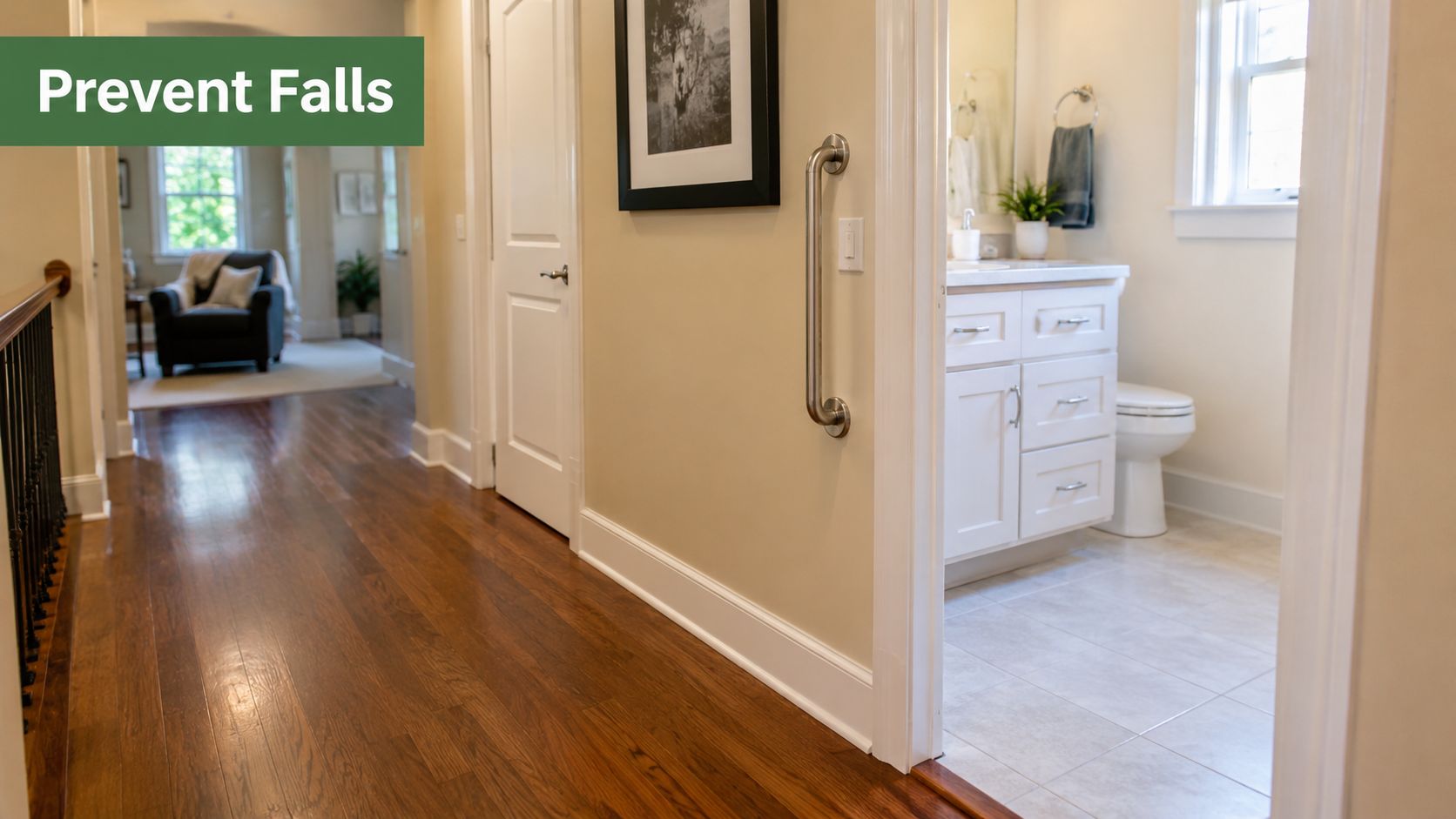
For room-by-room planning, review fall prevention guidance for elderly caregivers and consider an ADA-compliant Melbourne bathroom guide for practical accessibility features.
Phone prompt: “Since yesterday, have you stumbled, held onto furniture, or felt less steady in the bedroom, hallway, stairs, or bathroom?”
A short demonstration can reinforce the conversation, but family members still need to arrange hands-on changes.
3. Preventing Wandering and Managing Disorientation
Disorientation can change with the hour. Someone may know where they are in the morning and become convinced they need to leave for work later in the day. Arguing about the mistaken belief usually increases distress. A calmer response acknowledges the feeling, offers orientation, and redirects attention to a familiar activity.
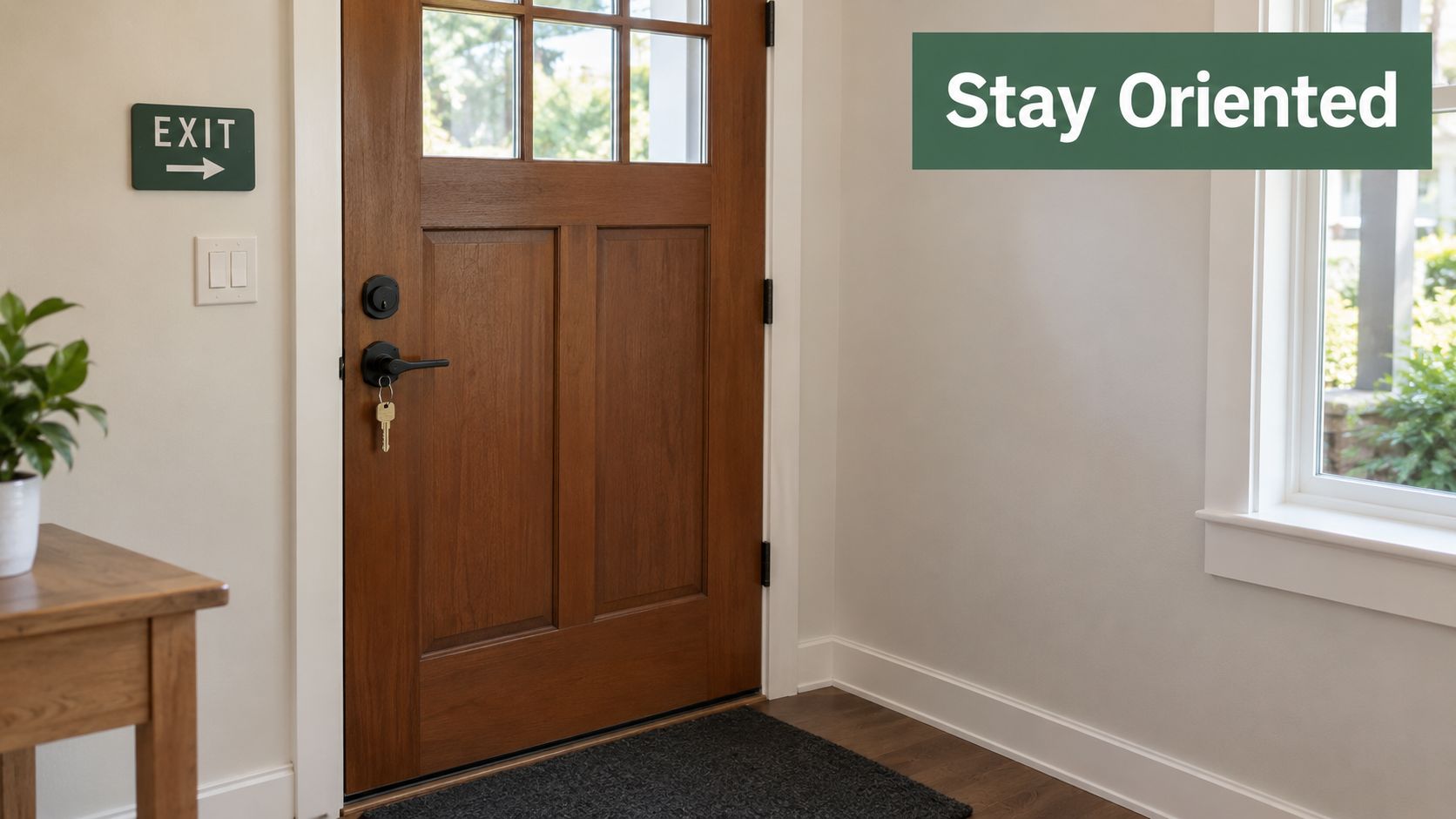
Use the same brief orientation language on every call. State the person's name, the day if known, the location, and who is calling. At home, pair that repetition with a clearly visible calendar, family photographs, and labels on important rooms. Door alerts or other technology may add notice, but they don't provide supervision or guarantee that a person won't leave.
Keep the script stable: “You're at home, and I'm calling to check in with you” is easier to recognize than a changing explanation.
Identify patterns: Note whether confusion increases after a disrupted routine, during a particular part of the day, or around a specific doorway.
Plan reassurance: Share biographical details with the care team so reminiscence can ground the person in familiar relationships and accomplishments.
A family may learn from repeated call notes that the person becomes most disoriented in the early evening. That pattern can guide a visit schedule or added in-person support. Increasing confusion should be discussed with the family and clinician, especially when it represents a clear change from baseline.
Phone prompt: “It's [day], you're at home, and I'm [name]. What room are you in, and what would feel comforting to do next?”
A phone-based orientation conversation can calm and inform. It can't locate someone who has already wandered or keep a person safe outside the home.
4. Regular Health and Wellness Monitoring
Daily monitoring works best when it looks for change, not perfection. Ask about pain, appetite, sleep, mood, confusion, swallowing, mobility, and recent falls in plain language. A person with dementia may not connect a new symptom to a medical problem, so family members should compare answers with the person's usual behavior.
Structured calls create a series of observations between appointments. A care manager may notice that someone sounds unusually irritable or confused across several calls, while a family member might dismiss one difficult conversation as a bad day. The call record can then help the family decide what to share with a doctor.
Track function as well as symptoms
Changes in everyday ability can matter as much as a direct complaint. Difficulty using utensils, managing a familiar task, or finding the bathroom may signal a health issue, a medication effect, or a progression in cognitive impairment. Don't assume every change is “just dementia.”
Keep a short trend summary for medical appointments. Include the date, the observed change, what the person reported, and who was notified. If the person reports new swallowing difficulty, repeated confusion, or a significant mood shift, contact the relevant clinician rather than trying to diagnose the cause by phone.
Phone prompt: “What feels different today from your usual day? Any new pain, trouble eating or swallowing, unusual confusion, or difficulty moving?”
For a broader framework around maintaining health routines, families can consult this modern guide by Venus Health Co., while keeping clinical decisions with the person's healthcare team.
5. Behavioral Change Recognition and Emergency Preparedness
A sudden change in anxiety, agitation, tearfulness, withdrawal, or repetitive questioning deserves attention. The behavior may reflect a disrupted routine, pain, a medication issue, infection, poor sleep, or another medical concern. It shouldn't be dismissed automatically as a dementia symptom.
Start by documenting the person's baseline. Note usual mood, communication style, daily activities, and common triggers. Then ask the care team to record meaningful deviations, including whether the change appeared during a particular call or after a routine interruption. A pattern of agitation on a day when the regular caregiver is absent may point to a support gap rather than a need for confrontation.
Prepare an emergency packet and keep it visible. Include current medications, allergies, medical history, emergency contacts, baseline behaviors, clinician details, and instructions about who should be called first. The family should agree in advance when to contact a clinician, an urgent service, or emergency services.
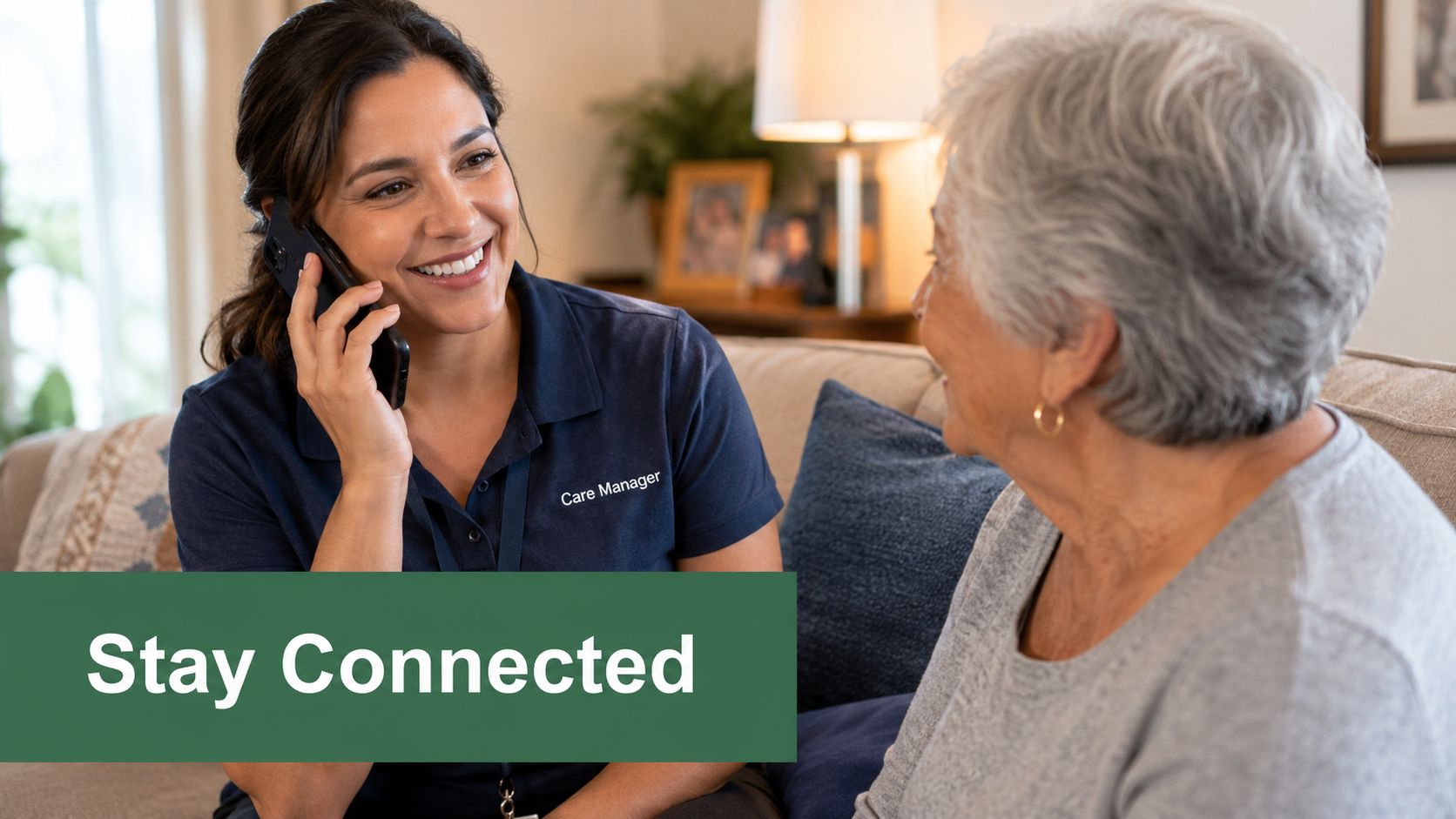
Phone prompt: “Are you feeling worried, frightened, unusually upset, or unwell right now? Is there someone with you?”
If the person doesn't answer repeated calls and that is unusual, treat the missed contact as a possible safety signal. A care manager can alert family according to the agreed plan, but emergency responders are the appropriate choice when there may be immediate danger.
6. Appointment and Schedule Management
A large calendar helps, but it won't solve every scheduling problem. The person may see the appointment and still forget what it is for, who is taking them, or how they will get there. Combine a prominent large-print calendar with verbal reminders, transportation planning, and follow-up confirmation.
Mention an important appointment during several calls before it occurs. Ask the person to repeat the practical details, then correct gently if the answer is wrong. This also reveals whether the appointment needs hands-on support rather than another reminder.
Prepare the context: Explain what the appointment is about in familiar language.
Confirm logistics: Ask where the person is going, who will accompany them, and what time they need to leave.
Close the loop: Afterward, confirm whether the visit happened and record any instructions for the family.
A family might move a therapy appointment to a day when a reminder call already occurs. That small alignment reduces the number of separate systems the person must remember. A care coordination platform may also help families keep responsibilities and updates visible across the support team.
Phone prompt: “What appointment is coming up, where will it happen, who is taking you, and what do you want to ask the clinician?”
7. Nutrition and Hydration Monitoring
“Did you eat?” is too broad for someone who has memory loss. Ask about a specific meal and invite a concrete answer. “What did you have for breakfast?” can reveal that the person ate toast, forgot the meal, or hasn't eaten at all.
Keep food routines simple and familiar. Use consistent meal times, a written cue at the table, easy-to-open containers, and foods the person already enjoys. If utensils have become difficult, adaptive equipment may preserve independence better than having someone take over every meal.
Hydration also needs a visible cue. A bottle or cup placed at the person's favorite chair can make drinking easier to remember. Family members should watch for persistent low intake, appetite changes, swallowing problems, or embarrassment around eating, then share those observations with a clinician.
Ask by meal: “Did you have breakfast? What did you eat?”
Ask about access: “Was anything hard to open, cut, chew, or hold?”
Ask about fluids: “What have you had to drink since you woke up?”
A care manager who notices repeated uncertainty about breakfast can alert the family to add a morning visit or a written cue. Phone support can prompt and observe through conversation, but it can't verify that food was prepared or consumed.
Phone prompt: “What did you eat at your last meal, and what are you planning to have next?”
8. Sleep Quality and Nighttime Safety
Nighttime confusion can create a chain of risks. A person who wakes disoriented may walk through a dark hallway, enter the kitchen, or try to leave the house. Ask about sleep during daytime calls, then connect the answer to what the family has observed overnight.
A consistent wake time, daytime movement, and a quieter evening routine can support a more predictable sleep pattern. Limit long daytime naps where appropriate, but don't make abrupt changes without considering the person's health and clinician guidance. Keep the route to the bathroom clear, use night lighting, and remove obstacles near the bed.
Separate sleep complaints from urgent changes
Occasional poor sleep is different from a new pattern of nighttime confusion, nightmares, or unsafe wandering. Record when the problem began, what happens, and whether a medication or routine changed around the same time. Share persistent or concerning changes with the doctor rather than starting sleep medicines independently.
Phone prompt: “How did you sleep last night? Did you wake often, feel frightened, or walk around the house?”
A care manager can discuss a calming bedtime routine and help identify patterns. Family members still need to decide whether nighttime supervision, environmental changes, or medical review is required.
9. Social Connection and Emotional Support
A safety routine should include a human conversation, not only a list of tasks. Loneliness, worry, and frustration can affect appetite, sleep, cooperation, and willingness to report symptoms. A predictable call gives the person a familiar point of contact and gives the caller a chance to hear changes in tone and engagement.
Personalize the conversation. Share hobbies, former work, favorite places, pets, family relationships, and meaningful life events with the care team. A person who enjoys gardening may respond more openly to questions about plants than to a formal mood screening. The topic isn't a distraction from safety. It can make safety questions easier to answer.
Protect continuity: Keep the same care manager when possible so the person doesn't have to repeatedly build trust.
Time the contact: Schedule calls when the person is usually most isolated or anxious.
Coordinate visits: Avoid overlapping every contact while preserving regular human connection.
A spouse may notice that the person becomes calmer after a familiar conversation, even when the details aren't remembered later. The lasting benefit can be the emotional regulation and routine, not perfect recall.
Phone prompt: “What has been on your mind today, and who or what would you enjoy talking about?”
Phone companionship can ease isolation, but it isn't a substitute for physical presence when the person needs help with bathing, meals, mobility, or urgent distress.
10. Cognitive Stimulation and Mental Exercise
Cognitive activities should feel meaningful, not like an exam. Match the task to the person's ability and interests. Reminiscence about a hometown, naming familiar objects, orientation to place, language prompts, and simple attention exercises can turn a routine call into a structured mental activity.
Success matters more than difficulty. If a multi-step task repeatedly causes frustration, simplify it or switch to a familiar topic. Celebrate participation and effort. The person should finish feeling capable and connected, not tested.
A family member might share details about a parent's former job or favorite music with the care team. The care manager can then use those details to create prompts that are easier to enter and more likely to sustain conversation. Vary activities across calls, but repeat successful formats often enough to create familiarity.
Use personal history: Ask about a known place, hobby, family tradition, or accomplishment.
Reinforce orientation: Include the day, location, and planned activity without turning the call into correction.
Combine formats: Pair phone conversation with in-person puzzles, reading, music, or card games.
Phone prompt: “Tell me about a place you loved living, or name three things you might find in your kitchen.”
Velma describes its calls as combining conversation, orientation, reminiscence, language, attention tasks, and practical daily check-ins. That can add structure between visits, while clinicians and family caregivers remain responsible for assessment, treatment, and hands-on safety.
13-Point Daily Safety Tips Comparison
Intervention | Implementation Complexity 🔄 | Resource Requirements ⚡ | Expected Outcomes ⭐ | Typical Impact 📊 | Ideal Use Cases / Key Tips 💡 |
|---|---|---|---|---|---|
Medication Management and Reminder Systems | Medium 🔄: initial setup and ongoing verification | Low–Med ⚡: pill organizers, scheduled calls, family alerts | ⭐⭐⭐⭐: improved adherence, fewer medication errors | Reduces missed/double doses; fewer med-related incidents | Ideal: people who can respond to cues. Tip: use large-print/color codes; align calls with dose times. |
Home Safety Assessments and Fall Prevention | Med–High 🔄: room-by-room evaluation; some in-person work | Med–High ⚡: OT assessment, hardware (grab bars, rails), minor renovations | ⭐⭐⭐⭐: fewer falls; increased home safety | Prevents injuries/hospitalizations; preserves independence | Ideal: mobility decline or hazardous homes. Tip: prioritize bathroom/bedroom and install night lights. |
Preventing Wandering and Managing Disorientation | Medium 🔄: combine environment, routine, and supervision | Med ⚡: door/window security, GPS/alerts, caregiver presence | ⭐⭐⭐: reduced wandering risk; increased orientation | Fewer elopement incidents; earlier detection of confusion patterns | Ideal: those with wandering history. Tip: use consistent orientation scripts and visual cues. |
Regular Health and Wellness Monitoring | Low–Med 🔄: structured calls and documentation | Low–Med ⚡: trained callers, documentation, PCP coordination | ⭐⭐⭐⭐: early detection of infections/side effects | Fewer ER visits; timely medical follow-up | Ideal: medically complex or changing health. Tip: ask targeted health questions and share trends with PCP. |
Behavioral Change Recognition & Emergency Preparedness | High 🔄: protocols, baseline documentation, crisis plans | High ⚡: trained staff, written emergency packet, family communication tree | ⭐⭐⭐⭐: faster crisis detection & triage | Reduces escalation; speeds family/medical response | Ideal: fluctuating behaviors or psychiatric risk. Tip: keep emergency packet accessible and document baseline behaviors. |
Appointment and Schedule Management | Low 🔄: reminders and follow‑ups integrated into calls | Low ⚡: calendars, call reminders, caregiver coordination | ⭐⭐⭐: improved appointment adherence | Fewer missed appointments; reduced appointment-related anxiety | Ideal: people who forget/miss appointments. Tip: use large-print calendar + multiple call reminders. |
Nutrition and Hydration Monitoring | Low–Med 🔄: regular meal/hydration checks and follow-up | Low–Med ⚡: care team prompts, family meal support, adaptive aids | ⭐⭐⭐⭐: earlier detection of malnutrition/dehydration | Prevents weight loss/infections; flags mood or swallowing issues | Ideal: appetite change or weight loss. Tip: ask specific meal questions and keep water visible. |
Sleep Quality and Nighttime Safety | Medium 🔄: assess patterns; implement hygiene and safety steps | Med ⚡: routine changes, night lights, possible supervision | ⭐⭐⭐: improved sleep routine; reduced sundowning | Better daytime function; fewer nighttime falls/wandering | Ideal: reversed sleep or nighttime wandering. Tip: consistent wake time, limit naps, secure nighttime pathways. |
Social Connection and Emotional Support | Low 🔄: scheduling consistent, empathic calls | Low ⚡: trained callers, recurring schedule | ⭐⭐⭐⭐: reduced loneliness; improved mood | Improved engagement, appetite, caregiver respite | Ideal: socially isolated individuals. Tip: match callers to interests and request continuity. |
Cognitive Stimulation and Mental Exercise | Medium 🔄: tailored, adaptive activities embedded in calls | Med ⚡: trained care managers, personalized prompts | ⭐⭐⭐⭐: slows decline (early–mid stages); boosts confidence | Improved engagement, mood, and cognitive performance | Ideal: early–mid-stage dementia. Tip: personalize prompts, vary exercises, celebrate successes. |
Turn the Checklist Into a Reliable Care Rhythm
A list becomes useful when someone owns each action. Start with the highest-risk issue, such as repeated falls, missed medication, wandering, or an unexplained health change. Assign the hands-on task to a specific person, whether that's a spouse, adult child, home aide, pharmacist, occupational therapist, or clinician. Then give the phone-based care team the exact information and wording they need.
Create a one-page routine with a daily side and a weekly side. The daily side can include the call time, medication confirmation, meal and fluid questions, mobility check, mood, sleep, and any immediate household concern. The weekly side can include reviewing call notes, checking the home for new hazards, updating the medication list, confirming appointments, and deciding whether supervision needs have changed.
Use a script that is short enough to repeat without sounding interrogative:
“Hi, it's [name]. You're at home in [location], and today is [day]. What medications were you meant to take this morning, and when did you take them? What did you eat and drink? Have you stumbled, fallen, or felt unsteady? How are you feeling emotionally? How did you sleep? What appointment or activity is coming up next?”
Specific questions work better than a broad request to “keep an eye on things.” Ask the care manager to document answers, uncertainty, missed calls, repeated concerns, and changes from baseline. Review patterns with family members instead of reacting to every isolated statement.
Escalation should be agreed before a crisis. A missed call may require a family check, while a suspected medication error needs a pharmacist, clinician, or poison control service. New confusion, swallowing trouble, repeated falls, or a marked mood change should go to the appropriate healthcare professional. Immediate danger, serious injury, severe breathing difficulty, or an unresponsive person requires emergency services.
Phone-based support has clear limits. A scheduled call can provide recurring conversation, cognitive stimulation, safety questions, and visibility into patterns between visits. It can't lift someone from the floor, inspect a stove, administer medication, assess a wound, or replace medical care. Velma can fit into that rhythm by giving families another documented point of contact while complementing, rather than replacing, family support and professional care.
Velma provides scheduled phone calls for older adults experiencing memory loss, combining conversation, cognitive exercises, emotional support, and practical daily check-ins. If your family needs a repeatable way to reinforce routines and notice patterns between in-person visits, visit Velma to learn how the program can fit alongside your existing care plan.
A morning call to an older parent can become a rapid safety assessment. You need to know whether the right medications were taken, whether breakfast and fluids were managed, whether the stove and doors are safe, and whether anything feels different from yesterday. A vague “How are you?” often produces a vague answer, especially when memory loss makes it difficult to notice or describe change.
The most reliable approach combines environmental changes, predictable routines, direct observation, and structured phone conversations. The ten daily safety tips below move from immediate household risks to medication, orientation, health signals, nutrition, sleep, connection, cognitive engagement, and escalation planning. Each item identifies the risk, what to check, a practical action, and a phone prompt you can use immediately.
Practical rule: Repeated, specific questions reveal more than occasional general check-ins.
Velma can complement family caregiving through scheduled calls, cognitive support, safety discussions, and documented patterns. It doesn't replace hands-on supervision, clinicians, medication instructions, or emergency services. Use each section as a small checkpoint that can fit into the person's existing day.
Table of Contents
1. Medication Management and Reminder Systems
2. Home Safety Assessments and Fall Prevention
3. Preventing Wandering and Managing Disorientation
4. Regular Health and Wellness Monitoring
Track function as well as symptoms
5. Behavioral Change Recognition and Emergency Preparedness
6. Appointment and Schedule Management
7. Nutrition and Hydration Monitoring
8. Sleep Quality and Nighttime Safety
Separate sleep complaints from urgent changes
9. Social Connection and Emotional Support
10. Cognitive Stimulation and Mental Exercise
13-Point Daily Safety Tips Comparison
Turn the Checklist Into a Reliable Care Rhythm
1. Medication Management and Reminder Systems
Medication errors often begin with an ordinary interruption. A person may forget a dose, take it twice, or become unsure whether a tablet was already taken. A dated pill organizer, large-print labels, and a consistent dose routine can reduce confusion, but an organizer alone can't confirm what happened.
Match the check-in to an established routine, such as after breakfast. A phone alarm set shortly before the dose can provide a secondary cue, while a simple written log gives family members something concrete to review during visits. Ask the person to describe the medication and timing, rather than accepting a quick “yes,” because specific recall can expose uncertainty.
Use visual cues: Choose large-print labels and color-coded organizers that make morning and evening doses easier to distinguish.
Document confirmation: Record when a dose was verbally confirmed, and note uncertainty instead of marking it as complete.
Escalate mistakes: If the person may have double-dosed or taken the wrong medication, contact the clinician, pharmacist, or poison control service promptly.
A spouse might pair the morning organizer with a Velma call after breakfast. If the care manager notices a recurring missed routine, the family can discuss timing with the prescribing team. Guidance on medication reminders for seniors can help families build the reminder layer without treating a phone call as medication administration.
Phone prompt: “Please look at today's section. Which medicines were you meant to take this morning, and can you tell me when you took them?”
For prescription changes, family members should also watch for identifying side effects after a prescription change and report concerns to the appropriate clinician.
2. Home Safety Assessments and Fall Prevention
A home can be familiar and still become unsafe when balance, vision, judgment, or spatial awareness changes. Start with the walking path from bed to bathroom, then inspect stairs, rugs, lighting, footwear, and slippery surfaces. Bathrooms deserve early attention because transfers, wet floors, and nighttime urgency can combine into a serious risk.
Falls warrant focused daily safety tips, not a once-a-year reminder. The CDC reports that more than 14 million adults age 65 and older, about 1 in 4, report falling each year. About 37% of older adults who fall report an injury requiring medical treatment or restricted activity for at least one day. The CDC also reports about 3 million emergency department visits and 1 million hospitalizations annually from older-adult falls.
Begin with a formal assessment by an occupational therapist or geriatric care manager when possible. During calls, ask about near-falls and room-specific difficulty. A parent who repeatedly mentions feeling unsteady in the bathroom may need grab bars, better lighting, or a change in supervision, not just reassurance.
Ask about the room, not just the symptom. “Where did you feel unsteady?” often produces more useful information than “Are you walking okay?”
A hallway with a grab bar can support safer movement, but it doesn't replace observation of how the person uses it.
For room-by-room planning, review fall prevention guidance for elderly caregivers and consider an ADA-compliant Melbourne bathroom guide for practical accessibility features.
Phone prompt: “Since yesterday, have you stumbled, held onto furniture, or felt less steady in the bedroom, hallway, stairs, or bathroom?”
A short demonstration can reinforce the conversation, but family members still need to arrange hands-on changes.
3. Preventing Wandering and Managing Disorientation
Disorientation can change with the hour. Someone may know where they are in the morning and become convinced they need to leave for work later in the day. Arguing about the mistaken belief usually increases distress. A calmer response acknowledges the feeling, offers orientation, and redirects attention to a familiar activity.
Use the same brief orientation language on every call. State the person's name, the day if known, the location, and who is calling. At home, pair that repetition with a clearly visible calendar, family photographs, and labels on important rooms. Door alerts or other technology may add notice, but they don't provide supervision or guarantee that a person won't leave.
Keep the script stable: “You're at home, and I'm calling to check in with you” is easier to recognize than a changing explanation.
Identify patterns: Note whether confusion increases after a disrupted routine, during a particular part of the day, or around a specific doorway.
Plan reassurance: Share biographical details with the care team so reminiscence can ground the person in familiar relationships and accomplishments.
A family may learn from repeated call notes that the person becomes most disoriented in the early evening. That pattern can guide a visit schedule or added in-person support. Increasing confusion should be discussed with the family and clinician, especially when it represents a clear change from baseline.
Phone prompt: “It's [day], you're at home, and I'm [name]. What room are you in, and what would feel comforting to do next?”
A phone-based orientation conversation can calm and inform. It can't locate someone who has already wandered or keep a person safe outside the home.
4. Regular Health and Wellness Monitoring
Daily monitoring works best when it looks for change, not perfection. Ask about pain, appetite, sleep, mood, confusion, swallowing, mobility, and recent falls in plain language. A person with dementia may not connect a new symptom to a medical problem, so family members should compare answers with the person's usual behavior.
Structured calls create a series of observations between appointments. A care manager may notice that someone sounds unusually irritable or confused across several calls, while a family member might dismiss one difficult conversation as a bad day. The call record can then help the family decide what to share with a doctor.
Track function as well as symptoms
Changes in everyday ability can matter as much as a direct complaint. Difficulty using utensils, managing a familiar task, or finding the bathroom may signal a health issue, a medication effect, or a progression in cognitive impairment. Don't assume every change is “just dementia.”
Keep a short trend summary for medical appointments. Include the date, the observed change, what the person reported, and who was notified. If the person reports new swallowing difficulty, repeated confusion, or a significant mood shift, contact the relevant clinician rather than trying to diagnose the cause by phone.
Phone prompt: “What feels different today from your usual day? Any new pain, trouble eating or swallowing, unusual confusion, or difficulty moving?”
For a broader framework around maintaining health routines, families can consult this modern guide by Venus Health Co., while keeping clinical decisions with the person's healthcare team.
5. Behavioral Change Recognition and Emergency Preparedness
A sudden change in anxiety, agitation, tearfulness, withdrawal, or repetitive questioning deserves attention. The behavior may reflect a disrupted routine, pain, a medication issue, infection, poor sleep, or another medical concern. It shouldn't be dismissed automatically as a dementia symptom.
Start by documenting the person's baseline. Note usual mood, communication style, daily activities, and common triggers. Then ask the care team to record meaningful deviations, including whether the change appeared during a particular call or after a routine interruption. A pattern of agitation on a day when the regular caregiver is absent may point to a support gap rather than a need for confrontation.
Prepare an emergency packet and keep it visible. Include current medications, allergies, medical history, emergency contacts, baseline behaviors, clinician details, and instructions about who should be called first. The family should agree in advance when to contact a clinician, an urgent service, or emergency services.
Phone prompt: “Are you feeling worried, frightened, unusually upset, or unwell right now? Is there someone with you?”
If the person doesn't answer repeated calls and that is unusual, treat the missed contact as a possible safety signal. A care manager can alert family according to the agreed plan, but emergency responders are the appropriate choice when there may be immediate danger.
6. Appointment and Schedule Management
A large calendar helps, but it won't solve every scheduling problem. The person may see the appointment and still forget what it is for, who is taking them, or how they will get there. Combine a prominent large-print calendar with verbal reminders, transportation planning, and follow-up confirmation.
Mention an important appointment during several calls before it occurs. Ask the person to repeat the practical details, then correct gently if the answer is wrong. This also reveals whether the appointment needs hands-on support rather than another reminder.
Prepare the context: Explain what the appointment is about in familiar language.
Confirm logistics: Ask where the person is going, who will accompany them, and what time they need to leave.
Close the loop: Afterward, confirm whether the visit happened and record any instructions for the family.
A family might move a therapy appointment to a day when a reminder call already occurs. That small alignment reduces the number of separate systems the person must remember. A care coordination platform may also help families keep responsibilities and updates visible across the support team.
Phone prompt: “What appointment is coming up, where will it happen, who is taking you, and what do you want to ask the clinician?”
7. Nutrition and Hydration Monitoring
“Did you eat?” is too broad for someone who has memory loss. Ask about a specific meal and invite a concrete answer. “What did you have for breakfast?” can reveal that the person ate toast, forgot the meal, or hasn't eaten at all.
Keep food routines simple and familiar. Use consistent meal times, a written cue at the table, easy-to-open containers, and foods the person already enjoys. If utensils have become difficult, adaptive equipment may preserve independence better than having someone take over every meal.
Hydration also needs a visible cue. A bottle or cup placed at the person's favorite chair can make drinking easier to remember. Family members should watch for persistent low intake, appetite changes, swallowing problems, or embarrassment around eating, then share those observations with a clinician.
Ask by meal: “Did you have breakfast? What did you eat?”
Ask about access: “Was anything hard to open, cut, chew, or hold?”
Ask about fluids: “What have you had to drink since you woke up?”
A care manager who notices repeated uncertainty about breakfast can alert the family to add a morning visit or a written cue. Phone support can prompt and observe through conversation, but it can't verify that food was prepared or consumed.
Phone prompt: “What did you eat at your last meal, and what are you planning to have next?”
8. Sleep Quality and Nighttime Safety
Nighttime confusion can create a chain of risks. A person who wakes disoriented may walk through a dark hallway, enter the kitchen, or try to leave the house. Ask about sleep during daytime calls, then connect the answer to what the family has observed overnight.
A consistent wake time, daytime movement, and a quieter evening routine can support a more predictable sleep pattern. Limit long daytime naps where appropriate, but don't make abrupt changes without considering the person's health and clinician guidance. Keep the route to the bathroom clear, use night lighting, and remove obstacles near the bed.
Separate sleep complaints from urgent changes
Occasional poor sleep is different from a new pattern of nighttime confusion, nightmares, or unsafe wandering. Record when the problem began, what happens, and whether a medication or routine changed around the same time. Share persistent or concerning changes with the doctor rather than starting sleep medicines independently.
Phone prompt: “How did you sleep last night? Did you wake often, feel frightened, or walk around the house?”
A care manager can discuss a calming bedtime routine and help identify patterns. Family members still need to decide whether nighttime supervision, environmental changes, or medical review is required.
9. Social Connection and Emotional Support
A safety routine should include a human conversation, not only a list of tasks. Loneliness, worry, and frustration can affect appetite, sleep, cooperation, and willingness to report symptoms. A predictable call gives the person a familiar point of contact and gives the caller a chance to hear changes in tone and engagement.
Personalize the conversation. Share hobbies, former work, favorite places, pets, family relationships, and meaningful life events with the care team. A person who enjoys gardening may respond more openly to questions about plants than to a formal mood screening. The topic isn't a distraction from safety. It can make safety questions easier to answer.
Protect continuity: Keep the same care manager when possible so the person doesn't have to repeatedly build trust.
Time the contact: Schedule calls when the person is usually most isolated or anxious.
Coordinate visits: Avoid overlapping every contact while preserving regular human connection.
A spouse may notice that the person becomes calmer after a familiar conversation, even when the details aren't remembered later. The lasting benefit can be the emotional regulation and routine, not perfect recall.
Phone prompt: “What has been on your mind today, and who or what would you enjoy talking about?”
Phone companionship can ease isolation, but it isn't a substitute for physical presence when the person needs help with bathing, meals, mobility, or urgent distress.
10. Cognitive Stimulation and Mental Exercise
Cognitive activities should feel meaningful, not like an exam. Match the task to the person's ability and interests. Reminiscence about a hometown, naming familiar objects, orientation to place, language prompts, and simple attention exercises can turn a routine call into a structured mental activity.
Success matters more than difficulty. If a multi-step task repeatedly causes frustration, simplify it or switch to a familiar topic. Celebrate participation and effort. The person should finish feeling capable and connected, not tested.
A family member might share details about a parent's former job or favorite music with the care team. The care manager can then use those details to create prompts that are easier to enter and more likely to sustain conversation. Vary activities across calls, but repeat successful formats often enough to create familiarity.
Use personal history: Ask about a known place, hobby, family tradition, or accomplishment.
Reinforce orientation: Include the day, location, and planned activity without turning the call into correction.
Combine formats: Pair phone conversation with in-person puzzles, reading, music, or card games.
Phone prompt: “Tell me about a place you loved living, or name three things you might find in your kitchen.”
Velma describes its calls as combining conversation, orientation, reminiscence, language, attention tasks, and practical daily check-ins. That can add structure between visits, while clinicians and family caregivers remain responsible for assessment, treatment, and hands-on safety.
13-Point Daily Safety Tips Comparison
Intervention | Implementation Complexity 🔄 | Resource Requirements ⚡ | Expected Outcomes ⭐ | Typical Impact 📊 | Ideal Use Cases / Key Tips 💡 |
|---|---|---|---|---|---|
Medication Management and Reminder Systems | Medium 🔄: initial setup and ongoing verification | Low–Med ⚡: pill organizers, scheduled calls, family alerts | ⭐⭐⭐⭐: improved adherence, fewer medication errors | Reduces missed/double doses; fewer med-related incidents | Ideal: people who can respond to cues. Tip: use large-print/color codes; align calls with dose times. |
Home Safety Assessments and Fall Prevention | Med–High 🔄: room-by-room evaluation; some in-person work | Med–High ⚡: OT assessment, hardware (grab bars, rails), minor renovations | ⭐⭐⭐⭐: fewer falls; increased home safety | Prevents injuries/hospitalizations; preserves independence | Ideal: mobility decline or hazardous homes. Tip: prioritize bathroom/bedroom and install night lights. |
Preventing Wandering and Managing Disorientation | Medium 🔄: combine environment, routine, and supervision | Med ⚡: door/window security, GPS/alerts, caregiver presence | ⭐⭐⭐: reduced wandering risk; increased orientation | Fewer elopement incidents; earlier detection of confusion patterns | Ideal: those with wandering history. Tip: use consistent orientation scripts and visual cues. |
Regular Health and Wellness Monitoring | Low–Med 🔄: structured calls and documentation | Low–Med ⚡: trained callers, documentation, PCP coordination | ⭐⭐⭐⭐: early detection of infections/side effects | Fewer ER visits; timely medical follow-up | Ideal: medically complex or changing health. Tip: ask targeted health questions and share trends with PCP. |
Behavioral Change Recognition & Emergency Preparedness | High 🔄: protocols, baseline documentation, crisis plans | High ⚡: trained staff, written emergency packet, family communication tree | ⭐⭐⭐⭐: faster crisis detection & triage | Reduces escalation; speeds family/medical response | Ideal: fluctuating behaviors or psychiatric risk. Tip: keep emergency packet accessible and document baseline behaviors. |
Appointment and Schedule Management | Low 🔄: reminders and follow‑ups integrated into calls | Low ⚡: calendars, call reminders, caregiver coordination | ⭐⭐⭐: improved appointment adherence | Fewer missed appointments; reduced appointment-related anxiety | Ideal: people who forget/miss appointments. Tip: use large-print calendar + multiple call reminders. |
Nutrition and Hydration Monitoring | Low–Med 🔄: regular meal/hydration checks and follow-up | Low–Med ⚡: care team prompts, family meal support, adaptive aids | ⭐⭐⭐⭐: earlier detection of malnutrition/dehydration | Prevents weight loss/infections; flags mood or swallowing issues | Ideal: appetite change or weight loss. Tip: ask specific meal questions and keep water visible. |
Sleep Quality and Nighttime Safety | Medium 🔄: assess patterns; implement hygiene and safety steps | Med ⚡: routine changes, night lights, possible supervision | ⭐⭐⭐: improved sleep routine; reduced sundowning | Better daytime function; fewer nighttime falls/wandering | Ideal: reversed sleep or nighttime wandering. Tip: consistent wake time, limit naps, secure nighttime pathways. |
Social Connection and Emotional Support | Low 🔄: scheduling consistent, empathic calls | Low ⚡: trained callers, recurring schedule | ⭐⭐⭐⭐: reduced loneliness; improved mood | Improved engagement, appetite, caregiver respite | Ideal: socially isolated individuals. Tip: match callers to interests and request continuity. |
Cognitive Stimulation and Mental Exercise | Medium 🔄: tailored, adaptive activities embedded in calls | Med ⚡: trained care managers, personalized prompts | ⭐⭐⭐⭐: slows decline (early–mid stages); boosts confidence | Improved engagement, mood, and cognitive performance | Ideal: early–mid-stage dementia. Tip: personalize prompts, vary exercises, celebrate successes. |
Turn the Checklist Into a Reliable Care Rhythm
A list becomes useful when someone owns each action. Start with the highest-risk issue, such as repeated falls, missed medication, wandering, or an unexplained health change. Assign the hands-on task to a specific person, whether that's a spouse, adult child, home aide, pharmacist, occupational therapist, or clinician. Then give the phone-based care team the exact information and wording they need.
Create a one-page routine with a daily side and a weekly side. The daily side can include the call time, medication confirmation, meal and fluid questions, mobility check, mood, sleep, and any immediate household concern. The weekly side can include reviewing call notes, checking the home for new hazards, updating the medication list, confirming appointments, and deciding whether supervision needs have changed.
Use a script that is short enough to repeat without sounding interrogative:
“Hi, it's [name]. You're at home in [location], and today is [day]. What medications were you meant to take this morning, and when did you take them? What did you eat and drink? Have you stumbled, fallen, or felt unsteady? How are you feeling emotionally? How did you sleep? What appointment or activity is coming up next?”
Specific questions work better than a broad request to “keep an eye on things.” Ask the care manager to document answers, uncertainty, missed calls, repeated concerns, and changes from baseline. Review patterns with family members instead of reacting to every isolated statement.
Escalation should be agreed before a crisis. A missed call may require a family check, while a suspected medication error needs a pharmacist, clinician, or poison control service. New confusion, swallowing trouble, repeated falls, or a marked mood change should go to the appropriate healthcare professional. Immediate danger, serious injury, severe breathing difficulty, or an unresponsive person requires emergency services.
Phone-based support has clear limits. A scheduled call can provide recurring conversation, cognitive stimulation, safety questions, and visibility into patterns between visits. It can't lift someone from the floor, inspect a stove, administer medication, assess a wound, or replace medical care. Velma can fit into that rhythm by giving families another documented point of contact while complementing, rather than replacing, family support and professional care.
Velma provides scheduled phone calls for older adults experiencing memory loss, combining conversation, cognitive exercises, emotional support, and practical daily check-ins. If your family needs a repeatable way to reinforce routines and notice patterns between in-person visits, visit Velma to learn how the program can fit alongside your existing care plan.
Suggested Article: