What Is Reminiscence Therapy and How It Helps Dementia
Reminiscence therapy is a structured approach using personal memories and cues to support cognition, mood, and connection in older adults, especially those with dementia. A 2026 meta-analysis found pooled improvements in cognition (SMD 0.74), depressive symptoms (SMD -0.36), and quality of life (SMD 0.36).
You may already be seeing why this approach matters. Your parent might ask the same question several times, lose track of the day, or struggle to follow a recent conversation. Then an old photograph, a familiar song, or a question about a first job suddenly brings warmth, detail, and confidence into their voice. Reminiscence therapy builds on that opening, but it isn't a memory quiz and it isn't a cure for dementia.
The method gives a person carefully chosen cues and time to talk about their own life. For families who can't always be present, a structured phone call can offer another way to create that connection without requiring an app, video platform, or complicated device.
Table of Contents
Understanding Reminiscence Therapy for Families
Following the story, not the facts
How Reminiscence Therapy Works in the Brain
The connected process
The Research History Behind Reminiscence Therapy
Research milestones
What the history can and can't prove
What the Evidence Says About Benefits
What the numbers mean for care
Delivery Formats Including Phone Based Care
Matching the format to the person
Reminiscence Therapy Session Examples
Precautions and Who Should Adapt Approach
Key Takeaways for Dementia Families
Understanding Reminiscence Therapy for Families
Reminiscence therapy begins with what a person can still access, their personal history. With dementia, recent memories may become difficult while older experiences remain easier to describe. A parent might forget breakfast but speak with feeling about a wedding day, childhood neighborhood, or first workplace. This difference can confuse families. It also shows why sessions start with familiar life experiences rather than recent facts.
Reminiscence therapy, or RT, uses memories and prompts to support conversation, identity, mood, and social connection. A facilitator might introduce a photograph, song, familiar object, or question about an important life experience. The person does not need to give a correct answer. The aim is to help them feel recognized, involved, and able to contribute.
Following the story, not the facts
Memory training usually measures accurate recall. RT follows the personal meaning of what someone shares. For example, a facilitator may ask, “What do you remember about working there?” instead of asking for the year the job began. If details are missing or change, the facilitator listens for the story's meaning rather than correcting each fact.
That approach can reduce embarrassment and frustration. The conversation stays connected to the person's experience, feelings, and identity. A memory can be useful even when its dates or details are uncertain.
Practical rule: Ask open questions, offer a cue, and let the person decide where the memory goes.
RT can take place one-to-one, with family, in a care setting, or by phone. A phone session can be a simple, structured conversation, with a relative or facilitator using familiar questions and allowing extra time for responses. It does not require an app or video platform, although the person still needs to feel comfortable and heard.
RT may suit someone with memory loss who enjoys discussing the past. Each session should match their communication ability, energy, interests, and comfort. A successful conversation may last only while the person remains relaxed and involved.
How Reminiscence Therapy Works in the Brain
Think of reminiscence therapy as opening a familiar photo album, not sitting an exam. The album offers a starting point, but nobody has to identify every face, date, or location correctly. A photograph of a kitchen may lead to a story about a mother, a favorite meal, a neighborhood, or the feeling of coming home.
A personal cue can activate several forms of engagement at once. The person may search for a memory, find words to describe it, connect the story to a role they once held, and experience an emotion linked to that period. Even when the factual details are uncertain, the conversation can still support a sense of continuity and belonging.
The connected process
The process can be understood as a simple chain:
A personal cue opens a pathway, such as a photograph, song, object, or familiar question.
Autobiographical recall brings forward part of the person's own history.
Language and emotion give the memory shape through storytelling, laughter, sadness, or recognition.
Identity and connection grow when another person listens without turning the exchange into a test.

This is why mood may improve even when factual recall doesn't. The person may not remember the exact date of a family event, but they may remember feeling proud, loved, useful, or adventurous. The facilitator reinforces that emotional and personal meaning.
RT isn't the same as every activity described as cognitive stimulation. Someone might also enjoy brain training through card games, but a card game usually focuses on play, attention, or problem-solving. RT focuses on the person's life story and the relationship created while that story is shared. Families can also explore the broader idea of cognitive conditioning, while keeping its goals distinct from reminiscence-based conversation.
The Research History Behind Reminiscence Therapy
Reminiscence therapy didn't appear suddenly as a modern dementia trend. Its documented research history reaches back to Butler's 1963 “life review” model, which described reflection on past experiences as psychologically meaningful in later life. Dementia-focused clinical reviews later formalized the approach, with the Cochrane review first published in 1998 and updated in 2018. The Cochrane evidence record shows how the field developed from a conceptual geriatric practice into an intervention examined through randomized research.
Research milestones
Milestone | Year | Participants |
|---|---|---|
Butler's life review model | 1963 | Not applicable |
First Cochrane review on reminiscence therapy in dementia | 1998 | Not specified in the milestone |
Cochrane review update | 2018 | Not specified in the milestone |
Systematic review of randomized studies | Not specified | 16 studies, 1,749 participants |
The participant total matters because it signals a research program rather than a collection of isolated anecdotes. Investigators have studied RT across different settings and delivery formats, including approaches that vary in structure, intensity, and whether people participate individually or with a group.
That history also explains why readers may encounter apparently different conclusions. A review may examine immediate outcomes, while another pools studies with different session designs or participants. One review can identify a small effect in a specific outcome without proving that every person will experience the same change.
What the history can and can't prove
A mature evidence base supports careful confidence, not unlimited promises. RT has been measured, compared, and reviewed, but the research history doesn't establish that it reverses dementia or replaces medical care. It supports testing a personalized, low-burden activity as part of a wider care plan.
For families, the practical conclusion is straightforward. Ask how the program is delivered, what outcome it is targeting, and whether the person enjoys taking part. A program that respects those details is more informative than a broad claim that reminiscence therapy works identically for everyone.
What the Evidence Says About Benefits
The evidence points to modest but real benefits, with important variation between reviews and outcomes. The Cochrane review reported a very small cognitive benefit at the end of treatment, SMD 0.11 across 14 studies involving 1,219 participants, and found no important immediate quality-of-life effect, SMD 0.11 across 8 studies involving 1,060 participants. The review published in the medical literature presents these findings alongside positive signals for communication, mood, and cognition in some settings and formats.
A later meta-analysis published in 2026 pooled 26 studies and 2,766 participants. It found improvements in cognition, depressive symptoms, and quality of life, with pooled SMD values of 0.74, -0.36, and 0.36, respectively. Those results suggest that RT can do more than create a pleasant conversation, but they still shouldn't be translated into a promise of recovery.

What the numbers mean for care
A standardized mean difference helps researchers combine results measured with different tools. It isn't a prediction of how many points a particular person will gain on a memory test. A pooled result describes the average pattern across studies, while an individual response may be smaller, larger, or absent.
The best way to communicate the evidence is to separate likely aims from uncertain ones:
Cognition: Reviews show measurable improvement signals, though the size varies.
Mood: Depressive symptoms may improve, especially when conversations feel meaningful and personally relevant.
Quality of life: Results range from little immediate change in the Cochrane review to a positive pooled effect in later analysis.
Behavior and caregiver burden: Benefits aren't established as a general solution for agitation, disruptive symptoms, or caregiver stress.
RT is therefore best treated as a non-pharmacological adjunct, not a cure. It may make conversations easier, support participation, and create emotionally positive moments, but it won't remove the underlying condition or guarantee fewer care challenges. Families can also read about life review therapy to understand how structured reflection relates to, but isn't always identical with, reminiscence therapy.
Delivery Formats Including Phone Based Care
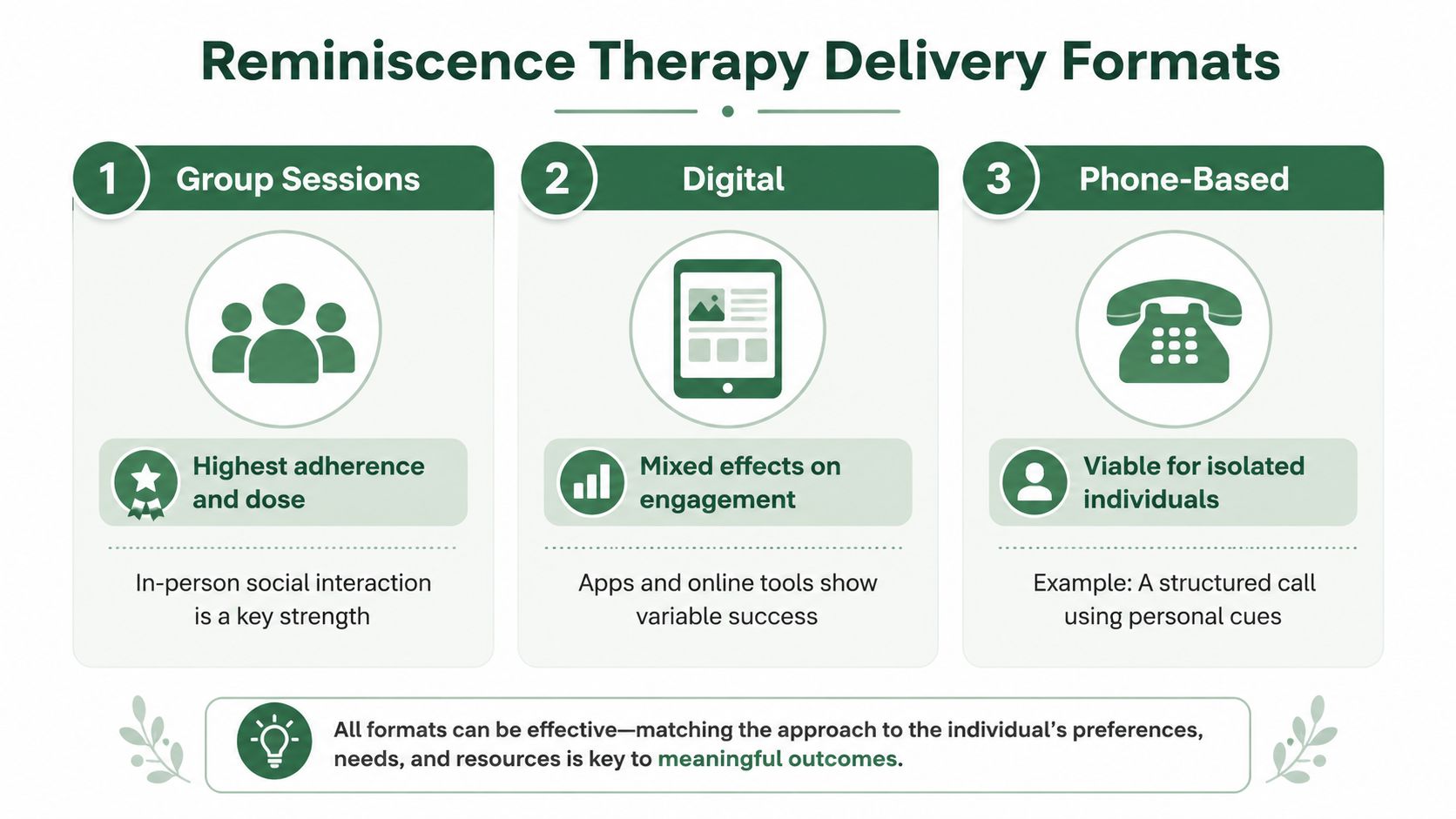
Reminiscence therapy can be delivered in several ways, and the format changes the experience. In a group, people share social energy and may recognize parts of one another's stories. Digital tools can display photos, music, or other prompts, but they require a person to manage the device and may produce uneven engagement. A phone call removes the need for a screen while preserving the central ingredient, a guided conversation shaped around personal cues.
A 2025 systematic review and network meta-analysis found that digital reminiscence therapy appeared most effective for people with dementia or mild cognitive impairment, while group reminiscence had higher adherence. The same evidence base includes a recommendation for weekly group sessions lasting 30 to 45 minutes for at least 12 weeks, but it didn't establish one universal format for every person. The PubMed review also reported no meaningful subgroup differences in its meta-analytic findings.
Matching the format to the person
Format | Practical strength | Possible obstacle |
|---|---|---|
Group sessions | Social interaction and higher adherence | Travel, hearing difficulty, or discomfort in groups |
Digital tools | Rich visual and audio prompts | Device skills, setup, and variable engagement |
Phone-based calls | Access without an app or screen | Less access to visual cues unless family prepares them |
Phone-based care can work particularly well for an older adult who lives alone, dislikes technology, or can't attend a group. A trained caller can use a birthday, former workplace, favorite hobby, or family tradition as a starting point, then adjust the pace when the person tires or becomes confused.
A phone program may also combine reminiscence with orientation, language, attention, and routine check-ins. That broader structure is different from a single therapy session. Families considering recurring calls can compare the approach with daily check-in calls for seniors, especially when the main concern includes isolation or missed everyday tasks.
Reminiscence Therapy Session Examples
A group session might begin with a facilitator placing several old photographs on a table. One participant recognizes a seaside setting, another talks about a family celebration, and someone else remembers the clothes people wore during that period. The facilitator doesn't ask the group to identify every date or person. Instead, they ask what the place felt like, who enjoyed going there, or what people did after arriving.
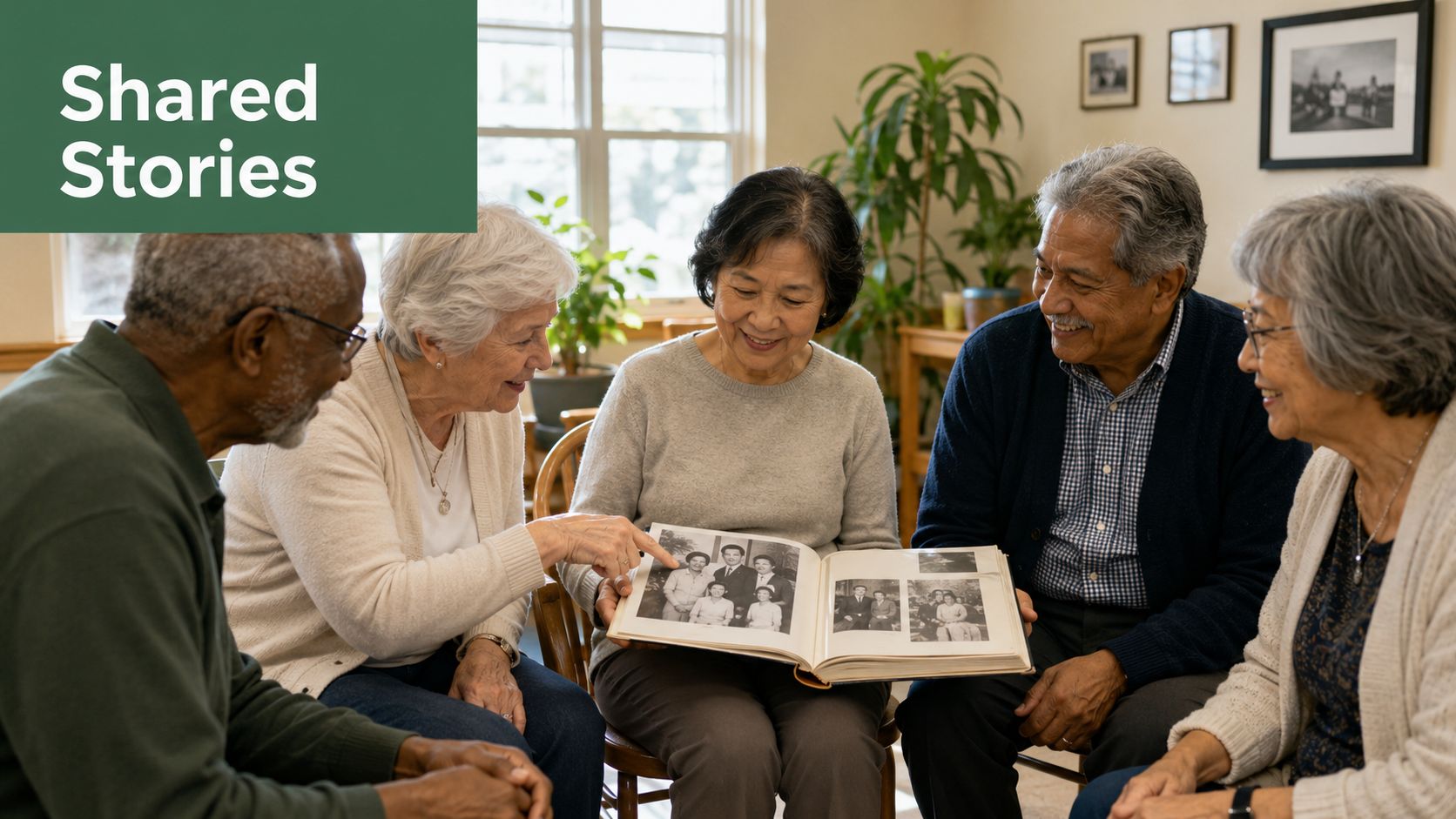
The facilitator watches for participation, comfort, and connection. If one person becomes quiet, the facilitator may offer a simpler prompt or let them listen. If a story becomes painful, the group can shift toward a safer topic without treating the change as failure.
A phone-based session might start with a personal birthday cue: “Your birthday is coming up. What did birthdays look like when you were young?” The older adult may talk about a cake, a sibling, a favorite song, or a family member who is no longer alive. The caller can respond with curiosity, validate the feeling, and avoid pressing for details the person can't retrieve.
After the call, a family member might receive a brief update such as: the parent engaged with the birthday topic, became tearful when discussing a sibling, and settled after talking about a favorite meal. That information doesn't diagnose a problem, but it can help the family notice patterns and choose a gentler topic for the next conversation.
The following video offers another visual way to understand the tone and activity of reminiscence sessions:
The important feature isn't the object or question by itself. It's the relationship around the cue. Someone listens, follows the person's lead, and treats the story as meaningful even when the details are incomplete.
Precautions and Who Should Adapt Approach
Reminiscence therapy should feel safe, voluntary, and flexible. A familiar memory can bring joy, but it can also bring grief, fear, regret, or confusion. The facilitator needs to watch the person's face, voice, pace, and willingness to continue, not just the words they use.
Use these safeguards in everyday practice:
Don't correct every detail: If a memory is inaccurate but harmless, follow the emotional meaning instead of turning the exchange into a fact check.
Pause when distress appears: Silence, withdrawal, agitation, or repeated attempts to change the subject can signal that the topic is too difficult.
Match the person's ability: Use shorter prompts, familiar subjects, or nonverbal cues when speech and recall are limited.
Avoid forced positivity: A person doesn't have to describe the past as happy. Listening respectfully may matter more than redirecting immediately.
Keep medical care in place: RT doesn't diagnose dementia, treat an emergency, or replace medication reviews, clinical assessment, or hands-on support.
Evidence also sets a clear boundary. A 2025 umbrella review found benefits for self-esteem, communication, interaction, function, and loneliness, but no significant benefits for well-being, agitation, or apathy. Its findings support using RT for connection and mood rather than presenting it as a broad fix for disruptive behavior or caregiver burden.
Phone check-ins can help families notice changes in mood or confusion, but a caller can't physically assess a fall, unsafe cooking, or sudden illness. Escalate urgent concerns through the appropriate medical or emergency service.
Key Takeaways for Dementia Families
The answer to what is reminiscence therapy is practical rather than mysterious. It's a structured invitation to use a person's own memories, objects, music, and life stories to encourage conversation, emotional connection, and participation. The person doesn't need perfect recall, and the session doesn't need to produce a correct timeline.
Keep these principles in mind:
Start with identity: Ask about roles, places, work, family traditions, or hobbies that shaped the person.
Use a gentle cue: A photograph, familiar song, birthday, recipe, or object can offer an easier entry point than a direct memory question.
Measure the right outcome: Notice engagement, comfort, communication, and mood. Don't expect RT to reverse dementia.
Repeat thoughtfully: Personalized sessions may work better when they become a familiar part of care, but the pace should follow the person's energy and preferences.
Choose accessible delivery: Groups offer social contact, digital tools offer multimedia prompts, and phone calls can reach someone who struggles with devices or isolation.
For families, a phone-based program can sit alongside medical care, family visits, and in-person support. Velma offers scheduled calls with trained care team members, guided reminiscence prompts, orientation and cognitive exercises, companionship, and practical check-ins for older adults with early to mid-stage memory loss. It can be considered when regular conversation and structured support are useful but an app or frequent travel isn't realistic.
If your parent would benefit from regular conversation, guided reminiscence, and structured cognitive support without managing an app, visit Velma to learn how its scheduled phone calls work. Share the details with your family or care manager and decide whether this type of support fits the person's routines, preferences, and current care plan.
Reminiscence therapy is a structured approach using personal memories and cues to support cognition, mood, and connection in older adults, especially those with dementia. A 2026 meta-analysis found pooled improvements in cognition (SMD 0.74), depressive symptoms (SMD -0.36), and quality of life (SMD 0.36).
You may already be seeing why this approach matters. Your parent might ask the same question several times, lose track of the day, or struggle to follow a recent conversation. Then an old photograph, a familiar song, or a question about a first job suddenly brings warmth, detail, and confidence into their voice. Reminiscence therapy builds on that opening, but it isn't a memory quiz and it isn't a cure for dementia.
The method gives a person carefully chosen cues and time to talk about their own life. For families who can't always be present, a structured phone call can offer another way to create that connection without requiring an app, video platform, or complicated device.
Table of Contents
Understanding Reminiscence Therapy for Families
Following the story, not the facts
How Reminiscence Therapy Works in the Brain
The connected process
The Research History Behind Reminiscence Therapy
Research milestones
What the history can and can't prove
What the Evidence Says About Benefits
What the numbers mean for care
Delivery Formats Including Phone Based Care
Matching the format to the person
Reminiscence Therapy Session Examples
Precautions and Who Should Adapt Approach
Key Takeaways for Dementia Families
Understanding Reminiscence Therapy for Families
Reminiscence therapy begins with what a person can still access, their personal history. With dementia, recent memories may become difficult while older experiences remain easier to describe. A parent might forget breakfast but speak with feeling about a wedding day, childhood neighborhood, or first workplace. This difference can confuse families. It also shows why sessions start with familiar life experiences rather than recent facts.
Reminiscence therapy, or RT, uses memories and prompts to support conversation, identity, mood, and social connection. A facilitator might introduce a photograph, song, familiar object, or question about an important life experience. The person does not need to give a correct answer. The aim is to help them feel recognized, involved, and able to contribute.
Following the story, not the facts
Memory training usually measures accurate recall. RT follows the personal meaning of what someone shares. For example, a facilitator may ask, “What do you remember about working there?” instead of asking for the year the job began. If details are missing or change, the facilitator listens for the story's meaning rather than correcting each fact.
That approach can reduce embarrassment and frustration. The conversation stays connected to the person's experience, feelings, and identity. A memory can be useful even when its dates or details are uncertain.
Practical rule: Ask open questions, offer a cue, and let the person decide where the memory goes.
RT can take place one-to-one, with family, in a care setting, or by phone. A phone session can be a simple, structured conversation, with a relative or facilitator using familiar questions and allowing extra time for responses. It does not require an app or video platform, although the person still needs to feel comfortable and heard.
RT may suit someone with memory loss who enjoys discussing the past. Each session should match their communication ability, energy, interests, and comfort. A successful conversation may last only while the person remains relaxed and involved.
How Reminiscence Therapy Works in the Brain
Think of reminiscence therapy as opening a familiar photo album, not sitting an exam. The album offers a starting point, but nobody has to identify every face, date, or location correctly. A photograph of a kitchen may lead to a story about a mother, a favorite meal, a neighborhood, or the feeling of coming home.
A personal cue can activate several forms of engagement at once. The person may search for a memory, find words to describe it, connect the story to a role they once held, and experience an emotion linked to that period. Even when the factual details are uncertain, the conversation can still support a sense of continuity and belonging.
The connected process
The process can be understood as a simple chain:
A personal cue opens a pathway, such as a photograph, song, object, or familiar question.
Autobiographical recall brings forward part of the person's own history.
Language and emotion give the memory shape through storytelling, laughter, sadness, or recognition.
Identity and connection grow when another person listens without turning the exchange into a test.
This is why mood may improve even when factual recall doesn't. The person may not remember the exact date of a family event, but they may remember feeling proud, loved, useful, or adventurous. The facilitator reinforces that emotional and personal meaning.
RT isn't the same as every activity described as cognitive stimulation. Someone might also enjoy brain training through card games, but a card game usually focuses on play, attention, or problem-solving. RT focuses on the person's life story and the relationship created while that story is shared. Families can also explore the broader idea of cognitive conditioning, while keeping its goals distinct from reminiscence-based conversation.
The Research History Behind Reminiscence Therapy
Reminiscence therapy didn't appear suddenly as a modern dementia trend. Its documented research history reaches back to Butler's 1963 “life review” model, which described reflection on past experiences as psychologically meaningful in later life. Dementia-focused clinical reviews later formalized the approach, with the Cochrane review first published in 1998 and updated in 2018. The Cochrane evidence record shows how the field developed from a conceptual geriatric practice into an intervention examined through randomized research.
Research milestones
Milestone | Year | Participants |
|---|---|---|
Butler's life review model | 1963 | Not applicable |
First Cochrane review on reminiscence therapy in dementia | 1998 | Not specified in the milestone |
Cochrane review update | 2018 | Not specified in the milestone |
Systematic review of randomized studies | Not specified | 16 studies, 1,749 participants |
The participant total matters because it signals a research program rather than a collection of isolated anecdotes. Investigators have studied RT across different settings and delivery formats, including approaches that vary in structure, intensity, and whether people participate individually or with a group.
That history also explains why readers may encounter apparently different conclusions. A review may examine immediate outcomes, while another pools studies with different session designs or participants. One review can identify a small effect in a specific outcome without proving that every person will experience the same change.
What the history can and can't prove
A mature evidence base supports careful confidence, not unlimited promises. RT has been measured, compared, and reviewed, but the research history doesn't establish that it reverses dementia or replaces medical care. It supports testing a personalized, low-burden activity as part of a wider care plan.
For families, the practical conclusion is straightforward. Ask how the program is delivered, what outcome it is targeting, and whether the person enjoys taking part. A program that respects those details is more informative than a broad claim that reminiscence therapy works identically for everyone.
What the Evidence Says About Benefits
The evidence points to modest but real benefits, with important variation between reviews and outcomes. The Cochrane review reported a very small cognitive benefit at the end of treatment, SMD 0.11 across 14 studies involving 1,219 participants, and found no important immediate quality-of-life effect, SMD 0.11 across 8 studies involving 1,060 participants. The review published in the medical literature presents these findings alongside positive signals for communication, mood, and cognition in some settings and formats.
A later meta-analysis published in 2026 pooled 26 studies and 2,766 participants. It found improvements in cognition, depressive symptoms, and quality of life, with pooled SMD values of 0.74, -0.36, and 0.36, respectively. Those results suggest that RT can do more than create a pleasant conversation, but they still shouldn't be translated into a promise of recovery.
What the numbers mean for care
A standardized mean difference helps researchers combine results measured with different tools. It isn't a prediction of how many points a particular person will gain on a memory test. A pooled result describes the average pattern across studies, while an individual response may be smaller, larger, or absent.
The best way to communicate the evidence is to separate likely aims from uncertain ones:
Cognition: Reviews show measurable improvement signals, though the size varies.
Mood: Depressive symptoms may improve, especially when conversations feel meaningful and personally relevant.
Quality of life: Results range from little immediate change in the Cochrane review to a positive pooled effect in later analysis.
Behavior and caregiver burden: Benefits aren't established as a general solution for agitation, disruptive symptoms, or caregiver stress.
RT is therefore best treated as a non-pharmacological adjunct, not a cure. It may make conversations easier, support participation, and create emotionally positive moments, but it won't remove the underlying condition or guarantee fewer care challenges. Families can also read about life review therapy to understand how structured reflection relates to, but isn't always identical with, reminiscence therapy.
Delivery Formats Including Phone Based Care
Reminiscence therapy can be delivered in several ways, and the format changes the experience. In a group, people share social energy and may recognize parts of one another's stories. Digital tools can display photos, music, or other prompts, but they require a person to manage the device and may produce uneven engagement. A phone call removes the need for a screen while preserving the central ingredient, a guided conversation shaped around personal cues.
A 2025 systematic review and network meta-analysis found that digital reminiscence therapy appeared most effective for people with dementia or mild cognitive impairment, while group reminiscence had higher adherence. The same evidence base includes a recommendation for weekly group sessions lasting 30 to 45 minutes for at least 12 weeks, but it didn't establish one universal format for every person. The PubMed review also reported no meaningful subgroup differences in its meta-analytic findings.
Matching the format to the person
Format | Practical strength | Possible obstacle |
|---|---|---|
Group sessions | Social interaction and higher adherence | Travel, hearing difficulty, or discomfort in groups |
Digital tools | Rich visual and audio prompts | Device skills, setup, and variable engagement |
Phone-based calls | Access without an app or screen | Less access to visual cues unless family prepares them |
Phone-based care can work particularly well for an older adult who lives alone, dislikes technology, or can't attend a group. A trained caller can use a birthday, former workplace, favorite hobby, or family tradition as a starting point, then adjust the pace when the person tires or becomes confused.
A phone program may also combine reminiscence with orientation, language, attention, and routine check-ins. That broader structure is different from a single therapy session. Families considering recurring calls can compare the approach with daily check-in calls for seniors, especially when the main concern includes isolation or missed everyday tasks.
Reminiscence Therapy Session Examples
A group session might begin with a facilitator placing several old photographs on a table. One participant recognizes a seaside setting, another talks about a family celebration, and someone else remembers the clothes people wore during that period. The facilitator doesn't ask the group to identify every date or person. Instead, they ask what the place felt like, who enjoyed going there, or what people did after arriving.
The facilitator watches for participation, comfort, and connection. If one person becomes quiet, the facilitator may offer a simpler prompt or let them listen. If a story becomes painful, the group can shift toward a safer topic without treating the change as failure.
A phone-based session might start with a personal birthday cue: “Your birthday is coming up. What did birthdays look like when you were young?” The older adult may talk about a cake, a sibling, a favorite song, or a family member who is no longer alive. The caller can respond with curiosity, validate the feeling, and avoid pressing for details the person can't retrieve.
After the call, a family member might receive a brief update such as: the parent engaged with the birthday topic, became tearful when discussing a sibling, and settled after talking about a favorite meal. That information doesn't diagnose a problem, but it can help the family notice patterns and choose a gentler topic for the next conversation.
The following video offers another visual way to understand the tone and activity of reminiscence sessions:
The important feature isn't the object or question by itself. It's the relationship around the cue. Someone listens, follows the person's lead, and treats the story as meaningful even when the details are incomplete.
Precautions and Who Should Adapt Approach
Reminiscence therapy should feel safe, voluntary, and flexible. A familiar memory can bring joy, but it can also bring grief, fear, regret, or confusion. The facilitator needs to watch the person's face, voice, pace, and willingness to continue, not just the words they use.
Use these safeguards in everyday practice:
Don't correct every detail: If a memory is inaccurate but harmless, follow the emotional meaning instead of turning the exchange into a fact check.
Pause when distress appears: Silence, withdrawal, agitation, or repeated attempts to change the subject can signal that the topic is too difficult.
Match the person's ability: Use shorter prompts, familiar subjects, or nonverbal cues when speech and recall are limited.
Avoid forced positivity: A person doesn't have to describe the past as happy. Listening respectfully may matter more than redirecting immediately.
Keep medical care in place: RT doesn't diagnose dementia, treat an emergency, or replace medication reviews, clinical assessment, or hands-on support.
Evidence also sets a clear boundary. A 2025 umbrella review found benefits for self-esteem, communication, interaction, function, and loneliness, but no significant benefits for well-being, agitation, or apathy. Its findings support using RT for connection and mood rather than presenting it as a broad fix for disruptive behavior or caregiver burden.
Phone check-ins can help families notice changes in mood or confusion, but a caller can't physically assess a fall, unsafe cooking, or sudden illness. Escalate urgent concerns through the appropriate medical or emergency service.
Key Takeaways for Dementia Families
The answer to what is reminiscence therapy is practical rather than mysterious. It's a structured invitation to use a person's own memories, objects, music, and life stories to encourage conversation, emotional connection, and participation. The person doesn't need perfect recall, and the session doesn't need to produce a correct timeline.
Keep these principles in mind:
Start with identity: Ask about roles, places, work, family traditions, or hobbies that shaped the person.
Use a gentle cue: A photograph, familiar song, birthday, recipe, or object can offer an easier entry point than a direct memory question.
Measure the right outcome: Notice engagement, comfort, communication, and mood. Don't expect RT to reverse dementia.
Repeat thoughtfully: Personalized sessions may work better when they become a familiar part of care, but the pace should follow the person's energy and preferences.
Choose accessible delivery: Groups offer social contact, digital tools offer multimedia prompts, and phone calls can reach someone who struggles with devices or isolation.
For families, a phone-based program can sit alongside medical care, family visits, and in-person support. Velma offers scheduled calls with trained care team members, guided reminiscence prompts, orientation and cognitive exercises, companionship, and practical check-ins for older adults with early to mid-stage memory loss. It can be considered when regular conversation and structured support are useful but an app or frequent travel isn't realistic.
If your parent would benefit from regular conversation, guided reminiscence, and structured cognitive support without managing an app, visit Velma to learn how its scheduled phone calls work. Share the details with your family or care manager and decide whether this type of support fits the person's routines, preferences, and current care plan.
Suggested Article: