Memory Exercises for Dementia: 8 Effective Daily Tasks

A daughter calls her father before work. She asks what he had for breakfast, who visited yesterday, and whether he remembers the appointment later that day. Within minutes, the conversation starts to feel like a quiz. He hesitates, she corrects him, and both of them end the call tense.
The best memory exercises for dementia don't create that pressure. They turn familiar conversation into gentle cognitive engagement, using a person's interests, routines, language, attention, and life history without making correct answers the measure of success. A phone call about a career, a favorite meal, or an upcoming family visit can be more useful than a demanding brain game when it preserves confidence and connection.
The eight approaches below include reminiscence, orientation, spaced retrieval, language stimulation, attention, semantic knowledge, executive function, and conversation-based cognitive stimulation therapy, or CST. Adapt them to the person's abilities. Use familiar strengths in early stages, simplify prompts as needs increase, and choose connection over correction at every stage. These activities complement medical care and shouldn't continue unchanged if they cause distress, fatigue, fear, or agitation.
Table of Contents
1. Reminiscence Therapy
Make the person's history the resource
2. Orientation and Time and Place Reorientation
Use familiar anchors
3. Spaced Retrieval Training
Keep the wording stable
4. Word-Finding and Language Stimulation Exercises
Turn hesitation into collaboration
5. Attention and Concentration Tasks
Use everyday attention
6. Semantic Knowledge and Category Naming Tasks
Build from accessible to more nuanced
7. Executive Function and Problem-Solving Exercises
Make the problem real
8. Conversation-Based Cognitive Stimulation Therapy
Let dialogue do the work
Adapting Memory Exercises by Dementia Stage
Early-stage needs
Mid-stage needs
More advanced needs
9-Point Comparison of Dementia Memory Exercises
Choose Connection Over Correction
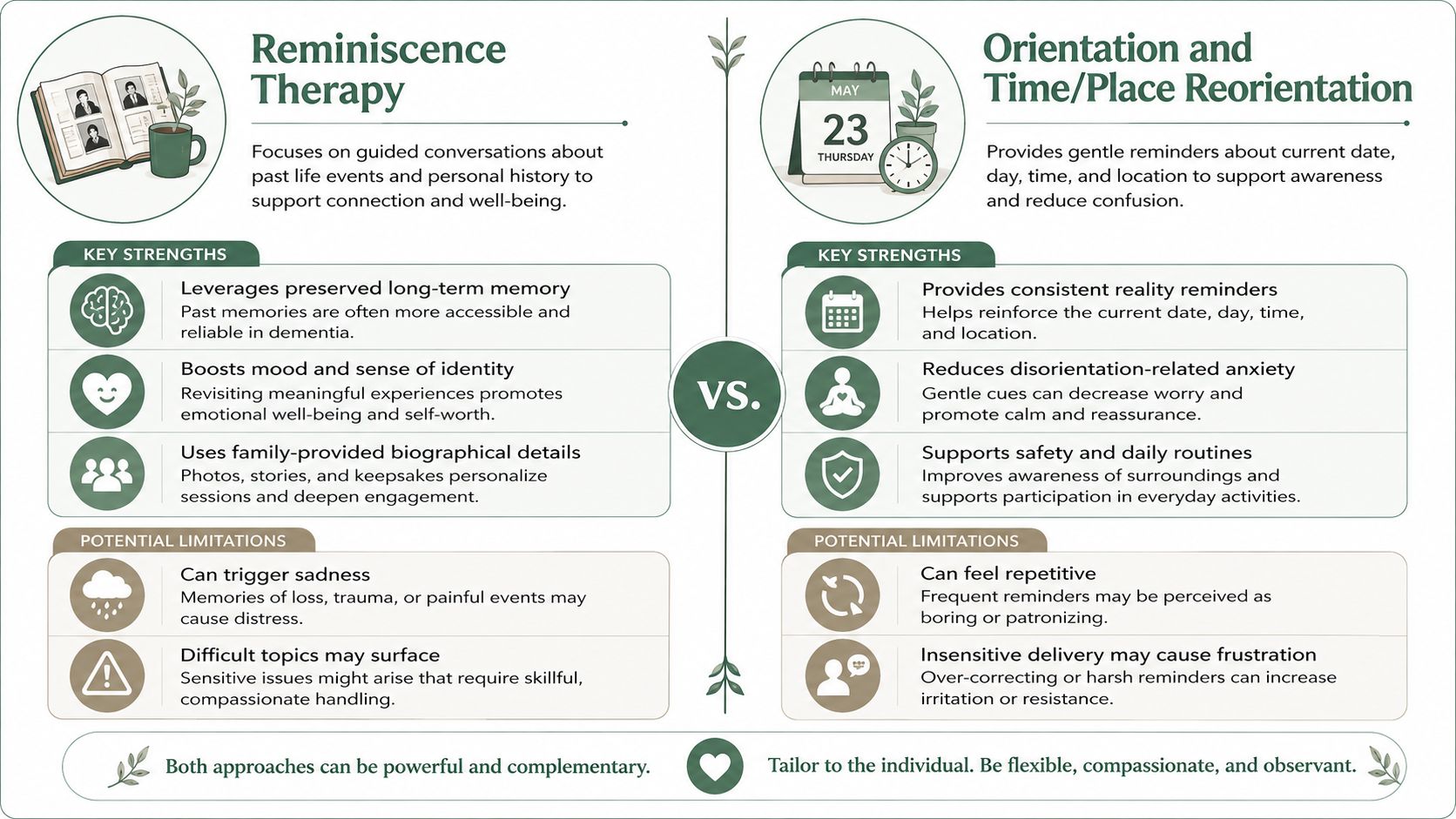
1. Reminiscence Therapy
Reminiscence begins with a person's life, not a worksheet. A caller might ask about a first job, a wedding tradition, a favorite holiday, or the garden someone kept for years. These conversations often draw on older personal memories that remain easier to access than recent information, while also reinforcing identity and giving the person space to be the expert.
A care coordinator could say, “Tell me about the work you did before you retired,” rather than “Do you remember where you worked?” The first prompt invites a story. If the person mentions a colleague, the caller can follow with, “What was she like?” or “What did you enjoy most about working together?”
Make the person's history the resource
Before a call, family members can share meaningful details about careers, relatives, sports, music, hobbies, places, and traditions. Specific names and objects can help anchor the conversation, but the caller shouldn't force a particular answer or insist that a detail is remembered accurately.
Useful prompts include:
Career memories: “What was a typical day like when you worked at the hospital?”
Family traditions: “What did your family usually do during the holidays?”
Travel stories: “Tell me about a trip that stands out to you.”
Past interests: “What did you enjoy making, collecting, or watching?”
If a memory becomes painful, acknowledge the feeling and gently move toward another period or topic. Documenting stories can help family members use consistent prompts on future calls and shows the person that their experiences matter. Families can also learn more about life review therapy when they want a more structured approach.
2. Orientation and Time and Place Reorientation
Orientation works best as a warm routine, not a test of whether someone knows the date. At the beginning of a call, the speaker can naturally mention the day, time of day, weather, location, and an upcoming event. The same pattern gives the conversation a dependable starting point.
A morning call might sound like this: “Hi, it's Sarah from Velma. It's Wednesday morning, and it's sunny outside. You're at home, and your daughter is visiting later today. How are you feeling?” The caller supplies useful information instead of asking, “What day is it?” and waiting for an answer that may create embarrassment.
Use familiar anchors
Connect orientation to events the person already recognizes:
Meals: “It's nearly lunchtime.”
Family routines: “Your son usually visits on Tuesdays.”
Television: “Your favorite program is on tonight.”
Weather: “It's cool and rainy, so your coat may be useful.”
Appointments: “The nurse is coming tomorrow afternoon.”
Repeat the framework consistently, but don't argue if the person gives a different answer. A calm response such as, “That can be confusing. Today is Wednesday, and we're talking on the phone from your home,” offers an anchor without turning the exchange into a correction. Coordinate wording with family and caregivers so the person hears the same information across settings. For more background, see this guide to reality orientation therapy.
Practical rule: Orientation should reduce uncertainty, not demand proof that the person is oriented.
3. Spaced Retrieval Training
Spaced retrieval helps a person practice important information over gradually longer intervals. The information should serve daily life, such as a caregiver's name, a regular visit, a safety instruction, or the location of an essential item. The caller introduces one fact, checks recall soon afterward, and revisits it during later conversations.
Suppose Sarah, the person's daughter, visits on Tuesdays. The first call might include, “Sarah visits on Tuesdays.” After a short conversation, the caller asks, “When does Sarah visit?” If the answer is correct, the next question can come after a longer pause or on a later call. If the answer isn't available, repeat the information kindly and use a shorter interval next time.
Keep the wording stable
Consistency matters more than cleverness. Use the same name, phrase, and question each time, and select facts that are meaningful rather than random. Other examples include learning the name of a new home health aide or remembering, “Before using the stove, check that the knob is off.”
A failed recall isn't a failure by the person. It tells the caregiver to make the task easier, offer the answer, or reduce the interval. Praise the effort with language such as, “You're working on remembering that,” rather than “You got it wrong.” A simple record of which facts are recalled can help family members reinforce the same information during visits.
For a broader set of ideas, explore cognitive exercises for memory.
The technique is most useful when it supports a practical routine. It shouldn't replace medication management, professional advice, or supervision around hazards.
4. Word-Finding and Language Stimulation Exercises
Word-finding activities can feel like ordinary conversation when the topics are familiar. Ask the person to name animals, describe a kitchen object, suggest words that rhyme, or explain what they'd do before a picnic. The aim is to keep language active and enjoyable, not to expose every missed word.
Start with concrete subjects such as food, clothing, family members, or household objects. A caller might say, “Let's name birds,” then accept any answer and add gentle prompts only when needed. If unprompted naming is difficult, offer a choice: “Is it a spoon or a fork?” An initial sound can also help, as in, “It starts with d.”
Turn hesitation into collaboration
Consider a descriptive prompt: “I'm thinking of something used to cook food. It's round and flat. What could it be?” If the person says “plate,” the caller can respond, “That's a good possibility. What else might be in the kitchen?” The conversation can continue without marking the answer as right or wrong.
Try these phone-friendly options:
Category naming: “What kinds of fruit do you like?”
Word association: “What does sunshine make you think of?”
Rhyming: “What rhymes with cat?”
Scenario description: “Tell me how you'd get ready for a picnic.”
Object properties: “What does a kettle do?”
Celebrate communication, descriptions, humor, and persistence. If frustration appears, shift to an easier topic or let the person talk about something familiar. Families seeking digital support can also review the best iPad apps for speech therapy in 2026, while remembering that a live conversation can be easier to personalize than an app.

5. Attention and Concentration Tasks
Attention tasks ask the person to stay with information, follow a short sequence, or notice a specific detail. They can support cognitive engagement, but they need careful calibration. A task that's manageable in the morning may feel difficult later, especially if the person is tired, in pain, anxious, or distracted.
Begin with one instruction. Say, “I'll give you some numbers. Please repeat them,” and offer a short sequence such as 3, 7, 2. If that goes well, try a slightly longer sequence another time. Don't turn the session into a contest, and don't keep increasing difficulty just because a person succeeds once.
Use everyday attention
Practical scenarios often feel more meaningful than abstract drills:
Listening for details: “I'll describe a park. Tell me how many people you hear in the story.”
Following steps: “Think of your favorite animal, then tell me its name and color.”
Shopping memory: Discuss a small shopping list and revisit the items later.
Counting backward: Try a gentle sequence only if numbers are comfortable.
Selective attention: Ask the person to listen for one detail in a short description.
Give instructions clearly and repeat them without sounding impatient. Praise careful listening and effort, not just accuracy. If the person loses the thread, shorten the instruction or offer one part at a time. A caller can say, “Let's try the first step together,” which keeps the interaction collaborative.
The best level is challenging enough to hold attention but easy enough to preserve confidence. When attention fades, change the activity, pause, or return to conversation.
6. Semantic Knowledge and Category Naming Tasks
Semantic knowledge includes meanings, familiar facts, categories, and the properties of objects. These activities draw on what a person has learned across a lifetime, so they can reveal strengths that recent-memory questions may miss. Someone who struggles to recall breakfast might speak confidently about gardening, baseball, nursing, cars, or a favorite historical period.
Tailor the topic to the person's expertise. A caller could ask, “You've always known a lot about gardening. Which vegetables grow well in your area?” The answer can lead to follow-up questions about soil, seasons, tools, or family recipes. The person isn't being asked to prove knowledge. They're being invited to use it.
Build from accessible to more nuanced
Begin with familiar meanings and relationships:
Categories: “What vegetables might you find at a market?”
Definitions: “What's a lighthouse, and what does it do?”
Properties: “What would you use a blanket for?”
Personal expertise: “Which baseball teams do you remember?”
Cultural knowledge: “What tradition did your family enjoy most?”
Offer partial cues instead of immediately supplying the answer. “It's a sport played with a bat,” may help more than silence after a difficult question. Multiple choices can also make participation easier, but open-ended prompts should remain available when the person wants to elaborate.
Family members can share interests during intake and record which topics create energy, humor, or longer responses. Rotate between subjects, but don't abandon a topic because the person wants to stay with it. A strong conversation may involve one area of knowledge explored slowly and respectfully.
7. Executive Function and Problem-Solving Exercises
Executive-function activities connect cognitive engagement with independence. They involve planning, choosing, sequencing, adapting, and explaining a decision. A phone call can rehearse an upcoming event without pretending that rehearsal alone makes a risky task safe.
Ask, “Your daughter is visiting this weekend. What would you like to prepare?” Then support the person's reasoning with small prompts: “What would you do first?” and “What would you need from the store?” The caller can offer choices when the plan becomes too complex, such as choosing between soup and sandwiches rather than planning an entire meal.
Make the problem real
Useful scenarios include:
Sequencing: “Talk me through making your favorite sandwich.”
Decision-making: “It's cold outside. What would you wear?”
Flexibility: “The recipe needs milk, but there isn't any. What might you use?”
Household planning: “The bathroom light isn't working. Who could help?”
Upcoming events: “What should you have ready before the appointment?”
Praise each step of the reasoning, not only the final choice. If a person suggests an unsafe response, avoid shaming them. Say, “That's one possibility. Let's think about a safer option,” and involve family or clinicians when the concern involves the stove, driving, medication, falls, or another real hazard.
These conversations can also help caregivers notice changing support needs. A person may still express preferences clearly while needing help with execution. Respecting that distinction protects dignity and gives families better information for care planning.
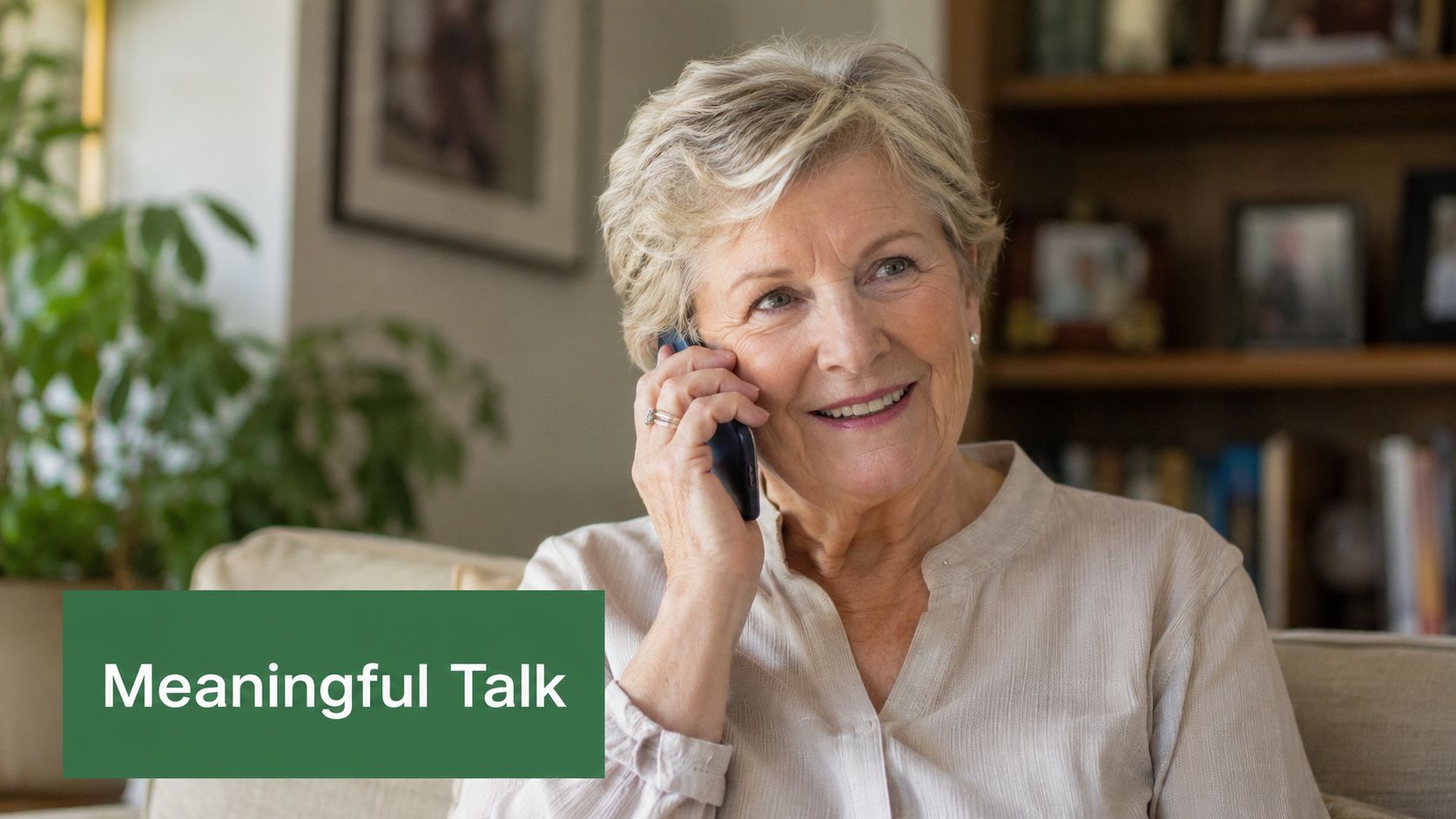
8. Conversation-Based Cognitive Stimulation Therapy
Conversation-based CST uses themes to engage memory, language, attention, thinking, and social connection at the same time. It doesn't need to sound like therapy. A caller can discuss travel, music, hobbies, relationships, seasonal traditions, entertainment, or a recent personal experience while using open-ended follow-up questions.
Start with a topic gathered from the person's history. “You once told me you loved visiting the coast. What did you enjoy most about those trips?” If the person mentions a beach, ask about the sounds, food, people, or activities connected with it. The caller follows the person's lead instead of rushing through prepared questions.
Let dialogue do the work
Prepare a few prompts, but treat them as conversation starters:
Hobbies: “What did you most enjoy growing in your garden?”
Relationships: “What made that person important to you?”
Entertainment: “What have you enjoyed watching recently?”
Traditions: “What did your family do during the holidays?”
Travel: “Which place would you happily visit again?”
Active listening matters. Validate contributions with responses such as, “That sounds wonderful. Tell me more,” and allow pauses. The person should do most of the talking when possible, but the exact balance can change with fatigue, hearing difficulty, mood, and confidence.
A themed conversation can shift smoothly between abilities. Talking about gardening may involve personal memories, category naming, word finding, planning, and emotional expression without any obvious test. If the topic becomes sad or distressing, acknowledge the feeling and pivot gently to a safer subject. The activity's value lies in meaningful participation, not in covering every cognitive domain during one call.
Adapting Memory Exercises by Dementia Stage
Stage labels can help families choose a starting point, but they aren't a substitute for individualized clinical guidance. Abilities vary widely, and the same person may perform differently depending on sleep, mood, health, hearing, medication effects, and the setting.
Early-stage needs
Use open-ended reminiscence, semantic discussion, spaced retrieval, and practical planning. A person may enjoy explaining a hobby, remembering a meaningful name, organizing a simple outing, or following a short attention task. Offer time to answer before adding a cue.
Mid-stage needs
Use familiar topics, shorter prompts, repeated orientation, and concrete choices. Spaced retrieval may focus on one useful fact at a time. Language tasks can include choices or initial-sound cues, while executive-function activities should break plans into individual steps.
More advanced needs
Prioritize emotional safety, familiar routines, validation, music or personal stories, and simple conversation. Reduce questions that demand recall, accept nonverbal responses, and stop or change direction when effort produces distress. A calm voice and familiar subject may provide more benefit than a difficult exercise.
The evidence supports realistic expectations. A 2023 Cochrane review included 37 studies involving 2,766 participants, with an average age of 79 years, and found moderate-quality evidence for a small cognitive benefit from cognitive stimulation, with an SMD of 0.40 and a 95% confidence interval of 0.25 to 0.55 (Cochrane review). That supports structured engagement, but it doesn't justify promising a cure or preventing progression.
9-Point Comparison of Dementia Memory Exercises
Intervention | Implementation complexity 🔄 | Resource requirements ⚡ | Expected outcomes 📊 | Effectiveness ⭐ | Ideal use cases & tips 💡 |
|---|---|---|---|---|---|
Reminiscence Therapy | Moderate, needs biographical intake & sensitive facilitation | Low, phone-based; family history + trained coordinator | Improved mood, identity reinforcement, increased engagement | ⭐⭐⭐⭐ | Early–mid dementia; use open-ended questions, gather family stories, avoid triggering topics |
Orientation & Time/Place Reorientation | Low, routine/scripted prompts integrated into calls | Very low, consistent script and brief reminders | Reduced confusion/anxiety, improved safety and routine adherence | ⭐⭐⭐⭐ | Persons with temporal/spatial disorientation; weave into start of calls, use external anchors (weather, meals) |
Spaced Retrieval Training | Moderate, requires planned intervals and tracking | Moderate, documentation system and trained pacing | Better retention of practical facts (names, schedules), measurable gains | ⭐⭐⭐⭐⭐ | Teach caregiver names, medication rules; track successes, increase intervals when successful |
Word‑Finding & Language Stimulation | Low–Moderate, needs difficulty calibration | Low, phone only; coordinator skill in cueing | Maintains verbal fluency and social communication | ⭐⭐⭐⭐ | Useful for socially active participants; start with concrete topics, offer gentle hints and celebrate success |
Attention & Concentration Tasks | Moderate, grading complexity and monitoring frustration | Low–Moderate, coordinator training to adjust difficulty | Improved working memory, task-following, practical attention for safety | ⭐⭐⭐⭐ | Ideal when working memory declines affect daily tasks; start simple, increase gradually, praise effort |
Semantic Knowledge & Category Naming | Low, personalized topics but simple delivery | Low, relies on intake information and conversational prompts | Preserves general knowledge, supports confidence and identity | ⭐⭐⭐⭐ | Leverage lifelong expertise (hobbies, career); ask open-ended questions and cue gently if needed |
Executive Function & Problem‑Solving Exercises | Moderate–High, requires scaffolding and sensitive delivery | Moderate, scenario prep and skilled facilitation | Better planning/decision-making insights; supports independence and safety | ⭐⭐⭐ | Best for those still making daily decisions; ground tasks in real-life scenarios, scaffold steps and document difficulties |
Conversation‑Based Cognitive Stimulation Therapy (CST) | Moderate, structured themes plus natural dialogue; needs facilitator skill | Moderate, theme prep and trained coordinators | Broad cognitive and mood benefits; reduced loneliness and improved engagement | ⭐⭐⭐⭐⭐ | Early–mid dementia and isolated individuals; rotate themes, prepare 2–3 open questions, follow participant lead |
Memory Exercises by Dementia Stage (adaptation guidance) | Low–Moderate, requires stage-aware tailoring and clinical judgment | Low, protocols and staff training for tailoring | Safer, more effective sessions; reduced distress when matched to stage | ⭐⭐⭐⭐ | Use matrix: early = open reminiscence, spaced retrieval, CST; mid = shorter prompts, cues, repeated orientation; advanced = simple validation, routines, stop when distressed |
Choose Connection Over Correction
A repeatable phone routine can make these activities easier to use. Begin with warm orientation, share the day or an upcoming event, and ask how the person is feeling. Choose one ability-matched activity, offer a familiar prompt, wait patiently, and use a gentle cue only when needed.
Celebrate effort, curiosity, humor, and participation. If the person remembers a detail, acknowledge it. If they don't, move on without announcing the mistake. “Let's think about that together” creates partnership, while “No, that's wrong” turns a supportive call into an examination.
A simple call record can help families notice patterns. Write down which topics led to relaxed conversation, which prompts needed support, and which subjects caused sadness or confusion. Share meaningful changes with the person's clinician or care team, especially when you notice new safety concerns, medication problems, falls, sudden confusion, worsening anxiety, or a change from the person's usual behavior.
The research supports modest, practical expectations. A 2021 systematic review and meta-analysis included 20 randomized controlled trials with 1,251 participants and reported a positive cognitive effect, with Hedges's g = 0.313 and p < 0.001 (systematic review). A broader analysis covering 44 randomized controlled trial comparisons and 2,444 participants found a medium-sized immediate effect on global cognition, with g = 0.49, and reported gains in memory, daily activities, and depressive symptoms (meta-analysis PDF). These findings support structured cognitive stimulation as an adjunct to care, not as a replacement for diagnosis, medication review, medical treatment, or hands-on support.
Families should also be cautious about promises that brain training prevents dementia or stops progression. High-level guidance reports very little evidence that brain training prevents dementia, and one long-term analysis cited by the Alzheimer's Society found that speed-of-processing training with booster sessions lowered dementia diagnoses by 25%, while memory training itself showed no significant effect on dementia incidence (Alzheimer's Society guidance). That distinction matters. The purpose of these calls is to support engagement, confidence, communication, routines, and quality of life today.
Velma is one example of scheduled phone-based support for older adults with early to mid-stage memory loss. Its calls combine guided cognitive stimulation, companionship, practical check-ins, documentation, and care-manager coordination, while complementing medical treatment and in-person caregiving rather than replacing them.
Velma offers scheduled phone calls led by trained care team members, with exercises shaped around a person's memories, interests, routines, and abilities. Visit Velma to explore phone-based cognitive support that can add consistent conversation, practical check-ins, and family coordination to a dementia care plan.
A daughter calls her father before work. She asks what he had for breakfast, who visited yesterday, and whether he remembers the appointment later that day. Within minutes, the conversation starts to feel like a quiz. He hesitates, she corrects him, and both of them end the call tense.
The best memory exercises for dementia don't create that pressure. They turn familiar conversation into gentle cognitive engagement, using a person's interests, routines, language, attention, and life history without making correct answers the measure of success. A phone call about a career, a favorite meal, or an upcoming family visit can be more useful than a demanding brain game when it preserves confidence and connection.
The eight approaches below include reminiscence, orientation, spaced retrieval, language stimulation, attention, semantic knowledge, executive function, and conversation-based cognitive stimulation therapy, or CST. Adapt them to the person's abilities. Use familiar strengths in early stages, simplify prompts as needs increase, and choose connection over correction at every stage. These activities complement medical care and shouldn't continue unchanged if they cause distress, fatigue, fear, or agitation.
Table of Contents
1. Reminiscence Therapy
Make the person's history the resource
2. Orientation and Time and Place Reorientation
Use familiar anchors
3. Spaced Retrieval Training
Keep the wording stable
4. Word-Finding and Language Stimulation Exercises
Turn hesitation into collaboration
5. Attention and Concentration Tasks
Use everyday attention
6. Semantic Knowledge and Category Naming Tasks
Build from accessible to more nuanced
7. Executive Function and Problem-Solving Exercises
Make the problem real
8. Conversation-Based Cognitive Stimulation Therapy
Let dialogue do the work
Adapting Memory Exercises by Dementia Stage
Early-stage needs
Mid-stage needs
More advanced needs
9-Point Comparison of Dementia Memory Exercises
Choose Connection Over Correction
1. Reminiscence Therapy
Reminiscence begins with a person's life, not a worksheet. A caller might ask about a first job, a wedding tradition, a favorite holiday, or the garden someone kept for years. These conversations often draw on older personal memories that remain easier to access than recent information, while also reinforcing identity and giving the person space to be the expert.
A care coordinator could say, “Tell me about the work you did before you retired,” rather than “Do you remember where you worked?” The first prompt invites a story. If the person mentions a colleague, the caller can follow with, “What was she like?” or “What did you enjoy most about working together?”
Make the person's history the resource
Before a call, family members can share meaningful details about careers, relatives, sports, music, hobbies, places, and traditions. Specific names and objects can help anchor the conversation, but the caller shouldn't force a particular answer or insist that a detail is remembered accurately.
Useful prompts include:
Career memories: “What was a typical day like when you worked at the hospital?”
Family traditions: “What did your family usually do during the holidays?”
Travel stories: “Tell me about a trip that stands out to you.”
Past interests: “What did you enjoy making, collecting, or watching?”
If a memory becomes painful, acknowledge the feeling and gently move toward another period or topic. Documenting stories can help family members use consistent prompts on future calls and shows the person that their experiences matter. Families can also learn more about life review therapy when they want a more structured approach.
2. Orientation and Time and Place Reorientation
Orientation works best as a warm routine, not a test of whether someone knows the date. At the beginning of a call, the speaker can naturally mention the day, time of day, weather, location, and an upcoming event. The same pattern gives the conversation a dependable starting point.
A morning call might sound like this: “Hi, it's Sarah from Velma. It's Wednesday morning, and it's sunny outside. You're at home, and your daughter is visiting later today. How are you feeling?” The caller supplies useful information instead of asking, “What day is it?” and waiting for an answer that may create embarrassment.
Use familiar anchors
Connect orientation to events the person already recognizes:
Meals: “It's nearly lunchtime.”
Family routines: “Your son usually visits on Tuesdays.”
Television: “Your favorite program is on tonight.”
Weather: “It's cool and rainy, so your coat may be useful.”
Appointments: “The nurse is coming tomorrow afternoon.”
Repeat the framework consistently, but don't argue if the person gives a different answer. A calm response such as, “That can be confusing. Today is Wednesday, and we're talking on the phone from your home,” offers an anchor without turning the exchange into a correction. Coordinate wording with family and caregivers so the person hears the same information across settings. For more background, see this guide to reality orientation therapy.
Practical rule: Orientation should reduce uncertainty, not demand proof that the person is oriented.
3. Spaced Retrieval Training
Spaced retrieval helps a person practice important information over gradually longer intervals. The information should serve daily life, such as a caregiver's name, a regular visit, a safety instruction, or the location of an essential item. The caller introduces one fact, checks recall soon afterward, and revisits it during later conversations.
Suppose Sarah, the person's daughter, visits on Tuesdays. The first call might include, “Sarah visits on Tuesdays.” After a short conversation, the caller asks, “When does Sarah visit?” If the answer is correct, the next question can come after a longer pause or on a later call. If the answer isn't available, repeat the information kindly and use a shorter interval next time.
Keep the wording stable
Consistency matters more than cleverness. Use the same name, phrase, and question each time, and select facts that are meaningful rather than random. Other examples include learning the name of a new home health aide or remembering, “Before using the stove, check that the knob is off.”
A failed recall isn't a failure by the person. It tells the caregiver to make the task easier, offer the answer, or reduce the interval. Praise the effort with language such as, “You're working on remembering that,” rather than “You got it wrong.” A simple record of which facts are recalled can help family members reinforce the same information during visits.
For a broader set of ideas, explore cognitive exercises for memory.
The technique is most useful when it supports a practical routine. It shouldn't replace medication management, professional advice, or supervision around hazards.
4. Word-Finding and Language Stimulation Exercises
Word-finding activities can feel like ordinary conversation when the topics are familiar. Ask the person to name animals, describe a kitchen object, suggest words that rhyme, or explain what they'd do before a picnic. The aim is to keep language active and enjoyable, not to expose every missed word.
Start with concrete subjects such as food, clothing, family members, or household objects. A caller might say, “Let's name birds,” then accept any answer and add gentle prompts only when needed. If unprompted naming is difficult, offer a choice: “Is it a spoon or a fork?” An initial sound can also help, as in, “It starts with d.”
Turn hesitation into collaboration
Consider a descriptive prompt: “I'm thinking of something used to cook food. It's round and flat. What could it be?” If the person says “plate,” the caller can respond, “That's a good possibility. What else might be in the kitchen?” The conversation can continue without marking the answer as right or wrong.
Try these phone-friendly options:
Category naming: “What kinds of fruit do you like?”
Word association: “What does sunshine make you think of?”
Rhyming: “What rhymes with cat?”
Scenario description: “Tell me how you'd get ready for a picnic.”
Object properties: “What does a kettle do?”
Celebrate communication, descriptions, humor, and persistence. If frustration appears, shift to an easier topic or let the person talk about something familiar. Families seeking digital support can also review the best iPad apps for speech therapy in 2026, while remembering that a live conversation can be easier to personalize than an app.
5. Attention and Concentration Tasks
Attention tasks ask the person to stay with information, follow a short sequence, or notice a specific detail. They can support cognitive engagement, but they need careful calibration. A task that's manageable in the morning may feel difficult later, especially if the person is tired, in pain, anxious, or distracted.
Begin with one instruction. Say, “I'll give you some numbers. Please repeat them,” and offer a short sequence such as 3, 7, 2. If that goes well, try a slightly longer sequence another time. Don't turn the session into a contest, and don't keep increasing difficulty just because a person succeeds once.
Use everyday attention
Practical scenarios often feel more meaningful than abstract drills:
Listening for details: “I'll describe a park. Tell me how many people you hear in the story.”
Following steps: “Think of your favorite animal, then tell me its name and color.”
Shopping memory: Discuss a small shopping list and revisit the items later.
Counting backward: Try a gentle sequence only if numbers are comfortable.
Selective attention: Ask the person to listen for one detail in a short description.
Give instructions clearly and repeat them without sounding impatient. Praise careful listening and effort, not just accuracy. If the person loses the thread, shorten the instruction or offer one part at a time. A caller can say, “Let's try the first step together,” which keeps the interaction collaborative.
The best level is challenging enough to hold attention but easy enough to preserve confidence. When attention fades, change the activity, pause, or return to conversation.
6. Semantic Knowledge and Category Naming Tasks
Semantic knowledge includes meanings, familiar facts, categories, and the properties of objects. These activities draw on what a person has learned across a lifetime, so they can reveal strengths that recent-memory questions may miss. Someone who struggles to recall breakfast might speak confidently about gardening, baseball, nursing, cars, or a favorite historical period.
Tailor the topic to the person's expertise. A caller could ask, “You've always known a lot about gardening. Which vegetables grow well in your area?” The answer can lead to follow-up questions about soil, seasons, tools, or family recipes. The person isn't being asked to prove knowledge. They're being invited to use it.
Build from accessible to more nuanced
Begin with familiar meanings and relationships:
Categories: “What vegetables might you find at a market?”
Definitions: “What's a lighthouse, and what does it do?”
Properties: “What would you use a blanket for?”
Personal expertise: “Which baseball teams do you remember?”
Cultural knowledge: “What tradition did your family enjoy most?”
Offer partial cues instead of immediately supplying the answer. “It's a sport played with a bat,” may help more than silence after a difficult question. Multiple choices can also make participation easier, but open-ended prompts should remain available when the person wants to elaborate.
Family members can share interests during intake and record which topics create energy, humor, or longer responses. Rotate between subjects, but don't abandon a topic because the person wants to stay with it. A strong conversation may involve one area of knowledge explored slowly and respectfully.
7. Executive Function and Problem-Solving Exercises
Executive-function activities connect cognitive engagement with independence. They involve planning, choosing, sequencing, adapting, and explaining a decision. A phone call can rehearse an upcoming event without pretending that rehearsal alone makes a risky task safe.
Ask, “Your daughter is visiting this weekend. What would you like to prepare?” Then support the person's reasoning with small prompts: “What would you do first?” and “What would you need from the store?” The caller can offer choices when the plan becomes too complex, such as choosing between soup and sandwiches rather than planning an entire meal.
Make the problem real
Useful scenarios include:
Sequencing: “Talk me through making your favorite sandwich.”
Decision-making: “It's cold outside. What would you wear?”
Flexibility: “The recipe needs milk, but there isn't any. What might you use?”
Household planning: “The bathroom light isn't working. Who could help?”
Upcoming events: “What should you have ready before the appointment?”
Praise each step of the reasoning, not only the final choice. If a person suggests an unsafe response, avoid shaming them. Say, “That's one possibility. Let's think about a safer option,” and involve family or clinicians when the concern involves the stove, driving, medication, falls, or another real hazard.
These conversations can also help caregivers notice changing support needs. A person may still express preferences clearly while needing help with execution. Respecting that distinction protects dignity and gives families better information for care planning.
8. Conversation-Based Cognitive Stimulation Therapy
Conversation-based CST uses themes to engage memory, language, attention, thinking, and social connection at the same time. It doesn't need to sound like therapy. A caller can discuss travel, music, hobbies, relationships, seasonal traditions, entertainment, or a recent personal experience while using open-ended follow-up questions.
Start with a topic gathered from the person's history. “You once told me you loved visiting the coast. What did you enjoy most about those trips?” If the person mentions a beach, ask about the sounds, food, people, or activities connected with it. The caller follows the person's lead instead of rushing through prepared questions.
Let dialogue do the work
Prepare a few prompts, but treat them as conversation starters:
Hobbies: “What did you most enjoy growing in your garden?”
Relationships: “What made that person important to you?”
Entertainment: “What have you enjoyed watching recently?”
Traditions: “What did your family do during the holidays?”
Travel: “Which place would you happily visit again?”
Active listening matters. Validate contributions with responses such as, “That sounds wonderful. Tell me more,” and allow pauses. The person should do most of the talking when possible, but the exact balance can change with fatigue, hearing difficulty, mood, and confidence.
A themed conversation can shift smoothly between abilities. Talking about gardening may involve personal memories, category naming, word finding, planning, and emotional expression without any obvious test. If the topic becomes sad or distressing, acknowledge the feeling and pivot gently to a safer subject. The activity's value lies in meaningful participation, not in covering every cognitive domain during one call.
Adapting Memory Exercises by Dementia Stage
Stage labels can help families choose a starting point, but they aren't a substitute for individualized clinical guidance. Abilities vary widely, and the same person may perform differently depending on sleep, mood, health, hearing, medication effects, and the setting.
Early-stage needs
Use open-ended reminiscence, semantic discussion, spaced retrieval, and practical planning. A person may enjoy explaining a hobby, remembering a meaningful name, organizing a simple outing, or following a short attention task. Offer time to answer before adding a cue.
Mid-stage needs
Use familiar topics, shorter prompts, repeated orientation, and concrete choices. Spaced retrieval may focus on one useful fact at a time. Language tasks can include choices or initial-sound cues, while executive-function activities should break plans into individual steps.
More advanced needs
Prioritize emotional safety, familiar routines, validation, music or personal stories, and simple conversation. Reduce questions that demand recall, accept nonverbal responses, and stop or change direction when effort produces distress. A calm voice and familiar subject may provide more benefit than a difficult exercise.
The evidence supports realistic expectations. A 2023 Cochrane review included 37 studies involving 2,766 participants, with an average age of 79 years, and found moderate-quality evidence for a small cognitive benefit from cognitive stimulation, with an SMD of 0.40 and a 95% confidence interval of 0.25 to 0.55 (Cochrane review). That supports structured engagement, but it doesn't justify promising a cure or preventing progression.
9-Point Comparison of Dementia Memory Exercises
Intervention | Implementation complexity 🔄 | Resource requirements ⚡ | Expected outcomes 📊 | Effectiveness ⭐ | Ideal use cases & tips 💡 |
|---|---|---|---|---|---|
Reminiscence Therapy | Moderate, needs biographical intake & sensitive facilitation | Low, phone-based; family history + trained coordinator | Improved mood, identity reinforcement, increased engagement | ⭐⭐⭐⭐ | Early–mid dementia; use open-ended questions, gather family stories, avoid triggering topics |
Orientation & Time/Place Reorientation | Low, routine/scripted prompts integrated into calls | Very low, consistent script and brief reminders | Reduced confusion/anxiety, improved safety and routine adherence | ⭐⭐⭐⭐ | Persons with temporal/spatial disorientation; weave into start of calls, use external anchors (weather, meals) |
Spaced Retrieval Training | Moderate, requires planned intervals and tracking | Moderate, documentation system and trained pacing | Better retention of practical facts (names, schedules), measurable gains | ⭐⭐⭐⭐⭐ | Teach caregiver names, medication rules; track successes, increase intervals when successful |
Word‑Finding & Language Stimulation | Low–Moderate, needs difficulty calibration | Low, phone only; coordinator skill in cueing | Maintains verbal fluency and social communication | ⭐⭐⭐⭐ | Useful for socially active participants; start with concrete topics, offer gentle hints and celebrate success |
Attention & Concentration Tasks | Moderate, grading complexity and monitoring frustration | Low–Moderate, coordinator training to adjust difficulty | Improved working memory, task-following, practical attention for safety | ⭐⭐⭐⭐ | Ideal when working memory declines affect daily tasks; start simple, increase gradually, praise effort |
Semantic Knowledge & Category Naming | Low, personalized topics but simple delivery | Low, relies on intake information and conversational prompts | Preserves general knowledge, supports confidence and identity | ⭐⭐⭐⭐ | Leverage lifelong expertise (hobbies, career); ask open-ended questions and cue gently if needed |
Executive Function & Problem‑Solving Exercises | Moderate–High, requires scaffolding and sensitive delivery | Moderate, scenario prep and skilled facilitation | Better planning/decision-making insights; supports independence and safety | ⭐⭐⭐ | Best for those still making daily decisions; ground tasks in real-life scenarios, scaffold steps and document difficulties |
Conversation‑Based Cognitive Stimulation Therapy (CST) | Moderate, structured themes plus natural dialogue; needs facilitator skill | Moderate, theme prep and trained coordinators | Broad cognitive and mood benefits; reduced loneliness and improved engagement | ⭐⭐⭐⭐⭐ | Early–mid dementia and isolated individuals; rotate themes, prepare 2–3 open questions, follow participant lead |
Memory Exercises by Dementia Stage (adaptation guidance) | Low–Moderate, requires stage-aware tailoring and clinical judgment | Low, protocols and staff training for tailoring | Safer, more effective sessions; reduced distress when matched to stage | ⭐⭐⭐⭐ | Use matrix: early = open reminiscence, spaced retrieval, CST; mid = shorter prompts, cues, repeated orientation; advanced = simple validation, routines, stop when distressed |
Choose Connection Over Correction
A repeatable phone routine can make these activities easier to use. Begin with warm orientation, share the day or an upcoming event, and ask how the person is feeling. Choose one ability-matched activity, offer a familiar prompt, wait patiently, and use a gentle cue only when needed.
Celebrate effort, curiosity, humor, and participation. If the person remembers a detail, acknowledge it. If they don't, move on without announcing the mistake. “Let's think about that together” creates partnership, while “No, that's wrong” turns a supportive call into an examination.
A simple call record can help families notice patterns. Write down which topics led to relaxed conversation, which prompts needed support, and which subjects caused sadness or confusion. Share meaningful changes with the person's clinician or care team, especially when you notice new safety concerns, medication problems, falls, sudden confusion, worsening anxiety, or a change from the person's usual behavior.
The research supports modest, practical expectations. A 2021 systematic review and meta-analysis included 20 randomized controlled trials with 1,251 participants and reported a positive cognitive effect, with Hedges's g = 0.313 and p < 0.001 (systematic review). A broader analysis covering 44 randomized controlled trial comparisons and 2,444 participants found a medium-sized immediate effect on global cognition, with g = 0.49, and reported gains in memory, daily activities, and depressive symptoms (meta-analysis PDF). These findings support structured cognitive stimulation as an adjunct to care, not as a replacement for diagnosis, medication review, medical treatment, or hands-on support.
Families should also be cautious about promises that brain training prevents dementia or stops progression. High-level guidance reports very little evidence that brain training prevents dementia, and one long-term analysis cited by the Alzheimer's Society found that speed-of-processing training with booster sessions lowered dementia diagnoses by 25%, while memory training itself showed no significant effect on dementia incidence (Alzheimer's Society guidance). That distinction matters. The purpose of these calls is to support engagement, confidence, communication, routines, and quality of life today.
Velma is one example of scheduled phone-based support for older adults with early to mid-stage memory loss. Its calls combine guided cognitive stimulation, companionship, practical check-ins, documentation, and care-manager coordination, while complementing medical treatment and in-person caregiving rather than replacing them.
Velma offers scheduled phone calls led by trained care team members, with exercises shaped around a person's memories, interests, routines, and abilities. Visit Velma to explore phone-based cognitive support that can add consistent conversation, practical check-ins, and family coordination to a dementia care plan.
Suggested Article: