Emotional Support for Dementia Patients: A Practical Guide

You answer the same question again. Your mother asked when her appointment is, you explained it, and five minutes later she asks again. By the third repetition, you're fighting irritation, guilt, and worry at the same time. She may look stubborn, but the repeated question often reflects fear, confusion, or a need for reassurance that memory loss has made difficult to settle.
Emotional support for dementia patients isn't a pleasant extra added after medication, appointments, and home safety. It's the daily work of helping a person feel understood, secure, useful, and connected. The right approach changes with cognitive stage, communication ability, personality, and the reason behind the distress.
Table of Contents
Why Emotional Care Is a Core Part of Dementia Support
How to Communicate With Empathy and Clarity
Make the conversation easier to enter
Protect dignity while redirecting
Validation and Calming Techniques for Distress
Use the feeling as your guide
Change the surroundings before you add more words
Activities and Reminiscence That Lift Mood
Match the activity to ability
Let reminiscence create connection
A Simple Daily Check-In Routine That Actually Works
Observe before you question
Know when to escalate
Coordinating Support With Family and Clinicians
Keep one shared care summary
Report patterns, not arguments
How Phone-Based Cognitive Programs Fit Into the Plan
Start small and evaluate the response
Why Emotional Care Is a Core Part of Dementia Support
Clinical treatment can address diagnosis, symptoms, and medical risks. It can't sit beside your parent during a lonely afternoon, interpret a frightened expression, or turn a confusing household task into a manageable one. Emotional care fills that gap through calm communication, validation, meaningful activity, predictable contact, and coordinated follow-up.
Dementia can make it harder to recognize emotions, organize thoughts, explain discomfort, or use familiar coping strategies. Anxiety may appear as pacing. Fear may sound like an accusation that someone stole a wallet. Loneliness may look like withdrawal, irritability, or repeated demands for attention. Responding only to the behavior misses the need underneath it.
The need is widespread. A 2025 meta-analysis estimated loneliness among people with dementia at 42.7%, while social isolation among people with cognitive impairment was estimated at 64.3%. The same analysis estimated moderate loneliness in 29.8% and severe loneliness in 5.5% of people with dementia. Earlier IDEAL research reported moderate loneliness in about 30.1% and severe loneliness in 5.2%. These findings are reported in the 2025 meta-analysis of loneliness and social isolation in dementia.
That doesn't mean every difficult moment comes from loneliness. It does mean emotional connection deserves a place beside medication management, nutrition, sleep, mobility, and safety planning. A person who feels calmer may be more willing to accept help, eat, rest, take medication, or participate in an appointment.
Start with six practical areas:
Empathic communication, so conversations feel safe rather than corrective.
Validation, so distress isn't intensified by arguments about facts.
Purposeful activity, so the day contains contribution and pleasure.
Predictable check-ins, so changes surface before they become crises.
Family coordination, so support doesn't depend on one exhausted person.
Phone-based cognitive support, so connection can continue between visits.
If your parent's distress is part of a broader mental health concern, an adult mental health evaluation guide can help you think through when professional assessment may be appropriate.
How to Communicate With Empathy and Clarity
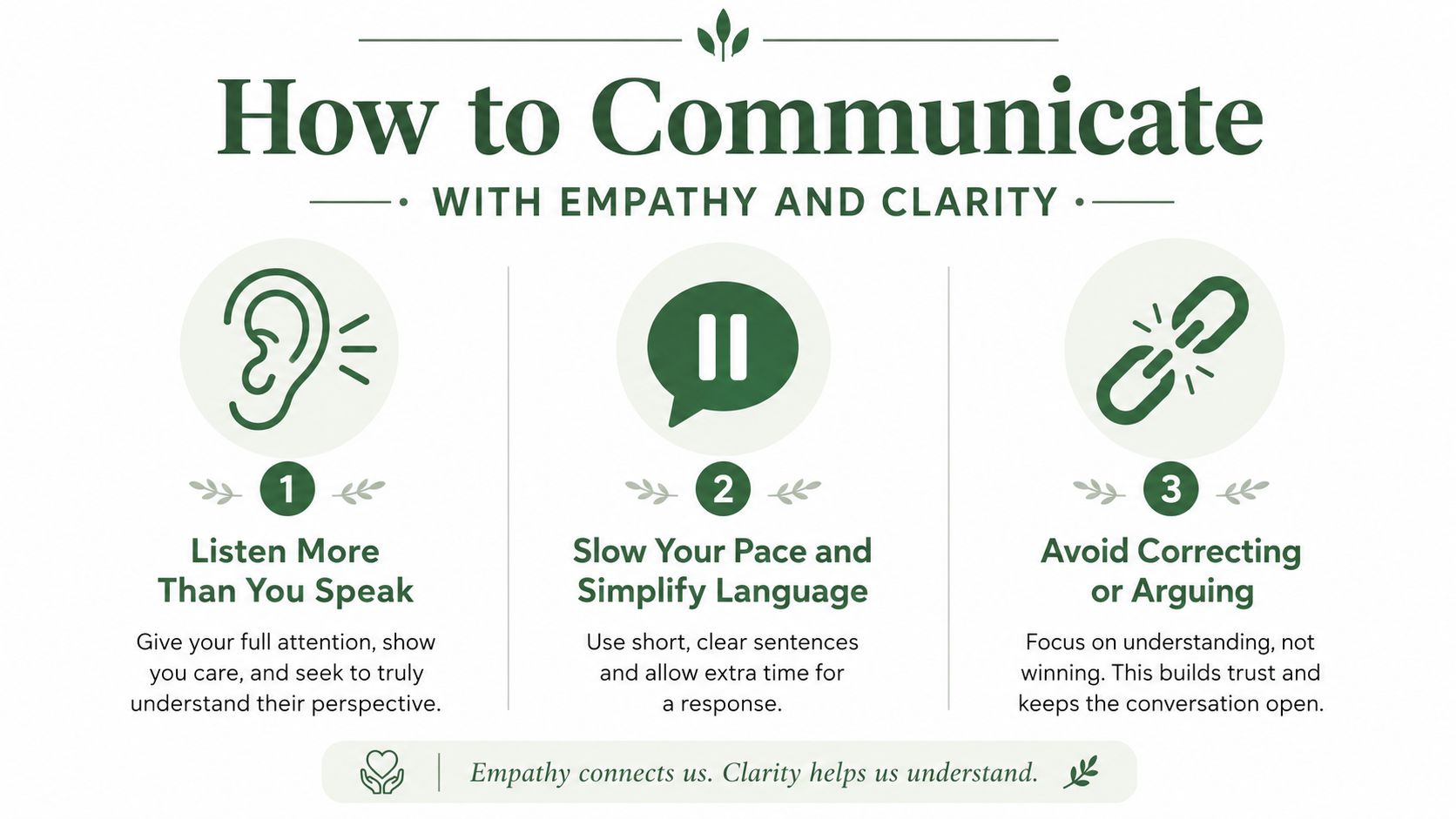
The fastest way to lose a dementia conversation is to turn it into a memory test. Your parent doesn't need to prove what they know. They need enough time, clarity, and emotional safety to participate.
Make the conversation easier to enter
Approach from the front, use the person's name, get to eye level, and reduce competing noise. Speak at a steady pace with short sentences. Simplifying language isn't talking down to someone. It removes unnecessary processing work.
Ask one question at a time and wait. A pause can feel long to you while the person is still forming a response. Don't fill it immediately.
Moment | Try this | Avoid this |
|---|---|---|
Greeting | “Hi, Dad. It's good to see you.” | Starting with a demand |
Repeated question | “You're worried about the appointment. It's after lunch, and I'll remind you.” | “I already told you that.” |
Mistake | “That part is tricky. Let's do it together.” | “You're doing it wrong.” |
Offering a choice | “Would you like tea or water?” | “What do you want to drink, eat, and do?” |
The dementia communication strategies guide offers another practical reference for adjusting conversations as symptoms change.
Protect dignity while redirecting
Don't quiz memory with “Don't you remember?” Don't finish sentences unless the person asks for help. Don't correct a harmless detail because it's inaccurate. If your parent says a family gathering happened on the wrong day, the date may matter less than the feeling attached to the memory.
Use the emotional meaning as your entry point. “You sound proud of that day” keeps the person connected without forcing a factual debate. If the mistake affects safety, correct it briefly and provide the next action: “The stove is off. I'll check it with you.”
Practical rule: Your tone, facial expression, and patience carry more meaning than perfect wording.
When communication breaks down, lower the number of words rather than raising your volume. Give reassurance without pretending everything is fine. “You're safe, and I'm staying with you” is more useful than a long explanation the person can't retain.
Validation and Calming Techniques for Distress
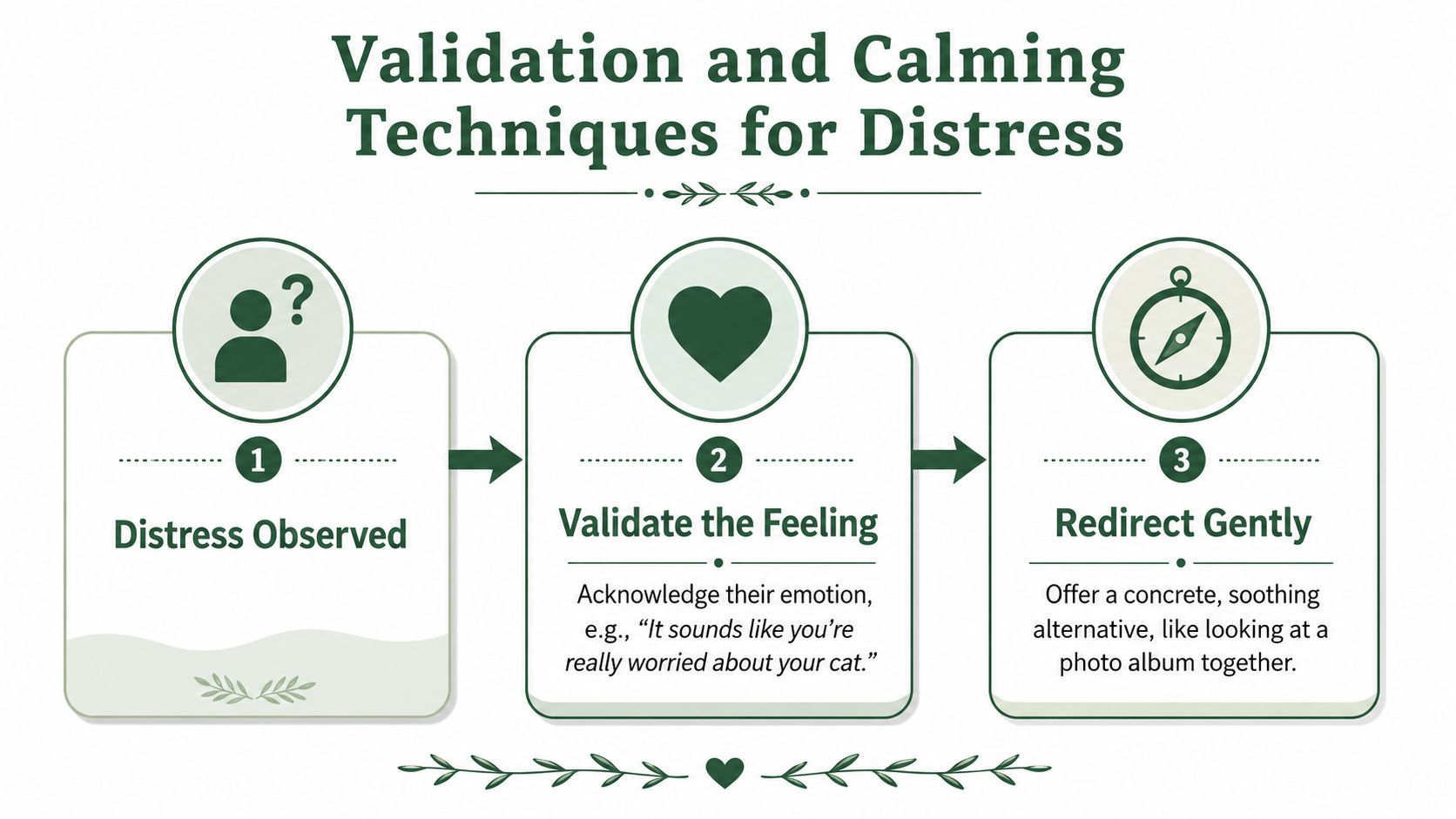
Validation doesn't mean agreeing that an untrue event happened. It means recognizing the emotion as real. A parent who believes a wallet was stolen may be wrong about the wallet, but the fear and frustration are genuine.
Start with three moves: notice, acknowledge, redirect. Notice the behavior and likely feeling. Acknowledge it without arguing. Then offer a concrete, soothing next step.
Use the feeling as your guide
Try these responses for common triggers:
Searching for a deceased parent: “You miss your mother and want to feel close to her. Let's sit together and look at this photo.”
A wallet believed to be stolen: “That's upsetting. You want to know where it is. Let's check the usual place together.”
Insisting they need to go to work: “Work feels important today. You're concerned about being late. Let's have some tea, then decide what needs doing.”
Evening distress: “The day is winding down, and you seem unsettled. Let's turn on a familiar lamp and listen to some music.”
Don't promise that the missing person will return. Don't insist that the person has been dead for years. Don't use logic as a weapon. Repeating the facts may increase grief without improving understanding.
Change the surroundings before you add more words
A crowded room, harsh lighting, television noise, pain, hunger, fatigue, or an urgent need for the bathroom can make distress worse. Move to a quieter space if possible. Lower the lighting, soften your voice, and slow your breathing so the person has a calm rhythm to follow.
Offer familiar music or a simple sensory activity. A gentle touch on the arm may help if your parent normally welcomes touch, but never force physical contact. Stand nearby, keep your posture relaxed, and give the person room to settle.
Avoid dismissive reassurance such as “There's nothing to worry about.” Avoid confronting the person as a group, especially in front of relatives. One calm speaker is usually easier to process than several people correcting, questioning, and offering competing explanations.
If the distress is new, unusually intense, or paired with sudden confusion, pain, fever, hallucinations, a fall, or a major change in function, treat it as a possible health issue and contact the care team.
Activities and Reminiscence That Lift Mood
A successful activity isn't one your parent completes perfectly. It's one that creates connection, confidence, and a manageable sense of purpose.
Mrs. Patel may have spent decades cooking for her family. Asking her to follow a complicated new recipe could expose every difficulty at once. Giving her a bowl, softened ingredients, and one step at a time may let her knead dough while you work beside her. The task becomes a shared rhythm, not an assessment.
Match the activity to ability
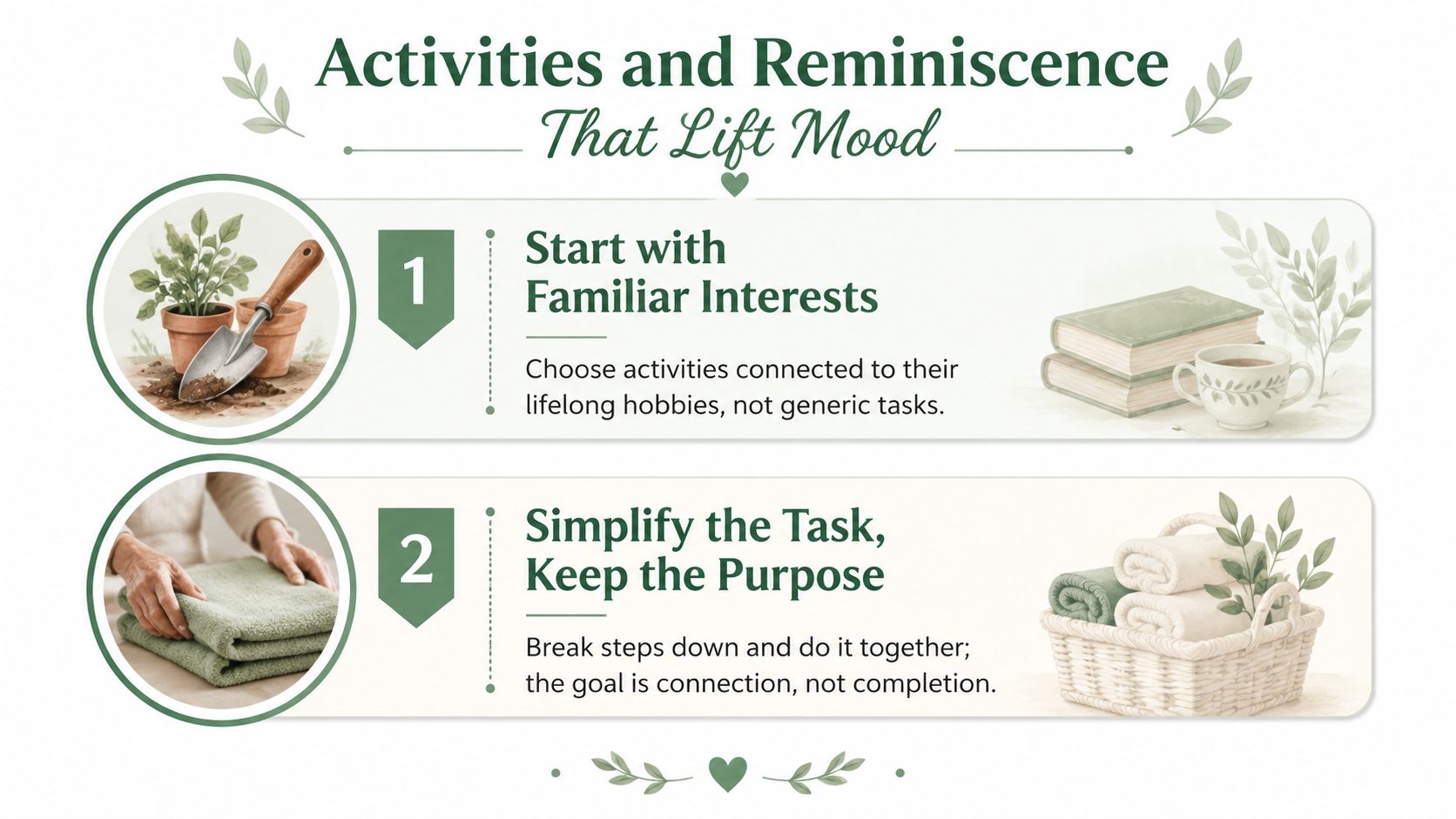
In early-stage dementia, offer meaningful choices: “Would you like to sort the photos or help make lunch?” In mid-stage dementia, show the supplies, reduce the steps, and give one instruction at a time.
Good options include:
Folding towels or pairing socks.
Watering plants.
Setting a simple table.
Sorting buttons or objects by color.
Kneading dough.
Looking through a family album.
Listening to familiar music.
Completing a familiar recipe with support.
Begin with interests your parent still recognizes. A gardening trowel, recipe card, knitting basket, sports program, or favorite song may invite participation more effectively than a generic puzzle.
Let reminiscence create connection
Reminiscence works best when you offer sensory prompts and open questions. Try a family photograph, a familiar scent, an old recipe, or a song from an important period of life. Ask, “What did weekends look like when you were young?” rather than “Do you remember who this is?”
If the details are uncertain, follow the emotion. “That sounds like a happy time” keeps the exchange warm without turning it into a correction exercise. The reminiscence therapy guide provides further ideas for using personal memories respectfully.
Stop while the activity is still going well. Relaxed attention, humor, and voluntary participation count as wins. If your parent becomes frustrated, withdrawn, or tired, end it promptly: “You did enough. Let's do something calm.” A phone-based cognitive program can add level-appropriate prompts between visits, but it shouldn't replace conversation, movement, household participation, or shared time.
A Simple Daily Check-In Routine That Actually Works
A daily check-in should feel like contact, not an inspection. Choose the same general time when your parent is usually most alert, then keep the visit or call short enough to sustain.
Observe before you question
Look for changes in appearance, movement, speech, appetite, sleep, pain, medication use, and completion of basic household tasks. Check whether glasses and hearing aids are available and working. Notice hydration, comfort, and whether the home seems unusually disorganized or unsafe.
Then ask one gentle question. “What felt good today?” may reveal more than “Did you take your medication?” Follow with a practical question only when needed, and give time for an answer.
Keep notes factual:
What happened: “Repeated the same question several times.”
When it happened: Record the part of the day.
What helped: “Settled after tea and familiar music.”
What changed: Note differences from the person's usual pattern.
Don't diagnose from one difficult morning. Mild forgetfulness, fatigue, or occasional irritability can occur without an urgent problem. Look for patterns and act on meaningful changes.
Know when to escalate
Contact the care team promptly for repeated confusion, sudden decline, new hallucinations, unsafe wandering, missed medication, rapid mood change, or inability to manage essential needs. Seek emergency help for a sudden neurological change, chest pain, severe breathing difficulty, or immediate danger.
A five-minute call is better than a long interrogation your parent dreads. A structured phone program can provide another consistent touchpoint, while a shared log helps relatives distinguish an isolated episode from a developing pattern.
Coordinating Support With Family and Clinicians
Family care becomes unreliable when everyone assumes someone else is handling the important task. Choose one coordinator to maintain a concise summary, but don't make that person responsible for every visit, appointment, errand, and emotional conversation.
Build the plan around the person's preferences, abilities, triggers, and consent. One sibling may manage appointments. Another may handle finances. A spouse, friend, or neighbor may provide a regular check-in. Assign work according to availability and skill, not according to who feels most guilty.
Keep one shared care summary
Include:
Preferred name and communication style.
Baseline cognition and mobility.
Hearing and vision needs.
Medications and allergies.
Known calming approaches and distress triggers.
Driving status and emergency contacts.
Primary clinician, specialists, pharmacist, and care manager.
The person's privacy preferences and decision-making arrangements.
Use one shared calendar and one reliable update channel. Families create confusion when five relatives separately ask the same distressed person what happened. Share observations among adults so the person with dementia doesn't have to repeatedly defend or explain themselves.
Report patterns, not arguments
After a concerning event, record what you saw, when it occurred, what preceded it, and what helped. Include possible illness, disrupted sleep, pain, or a medication change. Tell the clinician, “She became confused after lunch, couldn't find the bathroom, and improved after resting,” rather than “She's getting impossible.”
Ask the care team which changes should trigger a call, whether medication review is appropriate, and when a home assessment or further evaluation is needed. A clinician can help separate expected fluctuation from a problem requiring attention.
A brief family review every two to four weeks can identify duplicated tasks, uncovered periods, and caregiver strain. Hold it sooner after hospitalization or a significant decline. Protect your parent from adult disagreements, and arrange respite before the main caregiver reaches collapse. Emotional support is hard to provide when the person providing it is isolated and exhausted.
How Phone-Based Cognitive Programs Fit Into the Plan
Phone support works best when it answers a specific gap. Perhaps your parent lives alone between family visits. Perhaps siblings can cover appointments but not regular conversation. Perhaps the main caregiver needs another person to notice changes in mood, repetition, responsiveness, or daily functioning.
A structured service can provide scheduled calls that combine conversation, reminiscence prompts, orientation, language or attention activities, memory cues, and practical check-ins. It may also offer encouragement when the person feels anxious or disconnected. The value isn't the phone itself. It's the predictable human contact and repeatable routine that families often struggle to maintain.
Research supports a careful, personalized approach. A review of 44 randomized caregiver studies found statistically significant improvement in psychological morbidity for group-based psychoeducational programs, while other information and support formats didn't show consistent benefit. The systematic review of dementia caregiver support interventions reinforces a practical point: support needs structure, education, validation, and a format suited to the people receiving it.
For people with mild to moderate dementia, individualized counseling and psychotherapeutic support matched to cognitive stage and communication ability may help with depression and anxiety, according to a 2024 systematic review of therapeutic support. A separate analysis in that review found benefits were more likely when activities matched the person's interests and abilities and caregivers received education about dementia and communication. Generic reassurance isn't enough.
Start small and evaluate the response
Begin with a realistic schedule, such as three short calls each week. Watch your parent's response rather than assuming more contact is automatically better. Adjust or stop a call if it causes fatigue, frustration, confusion, or distress.
Ask the provider:
Who conducts the calls, and what dementia communication training do they receive?
Can the schedule, conversation topics, and activities be personalized?
How does a family caregiver oversee participation?
What happens if the caller notices a safety concern?
How is information reported, and who can access it?
What privacy safeguards apply?
How does the service coordinate with existing family and clinical care?
The cognitive conditioning overview explains how structured cognitive engagement can sit alongside ordinary conversation and daily routines. A program's observations can help families notice patterns, but they aren't a diagnosis and shouldn't replace medical evaluation, supervision, movement, social contact, or hands-on care.
Evidence on remote support for informal dementia caregivers remains insufficient for firm conclusions, although a recent systematic review suggests remote interventions may help reduce caregiver loneliness and support mental health. Read the review of remote interventions for dementia caregivers with the right expectation: phone contact is a practical supplement, not a cure for isolation or a substitute for a care plan.
Velma offers scheduled phone calls with guided cognitive activities, reminiscence, validation, companionship, and practical check-ins for older adults experiencing memory loss in the early to mid stages of dementia. If your parent needs dependable contact between family visits, visit Velma to see whether its structured calls can fit your support plan.
You answer the same question again. Your mother asked when her appointment is, you explained it, and five minutes later she asks again. By the third repetition, you're fighting irritation, guilt, and worry at the same time. She may look stubborn, but the repeated question often reflects fear, confusion, or a need for reassurance that memory loss has made difficult to settle.
Emotional support for dementia patients isn't a pleasant extra added after medication, appointments, and home safety. It's the daily work of helping a person feel understood, secure, useful, and connected. The right approach changes with cognitive stage, communication ability, personality, and the reason behind the distress.
Table of Contents
Why Emotional Care Is a Core Part of Dementia Support
How to Communicate With Empathy and Clarity
Make the conversation easier to enter
Protect dignity while redirecting
Validation and Calming Techniques for Distress
Use the feeling as your guide
Change the surroundings before you add more words
Activities and Reminiscence That Lift Mood
Match the activity to ability
Let reminiscence create connection
A Simple Daily Check-In Routine That Actually Works
Observe before you question
Know when to escalate
Coordinating Support With Family and Clinicians
Keep one shared care summary
Report patterns, not arguments
How Phone-Based Cognitive Programs Fit Into the Plan
Start small and evaluate the response
Why Emotional Care Is a Core Part of Dementia Support
Clinical treatment can address diagnosis, symptoms, and medical risks. It can't sit beside your parent during a lonely afternoon, interpret a frightened expression, or turn a confusing household task into a manageable one. Emotional care fills that gap through calm communication, validation, meaningful activity, predictable contact, and coordinated follow-up.
Dementia can make it harder to recognize emotions, organize thoughts, explain discomfort, or use familiar coping strategies. Anxiety may appear as pacing. Fear may sound like an accusation that someone stole a wallet. Loneliness may look like withdrawal, irritability, or repeated demands for attention. Responding only to the behavior misses the need underneath it.
The need is widespread. A 2025 meta-analysis estimated loneliness among people with dementia at 42.7%, while social isolation among people with cognitive impairment was estimated at 64.3%. The same analysis estimated moderate loneliness in 29.8% and severe loneliness in 5.5% of people with dementia. Earlier IDEAL research reported moderate loneliness in about 30.1% and severe loneliness in 5.2%. These findings are reported in the 2025 meta-analysis of loneliness and social isolation in dementia.
That doesn't mean every difficult moment comes from loneliness. It does mean emotional connection deserves a place beside medication management, nutrition, sleep, mobility, and safety planning. A person who feels calmer may be more willing to accept help, eat, rest, take medication, or participate in an appointment.
Start with six practical areas:
Empathic communication, so conversations feel safe rather than corrective.
Validation, so distress isn't intensified by arguments about facts.
Purposeful activity, so the day contains contribution and pleasure.
Predictable check-ins, so changes surface before they become crises.
Family coordination, so support doesn't depend on one exhausted person.
Phone-based cognitive support, so connection can continue between visits.
If your parent's distress is part of a broader mental health concern, an adult mental health evaluation guide can help you think through when professional assessment may be appropriate.
How to Communicate With Empathy and Clarity
The fastest way to lose a dementia conversation is to turn it into a memory test. Your parent doesn't need to prove what they know. They need enough time, clarity, and emotional safety to participate.
Make the conversation easier to enter
Approach from the front, use the person's name, get to eye level, and reduce competing noise. Speak at a steady pace with short sentences. Simplifying language isn't talking down to someone. It removes unnecessary processing work.
Ask one question at a time and wait. A pause can feel long to you while the person is still forming a response. Don't fill it immediately.
Moment | Try this | Avoid this |
|---|---|---|
Greeting | “Hi, Dad. It's good to see you.” | Starting with a demand |
Repeated question | “You're worried about the appointment. It's after lunch, and I'll remind you.” | “I already told you that.” |
Mistake | “That part is tricky. Let's do it together.” | “You're doing it wrong.” |
Offering a choice | “Would you like tea or water?” | “What do you want to drink, eat, and do?” |
The dementia communication strategies guide offers another practical reference for adjusting conversations as symptoms change.
Protect dignity while redirecting
Don't quiz memory with “Don't you remember?” Don't finish sentences unless the person asks for help. Don't correct a harmless detail because it's inaccurate. If your parent says a family gathering happened on the wrong day, the date may matter less than the feeling attached to the memory.
Use the emotional meaning as your entry point. “You sound proud of that day” keeps the person connected without forcing a factual debate. If the mistake affects safety, correct it briefly and provide the next action: “The stove is off. I'll check it with you.”
Practical rule: Your tone, facial expression, and patience carry more meaning than perfect wording.
When communication breaks down, lower the number of words rather than raising your volume. Give reassurance without pretending everything is fine. “You're safe, and I'm staying with you” is more useful than a long explanation the person can't retain.
Validation and Calming Techniques for Distress
Validation doesn't mean agreeing that an untrue event happened. It means recognizing the emotion as real. A parent who believes a wallet was stolen may be wrong about the wallet, but the fear and frustration are genuine.
Start with three moves: notice, acknowledge, redirect. Notice the behavior and likely feeling. Acknowledge it without arguing. Then offer a concrete, soothing next step.
Use the feeling as your guide
Try these responses for common triggers:
Searching for a deceased parent: “You miss your mother and want to feel close to her. Let's sit together and look at this photo.”
A wallet believed to be stolen: “That's upsetting. You want to know where it is. Let's check the usual place together.”
Insisting they need to go to work: “Work feels important today. You're concerned about being late. Let's have some tea, then decide what needs doing.”
Evening distress: “The day is winding down, and you seem unsettled. Let's turn on a familiar lamp and listen to some music.”
Don't promise that the missing person will return. Don't insist that the person has been dead for years. Don't use logic as a weapon. Repeating the facts may increase grief without improving understanding.
Change the surroundings before you add more words
A crowded room, harsh lighting, television noise, pain, hunger, fatigue, or an urgent need for the bathroom can make distress worse. Move to a quieter space if possible. Lower the lighting, soften your voice, and slow your breathing so the person has a calm rhythm to follow.
Offer familiar music or a simple sensory activity. A gentle touch on the arm may help if your parent normally welcomes touch, but never force physical contact. Stand nearby, keep your posture relaxed, and give the person room to settle.
Avoid dismissive reassurance such as “There's nothing to worry about.” Avoid confronting the person as a group, especially in front of relatives. One calm speaker is usually easier to process than several people correcting, questioning, and offering competing explanations.
If the distress is new, unusually intense, or paired with sudden confusion, pain, fever, hallucinations, a fall, or a major change in function, treat it as a possible health issue and contact the care team.
Activities and Reminiscence That Lift Mood
A successful activity isn't one your parent completes perfectly. It's one that creates connection, confidence, and a manageable sense of purpose.
Mrs. Patel may have spent decades cooking for her family. Asking her to follow a complicated new recipe could expose every difficulty at once. Giving her a bowl, softened ingredients, and one step at a time may let her knead dough while you work beside her. The task becomes a shared rhythm, not an assessment.
Match the activity to ability
In early-stage dementia, offer meaningful choices: “Would you like to sort the photos or help make lunch?” In mid-stage dementia, show the supplies, reduce the steps, and give one instruction at a time.
Good options include:
Folding towels or pairing socks.
Watering plants.
Setting a simple table.
Sorting buttons or objects by color.
Kneading dough.
Looking through a family album.
Listening to familiar music.
Completing a familiar recipe with support.
Begin with interests your parent still recognizes. A gardening trowel, recipe card, knitting basket, sports program, or favorite song may invite participation more effectively than a generic puzzle.
Let reminiscence create connection
Reminiscence works best when you offer sensory prompts and open questions. Try a family photograph, a familiar scent, an old recipe, or a song from an important period of life. Ask, “What did weekends look like when you were young?” rather than “Do you remember who this is?”
If the details are uncertain, follow the emotion. “That sounds like a happy time” keeps the exchange warm without turning it into a correction exercise. The reminiscence therapy guide provides further ideas for using personal memories respectfully.
Stop while the activity is still going well. Relaxed attention, humor, and voluntary participation count as wins. If your parent becomes frustrated, withdrawn, or tired, end it promptly: “You did enough. Let's do something calm.” A phone-based cognitive program can add level-appropriate prompts between visits, but it shouldn't replace conversation, movement, household participation, or shared time.
A Simple Daily Check-In Routine That Actually Works
A daily check-in should feel like contact, not an inspection. Choose the same general time when your parent is usually most alert, then keep the visit or call short enough to sustain.
Observe before you question
Look for changes in appearance, movement, speech, appetite, sleep, pain, medication use, and completion of basic household tasks. Check whether glasses and hearing aids are available and working. Notice hydration, comfort, and whether the home seems unusually disorganized or unsafe.
Then ask one gentle question. “What felt good today?” may reveal more than “Did you take your medication?” Follow with a practical question only when needed, and give time for an answer.
Keep notes factual:
What happened: “Repeated the same question several times.”
When it happened: Record the part of the day.
What helped: “Settled after tea and familiar music.”
What changed: Note differences from the person's usual pattern.
Don't diagnose from one difficult morning. Mild forgetfulness, fatigue, or occasional irritability can occur without an urgent problem. Look for patterns and act on meaningful changes.
Know when to escalate
Contact the care team promptly for repeated confusion, sudden decline, new hallucinations, unsafe wandering, missed medication, rapid mood change, or inability to manage essential needs. Seek emergency help for a sudden neurological change, chest pain, severe breathing difficulty, or immediate danger.
A five-minute call is better than a long interrogation your parent dreads. A structured phone program can provide another consistent touchpoint, while a shared log helps relatives distinguish an isolated episode from a developing pattern.
Coordinating Support With Family and Clinicians
Family care becomes unreliable when everyone assumes someone else is handling the important task. Choose one coordinator to maintain a concise summary, but don't make that person responsible for every visit, appointment, errand, and emotional conversation.
Build the plan around the person's preferences, abilities, triggers, and consent. One sibling may manage appointments. Another may handle finances. A spouse, friend, or neighbor may provide a regular check-in. Assign work according to availability and skill, not according to who feels most guilty.
Keep one shared care summary
Include:
Preferred name and communication style.
Baseline cognition and mobility.
Hearing and vision needs.
Medications and allergies.
Known calming approaches and distress triggers.
Driving status and emergency contacts.
Primary clinician, specialists, pharmacist, and care manager.
The person's privacy preferences and decision-making arrangements.
Use one shared calendar and one reliable update channel. Families create confusion when five relatives separately ask the same distressed person what happened. Share observations among adults so the person with dementia doesn't have to repeatedly defend or explain themselves.
Report patterns, not arguments
After a concerning event, record what you saw, when it occurred, what preceded it, and what helped. Include possible illness, disrupted sleep, pain, or a medication change. Tell the clinician, “She became confused after lunch, couldn't find the bathroom, and improved after resting,” rather than “She's getting impossible.”
Ask the care team which changes should trigger a call, whether medication review is appropriate, and when a home assessment or further evaluation is needed. A clinician can help separate expected fluctuation from a problem requiring attention.
A brief family review every two to four weeks can identify duplicated tasks, uncovered periods, and caregiver strain. Hold it sooner after hospitalization or a significant decline. Protect your parent from adult disagreements, and arrange respite before the main caregiver reaches collapse. Emotional support is hard to provide when the person providing it is isolated and exhausted.
How Phone-Based Cognitive Programs Fit Into the Plan
Phone support works best when it answers a specific gap. Perhaps your parent lives alone between family visits. Perhaps siblings can cover appointments but not regular conversation. Perhaps the main caregiver needs another person to notice changes in mood, repetition, responsiveness, or daily functioning.
A structured service can provide scheduled calls that combine conversation, reminiscence prompts, orientation, language or attention activities, memory cues, and practical check-ins. It may also offer encouragement when the person feels anxious or disconnected. The value isn't the phone itself. It's the predictable human contact and repeatable routine that families often struggle to maintain.
Research supports a careful, personalized approach. A review of 44 randomized caregiver studies found statistically significant improvement in psychological morbidity for group-based psychoeducational programs, while other information and support formats didn't show consistent benefit. The systematic review of dementia caregiver support interventions reinforces a practical point: support needs structure, education, validation, and a format suited to the people receiving it.
For people with mild to moderate dementia, individualized counseling and psychotherapeutic support matched to cognitive stage and communication ability may help with depression and anxiety, according to a 2024 systematic review of therapeutic support. A separate analysis in that review found benefits were more likely when activities matched the person's interests and abilities and caregivers received education about dementia and communication. Generic reassurance isn't enough.
Start small and evaluate the response
Begin with a realistic schedule, such as three short calls each week. Watch your parent's response rather than assuming more contact is automatically better. Adjust or stop a call if it causes fatigue, frustration, confusion, or distress.
Ask the provider:
Who conducts the calls, and what dementia communication training do they receive?
Can the schedule, conversation topics, and activities be personalized?
How does a family caregiver oversee participation?
What happens if the caller notices a safety concern?
How is information reported, and who can access it?
What privacy safeguards apply?
How does the service coordinate with existing family and clinical care?
The cognitive conditioning overview explains how structured cognitive engagement can sit alongside ordinary conversation and daily routines. A program's observations can help families notice patterns, but they aren't a diagnosis and shouldn't replace medical evaluation, supervision, movement, social contact, or hands-on care.
Evidence on remote support for informal dementia caregivers remains insufficient for firm conclusions, although a recent systematic review suggests remote interventions may help reduce caregiver loneliness and support mental health. Read the review of remote interventions for dementia caregivers with the right expectation: phone contact is a practical supplement, not a cure for isolation or a substitute for a care plan.
Velma offers scheduled phone calls with guided cognitive activities, reminiscence, validation, companionship, and practical check-ins for older adults experiencing memory loss in the early to mid stages of dementia. If your parent needs dependable contact between family visits, visit Velma to see whether its structured calls can fit your support plan.
Suggested Article: