Social Isolation and Loneliness: Care Guide 2026

You're sitting at the kitchen table, looking at your mother's calendar. The appointments are written down, the radio is playing, and the house is tidy. Yet no one has spoken with her since yesterday. When you call, she says she's fine, then asks when you're coming again. You leave the conversation wondering whether she's lonely, isolated, depressed, or just having a quiet day.
That uncertainty matters. Social isolation and loneliness aren't synonyms, and treating them as interchangeable can lead families toward the wrong support. Isolation describes a person's actual level of contact with other people. Loneliness describes how that contact feels. A good care plan measures both, then builds dependable connection around the person's cognitive abilities, health, routines, and the caregiver's limits.
Table of Contents
What Social Isolation and Loneliness Actually Mean
Two different questions for care teams
Why Isolation and Loneliness Matter for Health
The dementia connection
Signs to Watch For in Older Adults and People With Dementia
Changes that can look like dementia progression
Why Common Advice Often Falls Short
Design contact around capacity
Comparing Practical Interventions
How Scheduled Phone-Based Cognitive Programs Work
What happens around the call
Choosing and Monitoring a Program as a Caregiver or Agency
Select
Onboard
Monitor
Putting It All Together for Lasting Connection
What Social Isolation and Loneliness Actually Mean
Social isolation is the more observable variable. It concerns how often someone speaks with, sees, or spends meaningful time with other people. A person who lives alone, rarely receives calls, and has stopped attending appointments may have a significant lack of social contact, even if they don't describe themselves as lonely.
Loneliness is subjective. Someone can have visitors every day and still feel alone because conversations are rushed, confusing, or emotionally distant. A person living with dementia may sit among relatives and aides but fail to follow the conversation, recognize the relationships, or feel included. That experience can be lonely even when the room is full.

Two different questions for care teams
Ask two separate questions:
How much contact does this person have? Count regular calls, visits, activities, and conversations, while considering whether the contact is sustained and meaningful.
How does the person experience that contact? Look for statements such as “no one understands me,” distress after visitors leave, or a desire for company despite frequent interaction.
A widower who gardens, speaks with neighbors, and enjoys quiet evenings may have little contact but feel content. Another person may have family nearby and still feel disconnected. The first situation calls for observation, not automatic intervention. The second calls for better-quality, more understandable, and more emotionally responsive contact.
Practical rule: A busy house doesn't prove connection, and an empty house doesn't prove loneliness.
For caregivers, the distinction changes the response. Objective isolation may improve through scheduled calls or visits. Loneliness may require a familiar voice, patient pacing, reminiscence, validation, or a relationship that gives the person something to anticipate.
Why Isolation and Loneliness Matter for Health
The health concern isn't limited to sadness. The World Health Organization's overview of social isolation and loneliness identifies both as major global public health issues. WHO reports that loneliness affects about 1 in 6 people worldwide, and estimates that around 100 people die every hour from loneliness-related causes, adding up to more than 871,000 deaths each year.
Older adults face particular vulnerability. WHO reports that around 1 in 10 older people experience loneliness and 1 in 4 are socially isolated. In several regions, including China, Europe, Latin America, and the United States, 20–34% of older people report being lonely, showing that this isn't a problem limited to one culture or health system.
The mortality evidence also separates the two variables. A 2023 meta-analysis published in Nature Human Behaviour, covering more than 2 million adults across 90 prospective cohort studies, associated social isolation with a 32% higher risk of all-cause mortality and loneliness with a 14% higher risk. The analysis also found associations with higher cancer mortality. These are associations, not proof that loneliness alone causes a particular death, but they're strong enough to make social connection relevant to clinical assessment.
The dementia connection
Loneliness also tracks with cognitive outcomes in older adults. A cohort meta-analysis indexed by PubMed found increased risks associated with loneliness for all-cause dementia, Alzheimer's disease, vascular dementia, and cognitive impairment. The reported hazard ratios were 1.306, 1.393, 1.735, and 1.150, respectively.
Objective isolation deserves separate attention. A large meta-analysis of social isolation and mortality reported all-cause mortality hazard ratios of 1.35 for social isolation and 1.21 for living alone. That makes contact frequency, living arrangements, and participation practical screening variables, even when a person doesn't use the word lonely.
Outcome | Isolation risk | Loneliness risk | Population studied |
|---|---|---|---|
All-cause mortality | 32% higher risk | 14% higher risk | Adults aged 18 and older across 90 prospective cohorts |
Dementia | Increased risk associated with social isolation | HR 1.306 | Older adults in cohort meta-analysis |
Alzheimer's disease | Increased risk associated with social isolation | HR 1.393 | Older adults in cohort meta-analysis |
Vascular dementia | Increased risk associated with social isolation | HR 1.735 | Older adults in cohort meta-analysis |
Cognitive impairment | Increased risk associated with social isolation | HR 1.150 | Older adults in cohort meta-analysis |
For someone already experiencing memory loss, the practical takeaway is straightforward. Don't wait for the person to ask for company. Cognitive decline can reduce initiative, confidence, and the ability to organize a social plan, so dependable contact needs to be built into the care routine.
Signs to Watch For in Older Adults and People With Dementia
The first signs are often ordinary enough to dismiss. A calendar fills with appointments that no one attends. The phone stays face-down. Curtains remain closed later into the morning, and a person who once enjoyed the porch stops sitting outside.
A daughter may notice that her father answers every question with “fine,” but offers no story of his own. A home-care worker may see him spend an entire visit polishing one small object or talking only about the dog. That narrow focus can be a calming substitute for human contact, not just a new hobby.
Changes that can look like dementia progression
People living with dementia may withdraw because group conversations move too quickly or contain too many voices. They may become silent when several relatives arrive, repeat the same question to anyone who will listen, or show a flat expression that families interpret as indifference. In reality, the person may feel lost, embarrassed, or unable to enter the conversation.
Repeated calls can carry the same message in disguise. If a parent calls at 2 a.m. to ask about a minor detail, the stated reason may not explain the whole need. The person may be seeking reassurance, orientation, or a familiar human voice.
Track patterns rather than diagnosing from one incident. Note when withdrawal occurs, who was present, what topics helped, and whether the person engages more easily in one-to-one conversation. Families can also use practical guidance on emotional support for seniors when they're trying to respond without arguing or correcting.
Caregivers need screening too. Skipping personal appointments, abandoning hobbies, changing eating habits, and becoming irritable without another clear cause can indicate that the caregiving role has narrowed the person's world. The right response isn't blame. It's to add support that doesn't require the caregiver to arrange another complicated outing.
Why Common Advice Often Falls Short
“Join a senior center” sounds sensible until you consider what the person must do to make it work. They need transportation, physical stamina, confidence in an unfamiliar setting, and enough cognitive flexibility to follow a group conversation. Someone with mid-stage dementia may not remember the group, recognize new people, or know when it's their turn to speak.
“Try video calls” creates a different burden. The older adult must manage a device, hear through a speaker, interpret faces on a screen, and tolerate the awkward pauses that technology can create. A family member may also need to set up the call, troubleshoot it, and remain available when the connection fails.
Caregivers face their own constraints. A spouse may be unable to leave the house during a difficult part of the day. An adult child may live far away and already coordinate medications, appointments, and home-care workers. Adding one more scheduled event can increase pressure instead of relieving it.
Design contact around capacity
Effective contact tends to share several qualities:
Predictable timing: A recurring call or visit gives the person something familiar to anticipate.
Short, manageable sessions: Contact should end before fatigue or confusion takes over.
One-to-one attention: A single conversational partner reduces competing voices and social performance demands.
Low technology requirements: A regular phone can remove barriers that apps and video platforms create.
Flexible structure: A call can include an activity, but it must leave room for silence, stories, and emotional reassurance.
Relationship continuity: Familiarity helps the person feel safe and reduces the effort required to explain themselves.
The question isn't whether an activity sounds socially healthy. Ask whether this person can start it, understand it, tolerate it, and repeat it without exhausting the caregiver. That test eliminates many attractive but impractical recommendations.
Comparing Practical Interventions
Families and agencies usually choose among four formats. In-person companions offer warmth and observation, but geography, staffing, and scheduling can limit availability. Senior centers and adult day programs create wider social opportunities, yet group noise and unfamiliar routines can overwhelm someone with dementia.
Video calls preserve family relationships across distance, but they depend on equipment, reliable setup, and sensory tolerance. Scheduled phone-based cognitive and companionship programs require less technology and can create a consistent baseline of contact, particularly for someone who lives alone or a caregiver who needs predictable relief.
Format | Access | Dementia fit | Caregiver relief | Family visibility | Scalability |
|---|---|---|---|---|---|
In-person visitors or companions | Strong when local staff are available, limited by travel and scheduling | Often good for one-to-one contact, with direct observation | Can provide meaningful relief when consistently staffed | Family may receive informal updates | Moderate, depending on workforce |
Senior center or adult day program | Depends on transportation, hours, and mobility | Variable, group pace and noise may be difficult | Can provide substantial relief during attendance | Usually indirect unless the program documents engagement | Moderate |
Video calls with family | Broad geographic reach, but requires equipment and setup | Variable, screen fatigue and hearing difficulty can interfere | Usually adds coordination work unless the older adult manages independently | High during the call, limited between calls | High for families, less so for individualized support |
Scheduled phone-based cognitive and companionship program | Broad reach through an ordinary phone and fixed scheduling | Often suitable for early to moderate cognitive impairment when calls are adapted | Can reduce the need for family members to provide every check-in | Strong when providers share notes and alerts | High for agencies serving distributed clients |
No format solves every problem. A person may need an in-person companion for meals and safety, family video calls for emotional closeness, and scheduled phone contact between visits. For readers exploring the emotional side of treatment, CBT for social isolation offers useful context on when structured therapy may be appropriate.
A phone program can serve as the dependable backbone, but it shouldn't replace medical care, therapy, hands-on supervision, or genuine family relationships. Families comparing digital options can also review an AI companion for seniors, while checking whether the service provides human oversight and dementia-appropriate safeguards.
How Scheduled Phone-Based Cognitive Programs Work
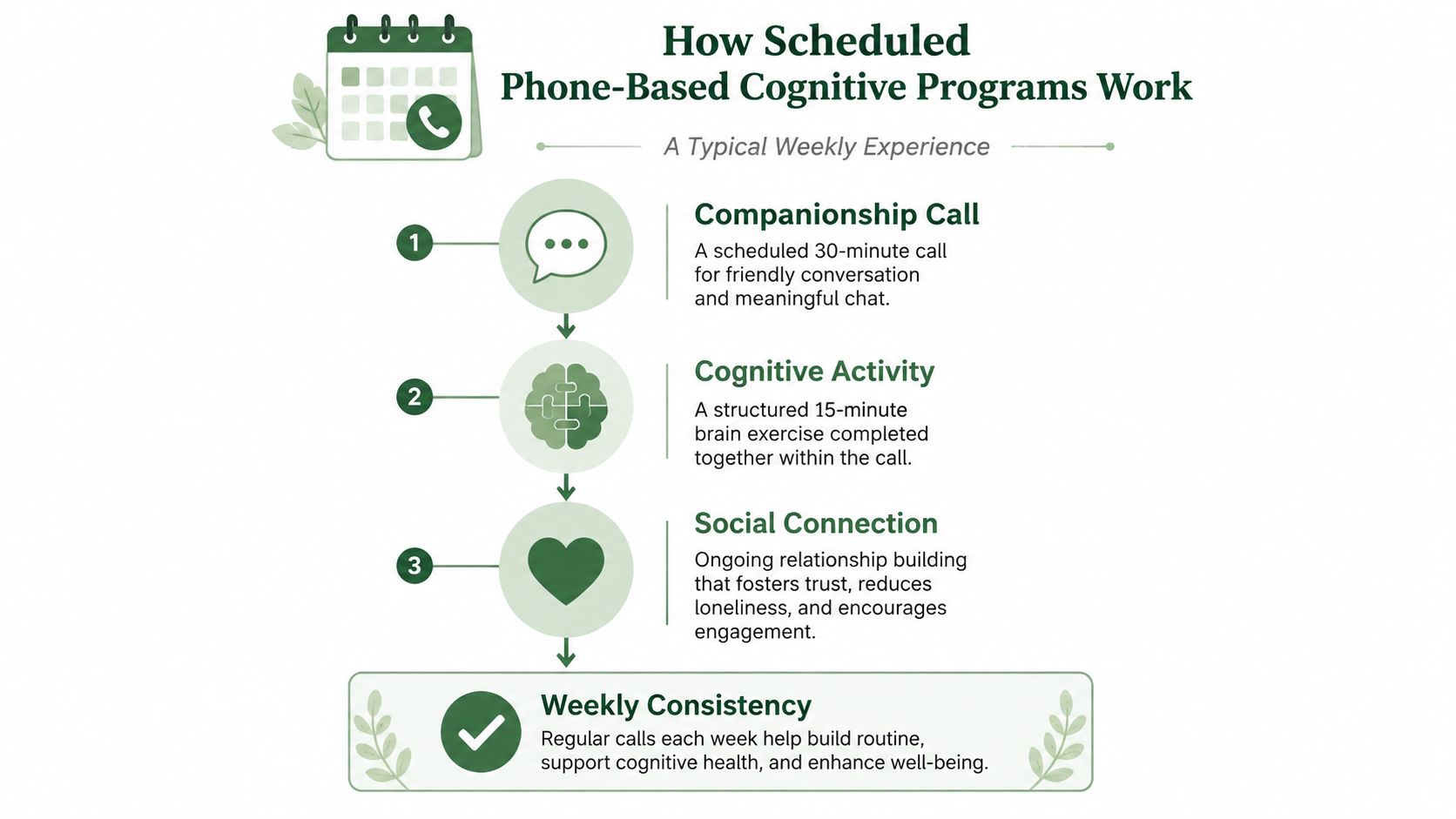
A typical week starts with a calendar, not a crisis call. The participant receives recurring calls at fixed times, often three to five calls per week, with sessions commonly lasting 20 to 45 minutes. Predictability matters because the person doesn't have to remember whom to call or negotiate a new plan each day.
A trained companion may begin with ordinary conversation about breakfast, the weather, a favorite song, or a family memory. The call can then move into a gentle activity such as word games, reminiscence prompts, orientation questions, music recall, language practice, or attention tasks. The structure gives the participant a reason to engage, while the companionship keeps the interaction from feeling like a test.
What happens around the call
A dementia-informed program should do more than mark a call as complete. Families may receive brief notes about mood, participation, conversation themes, and changes that deserve attention. If a person sounds unusually confused, anxious, withdrawn, or worried about safety, the care team can flag the pattern for the appropriate family member or clinician.
Some services also include practical check-ins. A companion might ask whether the participant remembers an appointment, has taken a medication according to the existing care plan, or has noticed a household concern. Those prompts support daily routines, but they don't replace medication management, medical advice, or in-person safety checks.
Daily check-in calls for seniors can be useful when the central need is regular human contact and observation. A Velma-style phone-based cognitive support program combines scheduled conversation, cognitive activities, companionship, and practical check-ins for people with memory loss in the early to mid stages of dementia.
The best fit is usually an older adult living alone, a person whose caregiver needs dependable breaks, or someone in a rural or transportation-limited area. Families should evaluate fit alongside medical treatment and in-person support, watching whether the person looks forward to calls, participates without excessive fatigue, and benefits from the rhythm rather than feeling pressured by it.
Choosing and Monitoring a Program as a Caregiver or Agency
Selection should begin with the participant, not the feature list. Before enrolling, ask what the person can hear, remember, follow, and enjoy. Consider preferred topics, language, time of day, history of anxiety, and whether the person responds better to familiar stories than direct questions.
Select
Ask the provider:
Who makes the calls? Look for companions trained in dementia communication, not only general customer service.
How flexible is the schedule? The program should accommodate the person's routine and adjust when mornings, meals, or sundowning create problems.
What happens during a session? Request a clear explanation of conversation, cognitive engagement, pauses, and redirection.
Who supervises the work? Ask whether a clinical professional or dementia specialist reviews the framework and supports care decisions.
What happens after a missed call? The provider should have a documented process for rescheduling, checking safety, and notifying the right person.

Onboard
Introduce the service as a friendly regular call, not as a response to failure. Share the participant's interests, important names, preferred routines, hearing needs, and topics that trigger distress. Start with achievable conversation and allow the companion to learn the person's pace.
Monitor
During the first four to eight weeks, document engagement, mood, recall attempts, conversation themes, resistance, and any meaningful change in routine. Notes don't need to become lengthy clinical records. A short entry such as “engaged after music discussion, became tired near the end, asked about daughter twice” can help family members recognize patterns.
Watch for: Scripted delivery, missing progress notes, unexplained staff changes, and an inability to adapt for hearing loss or cognitive limitations.
Agencies should share concise updates with family and home-care staff through an agreed channel. Escalate changes that suggest medical, psychiatric, or safety concerns rather than asking the phone program to manage them alone. A scheduled call belongs inside a broader care plan, alongside clinicians, hands-on support, and family involvement.
Putting It All Together for Lasting Connection
A useful care plan treats isolation and loneliness as separate outcomes. Record how often the person has real contact, then ask whether that contact feels satisfying, understandable, and emotionally safe. A person can improve on one measure while remaining at risk on the other.
For someone living with dementia, the plan should match the cognitive stage and preserve dignity. A quiet one-to-one call may work better than a crowded activity. A familiar companion may achieve more than a rotating list of well-intentioned visitors. For the caregiver, support must also reduce the role's social cost, not create another task to organize.

Layer the response:
Measure it: Track contact frequency, living arrangements, participation, and the person's own sense of connection.
Address it: Combine medical attention, in-person help, family contact, therapy when appropriate, and structured phone-based engagement.
Sustain it: Choose support that can continue between appointments and gives caregivers visibility into what's changing.
The practical step this week is small but concrete. Identify one person at risk, name the empty part of their week, and schedule one structured contact to fill it. A recurring conversation may be more useful than a vague promise to visit soon.
Velma offers scheduled phone calls that combine companionship, dementia-appropriate cognitive exercises, practical check-ins, and updates for families supporting someone with early to mid-stage memory loss. Visit Velma to explore whether structured phone-based support fits the older adult and caregiver in your life.
You're sitting at the kitchen table, looking at your mother's calendar. The appointments are written down, the radio is playing, and the house is tidy. Yet no one has spoken with her since yesterday. When you call, she says she's fine, then asks when you're coming again. You leave the conversation wondering whether she's lonely, isolated, depressed, or just having a quiet day.
That uncertainty matters. Social isolation and loneliness aren't synonyms, and treating them as interchangeable can lead families toward the wrong support. Isolation describes a person's actual level of contact with other people. Loneliness describes how that contact feels. A good care plan measures both, then builds dependable connection around the person's cognitive abilities, health, routines, and the caregiver's limits.
Table of Contents
What Social Isolation and Loneliness Actually Mean
Two different questions for care teams
Why Isolation and Loneliness Matter for Health
The dementia connection
Signs to Watch For in Older Adults and People With Dementia
Changes that can look like dementia progression
Why Common Advice Often Falls Short
Design contact around capacity
Comparing Practical Interventions
How Scheduled Phone-Based Cognitive Programs Work
What happens around the call
Choosing and Monitoring a Program as a Caregiver or Agency
Select
Onboard
Monitor
Putting It All Together for Lasting Connection
What Social Isolation and Loneliness Actually Mean
Social isolation is the more observable variable. It concerns how often someone speaks with, sees, or spends meaningful time with other people. A person who lives alone, rarely receives calls, and has stopped attending appointments may have a significant lack of social contact, even if they don't describe themselves as lonely.
Loneliness is subjective. Someone can have visitors every day and still feel alone because conversations are rushed, confusing, or emotionally distant. A person living with dementia may sit among relatives and aides but fail to follow the conversation, recognize the relationships, or feel included. That experience can be lonely even when the room is full.
Two different questions for care teams
Ask two separate questions:
How much contact does this person have? Count regular calls, visits, activities, and conversations, while considering whether the contact is sustained and meaningful.
How does the person experience that contact? Look for statements such as “no one understands me,” distress after visitors leave, or a desire for company despite frequent interaction.
A widower who gardens, speaks with neighbors, and enjoys quiet evenings may have little contact but feel content. Another person may have family nearby and still feel disconnected. The first situation calls for observation, not automatic intervention. The second calls for better-quality, more understandable, and more emotionally responsive contact.
Practical rule: A busy house doesn't prove connection, and an empty house doesn't prove loneliness.
For caregivers, the distinction changes the response. Objective isolation may improve through scheduled calls or visits. Loneliness may require a familiar voice, patient pacing, reminiscence, validation, or a relationship that gives the person something to anticipate.
Why Isolation and Loneliness Matter for Health
The health concern isn't limited to sadness. The World Health Organization's overview of social isolation and loneliness identifies both as major global public health issues. WHO reports that loneliness affects about 1 in 6 people worldwide, and estimates that around 100 people die every hour from loneliness-related causes, adding up to more than 871,000 deaths each year.
Older adults face particular vulnerability. WHO reports that around 1 in 10 older people experience loneliness and 1 in 4 are socially isolated. In several regions, including China, Europe, Latin America, and the United States, 20–34% of older people report being lonely, showing that this isn't a problem limited to one culture or health system.
The mortality evidence also separates the two variables. A 2023 meta-analysis published in Nature Human Behaviour, covering more than 2 million adults across 90 prospective cohort studies, associated social isolation with a 32% higher risk of all-cause mortality and loneliness with a 14% higher risk. The analysis also found associations with higher cancer mortality. These are associations, not proof that loneliness alone causes a particular death, but they're strong enough to make social connection relevant to clinical assessment.
The dementia connection
Loneliness also tracks with cognitive outcomes in older adults. A cohort meta-analysis indexed by PubMed found increased risks associated with loneliness for all-cause dementia, Alzheimer's disease, vascular dementia, and cognitive impairment. The reported hazard ratios were 1.306, 1.393, 1.735, and 1.150, respectively.
Objective isolation deserves separate attention. A large meta-analysis of social isolation and mortality reported all-cause mortality hazard ratios of 1.35 for social isolation and 1.21 for living alone. That makes contact frequency, living arrangements, and participation practical screening variables, even when a person doesn't use the word lonely.
Outcome | Isolation risk | Loneliness risk | Population studied |
|---|---|---|---|
All-cause mortality | 32% higher risk | 14% higher risk | Adults aged 18 and older across 90 prospective cohorts |
Dementia | Increased risk associated with social isolation | HR 1.306 | Older adults in cohort meta-analysis |
Alzheimer's disease | Increased risk associated with social isolation | HR 1.393 | Older adults in cohort meta-analysis |
Vascular dementia | Increased risk associated with social isolation | HR 1.735 | Older adults in cohort meta-analysis |
Cognitive impairment | Increased risk associated with social isolation | HR 1.150 | Older adults in cohort meta-analysis |
For someone already experiencing memory loss, the practical takeaway is straightforward. Don't wait for the person to ask for company. Cognitive decline can reduce initiative, confidence, and the ability to organize a social plan, so dependable contact needs to be built into the care routine.
Signs to Watch For in Older Adults and People With Dementia
The first signs are often ordinary enough to dismiss. A calendar fills with appointments that no one attends. The phone stays face-down. Curtains remain closed later into the morning, and a person who once enjoyed the porch stops sitting outside.
A daughter may notice that her father answers every question with “fine,” but offers no story of his own. A home-care worker may see him spend an entire visit polishing one small object or talking only about the dog. That narrow focus can be a calming substitute for human contact, not just a new hobby.
Changes that can look like dementia progression
People living with dementia may withdraw because group conversations move too quickly or contain too many voices. They may become silent when several relatives arrive, repeat the same question to anyone who will listen, or show a flat expression that families interpret as indifference. In reality, the person may feel lost, embarrassed, or unable to enter the conversation.
Repeated calls can carry the same message in disguise. If a parent calls at 2 a.m. to ask about a minor detail, the stated reason may not explain the whole need. The person may be seeking reassurance, orientation, or a familiar human voice.
Track patterns rather than diagnosing from one incident. Note when withdrawal occurs, who was present, what topics helped, and whether the person engages more easily in one-to-one conversation. Families can also use practical guidance on emotional support for seniors when they're trying to respond without arguing or correcting.
Caregivers need screening too. Skipping personal appointments, abandoning hobbies, changing eating habits, and becoming irritable without another clear cause can indicate that the caregiving role has narrowed the person's world. The right response isn't blame. It's to add support that doesn't require the caregiver to arrange another complicated outing.
Why Common Advice Often Falls Short
“Join a senior center” sounds sensible until you consider what the person must do to make it work. They need transportation, physical stamina, confidence in an unfamiliar setting, and enough cognitive flexibility to follow a group conversation. Someone with mid-stage dementia may not remember the group, recognize new people, or know when it's their turn to speak.
“Try video calls” creates a different burden. The older adult must manage a device, hear through a speaker, interpret faces on a screen, and tolerate the awkward pauses that technology can create. A family member may also need to set up the call, troubleshoot it, and remain available when the connection fails.
Caregivers face their own constraints. A spouse may be unable to leave the house during a difficult part of the day. An adult child may live far away and already coordinate medications, appointments, and home-care workers. Adding one more scheduled event can increase pressure instead of relieving it.
Design contact around capacity
Effective contact tends to share several qualities:
Predictable timing: A recurring call or visit gives the person something familiar to anticipate.
Short, manageable sessions: Contact should end before fatigue or confusion takes over.
One-to-one attention: A single conversational partner reduces competing voices and social performance demands.
Low technology requirements: A regular phone can remove barriers that apps and video platforms create.
Flexible structure: A call can include an activity, but it must leave room for silence, stories, and emotional reassurance.
Relationship continuity: Familiarity helps the person feel safe and reduces the effort required to explain themselves.
The question isn't whether an activity sounds socially healthy. Ask whether this person can start it, understand it, tolerate it, and repeat it without exhausting the caregiver. That test eliminates many attractive but impractical recommendations.
Comparing Practical Interventions
Families and agencies usually choose among four formats. In-person companions offer warmth and observation, but geography, staffing, and scheduling can limit availability. Senior centers and adult day programs create wider social opportunities, yet group noise and unfamiliar routines can overwhelm someone with dementia.
Video calls preserve family relationships across distance, but they depend on equipment, reliable setup, and sensory tolerance. Scheduled phone-based cognitive and companionship programs require less technology and can create a consistent baseline of contact, particularly for someone who lives alone or a caregiver who needs predictable relief.
Format | Access | Dementia fit | Caregiver relief | Family visibility | Scalability |
|---|---|---|---|---|---|
In-person visitors or companions | Strong when local staff are available, limited by travel and scheduling | Often good for one-to-one contact, with direct observation | Can provide meaningful relief when consistently staffed | Family may receive informal updates | Moderate, depending on workforce |
Senior center or adult day program | Depends on transportation, hours, and mobility | Variable, group pace and noise may be difficult | Can provide substantial relief during attendance | Usually indirect unless the program documents engagement | Moderate |
Video calls with family | Broad geographic reach, but requires equipment and setup | Variable, screen fatigue and hearing difficulty can interfere | Usually adds coordination work unless the older adult manages independently | High during the call, limited between calls | High for families, less so for individualized support |
Scheduled phone-based cognitive and companionship program | Broad reach through an ordinary phone and fixed scheduling | Often suitable for early to moderate cognitive impairment when calls are adapted | Can reduce the need for family members to provide every check-in | Strong when providers share notes and alerts | High for agencies serving distributed clients |
No format solves every problem. A person may need an in-person companion for meals and safety, family video calls for emotional closeness, and scheduled phone contact between visits. For readers exploring the emotional side of treatment, CBT for social isolation offers useful context on when structured therapy may be appropriate.
A phone program can serve as the dependable backbone, but it shouldn't replace medical care, therapy, hands-on supervision, or genuine family relationships. Families comparing digital options can also review an AI companion for seniors, while checking whether the service provides human oversight and dementia-appropriate safeguards.
How Scheduled Phone-Based Cognitive Programs Work
A typical week starts with a calendar, not a crisis call. The participant receives recurring calls at fixed times, often three to five calls per week, with sessions commonly lasting 20 to 45 minutes. Predictability matters because the person doesn't have to remember whom to call or negotiate a new plan each day.
A trained companion may begin with ordinary conversation about breakfast, the weather, a favorite song, or a family memory. The call can then move into a gentle activity such as word games, reminiscence prompts, orientation questions, music recall, language practice, or attention tasks. The structure gives the participant a reason to engage, while the companionship keeps the interaction from feeling like a test.
What happens around the call
A dementia-informed program should do more than mark a call as complete. Families may receive brief notes about mood, participation, conversation themes, and changes that deserve attention. If a person sounds unusually confused, anxious, withdrawn, or worried about safety, the care team can flag the pattern for the appropriate family member or clinician.
Some services also include practical check-ins. A companion might ask whether the participant remembers an appointment, has taken a medication according to the existing care plan, or has noticed a household concern. Those prompts support daily routines, but they don't replace medication management, medical advice, or in-person safety checks.
Daily check-in calls for seniors can be useful when the central need is regular human contact and observation. A Velma-style phone-based cognitive support program combines scheduled conversation, cognitive activities, companionship, and practical check-ins for people with memory loss in the early to mid stages of dementia.
The best fit is usually an older adult living alone, a person whose caregiver needs dependable breaks, or someone in a rural or transportation-limited area. Families should evaluate fit alongside medical treatment and in-person support, watching whether the person looks forward to calls, participates without excessive fatigue, and benefits from the rhythm rather than feeling pressured by it.
Choosing and Monitoring a Program as a Caregiver or Agency
Selection should begin with the participant, not the feature list. Before enrolling, ask what the person can hear, remember, follow, and enjoy. Consider preferred topics, language, time of day, history of anxiety, and whether the person responds better to familiar stories than direct questions.
Select
Ask the provider:
Who makes the calls? Look for companions trained in dementia communication, not only general customer service.
How flexible is the schedule? The program should accommodate the person's routine and adjust when mornings, meals, or sundowning create problems.
What happens during a session? Request a clear explanation of conversation, cognitive engagement, pauses, and redirection.
Who supervises the work? Ask whether a clinical professional or dementia specialist reviews the framework and supports care decisions.
What happens after a missed call? The provider should have a documented process for rescheduling, checking safety, and notifying the right person.
Onboard
Introduce the service as a friendly regular call, not as a response to failure. Share the participant's interests, important names, preferred routines, hearing needs, and topics that trigger distress. Start with achievable conversation and allow the companion to learn the person's pace.
Monitor
During the first four to eight weeks, document engagement, mood, recall attempts, conversation themes, resistance, and any meaningful change in routine. Notes don't need to become lengthy clinical records. A short entry such as “engaged after music discussion, became tired near the end, asked about daughter twice” can help family members recognize patterns.
Watch for: Scripted delivery, missing progress notes, unexplained staff changes, and an inability to adapt for hearing loss or cognitive limitations.
Agencies should share concise updates with family and home-care staff through an agreed channel. Escalate changes that suggest medical, psychiatric, or safety concerns rather than asking the phone program to manage them alone. A scheduled call belongs inside a broader care plan, alongside clinicians, hands-on support, and family involvement.
Putting It All Together for Lasting Connection
A useful care plan treats isolation and loneliness as separate outcomes. Record how often the person has real contact, then ask whether that contact feels satisfying, understandable, and emotionally safe. A person can improve on one measure while remaining at risk on the other.
For someone living with dementia, the plan should match the cognitive stage and preserve dignity. A quiet one-to-one call may work better than a crowded activity. A familiar companion may achieve more than a rotating list of well-intentioned visitors. For the caregiver, support must also reduce the role's social cost, not create another task to organize.
Layer the response:
Measure it: Track contact frequency, living arrangements, participation, and the person's own sense of connection.
Address it: Combine medical attention, in-person help, family contact, therapy when appropriate, and structured phone-based engagement.
Sustain it: Choose support that can continue between appointments and gives caregivers visibility into what's changing.
The practical step this week is small but concrete. Identify one person at risk, name the empty part of their week, and schedule one structured contact to fill it. A recurring conversation may be more useful than a vague promise to visit soon.
Velma offers scheduled phone calls that combine companionship, dementia-appropriate cognitive exercises, practical check-ins, and updates for families supporting someone with early to mid-stage memory loss. Visit Velma to explore whether structured phone-based support fits the older adult and caregiver in your life.
Suggested Article: