8 Short Term Memory Loss Exercises
A parent forgets a conversation from breakfast, asks about the same appointment twice, or recognizes a neighbor but can't retrieve the person's name. For families, the moment can feel alarming. For the older adult, repeated correction can feel embarrassing and exhausting.
The most useful approach combines brief, meaningful retrieval practice with conversation, external supports, movement, and emotional reassurance. These short term memory loss exercises aren't a test of intelligence, and they aren't a cure for dementia. They're tools for supporting attention, recall, communication, confidence, and daily routines.
Keep one safety rule in view: adapt every activity to the person's abilities, stop when distress or fatigue appears, and use exercises alongside professional medical care, not instead of it. A simple pacing framework works well: choose one activity, keep it brief, offer cues, record what helped, and revisit it consistently.
Recurring phone support, such as Velma's scheduled calls, can add predictable practice and caregiver visibility without requiring an app. The strongest plan usually feels manageable enough to repeat, personal enough to matter, and flexible enough to change when the person's needs change.
Table of Contents
1. Spaced Retrieval Technique
2. Reminiscence Therapy
Make the conversation personal
3. Orientation to Time and Place
Use orientation as a bridge to action
4. Attention and Concentration Tasks
5. Language and Word Retrieval Exercises
Guide retrieval without taking over
6. Errorless Learning and Encoding Optimization
Connect new information to an established action
7. Practical Memory Aids and External Cognitive Support Strategies
Build one dependable support system
8. Structured Conversation with Strategic Questioning Techniques
Keep the conversation warm and clinically useful
Short-Term Memory Exercises: 8-Method Comparison
Build a Supportive Routine, Not a Test
1. Spaced Retrieval Technique
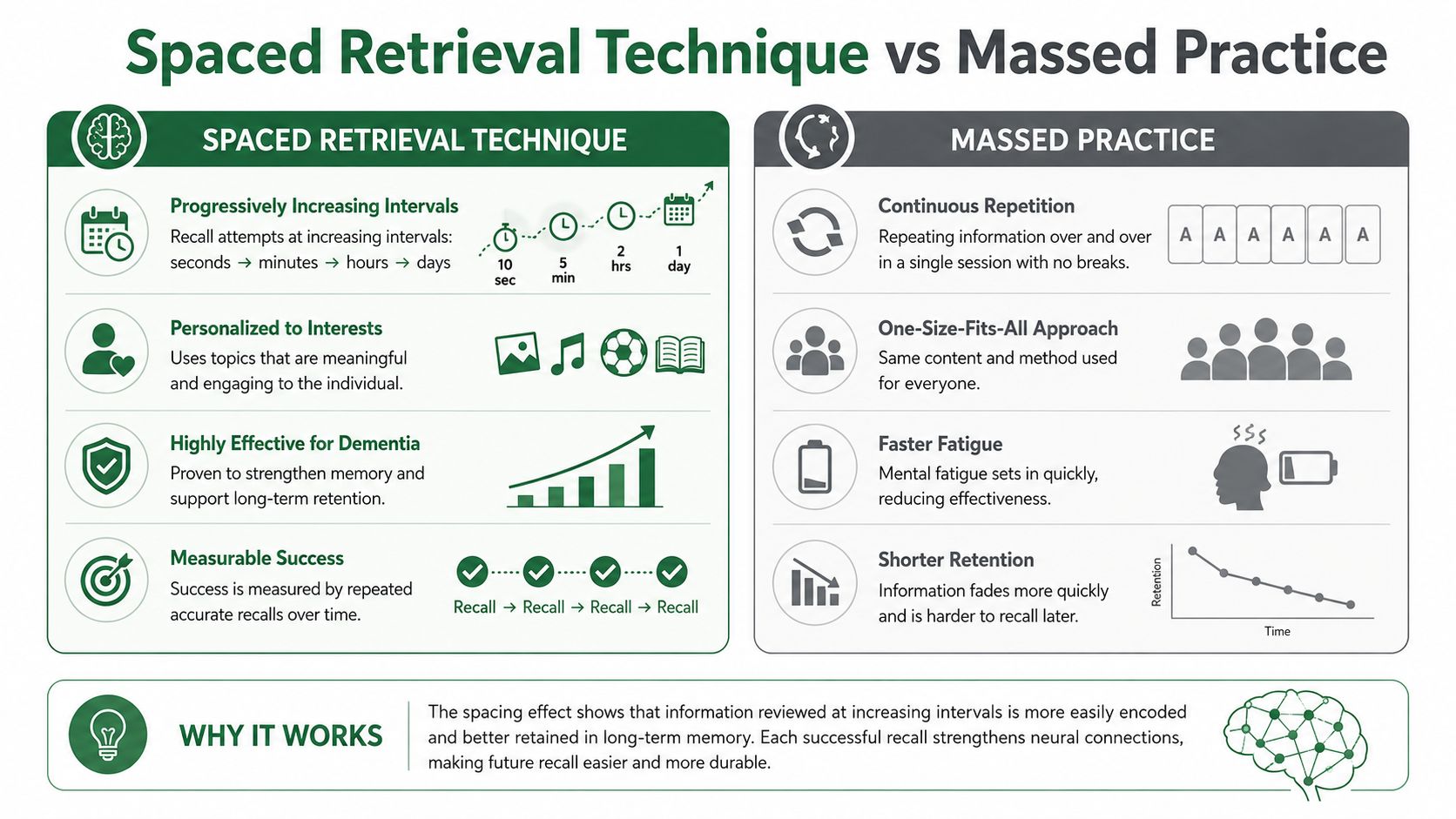
Spaced retrieval helps a person practice recalling one useful piece of information after gradually lengthening pauses. The information might be a family member's name, the location of a phone, the next appointment, or a step in a familiar routine.
Begin with something meaningful. Say, “Your granddaughter's name is Maya.” Ask the person to repeat it. If they can, wait briefly and ask again. Gradually extend the interval to several minutes, a later call, the next day, and eventually a later week. If recall fails, provide the answer calmly, have them repeat it, and return to a shorter interval.
This method works best when the target is specific and practical. A care manager might reinforce, “Your doctor's appointment is Thursday,” while pairing that information with a calendar entry. Family members can use the same wording so the person hears a consistent cue rather than several competing versions.
Practical rule: Success matters more than difficulty. If the person struggles, shorten the delay instead of turning the activity into an interrogation.
Use written reminders between practice attempts. Spaced retrieval can support internal recall, but a calendar, labeled note, or phone reminder remains important for safety. The evidence for structured cognitive training is encouraging but modest. A large review of memory training in older adults found an overall effect size of 0.31 standard deviations compared with control conditions, with some benefits remaining years after training in a major trial, as described in this review of memory training evidence.
For additional ideas on selecting meaningful prompts, see these cognitive exercises for memory.
2. Reminiscence Therapy
A person who struggles to remember yesterday's lunch may vividly describe a first job, a wedding, a favorite vacation, or the sound of music from home. Reminiscence activities use those accessible autobiographical memories to invite conversation, identity, and emotional connection.
Ask, “Tell me about the work you enjoyed most,” rather than “Did you enjoy your job?” Open questions give the person room to choose details. Leave comfortable pauses. Don't rush to fill silence, and don't correct minor factual differences when the emotional meaning remains clear.
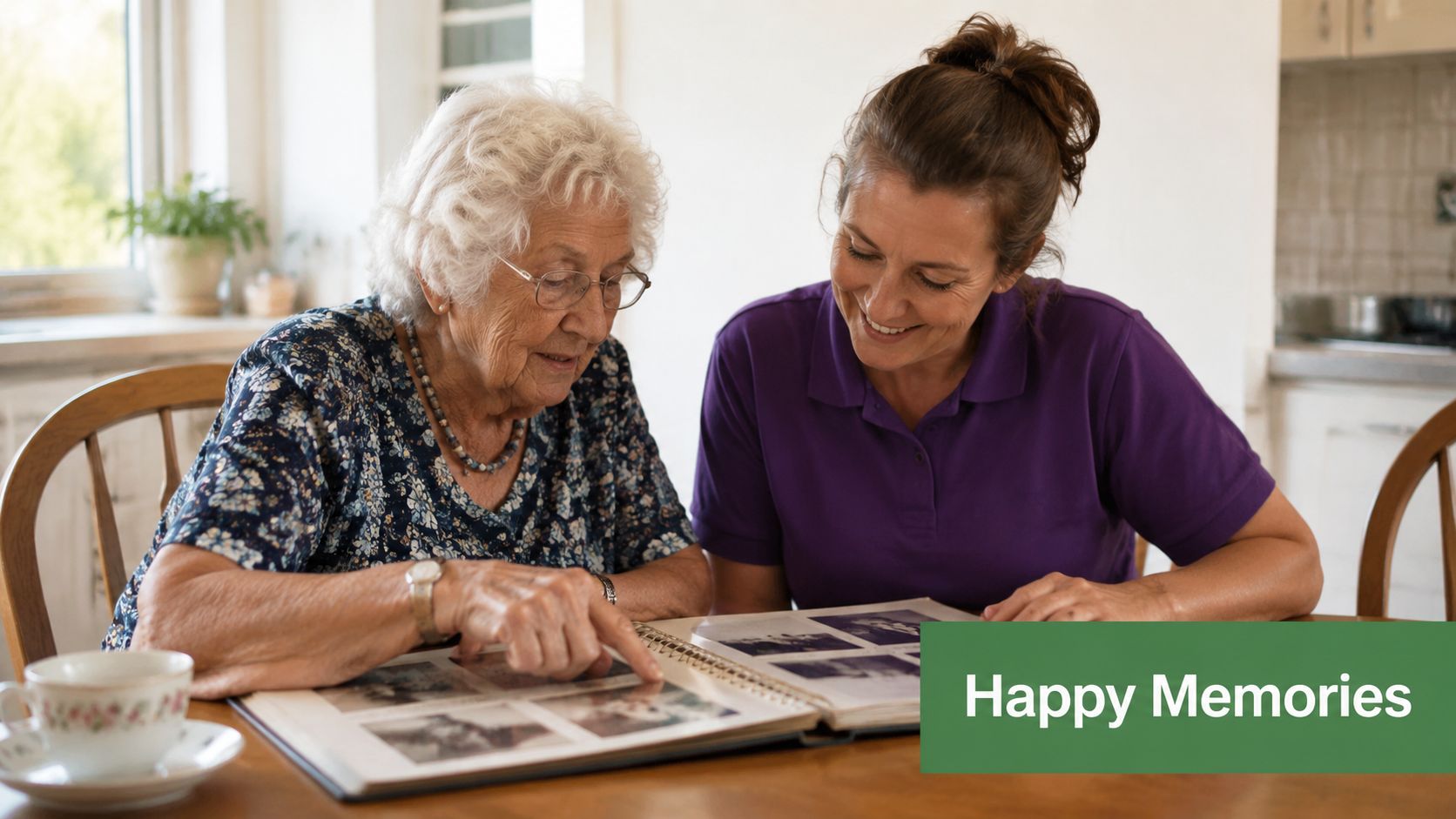
A caregiver can use photographs, familiar music, recipes, clothing, or objects as prompts. A family member might show an album and ask about the people, setting, or feelings connected to a picture. Over the phone, sensory prompts can still work: ask about a favorite meal, a garden, a holiday tradition, or a song associated with a particular period of life.
Make the conversation personal
Collect a short life history from relatives, including occupations, hobbies, places lived, important relationships, and topics that cause discomfort. That background helps a care manager avoid generic questions and return to successful conversation threads during later calls. A detailed discussion of life review therapy can help families understand how structured personal storytelling differs from asking someone to remember facts.
The purpose isn't to prove that every detail is accurate. It's to support expression, belonging, and a coherent sense of self. A 2023 Cochrane review of cognitive stimulation in people with mild-to-moderate dementia found a small but clinically meaningful cognitive effect, SMD 0.40, across 25 studies and 1,893 participants, alongside probable benefits in communication and social interaction, as reported in this Cochrane review of cognitive stimulation.
Document rich details and mood changes. A story about gardening may reveal a useful future activity, while a repeated story about a lost spouse may signal a need for comfort rather than more questioning.
3. Orientation to Time and Place
Orientation practice should feel like a helpful welcome, not a quiz. At the start of a call, say, “Hi, it's Sam calling on Tuesday morning. You're at home, and the weather is cool today.” Then connect the information to something meaningful, such as a garden club, a favorite television program, or an upcoming family visit.
A large calendar and an easy-to-read clock can carry much of the burden. Place them where the person naturally looks, and write appointments in plain language. “Eye doctor, Thursday morning” is more useful than a dense schedule full of abbreviations.
Use orientation as a bridge to action
Orientation becomes more practical when it leads to a next step. “It's Tuesday, and your refill is due Thursday. Let's check the calendar and decide who will call the pharmacy.” This approach supports daily organization without demanding that the person hold every detail in mind.
Useful prompts include:
Time of day: Ask whether the person has had breakfast or lunch, then connect the answer to the current routine.
Season and weather: Discuss the temperature, daylight, clothing, or seasonal activity.
Place: Confirm whether the person is at home, visiting family, or in another familiar setting.
Upcoming events: Link a birthday, appointment, or holiday to the calendar.
Respond positively when the person is oriented. If they're confused, give the answer gently and move on. Repeatedly insisting on the “correct” date can increase shame without improving recall. Consistent language across family, care managers, and clinicians makes the environment easier to follow.
Use a visible calendar or clock as a compensatory support, not as evidence that the exercise has failed. Orientation cues can reduce uncertainty, but new or rapidly worsening disorientation needs medical attention.

4. Attention and Concentration Tasks
A person may seem forgetful after missing the first part of a conversation. Background television, rapid speech, or several instructions at once can overload attention before memory has a chance to work. These tasks target that entry point by narrowing focus to one sound, word, sequence, or action.
Use a phone timer for a brief practice period, then stop while participation remains comfortable. Say, “I'll read several words. Tell me when you hear ‘garden.’” Other starting points include naming nearby kitchen objects, taking turns with word associations, or repeating a short digit sequence. A caregiver can demonstrate first, reduce distractions, and allow extra response time.
Change the task as performance changes. Replace backward counting with a simpler sequence if frustration appears. Shorten a story and ask one concrete question when listening becomes difficult. If the person responds easily, add only one demand, such as describing the story in their own words. The trade-off is clear: more difficulty may provide practice, but excessive challenge can reduce accuracy, confidence, and willingness to continue.
Try these variations:
Category naming: Name familiar objects in a kitchen or animals found on a farm.
Listening focus: Read a short passage and listen for one repeated word.
Digit repetition: Repeat a short number sequence, reducing its length when needed.
Word association: Respond to a prompt such as “rain,” “garden,” or “music.”
Simple switching: Alternate between two categories, such as a food and a color.
A randomized memory-training study reported a generalization effect size of 0.25 across the full group, with gains sustained after follow-up. Its findings support varying activities rather than assuming that progress on one exercise will transfer to every daily memory problem. For people with greater cognitive impairment, use familiar words, shorter turns, and caregiver modeling. Treat these exercises as attention and memory practice, not a way to prevent or reverse dementia.
Record patterns such as accuracy, distraction, and fatigue when that information helps adjust care. Avoid turning every phone call into a test. Enjoyment, choice, and a manageable pace make regular participation more realistic.
5. Language and Word Retrieval Exercises
A familiar word can disappear during an ordinary phone call, leaving the speaker frustrated or quiet. Structured language practice creates low-pressure chances to retrieve words, describe experiences, and remain socially involved. It supports communication, but it does not treat every cause of word-finding difficulty.
Start with interests the person already knows. Ask for birds, flowers, foods, or tools, then adjust the task to their ability. You might say, “Tell me what you see outside your window,” or invite a story about a memorable meal, favorite trip, or hobby. If “banana” is difficult, offer meaning-based cues: “It's a fruit, yellow, and monkeys are often associated with it.”
Guide retrieval without taking over
Pause before supplying the answer. Offer one cue about the category, function, location, or first sound, then allow time. If the word still does not come, say it naturally and continue. Repeated guessing can increase pressure, while immediate answers remove useful practice.
Use a phone call, voice memo, or face-to-face conversation for activities such as:
Category fluency: Name familiar garden plants or breakfast foods.
Description practice: Explain an object without naming it while the listener guesses.
Finish the phrase: Complete a familiar saying or song lyric, when appropriate.
Twenty questions: Identify an animal, food, or household object through yes-or-no questions.
Personal storytelling: Describe a family tradition and what usually happens next.
For greater impairment, choose familiar topics, shorten turns, and let a caregiver model the first response. The benefit is accessible practice; the trade-off is that open-ended tasks may become tiring or discouraging. Stop when frustration, fatigue, or communication breakdown increases. Works naturally within phone calls; boosts communication and mood when participation remains voluntary.
Respond to errors without criticism. “You're close. It's the thing you use to cut paper” gives a useful cue. After a correct answer, ask one related question, such as where the rose was planted. Sudden changes in speech, confusion, or comprehension require prompt clinical evaluation.
6. Errorless Learning and Encoding Optimization
Errorless learning reduces avoidable mistakes during practice by giving the correct response early, then guiding repeated use. It can suit someone who becomes confused by wrong answers or loses confidence after repeated guessing. The aim is dependable learning of a routine, not a test of memory ability.
Start with one practical task. To teach the location of a medication organizer, say, “The organizer is on the kitchen counter.” Walk with the person to the counter, repeat the same wording, and invite them to point to or pick up the organizer. If hesitation appears, provide the cue promptly. Several unsuccessful guesses can create competing answers, while immediate support keeps the routine clear.
Connect new information to an established action
Link the new detail to a familiar cue, such as an appointment after morning coffee or a safety step after locking the door. Use the same short phrase across caregivers, phone calls, and written reminders. Consistent wording reduces the effort needed to interpret each instruction.
Strengthen encoding by making the information:
Meaningful: State why it matters to the person.
Contextual: Practise it where the action will occur.
Multisensory: Pair speech with a note, gesture, or visible object.
Consistent: Keep the wording and sequence unchanged.
Supported: Leave the cue available while the routine develops.
This approach trades challenge for reliable success. That trade-off may be appropriate when impairment is greater, because completing a useful routine matters more than demonstrating unaided recall. For milder difficulties, gradually reduce prompts only when performance remains steady. A caregiver can model the first step, use a phone voice memo with the agreed phrase, or practise briefly during an existing routine.
Errorless learning does not replace safety supervision. A cue may support medication organisation, but missed doses, duplicate doses, or unsafe cooking require stronger oversight from a caregiver, pharmacist, or clinician. Stop or shorten practice when fatigue, distress, or confusion increases.
7. Practical Memory Aids and External Cognitive Support Strategies
A person may remember an appointment during breakfast and forget it by lunchtime. External aids reduce that demand by placing information where it is needed. They support daily function rather than train internal recall, which may be the more respectful choice when short-term memory loss disrupts routines.
Begin with tasks that carry safety or timing risks. A large wall calendar can show appointments. A labeled family photo board can identify names and relationships. A checklist can guide the morning sequence. A medication organizer may help only if the person can use it safely, with someone checking the system when needed.
Build one dependable support system
Use a consistent location, large print, high contrast, and short wording. Ask the older adult to help choose the colors, photographs, or layout. Familiarity and personal choice can make the aid easier to accept and use.
Match each aid to a specific need:
Appointment calendar: Record the event, time, location, and transportation plan in plain language.
Daily checklist: List morning actions in the order they occur.
Labeled photographs: Add names and relationships, not only faces.
Safety cues: Put reminders near the stove, door, or refrigerator when appropriate.
Phone reminders: Set calls, alarms, or texts for recurring tasks.
Activity log: Note recent conversations or activities so family members can reconnect naturally.
Test the system in real use. After explaining it, demonstrate one step and ask the person to use the aid. This shows whether the print is readable, the location is convenient, and the instructions are understood. A caregiver can simplify the design or add supervision rather than treating difficulty as a memory failure.
Review the setup regularly. A note that blends into the wall may stop attracting attention, while an outdated calendar can increase confusion. Velma's medication reminders for seniors can support recurring conversations that include routine check-ins. Nutrition is another topic families may ask about; this guide to boosting brain function explains the evidence discussed around vitamins and memory.
Use external aids alongside appropriate supervision. They do not replace help with missed doses, duplicate doses, unsafe cooking, or other hazards. Stop or adjust practice if fatigue, distress, or confusion rises.
8. Structured Conversation with Strategic Questioning Techniques
A phone call can begin with a familiar topic, then shift toward practical support. Choose one interest, ask an open question, listen for the person's response, and follow their lead. “Tell me about a family celebration you remember fondly” invites more detail than “Did you have birthday parties?”
If recall stops, add a cue rather than correcting the person. Refer to a place, category, or earlier detail: “You mentioned your garden last time. What did you most enjoy growing?” For someone who worked in education, “What subjects did you teach?” supplies a useful pathway without giving the answer away. Pause long enough for retrieval, and accept an approximate answer.
Keep the conversation warm and clinically useful
A structured call can also reveal changes in daily functioning. After discussing a favorite recipe, ask whether the person has eaten or whether the kitchen feels safe. Ask about an upcoming plan only when the topic fits, and stop if the person becomes distressed.
Try this flexible rhythm:
Choose one personal topic: Use a hobby, relationship, place, or achievement.
Ask an open prompt: Invite description rather than a yes-or-no reply.
Add a graded cue: Offer context, category, or meaning before supplying the answer.
Wait: Silence gives the person time to retrieve information.
Validate emotion: Respond to pride, sadness, humor, or concern even when details are uncertain.
Check daily needs: Move toward routines, medication concerns, safety, or plans when appropriate.
Record useful observations: Note mood, confusion, strengths, and topics that caused distress.
The original 14-session Cognitive Stimulation Therapy protocol has evidence summarized in this Cognitive Stimulation Therapy evidence record. The reported benefits span cognition, language, working memory, mood, communication, quality of life, and dementia-related measures. This supports using purposeful conversation as part of broader cognitive stimulation, rather than treating isolated memory drills as the whole intervention.
Family members can apply these questioning principles, but supervision matters. Do not pressure someone to perform, argue over uncertain details, or turn an emotionally difficult memory into a test. Adjust the topic, shorten the call, or end the exercise when fatigue, distress, or confusion increases.
Short-Term Memory Exercises: 8-Method Comparison
Technique | Implementation Complexity 🔄 | Resource Requirements ⚡ | Expected Outcomes ⭐ | Ideal Use Cases 💡 | Key Advantages 📊 |
|---|---|---|---|---|---|
Spaced Retrieval Technique | Moderate, needs scheduling, interval tracking, facilitator calibration | Low-tech (phone + documentation); moderate staff time | Strong, item-specific retention; measurable recall gains | Early–mid dementia; medication/appointment reminders; personal facts | High effectiveness for targeted memories; emotionally relevant and adaptable |
Reminiscence Therapy | Low–Moderate, conversational prep and life-history review | Low (photos, music); time for research and rapport building | Improved mood, identity, and social engagement; indirect cognitive benefit | Mood support, rapport building, long-term memory stimulation | Reduces anxiety/agitation; enhances sense of self and engagement |
Orientation to Time and Place | Low, embed gentle cues into routine calls | Minimal (calendars/clocks); consistent call structure | Better temporal awareness; improved safety and task adherence | Short-term memory loss; safety-critical scheduling and routines | Directly reduces disorientation; objectively trackable over time |
Attention and Concentration Tasks | Moderate, requires task grading and real-time adaptation | Low materials; skilled facilitators; short sessions | Improved attention, processing speed, and measurable performance | Maintain executive function; cognitive reserve training | Directly trains attention; gamifiable and trackable |
Language and Word Retrieval Exercises | Low–Moderate, integrated into natural conversation | Minimal, facilitator skill is main resource | Improved verbal fluency and communication confidence | Word-finding difficulties; social engagement and conversation | Seamless in phone calls; boosts communication and mood |
Errorless Learning & Encoding Optimization | High, careful scaffolding to avoid errors; planned encoding | Moderate, coordination across caregivers; multisensory cues | Strong retention for practical info; fewer false memories | Significant short-term impairment; safety-critical learning | High success rates; reduces frustration; evidence-based approach |
Practical Memory Aids & External Supports | Low–Moderate, setup and ongoing family coordination | Low-cost materials (calendars, organizers); family involvement | Immediate functional gains; improved adherence and independence | Moderate memory loss; daily routines, medication management | Practical, immediate, low-tech; reduces reliance on internal memory |
Structured Conversation with Strategic Questioning | High, requires formal training and supervision | Low material needs; high facilitator skill and oversight | Combined cognitive and emotional benefits; sustained engagement | Ongoing phone-based care models; multi-goal interactions | Personalized, relationship-based; blends stimulation with practical checks |
Build a Supportive Routine, Not a Test
The best routine isn't the one with the hardest puzzles. It's the one the person can tolerate, understand, and repeat. Start by choosing one meaningful activity, such as recalling a grandchild's name, discussing a favorite career, orienting to the calendar, or practicing a familiar morning step.
Keep the first session brief enough to finish successfully. Offer cues before frustration builds. Record more than accuracy. Note whether the person was interested, anxious, tired, distracted, or proud. A task that produces fewer correct answers but leaves the person engaged may be more useful than a demanding exercise that causes withdrawal.
Use the different approaches for different jobs:
Spaced retrieval supports learning a specific piece of information.
Reminiscence supports identity, expression, and emotional connection.
Orientation anchors time, place, and upcoming routines.
Attention tasks practice focus and mental control.
Language exercises support word access and conversation.
Errorless learning reduces repeated mistakes while teaching practical information.
Memory aids compensate for limitations in internal recall.
Structured conversation combines cognitive engagement with companionship and observation.
A weekly plan can rotate these activities without making every interaction feel like therapy. One call might use a personal story, another might review the calendar, and another might practice a safety routine. Caregivers should use consistent language, keep external supports in the same place, and share observations with the care team.
Evidence supports structured cognitive stimulation and exercise as components of cognitive support, but it doesn't establish that exercises prevent dementia or reverse established impairment. Prevention evidence remains insufficient, and the effects in dementia populations are generally modest. Physical activity also matters. Reviews have found cognitive benefits from exercise, including memory and learning outcomes, with stronger protocols involving regular, sustained sessions over a longer training period, but exercise should still be framed as support, not a cure, as discussed in this review of exercise and cognition in older adults.
Stop if the person becomes distressed, unusually tired, dizzy, or unsafe. Consult a clinician about new, sudden, or rapidly worsening memory loss, changes in speech, falls, medication errors, or difficulties with daily functioning. Exercises must never replace medical evaluation, medication oversight, supervision, or household safety measures.
For families seeking recurring support, Velma offers scheduled phone conversations that can combine cognitive prompts, reminiscence, orientation, practical check-ins, and care-manager coordination. It can complement medical treatment and in-person caregiving without replacing either.
Velma provides scheduled phone calls with trained care team members who tailor conversation and cognitive exercises to an older adult's history, interests, routines, and abilities. If your family needs consistent practice and clearer visibility between visits, visit Velma to learn how phone-based support could fit into the care plan.
A parent forgets a conversation from breakfast, asks about the same appointment twice, or recognizes a neighbor but can't retrieve the person's name. For families, the moment can feel alarming. For the older adult, repeated correction can feel embarrassing and exhausting.
The most useful approach combines brief, meaningful retrieval practice with conversation, external supports, movement, and emotional reassurance. These short term memory loss exercises aren't a test of intelligence, and they aren't a cure for dementia. They're tools for supporting attention, recall, communication, confidence, and daily routines.
Keep one safety rule in view: adapt every activity to the person's abilities, stop when distress or fatigue appears, and use exercises alongside professional medical care, not instead of it. A simple pacing framework works well: choose one activity, keep it brief, offer cues, record what helped, and revisit it consistently.
Recurring phone support, such as Velma's scheduled calls, can add predictable practice and caregiver visibility without requiring an app. The strongest plan usually feels manageable enough to repeat, personal enough to matter, and flexible enough to change when the person's needs change.
Table of Contents
1. Spaced Retrieval Technique
2. Reminiscence Therapy
Make the conversation personal
3. Orientation to Time and Place
Use orientation as a bridge to action
4. Attention and Concentration Tasks
5. Language and Word Retrieval Exercises
Guide retrieval without taking over
6. Errorless Learning and Encoding Optimization
Connect new information to an established action
7. Practical Memory Aids and External Cognitive Support Strategies
Build one dependable support system
8. Structured Conversation with Strategic Questioning Techniques
Keep the conversation warm and clinically useful
Short-Term Memory Exercises: 8-Method Comparison
Build a Supportive Routine, Not a Test
1. Spaced Retrieval Technique
Spaced retrieval helps a person practice recalling one useful piece of information after gradually lengthening pauses. The information might be a family member's name, the location of a phone, the next appointment, or a step in a familiar routine.
Begin with something meaningful. Say, “Your granddaughter's name is Maya.” Ask the person to repeat it. If they can, wait briefly and ask again. Gradually extend the interval to several minutes, a later call, the next day, and eventually a later week. If recall fails, provide the answer calmly, have them repeat it, and return to a shorter interval.
This method works best when the target is specific and practical. A care manager might reinforce, “Your doctor's appointment is Thursday,” while pairing that information with a calendar entry. Family members can use the same wording so the person hears a consistent cue rather than several competing versions.
Practical rule: Success matters more than difficulty. If the person struggles, shorten the delay instead of turning the activity into an interrogation.
Use written reminders between practice attempts. Spaced retrieval can support internal recall, but a calendar, labeled note, or phone reminder remains important for safety. The evidence for structured cognitive training is encouraging but modest. A large review of memory training in older adults found an overall effect size of 0.31 standard deviations compared with control conditions, with some benefits remaining years after training in a major trial, as described in this review of memory training evidence.
For additional ideas on selecting meaningful prompts, see these cognitive exercises for memory.
2. Reminiscence Therapy
A person who struggles to remember yesterday's lunch may vividly describe a first job, a wedding, a favorite vacation, or the sound of music from home. Reminiscence activities use those accessible autobiographical memories to invite conversation, identity, and emotional connection.
Ask, “Tell me about the work you enjoyed most,” rather than “Did you enjoy your job?” Open questions give the person room to choose details. Leave comfortable pauses. Don't rush to fill silence, and don't correct minor factual differences when the emotional meaning remains clear.
A caregiver can use photographs, familiar music, recipes, clothing, or objects as prompts. A family member might show an album and ask about the people, setting, or feelings connected to a picture. Over the phone, sensory prompts can still work: ask about a favorite meal, a garden, a holiday tradition, or a song associated with a particular period of life.
Make the conversation personal
Collect a short life history from relatives, including occupations, hobbies, places lived, important relationships, and topics that cause discomfort. That background helps a care manager avoid generic questions and return to successful conversation threads during later calls. A detailed discussion of life review therapy can help families understand how structured personal storytelling differs from asking someone to remember facts.
The purpose isn't to prove that every detail is accurate. It's to support expression, belonging, and a coherent sense of self. A 2023 Cochrane review of cognitive stimulation in people with mild-to-moderate dementia found a small but clinically meaningful cognitive effect, SMD 0.40, across 25 studies and 1,893 participants, alongside probable benefits in communication and social interaction, as reported in this Cochrane review of cognitive stimulation.
Document rich details and mood changes. A story about gardening may reveal a useful future activity, while a repeated story about a lost spouse may signal a need for comfort rather than more questioning.
3. Orientation to Time and Place
Orientation practice should feel like a helpful welcome, not a quiz. At the start of a call, say, “Hi, it's Sam calling on Tuesday morning. You're at home, and the weather is cool today.” Then connect the information to something meaningful, such as a garden club, a favorite television program, or an upcoming family visit.
A large calendar and an easy-to-read clock can carry much of the burden. Place them where the person naturally looks, and write appointments in plain language. “Eye doctor, Thursday morning” is more useful than a dense schedule full of abbreviations.
Use orientation as a bridge to action
Orientation becomes more practical when it leads to a next step. “It's Tuesday, and your refill is due Thursday. Let's check the calendar and decide who will call the pharmacy.” This approach supports daily organization without demanding that the person hold every detail in mind.
Useful prompts include:
Time of day: Ask whether the person has had breakfast or lunch, then connect the answer to the current routine.
Season and weather: Discuss the temperature, daylight, clothing, or seasonal activity.
Place: Confirm whether the person is at home, visiting family, or in another familiar setting.
Upcoming events: Link a birthday, appointment, or holiday to the calendar.
Respond positively when the person is oriented. If they're confused, give the answer gently and move on. Repeatedly insisting on the “correct” date can increase shame without improving recall. Consistent language across family, care managers, and clinicians makes the environment easier to follow.
Use a visible calendar or clock as a compensatory support, not as evidence that the exercise has failed. Orientation cues can reduce uncertainty, but new or rapidly worsening disorientation needs medical attention.
4. Attention and Concentration Tasks
A person may seem forgetful after missing the first part of a conversation. Background television, rapid speech, or several instructions at once can overload attention before memory has a chance to work. These tasks target that entry point by narrowing focus to one sound, word, sequence, or action.
Use a phone timer for a brief practice period, then stop while participation remains comfortable. Say, “I'll read several words. Tell me when you hear ‘garden.’” Other starting points include naming nearby kitchen objects, taking turns with word associations, or repeating a short digit sequence. A caregiver can demonstrate first, reduce distractions, and allow extra response time.
Change the task as performance changes. Replace backward counting with a simpler sequence if frustration appears. Shorten a story and ask one concrete question when listening becomes difficult. If the person responds easily, add only one demand, such as describing the story in their own words. The trade-off is clear: more difficulty may provide practice, but excessive challenge can reduce accuracy, confidence, and willingness to continue.
Try these variations:
Category naming: Name familiar objects in a kitchen or animals found on a farm.
Listening focus: Read a short passage and listen for one repeated word.
Digit repetition: Repeat a short number sequence, reducing its length when needed.
Word association: Respond to a prompt such as “rain,” “garden,” or “music.”
Simple switching: Alternate between two categories, such as a food and a color.
A randomized memory-training study reported a generalization effect size of 0.25 across the full group, with gains sustained after follow-up. Its findings support varying activities rather than assuming that progress on one exercise will transfer to every daily memory problem. For people with greater cognitive impairment, use familiar words, shorter turns, and caregiver modeling. Treat these exercises as attention and memory practice, not a way to prevent or reverse dementia.
Record patterns such as accuracy, distraction, and fatigue when that information helps adjust care. Avoid turning every phone call into a test. Enjoyment, choice, and a manageable pace make regular participation more realistic.
5. Language and Word Retrieval Exercises
A familiar word can disappear during an ordinary phone call, leaving the speaker frustrated or quiet. Structured language practice creates low-pressure chances to retrieve words, describe experiences, and remain socially involved. It supports communication, but it does not treat every cause of word-finding difficulty.
Start with interests the person already knows. Ask for birds, flowers, foods, or tools, then adjust the task to their ability. You might say, “Tell me what you see outside your window,” or invite a story about a memorable meal, favorite trip, or hobby. If “banana” is difficult, offer meaning-based cues: “It's a fruit, yellow, and monkeys are often associated with it.”
Guide retrieval without taking over
Pause before supplying the answer. Offer one cue about the category, function, location, or first sound, then allow time. If the word still does not come, say it naturally and continue. Repeated guessing can increase pressure, while immediate answers remove useful practice.
Use a phone call, voice memo, or face-to-face conversation for activities such as:
Category fluency: Name familiar garden plants or breakfast foods.
Description practice: Explain an object without naming it while the listener guesses.
Finish the phrase: Complete a familiar saying or song lyric, when appropriate.
Twenty questions: Identify an animal, food, or household object through yes-or-no questions.
Personal storytelling: Describe a family tradition and what usually happens next.
For greater impairment, choose familiar topics, shorten turns, and let a caregiver model the first response. The benefit is accessible practice; the trade-off is that open-ended tasks may become tiring or discouraging. Stop when frustration, fatigue, or communication breakdown increases. Works naturally within phone calls; boosts communication and mood when participation remains voluntary.
Respond to errors without criticism. “You're close. It's the thing you use to cut paper” gives a useful cue. After a correct answer, ask one related question, such as where the rose was planted. Sudden changes in speech, confusion, or comprehension require prompt clinical evaluation.
6. Errorless Learning and Encoding Optimization
Errorless learning reduces avoidable mistakes during practice by giving the correct response early, then guiding repeated use. It can suit someone who becomes confused by wrong answers or loses confidence after repeated guessing. The aim is dependable learning of a routine, not a test of memory ability.
Start with one practical task. To teach the location of a medication organizer, say, “The organizer is on the kitchen counter.” Walk with the person to the counter, repeat the same wording, and invite them to point to or pick up the organizer. If hesitation appears, provide the cue promptly. Several unsuccessful guesses can create competing answers, while immediate support keeps the routine clear.
Connect new information to an established action
Link the new detail to a familiar cue, such as an appointment after morning coffee or a safety step after locking the door. Use the same short phrase across caregivers, phone calls, and written reminders. Consistent wording reduces the effort needed to interpret each instruction.
Strengthen encoding by making the information:
Meaningful: State why it matters to the person.
Contextual: Practise it where the action will occur.
Multisensory: Pair speech with a note, gesture, or visible object.
Consistent: Keep the wording and sequence unchanged.
Supported: Leave the cue available while the routine develops.
This approach trades challenge for reliable success. That trade-off may be appropriate when impairment is greater, because completing a useful routine matters more than demonstrating unaided recall. For milder difficulties, gradually reduce prompts only when performance remains steady. A caregiver can model the first step, use a phone voice memo with the agreed phrase, or practise briefly during an existing routine.
Errorless learning does not replace safety supervision. A cue may support medication organisation, but missed doses, duplicate doses, or unsafe cooking require stronger oversight from a caregiver, pharmacist, or clinician. Stop or shorten practice when fatigue, distress, or confusion increases.
7. Practical Memory Aids and External Cognitive Support Strategies
A person may remember an appointment during breakfast and forget it by lunchtime. External aids reduce that demand by placing information where it is needed. They support daily function rather than train internal recall, which may be the more respectful choice when short-term memory loss disrupts routines.
Begin with tasks that carry safety or timing risks. A large wall calendar can show appointments. A labeled family photo board can identify names and relationships. A checklist can guide the morning sequence. A medication organizer may help only if the person can use it safely, with someone checking the system when needed.
Build one dependable support system
Use a consistent location, large print, high contrast, and short wording. Ask the older adult to help choose the colors, photographs, or layout. Familiarity and personal choice can make the aid easier to accept and use.
Match each aid to a specific need:
Appointment calendar: Record the event, time, location, and transportation plan in plain language.
Daily checklist: List morning actions in the order they occur.
Labeled photographs: Add names and relationships, not only faces.
Safety cues: Put reminders near the stove, door, or refrigerator when appropriate.
Phone reminders: Set calls, alarms, or texts for recurring tasks.
Activity log: Note recent conversations or activities so family members can reconnect naturally.
Test the system in real use. After explaining it, demonstrate one step and ask the person to use the aid. This shows whether the print is readable, the location is convenient, and the instructions are understood. A caregiver can simplify the design or add supervision rather than treating difficulty as a memory failure.
Review the setup regularly. A note that blends into the wall may stop attracting attention, while an outdated calendar can increase confusion. Velma's medication reminders for seniors can support recurring conversations that include routine check-ins. Nutrition is another topic families may ask about; this guide to boosting brain function explains the evidence discussed around vitamins and memory.
Use external aids alongside appropriate supervision. They do not replace help with missed doses, duplicate doses, unsafe cooking, or other hazards. Stop or adjust practice if fatigue, distress, or confusion rises.
8. Structured Conversation with Strategic Questioning Techniques
A phone call can begin with a familiar topic, then shift toward practical support. Choose one interest, ask an open question, listen for the person's response, and follow their lead. “Tell me about a family celebration you remember fondly” invites more detail than “Did you have birthday parties?”
If recall stops, add a cue rather than correcting the person. Refer to a place, category, or earlier detail: “You mentioned your garden last time. What did you most enjoy growing?” For someone who worked in education, “What subjects did you teach?” supplies a useful pathway without giving the answer away. Pause long enough for retrieval, and accept an approximate answer.
Keep the conversation warm and clinically useful
A structured call can also reveal changes in daily functioning. After discussing a favorite recipe, ask whether the person has eaten or whether the kitchen feels safe. Ask about an upcoming plan only when the topic fits, and stop if the person becomes distressed.
Try this flexible rhythm:
Choose one personal topic: Use a hobby, relationship, place, or achievement.
Ask an open prompt: Invite description rather than a yes-or-no reply.
Add a graded cue: Offer context, category, or meaning before supplying the answer.
Wait: Silence gives the person time to retrieve information.
Validate emotion: Respond to pride, sadness, humor, or concern even when details are uncertain.
Check daily needs: Move toward routines, medication concerns, safety, or plans when appropriate.
Record useful observations: Note mood, confusion, strengths, and topics that caused distress.
The original 14-session Cognitive Stimulation Therapy protocol has evidence summarized in this Cognitive Stimulation Therapy evidence record. The reported benefits span cognition, language, working memory, mood, communication, quality of life, and dementia-related measures. This supports using purposeful conversation as part of broader cognitive stimulation, rather than treating isolated memory drills as the whole intervention.
Family members can apply these questioning principles, but supervision matters. Do not pressure someone to perform, argue over uncertain details, or turn an emotionally difficult memory into a test. Adjust the topic, shorten the call, or end the exercise when fatigue, distress, or confusion increases.
Short-Term Memory Exercises: 8-Method Comparison
Technique | Implementation Complexity 🔄 | Resource Requirements ⚡ | Expected Outcomes ⭐ | Ideal Use Cases 💡 | Key Advantages 📊 |
|---|---|---|---|---|---|
Spaced Retrieval Technique | Moderate, needs scheduling, interval tracking, facilitator calibration | Low-tech (phone + documentation); moderate staff time | Strong, item-specific retention; measurable recall gains | Early–mid dementia; medication/appointment reminders; personal facts | High effectiveness for targeted memories; emotionally relevant and adaptable |
Reminiscence Therapy | Low–Moderate, conversational prep and life-history review | Low (photos, music); time for research and rapport building | Improved mood, identity, and social engagement; indirect cognitive benefit | Mood support, rapport building, long-term memory stimulation | Reduces anxiety/agitation; enhances sense of self and engagement |
Orientation to Time and Place | Low, embed gentle cues into routine calls | Minimal (calendars/clocks); consistent call structure | Better temporal awareness; improved safety and task adherence | Short-term memory loss; safety-critical scheduling and routines | Directly reduces disorientation; objectively trackable over time |
Attention and Concentration Tasks | Moderate, requires task grading and real-time adaptation | Low materials; skilled facilitators; short sessions | Improved attention, processing speed, and measurable performance | Maintain executive function; cognitive reserve training | Directly trains attention; gamifiable and trackable |
Language and Word Retrieval Exercises | Low–Moderate, integrated into natural conversation | Minimal, facilitator skill is main resource | Improved verbal fluency and communication confidence | Word-finding difficulties; social engagement and conversation | Seamless in phone calls; boosts communication and mood |
Errorless Learning & Encoding Optimization | High, careful scaffolding to avoid errors; planned encoding | Moderate, coordination across caregivers; multisensory cues | Strong retention for practical info; fewer false memories | Significant short-term impairment; safety-critical learning | High success rates; reduces frustration; evidence-based approach |
Practical Memory Aids & External Supports | Low–Moderate, setup and ongoing family coordination | Low-cost materials (calendars, organizers); family involvement | Immediate functional gains; improved adherence and independence | Moderate memory loss; daily routines, medication management | Practical, immediate, low-tech; reduces reliance on internal memory |
Structured Conversation with Strategic Questioning | High, requires formal training and supervision | Low material needs; high facilitator skill and oversight | Combined cognitive and emotional benefits; sustained engagement | Ongoing phone-based care models; multi-goal interactions | Personalized, relationship-based; blends stimulation with practical checks |
Build a Supportive Routine, Not a Test
The best routine isn't the one with the hardest puzzles. It's the one the person can tolerate, understand, and repeat. Start by choosing one meaningful activity, such as recalling a grandchild's name, discussing a favorite career, orienting to the calendar, or practicing a familiar morning step.
Keep the first session brief enough to finish successfully. Offer cues before frustration builds. Record more than accuracy. Note whether the person was interested, anxious, tired, distracted, or proud. A task that produces fewer correct answers but leaves the person engaged may be more useful than a demanding exercise that causes withdrawal.
Use the different approaches for different jobs:
Spaced retrieval supports learning a specific piece of information.
Reminiscence supports identity, expression, and emotional connection.
Orientation anchors time, place, and upcoming routines.
Attention tasks practice focus and mental control.
Language exercises support word access and conversation.
Errorless learning reduces repeated mistakes while teaching practical information.
Memory aids compensate for limitations in internal recall.
Structured conversation combines cognitive engagement with companionship and observation.
A weekly plan can rotate these activities without making every interaction feel like therapy. One call might use a personal story, another might review the calendar, and another might practice a safety routine. Caregivers should use consistent language, keep external supports in the same place, and share observations with the care team.
Evidence supports structured cognitive stimulation and exercise as components of cognitive support, but it doesn't establish that exercises prevent dementia or reverse established impairment. Prevention evidence remains insufficient, and the effects in dementia populations are generally modest. Physical activity also matters. Reviews have found cognitive benefits from exercise, including memory and learning outcomes, with stronger protocols involving regular, sustained sessions over a longer training period, but exercise should still be framed as support, not a cure, as discussed in this review of exercise and cognition in older adults.
Stop if the person becomes distressed, unusually tired, dizzy, or unsafe. Consult a clinician about new, sudden, or rapidly worsening memory loss, changes in speech, falls, medication errors, or difficulties with daily functioning. Exercises must never replace medical evaluation, medication oversight, supervision, or household safety measures.
For families seeking recurring support, Velma offers scheduled phone conversations that can combine cognitive prompts, reminiscence, orientation, practical check-ins, and care-manager coordination. It can complement medical treatment and in-person caregiving without replacing either.
Velma provides scheduled phone calls with trained care team members who tailor conversation and cognitive exercises to an older adult's history, interests, routines, and abilities. If your family needs consistent practice and clearer visibility between visits, visit Velma to learn how phone-based support could fit into the care plan.
Suggested Article: