Financial Management for Elderly: A Caregiver's Action Plan

You're probably seeing the same pattern in real time. A parent starts misplacing bills, forgetting whether a premium was paid, or getting irritated when you ask about accounts, and everyone around the table wants to treat it as a paperwork problem. It isn't just paperwork. In later life, financial management for elderly adults is a safety issue, because money mistakes can lead to missed medications, shutoff notices, overdrafts, and scams that drain the cash needed for housing, food, and care.
That risk sits on top of a harsh reality. In 2024, the National Council on Aging reported that more than 17 million Americans age 65+ were economically insecure, defined as living at or below 200% of the federal poverty level, which is roughly 1 in 3 older adults (NCOA economic security facts). The same analysis found that 44.1% of Black older adults and 42.1% of Hispanic older adults were below that threshold, while the median income of older adults was $29,740 in 2022 and 10% of older adults with any income earned less than $10,000 (NCOA economic security facts). When that's the financial backdrop, the right goal isn't maximizing every dollar. It's keeping money flowing cleanly enough to preserve dignity and stability.
Table of Contents
Why Financial Management Becomes a Safety Issue
What actually goes wrong
Assessing Financial Capacity Before Taking Control
What families should document
Establishing Legal Authority Without Overreaching
Choosing the least harmful tool
Simplifying Accounts and Building Bill-Pay Systems
Build a structure that is easy to watch
Put guardrails on the system
Navigating Healthcare Costs and Accessing Benefits
Where families should focus first
Using Cognitive Check-Ins as Financial Early Warning
What to listen for
Use call patterns as triggers
Building an Ongoing Monitoring and Communication Routine
What to document and share
Why Financial Management Becomes a Safety Issue
The first mistake families make is treating late-life money problems like an organizer's headache. Consolidate accounts, set up autopay, check in once a month, and everything will stay neat. That mindset falls apart when memory, judgment, or attention starts slipping, because the danger isn't clutter, it's cash flow disruption.
The Federal Reserve's older-adult financial experience research found that 18% of respondents needed help with everyday money management in the past year, and the underlying work defined that management as routine tasks like deposits, transfers, payments, check writing, and balancing accounts (Federal Reserve older adult survey). That matters because these are the exact tasks that keep a household functioning. If they break down, the consequences are immediate, and they rarely announce themselves politely.
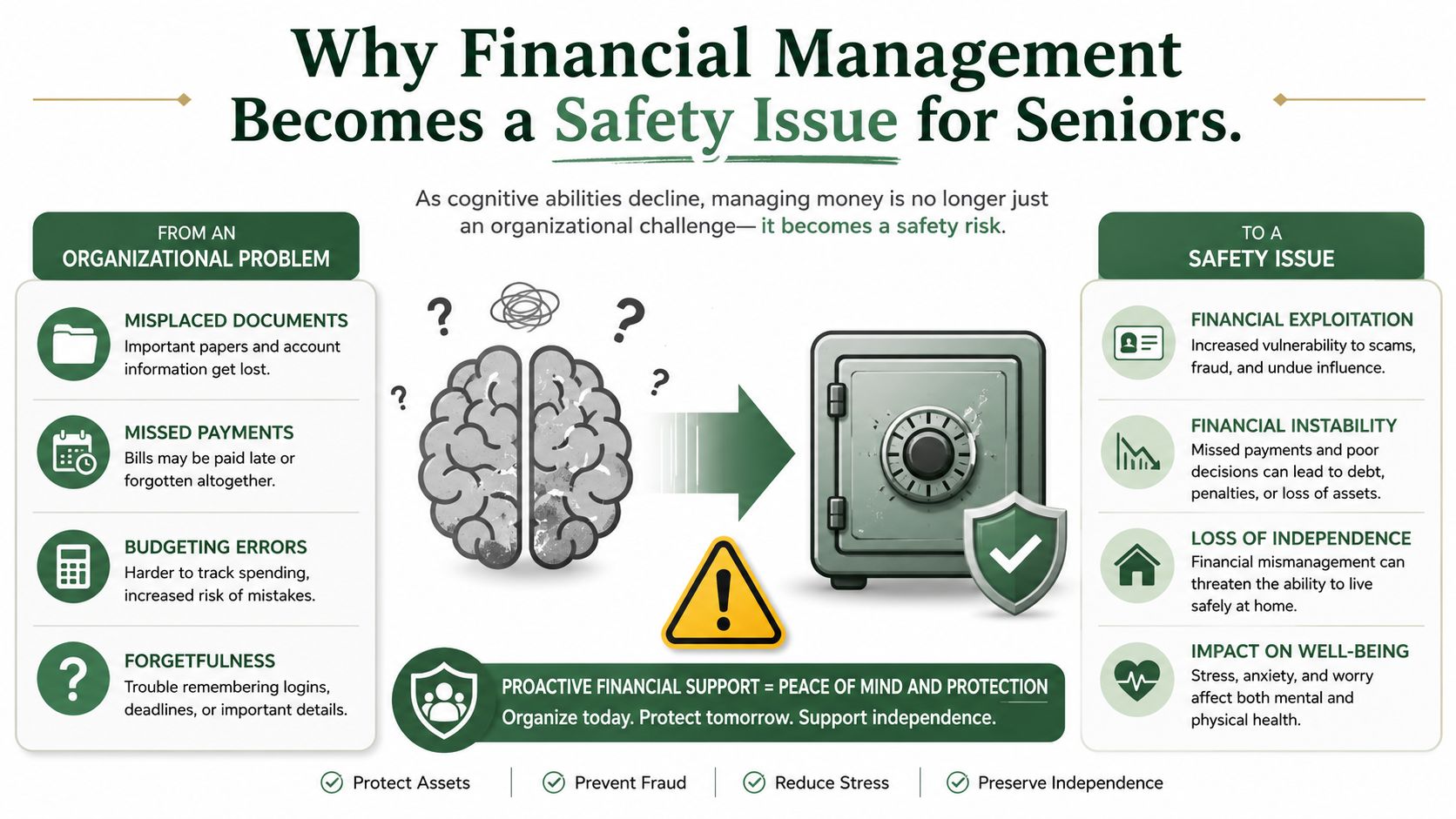
What actually goes wrong
A missed utility bill can trigger a late fee or shutoff. A forgotten prescription payment can interrupt treatment. A scam call can exploit confusion before anyone notices the account drain. That's why I tell families to think in terms of protection, not control.
Practical rule: If the money task affects housing, food, transportation, or medical access, treat it as a safety function, not a bookkeeping preference.
Older adults are also heavily targeted by fraud, especially when they're alone with complex account structures and no one watching for unusual behavior. Consumer guidance on elder fraud puts the focus on account monitoring, scam education, and document protection, because warning signs are often visible before the damage is fully felt. A useful explainer on the pattern itself is stop elder financial abuse, especially if you're trying to explain the issue to siblings who still think this is “just a bad phone call.”
The basic takeaway is blunt. Once cognition starts affecting money handling, the family's job changes from organizing finances to reducing exposure.
Assessing Financial Capacity Before Taking Control
Start with observation, not takeover. Open mail piled on the table, bills paid twice, missing check registers, odd transfers, or repeated confusion about what is due are not proof by themselves, but they are signs worth writing down. If the person can still explain why a payment matters, say what happens if it is missed, and admit when help is needed, the answer may be support rather than replacement.
A structured capacity review should happen in stages. First, look for cognitive or mental health decline. Then ask whether it is affecting financial decisions. Next, check awareness, compensating habits, and how easily the person is pressured by others. Only after that should anyone match the findings to the legal standard that applies, because task-specific capacity is different from a blanket claim that someone cannot manage any money at all. For a practical framework, see capacity assessment guidance.
What families should document
Keep a dated record of concrete issues, not impressions.
Unopened mail: Statements, notices, or insurance letters left untouched.
Duplicate payments: Two checks for the same bill, or a bill paid after a reminder was already sent.
Odd account activity: Transfers that do not fit the person's normal pattern.
Disorganized records: Statements, receipts, and passwords scattered without a usable system.
Repeated confusion: The same questions about due dates, balances, or whether something was already handled.
A written pattern matters because memory loss often shows up first in small money tasks, then spreads into missed deadlines, duplicate payments, or poor responses to pressure. Families who are also watching for broader cognitive change should use a phone-based support tool or structured check-in, because Hey Velma's article on cognitive decline in older adults helps explain why confusion in daily routines can show up before a crisis in the accounts.
When the pattern is unclear, bring in a clinician, a neuropsychologist, or another professional who can test memory, judgment, and execution together. A single conversation is not enough. A basic cognitive screen is not enough either. Expert guidance in this area recommends pairing interview data with medical history, cognitive testing, and direct performance-based assessment of financial skills.

The point is to decide whether the person needs full takeover, partial support, or a better system. That distinction protects both autonomy and safety.
Establishing Legal Authority Without Overreaching
A worried family often wants to move fast, but speed is how people overreach. If the older adult can still understand what they are signing, use the lightest legal tool that gives real oversight. If they cannot, stop trying to force a workaround that looks simple on paper and turns messy in practice.
A durable power of attorney is usually the first document to consider. It lets a trusted person handle money tasks while leaving the older adult's rights intact as long as capacity is still there to sign it. Joint accounts seem convenient, yet they can blur ownership, invite conflict, and create headaches when siblings disagree about access or use. Representative payee status can work for benefit income, but it does not cover every part of a person's finances.
Choosing the least harmful tool
Use the match that fits the person's actual condition and the job at hand.
Situation | Better fit | Why it tends to work |
|---|---|---|
Person still understands documents and wants help | Durable power of attorney | Preserves dignity while giving a named helper authority |
Small household finances need shared access | Joint bank account | Simple, but risky if the relationship later sours |
Benefits income needs management | Representative payee | Narrower than full control and tied to that payment stream |
Capacity is gone and risk is high | Guardianship or conservatorship | Last resort, because it removes more autonomy |
An elder law attorney should review the setup, because state law controls the fine print. If the family is also sorting out inheritance and access, Fintrack's estate planning trust steps can help clarify how authority and property transfer are handled without mixing up separate documents.
The best legal arrangement protects money without making the older adult feel erased.
Get the papers signed while the person still understands the authority they are granting. Bring identity documents, a clean list of accounts, and a plain explanation of who will do what. Keep the conversation focused if the family is tense, because vague promises are where disputes begin.
Simplifying Accounts and Building Bill-Pay Systems
Complexity is the enemy. Every extra account, card, and due date creates another opening for missed payments, confusion, or exploitation. The job is to simplify the system so it is easier to monitor and harder to misuse, while still respecting the older adult's autonomy.
Build a structure that is easy to watch
Start by closing or consolidating accounts that no longer serve a clear purpose. Keep the accounts that matter to the older adult's daily life and sense of control, then move recurring expenses to autopay only when the amount is steady and predictable. Fixed bills belong on automation. Variable spending does not.
Review the cash flow every month. Check what came in, what went out, which payments cleared, and whether anything looks out of place. Unopened mail, bills scattered across the house, duplicate charges, and unexplained large withdrawals are warning signs that can point to confusion or exploitation, as noted in the CEPAR financial decision-making brief.
A simple bill-pay system also works as an early warning tool. If the older adult has begun missing details in conversations, repeating questions about payments, or losing track of routine obligations, that is not just a money issue. It can be one of the first signs that cognitive support is slipping, and phone-based check-ins can help family members spot those changes before a missed bill turns into a crisis.
Put guardrails on the system
Use paper statements too: Online access helps, but paper gives caregivers a second trail to compare against missing payments.
Set alerts on key accounts: Payment confirmations, low-balance warnings, and unusual transfer notices should go to someone who will read them.
Shred old documents: Account numbers, statements, and card offers should never sit in reachable trash.
Add a trusted contact where available: That gives the institution a secondary person to call if something looks wrong.
Limit spending exposure: Keep discretionary cash in a smaller account so one mistake does not hit the whole household.
Keep the older adult involved. They should still review what they can, approve what they understand, and know where the money goes. That protects dignity while reducing the chance of a hard-to-fix surprise.
Navigating Healthcare Costs and Accessing Benefits
Most guides spend too much time on generic budgeting and not enough on the expense category that often blows up late-life finances. Healthcare is where the monthly plan gets broken. The medical side of financial management for elderly adults includes insurance review, bill scrutiny, prescription affordability, and benefits screening, because those choices shape cash flow far more than a tidy spreadsheet does.
Older adults often need help across five domains, not one: money management, medical bill management, understanding health insurance, choosing appropriate health services, and planning for long-term care (financial health literacy research). That's the right lens. If the older adult is trying to decode an Explanation of Benefits, choose between services, or figure out whether a medication is affordable, this is financial work.
Where families should focus first
Audit the current coverage before the bills pile up. Check for gaps, copays, out-of-network issues, and recurring prescriptions that could be priced better. If the person is already struggling with dementia or memory loss, ask a benefits counselor or geriatric care manager to step in before the paperwork becomes a barrier.
Direct advice: Don't wait for a surprise bill to start reviewing insurance. By then, the money has already left the safe zone.
The internal problem is usually clarity, not willingness. Many older adults can still say they want care, but they can't reliably compare options or track what's been billed. For a focused look at that intersection, Hey Velma's Medicare coverage guide for dementia care is useful because it keeps the conversation anchored on coverage decisions, not abstract insurance jargon.
Families should also screen for every legitimate support path before paying full price. That includes utility relief, housing help, tax-related relief, and medication assistance when it applies. Wealth Collective's planning guide is a good reference point if you're trying to think beyond one bill at a time and build a broader care budget.
The hard truth is that low-income older adults often do better when priorities are simplified around housing, food, and medications. That's not giving up. It's choosing survival first.
Using Cognitive Check-Ins as Financial Early Warning
Monthly account reviews catch problems late. By the time you see a missed payment or a strange transfer, the behavior that caused it may have been building for weeks. That's why phone-based cognitive support can do more than provide companionship, it can act as an early warning system for financial decline.
A regular call pattern reveals how someone is tracking time, remembering tasks, and handling stress. Confusion about the day of the week, repeated questions about bills, or rising anxiety about money often shows up in conversation before it shows up in a bank statement. Families who pay attention to those patterns get time to adjust oversight before the account gets hit.
What to listen for
Listen for repeated orientation problems, especially around dates, appointments, and bill timing. Listen for executive-function clues too, such as trouble following a sequence or switching between topics without losing the thread. When someone starts sounding uncertain about who paid what, or whether a notice was already handled, that's not small talk. That's a money-management signal.
The reason this matters is simple. Financial decisions depend on memory, judgment, and follow-through. When those weaken, the risk moves from oversight to loss. A structured call program can surface that decline earlier than a bank alert can, because the conversation shows the person's actual functioning in real time. Hey Velma's daily check-in calls for seniors is a relevant example of how routine calls can document changes that families would otherwise miss.
Use call patterns as triggers
Repeated date confusion: Escalate oversight of payments and reminders.
Bills becoming a recurring anxiety topic: Recheck the payment system and reduce complexity.
New suspiciousness or shame about money: Look for exploitation or a hidden mistake.
Slower responses or lost train of thought: Reassess capacity and support needs.
Sudden withdrawal from financial conversation: Treat it as a possible decline signal, not a personality quirk.
This approach works because it shifts the family's attention upstream. You're not waiting for the overdraft notice. You're watching the thinking that makes the overdraft more likely.
Building an Ongoing Monitoring and Communication Routine
A stable setup still needs maintenance. Money management in later life changes as cognition changes, so the family has to keep watching without turning every week into an audit. The routine should be simple enough to sustain and tight enough to catch drift early.
Use a weekly and monthly rhythm. Weekly, check for alerts, unopened mail, odd charges, and any messages from banks or insurers. Monthly, review the spending pattern, confirm fixed bills cleared, and ask whether anything felt harder than usual. If the person seems more confused, more defensive, or more dependent on reminders, that's a signal to step up support.
What to document and share
Keep notes that are factual and dated. Record what was observed, what was paid, what was questioned, and what changed. Share the minimum necessary detail with siblings or other helpers, because loose family communication creates resentment fast. One person should own the financial overview, even if others are kept informed.
If disagreement starts, go back to the paper trail. That protects the older adult from being argued over and protects the caregiver from being accused of hiding things. It also gives the attorney, care manager, or clinician a clearer picture if the support plan has to change.
Bottom line: Dignity and oversight can coexist, but only if the family treats financial management as a living system, not a one-time setup.
The trigger for reassessment is not a single bad week. It's a pattern of repeated misses, new confusion, unexplained transfers, or growing fear around money. When that happens, loosen the person's burden, tighten the safeguards, and make the next decision based on what they can still do well.
If you're managing a parent's money and the system already feels fragile, don't wait for the next missed bill or scam call. Visit Velma to see how a structured phone-based cognitive support program can help you catch financial warning signs earlier and keep the older adult you love safer, calmer, and more involved.
You're probably seeing the same pattern in real time. A parent starts misplacing bills, forgetting whether a premium was paid, or getting irritated when you ask about accounts, and everyone around the table wants to treat it as a paperwork problem. It isn't just paperwork. In later life, financial management for elderly adults is a safety issue, because money mistakes can lead to missed medications, shutoff notices, overdrafts, and scams that drain the cash needed for housing, food, and care.
That risk sits on top of a harsh reality. In 2024, the National Council on Aging reported that more than 17 million Americans age 65+ were economically insecure, defined as living at or below 200% of the federal poverty level, which is roughly 1 in 3 older adults (NCOA economic security facts). The same analysis found that 44.1% of Black older adults and 42.1% of Hispanic older adults were below that threshold, while the median income of older adults was $29,740 in 2022 and 10% of older adults with any income earned less than $10,000 (NCOA economic security facts). When that's the financial backdrop, the right goal isn't maximizing every dollar. It's keeping money flowing cleanly enough to preserve dignity and stability.
Table of Contents
Why Financial Management Becomes a Safety Issue
What actually goes wrong
Assessing Financial Capacity Before Taking Control
What families should document
Establishing Legal Authority Without Overreaching
Choosing the least harmful tool
Simplifying Accounts and Building Bill-Pay Systems
Build a structure that is easy to watch
Put guardrails on the system
Navigating Healthcare Costs and Accessing Benefits
Where families should focus first
Using Cognitive Check-Ins as Financial Early Warning
What to listen for
Use call patterns as triggers
Building an Ongoing Monitoring and Communication Routine
What to document and share
Why Financial Management Becomes a Safety Issue
The first mistake families make is treating late-life money problems like an organizer's headache. Consolidate accounts, set up autopay, check in once a month, and everything will stay neat. That mindset falls apart when memory, judgment, or attention starts slipping, because the danger isn't clutter, it's cash flow disruption.
The Federal Reserve's older-adult financial experience research found that 18% of respondents needed help with everyday money management in the past year, and the underlying work defined that management as routine tasks like deposits, transfers, payments, check writing, and balancing accounts (Federal Reserve older adult survey). That matters because these are the exact tasks that keep a household functioning. If they break down, the consequences are immediate, and they rarely announce themselves politely.
What actually goes wrong
A missed utility bill can trigger a late fee or shutoff. A forgotten prescription payment can interrupt treatment. A scam call can exploit confusion before anyone notices the account drain. That's why I tell families to think in terms of protection, not control.
Practical rule: If the money task affects housing, food, transportation, or medical access, treat it as a safety function, not a bookkeeping preference.
Older adults are also heavily targeted by fraud, especially when they're alone with complex account structures and no one watching for unusual behavior. Consumer guidance on elder fraud puts the focus on account monitoring, scam education, and document protection, because warning signs are often visible before the damage is fully felt. A useful explainer on the pattern itself is stop elder financial abuse, especially if you're trying to explain the issue to siblings who still think this is “just a bad phone call.”
The basic takeaway is blunt. Once cognition starts affecting money handling, the family's job changes from organizing finances to reducing exposure.
Assessing Financial Capacity Before Taking Control
Start with observation, not takeover. Open mail piled on the table, bills paid twice, missing check registers, odd transfers, or repeated confusion about what is due are not proof by themselves, but they are signs worth writing down. If the person can still explain why a payment matters, say what happens if it is missed, and admit when help is needed, the answer may be support rather than replacement.
A structured capacity review should happen in stages. First, look for cognitive or mental health decline. Then ask whether it is affecting financial decisions. Next, check awareness, compensating habits, and how easily the person is pressured by others. Only after that should anyone match the findings to the legal standard that applies, because task-specific capacity is different from a blanket claim that someone cannot manage any money at all. For a practical framework, see capacity assessment guidance.
What families should document
Keep a dated record of concrete issues, not impressions.
Unopened mail: Statements, notices, or insurance letters left untouched.
Duplicate payments: Two checks for the same bill, or a bill paid after a reminder was already sent.
Odd account activity: Transfers that do not fit the person's normal pattern.
Disorganized records: Statements, receipts, and passwords scattered without a usable system.
Repeated confusion: The same questions about due dates, balances, or whether something was already handled.
A written pattern matters because memory loss often shows up first in small money tasks, then spreads into missed deadlines, duplicate payments, or poor responses to pressure. Families who are also watching for broader cognitive change should use a phone-based support tool or structured check-in, because Hey Velma's article on cognitive decline in older adults helps explain why confusion in daily routines can show up before a crisis in the accounts.
When the pattern is unclear, bring in a clinician, a neuropsychologist, or another professional who can test memory, judgment, and execution together. A single conversation is not enough. A basic cognitive screen is not enough either. Expert guidance in this area recommends pairing interview data with medical history, cognitive testing, and direct performance-based assessment of financial skills.
The point is to decide whether the person needs full takeover, partial support, or a better system. That distinction protects both autonomy and safety.
Establishing Legal Authority Without Overreaching
A worried family often wants to move fast, but speed is how people overreach. If the older adult can still understand what they are signing, use the lightest legal tool that gives real oversight. If they cannot, stop trying to force a workaround that looks simple on paper and turns messy in practice.
A durable power of attorney is usually the first document to consider. It lets a trusted person handle money tasks while leaving the older adult's rights intact as long as capacity is still there to sign it. Joint accounts seem convenient, yet they can blur ownership, invite conflict, and create headaches when siblings disagree about access or use. Representative payee status can work for benefit income, but it does not cover every part of a person's finances.
Choosing the least harmful tool
Use the match that fits the person's actual condition and the job at hand.
Situation | Better fit | Why it tends to work |
|---|---|---|
Person still understands documents and wants help | Durable power of attorney | Preserves dignity while giving a named helper authority |
Small household finances need shared access | Joint bank account | Simple, but risky if the relationship later sours |
Benefits income needs management | Representative payee | Narrower than full control and tied to that payment stream |
Capacity is gone and risk is high | Guardianship or conservatorship | Last resort, because it removes more autonomy |
An elder law attorney should review the setup, because state law controls the fine print. If the family is also sorting out inheritance and access, Fintrack's estate planning trust steps can help clarify how authority and property transfer are handled without mixing up separate documents.
The best legal arrangement protects money without making the older adult feel erased.
Get the papers signed while the person still understands the authority they are granting. Bring identity documents, a clean list of accounts, and a plain explanation of who will do what. Keep the conversation focused if the family is tense, because vague promises are where disputes begin.
Simplifying Accounts and Building Bill-Pay Systems
Complexity is the enemy. Every extra account, card, and due date creates another opening for missed payments, confusion, or exploitation. The job is to simplify the system so it is easier to monitor and harder to misuse, while still respecting the older adult's autonomy.
Build a structure that is easy to watch
Start by closing or consolidating accounts that no longer serve a clear purpose. Keep the accounts that matter to the older adult's daily life and sense of control, then move recurring expenses to autopay only when the amount is steady and predictable. Fixed bills belong on automation. Variable spending does not.
Review the cash flow every month. Check what came in, what went out, which payments cleared, and whether anything looks out of place. Unopened mail, bills scattered across the house, duplicate charges, and unexplained large withdrawals are warning signs that can point to confusion or exploitation, as noted in the CEPAR financial decision-making brief.
A simple bill-pay system also works as an early warning tool. If the older adult has begun missing details in conversations, repeating questions about payments, or losing track of routine obligations, that is not just a money issue. It can be one of the first signs that cognitive support is slipping, and phone-based check-ins can help family members spot those changes before a missed bill turns into a crisis.
Put guardrails on the system
Use paper statements too: Online access helps, but paper gives caregivers a second trail to compare against missing payments.
Set alerts on key accounts: Payment confirmations, low-balance warnings, and unusual transfer notices should go to someone who will read them.
Shred old documents: Account numbers, statements, and card offers should never sit in reachable trash.
Add a trusted contact where available: That gives the institution a secondary person to call if something looks wrong.
Limit spending exposure: Keep discretionary cash in a smaller account so one mistake does not hit the whole household.
Keep the older adult involved. They should still review what they can, approve what they understand, and know where the money goes. That protects dignity while reducing the chance of a hard-to-fix surprise.
Navigating Healthcare Costs and Accessing Benefits
Most guides spend too much time on generic budgeting and not enough on the expense category that often blows up late-life finances. Healthcare is where the monthly plan gets broken. The medical side of financial management for elderly adults includes insurance review, bill scrutiny, prescription affordability, and benefits screening, because those choices shape cash flow far more than a tidy spreadsheet does.
Older adults often need help across five domains, not one: money management, medical bill management, understanding health insurance, choosing appropriate health services, and planning for long-term care (financial health literacy research). That's the right lens. If the older adult is trying to decode an Explanation of Benefits, choose between services, or figure out whether a medication is affordable, this is financial work.
Where families should focus first
Audit the current coverage before the bills pile up. Check for gaps, copays, out-of-network issues, and recurring prescriptions that could be priced better. If the person is already struggling with dementia or memory loss, ask a benefits counselor or geriatric care manager to step in before the paperwork becomes a barrier.
Direct advice: Don't wait for a surprise bill to start reviewing insurance. By then, the money has already left the safe zone.
The internal problem is usually clarity, not willingness. Many older adults can still say they want care, but they can't reliably compare options or track what's been billed. For a focused look at that intersection, Hey Velma's Medicare coverage guide for dementia care is useful because it keeps the conversation anchored on coverage decisions, not abstract insurance jargon.
Families should also screen for every legitimate support path before paying full price. That includes utility relief, housing help, tax-related relief, and medication assistance when it applies. Wealth Collective's planning guide is a good reference point if you're trying to think beyond one bill at a time and build a broader care budget.
The hard truth is that low-income older adults often do better when priorities are simplified around housing, food, and medications. That's not giving up. It's choosing survival first.
Using Cognitive Check-Ins as Financial Early Warning
Monthly account reviews catch problems late. By the time you see a missed payment or a strange transfer, the behavior that caused it may have been building for weeks. That's why phone-based cognitive support can do more than provide companionship, it can act as an early warning system for financial decline.
A regular call pattern reveals how someone is tracking time, remembering tasks, and handling stress. Confusion about the day of the week, repeated questions about bills, or rising anxiety about money often shows up in conversation before it shows up in a bank statement. Families who pay attention to those patterns get time to adjust oversight before the account gets hit.
What to listen for
Listen for repeated orientation problems, especially around dates, appointments, and bill timing. Listen for executive-function clues too, such as trouble following a sequence or switching between topics without losing the thread. When someone starts sounding uncertain about who paid what, or whether a notice was already handled, that's not small talk. That's a money-management signal.
The reason this matters is simple. Financial decisions depend on memory, judgment, and follow-through. When those weaken, the risk moves from oversight to loss. A structured call program can surface that decline earlier than a bank alert can, because the conversation shows the person's actual functioning in real time. Hey Velma's daily check-in calls for seniors is a relevant example of how routine calls can document changes that families would otherwise miss.
Use call patterns as triggers
Repeated date confusion: Escalate oversight of payments and reminders.
Bills becoming a recurring anxiety topic: Recheck the payment system and reduce complexity.
New suspiciousness or shame about money: Look for exploitation or a hidden mistake.
Slower responses or lost train of thought: Reassess capacity and support needs.
Sudden withdrawal from financial conversation: Treat it as a possible decline signal, not a personality quirk.
This approach works because it shifts the family's attention upstream. You're not waiting for the overdraft notice. You're watching the thinking that makes the overdraft more likely.
Building an Ongoing Monitoring and Communication Routine
A stable setup still needs maintenance. Money management in later life changes as cognition changes, so the family has to keep watching without turning every week into an audit. The routine should be simple enough to sustain and tight enough to catch drift early.
Use a weekly and monthly rhythm. Weekly, check for alerts, unopened mail, odd charges, and any messages from banks or insurers. Monthly, review the spending pattern, confirm fixed bills cleared, and ask whether anything felt harder than usual. If the person seems more confused, more defensive, or more dependent on reminders, that's a signal to step up support.
What to document and share
Keep notes that are factual and dated. Record what was observed, what was paid, what was questioned, and what changed. Share the minimum necessary detail with siblings or other helpers, because loose family communication creates resentment fast. One person should own the financial overview, even if others are kept informed.
If disagreement starts, go back to the paper trail. That protects the older adult from being argued over and protects the caregiver from being accused of hiding things. It also gives the attorney, care manager, or clinician a clearer picture if the support plan has to change.
Bottom line: Dignity and oversight can coexist, but only if the family treats financial management as a living system, not a one-time setup.
The trigger for reassessment is not a single bad week. It's a pattern of repeated misses, new confusion, unexplained transfers, or growing fear around money. When that happens, loosen the person's burden, tighten the safeguards, and make the next decision based on what they can still do well.
If you're managing a parent's money and the system already feels fragile, don't wait for the next missed bill or scam call. Visit Velma to see how a structured phone-based cognitive support program can help you catch financial warning signs earlier and keep the older adult you love safer, calmer, and more involved.
Suggested Article: