Home Based Dementia Care: A Practical Family Guide

Your mother says she's fine, but she's missed two appointments, the stove was left on twice, and you're hearing the same question every time you call. You're trying to do the right thing from a distance, and you already know this isn't just about “getting help.” It's about coordinating a mix of family effort, paid support, medical oversight, and steady cognitive contact so the home stays safe enough for the person you love.
That's the core job of home based dementia care. It's not one service you buy, it's a system you build around a changing condition. The families who do this well stop asking, “Which agency is best?” and start asking, “What's missing on Tuesday afternoons, who catches medication mistakes, and who notices when confusion is getting worse?” If caregiver strain is already showing up in your house, the practical advice in caregiver stress and burnout is worth reading alongside this.
For many families, this is also where emotional health gets overlooked. If dementia care is colliding with depression, grief, or chronic stress in the household, a local resource like depression treatment Vernon BC can be part of the larger support plan, especially when one exhausted spouse or adult child is carrying too much.
Table of Contents
The Reality of Caring for Someone With Dementia at Home
What Home Based Dementia Care Actually Means
The Main Types of Home Dementia Care Services
Medical home health
Personal care
Companionship and homemaking
Structured cognitive support
How to Assess Needs Before You Hire Anyone
The four domains that matter
Comparing In-Home Care Models Side by Side
Safety, Legal, and Financial Considerations Families Should Not Skip
A Realistic 30-Day Plan to Set Up Home Based Dementia Care
Frequently Asked Questions About Home Based Dementia Care
The Reality of Caring for Someone With Dementia at Home
The first warning sign usually shows up in an ordinary moment. An adult daughter is standing in the kitchen with a calendar open, trying to line up her father's rides, medications, meals, and an afternoon check-in because he is alone more than he should be after lunch. He wants to stay home. The family wants that too. It only works if someone is handling the details every day.
That is the core work of home based dementia care. Families have to coordinate medical support, personal care, companionship, and steady cognitive contact so the person can keep living at home without the whole setup falling apart. The CDC's caregiving overview shows how many unpaid caregivers are already carrying that load in the U.S., and a separate CDC dataset on dementia caregiving puts the scale of home care in plain terms, with the vast majority of people with dementia receiving care at home (CDC caregiving overview, CDC dementia caregiving data). That scale matters because it shows the pattern families keep repeating. They are already doing pieces of the job, just without a system.
If you are relying on memory, goodwill, and a series of urgent phone calls, you do not have a care plan. You have a scramble.
The job is to cover four pillars at once, medical support, personal care, companionship, and structured cognitive engagement. A home health nurse does not do the same work as a companion. A family member who reminds someone about lunch is not automatically catching medication drift, wandering risk, or a change in judgment. Phone-based cognitive programs fit into this same structure, because regular prompts and familiar conversation help a person stay oriented when short-term memory is slipping. When those pieces are coordinated, people can often remain at home with less chaos. When they are not, the same crisis keeps coming back.
Canada shows the same pattern. Many seniors with dementia live at home, and the care load is carried by families, not by wishful thinking. CIHI also points to the scale of unpaid help, including 82 billion hours of informal care in the cited year. Home care works when support is reliable and coordinated. It fails when everyone assumes the next person will notice the problem first.
What Home Based Dementia Care Actually Means
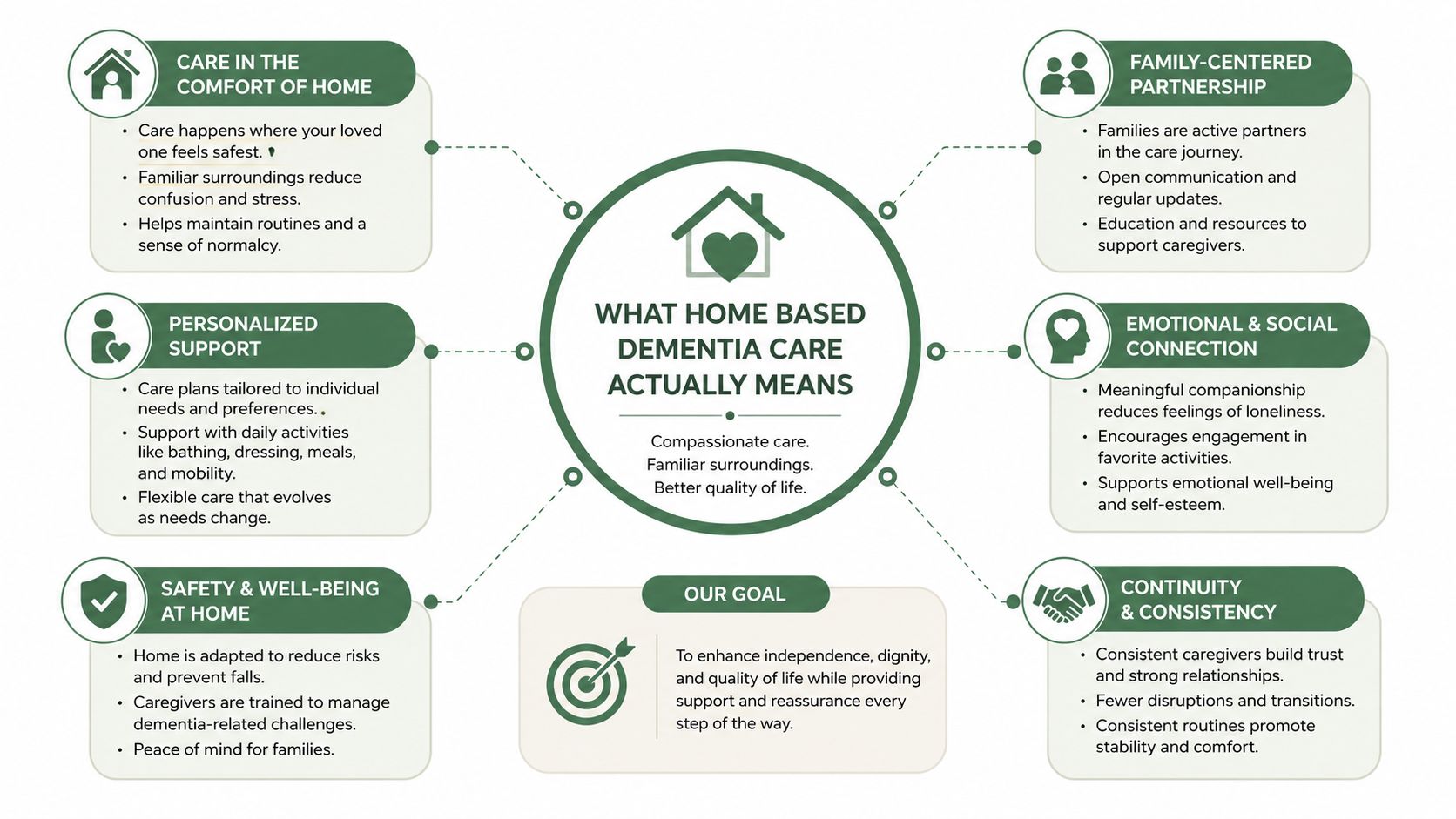
Home based dementia care means the person lives in their own home while support comes to them in different forms. Some support is clinical. Some is practical. Some is social. Some is structured cognitive contact by phone, which matters more than many realize because routine cues do a lot of the work that memory can no longer do well.
A clean way to think about it is this, medical care keeps track of health problems, personal care gets through the day, companionship and homemaking keep the home livable, and cognitive engagement keeps the person oriented and connected. A home health nurse and a companion do not do the same job, and a family caregiver who reminds someone about lunch is not automatically catching medication drift or wandering risk.
The most useful analogy is air traffic control versus the runway. The runway is the person's home, their daily routine, and their familiar objects. Air traffic control is the system of prompts, reminders, checks, and supervision that helps them land safely when judgment and short-term memory are unreliable.
The care logic also needs to match the condition. A major review from HHS notes that home-based dementia care works best with regular reassessment of cognition, function, behavior, medical status, living environment, and safety, including watching for falls, dehydration, wandering, and medication misuse (HHS ASPE report). That's why a phone-based program can fit well. It doesn't replace in-person care, it adds a structured layer between visits.
For families comparing options, 2026 dementia care at home is a useful example of how home support is being packaged as a multi-layer service rather than a single appointment.
One more point deserves emphasis. A family can have excellent intentions and still miss the basic structure. The internal reference on companion care for elderly is useful here because companionship is only one layer, and it doesn't substitute for medication checks, safety oversight, or clinical follow-up.
The Main Types of Home Dementia Care Services
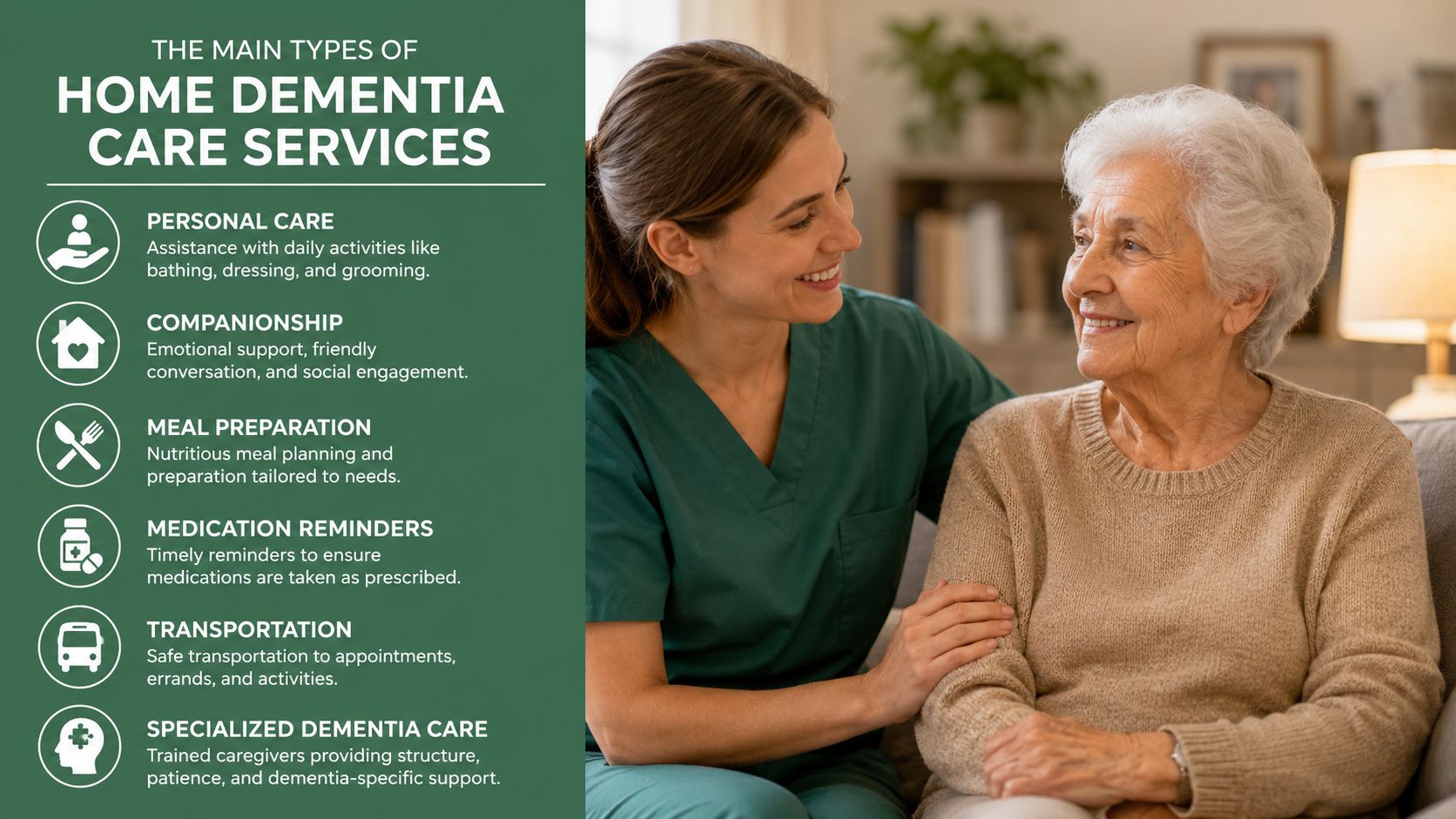
Families get into trouble when they assume “home care” means one thing. It doesn't. You're usually choosing among several service layers, then combining them around the person's actual risks.
Medical home health
This is the skilled side. Nurses, therapists, and physician-ordered services handle medication review, wound care, therapy, and other clinical needs. Medicare data show that nearly 44.4% of community-dwelling people with dementia received some type of Medicare-funded home-based clinical care over 12 months, which tells you this is already a normal layer in major markets, not a rare add-on (HHS ASPE report).
This service doesn't usually cover long companionship or all-day supervision. It's there to keep clinical problems from being ignored.
Personal care
This is the hands-on help with bathing, dressing, toileting, meals, transfers, and medication reminders. It's the layer families need when mornings are getting messy or hygiene is slipping. A good personal care aide does routine well. They are not a substitute for a nurse, and they shouldn't be expected to solve complex behavioral problems on the fly.
Companionship and homemaking
This covers conversation, light housekeeping, meal prep, errands, and a bit of structure so the day doesn't go completely off the rails. It's useful, but it has limits. A companion may notice that someone is lonely or agitated, but that doesn't mean they're trained to interpret medication misuse or escalating confusion.
Structured cognitive support
A phone-based program fits well here. Regular calls with orientation cues, reminiscence, and practical check-ins give the person repeated contact without the burden of devices or apps. Research on home dementia support notes that assistive approaches can support communication, daily activities, and risk reduction, while also reducing cognitive load when care is delivered in a familiar routine (PMC review).
Bottom line: don't hire for “dementia care” in the abstract. Hire for the exact gap, then layer the rest around it.
For families who want a concrete example, phone-based programs like Velma fit into the cognitive support layer by delivering scheduled calls, guided exercises, and check-ins that help families see what's changing between visits.
How to Assess Needs Before You Hire Anyone
Start with the person, not the provider. If you don't know what's failing, you'll buy the wrong service and blame the agency for doing the wrong job.
The four domains that matter
Cognitive and behavioral issues show up first as missed appointments, repeating the same question, getting lost in familiar places, suspiciousness, or anxiety. Safety issues are the next filter, especially falls, wandering, stove problems, medication mistakes, or unsafe driving. Daily living covers bathing, dressing, toileting, eating, and managing money. Social and emotional strain shows up as loneliness, withdrawal, irritability, or a home that's become silent and empty.
Here's the hard part. A one-time conversation won't do it. Dementia changes, so the map changes too. Families should revisit the assessment every few months, or sooner if there's a fall, a new medication problem, or a sharp change in mood.
Domain | Warning Signs to Watch For | Service Layer That Helps |
|---|---|---|
Cognitive and behavioral | Repeated questions, confusion about time, poor judgment, anxiety | Structured cognitive support, clinical review |
Safety and environment | Wandering, falls, stove risk, medication errors | Home safety changes, personal care, family oversight |
Daily living | Bathing resistance, missed meals, clothing confusion, bill problems | Personal care, homemaking, family management |
Social and emotional | Isolation, agitation, flat mood, loss of routine | Companionship, phone-based engagement, respite |
If you want a simple rule, use this one. When the warning signs start affecting more than one domain, the family needs more than a single helper. It needs a coordinated plan.
Comparing In-Home Care Models Side by Side
Families usually ask the wrong question first. They ask whether home care beats a facility. The better question is which mix covers the day without leaving gaps that turn into crises.
Family-only care looks cheapest on paper, and it breaks fastest in real life. It works only when several people share the load and keep sharing it, which is hard to sustain without resentment, missed handoffs, or simple exhaustion. Private-duty agencies fill specific shifts, such as mornings, afternoons, or live-in coverage, so they give families flexibility. Their value depends on the worker who shows up and whether that worker is trained for dementia care, not just general personal care.
Medicare-certified home health belongs in the medical lane. It handles skilled nursing or therapy needs, medication review when ordered, and short-term clinical support. It does not replace day-to-day supervision, meals, or companionship. Adult day programs solve a different problem. They give the person structure, activity, and supervision while out in the community, but they do nothing for the long evenings and empty hours at home.
A phone-based cognitive support program fits alongside those services. It does not bathe anyone or make lunch. It does give repeated orientation, a steady point of contact, and a written trail of changes family members can respond to. That matters when the person is home alone for stretches, because small shifts in confusion, mood, or routine can get missed until they become bigger problems.
The strongest care plans combine morning and afternoon supports rather than relying on one provider to do everything. A morning aide can handle bathing and breakfast. A nurse can check medications and flag clinical concerns. A scheduled phone program can reach the person during the afternoon slump, when confusion and anxiety often get worse. Family can then handle the parts that require judgment, trust, and knowledge of the person's history.
The internal guide on Medicare coverage for dementia care is worth using when you are deciding which layer insurance may support.
Safety, Legal, and Financial Considerations Families Should Not Skip
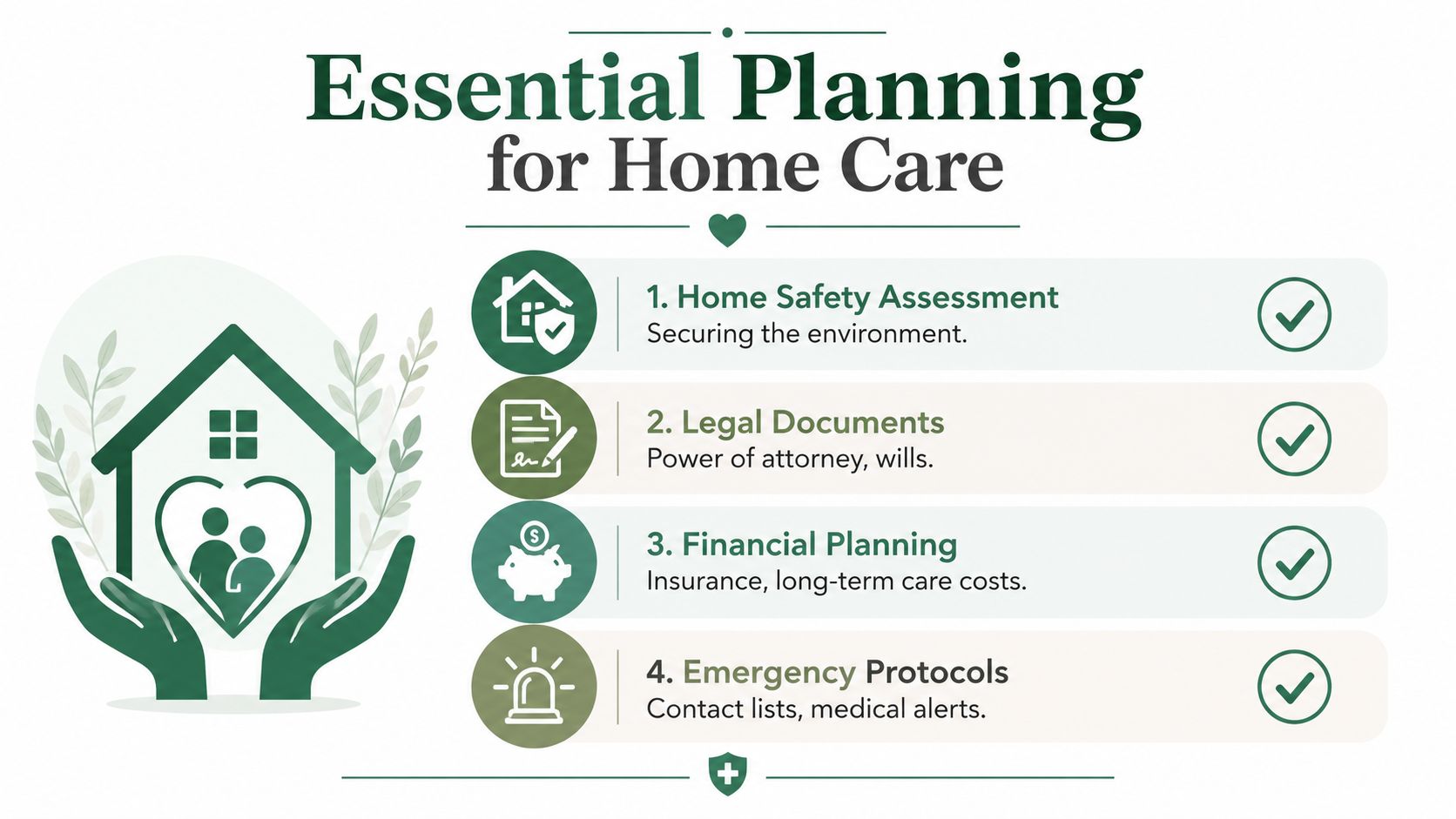
The polished version of home based dementia care talks about companionship and reminders. The version that holds up in real life starts with locks, documents, and clear authority when the person can no longer make every decision.
Home safety changes come first. Grab bars, better lighting, stove shut-offs, medication lock boxes, and door alarms are practical fixes, not extras. Driving needs the same blunt attention. Once there is a pattern of getting lost, near misses, or confusion behind the wheel, the family has to address it directly and stop treating it as a future problem.
Legal preparation should happen before a crisis. Advance directives, durable power of attorney for health care, and durable power of attorney for finances need to be in place while the person can still take part. If families wait too long, they often end up arguing in the middle of a crisis about decisions that should have been settled calmly.
Practical rule: if you do not know who can speak for the person in a hospital or with a bank, you are already behind.
Benefit rules matter just as much. Families need to know whether the person qualifies for Medicare home health, whether Medicaid HCBS waivers may apply, and whether veterans' benefits belong in the plan. The internal guide on Medicare coverage for dementia care helps families sort out which layer insurance may support. If relatives disagree about what serves the person's interests, use the best interest guidance by Pauline Vuyelwa Muswere-Enagbonma to keep the discussion anchored in the person's needs, not family politics.
Caregiver burnout belongs in the same conversation because it is not a side issue. CDC caregiver data show that family caregiving often stretches over long periods, which means families cannot improvise forever. Build respite into the plan from the start, and pair it with whatever mix of hands-on help, nurse oversight, and phone-based support keeps the week from falling apart.
A Realistic 30-Day Plan to Set Up Home Based Dementia Care
Week one, walk the house and write down risks. Check the stove, bathroom, doors, medication storage, trip hazards, and any places the person gets stuck or confused. At the same time, make a quick list of what's failing, meals, bathing, appointments, meds, or loneliness.
Week two, handle the legal and financial basics. Confirm the health care proxy, financial authority, insurance details, and any benefits that may apply. If the person can still sign documents and participate, do it now.
Week three, interview providers and test them. Ask each agency what dementia training they have, what they do when confusion escalates, and how they document concerns. Try a short period of service before locking into a longer arrangement.
Week four, set a weekly rhythm that matches the day's weak spots.
Morning: personal care for bathing, breakfast, and medication prompts.
Midweek: clinical review or nurse check if there are medication or wound issues.
Afternoon: scheduled phone-based cognitive calls or companion contact to cover the lonely hours.
Weekend: family review of what changed, what was missed, and what needs adjustment.
Keep it simple. The plan should reduce friction, not create a second full-time job for the adult child.
Frequently Asked Questions About Home Based Dementia Care
How often should the plan be reassessed? At least every few months, and sooner after a fall, a medication issue, or a noticeable change in mood or confusion. Dementia isn't stable, so the care plan can't be either.
What red flags mean the home setup is no longer enough? Repeated wandering, unsafe wandering risk, frequent falls, refusal of essential help, or caregivers who are so exhausted they can't keep going safely. At that point, the question isn't whether the family “failed.” It's whether the current model still fits.
How can you tell if a paid caregiver or program is helping? Look for fewer missed tasks, calmer transitions, better routine adherence, and cleaner communication between the caregiver and the family. If nobody can name what changed after a few weeks, the service may be too vague.
When should you consider a facility instead of more home support? When safety can't be kept up despite reasonable home changes and layered support, or when the care needs exceed what the family and paid helpers can reliably coordinate. A move isn't a moral failure. It's a practical decision.
How do you talk to a parent who resists outside help? Don't sell it as surrender. Tie the help to specific pain points, better mornings, fewer arguments, safer nights, less burden on family. People resist abstract loss, but they usually understand relief.
If the home plan is working, the house gets quieter in the right way. Fewer surprises. Fewer missed details. More ordinary days.
Velma gives families a structured phone-based layer for the hours that are hardest to cover, especially when a parent still lives at home but needs more than an occasional check-in. If you're building a care plan around routine, orientation, and daily contact, visit Velma and see how scheduled cognitive support can fit beside family, clinical, and personal care.
Your mother says she's fine, but she's missed two appointments, the stove was left on twice, and you're hearing the same question every time you call. You're trying to do the right thing from a distance, and you already know this isn't just about “getting help.” It's about coordinating a mix of family effort, paid support, medical oversight, and steady cognitive contact so the home stays safe enough for the person you love.
That's the core job of home based dementia care. It's not one service you buy, it's a system you build around a changing condition. The families who do this well stop asking, “Which agency is best?” and start asking, “What's missing on Tuesday afternoons, who catches medication mistakes, and who notices when confusion is getting worse?” If caregiver strain is already showing up in your house, the practical advice in caregiver stress and burnout is worth reading alongside this.
For many families, this is also where emotional health gets overlooked. If dementia care is colliding with depression, grief, or chronic stress in the household, a local resource like depression treatment Vernon BC can be part of the larger support plan, especially when one exhausted spouse or adult child is carrying too much.
Table of Contents
The Reality of Caring for Someone With Dementia at Home
What Home Based Dementia Care Actually Means
The Main Types of Home Dementia Care Services
Medical home health
Personal care
Companionship and homemaking
Structured cognitive support
How to Assess Needs Before You Hire Anyone
The four domains that matter
Comparing In-Home Care Models Side by Side
Safety, Legal, and Financial Considerations Families Should Not Skip
A Realistic 30-Day Plan to Set Up Home Based Dementia Care
Frequently Asked Questions About Home Based Dementia Care
The Reality of Caring for Someone With Dementia at Home
The first warning sign usually shows up in an ordinary moment. An adult daughter is standing in the kitchen with a calendar open, trying to line up her father's rides, medications, meals, and an afternoon check-in because he is alone more than he should be after lunch. He wants to stay home. The family wants that too. It only works if someone is handling the details every day.
That is the core work of home based dementia care. Families have to coordinate medical support, personal care, companionship, and steady cognitive contact so the person can keep living at home without the whole setup falling apart. The CDC's caregiving overview shows how many unpaid caregivers are already carrying that load in the U.S., and a separate CDC dataset on dementia caregiving puts the scale of home care in plain terms, with the vast majority of people with dementia receiving care at home (CDC caregiving overview, CDC dementia caregiving data). That scale matters because it shows the pattern families keep repeating. They are already doing pieces of the job, just without a system.
If you are relying on memory, goodwill, and a series of urgent phone calls, you do not have a care plan. You have a scramble.
The job is to cover four pillars at once, medical support, personal care, companionship, and structured cognitive engagement. A home health nurse does not do the same work as a companion. A family member who reminds someone about lunch is not automatically catching medication drift, wandering risk, or a change in judgment. Phone-based cognitive programs fit into this same structure, because regular prompts and familiar conversation help a person stay oriented when short-term memory is slipping. When those pieces are coordinated, people can often remain at home with less chaos. When they are not, the same crisis keeps coming back.
Canada shows the same pattern. Many seniors with dementia live at home, and the care load is carried by families, not by wishful thinking. CIHI also points to the scale of unpaid help, including 82 billion hours of informal care in the cited year. Home care works when support is reliable and coordinated. It fails when everyone assumes the next person will notice the problem first.
What Home Based Dementia Care Actually Means
Home based dementia care means the person lives in their own home while support comes to them in different forms. Some support is clinical. Some is practical. Some is social. Some is structured cognitive contact by phone, which matters more than many realize because routine cues do a lot of the work that memory can no longer do well.
A clean way to think about it is this, medical care keeps track of health problems, personal care gets through the day, companionship and homemaking keep the home livable, and cognitive engagement keeps the person oriented and connected. A home health nurse and a companion do not do the same job, and a family caregiver who reminds someone about lunch is not automatically catching medication drift or wandering risk.
The most useful analogy is air traffic control versus the runway. The runway is the person's home, their daily routine, and their familiar objects. Air traffic control is the system of prompts, reminders, checks, and supervision that helps them land safely when judgment and short-term memory are unreliable.
The care logic also needs to match the condition. A major review from HHS notes that home-based dementia care works best with regular reassessment of cognition, function, behavior, medical status, living environment, and safety, including watching for falls, dehydration, wandering, and medication misuse (HHS ASPE report). That's why a phone-based program can fit well. It doesn't replace in-person care, it adds a structured layer between visits.
For families comparing options, 2026 dementia care at home is a useful example of how home support is being packaged as a multi-layer service rather than a single appointment.
One more point deserves emphasis. A family can have excellent intentions and still miss the basic structure. The internal reference on companion care for elderly is useful here because companionship is only one layer, and it doesn't substitute for medication checks, safety oversight, or clinical follow-up.
The Main Types of Home Dementia Care Services
Families get into trouble when they assume “home care” means one thing. It doesn't. You're usually choosing among several service layers, then combining them around the person's actual risks.
Medical home health
This is the skilled side. Nurses, therapists, and physician-ordered services handle medication review, wound care, therapy, and other clinical needs. Medicare data show that nearly 44.4% of community-dwelling people with dementia received some type of Medicare-funded home-based clinical care over 12 months, which tells you this is already a normal layer in major markets, not a rare add-on (HHS ASPE report).
This service doesn't usually cover long companionship or all-day supervision. It's there to keep clinical problems from being ignored.
Personal care
This is the hands-on help with bathing, dressing, toileting, meals, transfers, and medication reminders. It's the layer families need when mornings are getting messy or hygiene is slipping. A good personal care aide does routine well. They are not a substitute for a nurse, and they shouldn't be expected to solve complex behavioral problems on the fly.
Companionship and homemaking
This covers conversation, light housekeeping, meal prep, errands, and a bit of structure so the day doesn't go completely off the rails. It's useful, but it has limits. A companion may notice that someone is lonely or agitated, but that doesn't mean they're trained to interpret medication misuse or escalating confusion.
Structured cognitive support
A phone-based program fits well here. Regular calls with orientation cues, reminiscence, and practical check-ins give the person repeated contact without the burden of devices or apps. Research on home dementia support notes that assistive approaches can support communication, daily activities, and risk reduction, while also reducing cognitive load when care is delivered in a familiar routine (PMC review).
Bottom line: don't hire for “dementia care” in the abstract. Hire for the exact gap, then layer the rest around it.
For families who want a concrete example, phone-based programs like Velma fit into the cognitive support layer by delivering scheduled calls, guided exercises, and check-ins that help families see what's changing between visits.
How to Assess Needs Before You Hire Anyone
Start with the person, not the provider. If you don't know what's failing, you'll buy the wrong service and blame the agency for doing the wrong job.
The four domains that matter
Cognitive and behavioral issues show up first as missed appointments, repeating the same question, getting lost in familiar places, suspiciousness, or anxiety. Safety issues are the next filter, especially falls, wandering, stove problems, medication mistakes, or unsafe driving. Daily living covers bathing, dressing, toileting, eating, and managing money. Social and emotional strain shows up as loneliness, withdrawal, irritability, or a home that's become silent and empty.
Here's the hard part. A one-time conversation won't do it. Dementia changes, so the map changes too. Families should revisit the assessment every few months, or sooner if there's a fall, a new medication problem, or a sharp change in mood.
Domain | Warning Signs to Watch For | Service Layer That Helps |
|---|---|---|
Cognitive and behavioral | Repeated questions, confusion about time, poor judgment, anxiety | Structured cognitive support, clinical review |
Safety and environment | Wandering, falls, stove risk, medication errors | Home safety changes, personal care, family oversight |
Daily living | Bathing resistance, missed meals, clothing confusion, bill problems | Personal care, homemaking, family management |
Social and emotional | Isolation, agitation, flat mood, loss of routine | Companionship, phone-based engagement, respite |
If you want a simple rule, use this one. When the warning signs start affecting more than one domain, the family needs more than a single helper. It needs a coordinated plan.
Comparing In-Home Care Models Side by Side
Families usually ask the wrong question first. They ask whether home care beats a facility. The better question is which mix covers the day without leaving gaps that turn into crises.
Family-only care looks cheapest on paper, and it breaks fastest in real life. It works only when several people share the load and keep sharing it, which is hard to sustain without resentment, missed handoffs, or simple exhaustion. Private-duty agencies fill specific shifts, such as mornings, afternoons, or live-in coverage, so they give families flexibility. Their value depends on the worker who shows up and whether that worker is trained for dementia care, not just general personal care.
Medicare-certified home health belongs in the medical lane. It handles skilled nursing or therapy needs, medication review when ordered, and short-term clinical support. It does not replace day-to-day supervision, meals, or companionship. Adult day programs solve a different problem. They give the person structure, activity, and supervision while out in the community, but they do nothing for the long evenings and empty hours at home.
A phone-based cognitive support program fits alongside those services. It does not bathe anyone or make lunch. It does give repeated orientation, a steady point of contact, and a written trail of changes family members can respond to. That matters when the person is home alone for stretches, because small shifts in confusion, mood, or routine can get missed until they become bigger problems.
The strongest care plans combine morning and afternoon supports rather than relying on one provider to do everything. A morning aide can handle bathing and breakfast. A nurse can check medications and flag clinical concerns. A scheduled phone program can reach the person during the afternoon slump, when confusion and anxiety often get worse. Family can then handle the parts that require judgment, trust, and knowledge of the person's history.
The internal guide on Medicare coverage for dementia care is worth using when you are deciding which layer insurance may support.
Safety, Legal, and Financial Considerations Families Should Not Skip
The polished version of home based dementia care talks about companionship and reminders. The version that holds up in real life starts with locks, documents, and clear authority when the person can no longer make every decision.
Home safety changes come first. Grab bars, better lighting, stove shut-offs, medication lock boxes, and door alarms are practical fixes, not extras. Driving needs the same blunt attention. Once there is a pattern of getting lost, near misses, or confusion behind the wheel, the family has to address it directly and stop treating it as a future problem.
Legal preparation should happen before a crisis. Advance directives, durable power of attorney for health care, and durable power of attorney for finances need to be in place while the person can still take part. If families wait too long, they often end up arguing in the middle of a crisis about decisions that should have been settled calmly.
Practical rule: if you do not know who can speak for the person in a hospital or with a bank, you are already behind.
Benefit rules matter just as much. Families need to know whether the person qualifies for Medicare home health, whether Medicaid HCBS waivers may apply, and whether veterans' benefits belong in the plan. The internal guide on Medicare coverage for dementia care helps families sort out which layer insurance may support. If relatives disagree about what serves the person's interests, use the best interest guidance by Pauline Vuyelwa Muswere-Enagbonma to keep the discussion anchored in the person's needs, not family politics.
Caregiver burnout belongs in the same conversation because it is not a side issue. CDC caregiver data show that family caregiving often stretches over long periods, which means families cannot improvise forever. Build respite into the plan from the start, and pair it with whatever mix of hands-on help, nurse oversight, and phone-based support keeps the week from falling apart.
A Realistic 30-Day Plan to Set Up Home Based Dementia Care
Week one, walk the house and write down risks. Check the stove, bathroom, doors, medication storage, trip hazards, and any places the person gets stuck or confused. At the same time, make a quick list of what's failing, meals, bathing, appointments, meds, or loneliness.
Week two, handle the legal and financial basics. Confirm the health care proxy, financial authority, insurance details, and any benefits that may apply. If the person can still sign documents and participate, do it now.
Week three, interview providers and test them. Ask each agency what dementia training they have, what they do when confusion escalates, and how they document concerns. Try a short period of service before locking into a longer arrangement.
Week four, set a weekly rhythm that matches the day's weak spots.
Morning: personal care for bathing, breakfast, and medication prompts.
Midweek: clinical review or nurse check if there are medication or wound issues.
Afternoon: scheduled phone-based cognitive calls or companion contact to cover the lonely hours.
Weekend: family review of what changed, what was missed, and what needs adjustment.
Keep it simple. The plan should reduce friction, not create a second full-time job for the adult child.
Frequently Asked Questions About Home Based Dementia Care
How often should the plan be reassessed? At least every few months, and sooner after a fall, a medication issue, or a noticeable change in mood or confusion. Dementia isn't stable, so the care plan can't be either.
What red flags mean the home setup is no longer enough? Repeated wandering, unsafe wandering risk, frequent falls, refusal of essential help, or caregivers who are so exhausted they can't keep going safely. At that point, the question isn't whether the family “failed.” It's whether the current model still fits.
How can you tell if a paid caregiver or program is helping? Look for fewer missed tasks, calmer transitions, better routine adherence, and cleaner communication between the caregiver and the family. If nobody can name what changed after a few weeks, the service may be too vague.
When should you consider a facility instead of more home support? When safety can't be kept up despite reasonable home changes and layered support, or when the care needs exceed what the family and paid helpers can reliably coordinate. A move isn't a moral failure. It's a practical decision.
How do you talk to a parent who resists outside help? Don't sell it as surrender. Tie the help to specific pain points, better mornings, fewer arguments, safer nights, less burden on family. People resist abstract loss, but they usually understand relief.
If the home plan is working, the house gets quieter in the right way. Fewer surprises. Fewer missed details. More ordinary days.
Velma gives families a structured phone-based layer for the hours that are hardest to cover, especially when a parent still lives at home but needs more than an occasional check-in. If you're building a care plan around routine, orientation, and daily contact, visit Velma and see how scheduled cognitive support can fit beside family, clinical, and personal care.
Suggested Article: