Sleep Problems in Dementia Patients: A Caregiver Guide

You're asleep in the next room, or trying to be, and you hear it again. A floorboard creaks. Then another. By 2 a.m., you're sitting up, listening for footsteps, waiting to see whether your parent, spouse, or patient is awake, confused, wandering, or breathing strangely enough to worry you. That's the part most families live with first, the vigilance, the interrupted nights, the sense that sleep has become everyone's problem.
Treat that pattern as a clinical issue, not a nuisance. Sleep problems in dementia patients are common, often multifactorial, and tightly tied to the person's brain changes, other illnesses, medications, and the caregiver's own exhaustion. A 2022 review found sleep-disturbance symptoms in 26% of community-dwelling people with dementia and clinically significant sleep disturbance in 19% across 2,719 participants, while a separate review of 55 studies found 38% prevalence in nursing homes by symptoms and 20% by clinical measures PubMed review. Those numbers are enough to make one thing clear, this is not rare, and it's not something to shrug off.
Table of Contents
Why Sleep Changes When Dementia Enters the Picture
The brain is not keeping a clean day-night rhythm anymore
The type of dementia matters more than most families realize
The Main Types of Sleep Problems Families See
Insomnia and fragmented sleep
Daytime sleepiness
Sleep-disordered breathing
REM sleep behavior disorder and restless legs syndrome
Sundowning-related agitation
Assessing the Problem Before Treating It
Start with primary sleep disorders, not assumptions
Review medications and medical triggers next
Track the whole day, not just the night
Evidence-Based Non-Drug Strategies for Dementia Sleep
Use light and movement early in the day
Build in engagement, not just supervision
Keep the schedule boring
Medications, Supplements, and When to Involve a Clinician
Compare the options head to head
Know the red flags
Daytime Engagement as a Nighttime Strategy
Structure the day so the night has a chance
Use human contact to break the loneliness loop
Keep the evening quiet but not empty
Caregiver Sleep, Hypervigilance, and Overnight Safety
Protect the caregiver first, because the patient depends on that
Ask for respite before you break
Questions Families Ask Most Often
Why Sleep Changes When Dementia Enters the Picture
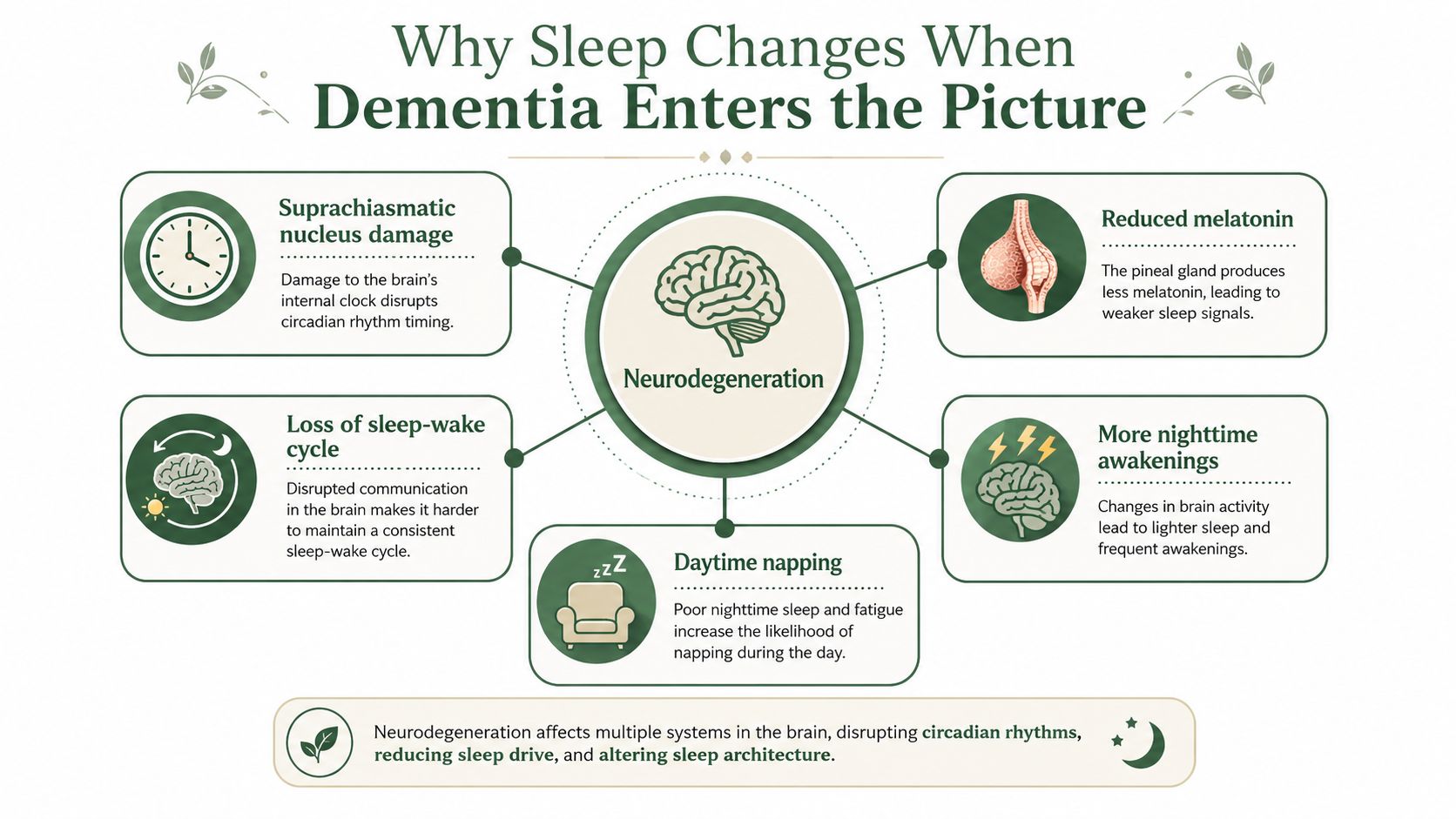
The first mistake families make is calling every rough night “just dementia.” That is too casual, and it hides problems that can be treated. Dementia can damage the brain circuits that regulate the sleep-wake cycle, but the same restless night can also come from pain, depression, medications, urinary urgency, or another sleep disorder layered on top.
You need to separate the dementia effect from the rest of the picture. If you skip that step, you end up chasing bedtime habits while the cause keeps going.
The brain is not keeping a clean day-night rhythm anymore
When dementia reaches the systems that organize circadian timing, the person often loses the clean handoff between daytime alertness and nighttime sleep. The result is broken sleep, daytime napping, and a clock that drifts farther off each week. A PubMed review reports that sleep disturbance is common in people with cognitive impairment and dementia, and that early-stage disease is not spared.
That does not mean the person is choosing to stay awake. It means the body's internal schedule is failing. Reduced daytime structure makes it worse, because an under-stimulated day gives the brain less reason to consolidate sleep at night.
Practical rule: If nights are getting worse, look at the day too.
The type of dementia matters more than most families realize
Sleep disruption is not evenly distributed across dementia types. Practical Neurology reports substantial subtype differences in sleep-apnea risk, including 53.9% in Alzheimer's disease, 74.4% in vascular dementia, 68% in frontotemporal dementia, and 76% in Lewy body or Parkinson's disease dementia Practical Neurology.
That matters because the sleep pattern can point toward the underlying disease. A person who kicks, yells, or acts out dreams is not having a generic “senior moment.” That can fit a specific sleep disorder tied to a specific dementia subtype. It also changes how hard the night becomes for the caregiver, because the person on the other side of the bed is dealing with broken rest, too.
The Main Types of Sleep Problems Families See
Families usually describe the chaos first, not the diagnosis. They say, “She's up all night,” or “He sleeps all day,” or “They keep thrashing around and scaring the whole house.” Those descriptions are useful, but they need a label. The next step depends on which pattern you are seeing, and the caregiver's experience matters just as much as the patient's.
Insomnia and fragmented sleep
This is the classic version. Falling asleep is hard, waking is frequent, and the person never looks rested. In more severe dementia, the sleep-wake cycle can become so broken that the person is neither continuously awake nor asleep for a full hour across a 24-hour period, according to a review summarized in Practical Neurology. That kind of fragmentation usually brings agitation with it, and it also means the caregiver is up half the night checking doors, listening, and trying to settle things down.
Daytime sleepiness
Excessive daytime sleepiness is often the flip side of poor nighttime sleep. The person dozes off in a chair, skips activities, then stays awake when the household wants quiet. In a multicenter study cited by Practical Neurology, 50.1% had excessive daytime sleepiness, which is one reason the “they're just lazy” explanation is wrong and unhelpful. It also drains the caregiver, because a sleepy day often turns into a harder evening.
Sleep-disordered breathing
Loud snoring, gasping, choking, or witnessed pauses in breathing point to possible obstructive sleep apnea. In that same source, sleep-disordered breathing showed up in 60% of people with mild cognitive impairment or dementia, and sleep apnea risk was especially high in vascular dementia and Lewy body or Parkinson's disease dementia. This is one of the most important patterns to name because it is medical, not a personality problem and not simple bedtime resistance.
REM sleep behavior disorder and restless legs syndrome
REM sleep behavior disorder means acting out dreams, kicking, punching, yelling, or thrashing during sleep. In the multicenter study, 22.6% had REM sleep behavior disorder and 6.1% had restless legs syndrome. In Lewy body dementia, REM sleep behavior disorder is especially important, and families should take it seriously. It puts both the patient and the bed partner at risk, and it can make the whole bedroom feel unsafe.
Sundowning-related agitation
Late-day agitation often gets bundled into sleep complaints because the whole evening falls apart. That is fair, but the timing is not the same as the problem. Anxiety, confusion, and agitation can make bedtime resistance look like insomnia, which is why a clear nighttime pattern matters.
For a plain-language companion piece on the anxiety side of this picture, see how to reduce anxiety in dementia patients.
Assessing the Problem Before Treating It
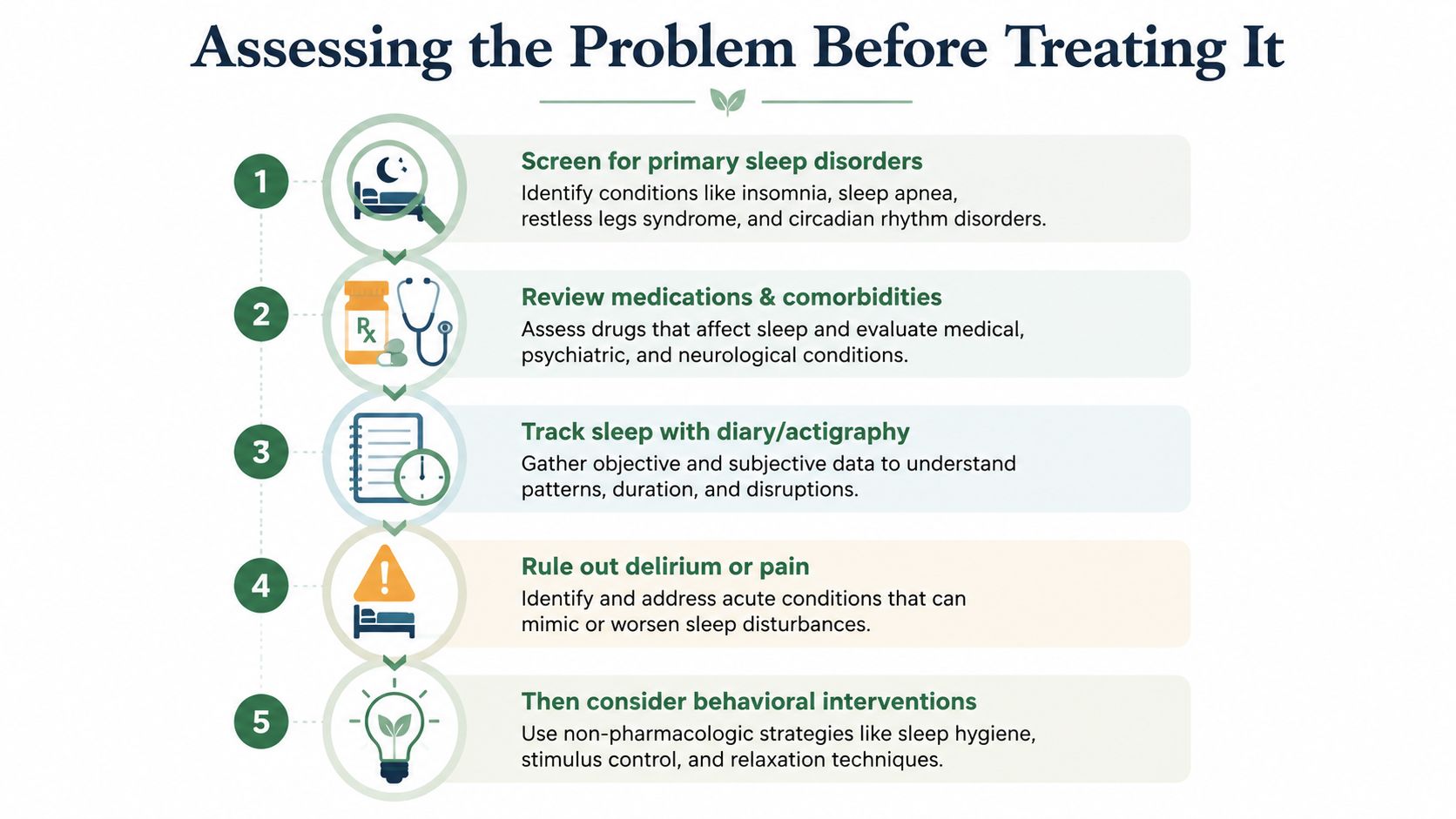
Most families start with bedtime routines like chamomile tea and white noise machines. I don't. The first move is to sort out the sleep problem itself, because the wrong label leads to the wrong fix, and the wrong fix wastes everyone's energy. A person waking from untreated apnea will not get better because the room is quieter. A person with pain will not improve because the pillow smells calming.
Start with primary sleep disorders, not assumptions
If you hear snoring, gasping, pauses in breathing, punching during dreams, or an irresistible urge to move the legs at night, ask for evaluation of a primary sleep disorder. The same goes for a sudden change in sleep that does not fit the person's usual dementia pattern. Major reviews recommend assessing and treating primary sleep disorders first, then looking at comorbidities and medications, because nighttime waking in dementia is often caused by more than one thing at once PMC review.
A sleep study is worth discussing when breathing pauses, loud snoring, or dream-enactment behavior shows up. Do not let anyone write that off as ordinary aging or “just dementia.”
Review medications and medical triggers next
Some prescriptions make nighttime worse, some daytime symptoms are side effects, and some “sleep problems” are really pain, depression, or delirium in disguise. Antihistamines, sedatives, antidepressants with sedating properties, and other common drugs can muddy the picture. If the sleep change started after a medication change, that timing matters.
Clinician script: “We need to rule out apnea, restless legs, pain, depression, and delirium before we call this dementia-related sleep disruption.”
Track the whole day, not just the night
A sleep diary is simple and useful. So is actigraphy when it's available. What you want is the full 24-hour pattern, naps, meals, activity, light exposure, agitation, and bedtime behavior. Families often discover that the person is exhausted because the day is empty, over-napped, or physically uncomfortable.
This is also the point to ask for a depression screen, a pain review, and a medication review if those have not already happened. If the person is suddenly much worse, or confusion changed overnight, that is not routine sleep trouble. It needs a medical check-in.
Evidence-Based Non-Drug Strategies for Dementia Sleep
The wrong non-drug advice is usually too vague. “Keep a routine,” “limit naps,” and “avoid caffeine” are not wrong, they are just incomplete and often too weak on their own. Dementia-related sleep disruption needs a layered approach, one that treats the person and the caregiver as a unit. The point is to build a day that gives the body a clear signal to sleep at night.
Use light and movement early in the day
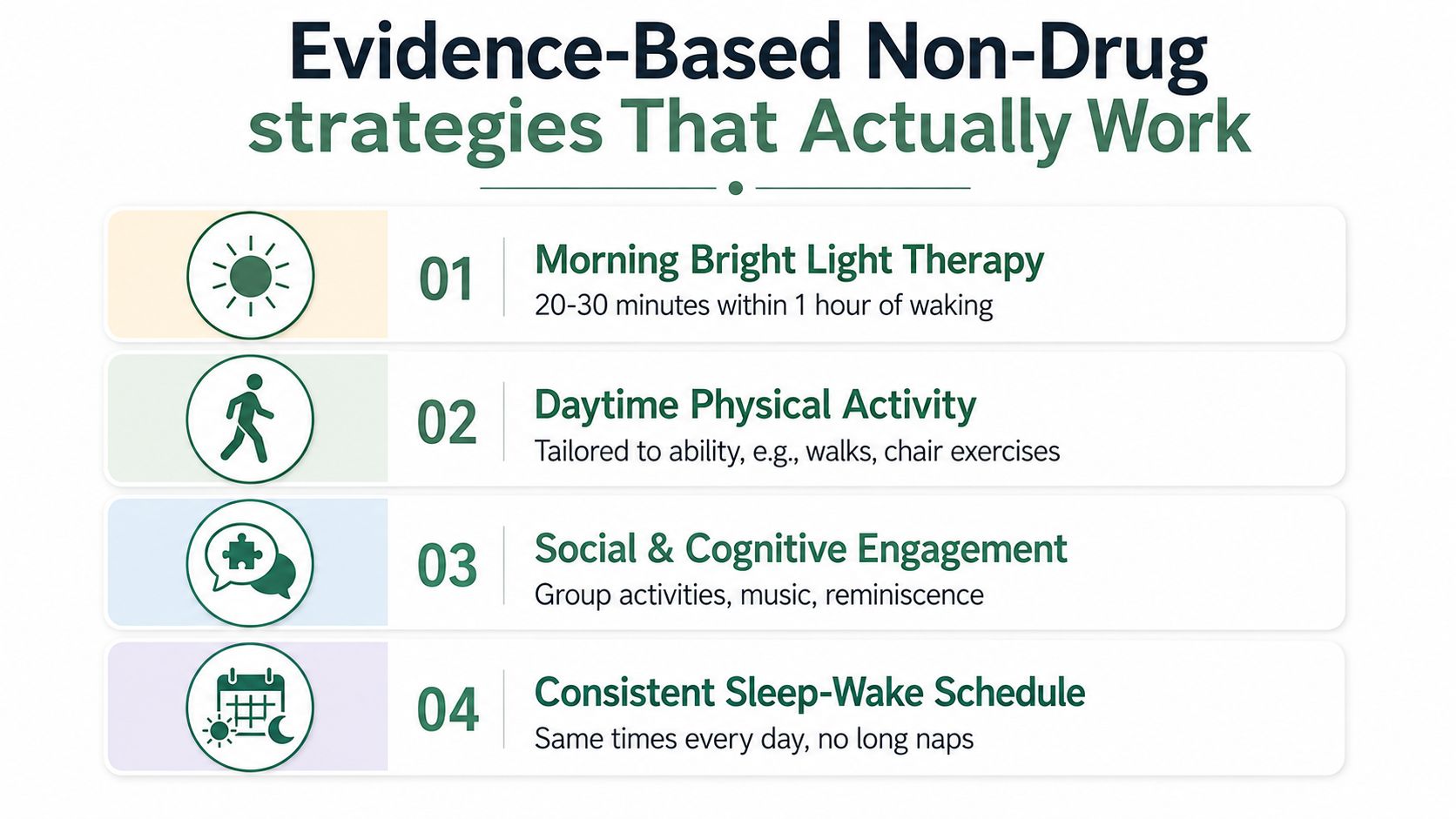
Morning bright light helps anchor the day. So does movement, even if it is only a short walk or chair exercises. The point is not fitness. It is signal strength. A stronger daytime signal makes nighttime sleep more likely to consolidate.
Families overcomplicate this. Put the light and activity early, before the person gets tired and resistant. Once evening hits, you are already fighting the clock.
A morning walk, breakfast by a bright window, or time outside can do more than another night of arguing about bedtime. For a different take on daytime structure and sleep, this source describes how morning light fits into a broader routine for dementia care. Pair that with a chart of evidence-based non-drug strategies, and the pattern is clear. Daytime cues matter more than bedtime speeches.
Build in engagement, not just supervision
Social contact, music, reminiscence, folding towels, watering plants, sorting cards, simple conversation. These are not nice extras. They are part of sleep treatment because boredom and isolation during the day feed nighttime wakefulness. If the person spends the day under-stimulated, the night usually pays for it.
That is also why adapted CBT for insomnia can help, when a clinician or therapist knows how to simplify it for cognitive impairment. It is not about lecturing someone into better sleep. It is about shaping the day so the body has a reason to rest at night.
Keep the schedule boring
I mean that in the best way. Same wake time, same bedtime, predictable meals, and no giant late naps. Sleep hygiene only works when it is treated like a household rule, not a suggestion.
My opinion: if you can only do two things, do morning light and daytime structure. Everything else sits on top of that.
For a practical day-structure example, see daily routines for seniors with early memory loss.
Medications, Supplements, and When to Involve a Clinician
Families want one clean answer here. There isn't one, because every sedating option in dementia brings trade-offs for the person and for the caregiver who is up with them. Some options may take the edge off sleep trouble. Some will worsen confusion, falls, or breathing problems. A prescriber should be involved before anyone starts experimenting at home.
Compare the options head to head
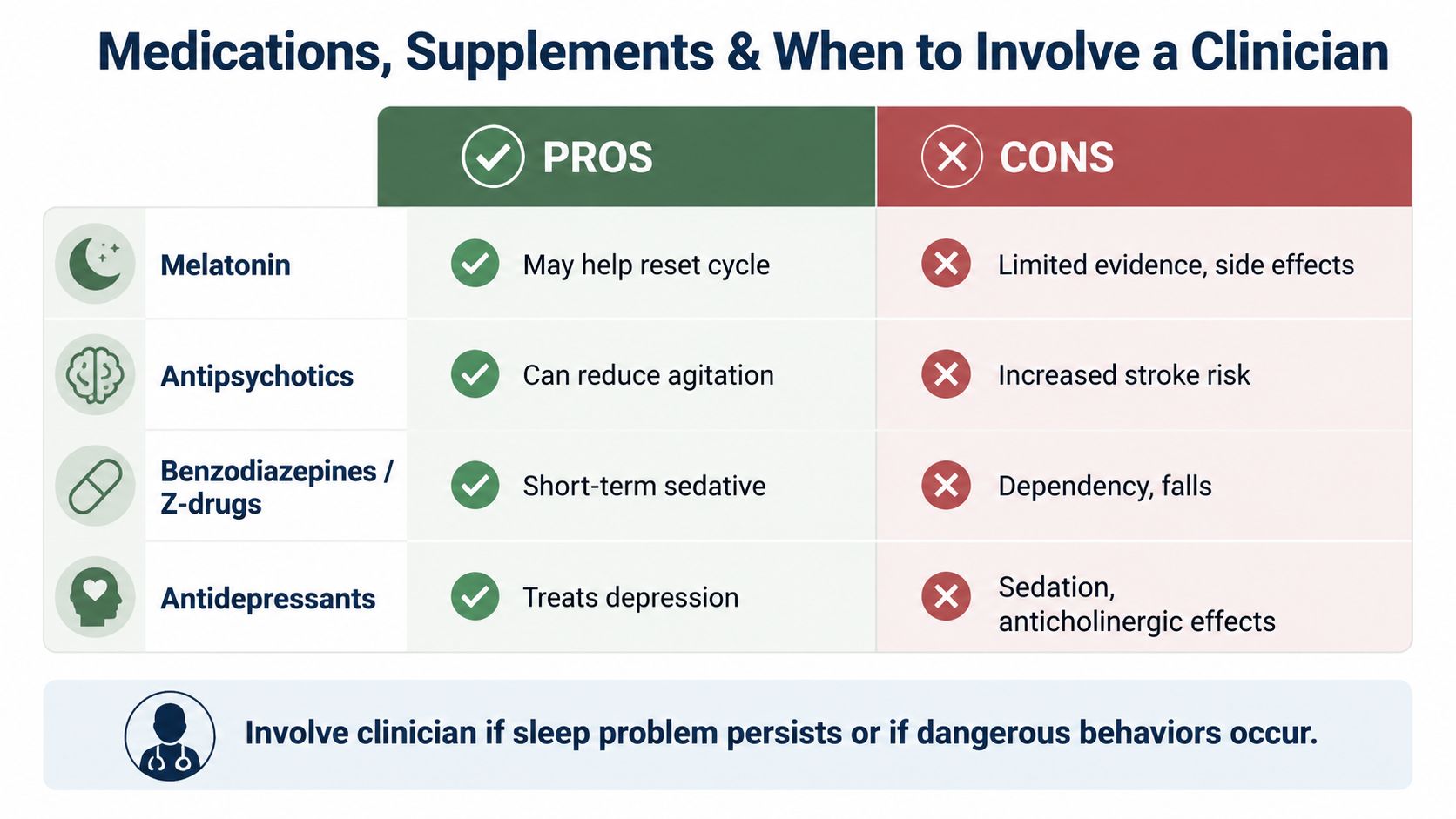
Melatonin comes up often because it may help reset the sleep-wake cycle, but it is not a cure, and the evidence is limited. It makes more sense when the pattern looks like circadian drift or REM sleep behavior disorder than when the problem is severe sleep apnea, pain, or another untreated medical issue.
Antipsychotics may reduce agitation, but they are not a sleep treatment, and they carry serious safety concerns in dementia. The FDA prescribing information includes a boxed warning about increased mortality in elderly patients with dementia-related psychosis, and the American Geriatrics Society Beers Criteria treats them as medications to avoid in many older adults with cognitive impairment except in narrow situations. A clinician who suggests one should be able to explain exactly why the expected benefit outweighs that risk for this person. See the FDA prescribing information for antipsychotics used in dementia-related psychosis and the American Geriatrics Society Beers Criteria.
Benzodiazepines and Z-drugs can sedate someone for the night, but the cost can be dependence, falls, and next-day confusion. In dementia, that trade often turns ugly fast.
Antidepressants can help when depression is part of the picture, but sedation and anticholinergic effects can work against you. If the person is already cloudy or unsteady, that matters.
Know the red flags
Call the clinician quickly if the sleep change comes with sudden confusion, hallucinations, witnessed breathing pauses, or a fall. Those are not symptoms to park on the back burner. They need an actual evaluation, not a new pillow.
If the person is wandering at night, the problem may be safety, delirium, or uncontrolled agitation, not just sleep. That is the point where urgency matters more than another home remedy.
Bottom line: if the sleep problem is dangerous, sudden, or changing fast, the answer is medical review, not a stronger bedtime routine.
Daytime Engagement as a Nighttime Strategy
A sleepy house at noon often turns into a restless house at midnight. That is not philosophy, it is pattern recognition. When the person with dementia spends most of the day inactive, disconnected, and half-napping, the night usually gets heavier, not calmer.
Structure the day so the night has a chance
Start with a predictable morning, then keep the person moving in small, realistic bursts. That can mean a short walk to the mailbox, audio-guided stretching in a chair, talking through the morning news aloud, folding laundry, or sitting outside for light and fresh air. Meals should happen at regular times, and the evening should be lower stimulation than the afternoon, not a second act of chaos.
You do not need a perfect schedule. You need enough structure that the brain can tell day from night. A steady rhythm helps the person settle, and it also helps the caregiver stop guessing what comes next.
Use human contact to break the loneliness loop
Loneliness makes daytime drag, and a dragged-out day often leaks into the evening. Scheduled phone contact, whether from family or a structured support program, can give the person something to anticipate, something to answer, and someone who notices when the day is going off the rails. For families who want a simple routine template, this guide to daily routines for people with early memory loss is worth keeping nearby.
If your person is isolated, daytime conversation is part of the intervention. Read a headline together, ask for a reaction, then move on. The point is contact, not entertainment.
Keep the evening quiet but not empty
The goal is not to exhaust the person into sleep. That backfires. The goal is to use the day to prevent the kind of evening agitation that keeps everyone awake. Light meals, hydration, gentle movement, and low-stress companionship all do more than another generic bedtime tip ever will.
A sleepy patient and a worn-down caregiver usually feed each other. If the day has no shape, the night gets harder for both of them.
Caregiver Sleep, Hypervigilance, and Overnight Safety
A spouse once told me she hadn't had a full night in two years. That is not a small complaint. That is what dementia caregiving looks like when the nights have taken over the house. Hypervigilance, repeated checking, and the constant fear of falls or wandering can turn the caregiver into the household's overnight guard.
Protect the caregiver first, because the patient depends on that
If you are sleeping with one ear open, you need a system, not just grit. Rotate nights with family if anyone else is available. Use a camera-based monitor with fall-detection alerts if it cuts down on room-checking. Clear the path from bed to bathroom, keep lighting low but visible, and remove trip hazards. If the person wanders or falls out of bed, use door alarms or other safety measures that reduce the need to patrol the house. A safer room setup also includes bedding and positioning that make transfers easier, which is where a practical resource like the Saatva adjustable bed review can help you think through comfort and positioning before you buy.
The caregiver's sleep matters because the patient depends on it.
Ask for respite before you break
Waiting until you are miserable is too late. If you are sleeping badly, losing patience, or dreading the night, that is the point to ask for backup. Read more about the warning signs of overload in caregiver stress and burnout.
Hard truth: a depleted caregiver is one of the fastest routes to unsafe care at home.
The goal is not to make the house feel clinical. It is to make the night survivable for both people. Better caregiver sleep usually means better judgment, fewer mistakes, and a calmer response when the person with dementia wakes confused.
Questions Families Ask Most Often
Is melatonin worth trying? Sometimes, especially if the person's sleep looks like a shifted body clock or dream enactment, but it's not a cure-all.
What about trazodone? It can be used by clinicians in some situations, but don't treat it like a casual sleep supplement. The person still needs a real assessment first.
Do wrist sleep trackers help? They can be useful for patterns, but they also make some caregivers obsessive. If the data makes you more anxious than informed, stop watching it so closely.
What if the person wanders at night? Focus on safety first, then ask whether delirium, pain, or a sleep disorder is driving the behavior.
When is it urgent? Sudden confusion, hallucinations, breathing pauses, and falls deserve prompt medical attention.
If the nights in your house are getting harder, don't wait for them to sort themselves out. Velma gives families structured, phone-based cognitive support that fits naturally into daily life and helps you spot changes before they snowball. Visit Velma if you want a practical layer of support for the person you're caring for, and for your own peace of mind.
You're asleep in the next room, or trying to be, and you hear it again. A floorboard creaks. Then another. By 2 a.m., you're sitting up, listening for footsteps, waiting to see whether your parent, spouse, or patient is awake, confused, wandering, or breathing strangely enough to worry you. That's the part most families live with first, the vigilance, the interrupted nights, the sense that sleep has become everyone's problem.
Treat that pattern as a clinical issue, not a nuisance. Sleep problems in dementia patients are common, often multifactorial, and tightly tied to the person's brain changes, other illnesses, medications, and the caregiver's own exhaustion. A 2022 review found sleep-disturbance symptoms in 26% of community-dwelling people with dementia and clinically significant sleep disturbance in 19% across 2,719 participants, while a separate review of 55 studies found 38% prevalence in nursing homes by symptoms and 20% by clinical measures PubMed review. Those numbers are enough to make one thing clear, this is not rare, and it's not something to shrug off.
Table of Contents
Why Sleep Changes When Dementia Enters the Picture
The brain is not keeping a clean day-night rhythm anymore
The type of dementia matters more than most families realize
The Main Types of Sleep Problems Families See
Insomnia and fragmented sleep
Daytime sleepiness
Sleep-disordered breathing
REM sleep behavior disorder and restless legs syndrome
Sundowning-related agitation
Assessing the Problem Before Treating It
Start with primary sleep disorders, not assumptions
Review medications and medical triggers next
Track the whole day, not just the night
Evidence-Based Non-Drug Strategies for Dementia Sleep
Use light and movement early in the day
Build in engagement, not just supervision
Keep the schedule boring
Medications, Supplements, and When to Involve a Clinician
Compare the options head to head
Know the red flags
Daytime Engagement as a Nighttime Strategy
Structure the day so the night has a chance
Use human contact to break the loneliness loop
Keep the evening quiet but not empty
Caregiver Sleep, Hypervigilance, and Overnight Safety
Protect the caregiver first, because the patient depends on that
Ask for respite before you break
Questions Families Ask Most Often
Why Sleep Changes When Dementia Enters the Picture
The first mistake families make is calling every rough night “just dementia.” That is too casual, and it hides problems that can be treated. Dementia can damage the brain circuits that regulate the sleep-wake cycle, but the same restless night can also come from pain, depression, medications, urinary urgency, or another sleep disorder layered on top.
You need to separate the dementia effect from the rest of the picture. If you skip that step, you end up chasing bedtime habits while the cause keeps going.
The brain is not keeping a clean day-night rhythm anymore
When dementia reaches the systems that organize circadian timing, the person often loses the clean handoff between daytime alertness and nighttime sleep. The result is broken sleep, daytime napping, and a clock that drifts farther off each week. A PubMed review reports that sleep disturbance is common in people with cognitive impairment and dementia, and that early-stage disease is not spared.
That does not mean the person is choosing to stay awake. It means the body's internal schedule is failing. Reduced daytime structure makes it worse, because an under-stimulated day gives the brain less reason to consolidate sleep at night.
Practical rule: If nights are getting worse, look at the day too.
The type of dementia matters more than most families realize
Sleep disruption is not evenly distributed across dementia types. Practical Neurology reports substantial subtype differences in sleep-apnea risk, including 53.9% in Alzheimer's disease, 74.4% in vascular dementia, 68% in frontotemporal dementia, and 76% in Lewy body or Parkinson's disease dementia Practical Neurology.
That matters because the sleep pattern can point toward the underlying disease. A person who kicks, yells, or acts out dreams is not having a generic “senior moment.” That can fit a specific sleep disorder tied to a specific dementia subtype. It also changes how hard the night becomes for the caregiver, because the person on the other side of the bed is dealing with broken rest, too.
The Main Types of Sleep Problems Families See
Families usually describe the chaos first, not the diagnosis. They say, “She's up all night,” or “He sleeps all day,” or “They keep thrashing around and scaring the whole house.” Those descriptions are useful, but they need a label. The next step depends on which pattern you are seeing, and the caregiver's experience matters just as much as the patient's.
Insomnia and fragmented sleep
This is the classic version. Falling asleep is hard, waking is frequent, and the person never looks rested. In more severe dementia, the sleep-wake cycle can become so broken that the person is neither continuously awake nor asleep for a full hour across a 24-hour period, according to a review summarized in Practical Neurology. That kind of fragmentation usually brings agitation with it, and it also means the caregiver is up half the night checking doors, listening, and trying to settle things down.
Daytime sleepiness
Excessive daytime sleepiness is often the flip side of poor nighttime sleep. The person dozes off in a chair, skips activities, then stays awake when the household wants quiet. In a multicenter study cited by Practical Neurology, 50.1% had excessive daytime sleepiness, which is one reason the “they're just lazy” explanation is wrong and unhelpful. It also drains the caregiver, because a sleepy day often turns into a harder evening.
Sleep-disordered breathing
Loud snoring, gasping, choking, or witnessed pauses in breathing point to possible obstructive sleep apnea. In that same source, sleep-disordered breathing showed up in 60% of people with mild cognitive impairment or dementia, and sleep apnea risk was especially high in vascular dementia and Lewy body or Parkinson's disease dementia. This is one of the most important patterns to name because it is medical, not a personality problem and not simple bedtime resistance.
REM sleep behavior disorder and restless legs syndrome
REM sleep behavior disorder means acting out dreams, kicking, punching, yelling, or thrashing during sleep. In the multicenter study, 22.6% had REM sleep behavior disorder and 6.1% had restless legs syndrome. In Lewy body dementia, REM sleep behavior disorder is especially important, and families should take it seriously. It puts both the patient and the bed partner at risk, and it can make the whole bedroom feel unsafe.
Sundowning-related agitation
Late-day agitation often gets bundled into sleep complaints because the whole evening falls apart. That is fair, but the timing is not the same as the problem. Anxiety, confusion, and agitation can make bedtime resistance look like insomnia, which is why a clear nighttime pattern matters.
For a plain-language companion piece on the anxiety side of this picture, see how to reduce anxiety in dementia patients.
Assessing the Problem Before Treating It
Most families start with bedtime routines like chamomile tea and white noise machines. I don't. The first move is to sort out the sleep problem itself, because the wrong label leads to the wrong fix, and the wrong fix wastes everyone's energy. A person waking from untreated apnea will not get better because the room is quieter. A person with pain will not improve because the pillow smells calming.
Start with primary sleep disorders, not assumptions
If you hear snoring, gasping, pauses in breathing, punching during dreams, or an irresistible urge to move the legs at night, ask for evaluation of a primary sleep disorder. The same goes for a sudden change in sleep that does not fit the person's usual dementia pattern. Major reviews recommend assessing and treating primary sleep disorders first, then looking at comorbidities and medications, because nighttime waking in dementia is often caused by more than one thing at once PMC review.
A sleep study is worth discussing when breathing pauses, loud snoring, or dream-enactment behavior shows up. Do not let anyone write that off as ordinary aging or “just dementia.”
Review medications and medical triggers next
Some prescriptions make nighttime worse, some daytime symptoms are side effects, and some “sleep problems” are really pain, depression, or delirium in disguise. Antihistamines, sedatives, antidepressants with sedating properties, and other common drugs can muddy the picture. If the sleep change started after a medication change, that timing matters.
Clinician script: “We need to rule out apnea, restless legs, pain, depression, and delirium before we call this dementia-related sleep disruption.”
Track the whole day, not just the night
A sleep diary is simple and useful. So is actigraphy when it's available. What you want is the full 24-hour pattern, naps, meals, activity, light exposure, agitation, and bedtime behavior. Families often discover that the person is exhausted because the day is empty, over-napped, or physically uncomfortable.
This is also the point to ask for a depression screen, a pain review, and a medication review if those have not already happened. If the person is suddenly much worse, or confusion changed overnight, that is not routine sleep trouble. It needs a medical check-in.
Evidence-Based Non-Drug Strategies for Dementia Sleep
The wrong non-drug advice is usually too vague. “Keep a routine,” “limit naps,” and “avoid caffeine” are not wrong, they are just incomplete and often too weak on their own. Dementia-related sleep disruption needs a layered approach, one that treats the person and the caregiver as a unit. The point is to build a day that gives the body a clear signal to sleep at night.
Use light and movement early in the day
Morning bright light helps anchor the day. So does movement, even if it is only a short walk or chair exercises. The point is not fitness. It is signal strength. A stronger daytime signal makes nighttime sleep more likely to consolidate.
Families overcomplicate this. Put the light and activity early, before the person gets tired and resistant. Once evening hits, you are already fighting the clock.
A morning walk, breakfast by a bright window, or time outside can do more than another night of arguing about bedtime. For a different take on daytime structure and sleep, this source describes how morning light fits into a broader routine for dementia care. Pair that with a chart of evidence-based non-drug strategies, and the pattern is clear. Daytime cues matter more than bedtime speeches.
Build in engagement, not just supervision
Social contact, music, reminiscence, folding towels, watering plants, sorting cards, simple conversation. These are not nice extras. They are part of sleep treatment because boredom and isolation during the day feed nighttime wakefulness. If the person spends the day under-stimulated, the night usually pays for it.
That is also why adapted CBT for insomnia can help, when a clinician or therapist knows how to simplify it for cognitive impairment. It is not about lecturing someone into better sleep. It is about shaping the day so the body has a reason to rest at night.
Keep the schedule boring
I mean that in the best way. Same wake time, same bedtime, predictable meals, and no giant late naps. Sleep hygiene only works when it is treated like a household rule, not a suggestion.
My opinion: if you can only do two things, do morning light and daytime structure. Everything else sits on top of that.
For a practical day-structure example, see daily routines for seniors with early memory loss.
Medications, Supplements, and When to Involve a Clinician
Families want one clean answer here. There isn't one, because every sedating option in dementia brings trade-offs for the person and for the caregiver who is up with them. Some options may take the edge off sleep trouble. Some will worsen confusion, falls, or breathing problems. A prescriber should be involved before anyone starts experimenting at home.
Compare the options head to head
Melatonin comes up often because it may help reset the sleep-wake cycle, but it is not a cure, and the evidence is limited. It makes more sense when the pattern looks like circadian drift or REM sleep behavior disorder than when the problem is severe sleep apnea, pain, or another untreated medical issue.
Antipsychotics may reduce agitation, but they are not a sleep treatment, and they carry serious safety concerns in dementia. The FDA prescribing information includes a boxed warning about increased mortality in elderly patients with dementia-related psychosis, and the American Geriatrics Society Beers Criteria treats them as medications to avoid in many older adults with cognitive impairment except in narrow situations. A clinician who suggests one should be able to explain exactly why the expected benefit outweighs that risk for this person. See the FDA prescribing information for antipsychotics used in dementia-related psychosis and the American Geriatrics Society Beers Criteria.
Benzodiazepines and Z-drugs can sedate someone for the night, but the cost can be dependence, falls, and next-day confusion. In dementia, that trade often turns ugly fast.
Antidepressants can help when depression is part of the picture, but sedation and anticholinergic effects can work against you. If the person is already cloudy or unsteady, that matters.
Know the red flags
Call the clinician quickly if the sleep change comes with sudden confusion, hallucinations, witnessed breathing pauses, or a fall. Those are not symptoms to park on the back burner. They need an actual evaluation, not a new pillow.
If the person is wandering at night, the problem may be safety, delirium, or uncontrolled agitation, not just sleep. That is the point where urgency matters more than another home remedy.
Bottom line: if the sleep problem is dangerous, sudden, or changing fast, the answer is medical review, not a stronger bedtime routine.
Daytime Engagement as a Nighttime Strategy
A sleepy house at noon often turns into a restless house at midnight. That is not philosophy, it is pattern recognition. When the person with dementia spends most of the day inactive, disconnected, and half-napping, the night usually gets heavier, not calmer.
Structure the day so the night has a chance
Start with a predictable morning, then keep the person moving in small, realistic bursts. That can mean a short walk to the mailbox, audio-guided stretching in a chair, talking through the morning news aloud, folding laundry, or sitting outside for light and fresh air. Meals should happen at regular times, and the evening should be lower stimulation than the afternoon, not a second act of chaos.
You do not need a perfect schedule. You need enough structure that the brain can tell day from night. A steady rhythm helps the person settle, and it also helps the caregiver stop guessing what comes next.
Use human contact to break the loneliness loop
Loneliness makes daytime drag, and a dragged-out day often leaks into the evening. Scheduled phone contact, whether from family or a structured support program, can give the person something to anticipate, something to answer, and someone who notices when the day is going off the rails. For families who want a simple routine template, this guide to daily routines for people with early memory loss is worth keeping nearby.
If your person is isolated, daytime conversation is part of the intervention. Read a headline together, ask for a reaction, then move on. The point is contact, not entertainment.
Keep the evening quiet but not empty
The goal is not to exhaust the person into sleep. That backfires. The goal is to use the day to prevent the kind of evening agitation that keeps everyone awake. Light meals, hydration, gentle movement, and low-stress companionship all do more than another generic bedtime tip ever will.
A sleepy patient and a worn-down caregiver usually feed each other. If the day has no shape, the night gets harder for both of them.
Caregiver Sleep, Hypervigilance, and Overnight Safety
A spouse once told me she hadn't had a full night in two years. That is not a small complaint. That is what dementia caregiving looks like when the nights have taken over the house. Hypervigilance, repeated checking, and the constant fear of falls or wandering can turn the caregiver into the household's overnight guard.
Protect the caregiver first, because the patient depends on that
If you are sleeping with one ear open, you need a system, not just grit. Rotate nights with family if anyone else is available. Use a camera-based monitor with fall-detection alerts if it cuts down on room-checking. Clear the path from bed to bathroom, keep lighting low but visible, and remove trip hazards. If the person wanders or falls out of bed, use door alarms or other safety measures that reduce the need to patrol the house. A safer room setup also includes bedding and positioning that make transfers easier, which is where a practical resource like the Saatva adjustable bed review can help you think through comfort and positioning before you buy.
The caregiver's sleep matters because the patient depends on it.
Ask for respite before you break
Waiting until you are miserable is too late. If you are sleeping badly, losing patience, or dreading the night, that is the point to ask for backup. Read more about the warning signs of overload in caregiver stress and burnout.
Hard truth: a depleted caregiver is one of the fastest routes to unsafe care at home.
The goal is not to make the house feel clinical. It is to make the night survivable for both people. Better caregiver sleep usually means better judgment, fewer mistakes, and a calmer response when the person with dementia wakes confused.
Questions Families Ask Most Often
Is melatonin worth trying? Sometimes, especially if the person's sleep looks like a shifted body clock or dream enactment, but it's not a cure-all.
What about trazodone? It can be used by clinicians in some situations, but don't treat it like a casual sleep supplement. The person still needs a real assessment first.
Do wrist sleep trackers help? They can be useful for patterns, but they also make some caregivers obsessive. If the data makes you more anxious than informed, stop watching it so closely.
What if the person wanders at night? Focus on safety first, then ask whether delirium, pain, or a sleep disorder is driving the behavior.
When is it urgent? Sudden confusion, hallucinations, breathing pauses, and falls deserve prompt medical attention.
If the nights in your house are getting harder, don't wait for them to sort themselves out. Velma gives families structured, phone-based cognitive support that fits naturally into daily life and helps you spot changes before they snowball. Visit Velma if you want a practical layer of support for the person you're caring for, and for your own peace of mind.
Suggested Article: