How to Improve Memory Loss in Older Adults

Your mother misses a dentist appointment, then insists nobody told her about it. A few days later, you find an unpaid bill beneath a stack of magazines, and she asks the same question twice during one conversation. You're left wondering whether this is ordinary ageing, stress, or the beginning of something that needs attention.
The most useful answer to how to improve memory loss isn't a single app, supplement, puzzle, or appointment. It's a daily support system built from repeated orientation, purposeful conversation, movement, familiar routines, medical review, and clear family coordination. Phone calls can become one part of that system, but they can't replace diagnosis, medication oversight, or in-person safety checks.
Table of Contents
What Memory Loss Looks Like Day to Day
Trust patterns, not isolated incidents
Why Daily Routines Matter More Than One-Time Fixes
Compare the two approaches
Evidence-Based Building Blocks That Actually Help
Start with structured cognitive stimulation
Add the non-cognitive inputs
Building a Realistic Daily Support Routine
Make the afternoon call purposeful
Where Phone-Based Cognitive Support Fits In
Evaluate the service before enrolling
Caregiver Habits That Keep the Routine Going
Make the workload visible
Closing the Gap Between Symptoms and Real Support
Start with four actions this week
What Memory Loss Looks Like Day to Day
Memory change rarely arrives as one dramatic event. More often, it appears in small disruptions that are easy to explain away. Your parent misses an appointment they normally manage, pays the same bill twice, puts keys in the refrigerator, or struggles to follow a recipe they've cooked for years.
Repeated questions deserve attention too, especially when they occur within the same conversation. So do problems with familiar routes, difficulty handling money, and sudden changes in mood or personality. A person may still tell stories confidently at a family gathering while becoming confused, anxious, or unsafe when alone.
Some slowing is normal with age. Taking longer to remember a name, occasionally misplacing an item, or needing more time to learn something new doesn't automatically indicate dementia. The warning sign is a pattern that interferes with familiar daily tasks, particularly when the person doesn't recognise the problem or has developed workarounds to hide it.
Trust patterns, not isolated incidents
Families often hesitate because each event has a plausible explanation. The missed appointment followed a poor night's sleep. The forgotten payment happened during a stressful week. The wrong turn may have resulted from roadworks. Those explanations may be true, but they don't cancel out a repeating pattern.
Keep a simple record with the date, what happened, what support was needed, and whether anything unusual was happening. Avoid arguing about whether the event occurred. Your notes will be more useful to a clinician than a general statement that your parent is “getting forgetful.”
Record function: Note missed medicines, unpaid bills, unsafe cooking, navigation problems, and changes in personal care.
Record frequency: A recurring problem matters more than one embarrassing mistake.
Record context: Include sleep, illness, stress, hearing difficulty, or a recent medication change.
Record safety: Mark anything involving driving, falls, wandering, scams, or household hazards.
For families in the UK, understanding why dementia awareness matters in UK care can make these conversations less personal and more practical. You can also use this guide to early signs of memory loss in aging parents when deciding what to document before seeking advice.
Practical rule: Don't wait for a crisis to prove that support is needed. A repeated pattern is enough reason to arrange an assessment and add structure at home.
Why Daily Routines Matter More Than One-Time Fixes
Dementia care is lived at the kitchen table, beside the medicine box, on the walk to the shops, and during the long afternoon when nobody visits. That's why a yearly appointment or occasional brain-training session can't carry the whole burden.
The scale of dementia makes this practical point urgent. The World Health Organization reports that 57 million people were living with dementia worldwide in 2021, with more than 60% living in low- and middle-income countries. WHO also reports nearly 10 million new cases each year, a global cost of US$1.3 trillion in 2019, and about 50% of those costs linked to informal care. Family members and close friends provide an average of 5 hours of care and supervision per day. These figures describe a global system, but the solution still has to work in ordinary homes.
A daily routine reduces the number of decisions a person must make from scratch. The same breakfast cue, visible calendar, scheduled call, familiar activity, and evening recap create external prompts that support attention and recall. Repetition also gives family members a way to notice changes before a small concern becomes a safety emergency.
Compare the two approaches
Aspect | One-Time Fix | Daily Routine |
|---|---|---|
Timing | Occasional and easy to miss | Predictable and attached to existing habits |
Focus | A test, app, appointment, or intensive activity | Orientation, conversation, movement, reminders, and observation |
Family role | One person carries the responsibility at key moments | Tasks can be shared across relatives and services |
Feedback | A snapshot of performance | A continuing picture of mood, function, and participation |
Practical value | May offer information or stimulation | Helps the person get through the day with fewer avoidable barriers |
The routine doesn't need to be elaborate. A morning review of the date, a midday check-in, a short walk, and an evening reminder can be more usable than a complicated programme nobody maintains. The right question isn't, “What is the strongest brain exercise?” Ask, “What support will still happen on a difficult Tuesday?”
A memory-support plan should be designed for repetition, not applause.
The routine also protects the adult child. When tasks happen at known times and are recorded in one place, you're less likely to spend the day mentally rehearsing whether your parent has eaten, taken medication, or remembered an appointment. Structure helps both people.
Evidence-Based Building Blocks That Actually Help
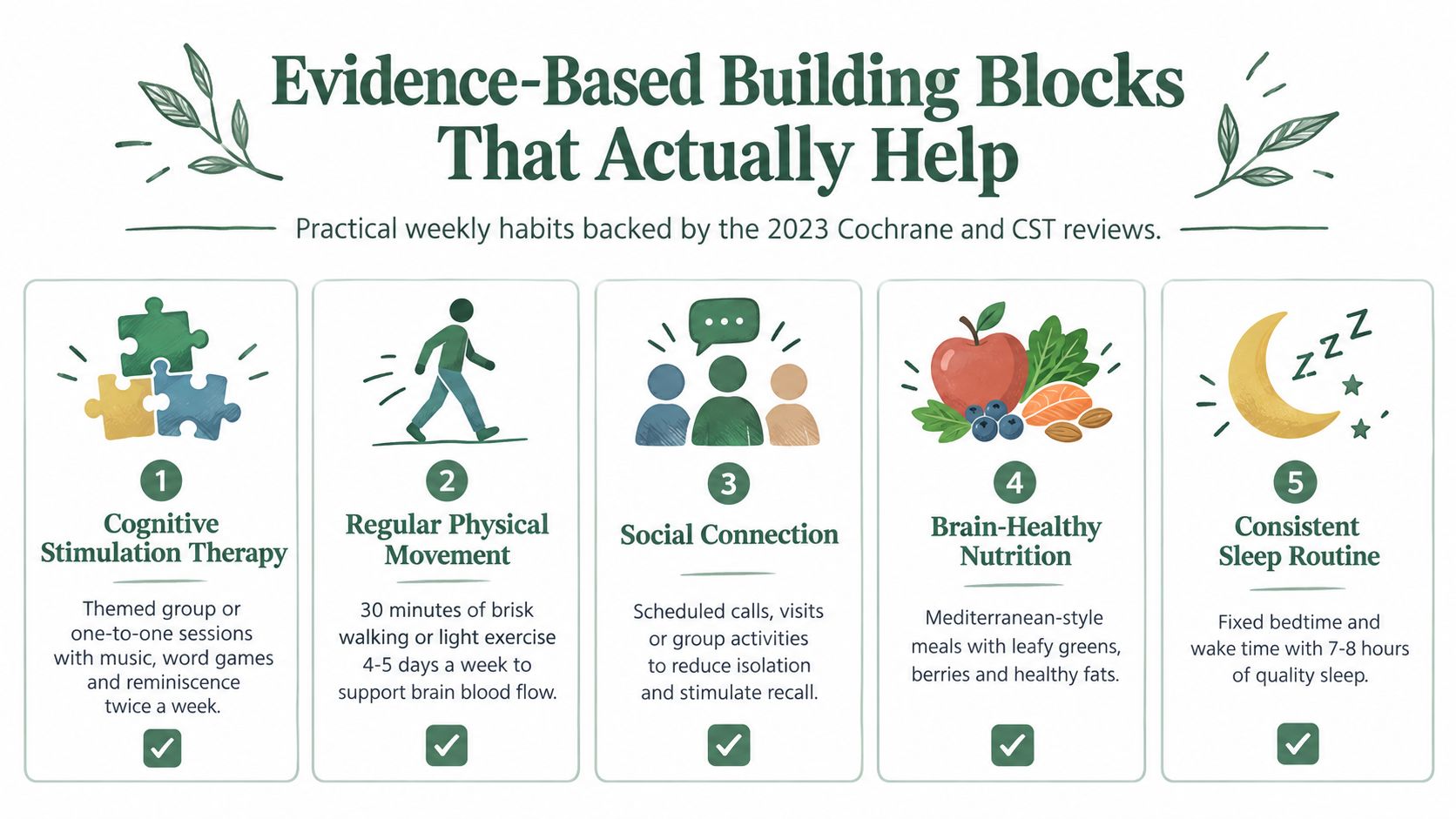
The strongest approach combines cognitive engagement with the physical, sensory, emotional, and medical factors that influence daily performance. No single activity reverses dementia, and families should reject products that promise a dramatic cure.
Start with structured cognitive stimulation
A 2023 Cochrane review found moderate-quality evidence that cognitive stimulation creates a small but measurable cognitive benefit for people with dementia. Across 37 studies involving 2,766 participants in 17 countries, the standardized mean difference was 0.40 (Cochrane review). The value isn't that every person will show the same change. It's that structured mental engagement has relevance across different care settings.
Cognitive Stimulation Therapy, or CST, gives families a more specific model. A 2023 systematic review found benefits when CST followed the original 14-session protocol, including global cognition, language, working memory, depression, communication, quality of life, and dementia severity. A high-quality evidence review found an MMSE advantage of 1.99 points across 25 studies and 1,893 participants (CST evidence review).
Use activities that require participation, not passive entertainment:
Orientation: Discuss the day, season, weather, location, and planned activity.
Language: Name objects, complete familiar phrases, sort words into categories, or describe a picture.
Attention: Follow a short sequence, compare two items, or listen for a chosen word in a story.
Reminiscence: Use personal photographs, music, familiar recipes, and life events as prompts.
Practical thinking: Plan a simple snack, organise a drawer, or talk through the steps of an everyday task.
Add the non-cognitive inputs
Movement supports general health and gives the day a useful anchor. Choose safe walking, gentle strength work, or balance practice suited to the person's abilities, and ask a clinician or physiotherapist for guidance if falls, pain, or mobility limitations are present.
Sleep, hydration, hearing, and social connection deserve equal attention. A tired or dehydrated person may appear more confused, while untreated hearing loss can make conversation look like memory failure. Medication review and management of vascular risks also belong on the appointment list, particularly when symptoms change or new medicines have been added.
Memory concerns often coexist with low mood, anxiety, or isolation. If emotional distress is interfering with participation, professional help may be appropriate, including Interactive Counselling mental health care. The objective is a repeatable week, not an impressive collection of activities.
Building a Realistic Daily Support Routine
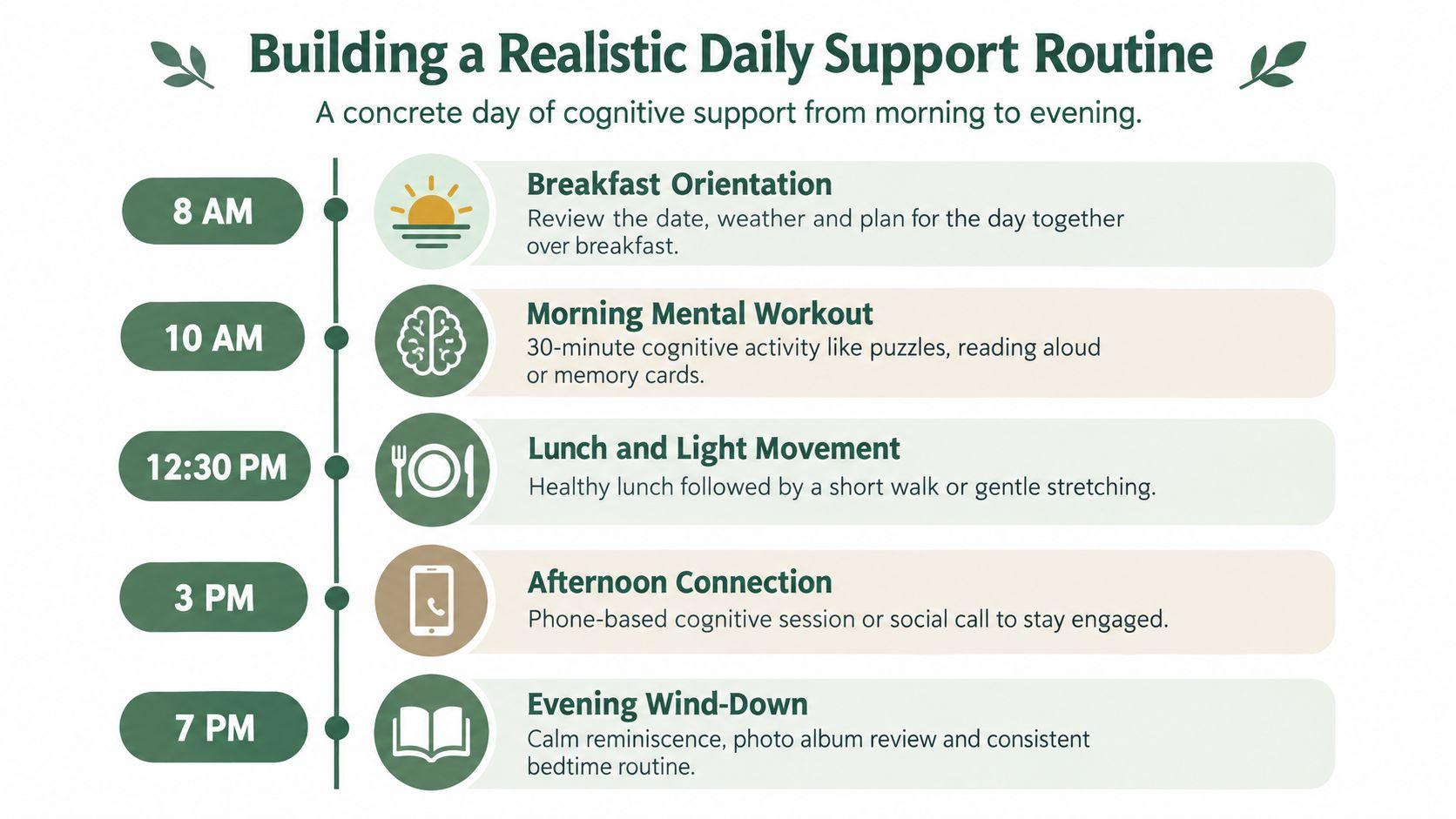
A workable routine begins with existing habits. Don't ask your parent to become a different person who completes a demanding cognitive programme. Attach small prompts to breakfast, lunch, the afternoon telephone slot, and the evening wind-down.
At 8:00 a.m., place a calendar and large clock beside the breakfast setting. Ask your parent to say the date, the weather, and one thing planned for the day. Keep the prompt neutral. If they give the wrong answer, provide the information without turning it into a test.
At 10:00 a.m., use a short mental activity while attention is usually available. Read a brief article aloud, sort familiar objects, complete a simple word task, or discuss a current household job. Stop while the person is still engaged. The purpose is regular participation, not exhausting them.
At 12:30 p.m., combine lunch with light movement. After eating, suggest a short walk or gentle stretching if it's safe. A consistent transition helps the person recognise what comes next without having to make a new decision.
Make the afternoon call purposeful
At 3:00 p.m., schedule a phone call. Start by asking where your parent is and what they've eaten. Then discuss one familiar topic, complete a gentle word-recall activity, and confirm what happens next. A call should feel like a conversation with structure, not an interrogation.
At 5:00 p.m., use three personal photographs for reminiscence. Ask who appears in each image, where it was taken, and what was happening around that time. Keep the session brief if your parent becomes tired, frustrated, or repetitive. A 2025 meta-analysis of 53 randomised controlled trials involving 4,582 participants found that reminiscence therapy improved cognition, depressive symptoms, and quality of life, but results varied by delivery format (reminiscence therapy review).
At 7:00 p.m., close the day with a calm recap. Write tomorrow's first item on a visible whiteboard, such as “Breakfast, then appointment.” Reset it each evening so the cue remains current.
Watch for three predictable breakdowns: the midday call disappears when the caregiver gets busy, reminiscence continues after fatigue begins, and the whiteboard isn't updated. This daily routine guide for seniors with early memory loss can help families adapt the framework to the home rather than relying on memory alone.
Use this video as a practical prompt for thinking about how structured support can fit into a normal day:
Where Phone-Based Cognitive Support Fits In
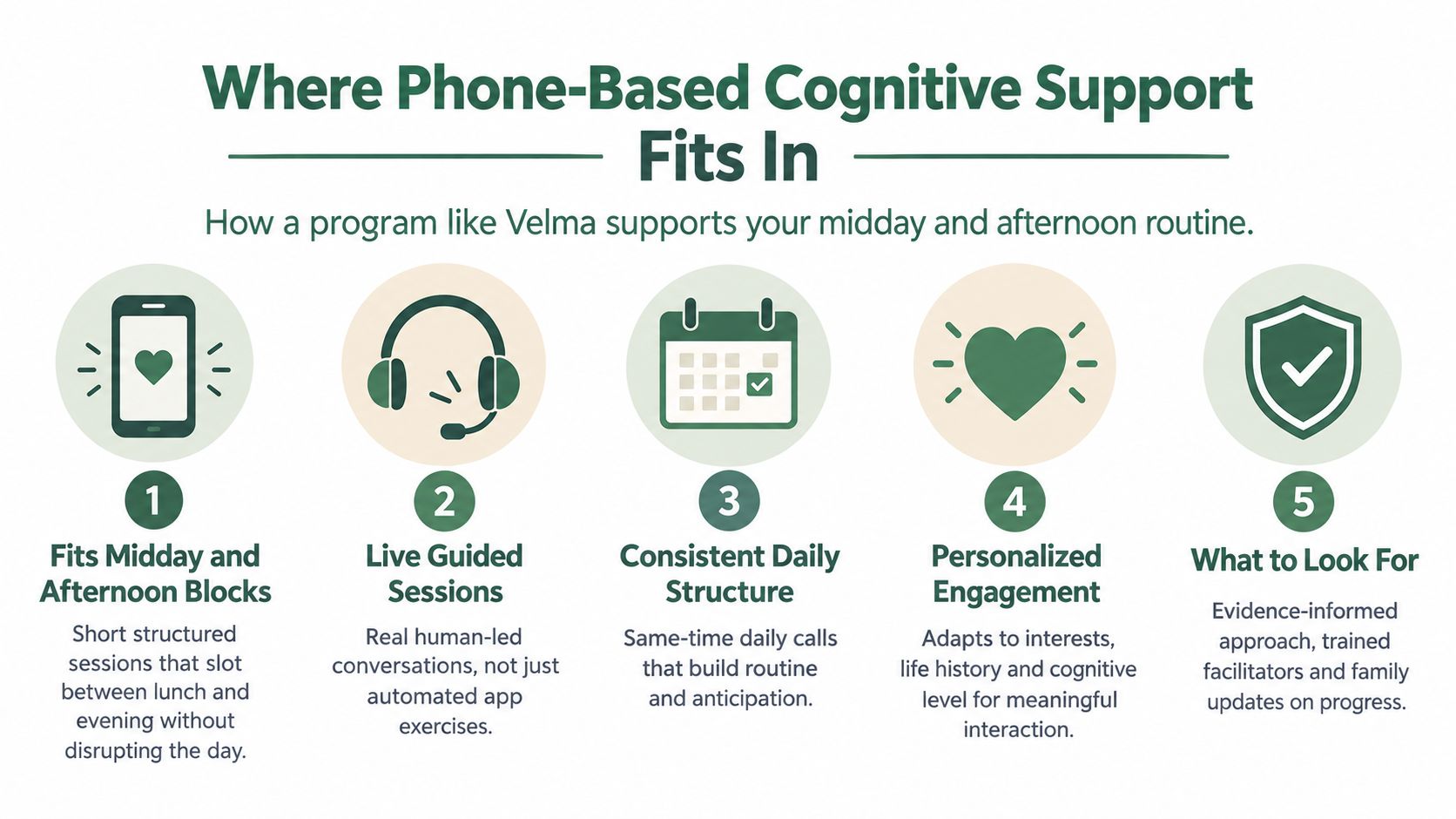
A phone call is useful when it occupies a defined place in the day. It can sit after lunch, during the afternoon period when the person is alone, or before an evening activity. It's less useful when calls happen randomly and consist only of “How are you?” followed by a rushed goodbye.
A remote service should provide a consistent caller, time, and structure wherever possible. The conversation should use the person's name, recent context, interests, and known routines. Good prompts include orientation to time and place, personal reminiscence, gentle word recall, and practical reminders. Generic trivia may entertain, but it doesn't necessarily support the person's actual daily needs.
Evaluate the service before enrolling
Ask direct questions. The answers will tell you whether the service belongs in a care plan or is a pleasant social call.
Call duration: How long does each session last, and can the length be adjusted when the person is tired?
Caller identity: Is the voice human or AI, and is that disclosed clearly to the participant and family?
Personalisation: Does the service use life history, interests, cognitive ability, and recent events?
Distress response: What happens if the person sounds frightened, confused, unwell, or at risk?
Family visibility: Can relatives see whether calls happened and receive meaningful updates?
Clinical boundaries: Does the provider state clearly that it doesn't diagnose, prescribe, or replace safety visits?
Remote support can reduce the gap between family visits, particularly when adult children live far away or work during the day. A systematic review found that telephone and other remote interventions may reduce behavioural and psychological symptoms of dementia and caregiver burden, but the certainty of evidence was low, so families should treat the approach as promising support rather than proven treatment (remote interventions review).
Velma is one phone-based option that provides scheduled calls combining structured conversation, orientation, reminiscence, memory cues, daily-living prompts, and family coordination. Families can read how Velma works for daily cognitive support before deciding whether that model fits their parent.
Phone support cannot assess a new neurological symptom, manage medicines, inspect a hazardous kitchen, or respond to a fall in the room. It's one spoke in a wider care wheel, alongside clinical care, family contact, home support, and in-person safety checks.
Caregiver Habits That Keep the Routine Going
A routine that depends on one exhausted adult child will eventually fail. Protecting the caregiver isn't a luxury added after the “real” work. It's the maintenance plan that keeps support available.
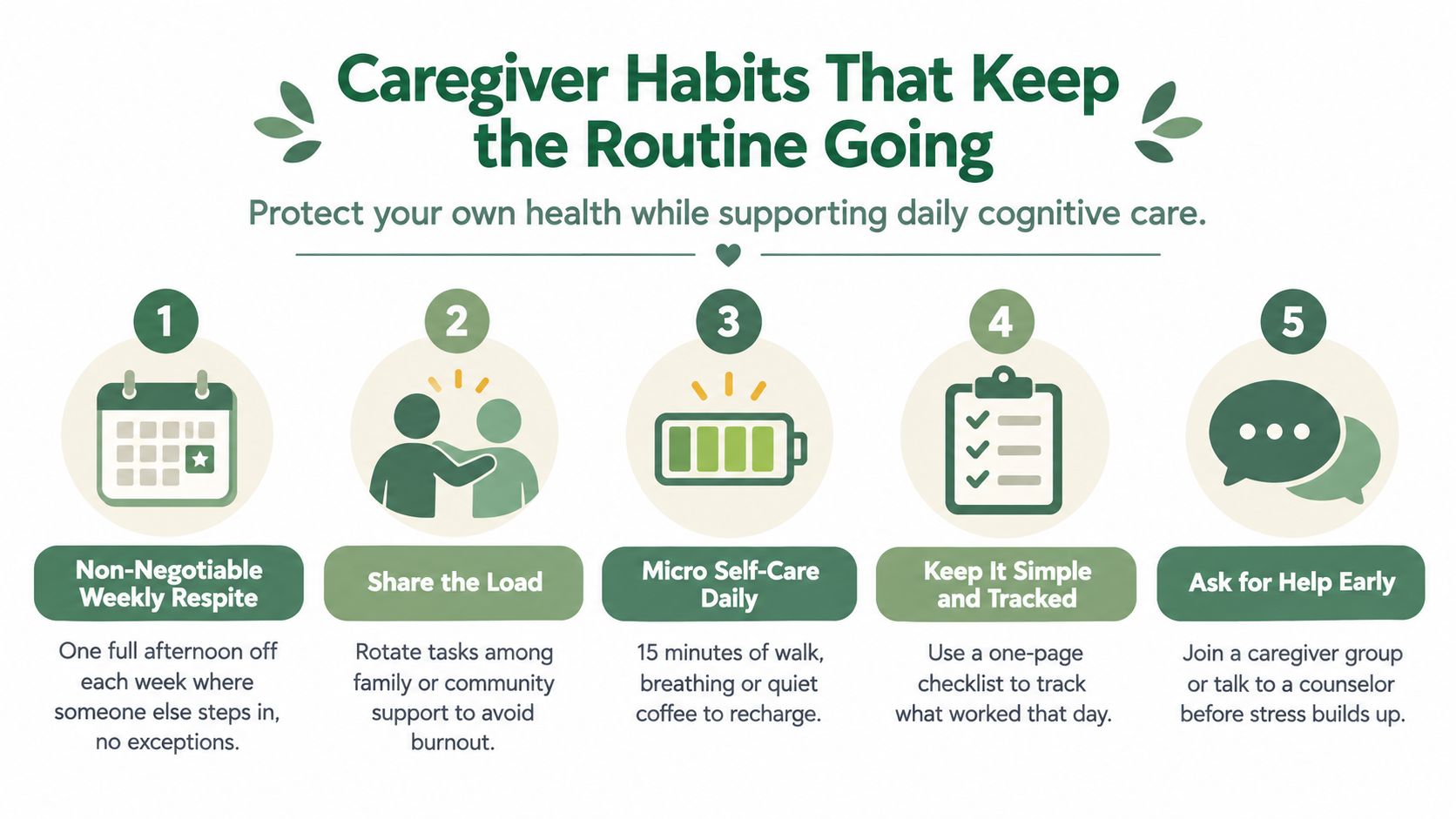
Book one full afternoon of respite each week and treat it as a fixed appointment. Another relative, friend, paid carer, community service, or phone-based programme can hold the routine during that time. If nobody else can step in, that isn't evidence that you should do more. It's evidence that the care plan needs another support.
Make the workload visible
Use one shared notebook or app. Record the day's orientation prompt, completed calls, meals or medication concerns, mood changes, falls, and questions for the clinician. A shared record prevents every family member from asking the same questions and stops the primary caregiver from carrying the entire mental map.
Schedule your own movement: Protect a 20-minute walk three times a week, even if someone else must cover the house.
Keep one peer connection: Arrange a standing call with another caregiver, support group, or trusted friend.
Review monthly: Decide what is helping, what is being skipped, and what has become performative theatre.
Share defined tasks: One person can manage appointments, another can handle shopping, and another can own the call schedule.
Notice warning signs: Missing your own medical appointments, losing sleep, and abandoning every friendship indicate strain, not commitment.
The monthly review should be blunt. If a complicated worksheet never gets used, remove it. If a favourite song reliably starts conversation, keep it. If an activity repeatedly causes anger, replace it with something calmer.
The goal is a routine that survives the caregiver, not a routine that proves the caregiver can endure anything.
Closing the Gap Between Symptoms and Real Support
Many families wait for a formal diagnosis before changing the daily environment. That's backwards. Evaluation matters, but support can begin while the appointment is being arranged.
In England, Alzheimer's Society reports an average wait of 3.5 years from first symptoms to diagnosis, nearly six months after GP referral before diagnosis, and one in five people receiving no support after diagnosis (Alzheimer's Society report). Those figures describe a serious support gap. They also explain why families need a practical bridge between noticing change and receiving coordinated care.
A clinical workup can investigate causes, establish a diagnosis, review medicines, and identify conditions that may be contributing to confusion. A daily system does something different. It provides orientation, repetition, companionship, reminders, observation, and safety conversations while clinical care develops.
Start with four actions this week
Write down three specific changes. Describe what happened and how it affected daily function.
Arrange a primary-care appointment. Bring the notes, medication list, and questions about hearing, sleep, mood, physical health, and referrals.
Set one recurring anchor. Choose a morning orientation, midday check-in, or evening whiteboard reset and put it on the calendar.
Assign ownership. Name the person responsible for checking that the routine happened, plus a backup.
A care consultant can help families clarify responsibilities, coordinate services, and turn scattered concerns into an actionable plan. This overview of what a care consultant does may help if your family is struggling to decide who should manage the next steps.
Early support doesn't need to be perfect to be useful. Consistent, small interactions usually offer more practical value than waiting for an ideal programme, a complete diagnosis, or a crisis that forces everyone to act.
Velma offers scheduled phone-based cognitive support for older adults with early to mid-stage memory loss, combining structured conversation, orientation, reminiscence, and family updates. If your parent needs a dependable bridge between visits and a routine your family can monitor, visit Velma to explore how it could fit into your daily care plan.
Your mother misses a dentist appointment, then insists nobody told her about it. A few days later, you find an unpaid bill beneath a stack of magazines, and she asks the same question twice during one conversation. You're left wondering whether this is ordinary ageing, stress, or the beginning of something that needs attention.
The most useful answer to how to improve memory loss isn't a single app, supplement, puzzle, or appointment. It's a daily support system built from repeated orientation, purposeful conversation, movement, familiar routines, medical review, and clear family coordination. Phone calls can become one part of that system, but they can't replace diagnosis, medication oversight, or in-person safety checks.
Table of Contents
What Memory Loss Looks Like Day to Day
Trust patterns, not isolated incidents
Why Daily Routines Matter More Than One-Time Fixes
Compare the two approaches
Evidence-Based Building Blocks That Actually Help
Start with structured cognitive stimulation
Add the non-cognitive inputs
Building a Realistic Daily Support Routine
Make the afternoon call purposeful
Where Phone-Based Cognitive Support Fits In
Evaluate the service before enrolling
Caregiver Habits That Keep the Routine Going
Make the workload visible
Closing the Gap Between Symptoms and Real Support
Start with four actions this week
What Memory Loss Looks Like Day to Day
Memory change rarely arrives as one dramatic event. More often, it appears in small disruptions that are easy to explain away. Your parent misses an appointment they normally manage, pays the same bill twice, puts keys in the refrigerator, or struggles to follow a recipe they've cooked for years.
Repeated questions deserve attention too, especially when they occur within the same conversation. So do problems with familiar routes, difficulty handling money, and sudden changes in mood or personality. A person may still tell stories confidently at a family gathering while becoming confused, anxious, or unsafe when alone.
Some slowing is normal with age. Taking longer to remember a name, occasionally misplacing an item, or needing more time to learn something new doesn't automatically indicate dementia. The warning sign is a pattern that interferes with familiar daily tasks, particularly when the person doesn't recognise the problem or has developed workarounds to hide it.
Trust patterns, not isolated incidents
Families often hesitate because each event has a plausible explanation. The missed appointment followed a poor night's sleep. The forgotten payment happened during a stressful week. The wrong turn may have resulted from roadworks. Those explanations may be true, but they don't cancel out a repeating pattern.
Keep a simple record with the date, what happened, what support was needed, and whether anything unusual was happening. Avoid arguing about whether the event occurred. Your notes will be more useful to a clinician than a general statement that your parent is “getting forgetful.”
Record function: Note missed medicines, unpaid bills, unsafe cooking, navigation problems, and changes in personal care.
Record frequency: A recurring problem matters more than one embarrassing mistake.
Record context: Include sleep, illness, stress, hearing difficulty, or a recent medication change.
Record safety: Mark anything involving driving, falls, wandering, scams, or household hazards.
For families in the UK, understanding why dementia awareness matters in UK care can make these conversations less personal and more practical. You can also use this guide to early signs of memory loss in aging parents when deciding what to document before seeking advice.
Practical rule: Don't wait for a crisis to prove that support is needed. A repeated pattern is enough reason to arrange an assessment and add structure at home.
Why Daily Routines Matter More Than One-Time Fixes
Dementia care is lived at the kitchen table, beside the medicine box, on the walk to the shops, and during the long afternoon when nobody visits. That's why a yearly appointment or occasional brain-training session can't carry the whole burden.
The scale of dementia makes this practical point urgent. The World Health Organization reports that 57 million people were living with dementia worldwide in 2021, with more than 60% living in low- and middle-income countries. WHO also reports nearly 10 million new cases each year, a global cost of US$1.3 trillion in 2019, and about 50% of those costs linked to informal care. Family members and close friends provide an average of 5 hours of care and supervision per day. These figures describe a global system, but the solution still has to work in ordinary homes.
A daily routine reduces the number of decisions a person must make from scratch. The same breakfast cue, visible calendar, scheduled call, familiar activity, and evening recap create external prompts that support attention and recall. Repetition also gives family members a way to notice changes before a small concern becomes a safety emergency.
Compare the two approaches
Aspect | One-Time Fix | Daily Routine |
|---|---|---|
Timing | Occasional and easy to miss | Predictable and attached to existing habits |
Focus | A test, app, appointment, or intensive activity | Orientation, conversation, movement, reminders, and observation |
Family role | One person carries the responsibility at key moments | Tasks can be shared across relatives and services |
Feedback | A snapshot of performance | A continuing picture of mood, function, and participation |
Practical value | May offer information or stimulation | Helps the person get through the day with fewer avoidable barriers |
The routine doesn't need to be elaborate. A morning review of the date, a midday check-in, a short walk, and an evening reminder can be more usable than a complicated programme nobody maintains. The right question isn't, “What is the strongest brain exercise?” Ask, “What support will still happen on a difficult Tuesday?”
A memory-support plan should be designed for repetition, not applause.
The routine also protects the adult child. When tasks happen at known times and are recorded in one place, you're less likely to spend the day mentally rehearsing whether your parent has eaten, taken medication, or remembered an appointment. Structure helps both people.
Evidence-Based Building Blocks That Actually Help
The strongest approach combines cognitive engagement with the physical, sensory, emotional, and medical factors that influence daily performance. No single activity reverses dementia, and families should reject products that promise a dramatic cure.
Start with structured cognitive stimulation
A 2023 Cochrane review found moderate-quality evidence that cognitive stimulation creates a small but measurable cognitive benefit for people with dementia. Across 37 studies involving 2,766 participants in 17 countries, the standardized mean difference was 0.40 (Cochrane review). The value isn't that every person will show the same change. It's that structured mental engagement has relevance across different care settings.
Cognitive Stimulation Therapy, or CST, gives families a more specific model. A 2023 systematic review found benefits when CST followed the original 14-session protocol, including global cognition, language, working memory, depression, communication, quality of life, and dementia severity. A high-quality evidence review found an MMSE advantage of 1.99 points across 25 studies and 1,893 participants (CST evidence review).
Use activities that require participation, not passive entertainment:
Orientation: Discuss the day, season, weather, location, and planned activity.
Language: Name objects, complete familiar phrases, sort words into categories, or describe a picture.
Attention: Follow a short sequence, compare two items, or listen for a chosen word in a story.
Reminiscence: Use personal photographs, music, familiar recipes, and life events as prompts.
Practical thinking: Plan a simple snack, organise a drawer, or talk through the steps of an everyday task.
Add the non-cognitive inputs
Movement supports general health and gives the day a useful anchor. Choose safe walking, gentle strength work, or balance practice suited to the person's abilities, and ask a clinician or physiotherapist for guidance if falls, pain, or mobility limitations are present.
Sleep, hydration, hearing, and social connection deserve equal attention. A tired or dehydrated person may appear more confused, while untreated hearing loss can make conversation look like memory failure. Medication review and management of vascular risks also belong on the appointment list, particularly when symptoms change or new medicines have been added.
Memory concerns often coexist with low mood, anxiety, or isolation. If emotional distress is interfering with participation, professional help may be appropriate, including Interactive Counselling mental health care. The objective is a repeatable week, not an impressive collection of activities.
Building a Realistic Daily Support Routine
A workable routine begins with existing habits. Don't ask your parent to become a different person who completes a demanding cognitive programme. Attach small prompts to breakfast, lunch, the afternoon telephone slot, and the evening wind-down.
At 8:00 a.m., place a calendar and large clock beside the breakfast setting. Ask your parent to say the date, the weather, and one thing planned for the day. Keep the prompt neutral. If they give the wrong answer, provide the information without turning it into a test.
At 10:00 a.m., use a short mental activity while attention is usually available. Read a brief article aloud, sort familiar objects, complete a simple word task, or discuss a current household job. Stop while the person is still engaged. The purpose is regular participation, not exhausting them.
At 12:30 p.m., combine lunch with light movement. After eating, suggest a short walk or gentle stretching if it's safe. A consistent transition helps the person recognise what comes next without having to make a new decision.
Make the afternoon call purposeful
At 3:00 p.m., schedule a phone call. Start by asking where your parent is and what they've eaten. Then discuss one familiar topic, complete a gentle word-recall activity, and confirm what happens next. A call should feel like a conversation with structure, not an interrogation.
At 5:00 p.m., use three personal photographs for reminiscence. Ask who appears in each image, where it was taken, and what was happening around that time. Keep the session brief if your parent becomes tired, frustrated, or repetitive. A 2025 meta-analysis of 53 randomised controlled trials involving 4,582 participants found that reminiscence therapy improved cognition, depressive symptoms, and quality of life, but results varied by delivery format (reminiscence therapy review).
At 7:00 p.m., close the day with a calm recap. Write tomorrow's first item on a visible whiteboard, such as “Breakfast, then appointment.” Reset it each evening so the cue remains current.
Watch for three predictable breakdowns: the midday call disappears when the caregiver gets busy, reminiscence continues after fatigue begins, and the whiteboard isn't updated. This daily routine guide for seniors with early memory loss can help families adapt the framework to the home rather than relying on memory alone.
Use this video as a practical prompt for thinking about how structured support can fit into a normal day:
Where Phone-Based Cognitive Support Fits In
A phone call is useful when it occupies a defined place in the day. It can sit after lunch, during the afternoon period when the person is alone, or before an evening activity. It's less useful when calls happen randomly and consist only of “How are you?” followed by a rushed goodbye.
A remote service should provide a consistent caller, time, and structure wherever possible. The conversation should use the person's name, recent context, interests, and known routines. Good prompts include orientation to time and place, personal reminiscence, gentle word recall, and practical reminders. Generic trivia may entertain, but it doesn't necessarily support the person's actual daily needs.
Evaluate the service before enrolling
Ask direct questions. The answers will tell you whether the service belongs in a care plan or is a pleasant social call.
Call duration: How long does each session last, and can the length be adjusted when the person is tired?
Caller identity: Is the voice human or AI, and is that disclosed clearly to the participant and family?
Personalisation: Does the service use life history, interests, cognitive ability, and recent events?
Distress response: What happens if the person sounds frightened, confused, unwell, or at risk?
Family visibility: Can relatives see whether calls happened and receive meaningful updates?
Clinical boundaries: Does the provider state clearly that it doesn't diagnose, prescribe, or replace safety visits?
Remote support can reduce the gap between family visits, particularly when adult children live far away or work during the day. A systematic review found that telephone and other remote interventions may reduce behavioural and psychological symptoms of dementia and caregiver burden, but the certainty of evidence was low, so families should treat the approach as promising support rather than proven treatment (remote interventions review).
Velma is one phone-based option that provides scheduled calls combining structured conversation, orientation, reminiscence, memory cues, daily-living prompts, and family coordination. Families can read how Velma works for daily cognitive support before deciding whether that model fits their parent.
Phone support cannot assess a new neurological symptom, manage medicines, inspect a hazardous kitchen, or respond to a fall in the room. It's one spoke in a wider care wheel, alongside clinical care, family contact, home support, and in-person safety checks.
Caregiver Habits That Keep the Routine Going
A routine that depends on one exhausted adult child will eventually fail. Protecting the caregiver isn't a luxury added after the “real” work. It's the maintenance plan that keeps support available.
Book one full afternoon of respite each week and treat it as a fixed appointment. Another relative, friend, paid carer, community service, or phone-based programme can hold the routine during that time. If nobody else can step in, that isn't evidence that you should do more. It's evidence that the care plan needs another support.
Make the workload visible
Use one shared notebook or app. Record the day's orientation prompt, completed calls, meals or medication concerns, mood changes, falls, and questions for the clinician. A shared record prevents every family member from asking the same questions and stops the primary caregiver from carrying the entire mental map.
Schedule your own movement: Protect a 20-minute walk three times a week, even if someone else must cover the house.
Keep one peer connection: Arrange a standing call with another caregiver, support group, or trusted friend.
Review monthly: Decide what is helping, what is being skipped, and what has become performative theatre.
Share defined tasks: One person can manage appointments, another can handle shopping, and another can own the call schedule.
Notice warning signs: Missing your own medical appointments, losing sleep, and abandoning every friendship indicate strain, not commitment.
The monthly review should be blunt. If a complicated worksheet never gets used, remove it. If a favourite song reliably starts conversation, keep it. If an activity repeatedly causes anger, replace it with something calmer.
The goal is a routine that survives the caregiver, not a routine that proves the caregiver can endure anything.
Closing the Gap Between Symptoms and Real Support
Many families wait for a formal diagnosis before changing the daily environment. That's backwards. Evaluation matters, but support can begin while the appointment is being arranged.
In England, Alzheimer's Society reports an average wait of 3.5 years from first symptoms to diagnosis, nearly six months after GP referral before diagnosis, and one in five people receiving no support after diagnosis (Alzheimer's Society report). Those figures describe a serious support gap. They also explain why families need a practical bridge between noticing change and receiving coordinated care.
A clinical workup can investigate causes, establish a diagnosis, review medicines, and identify conditions that may be contributing to confusion. A daily system does something different. It provides orientation, repetition, companionship, reminders, observation, and safety conversations while clinical care develops.
Start with four actions this week
Write down three specific changes. Describe what happened and how it affected daily function.
Arrange a primary-care appointment. Bring the notes, medication list, and questions about hearing, sleep, mood, physical health, and referrals.
Set one recurring anchor. Choose a morning orientation, midday check-in, or evening whiteboard reset and put it on the calendar.
Assign ownership. Name the person responsible for checking that the routine happened, plus a backup.
A care consultant can help families clarify responsibilities, coordinate services, and turn scattered concerns into an actionable plan. This overview of what a care consultant does may help if your family is struggling to decide who should manage the next steps.
Early support doesn't need to be perfect to be useful. Consistent, small interactions usually offer more practical value than waiting for an ideal programme, a complete diagnosis, or a crisis that forces everyone to act.
Velma offers scheduled phone-based cognitive support for older adults with early to mid-stage memory loss, combining structured conversation, orientation, reminiscence, and family updates. If your parent needs a dependable bridge between visits and a routine your family can monitor, visit Velma to explore how it could fit into your daily care plan.
Suggested Article: