Living Alone with Dementia Safety and Support Guide

A daughter calls her mother at 8:30 on a Monday morning. Her mother answers cheerfully, says she slept well, and mentions that she'll make tea after the call. Nothing sounds urgent. Later, the daughter discovers that the kettle was left on, breakfast was skipped, and the medication organizer still contains yesterday's tablets. Her mother can manage each task sometimes, but she can't manage the whole day reliably without structure.
That distinction matters. Living alone with dementia can remain possible for some people, particularly in the early to mid stages, but it requires an active care model rather than occasional reassurance. A short phone call can confirm that someone sounds well. It can't show whether they've eaten, taken medication correctly, become disoriented, or spent the afternoon distressed.
A 2025 DeNPRU Exeter report on living alone with dementia found that approximately 40% of people with dementia living in the community in England were living alone in 2023. The report says that proportion is increasing and describes this population as often overlooked. It also frames people living alone with dementia as potentially as many as one in three people with dementia overall, although that broader estimate isn't limited to the community setting.
Table of Contents
"Introduction Is Living Alone With Dementia Possible"
"How to Make Home Safer Without Taking Over"
Start with the kitchen
Reduce bathroom and bedroom hazards
Secure the entryway without creating a trap
"Daily Routines and Cognitive Supports That Reduce Confusion"
Build the day around anchors
Use cognitive prompts as invitations
"Building a Monitoring and Communication Plan That Catches Change Early"
Assign each touchpoint a job
Review patterns, not isolated bad days
"Choosing the Right Level of Support From Check-Ins to In-Home Care"
Match the option to the failure point
"When to Consider More Help and How to Plan the Next Transition"
"Introduction Is Living Alone With Dementia Possible"
The practical question isn't whether a person can remain in their home. It's whether the home can support reliable performance of essential tasks, with enough human contact to notice change before a crisis. A person may still dress, prepare a snack, or hold a pleasant conversation, yet struggle with sequencing, judgment, medication, finances, or emergencies.
Evidence also cautions against treating living alone as a simple yes-or-no cause of dementia. A systematic review found a 30% higher risk of incident dementia overall among people living alone, with a pooled relative risk of 1.30, while a separate longitudinal study linked each additional wave of cumulative living alone with about a 10% increase in dementia odds. Those findings come from the systematic review of dementia and living alone. Other research has found no significant association between living alone and dementia incidence over a five-year period, but it did find higher institutionalization risk, as discussed in this population-level review and memory-clinic evidence.
The care implication is more useful than the argument over causation: track the person's trajectory, not just their address. A sustainable plan has four jobs:
Make the home safer: Remove preventable hazards while preserving familiar spaces and choices.
Stabilize the day: Use visible routines for waking, meals, medications, activities, and sleep.
Create dependable touchpoints: Record what happens between visits instead of relying on memory or optimistic phone calls.
Add help at the right time: Increase support when tasks become inconsistent, risks accumulate, or family supervision becomes unsustainable.
Practical rule: Independence means having an appropriate degree of choice and control. It doesn't mean being left without support.
Phone-based cognitive support can fit into this model as one layer. Scheduled calls may provide conversation, orientation, cognitive activities, reminders, and observations about mood or daily functioning. They don't replace clinical assessment, medication prescribing, emergency response, or hands-on personal care.
Use the checklists below with the person, not on the person. Ask what feels useful, explain why a change is being considered, and review the plan regularly. Living arrangements can stay the same while the support around them changes.
"How to Make Home Safer Without Taking Over"
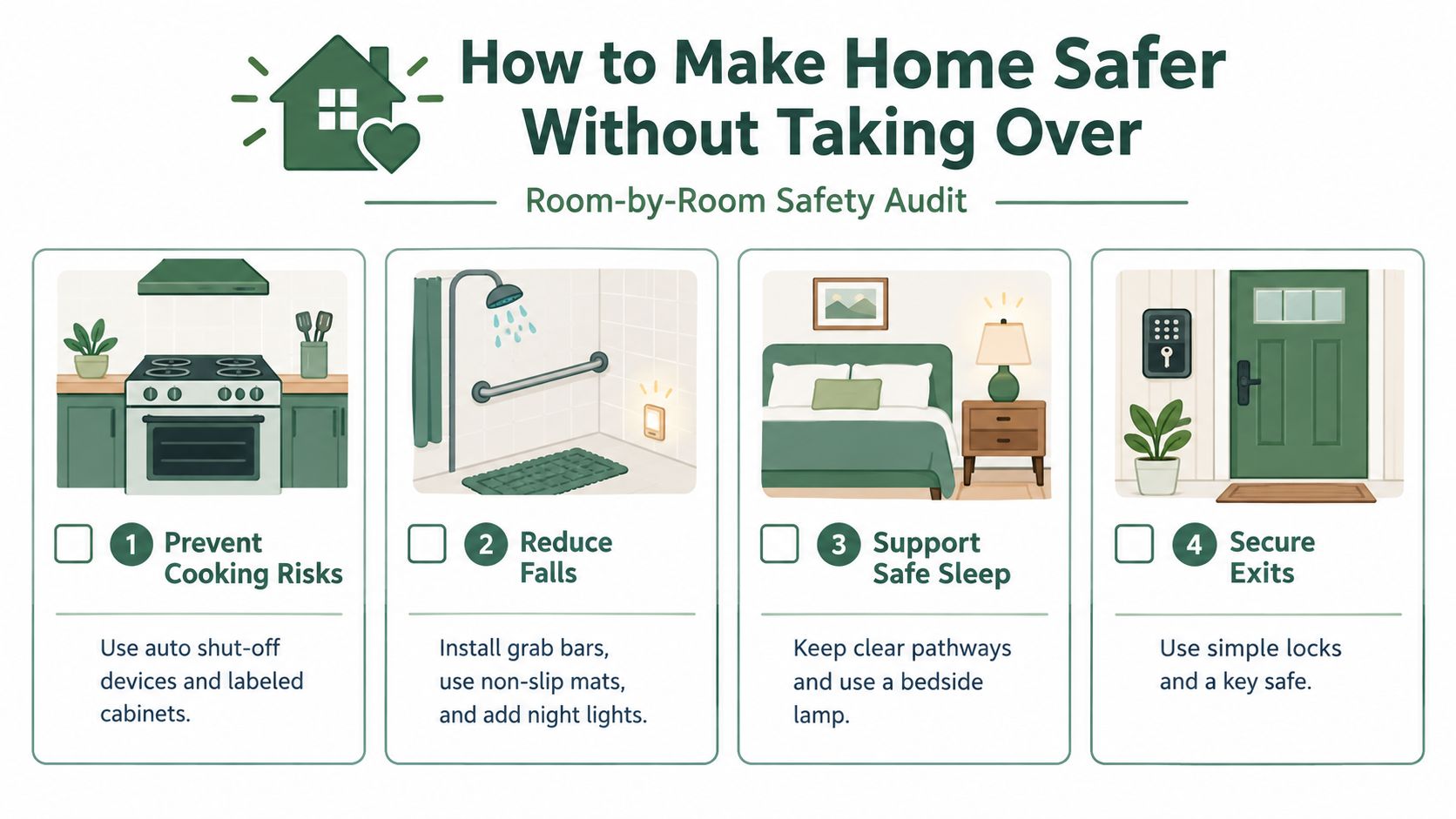
A weekend safety audit works best when it starts with ordinary routines. Walk through the home at the times when problems are most likely, including early morning, after dark, and during meal preparation. Look for tasks that require several steps, hidden hazards, or decisions that depend on memory.
Start with the kitchen
Cooking risks often come from interruption rather than inability. Someone may begin boiling water, hear the phone, and forget the pan. Consider an automatic stove shut-off, a clearly labeled cabinet for safe food and drinks, and a simple rule about when cooking requires another person present. Move knives, cleaning products, and appliances that are confusing or rarely used out of easy reach without stripping the kitchen of familiar items.
Check the refrigerator and cupboards together. Remove spoiled food, group easy meal options at eye level, and use large labels where they help. A label should answer a practical question, such as “Breakfast,” “Tea,” or “Ready meals,” rather than create a childlike environment.
Reduce bathroom and bedroom hazards
In the bathroom, prioritize stable transfers and visibility. Install appropriately positioned grab bars, use non-slip surfaces, keep toiletries within easy reach, and add lighting for nighttime trips. Families planning a larger renovation may find guidance on safe accessible bathroom design useful when weighing layout, fixtures, and ease of movement.
The bedroom needs a clear route from bed to bathroom and a lamp that can be reached without standing. Remove loose rugs, trailing cables, unstable furniture, and piles of clothing from the walking path. Keep footwear supportive and easy to put on.
Secure the entryway without creating a trap
The front door should be easy for the resident to use and harder for an unfamiliar person to exploit. Check that locks aren't confusing, keep a spare key in a secure key safe for authorized helpers, and make sure the person can reach the phone or alert system from the main living areas. If wandering is a concern, avoid improvised barriers that could delay emergency exit. Discuss door sensors or professional advice with the care team.
A room-by-room checklist can include:
Kitchen: Stove shut-off, clear counters, labeled food storage, working smoke alarms, and removed expired food.
Bathroom: Grab bars, stable flooring, night lighting, safe water temperature, and an unobstructed route.
Bedroom: Clear floor, reachable lamp, appropriate footwear, and a visible clock.
Entryway: Simple locks, key safe, emergency contacts, and a plan for unexpected visitors.
Whole home: Adequate lighting, working phone access, no loose rugs, and clearly marked essential rooms.
For further practical ideas, families can also review these daily safety tips.
A video can help families visualize common home adjustments before making changes.
The tone of the conversation matters as much as the equipment. Say, “Let's make the route to the bathroom easier at night,” rather than, “You can't manage this anymore.” Offer two safe choices where possible. A familiar chair, mug, or kitchen routine may support identity and comfort, so don't remove it just because a more clinical setup seems efficient.
"Daily Routines and Cognitive Supports That Reduce Confusion"
A predictable day reduces the number of decisions a person must make from memory. The routine should be visible, repeatable, and realistic for the person's abilities. Start with anchors that already exist, such as a preferred wake time, a regular breakfast, a favorite radio program, or an established bedtime.
Build the day around anchors
A large clock showing the day and date can support orientation, especially when placed where the person naturally looks. A whiteboard can display the next appointment, the visitor expected that day, and one or two simple tasks. Too much information becomes visual noise, so change it deliberately and keep wording consistent.
A workable flow might look like this:
Morning: Wake, open curtains, wash, dress, eat breakfast, take medication, and review the day's board.
Midday: Have lunch, complete one meaningful activity, and make or receive a planned call.
Afternoon: Rest, take a short walk if safe, sort photographs, fold laundry, or listen to familiar music.
Evening: Eat a simple meal, reduce stimulation, prepare clothing for the next day, and follow the same bedtime steps.
Medication support needs particular care. A visual pill organizer can reduce confusion, but it doesn't prove that medication was taken correctly. If doses are missed, doubled, or misunderstood, involve the prescribing clinician or pharmacist and consider whether hands-on medication management is needed.

Use cognitive prompts as invitations
Cognitive support works better when it connects to the person's history. Ask about a familiar recipe, identify people in a photo, sort buttons by color, finish a well-known phrase, or discuss the weather before choosing suitable clothing. The activity should be achievable, not a test that exposes mistakes.
When the person repeats a question, answer calmly and use the same visual cue each time. If anxiety centers on a handbag, wallet, pet, or missing object, acknowledge the concern first. Then redirect toward a concrete action, such as checking the usual place together or starting tea.
Recent evidence shows that practical and psychosocial needs extend beyond loneliness. A 2025 narrative synthesis of psychosocial needs reported unmet needs across love, comfort, identity, occupation, inclusion, and attachment. That means a routine should include belonging and purpose, not only meals and medication.
A person who lives alone may still have strong functional abilities while experiencing severe loneliness, lower income, and unmet needs despite using services, according to the same research source. Don't mistake an orderly home or independent dressing for adequate support.
"Building a Monitoring and Communication Plan That Catches Change Early"
A monitoring plan should answer one question: what has changed from the person's usual pattern? Without a shared record, each family member sees one conversation, one meal, or one missed appointment. A simple log turns scattered observations into a usable picture.
Assign each touchpoint a job
A daily call should be brief and consistent. Ask open but concrete questions: What have you eaten? Did you take the morning tablets? How did you sleep? What are you doing next? Listen for repeated confusion, unusual distress, slurred speech, difficulty following the conversation, or a change in the person's ability to explain their plan.
An in-person check should examine the environment rather than rely on reassurance. Look at food, medication, laundry, bathroom use, mail, temperature, and mobility. Ask the person to demonstrate an ordinary task only when appropriate, because performance during a test may not reflect the rest of the day.

A shared note can use four headings:
Function: Meals, medications, hygiene, mobility, appointments, and household tasks.
Mood: Anxiety, withdrawal, irritability, tearfulness, or unusual preoccupation.
Physical signals: Falls, pain, weakness, sleep disruption, appetite, and new confusion.
Action: Who will follow up, by when, and whether a clinician needs to be contacted.
Review patterns, not isolated bad days
One forgotten meal may have an explanation. Repeated missed meals, a new pattern of untouched medication, or increasing difficulty answering routine questions requires a different response. Document dates and observations in plain language, then share relevant changes with the family lead, care manager, and clinician.
The need for this visibility is supported by service-use evidence. In a large French cohort of people with mild-to-moderate Alzheimer's disease, living alone wasn't associated with increased mortality or weight loss, but it was associated with higher hospitalization risk, with a hazard ratio of 1.33, and substantially higher institutionalization risk, with a hazard ratio of 2.53, as reported in this peer-reviewed cohort study. The lesson is practical: delayed recognition and delayed escalation can matter even when the person doesn't appear acutely ill.
A personal alarm may add an important emergency layer, especially where falls or delayed assistance are concerns. Families comparing social personal alarm systems should check response arrangements, wearing comfort, charging requirements, and whether the person can use the device under stress.
For families establishing a repeatable rhythm, these daily check-in calls for seniors can provide ideas for consistent questions and contact timing.
"Choosing the Right Level of Support From Check-Ins to In-Home Care"
Support should match the task that is failing. A friendly call may help with orientation and connection, but it won't safely replace assistance with bathing, cooking, transfers, or medication administration. Conversely, bringing unfamiliar caregivers into the home before they're needed can feel intrusive and may reduce cooperation.
Support Type | Best For | Frequency | Key Benefit |
|---|---|---|---|
Scheduled phone contact | People who can manage basic physical tasks but need routine, conversation, and prompts | Regular calls at agreed times | Familiar human connection and visibility between visits |
Family or neighbor check-ins | A trusted network able to observe meals, mood, and home conditions | Based on risk and availability | Local knowledge and rapid response |
In-home care | Help with personal care, meals, medication routines, mobility, or household tasks | Matched to assessed needs | Hands-on support in the familiar home |
Adult day program | People who benefit from structured activity and social contact during the day | Scheduled attendance | Daytime occupation, supervision, and community |
Care manager coordination | Families managing multiple providers or changing needs | Ongoing review | Clear roles, escalation, and plan adjustment |
Medical alert system | People at risk of falls or being unable to summon help | Worn or available continuously | An additional emergency response route |
Match the option to the failure point
Use phone-based cognitive engagement when the main gaps are isolation, inconsistent orientation, missed reminders, or lack of stimulating conversation. It works best when the person can participate by phone and doesn't need someone physically present to complete essential tasks.
Add home care when the person needs help that can't be delivered through conversation. Examples include preparing food, supervising medication, assisting with hygiene, checking mobility, or responding to repeated safety concerns. Adult day programs can provide structure and company, but they won't cover evenings, overnight periods, or days the person refuses to attend.
Technology also has practical limits. A device may require charging, wearing, hearing, remembering, and accepting help. For organizations sending staff into homes alone, operational safeguards matter too. Resources on how to protect field teams with safeguards can help agencies think about check-in procedures and escalation for their own workers.
Families should also review companion care for elderly people when social connection and meaningful conversation are central needs. Velma is one phone-based option that combines scheduled calls, cognitive stimulation, orientation, emotional support, practical check-ins, and care manager coordination for older adults with early to mid-stage dementia. It complements, rather than replaces, medical treatment and in-person caregiving.
The strongest plan often combines layers. A call can identify that breakfast was missed, a family member can check the kitchen, and a home care worker can take responsibility for meals if the pattern continues. The value comes from coordination, not from choosing one service and expecting it to solve every problem.
"When to Consider More Help and How to Plan the Next Transition"
The decision to increase support should follow patterns of reduced reliability, not a single imperfect moment. Repeated missed medication, spoiled food, falls, wandering, new difficulty with hygiene, unpaid bills, unsafe judgment, or rising anxiety all deserve review. So does a family network that has become a full-time emergency system.
Living alone can carry a particularly important transition risk. In Swedish registry data involving 9,080 people with Alzheimer's disease, 46% were living alone at diagnosis, and living alone was associated with lower use of imaging or biomarker testing and fewer prescriptions for dementia and cardiovascular medications, according to the registry study summary. A household without an informant can make symptoms, medication problems, and unmet needs easier to miss.
Start the transition conversation before an emergency forces it. Ask the person what they want to preserve, such as staying in the neighborhood, keeping a pet nearby, choosing their meals, or maintaining a morning routine. Then discuss a trial of additional home visits, medication oversight, adult day support, or a different living arrangement. Involve the clinician when cognition, falls, medication changes, or new behavioral symptoms are part of the decision.
Use this short review:
Observe: Record what is happening repeatedly, not what the person promises during one conversation.
Prioritize: Separate immediate hazards from problems that can be addressed with more structure.
Coordinate: Give one person responsibility for the plan and make roles clear.
Trial: Add support and set a review point, rather than waiting for a crisis to decide everything.
Reassess: Increase, change, or reduce support according to observed function and well-being.
The aim isn't to prove that someone has failed at independence. It's to protect identity, connection, and choice while adjusting the conditions that make home possible. A plan that changes early is usually kinder than a plan that changes only after hospitalization or an unplanned placement.
Velma provides scheduled phone calls with trained care team members, combining conversation, cognitive activities, orientation, emotional support, and practical check-ins for older adults with early to mid-stage dementia. If your family needs more consistent human touchpoints while a loved one remains at home, visit Velma to learn how the program can fit alongside family, clinical, and in-home support.
A daughter calls her mother at 8:30 on a Monday morning. Her mother answers cheerfully, says she slept well, and mentions that she'll make tea after the call. Nothing sounds urgent. Later, the daughter discovers that the kettle was left on, breakfast was skipped, and the medication organizer still contains yesterday's tablets. Her mother can manage each task sometimes, but she can't manage the whole day reliably without structure.
That distinction matters. Living alone with dementia can remain possible for some people, particularly in the early to mid stages, but it requires an active care model rather than occasional reassurance. A short phone call can confirm that someone sounds well. It can't show whether they've eaten, taken medication correctly, become disoriented, or spent the afternoon distressed.
A 2025 DeNPRU Exeter report on living alone with dementia found that approximately 40% of people with dementia living in the community in England were living alone in 2023. The report says that proportion is increasing and describes this population as often overlooked. It also frames people living alone with dementia as potentially as many as one in three people with dementia overall, although that broader estimate isn't limited to the community setting.
Table of Contents
"Introduction Is Living Alone With Dementia Possible"
"How to Make Home Safer Without Taking Over"
Start with the kitchen
Reduce bathroom and bedroom hazards
Secure the entryway without creating a trap
"Daily Routines and Cognitive Supports That Reduce Confusion"
Build the day around anchors
Use cognitive prompts as invitations
"Building a Monitoring and Communication Plan That Catches Change Early"
Assign each touchpoint a job
Review patterns, not isolated bad days
"Choosing the Right Level of Support From Check-Ins to In-Home Care"
Match the option to the failure point
"When to Consider More Help and How to Plan the Next Transition"
"Introduction Is Living Alone With Dementia Possible"
The practical question isn't whether a person can remain in their home. It's whether the home can support reliable performance of essential tasks, with enough human contact to notice change before a crisis. A person may still dress, prepare a snack, or hold a pleasant conversation, yet struggle with sequencing, judgment, medication, finances, or emergencies.
Evidence also cautions against treating living alone as a simple yes-or-no cause of dementia. A systematic review found a 30% higher risk of incident dementia overall among people living alone, with a pooled relative risk of 1.30, while a separate longitudinal study linked each additional wave of cumulative living alone with about a 10% increase in dementia odds. Those findings come from the systematic review of dementia and living alone. Other research has found no significant association between living alone and dementia incidence over a five-year period, but it did find higher institutionalization risk, as discussed in this population-level review and memory-clinic evidence.
The care implication is more useful than the argument over causation: track the person's trajectory, not just their address. A sustainable plan has four jobs:
Make the home safer: Remove preventable hazards while preserving familiar spaces and choices.
Stabilize the day: Use visible routines for waking, meals, medications, activities, and sleep.
Create dependable touchpoints: Record what happens between visits instead of relying on memory or optimistic phone calls.
Add help at the right time: Increase support when tasks become inconsistent, risks accumulate, or family supervision becomes unsustainable.
Practical rule: Independence means having an appropriate degree of choice and control. It doesn't mean being left without support.
Phone-based cognitive support can fit into this model as one layer. Scheduled calls may provide conversation, orientation, cognitive activities, reminders, and observations about mood or daily functioning. They don't replace clinical assessment, medication prescribing, emergency response, or hands-on personal care.
Use the checklists below with the person, not on the person. Ask what feels useful, explain why a change is being considered, and review the plan regularly. Living arrangements can stay the same while the support around them changes.
"How to Make Home Safer Without Taking Over"
A weekend safety audit works best when it starts with ordinary routines. Walk through the home at the times when problems are most likely, including early morning, after dark, and during meal preparation. Look for tasks that require several steps, hidden hazards, or decisions that depend on memory.
Start with the kitchen
Cooking risks often come from interruption rather than inability. Someone may begin boiling water, hear the phone, and forget the pan. Consider an automatic stove shut-off, a clearly labeled cabinet for safe food and drinks, and a simple rule about when cooking requires another person present. Move knives, cleaning products, and appliances that are confusing or rarely used out of easy reach without stripping the kitchen of familiar items.
Check the refrigerator and cupboards together. Remove spoiled food, group easy meal options at eye level, and use large labels where they help. A label should answer a practical question, such as “Breakfast,” “Tea,” or “Ready meals,” rather than create a childlike environment.
Reduce bathroom and bedroom hazards
In the bathroom, prioritize stable transfers and visibility. Install appropriately positioned grab bars, use non-slip surfaces, keep toiletries within easy reach, and add lighting for nighttime trips. Families planning a larger renovation may find guidance on safe accessible bathroom design useful when weighing layout, fixtures, and ease of movement.
The bedroom needs a clear route from bed to bathroom and a lamp that can be reached without standing. Remove loose rugs, trailing cables, unstable furniture, and piles of clothing from the walking path. Keep footwear supportive and easy to put on.
Secure the entryway without creating a trap
The front door should be easy for the resident to use and harder for an unfamiliar person to exploit. Check that locks aren't confusing, keep a spare key in a secure key safe for authorized helpers, and make sure the person can reach the phone or alert system from the main living areas. If wandering is a concern, avoid improvised barriers that could delay emergency exit. Discuss door sensors or professional advice with the care team.
A room-by-room checklist can include:
Kitchen: Stove shut-off, clear counters, labeled food storage, working smoke alarms, and removed expired food.
Bathroom: Grab bars, stable flooring, night lighting, safe water temperature, and an unobstructed route.
Bedroom: Clear floor, reachable lamp, appropriate footwear, and a visible clock.
Entryway: Simple locks, key safe, emergency contacts, and a plan for unexpected visitors.
Whole home: Adequate lighting, working phone access, no loose rugs, and clearly marked essential rooms.
For further practical ideas, families can also review these daily safety tips.
A video can help families visualize common home adjustments before making changes.
The tone of the conversation matters as much as the equipment. Say, “Let's make the route to the bathroom easier at night,” rather than, “You can't manage this anymore.” Offer two safe choices where possible. A familiar chair, mug, or kitchen routine may support identity and comfort, so don't remove it just because a more clinical setup seems efficient.
"Daily Routines and Cognitive Supports That Reduce Confusion"
A predictable day reduces the number of decisions a person must make from memory. The routine should be visible, repeatable, and realistic for the person's abilities. Start with anchors that already exist, such as a preferred wake time, a regular breakfast, a favorite radio program, or an established bedtime.
Build the day around anchors
A large clock showing the day and date can support orientation, especially when placed where the person naturally looks. A whiteboard can display the next appointment, the visitor expected that day, and one or two simple tasks. Too much information becomes visual noise, so change it deliberately and keep wording consistent.
A workable flow might look like this:
Morning: Wake, open curtains, wash, dress, eat breakfast, take medication, and review the day's board.
Midday: Have lunch, complete one meaningful activity, and make or receive a planned call.
Afternoon: Rest, take a short walk if safe, sort photographs, fold laundry, or listen to familiar music.
Evening: Eat a simple meal, reduce stimulation, prepare clothing for the next day, and follow the same bedtime steps.
Medication support needs particular care. A visual pill organizer can reduce confusion, but it doesn't prove that medication was taken correctly. If doses are missed, doubled, or misunderstood, involve the prescribing clinician or pharmacist and consider whether hands-on medication management is needed.
Use cognitive prompts as invitations
Cognitive support works better when it connects to the person's history. Ask about a familiar recipe, identify people in a photo, sort buttons by color, finish a well-known phrase, or discuss the weather before choosing suitable clothing. The activity should be achievable, not a test that exposes mistakes.
When the person repeats a question, answer calmly and use the same visual cue each time. If anxiety centers on a handbag, wallet, pet, or missing object, acknowledge the concern first. Then redirect toward a concrete action, such as checking the usual place together or starting tea.
Recent evidence shows that practical and psychosocial needs extend beyond loneliness. A 2025 narrative synthesis of psychosocial needs reported unmet needs across love, comfort, identity, occupation, inclusion, and attachment. That means a routine should include belonging and purpose, not only meals and medication.
A person who lives alone may still have strong functional abilities while experiencing severe loneliness, lower income, and unmet needs despite using services, according to the same research source. Don't mistake an orderly home or independent dressing for adequate support.
"Building a Monitoring and Communication Plan That Catches Change Early"
A monitoring plan should answer one question: what has changed from the person's usual pattern? Without a shared record, each family member sees one conversation, one meal, or one missed appointment. A simple log turns scattered observations into a usable picture.
Assign each touchpoint a job
A daily call should be brief and consistent. Ask open but concrete questions: What have you eaten? Did you take the morning tablets? How did you sleep? What are you doing next? Listen for repeated confusion, unusual distress, slurred speech, difficulty following the conversation, or a change in the person's ability to explain their plan.
An in-person check should examine the environment rather than rely on reassurance. Look at food, medication, laundry, bathroom use, mail, temperature, and mobility. Ask the person to demonstrate an ordinary task only when appropriate, because performance during a test may not reflect the rest of the day.
A shared note can use four headings:
Function: Meals, medications, hygiene, mobility, appointments, and household tasks.
Mood: Anxiety, withdrawal, irritability, tearfulness, or unusual preoccupation.
Physical signals: Falls, pain, weakness, sleep disruption, appetite, and new confusion.
Action: Who will follow up, by when, and whether a clinician needs to be contacted.
Review patterns, not isolated bad days
One forgotten meal may have an explanation. Repeated missed meals, a new pattern of untouched medication, or increasing difficulty answering routine questions requires a different response. Document dates and observations in plain language, then share relevant changes with the family lead, care manager, and clinician.
The need for this visibility is supported by service-use evidence. In a large French cohort of people with mild-to-moderate Alzheimer's disease, living alone wasn't associated with increased mortality or weight loss, but it was associated with higher hospitalization risk, with a hazard ratio of 1.33, and substantially higher institutionalization risk, with a hazard ratio of 2.53, as reported in this peer-reviewed cohort study. The lesson is practical: delayed recognition and delayed escalation can matter even when the person doesn't appear acutely ill.
A personal alarm may add an important emergency layer, especially where falls or delayed assistance are concerns. Families comparing social personal alarm systems should check response arrangements, wearing comfort, charging requirements, and whether the person can use the device under stress.
For families establishing a repeatable rhythm, these daily check-in calls for seniors can provide ideas for consistent questions and contact timing.
"Choosing the Right Level of Support From Check-Ins to In-Home Care"
Support should match the task that is failing. A friendly call may help with orientation and connection, but it won't safely replace assistance with bathing, cooking, transfers, or medication administration. Conversely, bringing unfamiliar caregivers into the home before they're needed can feel intrusive and may reduce cooperation.
Support Type | Best For | Frequency | Key Benefit |
|---|---|---|---|
Scheduled phone contact | People who can manage basic physical tasks but need routine, conversation, and prompts | Regular calls at agreed times | Familiar human connection and visibility between visits |
Family or neighbor check-ins | A trusted network able to observe meals, mood, and home conditions | Based on risk and availability | Local knowledge and rapid response |
In-home care | Help with personal care, meals, medication routines, mobility, or household tasks | Matched to assessed needs | Hands-on support in the familiar home |
Adult day program | People who benefit from structured activity and social contact during the day | Scheduled attendance | Daytime occupation, supervision, and community |
Care manager coordination | Families managing multiple providers or changing needs | Ongoing review | Clear roles, escalation, and plan adjustment |
Medical alert system | People at risk of falls or being unable to summon help | Worn or available continuously | An additional emergency response route |
Match the option to the failure point
Use phone-based cognitive engagement when the main gaps are isolation, inconsistent orientation, missed reminders, or lack of stimulating conversation. It works best when the person can participate by phone and doesn't need someone physically present to complete essential tasks.
Add home care when the person needs help that can't be delivered through conversation. Examples include preparing food, supervising medication, assisting with hygiene, checking mobility, or responding to repeated safety concerns. Adult day programs can provide structure and company, but they won't cover evenings, overnight periods, or days the person refuses to attend.
Technology also has practical limits. A device may require charging, wearing, hearing, remembering, and accepting help. For organizations sending staff into homes alone, operational safeguards matter too. Resources on how to protect field teams with safeguards can help agencies think about check-in procedures and escalation for their own workers.
Families should also review companion care for elderly people when social connection and meaningful conversation are central needs. Velma is one phone-based option that combines scheduled calls, cognitive stimulation, orientation, emotional support, practical check-ins, and care manager coordination for older adults with early to mid-stage dementia. It complements, rather than replaces, medical treatment and in-person caregiving.
The strongest plan often combines layers. A call can identify that breakfast was missed, a family member can check the kitchen, and a home care worker can take responsibility for meals if the pattern continues. The value comes from coordination, not from choosing one service and expecting it to solve every problem.
"When to Consider More Help and How to Plan the Next Transition"
The decision to increase support should follow patterns of reduced reliability, not a single imperfect moment. Repeated missed medication, spoiled food, falls, wandering, new difficulty with hygiene, unpaid bills, unsafe judgment, or rising anxiety all deserve review. So does a family network that has become a full-time emergency system.
Living alone can carry a particularly important transition risk. In Swedish registry data involving 9,080 people with Alzheimer's disease, 46% were living alone at diagnosis, and living alone was associated with lower use of imaging or biomarker testing and fewer prescriptions for dementia and cardiovascular medications, according to the registry study summary. A household without an informant can make symptoms, medication problems, and unmet needs easier to miss.
Start the transition conversation before an emergency forces it. Ask the person what they want to preserve, such as staying in the neighborhood, keeping a pet nearby, choosing their meals, or maintaining a morning routine. Then discuss a trial of additional home visits, medication oversight, adult day support, or a different living arrangement. Involve the clinician when cognition, falls, medication changes, or new behavioral symptoms are part of the decision.
Use this short review:
Observe: Record what is happening repeatedly, not what the person promises during one conversation.
Prioritize: Separate immediate hazards from problems that can be addressed with more structure.
Coordinate: Give one person responsibility for the plan and make roles clear.
Trial: Add support and set a review point, rather than waiting for a crisis to decide everything.
Reassess: Increase, change, or reduce support according to observed function and well-being.
The aim isn't to prove that someone has failed at independence. It's to protect identity, connection, and choice while adjusting the conditions that make home possible. A plan that changes early is usually kinder than a plan that changes only after hospitalization or an unplanned placement.
Velma provides scheduled phone calls with trained care team members, combining conversation, cognitive activities, orientation, emotional support, and practical check-ins for older adults with early to mid-stage dementia. If your family needs more consistent human touchpoints while a loved one remains at home, visit Velma to learn how the program can fit alongside family, clinical, and in-home support.
Suggested Article: