Cognitive Stimulation Therapy for Alzheimer's Disease Guide

If you're caring for a parent or partner with early Alzheimer's, you may already know the scene. Breakfast ends, and ten minutes later the same question comes again. A once-social person goes quiet because following conversation takes more effort. They may still enjoy music, old stories, or a familiar joke, but the days can start to feel smaller and more repetitive.
That's usually when families start looking for help that isn't just another medication change. They want something practical. Something that supports attention, language, confidence, and connection in everyday life.
Table of Contents
Introduction to Cognitive Stimulation Therapy for Alzheimer's
Who CST is usually for
Why families pay attention to it
How Cognitive Stimulation Therapy Works in the Brain
Repetition helps, but variety matters too
Why the social piece is part of the therapy
How CST differs from cognitive training and rehabilitation
Why consistency beats intensity
Evidence Behind Cognitive Stimulation Therapy for Alzheimer's
The landmark trial
What later reviews found
What the evidence means in real life
Standard CST Protocol and What Happens in Sessions
What a standard course looks like
What makes a session therapeutic instead of casual
What facilitation sounds like
Expected Outcomes and Honest Limits for Alzheimer's
What families can reasonably expect
What CST improves reliably versus mixed evidence
A better way to set goals
When to reassess
Adapting CST for Phone Delivery and Everyday Support
What transfers well to the phone
What needs to be adapted
Where phone support fits in day-to-day care
Choosing and Integrating CST Into Your Care Plan
A simple decision checklist
What to track over a few weeks
How CST fits with other treatment
Introduction to Cognitive Stimulation Therapy for Alzheimer's
Cognitive stimulation therapy for Alzheimer's disease is one of the most established non-drug approaches for people in the mild to moderate stages of dementia. It isn't just a stack of puzzles, and it isn't casual chatting dressed up as treatment. CST is a structured therapy that uses themed conversation, orientation, memory prompts, language activities, and social engagement to support thinking and well-being.
A simple way to picture it is this. If memory loss makes the day feel foggy, CST gives the person repeated chances to find their footing again. A session might include talking about the date and season, naming familiar objects, discussing a shared topic like food or travel, or using music and reminiscence to spark conversation. The point isn't to test the person. The point is to help them stay mentally active in a guided, supportive way.
Who CST is usually for
CST is generally used for people who can still take part in conversation with some support, even if they repeat themselves, lose track, or need prompts. That often fits people in the earlier and middle phases of Alzheimer's disease.
It complements medical care rather than replacing it. Families often use it alongside clinician visits, medication review, home support, and routine planning.
Why families pay attention to it
CST matters because it has a stronger clinical footing than many activities marketed as "brain games." In the UK, it became a formal guideline-backed dementia intervention in 2006 when it was first recommended by NICE/SCIE, and the recommendation was strengthened in 2018 to specifically say to offer group CST to people living with mild to moderate dementia. A major review also noted that it remained the only manualized psychosocial intervention recommended by those guidelines to support cognition, independence, and well-being in dementia, according to this UCL review of CST and guideline history.
CST isn't fringe care. It sits inside evidence-based dementia care, especially when the goal is to support function and quality of life during the stage when people can still engage.
Families are often told to "keep them stimulated," but that advice is too vague to be useful. CST gives that idea a real shape. It tells you what kind of engagement helps, how often it should happen, and what results are realistic.
How Cognitive Stimulation Therapy Works in the Brain
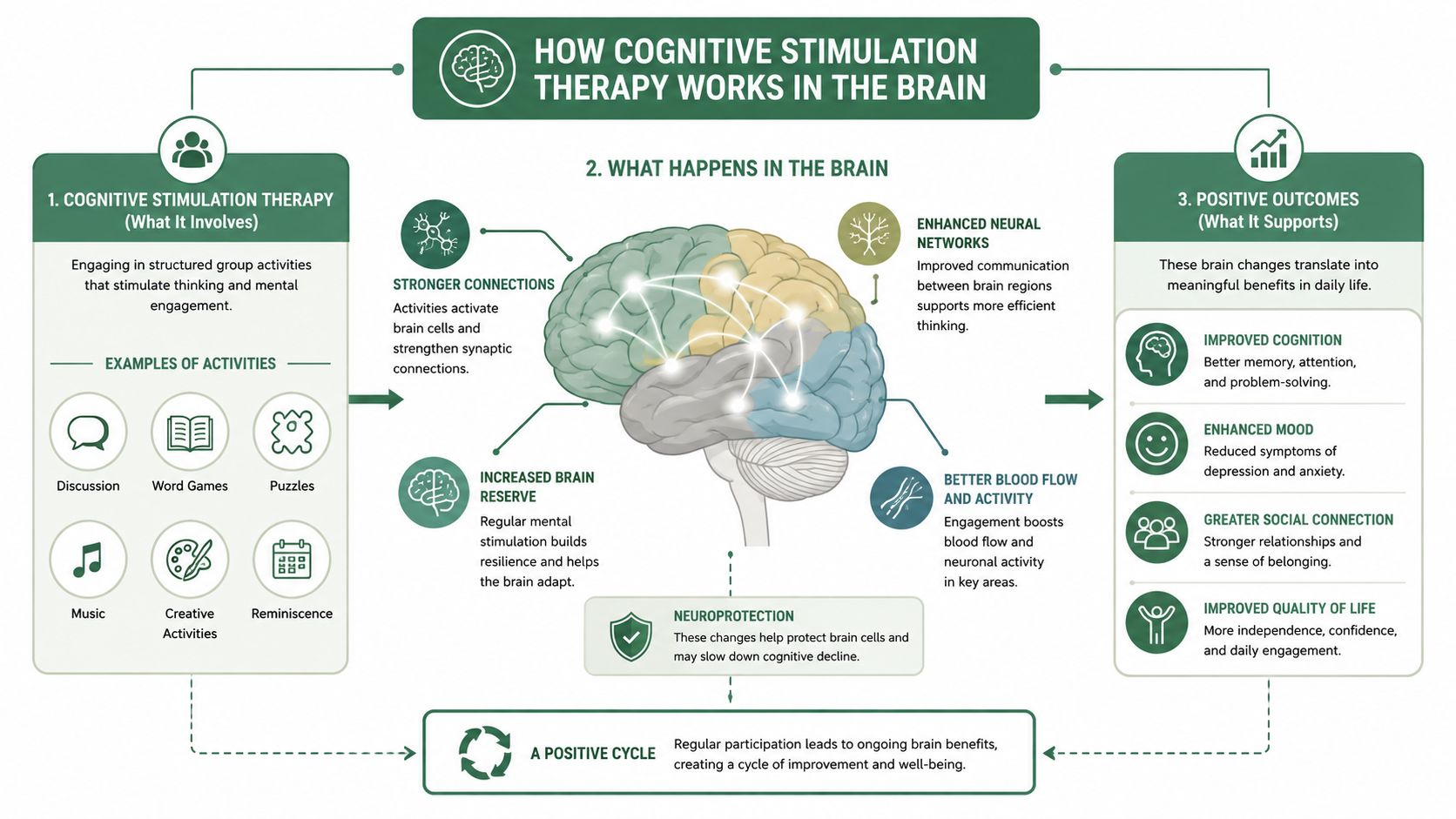
Think of the brain less like a battery that gets topped up and more like a network that works better when it gets regular, varied use. In Alzheimer's disease, some pathways become harder to access. CST doesn't reverse the disease, but it can help people use the pathways they still have more effectively through repetition, structure, and social cues.
Repetition helps, but variety matters too
A good CST session gently activates several skills at once. Not in a stressful way. In a natural way.
For example, if someone is asked what season it is, then talks about favorite winter foods, then names ingredients for soup, several systems are getting practice:
Orientation: noticing time, date, place, and what's happening now
Language: finding words, following questions, sharing opinions
Attention: staying with a topic for a few minutes
Memory access: pulling up older knowledge and familiar routines
Social response: taking turns, reading tone, feeling included
That mix matters more than difficulty. A crossword that frustrates someone isn't better than a warm, well-guided conversation that keeps them engaged.
Why the social piece is part of the therapy
People often hear "cognitive" and assume the goal is solitary brain exercise. CST works differently. Conversation itself is part of the intervention. When a person hears a prompt, searches for a word, listens to another person, and responds, they're practicing much more than memory alone.
This is one reason CST doesn't fit neatly into the same box as app-based brain training. If you'd like a plain-language comparison of different kinds of cognitive support, Velma's article on cognitive conditioning gives a useful frame.
Practical rule: In CST, the session should feel engaging and achievable. If it feels like a test, the level is probably off.
How CST differs from cognitive training and rehabilitation
These terms get mixed up a lot.
Cognitive training usually targets a specific skill through repeated tasks, like memory drills or attention exercises. Cognitive rehabilitation usually focuses on practical goals, like remembering steps for making tea safely or using a calendar to manage appointments. CST is broader. It uses structured, themed engagement to support global cognition and mood through regular participation.
That's why CST can include word work, reminiscence, current events, sensory prompts, and discussion in the same program. It isn't trying to create a perfect score on one task. It's trying to keep the person's overall thinking and connection more active.
Why consistency beats intensity
Families sometimes assume harder is better. With Alzheimer's, that's usually backwards. What helps most is consistent, well-paced stimulation that the person can tolerate and repeat.
A single great session won't carry much on its own. A predictable rhythm of sessions gives the brain repeated opportunities to rehearse orientation, language, and memory in context. That's part of why structured delivery matters so much.
Evidence Behind Cognitive Stimulation Therapy for Alzheimer's
CST has lasted in dementia care because it moved beyond good intentions and into measurable results. The evidence isn't vague. It includes guideline recognition, randomized trials, and later meta-analyses that looked across many studies.
Near the start of that evidence base was a large randomized controlled trial that helped define CST as a real clinical intervention rather than a pleasant activity program.
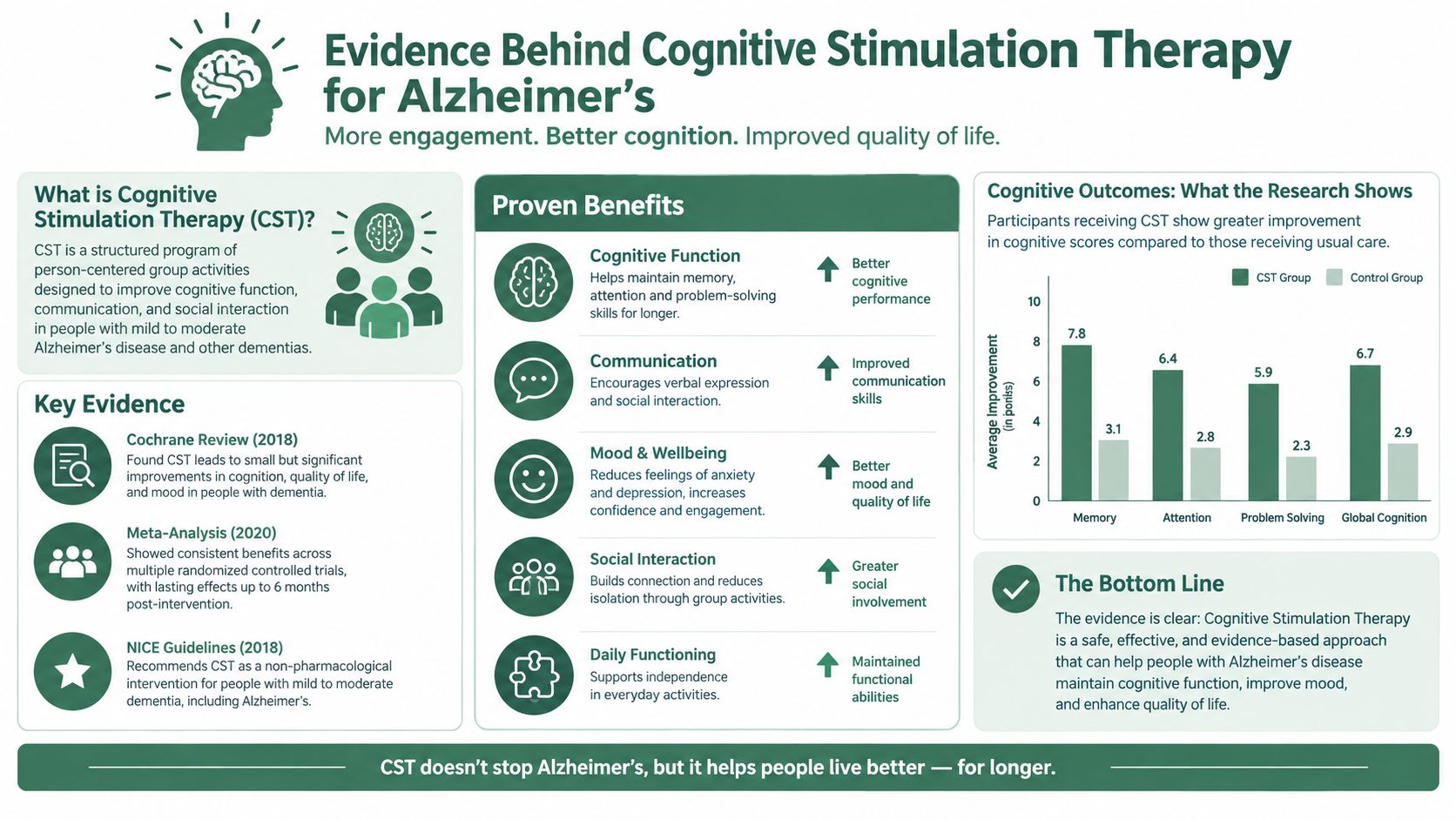
A helpful visual overview is below.
The landmark trial
A multi-centre randomized controlled trial recruited 201 older adults with dementia, with 115 assigned to CST and 86 to control. At follow-up, the CST group improved significantly more than controls on the Mini-Mental State Examination (P=0.044), the Alzheimer's Disease Assessment Scale-Cognition (P=0.014), and Quality of Life-Alzheimer's Disease scales (P=0.028). The trial also reported a number needed to treat of 6 using a criterion of at least 4 points of improvement on ADAS-Cog, as reported in this PubMed record for the CST randomized trial.
Those details matter because they show the gains weren't just subjective impressions. Researchers measured changes in cognition and quality of life using established dementia tools.
What later reviews found
The evidence didn't stop with one trial. A preregistered systematic review and meta-analysis covering 44 randomized controlled trials and 2,444 participants found a medium-sized immediate effect on global cognition, g = 0.49, and an average attenuation of cognitive decline of 2.41 points on ADAS-Cog after removing one outlier, according to this meta-analysis on CST outcomes.
That same analysis found significant improvements in memory, activities of daily living, depressive symptoms, and dementia ratings immediately after treatment. But it also found that benefits were not clearly sustained for global cognition at 1 to 10 months follow-up. That pattern is important for families. It suggests CST works best when treated as a time-linked, ongoing intervention, not a one-off burst of activity.
What the evidence means in real life
Here's the plain-language version:
Cognition can improve measurably: not in every person, and not forever, but enough to show up in trials.
Mood and engagement often improve too: especially during an active course of sessions.
Structure matters: the benefits seen in studies came from organized delivery, not random stimulation.
Maintenance probably matters: if support stops, gains may fade.
The fairest way to describe CST is this. It has real evidence behind it, but the benefits depend on regular delivery and realistic goals.
For many families, that makes CST worth trying. Not because it cures Alzheimer's disease, but because it offers a credible way to support the part of life that still can be supported.
Standard CST Protocol and What Happens in Sessions
One reason CST has held up in research is that it isn't loosely defined. There is an original protocol, and following it matters. A systematic review and meta-analysis focused on the original CST protocol found significant benefits when CST was delivered in adherence to the standard 14-session format, with improvements in global cognition, language, working memory, depression, neuropsychiatric symptoms, communication, self-reported quality of life, and dementia severity. The same review noted that in a maintenance CST randomized trial, continuing CST improved quality of life at 6 months and produced cognitive benefits in the subgroup taking acetylcholinesterase inhibitors, according to this UCL review on protocol fidelity and maintenance CST.
What a standard course looks like
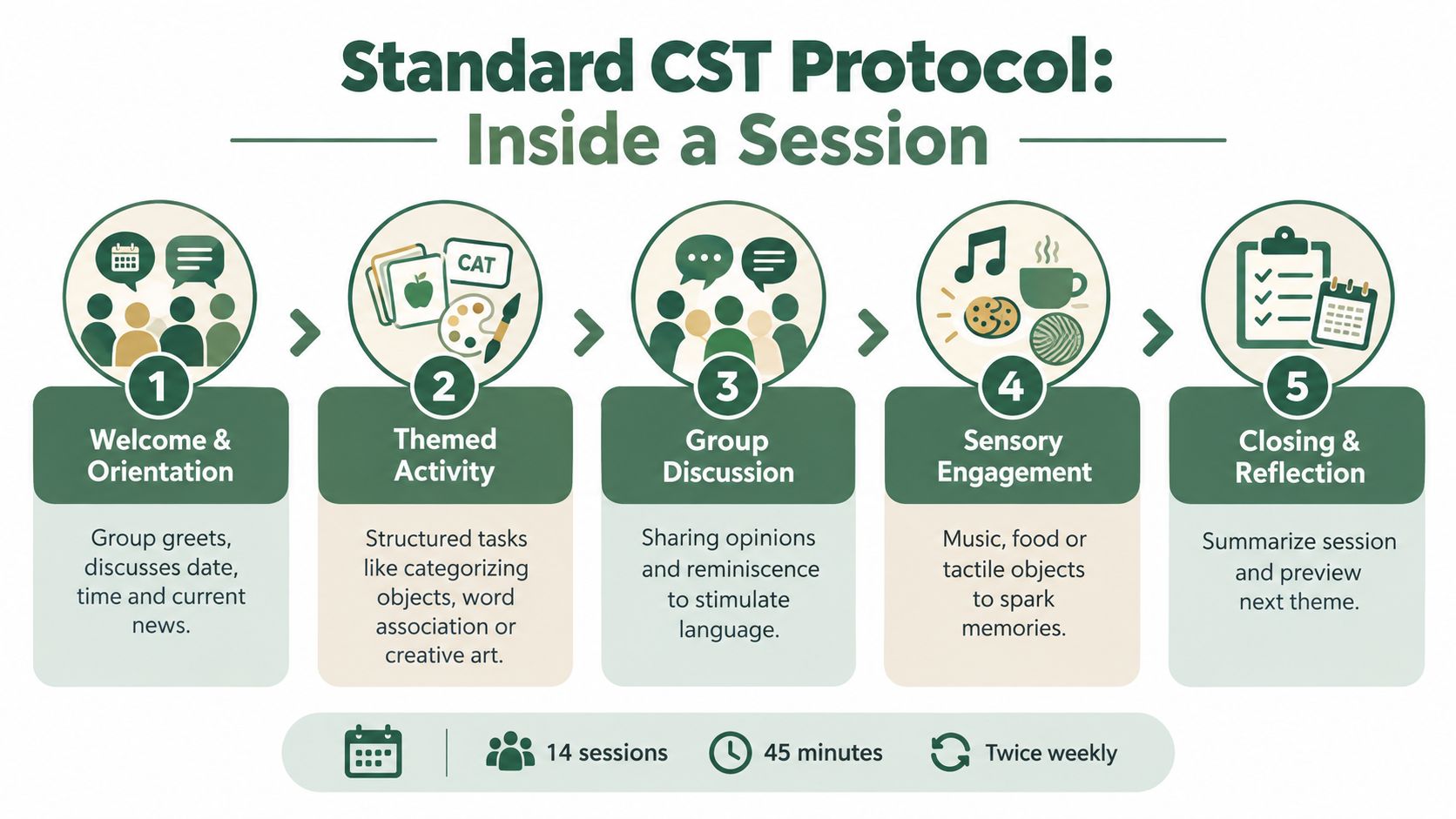
The classic CST format uses 14 sessions. The rhythm is usually twice weekly, which creates enough repetition to reinforce the skills being practiced without overwhelming the person.
A session often includes these ingredients:
Welcome and orientation
The facilitator helps the person settle in and reconnect with the present. That might mean discussing the day, date, season, location, weather, or a current event.A themed activity
Themes keep sessions predictable but not stale. Topics might involve food, faces, sounds, word associations, categorizing objects, or familiar routines.Guided discussion
The facilitator invites opinions and personal memories. This is less about right answers and more about expression, word finding, and participation.Sensory or reminiscence prompts
Music, objects, pictures, scents, or familiar topics can help facilitate conversation when direct recall is hard.A clear close
Sessions usually end with a simple recap and emotional landing, so the person doesn't leave feeling abruptly cut off or confused.
What makes a session therapeutic instead of casual
Families sometimes say, "We talk every day. Isn't that the same?" Not quite.
High-quality CST has a few features that ordinary conversation often lacks:
Deliberate scaffolding: prompts are adjusted so the person can succeed with support.
Balanced challenge: enough effort to engage the brain, not enough to trigger shame or shutdown.
Repeated core elements: orientation, language, attention, and memory cues show up again and again.
Validation: facilitators don't argue with confusion or pounce on mistakes.
Theme-based structure: sessions have shape, which reduces cognitive load.
If you're looking for examples that fit the spirit of CST at home, this guide to cognitive stimulation therapy activities is a useful starting point.
What facilitation sounds like
A good facilitator doesn't quiz. They guide.
Instead of saying, "No, that's wrong," they might say, "That's one way to think about it. Let's look at this clue together." Instead of asking a memory question with one exact answer, they may ask, "What meals do you remember making in winter?" That lets the person participate even if precise recall is weak.
The session should feel like supported thinking, not correction.
That tone matters as much as the task itself. Alzheimer's often makes people aware that things are harder. CST works best when the structure protects dignity while still asking the brain to stay involved.
Expected Outcomes and Honest Limits for Alzheimer's
Families deserve a straight answer about what CST can and can't do. The strongest case for CST is in cognition, especially during or soon after an active course. The evidence gets less consistent when you move from thinking skills to broader daily independence.
A recent 2025 meta-analysis of individual CST found a small cognitive benefit on MMSE, MD 1.65, and reduced depressive mood, but no significant effect on ADAS-Cog, quality of life, neuropsychiatric symptoms, or activities of daily living. A broader 2024 review found that cognitive stimulation, especially in group format, supports cognition across dementia severities, while cognitive rehabilitation mainly helps functional abilities in mild dementia, according to this review of individual CST and outcome boundaries.
What families can reasonably expect
If CST is a good fit, you may notice:
better conversational engagement
easier word finding on some days
improved participation during structured interaction
a lift in mood or less flatness
more confidence during guided activities
What you shouldn't assume is that better session performance will automatically translate into safer cooking, fewer medication mistakes, or broad independence in every daily task. Those outcomes often need other supports too.
What CST improves reliably versus mixed evidence
Outcome Domain | Evidence Strength and Typical Effect |
|---|---|
Global cognition | Strongest support. Trial and meta-analytic evidence show measurable short-term improvement. |
Memory and language | Supportive evidence. These often improve as part of broader cognitive gains. |
Mood and depressive symptoms | Supportive evidence. Some reviews found reduced depressive symptoms. |
Quality of life | Mixed to supportive. Some studies show benefit, but not every later review finds a clear effect across formats. |
Activities of daily living | Mixed. Some analyses found improvement, while others found no significant effect. |
Neuropsychiatric symptoms | Mixed. Improvement appears in some protocol-focused work, but not consistently across all reviews. |
Long-term durability without continued sessions | Limited. Benefits for global cognition aren't clearly sustained once the active treatment window ends. |
A better way to set goals
Don't use "get better" as the goal. It's too vague. Use goals that match what CST is built to support.
Try questions like these:
Cognition: Is the person staying with conversation a little longer?
Mood: Do they seem brighter or less withdrawn after sessions?
Engagement: Are they more willing to join in when prompted?
Daily life: Are there small carryovers, such as following a routine with fewer prompts?
A family can miss real progress if they're only watching for dramatic change.
When to reassess
If the person becomes distressed by the sessions, can't follow even with strong support, or shows no meaningful engagement over time, the format may need adjusting. Sometimes the answer is to simplify. Sometimes it's to switch toward more practical rehabilitation goals or more comfort-focused interaction.
Reality check: CST can support cognition and mood. It isn't a complete solution for independence, behavior, or long-term disease progression.
That's not a weakness in the therapy. It's a reminder to match the tool to the job.
Adapting CST for Phone Delivery and Everyday Support
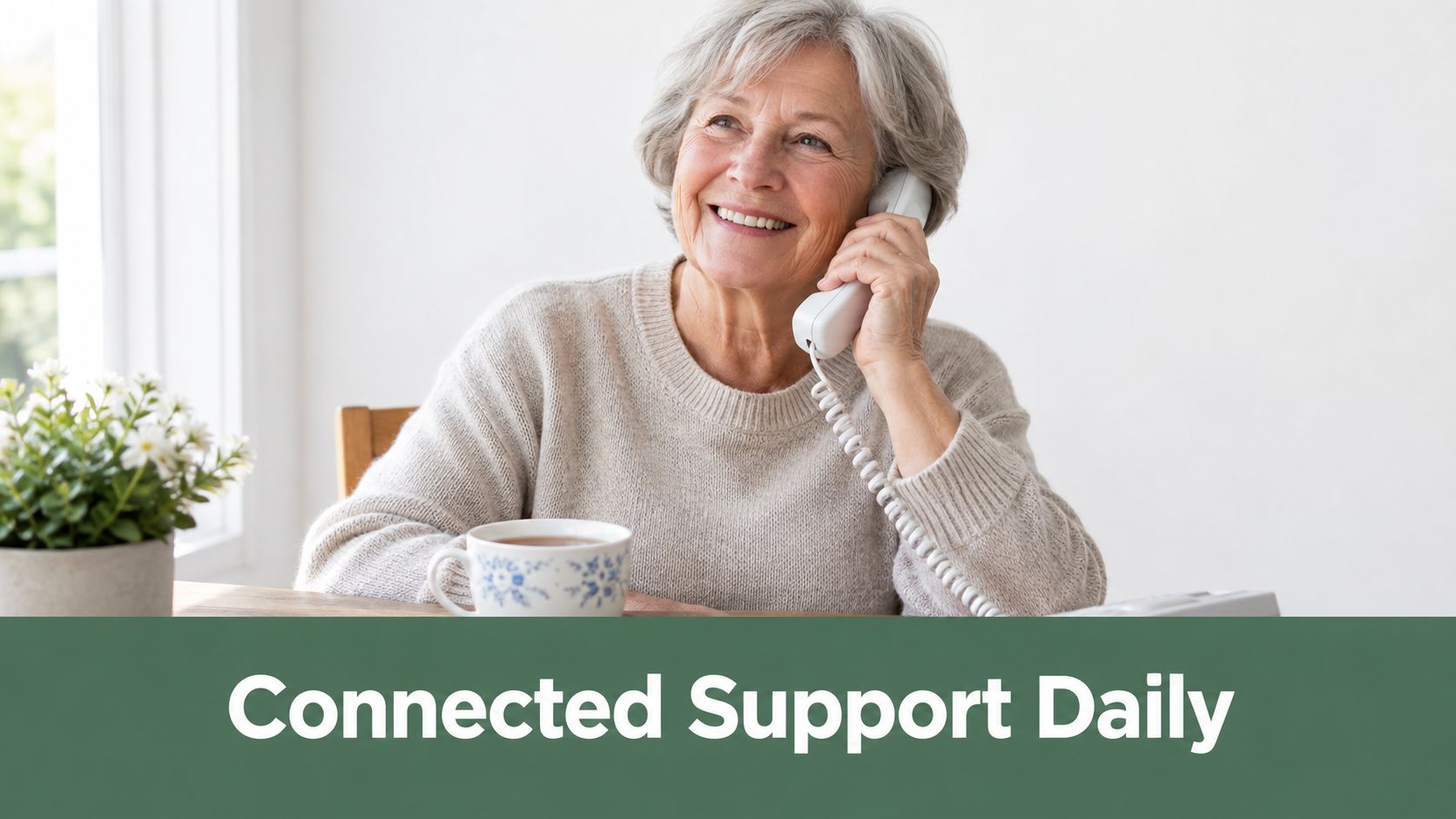
Phone delivery makes sense for many families because the core ingredients of CST aren't tied to a room full of materials. What matters most is structured, repeated engagement. A phone call can still include orientation, language rehearsal, reminiscence, attention prompts, and emotional validation.
What transfers well to the phone
A thoughtful call can do more than check in.
A caller can ask about the day and time, discuss the weather outside the window, revisit a favorite recipe, name items in the kitchen, compare seasons, or use a familiar song lyric to spark memory. That keeps the session grounded in real life rather than abstract testing.
Phone delivery also removes a barrier many older adults hit quickly. Apps, logins, passwords, tablets, and video platforms can create frustration before the cognitive work even begins.
What needs to be adapted
Phone-based support works best when the structure is simple and the prompts are clear.
Helpful adaptations include:
Short, steady pacing: one idea at a time, with pauses
Known routines: calls at the same time of day help reduce confusion
Personal content: prompts tied to the person's own history work better than generic trivia
Stage-aware support: early-stage participants may handle more open-ended discussion, while mid-stage participants may need tighter cueing
Family coordination: caregivers can flag hearing issues, anxiety triggers, or topics that usually go well
Recent reviews also point to a wider unanswered question in CST: who benefits most, in what format, and with what support. A 2025 systematic review focused on predictors of response suggested the field is still moving toward personalization, and another review noted benefits for caregivers' quality of life and relationship quality, though the evidence remained heterogeneous across 21 studies, according to this review on personalization and caregiver-related outcomes.
Where phone support fits in day-to-day care
A phone-based model can sit between clinic visits and family visits. It doesn't replace either. It fills the empty spaces.
One example is Velma, which offers scheduled phone-based cognitive support for older adults with early to mid-stage memory loss. Its program uses guided conversation, orientation prompts, reminiscence, language and attention tasks, mood support, safety check-ins, and care manager coordination. For families exploring this kind of routine support, Velma's overview of daily check-in calls for seniors shows how a call can support both cognition and daily stability.
The bigger point is practical. If the mechanism of CST depends on regular rehearsal and supportive conversation, a phone can carry quite a lot of that work when in-person care isn't available every day.
Choosing and Integrating CST Into Your Care Plan
The best way to start with CST is to think less like a shopper and more like a care coordinator. You're not buying a single activity. You're building a repeatable support pattern.
A simple decision checklist
Ask these questions:
Stage fit: Can your family member still engage in conversation with prompts?
Tolerance: Do they usually respond well to guided interaction, or does it create frustration?
Goal match: Are you hoping to support cognition, engagement, and mood more than complex independent functioning?
Delivery fit: Would group, one-to-one, or phone-based support be easiest to sustain?
Coordination: Can you share updates with clinicians, family, or a care manager?
What to track over a few weeks
Keep notes in ordinary language. You don't need a complicated system.
Write down:
how engaged they seemed during sessions
whether mood looked brighter, flatter, or unchanged
whether conversation flowed more easily
any changes in day-to-day function that matter to your household
signs that the sessions are too hard, too easy, or too tiring
This helps you make better decisions than memory alone, especially when different family members notice different things.
How CST fits with other treatment
CST works best as part of a broader plan. That can include medication management, hearing and vision checks, sleep support, safer routines at home, and caregiver education. If a person does well with the initial course, ask whether some form of maintenance makes sense. If they don't, adjust the approach instead of pushing through.
What matters most is consistency, dignity, and fit. People with Alzheimer's often do better when support is predictable, person-centered, and tied to the life they're still living now.
If you're looking for a way to bring structured cognitive support into everyday life, Velma offers scheduled phone-based calls for older adults with early to mid-stage memory loss. The program combines guided conversation, cognitive stimulation, emotional support, and practical check-ins that can complement clinical care and family caregiving at home.
If you're caring for a parent or partner with early Alzheimer's, you may already know the scene. Breakfast ends, and ten minutes later the same question comes again. A once-social person goes quiet because following conversation takes more effort. They may still enjoy music, old stories, or a familiar joke, but the days can start to feel smaller and more repetitive.
That's usually when families start looking for help that isn't just another medication change. They want something practical. Something that supports attention, language, confidence, and connection in everyday life.
Table of Contents
Introduction to Cognitive Stimulation Therapy for Alzheimer's
Who CST is usually for
Why families pay attention to it
How Cognitive Stimulation Therapy Works in the Brain
Repetition helps, but variety matters too
Why the social piece is part of the therapy
How CST differs from cognitive training and rehabilitation
Why consistency beats intensity
Evidence Behind Cognitive Stimulation Therapy for Alzheimer's
The landmark trial
What later reviews found
What the evidence means in real life
Standard CST Protocol and What Happens in Sessions
What a standard course looks like
What makes a session therapeutic instead of casual
What facilitation sounds like
Expected Outcomes and Honest Limits for Alzheimer's
What families can reasonably expect
What CST improves reliably versus mixed evidence
A better way to set goals
When to reassess
Adapting CST for Phone Delivery and Everyday Support
What transfers well to the phone
What needs to be adapted
Where phone support fits in day-to-day care
Choosing and Integrating CST Into Your Care Plan
A simple decision checklist
What to track over a few weeks
How CST fits with other treatment
Introduction to Cognitive Stimulation Therapy for Alzheimer's
Cognitive stimulation therapy for Alzheimer's disease is one of the most established non-drug approaches for people in the mild to moderate stages of dementia. It isn't just a stack of puzzles, and it isn't casual chatting dressed up as treatment. CST is a structured therapy that uses themed conversation, orientation, memory prompts, language activities, and social engagement to support thinking and well-being.
A simple way to picture it is this. If memory loss makes the day feel foggy, CST gives the person repeated chances to find their footing again. A session might include talking about the date and season, naming familiar objects, discussing a shared topic like food or travel, or using music and reminiscence to spark conversation. The point isn't to test the person. The point is to help them stay mentally active in a guided, supportive way.
Who CST is usually for
CST is generally used for people who can still take part in conversation with some support, even if they repeat themselves, lose track, or need prompts. That often fits people in the earlier and middle phases of Alzheimer's disease.
It complements medical care rather than replacing it. Families often use it alongside clinician visits, medication review, home support, and routine planning.
Why families pay attention to it
CST matters because it has a stronger clinical footing than many activities marketed as "brain games." In the UK, it became a formal guideline-backed dementia intervention in 2006 when it was first recommended by NICE/SCIE, and the recommendation was strengthened in 2018 to specifically say to offer group CST to people living with mild to moderate dementia. A major review also noted that it remained the only manualized psychosocial intervention recommended by those guidelines to support cognition, independence, and well-being in dementia, according to this UCL review of CST and guideline history.
CST isn't fringe care. It sits inside evidence-based dementia care, especially when the goal is to support function and quality of life during the stage when people can still engage.
Families are often told to "keep them stimulated," but that advice is too vague to be useful. CST gives that idea a real shape. It tells you what kind of engagement helps, how often it should happen, and what results are realistic.
How Cognitive Stimulation Therapy Works in the Brain
Think of the brain less like a battery that gets topped up and more like a network that works better when it gets regular, varied use. In Alzheimer's disease, some pathways become harder to access. CST doesn't reverse the disease, but it can help people use the pathways they still have more effectively through repetition, structure, and social cues.
Repetition helps, but variety matters too
A good CST session gently activates several skills at once. Not in a stressful way. In a natural way.
For example, if someone is asked what season it is, then talks about favorite winter foods, then names ingredients for soup, several systems are getting practice:
Orientation: noticing time, date, place, and what's happening now
Language: finding words, following questions, sharing opinions
Attention: staying with a topic for a few minutes
Memory access: pulling up older knowledge and familiar routines
Social response: taking turns, reading tone, feeling included
That mix matters more than difficulty. A crossword that frustrates someone isn't better than a warm, well-guided conversation that keeps them engaged.
Why the social piece is part of the therapy
People often hear "cognitive" and assume the goal is solitary brain exercise. CST works differently. Conversation itself is part of the intervention. When a person hears a prompt, searches for a word, listens to another person, and responds, they're practicing much more than memory alone.
This is one reason CST doesn't fit neatly into the same box as app-based brain training. If you'd like a plain-language comparison of different kinds of cognitive support, Velma's article on cognitive conditioning gives a useful frame.
Practical rule: In CST, the session should feel engaging and achievable. If it feels like a test, the level is probably off.
How CST differs from cognitive training and rehabilitation
These terms get mixed up a lot.
Cognitive training usually targets a specific skill through repeated tasks, like memory drills or attention exercises. Cognitive rehabilitation usually focuses on practical goals, like remembering steps for making tea safely or using a calendar to manage appointments. CST is broader. It uses structured, themed engagement to support global cognition and mood through regular participation.
That's why CST can include word work, reminiscence, current events, sensory prompts, and discussion in the same program. It isn't trying to create a perfect score on one task. It's trying to keep the person's overall thinking and connection more active.
Why consistency beats intensity
Families sometimes assume harder is better. With Alzheimer's, that's usually backwards. What helps most is consistent, well-paced stimulation that the person can tolerate and repeat.
A single great session won't carry much on its own. A predictable rhythm of sessions gives the brain repeated opportunities to rehearse orientation, language, and memory in context. That's part of why structured delivery matters so much.
Evidence Behind Cognitive Stimulation Therapy for Alzheimer's
CST has lasted in dementia care because it moved beyond good intentions and into measurable results. The evidence isn't vague. It includes guideline recognition, randomized trials, and later meta-analyses that looked across many studies.
Near the start of that evidence base was a large randomized controlled trial that helped define CST as a real clinical intervention rather than a pleasant activity program.
A helpful visual overview is below.
The landmark trial
A multi-centre randomized controlled trial recruited 201 older adults with dementia, with 115 assigned to CST and 86 to control. At follow-up, the CST group improved significantly more than controls on the Mini-Mental State Examination (P=0.044), the Alzheimer's Disease Assessment Scale-Cognition (P=0.014), and Quality of Life-Alzheimer's Disease scales (P=0.028). The trial also reported a number needed to treat of 6 using a criterion of at least 4 points of improvement on ADAS-Cog, as reported in this PubMed record for the CST randomized trial.
Those details matter because they show the gains weren't just subjective impressions. Researchers measured changes in cognition and quality of life using established dementia tools.
What later reviews found
The evidence didn't stop with one trial. A preregistered systematic review and meta-analysis covering 44 randomized controlled trials and 2,444 participants found a medium-sized immediate effect on global cognition, g = 0.49, and an average attenuation of cognitive decline of 2.41 points on ADAS-Cog after removing one outlier, according to this meta-analysis on CST outcomes.
That same analysis found significant improvements in memory, activities of daily living, depressive symptoms, and dementia ratings immediately after treatment. But it also found that benefits were not clearly sustained for global cognition at 1 to 10 months follow-up. That pattern is important for families. It suggests CST works best when treated as a time-linked, ongoing intervention, not a one-off burst of activity.
What the evidence means in real life
Here's the plain-language version:
Cognition can improve measurably: not in every person, and not forever, but enough to show up in trials.
Mood and engagement often improve too: especially during an active course of sessions.
Structure matters: the benefits seen in studies came from organized delivery, not random stimulation.
Maintenance probably matters: if support stops, gains may fade.
The fairest way to describe CST is this. It has real evidence behind it, but the benefits depend on regular delivery and realistic goals.
For many families, that makes CST worth trying. Not because it cures Alzheimer's disease, but because it offers a credible way to support the part of life that still can be supported.
Standard CST Protocol and What Happens in Sessions
One reason CST has held up in research is that it isn't loosely defined. There is an original protocol, and following it matters. A systematic review and meta-analysis focused on the original CST protocol found significant benefits when CST was delivered in adherence to the standard 14-session format, with improvements in global cognition, language, working memory, depression, neuropsychiatric symptoms, communication, self-reported quality of life, and dementia severity. The same review noted that in a maintenance CST randomized trial, continuing CST improved quality of life at 6 months and produced cognitive benefits in the subgroup taking acetylcholinesterase inhibitors, according to this UCL review on protocol fidelity and maintenance CST.
What a standard course looks like
The classic CST format uses 14 sessions. The rhythm is usually twice weekly, which creates enough repetition to reinforce the skills being practiced without overwhelming the person.
A session often includes these ingredients:
Welcome and orientation
The facilitator helps the person settle in and reconnect with the present. That might mean discussing the day, date, season, location, weather, or a current event.A themed activity
Themes keep sessions predictable but not stale. Topics might involve food, faces, sounds, word associations, categorizing objects, or familiar routines.Guided discussion
The facilitator invites opinions and personal memories. This is less about right answers and more about expression, word finding, and participation.Sensory or reminiscence prompts
Music, objects, pictures, scents, or familiar topics can help facilitate conversation when direct recall is hard.A clear close
Sessions usually end with a simple recap and emotional landing, so the person doesn't leave feeling abruptly cut off or confused.
What makes a session therapeutic instead of casual
Families sometimes say, "We talk every day. Isn't that the same?" Not quite.
High-quality CST has a few features that ordinary conversation often lacks:
Deliberate scaffolding: prompts are adjusted so the person can succeed with support.
Balanced challenge: enough effort to engage the brain, not enough to trigger shame or shutdown.
Repeated core elements: orientation, language, attention, and memory cues show up again and again.
Validation: facilitators don't argue with confusion or pounce on mistakes.
Theme-based structure: sessions have shape, which reduces cognitive load.
If you're looking for examples that fit the spirit of CST at home, this guide to cognitive stimulation therapy activities is a useful starting point.
What facilitation sounds like
A good facilitator doesn't quiz. They guide.
Instead of saying, "No, that's wrong," they might say, "That's one way to think about it. Let's look at this clue together." Instead of asking a memory question with one exact answer, they may ask, "What meals do you remember making in winter?" That lets the person participate even if precise recall is weak.
The session should feel like supported thinking, not correction.
That tone matters as much as the task itself. Alzheimer's often makes people aware that things are harder. CST works best when the structure protects dignity while still asking the brain to stay involved.
Expected Outcomes and Honest Limits for Alzheimer's
Families deserve a straight answer about what CST can and can't do. The strongest case for CST is in cognition, especially during or soon after an active course. The evidence gets less consistent when you move from thinking skills to broader daily independence.
A recent 2025 meta-analysis of individual CST found a small cognitive benefit on MMSE, MD 1.65, and reduced depressive mood, but no significant effect on ADAS-Cog, quality of life, neuropsychiatric symptoms, or activities of daily living. A broader 2024 review found that cognitive stimulation, especially in group format, supports cognition across dementia severities, while cognitive rehabilitation mainly helps functional abilities in mild dementia, according to this review of individual CST and outcome boundaries.
What families can reasonably expect
If CST is a good fit, you may notice:
better conversational engagement
easier word finding on some days
improved participation during structured interaction
a lift in mood or less flatness
more confidence during guided activities
What you shouldn't assume is that better session performance will automatically translate into safer cooking, fewer medication mistakes, or broad independence in every daily task. Those outcomes often need other supports too.
What CST improves reliably versus mixed evidence
Outcome Domain | Evidence Strength and Typical Effect |
|---|---|
Global cognition | Strongest support. Trial and meta-analytic evidence show measurable short-term improvement. |
Memory and language | Supportive evidence. These often improve as part of broader cognitive gains. |
Mood and depressive symptoms | Supportive evidence. Some reviews found reduced depressive symptoms. |
Quality of life | Mixed to supportive. Some studies show benefit, but not every later review finds a clear effect across formats. |
Activities of daily living | Mixed. Some analyses found improvement, while others found no significant effect. |
Neuropsychiatric symptoms | Mixed. Improvement appears in some protocol-focused work, but not consistently across all reviews. |
Long-term durability without continued sessions | Limited. Benefits for global cognition aren't clearly sustained once the active treatment window ends. |
A better way to set goals
Don't use "get better" as the goal. It's too vague. Use goals that match what CST is built to support.
Try questions like these:
Cognition: Is the person staying with conversation a little longer?
Mood: Do they seem brighter or less withdrawn after sessions?
Engagement: Are they more willing to join in when prompted?
Daily life: Are there small carryovers, such as following a routine with fewer prompts?
A family can miss real progress if they're only watching for dramatic change.
When to reassess
If the person becomes distressed by the sessions, can't follow even with strong support, or shows no meaningful engagement over time, the format may need adjusting. Sometimes the answer is to simplify. Sometimes it's to switch toward more practical rehabilitation goals or more comfort-focused interaction.
Reality check: CST can support cognition and mood. It isn't a complete solution for independence, behavior, or long-term disease progression.
That's not a weakness in the therapy. It's a reminder to match the tool to the job.
Adapting CST for Phone Delivery and Everyday Support
Phone delivery makes sense for many families because the core ingredients of CST aren't tied to a room full of materials. What matters most is structured, repeated engagement. A phone call can still include orientation, language rehearsal, reminiscence, attention prompts, and emotional validation.
What transfers well to the phone
A thoughtful call can do more than check in.
A caller can ask about the day and time, discuss the weather outside the window, revisit a favorite recipe, name items in the kitchen, compare seasons, or use a familiar song lyric to spark memory. That keeps the session grounded in real life rather than abstract testing.
Phone delivery also removes a barrier many older adults hit quickly. Apps, logins, passwords, tablets, and video platforms can create frustration before the cognitive work even begins.
What needs to be adapted
Phone-based support works best when the structure is simple and the prompts are clear.
Helpful adaptations include:
Short, steady pacing: one idea at a time, with pauses
Known routines: calls at the same time of day help reduce confusion
Personal content: prompts tied to the person's own history work better than generic trivia
Stage-aware support: early-stage participants may handle more open-ended discussion, while mid-stage participants may need tighter cueing
Family coordination: caregivers can flag hearing issues, anxiety triggers, or topics that usually go well
Recent reviews also point to a wider unanswered question in CST: who benefits most, in what format, and with what support. A 2025 systematic review focused on predictors of response suggested the field is still moving toward personalization, and another review noted benefits for caregivers' quality of life and relationship quality, though the evidence remained heterogeneous across 21 studies, according to this review on personalization and caregiver-related outcomes.
Where phone support fits in day-to-day care
A phone-based model can sit between clinic visits and family visits. It doesn't replace either. It fills the empty spaces.
One example is Velma, which offers scheduled phone-based cognitive support for older adults with early to mid-stage memory loss. Its program uses guided conversation, orientation prompts, reminiscence, language and attention tasks, mood support, safety check-ins, and care manager coordination. For families exploring this kind of routine support, Velma's overview of daily check-in calls for seniors shows how a call can support both cognition and daily stability.
The bigger point is practical. If the mechanism of CST depends on regular rehearsal and supportive conversation, a phone can carry quite a lot of that work when in-person care isn't available every day.
Choosing and Integrating CST Into Your Care Plan
The best way to start with CST is to think less like a shopper and more like a care coordinator. You're not buying a single activity. You're building a repeatable support pattern.
A simple decision checklist
Ask these questions:
Stage fit: Can your family member still engage in conversation with prompts?
Tolerance: Do they usually respond well to guided interaction, or does it create frustration?
Goal match: Are you hoping to support cognition, engagement, and mood more than complex independent functioning?
Delivery fit: Would group, one-to-one, or phone-based support be easiest to sustain?
Coordination: Can you share updates with clinicians, family, or a care manager?
What to track over a few weeks
Keep notes in ordinary language. You don't need a complicated system.
Write down:
how engaged they seemed during sessions
whether mood looked brighter, flatter, or unchanged
whether conversation flowed more easily
any changes in day-to-day function that matter to your household
signs that the sessions are too hard, too easy, or too tiring
This helps you make better decisions than memory alone, especially when different family members notice different things.
How CST fits with other treatment
CST works best as part of a broader plan. That can include medication management, hearing and vision checks, sleep support, safer routines at home, and caregiver education. If a person does well with the initial course, ask whether some form of maintenance makes sense. If they don't, adjust the approach instead of pushing through.
What matters most is consistency, dignity, and fit. People with Alzheimer's often do better when support is predictable, person-centered, and tied to the life they're still living now.
If you're looking for a way to bring structured cognitive support into everyday life, Velma offers scheduled phone-based calls for older adults with early to mid-stage memory loss. The program combines guided conversation, cognitive stimulation, emotional support, and practical check-ins that can complement clinical care and family caregiving at home.
Suggested Article: