8 Reminiscence Therapy Ideas for Meaningful Calls

A familiar song starts playing during a phone call. Your mother, who struggled to answer a question about yesterday, suddenly tells you about dancing with her sister, the dress she wore, and the room where the record player stood. Nobody asks her to prove the year or remember every detail. The conversation gives her a way back to a part of herself.
That's the value of well-led reminiscence. It isn't a memory test, and it shouldn't feel like one. These reminiscence therapy ideas use identity, sensory cues, family stories, historical periods, places, work, celebrations, and personal interests to create meaningful conversation while respecting changing abilities.
The strongest sessions are person-centered. They use validation instead of correction, pauses instead of pressure, and collaboration with family instead of assumptions. Phone delivery can work particularly well because the participant only needs a familiar voice, not an app or visual task. Velma is one example of scheduled phone-based support that combines conversation, cognitive stimulation, mood support, orientation, and practical check-ins. It complements medical treatment and in-person caregiving, rather than replacing either.
Before choosing a prompt, prepare the person, the setting, and the information you'll need.
Table of Contents
Prepare the conversation before the call
1. Life review and personal history exploration
Build a usable personal record
2. Sensory and memory association exercises
Match the cue to the person's access needs
3. Family stories and shared narratives
Turn family memories into shared connection
4. Decade-specific reminiscence
Build the call around personal anchors
5. Guided sensory visualization and imagination
6. Occupation and skill-based reminiscence
Adapt expertise when memory is less reliable
7. Holiday, celebration, and seasonal reminiscence
Hold joy and grief together
8. Hobbies, interests, and leisure activity reminiscence
Turn an old interest into present connection
8-Point Reminiscence Therapy Ideas Comparison
Turn one good memory into an ongoing connection
Prepare the conversation before the call
Start with a small amount of reliable background. A family member might share a former job, a favorite singer, the name of a hometown, a treasured recipe, or the holiday the person always hosted. One accurate detail is more useful than a long list of generic questions.
Match the prompt to the person's current communication ability. Someone with stronger language and attention may enjoy a layered story about moving across the country. Someone who becomes tired or loses words may respond better to recognizing a familiar song, choosing between two places, or answering a sensory question such as, “Did your kitchen smell more like bread or coffee on Sunday mornings?”
Use a calm, unhurried rhythm. Ask one question, then wait. Don't fill every silence, and don't turn uncertainty into correction. If the person says a detail differently from the family's records, respond to the meaning first. “That sounds like an important day” keeps connection intact, while “That's not what happened” turns the call into an examination.
A useful preparation note can include:
Known details: names, places, jobs, hobbies, traditions, and preferred music.
Safe entry points: subjects that usually bring warmth, pride, humor, or curiosity.
Sensitive subjects: losses, conflict, trauma, or topics the person has asked to avoid.
Follow-up options: a simpler recognition question, an either-or choice, or a change of topic.
The evidence supports a measured approach. The 2018 Cochrane review of reminiscence therapy for dementia included 22 trials with 1,972 participants. Its authors found no large immediate quality-of-life gain overall, while a later follow-up signal suggested that benefits may develop over time. That makes consistent, emotionally safe conversation more sensible than promising an instant transformation.
1. Life review and personal history exploration
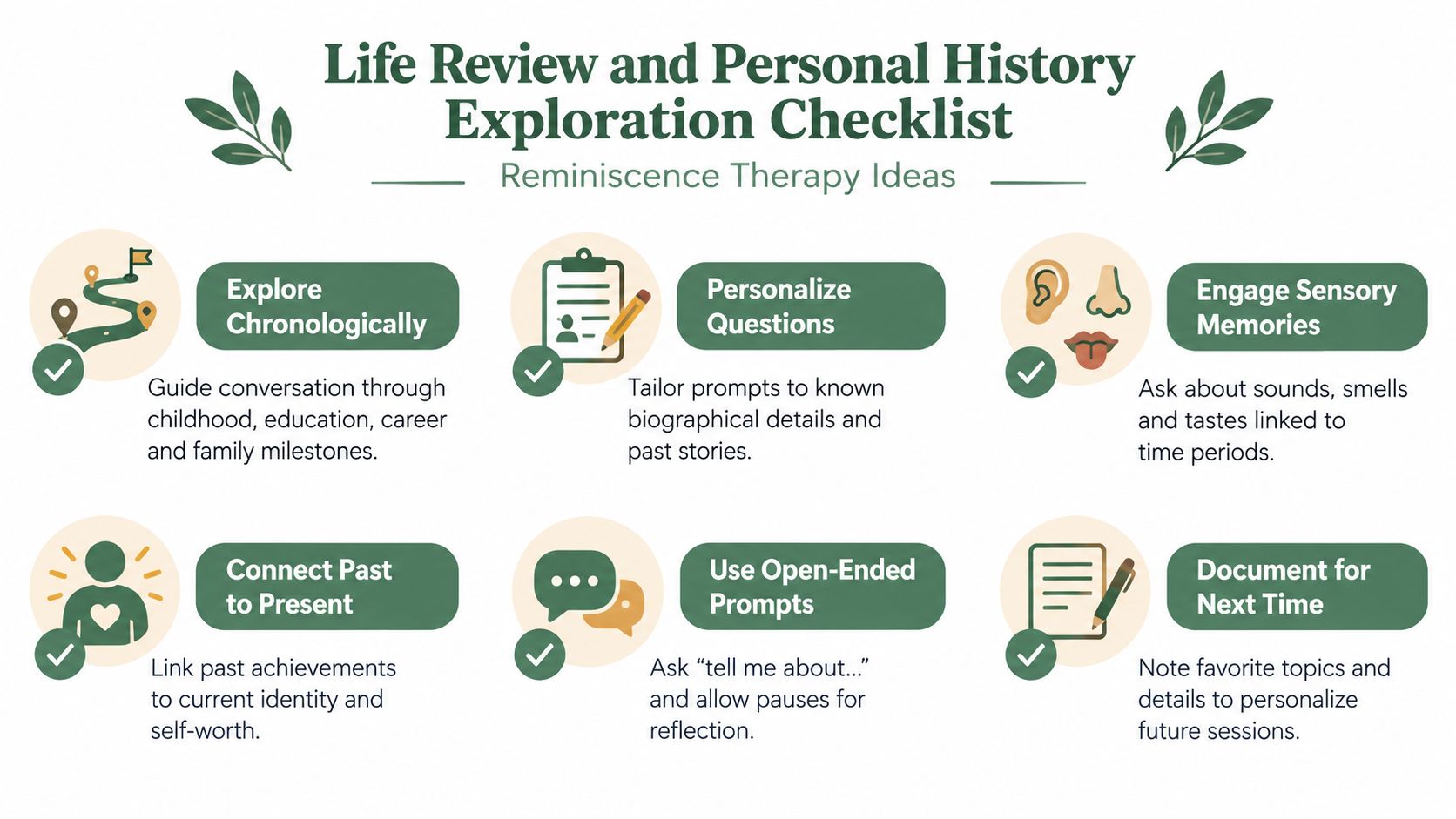
A life review gives the conversation a gentle shape. Instead of asking for one isolated memory, guide the person through meaningful chapters such as childhood, school, early adulthood, work, partnership, parenthood, and later transitions. The sequence doesn't need to be rigid. It gives both people a map when an open conversation feels difficult to start.
Ask for a scene, not a verdict. “Tell me about a day at work you remember clearly” invites more than “Did you enjoy teaching?” If the participant was a teacher, you might ask about a student who stayed in their thoughts, a classroom routine, or a moment when they felt their work mattered. If they served in the military, ask about a location, a unit, or a friendship, but let them decide how much detail they want to share.
Phone calls are especially suitable for this approach because the care team member can follow the participant's biography without needing photographs or objects in front of them. Velma, for example, can use details gathered during earlier calls to return to a meaningful career, family business, or life transition with a relevant follow-up question.
Build a usable personal record
Keep notes on the topics the participant chooses to revisit. Record names carefully, along with approximate life phases, places, emotional reactions, and details that help future callers continue naturally. A record can become the foundation for a legacy project built around personal stories, but it should never become a demand to produce a finished memoir.
Use open-ended prompts, then narrow only when needed:
Life phase: “What do you remember about your first years after school?”
Specific moment: “What did a typical workday look like?”
Meaning: “What part of that time made you proud?”
Recognition: “Was that the school on the main road or the one near the river?”
Practical rule: Follow the emotional importance of a memory, not just its factual accuracy.
If the person pauses, wait. If the story becomes confusing, reflect the feeling and gently redirect. “You worked hard during that period” may be more supportive than trying to repair every date or sequence.
2. Sensory and memory association exercises
A familiar sound, smell, texture, or taste can reach a memory through a different route than direct questions. During a phone call, a family member might play a few seconds of a song, describe the smell of bread baking, or ask about the sounds heard in a former workplace. These cues work best when they come from the person's own history, not from assumptions about their age or background.
Before the call, gather specific information from the participant or family:
Music: songs they requested, instruments they played, places where they listened
Food: recipes, markets, kitchens, cafés, or meals linked to particular people
Sounds: factory machinery, church bells, trains, school bells, or household appliances
Textures: wool, wood, gardening soil, work tools, sewing materials, or familiar clothing
A caller can then offer one cue and wait. “What does this song bring to mind?” leaves room for a person, place, activity, or feeling to emerge. If the answer is brief, accept it. “You heard this at dances?” is a gentler follow-up than a series of questions that turns the conversation into a memory test.
Match the cue to the person's access needs
Phone delivery requires careful preparation. Keep audio short, check that the volume is clear, and ask whether the participant wants to continue before replaying it. Hearing loss, aphasia, fatigue, or cognitive changes may make a sound difficult to interpret. A spoken description can work better than an audio clip, while a participant with limited verbal communication might respond through humming, facial expression, a gesture, or a single word.
One sensory cue can support several conversation paths:
Identity: “You mentioned playing piano. Where did you usually perform?”
Place: “Does that rain sound remind you of the house where you grew up?”
Work: “What tools made that sound during your working years?”
Emotion: “Does this feel pleasant, sad, exciting, or familiar?”
Stop promptly if the person becomes distressed, confused, unusually quiet, or asks to change the subject. A song associated with a deceased partner, lost home, or difficult employment may bring grief rather than comfort. Acknowledge the response without demanding an explanation, then offer a present-focused choice such as discussing the weather, a meal, or the next family call.
With permission, record the cue that helped and the response it produced. Family members can use that information during later calls, while avoiding repeated exposure if it caused distress. Guidance on reminiscence therapy for people living with dementia supports a structured, person-centered approach, but a sensory response should not be treated as proof of improvement. The practical aim is a respectful connection, with the participant controlling the pace and direction.
3. Family stories and shared narratives
A family story can show identity, belonging, grief, and contribution at once. Invite description rather than testing recall: “What was your oldest brother like?” or “What did your family usually do on birthdays?” If names are uncertain, accept a role, place, or personality detail as a meaningful response.
Before the call, prepare a simple relationship map with names, nicknames, connections, occupations, and important losses. Share it only with people who need it, and handle health information privately. This preparation reduces avoidable corrections. If the participant mentions someone who has died, acknowledge both the loss and the affection: “You still remember how she made everyone laugh.” Do not press for an explanation or redirect too quickly.
Traditions offer practical prompts. Recipes, moves, weddings, births, holiday preparations, and family gatherings can reveal what the participant contributed as a cook, organizer, caregiver, worker, or storyteller. On a phone call, ask one detail at a time. “Who made the dessert?” can lead to how it was prepared, who helped, and what the task meant to the family.
Adapt the conversation to the person's access to memory. Someone with stronger recall may describe a sequence of events; someone with more difficulty may respond to a familiar name, photograph, object, or short choice. Pause after each prompt. A relative can send a photo before the call, but should use it to invite a story rather than demand identification.
Turn family memories into shared connection
With permission, record useful themes for the family liaison or primary caregiver. If a father often mentions repairing bicycles with his brother, a daughter might send a related photograph, ask about a tool, or bring up the subject on a later call. Stop if the participant becomes distressed, confused, unusually quiet, or asks to change topics.
Phone prompts can connect the past with current family life:
Continuity: “Do the grandchildren enjoy that recipe too?”
Participation: “Who helps with the family gathering these days?”
Choice: “Would you rather tell me about the wedding or the family business?”
A milestone conversation can include posing ideas for a 50th anniversary, while keeping attention on what the celebration meant to the couple. Families can also draw from these reminiscence topics for seniors, replacing generic prompts with details from the participant's life.
4. Decade-specific reminiscence
A decade can give the caller a useful cultural frame, while the participant decides which parts matter. Begin with one ordinary detail: “What did a normal workday look like for you then?” From there, explore music, clothing, entertainment, transport, household routines, technology, work, or local news.
Choose a period tied to the person's own life. One participant may access young adulthood through music and first jobs. Another may respond more readily to the years spent raising children or running a business. Location, culture, class, family responsibilities, and historical events shaped each person's experience, so avoid treating a decade as a shared script.
A person who came of age during the 1960s might recall songs, clothing, or activities during a major public event. Someone discussing the 1950s may prefer a first car, an early workplace, or evenings at home. These details help identify whether the person is recalling facts, personal routines, or the feelings attached to that period.
Build the call around personal anchors
Before calling, prepare a short guide to the participant's activities, places, and relationships during the chosen period. Check historical references before introducing them. An inaccurate detail can weaken trust, particularly for someone with strong long-term knowledge.
Use prompts in a flexible order:
“What was happening in your life during that period?”
“What did a normal day look like?”
“What music, food, or entertainment belonged to that time?”
“What feels different from your life now?”
The final prompt connects reminiscence with present-day orientation without insisting that the past was better. Pause after each question. If open recall becomes difficult, offer recognition with two choices, such as, “Was your first car a Ford or a Chevrolet?” Accept correction if neither is right, and change direction without testing the person further.
Phone delivery may work better with one described object or setting at a time, such as a familiar shop, street, vehicle, or kitchen routine. A relative can show period photographs during an in-person visit, or send one before the call. Use the image to invite a response, not to require identification. A brief historical video can supply context, but the participant's story should remain central.
5. Guided sensory visualization and imagination
A familiar place can give a phone conversation a clear centre. Invite the participant to revisit a childhood home, former workplace, holiday cottage, favourite street, or another setting tied to identity. The caller provides a steady pace, while the participant decides which details belong in the memory.
Set expectations before starting: “I'd like to take a slow mental visit to a place you remember. You can keep your eyes open, and we can stop whenever you wish.” Use concrete prompts. Ask what is near the entrance, which room or area comes first, what sounds are present, and who might be nearby. Allow silence after each question.
Keep the memory owned by the participant. Do not supply details they have not mentioned. If you know the house had a blue door, ask, “Does a blue door feel familiar?” If you do not know, ask, “What colour do you remember?” This reduces the risk of suggesting an inaccurate detail.
A short visit usually works better than a long one for someone who becomes tired or confused. Use this sequence during the call:
Choose: offer one emotionally safe, familiar location.
Enter: start at a specific point, such as a door, gate, station, or desk.
Explore: ask about one sight, one sound, and one person.
Reflect: ask what the place meant to them.
Return: end the visit and reconnect with the present routine.
Close with a calm question: “We're back on the call now. How do you feel after visiting that place?” Then mention the current day, the next meal, or another immediate activity. Stop if the image brings fear, intense sadness, or confusion. Do not interpret the reaction or insist that the setting was happy. Mixed feelings are valid. Record places that prompt interest and those to avoid, then share the guidance with family or the care team.
Adapt the exercise to memory ability. If visualization is difficult, offer two familiar locations and let the participant choose. If detail remains accessible, ask about the route, people encountered, and changes noticed over time. A family member can join by holding up a known photograph during an in-person visit or sending it before the call. Use it as an invitation, not an identification test.

6. Occupation and skill-based reminiscence
Work often carries more than a job title. It holds competence, responsibility, relationships, and a sense of contribution. Ask what the person did, what made the work difficult, which skills mattered, and what they taught others.
Specificity helps. A retired nurse might describe a demanding shift, training, patient care, or colleagues. A farmer might discuss seasonal routines, equipment, weather, and decisions made under pressure. A tradesperson may remember tools, apprentices, measurements, and the satisfaction of finishing a difficult task. A parent or homemaker may describe the planning, negotiation, cooking, budgeting, and emotional labor required to keep a household running.
Create a simple occupational timeline when the person has held several jobs. Approximate periods and locations can provide useful anchors without demanding exact dates. Then ask questions that recognize expertise:
Challenge: “What was the hardest part of that work?”
Learning: “Who taught you the skill?”
Pride: “What are you most pleased you accomplished?”
Transfer: “Did that skill help you at home too?”
Adapt expertise when memory is less reliable
A person may not recall a supervisor's name but still demonstrate how a task was done. Ask for a process, gesture, sound, or tool. “What would you check first?” can be easier than “What year did you start?”
For phone delivery, the caller can describe a familiar workplace sound or ask the participant to explain an everyday object connected to the job. Family members can contribute photographs of uniforms, tools, storefronts, gardens, or kitchens, then use them as conversation anchors during a visit. Don't turn the object into a performance test. If the participant can't name it, respond to the knowledge they do express.
Work stories may also reveal current support needs. A conversation about medication routines, household repairs, or stove safety can move into a practical check-in without making the participant feel monitored. Velma's scheduled calls combine companionship and structured check-ins, which can help families notice patterns to discuss with clinicians or caregivers. They aren't a substitute for medical assessment or hands-on supervision.
7. Holiday, celebration, and seasonal reminiscence
Recurring occasions make strong memory anchors because they return each year and often involve the same foods, songs, people, and preparation rituals. Ask how the participant celebrated, but focus on their role within the event. Did they cook, decorate, host, choose gifts, attend religious services, organize travel, or keep everyone on schedule?
A winter holiday might lead to a story about a crowded kitchen, a particular dessert, a treasured gift, or the decorations used in a first home. A summer conversation could center on beach trips, community events, family picnics, or how the participant prepared the garden. Religious and cultural observances deserve careful, person-specific questions. Don't assume that a familiar holiday had the same meaning for everyone.
Sensory prompts often work well here. Ask about smells, music, textures, table settings, clothing, or the sound of relatives arriving. If the participant enjoys detail, follow the preparation from shopping to serving. If recall is limited, offer choices such as “Did you usually decorate early or at the last minute?”
Hold joy and grief together
Celebrations can make family absence more noticeable. A question about a favorite Christmas may bring sadness about a deceased spouse or changed family circumstances. Don't rush to replace the feeling with forced positivity. Acknowledge it, ask whether the person wants to continue, and offer a safer alternative if needed.
A seasonal call can close with the present:
Current plan: “What will you do for the upcoming holiday?”
Family link: “Who might call or visit?”
Choice: “Would you like to hear music, talk about food, or remember the decorations?”
Practical support: “Is there anything about the plan that feels difficult?”
Traditions can include scent, but use caution with incense, candles, food allergies, and respiratory sensitivities during in-person activities. A discussion of Yule incense traditions may be appropriate for a participant who connects with that custom, but conversation is safer than introducing an unfamiliar burning product without caregiver oversight.
8. Hobbies, interests, and leisure activity reminiscence
Hobbies reveal chosen identity. They show what the person enjoyed when nobody was assigning a task, whether that meant gardening, reading, collecting, sports, music, travel, crafts, cooking, or repairing things. Begin with genuine curiosity rather than trying to steer quickly toward a therapeutic outcome.
A gardener might describe favorite plants, the smell of soil, the best season, or the person who taught them to grow vegetables. A sports enthusiast may remember a team, a game, a position, or the friends who watched with them. A reader may name favorite authors, libraries, or the books that changed how they saw the world. A collector may explain the rules they used to choose each item.
Phone prompts can be concrete:
Skill: “Tell me how you learned to do that.”
Best memory: “What was your favorite garden, catch, project, or trip?”
Connection: “Who shared that interest with you?”
Meaning: “What did you enjoy most about it?”
Continuity: “Is there a simpler way to enjoy it now?”
Turn an old interest into present connection
The activity doesn't have to be performed to remain meaningful. A person who can no longer garden may sort seed packets, smell herbs, describe a favorite plant, or listen while a family member reports what's growing. Someone who can't travel may revisit a destination through a description, map, postcard, or familiar food.
Adapt the level of demand. Offer two sports, two destinations, or two book titles when open recall is hard. If the participant can sustain a narrative, ask about the first project, the hardest lesson, and the people involved. Record which subjects bring energy, humor, or sustained attention so future callers can return to them without repeating the same question mechanically.
The 2019 systematic review and meta-analysis of reminiscence therapy included 23 studies involving 1,763 participants, with average participant ages of 85.2 and 85.3 years in the intervention and control groups. Its findings, together with later evidence, fit the practical pattern seen in hobby conversations: emotional engagement, identity, and quality of life are more realistic aims than dramatic restoration of memory.
8-Point Reminiscence Therapy Ideas Comparison
Activity | Complexity (🔄) | Resource Requirements (⚡) | Expected Outcomes (📊) | Ideal Use Cases | Key Advantages (⭐ 💡) |
|---|---|---|---|---|---|
Life Review and Personal History Exploration | Moderate, structured, multi-session facilitation | Low-tech (phone); time-intensive intake & notes | Strengthened identity; reduced anxiety; cognitive stimulation | Phone-based scheduled calls; participants with autobiographical memory | ⭐ Highly personalized; 💡 keep detailed notes to tailor future sessions |
Sensory and Memory Association Exercises | Moderate, needs sensory selection and monitoring | Low-tech audio; curator knowledge of era-specific stimuli | Vivid recall; positive mood; strong emotional engagement | Moderate dementia; mood-boosting, short audio prompts | ⭐ Engages preserved sensory pathways; 💡 use 15–30s clips and test audio quality |
Family Stories and Shared Narratives | Moderate, requires sensitivity to family dynamics | Low-tech; family-tree intake; coordination with caregivers | Increased sense of belonging; reduced isolation; family connection | Participants with family ties or loneliness; family-involved care | ⭐ Deep relational meaning; 💡 maintain a family map for accuracy |
Decade-Specific Reminiscence (Cultural/Historical) | Low–Moderate, prep on era-specific prompts | Low-tech; decade guides or reference materials | Rich contextual recall; broad conversational engagement | Those responsive to cultural touchstones; historically aware participants | ⭐ Broadly relatable; 💡 prepare decade-specific prompts covering work, music, daily life |
Guided Sensory Visualization and Imagination | High, requires skilled pacing, tone, and grounding | Minimal tech; trained facilitator; prior location details | Immersive calmness; multi-sensory memory activation; mood support | Participants receptive to imagery; anxiety-reduction or short calming sessions | ⭐ Immersive and soothing; 💡 keep sessions brief (5–10 min) and grounded in real places |
Occupation and Skill-Based Reminiscence | Moderate, may need timeline organization | Low-tech; detailed occupational intake; probing questions | Reinforced competence and self-worth; rich storytelling | Retirees or those with strong work identity; identity-focused interventions | ⭐ Reinforces identity and pride; 💡 build a career timeline to structure sessions |
Holiday, Celebration, and Seasonal Reminiscence | Low, readily scheduled and repeatable | Low-tech; cultural/religious knowledge; sensory prompts | Positive affect; recurrent engagement opportunities across year | Around holidays/seasons; culturally diverse participants | ⭐ High emotional resonance; 💡 time conversations to upcoming holidays for relevance |
Hobbies, Interests, and Leisure Activity Reminiscence | Low–Moderate, individualized questioning needed | Low-tech; hobby intake and facilitator curiosity | High engagement; preserved skills and enjoyment; motivation | Participants with strong leisure identities; activity re-engagement | ⭐ Highly personal and motivating; 💡 explore adapted/current ways to engage past interests |
Turn one good memory into an ongoing connection
A meaningful call doesn't need a complicated program. Use a repeatable three-part routine.
First, prepare one personalized prompt from the participant's history. Choose a person, place, song, job, recipe, celebration, or hobby that has already shown signs of interest. One accurate detail is enough. If you're unsure whether a topic is safe, ask the family caregiver before using it.
Second, deliver the prompt with a concrete or sensory cue and generous pauses. Describe a place, play a brief piece of familiar music, mention a tool, name a family tradition, or offer two choices. Then listen. Don't interrupt to repair the timeline, and don't ask several questions in quick succession. The participant may need time to find a word or decide whether they want to continue.
Third, record what created engagement and what created distress. Note whether the person responded to music, recognition, a specific name, or a detailed follow-up. Also record signs of fatigue, anxiety, grief, withdrawal, or confusion. That record helps the next caller avoid repetition and choose a better starting point.
Match complexity to ability. When open-ended recall is difficult, use recognition, either-or choices, short sensory prompts, and familiar names. When the participant can sustain detail, use timelines, layered questions, and story-building. Neither approach is more valuable. The right level is the one that preserves dignity and participation.
Families can contribute practical material without taking over. Share names, photos, objects, favorite music, recipes, traditions, former workplaces, travel locations, and emotionally safe topics. An in-person caregiver can describe a photo or place it nearby while a phone-based care team member guides the conversation. Families should avoid correction, quizzing, pressure, and unsupported promises that reminiscence will stop agitation, restore lost abilities, or remove caregiver stress.
The evidence calls for that honesty. A 2026 meta-analysis of 26 studies involving 2,766 participants found improvements in cognition, depressive symptoms, and quality of life, but it did not find reductions in behavioral and psychological symptoms of dementia or caregiver burden, as reported in the published review record. An umbrella review cited in the same source found benefits in areas such as self-esteem, communication, functional activity, and loneliness, but not significant improvements in well-being, agitation, or apathy. Reminiscence is best treated as a companionship-and-engagement intervention, not a stand-alone solution for every dementia symptom.
Consistency matters too. A 2026 meta-analysis of reminiscence-based therapies found larger life-satisfaction gains in programs lasting at least 8 weeks than in shorter programs, with narrative therapy ranking highest for life satisfaction overall. That supports recurring calls with familiar facilitators, rather than relying on occasional prompts when a family member happens to have time.
If a person becomes repeatedly distressed, unusually confused, withdrawn, or unsafe, pause the activity and contact the appropriate clinician or care professional. Reminiscence can support care, but it doesn't diagnose symptoms or replace treatment.
For families seeking recurring phone contact, Velma offers scheduled calls with trained care team members, reminiscence and cognitive activities, companionship, orientation, practical check-ins, care-manager coordination, and structured communication with families. Details can change, so review the current offering directly at https://heyvelma.com.
Velma can turn these reminiscence therapy ideas into recurring phone conversations shaped around a person's history, interests, cognitive ability, and routine, while also including companionship and practical check-ins. Visit Velma to see whether scheduled support could give your family a consistent, person-centered way to stay connected.
A familiar song starts playing during a phone call. Your mother, who struggled to answer a question about yesterday, suddenly tells you about dancing with her sister, the dress she wore, and the room where the record player stood. Nobody asks her to prove the year or remember every detail. The conversation gives her a way back to a part of herself.
That's the value of well-led reminiscence. It isn't a memory test, and it shouldn't feel like one. These reminiscence therapy ideas use identity, sensory cues, family stories, historical periods, places, work, celebrations, and personal interests to create meaningful conversation while respecting changing abilities.
The strongest sessions are person-centered. They use validation instead of correction, pauses instead of pressure, and collaboration with family instead of assumptions. Phone delivery can work particularly well because the participant only needs a familiar voice, not an app or visual task. Velma is one example of scheduled phone-based support that combines conversation, cognitive stimulation, mood support, orientation, and practical check-ins. It complements medical treatment and in-person caregiving, rather than replacing either.
Before choosing a prompt, prepare the person, the setting, and the information you'll need.
Table of Contents
Prepare the conversation before the call
1. Life review and personal history exploration
Build a usable personal record
2. Sensory and memory association exercises
Match the cue to the person's access needs
3. Family stories and shared narratives
Turn family memories into shared connection
4. Decade-specific reminiscence
Build the call around personal anchors
5. Guided sensory visualization and imagination
6. Occupation and skill-based reminiscence
Adapt expertise when memory is less reliable
7. Holiday, celebration, and seasonal reminiscence
Hold joy and grief together
8. Hobbies, interests, and leisure activity reminiscence
Turn an old interest into present connection
8-Point Reminiscence Therapy Ideas Comparison
Turn one good memory into an ongoing connection
Prepare the conversation before the call
Start with a small amount of reliable background. A family member might share a former job, a favorite singer, the name of a hometown, a treasured recipe, or the holiday the person always hosted. One accurate detail is more useful than a long list of generic questions.
Match the prompt to the person's current communication ability. Someone with stronger language and attention may enjoy a layered story about moving across the country. Someone who becomes tired or loses words may respond better to recognizing a familiar song, choosing between two places, or answering a sensory question such as, “Did your kitchen smell more like bread or coffee on Sunday mornings?”
Use a calm, unhurried rhythm. Ask one question, then wait. Don't fill every silence, and don't turn uncertainty into correction. If the person says a detail differently from the family's records, respond to the meaning first. “That sounds like an important day” keeps connection intact, while “That's not what happened” turns the call into an examination.
A useful preparation note can include:
Known details: names, places, jobs, hobbies, traditions, and preferred music.
Safe entry points: subjects that usually bring warmth, pride, humor, or curiosity.
Sensitive subjects: losses, conflict, trauma, or topics the person has asked to avoid.
Follow-up options: a simpler recognition question, an either-or choice, or a change of topic.
The evidence supports a measured approach. The 2018 Cochrane review of reminiscence therapy for dementia included 22 trials with 1,972 participants. Its authors found no large immediate quality-of-life gain overall, while a later follow-up signal suggested that benefits may develop over time. That makes consistent, emotionally safe conversation more sensible than promising an instant transformation.
1. Life review and personal history exploration
A life review gives the conversation a gentle shape. Instead of asking for one isolated memory, guide the person through meaningful chapters such as childhood, school, early adulthood, work, partnership, parenthood, and later transitions. The sequence doesn't need to be rigid. It gives both people a map when an open conversation feels difficult to start.
Ask for a scene, not a verdict. “Tell me about a day at work you remember clearly” invites more than “Did you enjoy teaching?” If the participant was a teacher, you might ask about a student who stayed in their thoughts, a classroom routine, or a moment when they felt their work mattered. If they served in the military, ask about a location, a unit, or a friendship, but let them decide how much detail they want to share.
Phone calls are especially suitable for this approach because the care team member can follow the participant's biography without needing photographs or objects in front of them. Velma, for example, can use details gathered during earlier calls to return to a meaningful career, family business, or life transition with a relevant follow-up question.
Build a usable personal record
Keep notes on the topics the participant chooses to revisit. Record names carefully, along with approximate life phases, places, emotional reactions, and details that help future callers continue naturally. A record can become the foundation for a legacy project built around personal stories, but it should never become a demand to produce a finished memoir.
Use open-ended prompts, then narrow only when needed:
Life phase: “What do you remember about your first years after school?”
Specific moment: “What did a typical workday look like?”
Meaning: “What part of that time made you proud?”
Recognition: “Was that the school on the main road or the one near the river?”
Practical rule: Follow the emotional importance of a memory, not just its factual accuracy.
If the person pauses, wait. If the story becomes confusing, reflect the feeling and gently redirect. “You worked hard during that period” may be more supportive than trying to repair every date or sequence.
2. Sensory and memory association exercises
A familiar sound, smell, texture, or taste can reach a memory through a different route than direct questions. During a phone call, a family member might play a few seconds of a song, describe the smell of bread baking, or ask about the sounds heard in a former workplace. These cues work best when they come from the person's own history, not from assumptions about their age or background.
Before the call, gather specific information from the participant or family:
Music: songs they requested, instruments they played, places where they listened
Food: recipes, markets, kitchens, cafés, or meals linked to particular people
Sounds: factory machinery, church bells, trains, school bells, or household appliances
Textures: wool, wood, gardening soil, work tools, sewing materials, or familiar clothing
A caller can then offer one cue and wait. “What does this song bring to mind?” leaves room for a person, place, activity, or feeling to emerge. If the answer is brief, accept it. “You heard this at dances?” is a gentler follow-up than a series of questions that turns the conversation into a memory test.
Match the cue to the person's access needs
Phone delivery requires careful preparation. Keep audio short, check that the volume is clear, and ask whether the participant wants to continue before replaying it. Hearing loss, aphasia, fatigue, or cognitive changes may make a sound difficult to interpret. A spoken description can work better than an audio clip, while a participant with limited verbal communication might respond through humming, facial expression, a gesture, or a single word.
One sensory cue can support several conversation paths:
Identity: “You mentioned playing piano. Where did you usually perform?”
Place: “Does that rain sound remind you of the house where you grew up?”
Work: “What tools made that sound during your working years?”
Emotion: “Does this feel pleasant, sad, exciting, or familiar?”
Stop promptly if the person becomes distressed, confused, unusually quiet, or asks to change the subject. A song associated with a deceased partner, lost home, or difficult employment may bring grief rather than comfort. Acknowledge the response without demanding an explanation, then offer a present-focused choice such as discussing the weather, a meal, or the next family call.
With permission, record the cue that helped and the response it produced. Family members can use that information during later calls, while avoiding repeated exposure if it caused distress. Guidance on reminiscence therapy for people living with dementia supports a structured, person-centered approach, but a sensory response should not be treated as proof of improvement. The practical aim is a respectful connection, with the participant controlling the pace and direction.
3. Family stories and shared narratives
A family story can show identity, belonging, grief, and contribution at once. Invite description rather than testing recall: “What was your oldest brother like?” or “What did your family usually do on birthdays?” If names are uncertain, accept a role, place, or personality detail as a meaningful response.
Before the call, prepare a simple relationship map with names, nicknames, connections, occupations, and important losses. Share it only with people who need it, and handle health information privately. This preparation reduces avoidable corrections. If the participant mentions someone who has died, acknowledge both the loss and the affection: “You still remember how she made everyone laugh.” Do not press for an explanation or redirect too quickly.
Traditions offer practical prompts. Recipes, moves, weddings, births, holiday preparations, and family gatherings can reveal what the participant contributed as a cook, organizer, caregiver, worker, or storyteller. On a phone call, ask one detail at a time. “Who made the dessert?” can lead to how it was prepared, who helped, and what the task meant to the family.
Adapt the conversation to the person's access to memory. Someone with stronger recall may describe a sequence of events; someone with more difficulty may respond to a familiar name, photograph, object, or short choice. Pause after each prompt. A relative can send a photo before the call, but should use it to invite a story rather than demand identification.
Turn family memories into shared connection
With permission, record useful themes for the family liaison or primary caregiver. If a father often mentions repairing bicycles with his brother, a daughter might send a related photograph, ask about a tool, or bring up the subject on a later call. Stop if the participant becomes distressed, confused, unusually quiet, or asks to change topics.
Phone prompts can connect the past with current family life:
Continuity: “Do the grandchildren enjoy that recipe too?”
Participation: “Who helps with the family gathering these days?”
Choice: “Would you rather tell me about the wedding or the family business?”
A milestone conversation can include posing ideas for a 50th anniversary, while keeping attention on what the celebration meant to the couple. Families can also draw from these reminiscence topics for seniors, replacing generic prompts with details from the participant's life.
4. Decade-specific reminiscence
A decade can give the caller a useful cultural frame, while the participant decides which parts matter. Begin with one ordinary detail: “What did a normal workday look like for you then?” From there, explore music, clothing, entertainment, transport, household routines, technology, work, or local news.
Choose a period tied to the person's own life. One participant may access young adulthood through music and first jobs. Another may respond more readily to the years spent raising children or running a business. Location, culture, class, family responsibilities, and historical events shaped each person's experience, so avoid treating a decade as a shared script.
A person who came of age during the 1960s might recall songs, clothing, or activities during a major public event. Someone discussing the 1950s may prefer a first car, an early workplace, or evenings at home. These details help identify whether the person is recalling facts, personal routines, or the feelings attached to that period.
Build the call around personal anchors
Before calling, prepare a short guide to the participant's activities, places, and relationships during the chosen period. Check historical references before introducing them. An inaccurate detail can weaken trust, particularly for someone with strong long-term knowledge.
Use prompts in a flexible order:
“What was happening in your life during that period?”
“What did a normal day look like?”
“What music, food, or entertainment belonged to that time?”
“What feels different from your life now?”
The final prompt connects reminiscence with present-day orientation without insisting that the past was better. Pause after each question. If open recall becomes difficult, offer recognition with two choices, such as, “Was your first car a Ford or a Chevrolet?” Accept correction if neither is right, and change direction without testing the person further.
Phone delivery may work better with one described object or setting at a time, such as a familiar shop, street, vehicle, or kitchen routine. A relative can show period photographs during an in-person visit, or send one before the call. Use the image to invite a response, not to require identification. A brief historical video can supply context, but the participant's story should remain central.
5. Guided sensory visualization and imagination
A familiar place can give a phone conversation a clear centre. Invite the participant to revisit a childhood home, former workplace, holiday cottage, favourite street, or another setting tied to identity. The caller provides a steady pace, while the participant decides which details belong in the memory.
Set expectations before starting: “I'd like to take a slow mental visit to a place you remember. You can keep your eyes open, and we can stop whenever you wish.” Use concrete prompts. Ask what is near the entrance, which room or area comes first, what sounds are present, and who might be nearby. Allow silence after each question.
Keep the memory owned by the participant. Do not supply details they have not mentioned. If you know the house had a blue door, ask, “Does a blue door feel familiar?” If you do not know, ask, “What colour do you remember?” This reduces the risk of suggesting an inaccurate detail.
A short visit usually works better than a long one for someone who becomes tired or confused. Use this sequence during the call:
Choose: offer one emotionally safe, familiar location.
Enter: start at a specific point, such as a door, gate, station, or desk.
Explore: ask about one sight, one sound, and one person.
Reflect: ask what the place meant to them.
Return: end the visit and reconnect with the present routine.
Close with a calm question: “We're back on the call now. How do you feel after visiting that place?” Then mention the current day, the next meal, or another immediate activity. Stop if the image brings fear, intense sadness, or confusion. Do not interpret the reaction or insist that the setting was happy. Mixed feelings are valid. Record places that prompt interest and those to avoid, then share the guidance with family or the care team.
Adapt the exercise to memory ability. If visualization is difficult, offer two familiar locations and let the participant choose. If detail remains accessible, ask about the route, people encountered, and changes noticed over time. A family member can join by holding up a known photograph during an in-person visit or sending it before the call. Use it as an invitation, not an identification test.
6. Occupation and skill-based reminiscence
Work often carries more than a job title. It holds competence, responsibility, relationships, and a sense of contribution. Ask what the person did, what made the work difficult, which skills mattered, and what they taught others.
Specificity helps. A retired nurse might describe a demanding shift, training, patient care, or colleagues. A farmer might discuss seasonal routines, equipment, weather, and decisions made under pressure. A tradesperson may remember tools, apprentices, measurements, and the satisfaction of finishing a difficult task. A parent or homemaker may describe the planning, negotiation, cooking, budgeting, and emotional labor required to keep a household running.
Create a simple occupational timeline when the person has held several jobs. Approximate periods and locations can provide useful anchors without demanding exact dates. Then ask questions that recognize expertise:
Challenge: “What was the hardest part of that work?”
Learning: “Who taught you the skill?”
Pride: “What are you most pleased you accomplished?”
Transfer: “Did that skill help you at home too?”
Adapt expertise when memory is less reliable
A person may not recall a supervisor's name but still demonstrate how a task was done. Ask for a process, gesture, sound, or tool. “What would you check first?” can be easier than “What year did you start?”
For phone delivery, the caller can describe a familiar workplace sound or ask the participant to explain an everyday object connected to the job. Family members can contribute photographs of uniforms, tools, storefronts, gardens, or kitchens, then use them as conversation anchors during a visit. Don't turn the object into a performance test. If the participant can't name it, respond to the knowledge they do express.
Work stories may also reveal current support needs. A conversation about medication routines, household repairs, or stove safety can move into a practical check-in without making the participant feel monitored. Velma's scheduled calls combine companionship and structured check-ins, which can help families notice patterns to discuss with clinicians or caregivers. They aren't a substitute for medical assessment or hands-on supervision.
7. Holiday, celebration, and seasonal reminiscence
Recurring occasions make strong memory anchors because they return each year and often involve the same foods, songs, people, and preparation rituals. Ask how the participant celebrated, but focus on their role within the event. Did they cook, decorate, host, choose gifts, attend religious services, organize travel, or keep everyone on schedule?
A winter holiday might lead to a story about a crowded kitchen, a particular dessert, a treasured gift, or the decorations used in a first home. A summer conversation could center on beach trips, community events, family picnics, or how the participant prepared the garden. Religious and cultural observances deserve careful, person-specific questions. Don't assume that a familiar holiday had the same meaning for everyone.
Sensory prompts often work well here. Ask about smells, music, textures, table settings, clothing, or the sound of relatives arriving. If the participant enjoys detail, follow the preparation from shopping to serving. If recall is limited, offer choices such as “Did you usually decorate early or at the last minute?”
Hold joy and grief together
Celebrations can make family absence more noticeable. A question about a favorite Christmas may bring sadness about a deceased spouse or changed family circumstances. Don't rush to replace the feeling with forced positivity. Acknowledge it, ask whether the person wants to continue, and offer a safer alternative if needed.
A seasonal call can close with the present:
Current plan: “What will you do for the upcoming holiday?”
Family link: “Who might call or visit?”
Choice: “Would you like to hear music, talk about food, or remember the decorations?”
Practical support: “Is there anything about the plan that feels difficult?”
Traditions can include scent, but use caution with incense, candles, food allergies, and respiratory sensitivities during in-person activities. A discussion of Yule incense traditions may be appropriate for a participant who connects with that custom, but conversation is safer than introducing an unfamiliar burning product without caregiver oversight.
8. Hobbies, interests, and leisure activity reminiscence
Hobbies reveal chosen identity. They show what the person enjoyed when nobody was assigning a task, whether that meant gardening, reading, collecting, sports, music, travel, crafts, cooking, or repairing things. Begin with genuine curiosity rather than trying to steer quickly toward a therapeutic outcome.
A gardener might describe favorite plants, the smell of soil, the best season, or the person who taught them to grow vegetables. A sports enthusiast may remember a team, a game, a position, or the friends who watched with them. A reader may name favorite authors, libraries, or the books that changed how they saw the world. A collector may explain the rules they used to choose each item.
Phone prompts can be concrete:
Skill: “Tell me how you learned to do that.”
Best memory: “What was your favorite garden, catch, project, or trip?”
Connection: “Who shared that interest with you?”
Meaning: “What did you enjoy most about it?”
Continuity: “Is there a simpler way to enjoy it now?”
Turn an old interest into present connection
The activity doesn't have to be performed to remain meaningful. A person who can no longer garden may sort seed packets, smell herbs, describe a favorite plant, or listen while a family member reports what's growing. Someone who can't travel may revisit a destination through a description, map, postcard, or familiar food.
Adapt the level of demand. Offer two sports, two destinations, or two book titles when open recall is hard. If the participant can sustain a narrative, ask about the first project, the hardest lesson, and the people involved. Record which subjects bring energy, humor, or sustained attention so future callers can return to them without repeating the same question mechanically.
The 2019 systematic review and meta-analysis of reminiscence therapy included 23 studies involving 1,763 participants, with average participant ages of 85.2 and 85.3 years in the intervention and control groups. Its findings, together with later evidence, fit the practical pattern seen in hobby conversations: emotional engagement, identity, and quality of life are more realistic aims than dramatic restoration of memory.
8-Point Reminiscence Therapy Ideas Comparison
Activity | Complexity (🔄) | Resource Requirements (⚡) | Expected Outcomes (📊) | Ideal Use Cases | Key Advantages (⭐ 💡) |
|---|---|---|---|---|---|
Life Review and Personal History Exploration | Moderate, structured, multi-session facilitation | Low-tech (phone); time-intensive intake & notes | Strengthened identity; reduced anxiety; cognitive stimulation | Phone-based scheduled calls; participants with autobiographical memory | ⭐ Highly personalized; 💡 keep detailed notes to tailor future sessions |
Sensory and Memory Association Exercises | Moderate, needs sensory selection and monitoring | Low-tech audio; curator knowledge of era-specific stimuli | Vivid recall; positive mood; strong emotional engagement | Moderate dementia; mood-boosting, short audio prompts | ⭐ Engages preserved sensory pathways; 💡 use 15–30s clips and test audio quality |
Family Stories and Shared Narratives | Moderate, requires sensitivity to family dynamics | Low-tech; family-tree intake; coordination with caregivers | Increased sense of belonging; reduced isolation; family connection | Participants with family ties or loneliness; family-involved care | ⭐ Deep relational meaning; 💡 maintain a family map for accuracy |
Decade-Specific Reminiscence (Cultural/Historical) | Low–Moderate, prep on era-specific prompts | Low-tech; decade guides or reference materials | Rich contextual recall; broad conversational engagement | Those responsive to cultural touchstones; historically aware participants | ⭐ Broadly relatable; 💡 prepare decade-specific prompts covering work, music, daily life |
Guided Sensory Visualization and Imagination | High, requires skilled pacing, tone, and grounding | Minimal tech; trained facilitator; prior location details | Immersive calmness; multi-sensory memory activation; mood support | Participants receptive to imagery; anxiety-reduction or short calming sessions | ⭐ Immersive and soothing; 💡 keep sessions brief (5–10 min) and grounded in real places |
Occupation and Skill-Based Reminiscence | Moderate, may need timeline organization | Low-tech; detailed occupational intake; probing questions | Reinforced competence and self-worth; rich storytelling | Retirees or those with strong work identity; identity-focused interventions | ⭐ Reinforces identity and pride; 💡 build a career timeline to structure sessions |
Holiday, Celebration, and Seasonal Reminiscence | Low, readily scheduled and repeatable | Low-tech; cultural/religious knowledge; sensory prompts | Positive affect; recurrent engagement opportunities across year | Around holidays/seasons; culturally diverse participants | ⭐ High emotional resonance; 💡 time conversations to upcoming holidays for relevance |
Hobbies, Interests, and Leisure Activity Reminiscence | Low–Moderate, individualized questioning needed | Low-tech; hobby intake and facilitator curiosity | High engagement; preserved skills and enjoyment; motivation | Participants with strong leisure identities; activity re-engagement | ⭐ Highly personal and motivating; 💡 explore adapted/current ways to engage past interests |
Turn one good memory into an ongoing connection
A meaningful call doesn't need a complicated program. Use a repeatable three-part routine.
First, prepare one personalized prompt from the participant's history. Choose a person, place, song, job, recipe, celebration, or hobby that has already shown signs of interest. One accurate detail is enough. If you're unsure whether a topic is safe, ask the family caregiver before using it.
Second, deliver the prompt with a concrete or sensory cue and generous pauses. Describe a place, play a brief piece of familiar music, mention a tool, name a family tradition, or offer two choices. Then listen. Don't interrupt to repair the timeline, and don't ask several questions in quick succession. The participant may need time to find a word or decide whether they want to continue.
Third, record what created engagement and what created distress. Note whether the person responded to music, recognition, a specific name, or a detailed follow-up. Also record signs of fatigue, anxiety, grief, withdrawal, or confusion. That record helps the next caller avoid repetition and choose a better starting point.
Match complexity to ability. When open-ended recall is difficult, use recognition, either-or choices, short sensory prompts, and familiar names. When the participant can sustain detail, use timelines, layered questions, and story-building. Neither approach is more valuable. The right level is the one that preserves dignity and participation.
Families can contribute practical material without taking over. Share names, photos, objects, favorite music, recipes, traditions, former workplaces, travel locations, and emotionally safe topics. An in-person caregiver can describe a photo or place it nearby while a phone-based care team member guides the conversation. Families should avoid correction, quizzing, pressure, and unsupported promises that reminiscence will stop agitation, restore lost abilities, or remove caregiver stress.
The evidence calls for that honesty. A 2026 meta-analysis of 26 studies involving 2,766 participants found improvements in cognition, depressive symptoms, and quality of life, but it did not find reductions in behavioral and psychological symptoms of dementia or caregiver burden, as reported in the published review record. An umbrella review cited in the same source found benefits in areas such as self-esteem, communication, functional activity, and loneliness, but not significant improvements in well-being, agitation, or apathy. Reminiscence is best treated as a companionship-and-engagement intervention, not a stand-alone solution for every dementia symptom.
Consistency matters too. A 2026 meta-analysis of reminiscence-based therapies found larger life-satisfaction gains in programs lasting at least 8 weeks than in shorter programs, with narrative therapy ranking highest for life satisfaction overall. That supports recurring calls with familiar facilitators, rather than relying on occasional prompts when a family member happens to have time.
If a person becomes repeatedly distressed, unusually confused, withdrawn, or unsafe, pause the activity and contact the appropriate clinician or care professional. Reminiscence can support care, but it doesn't diagnose symptoms or replace treatment.
For families seeking recurring phone contact, Velma offers scheduled calls with trained care team members, reminiscence and cognitive activities, companionship, orientation, practical check-ins, care-manager coordination, and structured communication with families. Details can change, so review the current offering directly at https://heyvelma.com.
Velma can turn these reminiscence therapy ideas into recurring phone conversations shaped around a person's history, interests, cognitive ability, and routine, while also including companionship and practical check-ins. Visit Velma to see whether scheduled support could give your family a consistent, person-centered way to stay connected.
Suggested Article: