Emotional Well Being Support: A Guide for Older Adults

Your father answers the phone on a Tuesday evening, but the usual dry joke is missing. His voice sounds flat. After a long pause, he says he's fine, even though you can hear that something has changed. You ask about dinner, sleep, and the appointment he mentioned yesterday. Each answer is short, and the conversation ends before you know whether he's lonely, depressed, confused, or having a difficult day.
Families often face this uncertainty when an older adult lives alone or is beginning to experience memory loss. Emotional well being support can help, but it works best when it's treated as part of ongoing care rather than a response reserved for emergencies. Regular contact can create opportunities to notice changes in mood, confidence, sleep, engagement, and daily functioning.
The need is substantial. A World Health Organization benchmark on loneliness in older age estimates that about 11.8% of older people experience loneliness, while reported prevalence varies by region. The same source links loneliness and social isolation with depression, anxiety, cognitive decline, dementia, cardiovascular disease, stroke, diabetes, and shortened life expectancy. These risks affect the older person and the caregiver trying to keep everything steady.
Table of Contents
Why emotional well being support matters for older adults
Why loneliness becomes a care issue
What emotional well being support actually means
The basic elements
Why memory loss changes the approach
Signs that an older adult needs more support
Changes worth noticing
Evidence based approaches that actually help
Matching support to the person
Caregiver techniques that improve daily mood
Four responses that work in ordinary moments
How emotional support fits with clinical care
What coordinated care looks like
Choosing and evaluating the right service
A practical comparison
Why emotional well being support matters for older adults
A flat answer like “I'm fine” doesn't tell you enough. Your father may be grieving a spouse, struggling with a new diagnosis, sleeping poorly, or avoiding activities because memory lapses have made him embarrassed. He may also be experiencing ordinary sadness, medication effects, or a medical problem that needs prompt attention.
Emotional health shapes everyday behavior. A person who feels hopeless may skip meals or stop taking medication. Someone who feels anxious may avoid driving, appointments, or movement outside the home. Someone who feels socially disconnected may lose the motivation to keep up routines that once supported sleep, mobility, and independence.
Why loneliness becomes a care issue
Older adults often face several losses at once. Retirement can remove a valued role. Bereavement changes the rhythm of the day. Friends may become less available, chronic illness can limit travel, and early cognitive changes can make social situations feel risky. The caregiver may respond by doing more practical tasks while missing the emotional strain underneath.
In the United States, the share of adults aged 50 to 80 reporting a lack of companionship some of the time or often rose from 33.9% in 2018 to 41.4% in 2020, then stayed high at 33.4% in 2024, according to this JAMA report on emotional well-being among older adults. The pattern shows why support shouldn't end when an acute crisis passes.
Practical rule: A single reassuring call may soothe a difficult evening. A dependable rhythm of contact gives families a better chance to notice a pattern.
For a caregiver, this rhythm also reduces the pressure to interpret every phone call alone. A structured check-in can surface changes early, support ordinary conversation, and create a clear point for escalation when something no longer looks usual. Emotional well being support isn't a luxury added after physical care. It's one part of helping an older adult remain connected, engaged, and able to participate in decisions.
What emotional well being support actually means
Emotional well being support is practical help with the emotional side of daily life. It may involve a scheduled conversation, a peer visitor, a counseling session, a group activity, or a familiar routine that helps an older adult name feelings, stay connected, and retain a sense of identity.
It isn't the same as psychotherapy, psychiatric treatment, or crisis intervention. A trained volunteer can offer companionship, but a licensed clinician evaluates and treats conditions such as major depression, severe anxiety, trauma-related symptoms, or suicidal thinking. A phone program may notice a worrying change, but it shouldn't diagnose the cause or tell a family to stop prescribed treatment.
The basic elements
A useful support plan usually contains several connected parts:
Emotional expression: The older adult gets time to describe sadness, fear, frustration, boredom, or pride without being rushed.
Connection: Contact happens with enough consistency that the person knows when the next interaction will occur.
Meaningful activity: Conversation leads into something manageable, such as music, reminiscence, gardening, folding laundry, or a short walk.
Observation: Family members or program staff note changes in mood, participation, sleep, appetite, and confusion.
Escalation: The plan identifies when a clinician, emergency service, or trusted family member needs to become involved.
The provider might be a family member, trained peer, social worker, counselor, community worker, or group facilitator. The right choice depends on the older adult's needs and preferences. Someone with mild loneliness may benefit from a regular visitor, while someone with persistent anxiety or a marked mood change may need clinical assessment alongside social contact.
Why memory loss changes the approach
An older adult with cognitive impairment may not be able to explain distress directly. Repeated questions, irritability, refusal, or pacing can communicate fear, fatigue, pain, overstimulation, or a need for reassurance. Support therefore measures more than verbal mood reports. Families also watch engagement, comfort, participation, and quality of life.
The National Academies' review of social isolation and loneliness describes strong associations with depression, anxiety, lower perceived well-being, and reduced quality of life in older adults. It also notes that temporal patterns suggest loneliness and isolation may worsen mood outcomes, rather than appearing alongside them. That's why regular connection deserves a place in the care plan even when no formal diagnosis exists.
Signs that an older adult needs more support
Families rarely see a single dramatic announcement that something is wrong. More often, they notice small departures from a familiar person. The careful question isn't “Is this symptom proof of depression?” It's “What changed, how long has it lasted, and what support does this person need next?”
Changes worth noticing
Withdrawal from favorite activities: A person who stops attending choir, gardening, card games, or religious services may be coping with sadness, fatigue, fear of mistakes, or difficulty managing a changed environment.
Persistent sadness or emotional flatness: Mood that stays low or unusually blank deserves attention, especially when it continues instead of gradually easing.
Reversed sleep: Sleeping through the day and staying awake at night can reflect depression, anxiety, medication effects, pain, or disrupted routine.
New anxiety about driving or money: Avoidance may signal reduced confidence, cognitive change, fear of exploitation, vision problems, or a recent frightening incident.
Less interest in meals: Appetite changes can accompany low mood, illness, dental problems, medication effects, or difficulty shopping and cooking.
Irritability replacing patience: Anger may be the visible form of fear, exhaustion, pain, or overstimulation.
Rigid dependence on routine: Routine can be reassuring, but distress when a small detail changes may suggest that the person is using sameness to manage uncertainty.
One sign alone isn't a verdict. Start with a calm observation: “I've noticed you haven't wanted to go to the group lately. What has it been like for you?” Avoid turning the conversation into an interrogation or arguing about whether the person has a problem.
Grief often comes in waves and may soften as the person adapts. A mood shift that hardens, spreads across activities, or changes sleep and appetite deserves closer attention. Sudden emotional or behavioral changes, particularly when they appear with new confusion or memory symptoms, should prompt a clinician's advice because medical, medication-related, and cognitive causes may need review.
Families can also use this practical guide to social isolation in seniors to identify patterns that are easy to dismiss as ordinary aging. Write down what you observe, when it began, and what happens before and after difficult moments.
Evidence based approaches that actually help
No single format suits every older adult. A person with hearing loss may struggle with a phone line but thrive in a quiet room. Someone who refuses transport may accept a scheduled call. Someone with persistent depressive symptoms may need counseling even if a senior center provides welcome companionship.
Matching support to the person
Phone-based programs can include friendship lines, scheduled call series, caregiver interventions, and crisis services. Their strengths are reach, familiarity, and continuity without travel or apps. The evidence is promising but limited in important ways. A randomized telephone-based cognitive-behavioral intervention for family caregivers of people with dementia reported improved emotional well-being at post-test, with a Cohen's d of 0.373, and at follow-up, with a Cohen's d of 0.303, as reported in The Gerontologist. Those findings support structured calls that include validation, coping skills, and action planning, but they don't prove that every phone service will produce the same result.
In-person counseling offers clinical assessment, treatment planning, and closer observation of communication and behavior. Primary care referrals, community mental health services, and geropsychology can be appropriate when symptoms persist or interfere with functioning. Transportation, waitlists, cost, and reluctance to attend can limit access.
Peer and community supports address belonging directly. A senior center group, faith-community visitor, memory cafe, dementia-friendly choir, or caregiver group can give the person a role rather than treating them only as a recipient of care.
Group activities add structure through reminiscence, gentle exercise, music, art, or intergenerational contact. They work best when the environment is welcoming and the activity matches the person's abilities. A difficult or noisy group can increase withdrawal instead of reducing it.
Approach | Typical examples | Evidence strength | Best fit for |
|---|---|---|---|
Phone-based support | Scheduled companionship calls, skills-based telephone programs | Promising, with limits in certainty and follow-up | People with transport or technology barriers who value routine |
Clinical counseling | Primary care referral, therapy, geropsychology | Appropriate for assessment and treatment of clinical symptoms | Older adults or caregivers with persistent distress or functional change |
Peer and community support | Visitor programs, faith groups, memory cafes | Useful for connection, with effectiveness varying by program | People seeking belonging and regular social contact |
Group activities | Reminiscence, exercise, music, intergenerational programs | Can support engagement when well matched | People who enjoy shared activities and can tolerate the setting |
A guide to emotional support for dementia patients can help families think about support as a combination of connection, communication, and care coordination rather than a single intervention.
Caregiver techniques that improve daily mood
The caregiver's first tool is often validation. Validation doesn't mean agreeing with every factual statement. It means responding to the feeling underneath the words.
If a person with dementia asks when their long-deceased spouse is coming home, correcting the history may increase grief. Try, “You miss him tonight. You always felt better when he was nearby.” Then offer a safe next step, such as tea, a familiar song, or looking at photographs together.
Four responses that work in ordinary moments
Validate before redirecting. Acknowledge fear, disappointment, or longing before suggesting an activity. “That sounds worrying. Let's sit together and look at the appointment card.”
Use a believable next step. When agitation rises, offer one concrete choice. “Would you like tea at the table or a short walk in the hallway?” Too many options can create more pressure.
Create emotional anchors. Music after breakfast, sorting towels in the afternoon, or looking through old photographs can make the day feel predictable without turning it into a rigid schedule.
Keep repeated answers short. If the same question returns, repeat the answer calmly and shift the topic. “The appointment is tomorrow morning. Let's put your sweater by the chair.”
Environment matters too. Lower background noise, reduce clutter, improve lighting, and approach from the front. A gentle hand on the shoulder may reassure one person, while another may find touch upsetting. Watch the response rather than assuming that a technique is universally comforting.
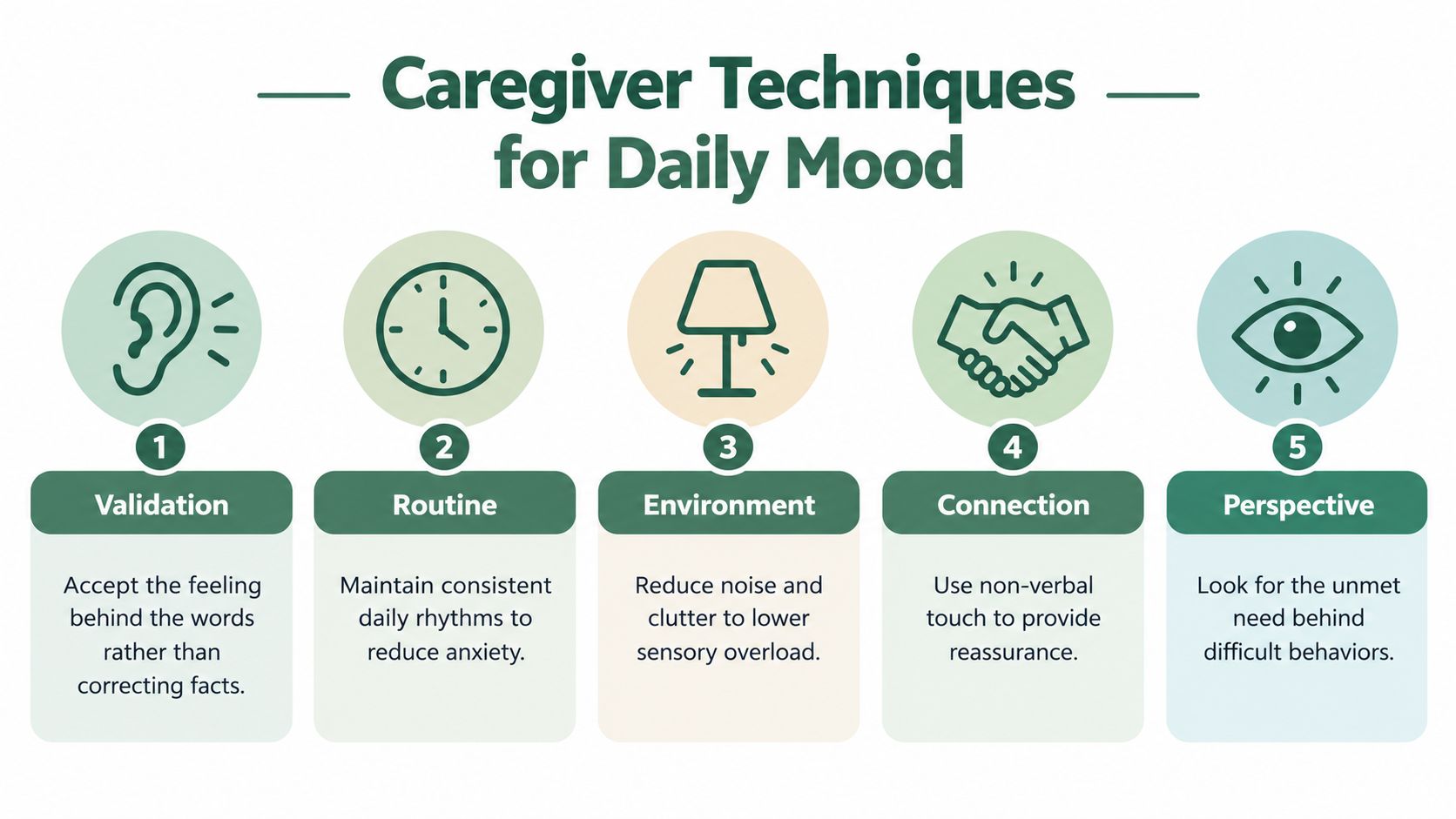
Caregivers also need to regulate themselves. A hurried voice, sharp correction, or visible panic can raise the older adult's distress. Pause, lower your pace, and decide whether the immediate need is reassurance, food, rest, pain relief, toileting, or a quieter room. Looking for the unmet need behind behavior is more productive than labeling the person difficult.
For activity ideas that can be adapted to ability and interest, read this psychologist's guide to dementia activities. Choose activities that feel familiar and achievable, then repeat them often enough to become dependable points of connection.
The video below offers another way to think about supportive dementia communication and engagement.
These techniques aren't magic tricks. They work through repetition, calm delivery, and a relationship in which the older adult expects safety. The same structure can support the caregiver too, because it replaces improvisation with a small set of responses that can be practiced.
Families who want a deeper explanation of accepting feelings before correcting facts can review validation therapy for dementia.
How emotional support fits with clinical care
A regular call or community group can improve daily connection, but it can't determine whether a mood change comes from depression, medication, infection, pain, sleep disruption, or cognitive decline. Nonclinical emotional support complements clinical care. It doesn't replace evaluation or treatment.
Consider a father who has become withdrawn and stopped eating regular meals. His daughter can bring observations to primary care, where the clinician may screen for depression, review medications, ask about sleep and pain, and consider counseling or other treatment. At the same time, the family might arrange a community call program or senior group that gives him predictable contact while the clinical assessment continues.
What coordinated care looks like
Good coordination doesn't require every provider to attend one meeting. It requires clear permission, defined responsibilities, and useful observations.
Primary care identifies medical contributors and follows mood, cognition, medications, sleep, and physical symptoms.
Mental health professionals assess and treat clinical conditions when symptoms warrant counseling, therapy, or psychiatric care.
Family caregivers record patterns instead of relying on memory after a stressful appointment.
Support programs report agreed observations such as participation, repeated distress, or changes in usual conversation.
Track the basics for a short period: when low mood appears, how long it lasts, what preceded it, how the person slept, whether they ate, and which activities helped. Avoid turning the home into a laboratory. A few consistent notes are more useful than a long list of impressions.

Ask the clinician, “Who should receive updates, what changes should we report, and how will we review whether the plan is helping?” A shared care plan should state what the support service does, what the family does, and which signs require urgent action.
Emotional support can improve comfort, participation, and connection while medical care addresses the underlying condition. Keeping those roles clear protects the older adult from both neglect and overpromising.
Choosing and evaluating the right service
Families can compare services without becoming experts in every therapy model. Start with five questions: Who delivers the contact? How does it happen? What does the service track? How are updates reviewed? What will the family pay or what coverage applies?
The provider's training matters. A licensed clinician offers assessment and treatment. A trained peer or volunteer may offer valuable companionship but shouldn't present themselves as a therapist. Ask how the service handles a sudden mood change, suicidal thoughts, abuse concerns, confusion, or a fall risk.
The format should match the person, not the family's ideal solution. Phone calls may suit someone who lives far from services or avoids video technology. Hearing loss, severe confusion, or a preference for face-to-face conversation may make an in-person or group option more workable. Someone already seeing a primary care clinician may benefit from a coordinated service rather than a stand-alone program that never shares observations.
A practical comparison
Attribute | Phone-based | In-person or group | Clinical counseling |
|---|---|---|---|
Delivery | Scheduled calls using a familiar device | Home visits, centers, faith settings, or activity groups | Office, clinic, telehealth, or specialist setting |
Main value | Continuity, conversation, and low access barriers | Social belonging, activity, and visible connection | Assessment, diagnosis, and treatment |
Questions to ask | Can the older adult hear the caller? Is contact recurring? | Is transport available? Is the environment dementia-friendly? | Is the clinician experienced with older adults and dementia? |
Progress review | Call notes, mood observations, participation | Attendance, engagement, and feedback | Clinical measures, symptom review, and treatment response |
Limits | Not a replacement for urgent or clinical care | May not address persistent psychiatric symptoms | Access may be limited by cost, waitlists, or travel |
A service should explain its goals in plain language. It might track mood patterns, social contact, participation, or loneliness, but families should ask how those observations are collected and who reviews them. A written summary or scheduled review can prevent months of passive enrollment.
After several weeks of regular contact, ask:
Mood: Are difficult periods less intense or less disruptive?
Conversation: Does the person initiate more contact or participate for longer?
Daily life: Are meals, sleep, activities, or appointments becoming easier?
Caregiver experience: Do you feel more informed, supported, or able to respond calmly?
Escalation: Has the service identified concerns and explained what happens next?
Be cautious if a provider guarantees a cure, hides staff credentials, discourages medical care, ignores caregiver concerns, or pressures you to pay an annual fee before you understand the service. Evidence for telephone support is encouraging in some settings, but it remains uneven. A 2025 review of telephone interventions for dementia described personalized calls as promising for behavioral symptoms and caregiver burden while rating the certainty of evidence low. The same review context reinforces a useful distinction: a service can be practical and worthwhile without claiming to work for everyone.
For families seeking structured phone contact for a person with early to mid-stage memory loss, Velma provides scheduled calls combining conversation, cognitive exercises, mood support, and practical check-ins, with care-manager coordination alongside family and clinical support.
If an older adult is spending long stretches alone or a caregiver is carrying every emotional check-in, consider adding a dependable layer of support rather than waiting for the next crisis. Explore Velma to see how scheduled phone conversations can support connection, cognitive engagement, and day-to-day visibility for families living with memory loss.
Your father answers the phone on a Tuesday evening, but the usual dry joke is missing. His voice sounds flat. After a long pause, he says he's fine, even though you can hear that something has changed. You ask about dinner, sleep, and the appointment he mentioned yesterday. Each answer is short, and the conversation ends before you know whether he's lonely, depressed, confused, or having a difficult day.
Families often face this uncertainty when an older adult lives alone or is beginning to experience memory loss. Emotional well being support can help, but it works best when it's treated as part of ongoing care rather than a response reserved for emergencies. Regular contact can create opportunities to notice changes in mood, confidence, sleep, engagement, and daily functioning.
The need is substantial. A World Health Organization benchmark on loneliness in older age estimates that about 11.8% of older people experience loneliness, while reported prevalence varies by region. The same source links loneliness and social isolation with depression, anxiety, cognitive decline, dementia, cardiovascular disease, stroke, diabetes, and shortened life expectancy. These risks affect the older person and the caregiver trying to keep everything steady.
Table of Contents
Why emotional well being support matters for older adults
Why loneliness becomes a care issue
What emotional well being support actually means
The basic elements
Why memory loss changes the approach
Signs that an older adult needs more support
Changes worth noticing
Evidence based approaches that actually help
Matching support to the person
Caregiver techniques that improve daily mood
Four responses that work in ordinary moments
How emotional support fits with clinical care
What coordinated care looks like
Choosing and evaluating the right service
A practical comparison
Why emotional well being support matters for older adults
A flat answer like “I'm fine” doesn't tell you enough. Your father may be grieving a spouse, struggling with a new diagnosis, sleeping poorly, or avoiding activities because memory lapses have made him embarrassed. He may also be experiencing ordinary sadness, medication effects, or a medical problem that needs prompt attention.
Emotional health shapes everyday behavior. A person who feels hopeless may skip meals or stop taking medication. Someone who feels anxious may avoid driving, appointments, or movement outside the home. Someone who feels socially disconnected may lose the motivation to keep up routines that once supported sleep, mobility, and independence.
Why loneliness becomes a care issue
Older adults often face several losses at once. Retirement can remove a valued role. Bereavement changes the rhythm of the day. Friends may become less available, chronic illness can limit travel, and early cognitive changes can make social situations feel risky. The caregiver may respond by doing more practical tasks while missing the emotional strain underneath.
In the United States, the share of adults aged 50 to 80 reporting a lack of companionship some of the time or often rose from 33.9% in 2018 to 41.4% in 2020, then stayed high at 33.4% in 2024, according to this JAMA report on emotional well-being among older adults. The pattern shows why support shouldn't end when an acute crisis passes.
Practical rule: A single reassuring call may soothe a difficult evening. A dependable rhythm of contact gives families a better chance to notice a pattern.
For a caregiver, this rhythm also reduces the pressure to interpret every phone call alone. A structured check-in can surface changes early, support ordinary conversation, and create a clear point for escalation when something no longer looks usual. Emotional well being support isn't a luxury added after physical care. It's one part of helping an older adult remain connected, engaged, and able to participate in decisions.
What emotional well being support actually means
Emotional well being support is practical help with the emotional side of daily life. It may involve a scheduled conversation, a peer visitor, a counseling session, a group activity, or a familiar routine that helps an older adult name feelings, stay connected, and retain a sense of identity.
It isn't the same as psychotherapy, psychiatric treatment, or crisis intervention. A trained volunteer can offer companionship, but a licensed clinician evaluates and treats conditions such as major depression, severe anxiety, trauma-related symptoms, or suicidal thinking. A phone program may notice a worrying change, but it shouldn't diagnose the cause or tell a family to stop prescribed treatment.
The basic elements
A useful support plan usually contains several connected parts:
Emotional expression: The older adult gets time to describe sadness, fear, frustration, boredom, or pride without being rushed.
Connection: Contact happens with enough consistency that the person knows when the next interaction will occur.
Meaningful activity: Conversation leads into something manageable, such as music, reminiscence, gardening, folding laundry, or a short walk.
Observation: Family members or program staff note changes in mood, participation, sleep, appetite, and confusion.
Escalation: The plan identifies when a clinician, emergency service, or trusted family member needs to become involved.
The provider might be a family member, trained peer, social worker, counselor, community worker, or group facilitator. The right choice depends on the older adult's needs and preferences. Someone with mild loneliness may benefit from a regular visitor, while someone with persistent anxiety or a marked mood change may need clinical assessment alongside social contact.
Why memory loss changes the approach
An older adult with cognitive impairment may not be able to explain distress directly. Repeated questions, irritability, refusal, or pacing can communicate fear, fatigue, pain, overstimulation, or a need for reassurance. Support therefore measures more than verbal mood reports. Families also watch engagement, comfort, participation, and quality of life.
The National Academies' review of social isolation and loneliness describes strong associations with depression, anxiety, lower perceived well-being, and reduced quality of life in older adults. It also notes that temporal patterns suggest loneliness and isolation may worsen mood outcomes, rather than appearing alongside them. That's why regular connection deserves a place in the care plan even when no formal diagnosis exists.
Signs that an older adult needs more support
Families rarely see a single dramatic announcement that something is wrong. More often, they notice small departures from a familiar person. The careful question isn't “Is this symptom proof of depression?” It's “What changed, how long has it lasted, and what support does this person need next?”
Changes worth noticing
Withdrawal from favorite activities: A person who stops attending choir, gardening, card games, or religious services may be coping with sadness, fatigue, fear of mistakes, or difficulty managing a changed environment.
Persistent sadness or emotional flatness: Mood that stays low or unusually blank deserves attention, especially when it continues instead of gradually easing.
Reversed sleep: Sleeping through the day and staying awake at night can reflect depression, anxiety, medication effects, pain, or disrupted routine.
New anxiety about driving or money: Avoidance may signal reduced confidence, cognitive change, fear of exploitation, vision problems, or a recent frightening incident.
Less interest in meals: Appetite changes can accompany low mood, illness, dental problems, medication effects, or difficulty shopping and cooking.
Irritability replacing patience: Anger may be the visible form of fear, exhaustion, pain, or overstimulation.
Rigid dependence on routine: Routine can be reassuring, but distress when a small detail changes may suggest that the person is using sameness to manage uncertainty.
One sign alone isn't a verdict. Start with a calm observation: “I've noticed you haven't wanted to go to the group lately. What has it been like for you?” Avoid turning the conversation into an interrogation or arguing about whether the person has a problem.
Grief often comes in waves and may soften as the person adapts. A mood shift that hardens, spreads across activities, or changes sleep and appetite deserves closer attention. Sudden emotional or behavioral changes, particularly when they appear with new confusion or memory symptoms, should prompt a clinician's advice because medical, medication-related, and cognitive causes may need review.
Families can also use this practical guide to social isolation in seniors to identify patterns that are easy to dismiss as ordinary aging. Write down what you observe, when it began, and what happens before and after difficult moments.
Evidence based approaches that actually help
No single format suits every older adult. A person with hearing loss may struggle with a phone line but thrive in a quiet room. Someone who refuses transport may accept a scheduled call. Someone with persistent depressive symptoms may need counseling even if a senior center provides welcome companionship.
Matching support to the person
Phone-based programs can include friendship lines, scheduled call series, caregiver interventions, and crisis services. Their strengths are reach, familiarity, and continuity without travel or apps. The evidence is promising but limited in important ways. A randomized telephone-based cognitive-behavioral intervention for family caregivers of people with dementia reported improved emotional well-being at post-test, with a Cohen's d of 0.373, and at follow-up, with a Cohen's d of 0.303, as reported in The Gerontologist. Those findings support structured calls that include validation, coping skills, and action planning, but they don't prove that every phone service will produce the same result.
In-person counseling offers clinical assessment, treatment planning, and closer observation of communication and behavior. Primary care referrals, community mental health services, and geropsychology can be appropriate when symptoms persist or interfere with functioning. Transportation, waitlists, cost, and reluctance to attend can limit access.
Peer and community supports address belonging directly. A senior center group, faith-community visitor, memory cafe, dementia-friendly choir, or caregiver group can give the person a role rather than treating them only as a recipient of care.
Group activities add structure through reminiscence, gentle exercise, music, art, or intergenerational contact. They work best when the environment is welcoming and the activity matches the person's abilities. A difficult or noisy group can increase withdrawal instead of reducing it.
Approach | Typical examples | Evidence strength | Best fit for |
|---|---|---|---|
Phone-based support | Scheduled companionship calls, skills-based telephone programs | Promising, with limits in certainty and follow-up | People with transport or technology barriers who value routine |
Clinical counseling | Primary care referral, therapy, geropsychology | Appropriate for assessment and treatment of clinical symptoms | Older adults or caregivers with persistent distress or functional change |
Peer and community support | Visitor programs, faith groups, memory cafes | Useful for connection, with effectiveness varying by program | People seeking belonging and regular social contact |
Group activities | Reminiscence, exercise, music, intergenerational programs | Can support engagement when well matched | People who enjoy shared activities and can tolerate the setting |
A guide to emotional support for dementia patients can help families think about support as a combination of connection, communication, and care coordination rather than a single intervention.
Caregiver techniques that improve daily mood
The caregiver's first tool is often validation. Validation doesn't mean agreeing with every factual statement. It means responding to the feeling underneath the words.
If a person with dementia asks when their long-deceased spouse is coming home, correcting the history may increase grief. Try, “You miss him tonight. You always felt better when he was nearby.” Then offer a safe next step, such as tea, a familiar song, or looking at photographs together.
Four responses that work in ordinary moments
Validate before redirecting. Acknowledge fear, disappointment, or longing before suggesting an activity. “That sounds worrying. Let's sit together and look at the appointment card.”
Use a believable next step. When agitation rises, offer one concrete choice. “Would you like tea at the table or a short walk in the hallway?” Too many options can create more pressure.
Create emotional anchors. Music after breakfast, sorting towels in the afternoon, or looking through old photographs can make the day feel predictable without turning it into a rigid schedule.
Keep repeated answers short. If the same question returns, repeat the answer calmly and shift the topic. “The appointment is tomorrow morning. Let's put your sweater by the chair.”
Environment matters too. Lower background noise, reduce clutter, improve lighting, and approach from the front. A gentle hand on the shoulder may reassure one person, while another may find touch upsetting. Watch the response rather than assuming that a technique is universally comforting.
Caregivers also need to regulate themselves. A hurried voice, sharp correction, or visible panic can raise the older adult's distress. Pause, lower your pace, and decide whether the immediate need is reassurance, food, rest, pain relief, toileting, or a quieter room. Looking for the unmet need behind behavior is more productive than labeling the person difficult.
For activity ideas that can be adapted to ability and interest, read this psychologist's guide to dementia activities. Choose activities that feel familiar and achievable, then repeat them often enough to become dependable points of connection.
The video below offers another way to think about supportive dementia communication and engagement.
These techniques aren't magic tricks. They work through repetition, calm delivery, and a relationship in which the older adult expects safety. The same structure can support the caregiver too, because it replaces improvisation with a small set of responses that can be practiced.
Families who want a deeper explanation of accepting feelings before correcting facts can review validation therapy for dementia.
How emotional support fits with clinical care
A regular call or community group can improve daily connection, but it can't determine whether a mood change comes from depression, medication, infection, pain, sleep disruption, or cognitive decline. Nonclinical emotional support complements clinical care. It doesn't replace evaluation or treatment.
Consider a father who has become withdrawn and stopped eating regular meals. His daughter can bring observations to primary care, where the clinician may screen for depression, review medications, ask about sleep and pain, and consider counseling or other treatment. At the same time, the family might arrange a community call program or senior group that gives him predictable contact while the clinical assessment continues.
What coordinated care looks like
Good coordination doesn't require every provider to attend one meeting. It requires clear permission, defined responsibilities, and useful observations.
Primary care identifies medical contributors and follows mood, cognition, medications, sleep, and physical symptoms.
Mental health professionals assess and treat clinical conditions when symptoms warrant counseling, therapy, or psychiatric care.
Family caregivers record patterns instead of relying on memory after a stressful appointment.
Support programs report agreed observations such as participation, repeated distress, or changes in usual conversation.
Track the basics for a short period: when low mood appears, how long it lasts, what preceded it, how the person slept, whether they ate, and which activities helped. Avoid turning the home into a laboratory. A few consistent notes are more useful than a long list of impressions.
Ask the clinician, “Who should receive updates, what changes should we report, and how will we review whether the plan is helping?” A shared care plan should state what the support service does, what the family does, and which signs require urgent action.
Emotional support can improve comfort, participation, and connection while medical care addresses the underlying condition. Keeping those roles clear protects the older adult from both neglect and overpromising.
Choosing and evaluating the right service
Families can compare services without becoming experts in every therapy model. Start with five questions: Who delivers the contact? How does it happen? What does the service track? How are updates reviewed? What will the family pay or what coverage applies?
The provider's training matters. A licensed clinician offers assessment and treatment. A trained peer or volunteer may offer valuable companionship but shouldn't present themselves as a therapist. Ask how the service handles a sudden mood change, suicidal thoughts, abuse concerns, confusion, or a fall risk.
The format should match the person, not the family's ideal solution. Phone calls may suit someone who lives far from services or avoids video technology. Hearing loss, severe confusion, or a preference for face-to-face conversation may make an in-person or group option more workable. Someone already seeing a primary care clinician may benefit from a coordinated service rather than a stand-alone program that never shares observations.
A practical comparison
Attribute | Phone-based | In-person or group | Clinical counseling |
|---|---|---|---|
Delivery | Scheduled calls using a familiar device | Home visits, centers, faith settings, or activity groups | Office, clinic, telehealth, or specialist setting |
Main value | Continuity, conversation, and low access barriers | Social belonging, activity, and visible connection | Assessment, diagnosis, and treatment |
Questions to ask | Can the older adult hear the caller? Is contact recurring? | Is transport available? Is the environment dementia-friendly? | Is the clinician experienced with older adults and dementia? |
Progress review | Call notes, mood observations, participation | Attendance, engagement, and feedback | Clinical measures, symptom review, and treatment response |
Limits | Not a replacement for urgent or clinical care | May not address persistent psychiatric symptoms | Access may be limited by cost, waitlists, or travel |
A service should explain its goals in plain language. It might track mood patterns, social contact, participation, or loneliness, but families should ask how those observations are collected and who reviews them. A written summary or scheduled review can prevent months of passive enrollment.
After several weeks of regular contact, ask:
Mood: Are difficult periods less intense or less disruptive?
Conversation: Does the person initiate more contact or participate for longer?
Daily life: Are meals, sleep, activities, or appointments becoming easier?
Caregiver experience: Do you feel more informed, supported, or able to respond calmly?
Escalation: Has the service identified concerns and explained what happens next?
Be cautious if a provider guarantees a cure, hides staff credentials, discourages medical care, ignores caregiver concerns, or pressures you to pay an annual fee before you understand the service. Evidence for telephone support is encouraging in some settings, but it remains uneven. A 2025 review of telephone interventions for dementia described personalized calls as promising for behavioral symptoms and caregiver burden while rating the certainty of evidence low. The same review context reinforces a useful distinction: a service can be practical and worthwhile without claiming to work for everyone.
For families seeking structured phone contact for a person with early to mid-stage memory loss, Velma provides scheduled calls combining conversation, cognitive exercises, mood support, and practical check-ins, with care-manager coordination alongside family and clinical support.
If an older adult is spending long stretches alone or a caregiver is carrying every emotional check-in, consider adding a dependable layer of support rather than waiting for the next crisis. Explore Velma to see how scheduled phone conversations can support connection, cognitive engagement, and day-to-day visibility for families living with memory loss.
Suggested Article: