Senior Mental Health: A Guide to Cognitive Wellness in 2026

About 14.75% of adults age 70 and older live with a mental disorder, which means this touches nearly 1 in 6 older adults. Senior mental health isn't a side issue in aging. It's a common, often missed part of health that families need to notice early.
Many adult children wait for a dramatic moment before they act. A parent stops driving. A neighbor reports wandering. A doctor finally says the word depression, anxiety, or dementia. But the harder truth is that mental health trouble in older age often begins subtly. It can look like irritability, canceled plans, repetitive worries, poor sleep, or a sudden loss of interest in things that used to matter.
That quiet pattern is why so many families feel blindsided. They were looking for a crisis. What they needed to look for was a drift.
Table of Contents
The Silent Crisis in Senior Mental Health
Why families miss it
Common Mental Health Conditions in Older Adults
Depression can look like low energy, not sadness
Anxiety often sounds like constant worry
Dementia-related distress isn't the same as dementia alone
Risk Factors and Warning Signs to Watch For
The risk factors that tend to cluster
Early warning signs families often explain away
What to do with a concern
The Critical Role of Social Connection and Low-Tech Support
Why phone-based support still matters
What a good low-tech support system looks like
Effective Communication Strategies for Caregivers
Start with observations, not conclusions
What helps a tense conversation stay calm
Special considerations when memory loss is involved
Evidence-Based Treatments and Care Options
Comparing the main options
Where the evidence is clearest
How to think about therapy and medication
Building a Sustainable Care Plan and Safety Net
Build the plan around observation
Create a response ladder
Keep the care plan realistic
The Silent Crisis in Senior Mental Health
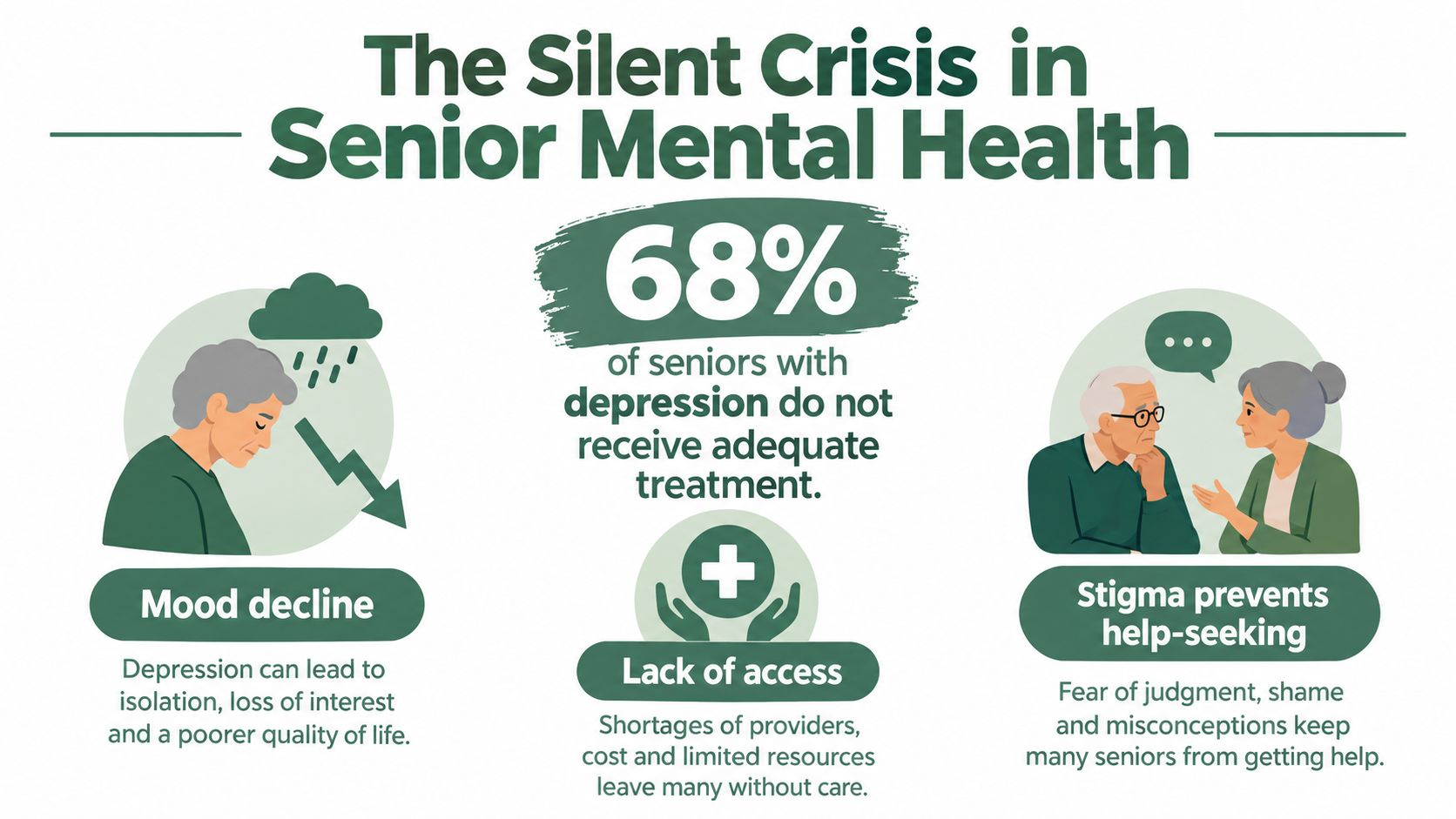
Mental health conditions account for 6.8% of years lived with disability among adults age 70 and older, according to the World Health Organization's fact sheet on older adult mental health. That number matters because it shifts the question from “How common is this?” to “How much daily life does this disrupt?” For many families, the answer shows up in ordinary routines long before anyone uses a mental health label.
A daughter may say her mother is “just slowing down.” Then the fuller picture appears. She no longer answers the phone. She has stopped going to church. Bills stay unopened on the table. She says she is fine, but nothing seems worth the effort. Each change can look small by itself. Together, they often point to a problem that has gone unrecognized.
That is the silent crisis. Older adults often describe emotional pain in indirect ways, and families often sort those changes into the wrong box. Sadness gets mistaken for fatigue. Anxiety gets mistaken for fussiness. Confusion gets blamed on age alone. It works like hearing a smoke alarm with a weak battery. The sound is there, but it is easy to dismiss until the problem grows.
Undiagnosed conditions are a major part of the danger. A senior who does not use email, patient portals, or smartphone apps can disappear from view even when relatives care and call themselves attentive. If support depends on logging in, downloading, or clicking through reminders, many older adults are left outside the system. In practice, a simple phone call, a landline check-in, or a weekly call schedule often does more than another app icon on a screen they do not use.
Why families miss it
Families usually watch for a sharp break. A fall. A wandering episode. A frightening memory lapse. Mental health trouble in later life more often behaves like a slow leak. The parent still eats, still takes medication, still says “I'm okay,” so the household looks stable from the outside.
That surface stability can be misleading. A person may keep a few habits in place while withdrawing from conversation, losing interest, or feeling too overwhelmed to handle everyday tasks. Older adults also try to protect their children from worry. Some grew up in a time when talking about depression, fear, or loneliness felt shameful. Others lack the words and talk instead about sleep, pain, or “nerves.”
Age does not create mental illness. It can make the signs easier to hide.
The stakes reach beyond mood. As noted earlier in the same WHO resource, older adults can be more vulnerable when they are isolated, frightened, dependent on others, or living with cognitive problems. That is one reason low-tech contact matters so much. Regular phone calls do more than provide company. They help families notice changes in voice, pace, memory, motivation, and fear. Those clues are often the first sign that a quiet problem is becoming a serious one.
Common Mental Health Conditions in Older Adults
Not every change in behavior means the same thing. That's where families get stuck. They see forgetfulness and assume dementia. They see withdrawal and assume stubbornness. They hear worry and call it personality.
A clearer way to think about it is to sort symptoms into three broad buckets: depression, anxiety, and dementia-related distress. These can overlap, which is why a proper evaluation matters.
Depression can look like low energy, not sadness
In older adults, depression often wears a disguise. A parent may not say they feel hopeless. They may say, “I'm tired,” “Nothing tastes good,” or “I don't see the point in going out.” Some seem more flat than sad. Others become unusually negative, critical, or withdrawn.
Watch for changes like these:
Loss of interest: Hobbies, social visits, and routines suddenly feel like chores.
Physical slowing: Getting dressed, cooking, or making decisions takes much more effort.
Memory-like problems: Trouble concentrating can look like forgetfulness.
Self-neglect: Laundry piles up, meals become sparse, or grooming drops off.
If alcohol use or medication misuse is also part of the picture, families may need care that addresses both conditions together. In that situation, learning about integrated dual-diagnosis options can help you understand why treating only mood, or only substance use, often misses the full problem.
Anxiety often sounds like constant worry
Anxiety in older adults isn't always panic. More often, it shows up as repeated fears about money, health, safety, schedules, or being alone. The person may call multiple times a day to confirm plans, become distressed when routines change, or avoid leaving home because too many things feel uncertain.
Common signs include:
Pattern | What families often notice |
|---|---|
Reassurance seeking | Repeated calls with the same questions |
Hypervigilance | Worry about locks, bills, or appointments |
Avoidance | Canceling outings, visits, or errands |
Body complaints | Restlessness, tension, poor sleep |
Dementia-related distress isn't the same as dementia alone
Dementia affects thinking, but it also affects emotional control. A person with memory loss may become frightened, suspicious, tearful, or agitated because the world stops making sense in predictable ways. They may accuse others of stealing when they've misplaced an item. They may panic when left alone for an hour.
That's why mood changes and memory changes need to be considered together. If you want a practical breakdown of how thinking problems show up in everyday life, this guide to cognitive decline in older adults is a useful starting point.
Practical rule: Ask yourself, “Is this a personality trait, or is this a change?” A change deserves attention.
Risk Factors and Warning Signs to Watch For
Mental health decline in later life usually isn't caused by one thing. It's more like a rope made of several strands: isolation, chronic illness, grief, sensory loss, reduced mobility, medication changes, and cognitive strain. Any one strand may seem manageable. Twisted together, they can pull a person downward.
One of the strongest warning signals is loneliness. A 2023 meta-analysis of 36 studies involving 128,927 participants found that loneliness was associated with a higher all-cause mortality risk, with HR 1.09 overall and a stronger effect in older men at HR 1.18, according to the PubMed record for that meta-analysis. In plain language, long stretches of disconnection don't just hurt feelings. They can make health risks worse.

The risk factors that tend to cluster
Some families look for a single explanation. It's usually more useful to look for combinations.
Recent losses: Bereavement, retirement, relocation, or the loss of a pet can shrink a person's world quickly.
Medical burden: Pain, fatigue, poor sleep, and multiple diagnoses can drain resilience.
Reduced independence: Needing help with driving, meals, or finances can trigger shame and withdrawal.
Sensory changes: Hearing and vision loss make conversation harder, which often leads to social retreat.
Cognitive confusion: Forgetfulness creates embarrassment. Embarrassment leads to avoidance.
A useful analogy is this. Think of late-life distress like dehydration in a frail older adult. It may start subtly, but once several small deficits stack up, the whole system works less well.
Early warning signs families often explain away
The first red flags are often behavioral, not verbal. Your parent may never say, “I think I need mental health support.” They may stop acting like themselves.
Watch for patterns such as:
Social retreat: Skipping regular calls, clubs, worship, or meals with others
Routine breakdown: Missing appointments, forgetting to pay bills, wearing the same clothes repeatedly
Mood shifts: More irritability, fearfulness, flatness, or tearfulness than usual
Thinking changes: Increased confusion, indecision, or repetitive questions
Home changes: Spoiled food, clutter, unopened mail, or neglected housekeeping
If you notice three small changes at once, treat that as one big signal.
What to do with a concern
Start documenting patterns. Note when you saw the change, how often it happens, and what seems to make it worse or better. That record helps a physician, therapist, or care manager separate a temporary rough patch from a more persistent mental health problem.
The Critical Role of Social Connection and Low-Tech Support
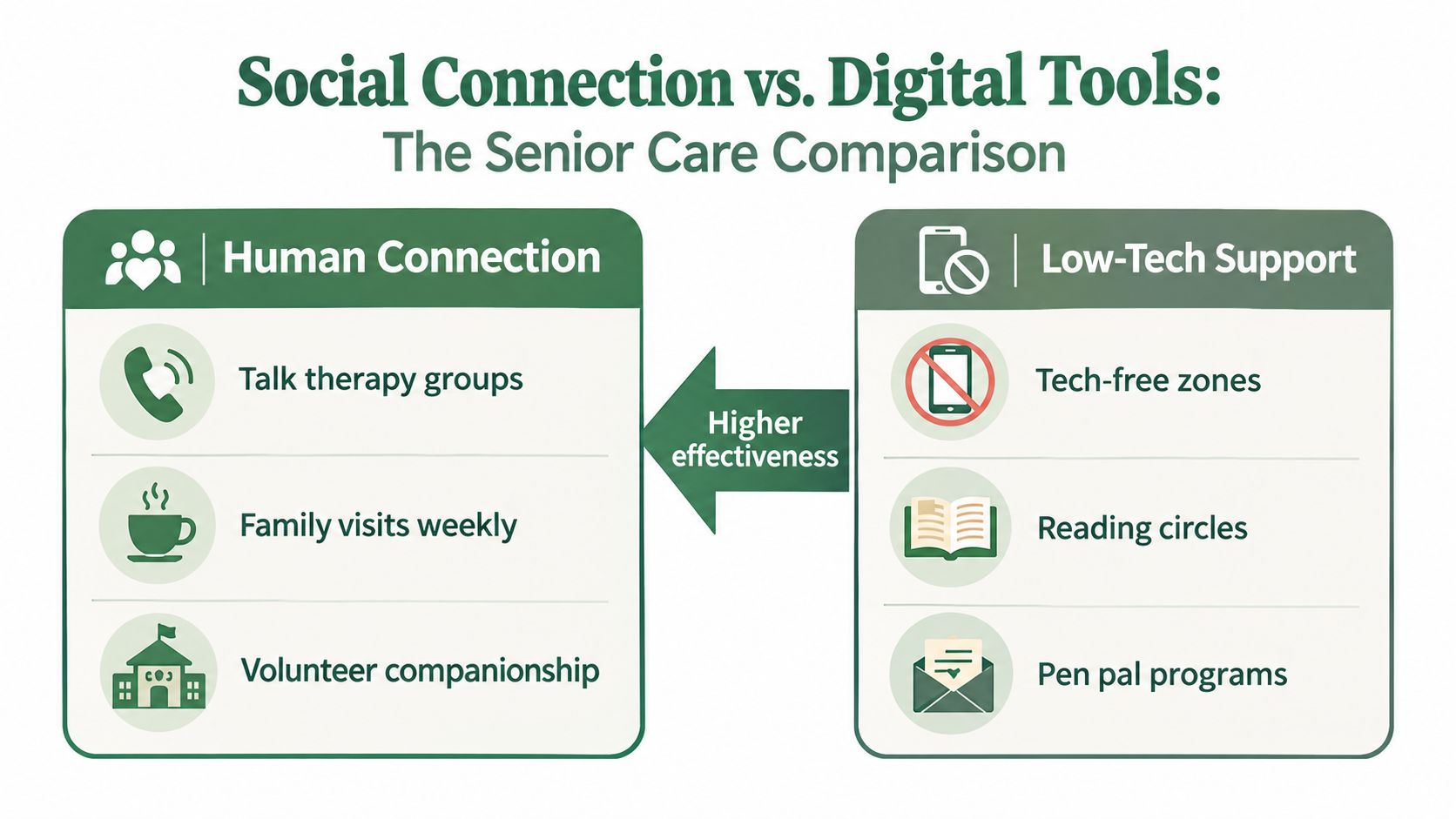
Families hear a lot about apps, portals, video visits, and remote monitoring. Those tools can help some older adults. But many of the seniors at highest risk are the least likely to use them consistently.
That's the part many care plans miss. If a support tool requires a password, a software update, or comfort with screens, it may fail the people who most need support.
Why phone-based support still matters
A 2026 meta-analysis found that socially isolated or digitally disconnected seniors had a 60% higher likelihood of depressive symptoms, and digital exclusion was independently associated with poorer physical functioning, according to the PMC review on digital exclusion and older adults. That doesn't mean technology is bad. It means digital access and digital use are not the same thing.
A smartphone app is only useful if the person will open it, understand it, and return to it regularly. Many older adults with anxiety, low vision, hearing trouble, or memory impairment do better with support that feels familiar. A phone call is familiar.
The short video below gives another view of how emotional support and cognitive needs can overlap in daily care.
What a good low-tech support system looks like
Low-tech doesn't mean unstructured. In fact, the best phone-based support is often highly structured.
Regular timing: Calls happen on a predictable schedule, which reduces uncertainty.
Real conversation: The caller notices tone, pauses, confusion, and distress, not just task completion.
Routine reinforcement: Appointments, meals, medication timing, and orientation cues get repeated kindly.
Pattern tracking: Families can see whether worry, forgetfulness, or low mood is getting better or worse.
If you're comparing options, this overview of senior companionship programs can help you sort social visits, volunteer programs, and more structured check-in models.
One example of a structured phone option is Velma, which provides scheduled calls for older adults with early to mid-stage memory loss that combine conversation, cognitive exercises, mood support, and practical check-ins. For some families, that kind of format fits better than app-based tools because it lowers the technology barrier while still creating consistency.
Phone-based care isn't old-fashioned. For many seniors, it's simply usable.
Effective Communication Strategies for Caregivers
Most adult children know something is off before they know how to talk about it. That conversation often goes wrong for one of two reasons. It becomes too clinical, or it becomes an argument.
A better approach is to talk the way you would if your parent had an injured knee. You wouldn't open with, “You can't be trusted to walk.” You'd start with what you've noticed and what you want to help with.
Start with observations, not conclusions
Try this pattern:
Name a specific change. “I've noticed you haven't been going to bridge lately.”
Add concern without judgment. “That doesn't seem like you, and I want to check in.”
Ask an open question. “What's been feeling hardest lately?”
Pause long enough for a real answer.
This works better than labels like “depressed,” “confused,” or “not coping,” especially at the start. Labels can make a parent feel cornered.
What helps a tense conversation stay calm
A few communication habits matter more than people realize.
Validate first: “That sounds frustrating” is often more useful than immediate advice.
Keep one topic at a time: Don't combine mood, driving, finances, and medication in one sitting.
Offer choices: “Would you rather talk to your doctor first or a counselor first?”
Protect dignity: Ask permission before stepping in too aggressively.
For caregivers who want a broader framework, this roundup of evidence-based advice from THERAPSY is helpful for understanding supportive language that doesn't become dismissive or pushy.
“I'm on your side” is often the most important sentence in the room.
Special considerations when memory loss is involved
If your parent has dementia or mild cognitive impairment, logic alone won't carry the conversation. Correcting every mistaken detail usually increases distress. Emotional truth matters more than factual precision in the moment.
For example, if your mother says, “Nobody ever calls me,” and you spoke with her yesterday, resist the urge to prove her wrong. Respond to the feeling first. “It sounds lonely today.” Then redirect gently.
If these situations come up often, these dementia communication strategies can help you shift from arguing facts to lowering distress.
Evidence-Based Treatments and Care Options
Families often ask one question too early: “What's the best treatment?” The better first question is, “What problem are we treating?” Low mood, chronic anxiety, grief, substance use, and dementia-related distress don't all need the same response.
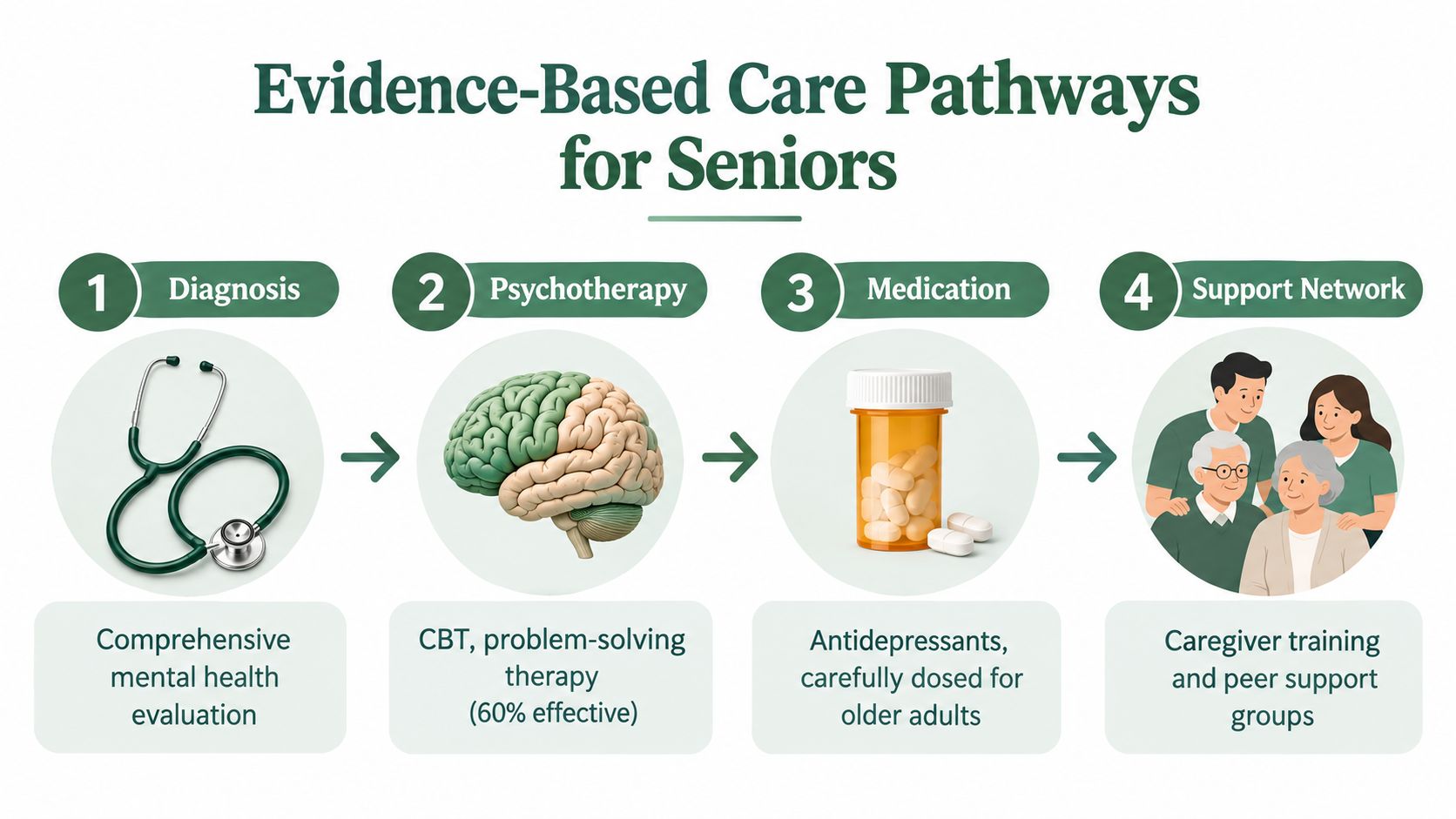
A good care plan usually combines several layers: medical review, psychotherapy when appropriate, careful medication management, and daily-life support.
Comparing the main options
Option | Best use | What families should know |
|---|---|---|
Psychotherapy | Depression, anxiety, adjustment, grief | Works best when the older adult can engage consistently |
Medication review and prescribing | Mood and anxiety symptoms, sleep issues, overlapping medical concerns | Older adults often need careful monitoring for side effects and interactions |
Cognitive stimulation | Dementia-related cognitive support | Supports thinking skills but isn't a full mood treatment on its own |
Social and routine supports | Isolation, apathy, low structure, caregiver gaps | Often determines whether clinical treatment actually works in daily life |
Where the evidence is clearest
For dementia, one of the stronger non-drug signals comes from cognitive stimulation. An umbrella review reported that both group and individual cognitive stimulation improved cognition in people living with dementia at any severity, while individual and group cognitive training improved global cognition in mild dementia, according to the PubMed umbrella review on cognitive stimulation and training. The same review found that effects on anxiety, depression, behavior, and quality of life were inconsistent. That matters.
It means families shouldn't expect one activity program to solve everything. Crossword puzzles, orientation prompts, reminiscence questions, and language exercises may support cognition. Emotional distress may still need separate treatment and support.
How to think about therapy and medication
Psychotherapy can help older adults challenge unhelpful thoughts, build coping routines, and process loss. If you want a plain-language refresher on how this approach works, the 2026 CBT guide by Uptown Psychology gives a useful overview of cognitive behavioral therapy.
Medication can also help, especially when symptoms are persistent or severe. But medication isn't a shortcut around monitoring. In older adults, response, side effects, and medication interactions need close follow-up.
The strongest plans are rarely one thing. They're layered, practical, and adjusted over time.
Building a Sustainable Care Plan and Safety Net
The families who cope best usually stop thinking in terms of one appointment and start thinking in systems. A sustainable senior mental health plan isn't built on hope that things stay stable. It's built on routines that catch change early.
That system can be simple. It just needs to be consistent.
Build the plan around observation
Start with a written baseline. What is your parent like on a normal week? Note sleep, appetite, social habits, memory slips, usual mood, mobility, and ability to manage daily tasks. Without a baseline, every change feels subjective.
Then assign roles. One sibling may coordinate appointments. Another may review finances for missed bills. A neighbor may be the local emergency contact. A paid caregiver may notice hygiene or food safety issues before anyone else.
Use a short checklist during regular check-ins:
Mood: Have they seemed more flat, fearful, or irritable?
Thinking: Are questions more repetitive or confusion more obvious?
Daily function: Are meals, medications, laundry, and appointments being managed?
Safety: Any concerns about falls, wandering, stove use, or suspicious phone scams?
Connection: Who has spoken with them this week, and how did they seem?
Create a response ladder
Not every concern needs the same response. Families get overwhelmed when they treat every issue like an emergency, or underreact when they dismiss everything as aging.
A simple response ladder helps:
Small change: Increase contact, document patterns, and ask gentle questions.
Persistent change: Schedule a primary care visit and bring specific examples.
Complex change: Add mental health or memory evaluation if symptoms overlap.
Safety threat: Act quickly if there's self-neglect, abuse concerns, severe confusion, or inability to manage basic needs.
This is also where recurring support matters. One-off visits catch snapshots. Repeated check-ins catch trends.
Keep the care plan realistic
The best plan is the one your family can maintain. Daily video calls sound good until nobody can keep them up. A weekly in-person visit may be meaningful, but it won't cover the long gaps between. For many families, a mix works best: medical care, family contact, and dependable low-tech support in between.
Families don't need perfect coverage. They need reliable touchpoints.
Finally, revisit the plan regularly. Senior mental health changes with health status, grief, medication shifts, and cognitive decline. What worked six months ago may not fit now. A plan should be living, not fixed.
If you're worried about a parent, trust the discomfort that made you read this far. You don't need absolute proof before you start paying closer attention. In older adults, the quiet changes are often the ones that matter most.
Velma offers scheduled phone-based cognitive support for older adults with early to mid-stage memory loss, combining conversation, research-backed cognitive exercises, mood support, and practical check-ins in a format many seniors can use consistently. If your family needs a low-tech layer of support between visits, learn more at Velma.
About 14.75% of adults age 70 and older live with a mental disorder, which means this touches nearly 1 in 6 older adults. Senior mental health isn't a side issue in aging. It's a common, often missed part of health that families need to notice early.
Many adult children wait for a dramatic moment before they act. A parent stops driving. A neighbor reports wandering. A doctor finally says the word depression, anxiety, or dementia. But the harder truth is that mental health trouble in older age often begins subtly. It can look like irritability, canceled plans, repetitive worries, poor sleep, or a sudden loss of interest in things that used to matter.
That quiet pattern is why so many families feel blindsided. They were looking for a crisis. What they needed to look for was a drift.
Table of Contents
The Silent Crisis in Senior Mental Health
Why families miss it
Common Mental Health Conditions in Older Adults
Depression can look like low energy, not sadness
Anxiety often sounds like constant worry
Dementia-related distress isn't the same as dementia alone
Risk Factors and Warning Signs to Watch For
The risk factors that tend to cluster
Early warning signs families often explain away
What to do with a concern
The Critical Role of Social Connection and Low-Tech Support
Why phone-based support still matters
What a good low-tech support system looks like
Effective Communication Strategies for Caregivers
Start with observations, not conclusions
What helps a tense conversation stay calm
Special considerations when memory loss is involved
Evidence-Based Treatments and Care Options
Comparing the main options
Where the evidence is clearest
How to think about therapy and medication
Building a Sustainable Care Plan and Safety Net
Build the plan around observation
Create a response ladder
Keep the care plan realistic
The Silent Crisis in Senior Mental Health
Mental health conditions account for 6.8% of years lived with disability among adults age 70 and older, according to the World Health Organization's fact sheet on older adult mental health. That number matters because it shifts the question from “How common is this?” to “How much daily life does this disrupt?” For many families, the answer shows up in ordinary routines long before anyone uses a mental health label.
A daughter may say her mother is “just slowing down.” Then the fuller picture appears. She no longer answers the phone. She has stopped going to church. Bills stay unopened on the table. She says she is fine, but nothing seems worth the effort. Each change can look small by itself. Together, they often point to a problem that has gone unrecognized.
That is the silent crisis. Older adults often describe emotional pain in indirect ways, and families often sort those changes into the wrong box. Sadness gets mistaken for fatigue. Anxiety gets mistaken for fussiness. Confusion gets blamed on age alone. It works like hearing a smoke alarm with a weak battery. The sound is there, but it is easy to dismiss until the problem grows.
Undiagnosed conditions are a major part of the danger. A senior who does not use email, patient portals, or smartphone apps can disappear from view even when relatives care and call themselves attentive. If support depends on logging in, downloading, or clicking through reminders, many older adults are left outside the system. In practice, a simple phone call, a landline check-in, or a weekly call schedule often does more than another app icon on a screen they do not use.
Why families miss it
Families usually watch for a sharp break. A fall. A wandering episode. A frightening memory lapse. Mental health trouble in later life more often behaves like a slow leak. The parent still eats, still takes medication, still says “I'm okay,” so the household looks stable from the outside.
That surface stability can be misleading. A person may keep a few habits in place while withdrawing from conversation, losing interest, or feeling too overwhelmed to handle everyday tasks. Older adults also try to protect their children from worry. Some grew up in a time when talking about depression, fear, or loneliness felt shameful. Others lack the words and talk instead about sleep, pain, or “nerves.”
Age does not create mental illness. It can make the signs easier to hide.
The stakes reach beyond mood. As noted earlier in the same WHO resource, older adults can be more vulnerable when they are isolated, frightened, dependent on others, or living with cognitive problems. That is one reason low-tech contact matters so much. Regular phone calls do more than provide company. They help families notice changes in voice, pace, memory, motivation, and fear. Those clues are often the first sign that a quiet problem is becoming a serious one.
Common Mental Health Conditions in Older Adults
Not every change in behavior means the same thing. That's where families get stuck. They see forgetfulness and assume dementia. They see withdrawal and assume stubbornness. They hear worry and call it personality.
A clearer way to think about it is to sort symptoms into three broad buckets: depression, anxiety, and dementia-related distress. These can overlap, which is why a proper evaluation matters.
Depression can look like low energy, not sadness
In older adults, depression often wears a disguise. A parent may not say they feel hopeless. They may say, “I'm tired,” “Nothing tastes good,” or “I don't see the point in going out.” Some seem more flat than sad. Others become unusually negative, critical, or withdrawn.
Watch for changes like these:
Loss of interest: Hobbies, social visits, and routines suddenly feel like chores.
Physical slowing: Getting dressed, cooking, or making decisions takes much more effort.
Memory-like problems: Trouble concentrating can look like forgetfulness.
Self-neglect: Laundry piles up, meals become sparse, or grooming drops off.
If alcohol use or medication misuse is also part of the picture, families may need care that addresses both conditions together. In that situation, learning about integrated dual-diagnosis options can help you understand why treating only mood, or only substance use, often misses the full problem.
Anxiety often sounds like constant worry
Anxiety in older adults isn't always panic. More often, it shows up as repeated fears about money, health, safety, schedules, or being alone. The person may call multiple times a day to confirm plans, become distressed when routines change, or avoid leaving home because too many things feel uncertain.
Common signs include:
Pattern | What families often notice |
|---|---|
Reassurance seeking | Repeated calls with the same questions |
Hypervigilance | Worry about locks, bills, or appointments |
Avoidance | Canceling outings, visits, or errands |
Body complaints | Restlessness, tension, poor sleep |
Dementia-related distress isn't the same as dementia alone
Dementia affects thinking, but it also affects emotional control. A person with memory loss may become frightened, suspicious, tearful, or agitated because the world stops making sense in predictable ways. They may accuse others of stealing when they've misplaced an item. They may panic when left alone for an hour.
That's why mood changes and memory changes need to be considered together. If you want a practical breakdown of how thinking problems show up in everyday life, this guide to cognitive decline in older adults is a useful starting point.
Practical rule: Ask yourself, “Is this a personality trait, or is this a change?” A change deserves attention.
Risk Factors and Warning Signs to Watch For
Mental health decline in later life usually isn't caused by one thing. It's more like a rope made of several strands: isolation, chronic illness, grief, sensory loss, reduced mobility, medication changes, and cognitive strain. Any one strand may seem manageable. Twisted together, they can pull a person downward.
One of the strongest warning signals is loneliness. A 2023 meta-analysis of 36 studies involving 128,927 participants found that loneliness was associated with a higher all-cause mortality risk, with HR 1.09 overall and a stronger effect in older men at HR 1.18, according to the PubMed record for that meta-analysis. In plain language, long stretches of disconnection don't just hurt feelings. They can make health risks worse.
The risk factors that tend to cluster
Some families look for a single explanation. It's usually more useful to look for combinations.
Recent losses: Bereavement, retirement, relocation, or the loss of a pet can shrink a person's world quickly.
Medical burden: Pain, fatigue, poor sleep, and multiple diagnoses can drain resilience.
Reduced independence: Needing help with driving, meals, or finances can trigger shame and withdrawal.
Sensory changes: Hearing and vision loss make conversation harder, which often leads to social retreat.
Cognitive confusion: Forgetfulness creates embarrassment. Embarrassment leads to avoidance.
A useful analogy is this. Think of late-life distress like dehydration in a frail older adult. It may start subtly, but once several small deficits stack up, the whole system works less well.
Early warning signs families often explain away
The first red flags are often behavioral, not verbal. Your parent may never say, “I think I need mental health support.” They may stop acting like themselves.
Watch for patterns such as:
Social retreat: Skipping regular calls, clubs, worship, or meals with others
Routine breakdown: Missing appointments, forgetting to pay bills, wearing the same clothes repeatedly
Mood shifts: More irritability, fearfulness, flatness, or tearfulness than usual
Thinking changes: Increased confusion, indecision, or repetitive questions
Home changes: Spoiled food, clutter, unopened mail, or neglected housekeeping
If you notice three small changes at once, treat that as one big signal.
What to do with a concern
Start documenting patterns. Note when you saw the change, how often it happens, and what seems to make it worse or better. That record helps a physician, therapist, or care manager separate a temporary rough patch from a more persistent mental health problem.
The Critical Role of Social Connection and Low-Tech Support
Families hear a lot about apps, portals, video visits, and remote monitoring. Those tools can help some older adults. But many of the seniors at highest risk are the least likely to use them consistently.
That's the part many care plans miss. If a support tool requires a password, a software update, or comfort with screens, it may fail the people who most need support.
Why phone-based support still matters
A 2026 meta-analysis found that socially isolated or digitally disconnected seniors had a 60% higher likelihood of depressive symptoms, and digital exclusion was independently associated with poorer physical functioning, according to the PMC review on digital exclusion and older adults. That doesn't mean technology is bad. It means digital access and digital use are not the same thing.
A smartphone app is only useful if the person will open it, understand it, and return to it regularly. Many older adults with anxiety, low vision, hearing trouble, or memory impairment do better with support that feels familiar. A phone call is familiar.
The short video below gives another view of how emotional support and cognitive needs can overlap in daily care.
What a good low-tech support system looks like
Low-tech doesn't mean unstructured. In fact, the best phone-based support is often highly structured.
Regular timing: Calls happen on a predictable schedule, which reduces uncertainty.
Real conversation: The caller notices tone, pauses, confusion, and distress, not just task completion.
Routine reinforcement: Appointments, meals, medication timing, and orientation cues get repeated kindly.
Pattern tracking: Families can see whether worry, forgetfulness, or low mood is getting better or worse.
If you're comparing options, this overview of senior companionship programs can help you sort social visits, volunteer programs, and more structured check-in models.
One example of a structured phone option is Velma, which provides scheduled calls for older adults with early to mid-stage memory loss that combine conversation, cognitive exercises, mood support, and practical check-ins. For some families, that kind of format fits better than app-based tools because it lowers the technology barrier while still creating consistency.
Phone-based care isn't old-fashioned. For many seniors, it's simply usable.
Effective Communication Strategies for Caregivers
Most adult children know something is off before they know how to talk about it. That conversation often goes wrong for one of two reasons. It becomes too clinical, or it becomes an argument.
A better approach is to talk the way you would if your parent had an injured knee. You wouldn't open with, “You can't be trusted to walk.” You'd start with what you've noticed and what you want to help with.
Start with observations, not conclusions
Try this pattern:
Name a specific change. “I've noticed you haven't been going to bridge lately.”
Add concern without judgment. “That doesn't seem like you, and I want to check in.”
Ask an open question. “What's been feeling hardest lately?”
Pause long enough for a real answer.
This works better than labels like “depressed,” “confused,” or “not coping,” especially at the start. Labels can make a parent feel cornered.
What helps a tense conversation stay calm
A few communication habits matter more than people realize.
Validate first: “That sounds frustrating” is often more useful than immediate advice.
Keep one topic at a time: Don't combine mood, driving, finances, and medication in one sitting.
Offer choices: “Would you rather talk to your doctor first or a counselor first?”
Protect dignity: Ask permission before stepping in too aggressively.
For caregivers who want a broader framework, this roundup of evidence-based advice from THERAPSY is helpful for understanding supportive language that doesn't become dismissive or pushy.
“I'm on your side” is often the most important sentence in the room.
Special considerations when memory loss is involved
If your parent has dementia or mild cognitive impairment, logic alone won't carry the conversation. Correcting every mistaken detail usually increases distress. Emotional truth matters more than factual precision in the moment.
For example, if your mother says, “Nobody ever calls me,” and you spoke with her yesterday, resist the urge to prove her wrong. Respond to the feeling first. “It sounds lonely today.” Then redirect gently.
If these situations come up often, these dementia communication strategies can help you shift from arguing facts to lowering distress.
Evidence-Based Treatments and Care Options
Families often ask one question too early: “What's the best treatment?” The better first question is, “What problem are we treating?” Low mood, chronic anxiety, grief, substance use, and dementia-related distress don't all need the same response.
A good care plan usually combines several layers: medical review, psychotherapy when appropriate, careful medication management, and daily-life support.
Comparing the main options
Option | Best use | What families should know |
|---|---|---|
Psychotherapy | Depression, anxiety, adjustment, grief | Works best when the older adult can engage consistently |
Medication review and prescribing | Mood and anxiety symptoms, sleep issues, overlapping medical concerns | Older adults often need careful monitoring for side effects and interactions |
Cognitive stimulation | Dementia-related cognitive support | Supports thinking skills but isn't a full mood treatment on its own |
Social and routine supports | Isolation, apathy, low structure, caregiver gaps | Often determines whether clinical treatment actually works in daily life |
Where the evidence is clearest
For dementia, one of the stronger non-drug signals comes from cognitive stimulation. An umbrella review reported that both group and individual cognitive stimulation improved cognition in people living with dementia at any severity, while individual and group cognitive training improved global cognition in mild dementia, according to the PubMed umbrella review on cognitive stimulation and training. The same review found that effects on anxiety, depression, behavior, and quality of life were inconsistent. That matters.
It means families shouldn't expect one activity program to solve everything. Crossword puzzles, orientation prompts, reminiscence questions, and language exercises may support cognition. Emotional distress may still need separate treatment and support.
How to think about therapy and medication
Psychotherapy can help older adults challenge unhelpful thoughts, build coping routines, and process loss. If you want a plain-language refresher on how this approach works, the 2026 CBT guide by Uptown Psychology gives a useful overview of cognitive behavioral therapy.
Medication can also help, especially when symptoms are persistent or severe. But medication isn't a shortcut around monitoring. In older adults, response, side effects, and medication interactions need close follow-up.
The strongest plans are rarely one thing. They're layered, practical, and adjusted over time.
Building a Sustainable Care Plan and Safety Net
The families who cope best usually stop thinking in terms of one appointment and start thinking in systems. A sustainable senior mental health plan isn't built on hope that things stay stable. It's built on routines that catch change early.
That system can be simple. It just needs to be consistent.
Build the plan around observation
Start with a written baseline. What is your parent like on a normal week? Note sleep, appetite, social habits, memory slips, usual mood, mobility, and ability to manage daily tasks. Without a baseline, every change feels subjective.
Then assign roles. One sibling may coordinate appointments. Another may review finances for missed bills. A neighbor may be the local emergency contact. A paid caregiver may notice hygiene or food safety issues before anyone else.
Use a short checklist during regular check-ins:
Mood: Have they seemed more flat, fearful, or irritable?
Thinking: Are questions more repetitive or confusion more obvious?
Daily function: Are meals, medications, laundry, and appointments being managed?
Safety: Any concerns about falls, wandering, stove use, or suspicious phone scams?
Connection: Who has spoken with them this week, and how did they seem?
Create a response ladder
Not every concern needs the same response. Families get overwhelmed when they treat every issue like an emergency, or underreact when they dismiss everything as aging.
A simple response ladder helps:
Small change: Increase contact, document patterns, and ask gentle questions.
Persistent change: Schedule a primary care visit and bring specific examples.
Complex change: Add mental health or memory evaluation if symptoms overlap.
Safety threat: Act quickly if there's self-neglect, abuse concerns, severe confusion, or inability to manage basic needs.
This is also where recurring support matters. One-off visits catch snapshots. Repeated check-ins catch trends.
Keep the care plan realistic
The best plan is the one your family can maintain. Daily video calls sound good until nobody can keep them up. A weekly in-person visit may be meaningful, but it won't cover the long gaps between. For many families, a mix works best: medical care, family contact, and dependable low-tech support in between.
Families don't need perfect coverage. They need reliable touchpoints.
Finally, revisit the plan regularly. Senior mental health changes with health status, grief, medication shifts, and cognitive decline. What worked six months ago may not fit now. A plan should be living, not fixed.
If you're worried about a parent, trust the discomfort that made you read this far. You don't need absolute proof before you start paying closer attention. In older adults, the quiet changes are often the ones that matter most.
Velma offers scheduled phone-based cognitive support for older adults with early to mid-stage memory loss, combining conversation, research-backed cognitive exercises, mood support, and practical check-ins in a format many seniors can use consistently. If your family needs a low-tech layer of support between visits, learn more at Velma.
Suggested Article: