Memory Aids for Dementia That Actually Help Daily Life

Some mornings tell you exactly how much support is needed. Your dad is standing in the kitchen with a pill bottle in one hand, the toaster running, and yesterday's mail spread across the table. He knows he needs to do something next. He just can't sort out what comes first.
For many families, that's the moment the search begins. Not because memory has disappeared all at once, but because daily life has started to feel shaky. Medications get missed. Appointments slip by. Familiar tasks suddenly take too many steps.
Table of Contents
Introduction Why Memory Aids Matter More Than Memory Itself
Independence often depends on support
A layered plan works better than a single tool
Understanding How Memory Aids Support Daily Life
Four jobs memory aids do
Three families of support
Why consistency matters more than complexity
Choosing the Right Memory Aid by Dementia Stage
Start with the daily friction points
Matching Memory Aids to Dementia Stage and Daily Need
Don't introduce too much at once
Personal fit matters more than category
Common Memory Aid Mistakes and How to Avoid Them
Why good tools go unused
Five mistakes that matter most
A simple adoption check
Making Memory Aids Safe and Supportive at Home
Set up the home so the next step is obvious
Build safety into routines
Emotional safety matters too
For families supporting someone who lives alone
How Phone Based Programs Complement Everyday Memory Aids
Conversation can become a memory support
What phone-based support adds
Where this approach fits
Putting Your Memory Aid Plan Into Action
A practical plan for the next week
Measure the right outcomes
Introduction Why Memory Aids Matter More Than Memory Itself
When families hear the phrase memory aids for dementia, they often picture a gadget. A talking clock. A reminder app. A pill organizer with alarms. Those tools can help, but the job of a memory aid is bigger than remembering facts.

A good memory aid acts like external scaffolding for the brain. It supports the parts of daily life that have become harder to hold in mind. It can reduce the strain of having to remember every step, every object, every time, every place. That matters because people with dementia usually aren't just dealing with forgetfulness. They may also be dealing with confusion, anxiety, distraction, and loss of confidence.
Independence often depends on support
A calendar on the wall can help someone know what day it is. A label on a drawer can help them find socks without asking for help. A routine of taking medicine right after breakfast can work better than repeated verbal reminders all day long.
These are not small fixes. They protect dignity.
Practical rule: The best memory aid is the one that makes a hard moment easier, not the one with the most features.
Some memory supports are low-tech. Some are built into the home. Some come through structured conversation and cognitive exercises. Research on cognitive stimulation therapy helps explain why this matters. A 2023 Cochrane review identified 37 studies with 2,766 participants across 17 countries and five continents, and found that cognitive stimulation probably produced a small improvement in cognitive function for people with mild or moderate dementia in the review summary. That's one reason practical prompts, orientation cues, language tasks, and routine-based recall supports are used so often in day-to-day care.
A layered plan works better than a single tool
Families often ask, “What's the best memory aid?” The more useful question is, “What support does this person need at this point in the day?”
That shift changes everything. Instead of shopping for one perfect item, you start building a layered system. One part might be a whiteboard. Another might be labels in the bathroom. Another might be a phone-based check-in that reinforces routine and orientation.
That's how memory aids help daily life. Not as a gadget list, but as a support system.
Understanding How Memory Aids Support Daily Life
Think about glasses. Glasses don't cure poor vision. They help a person function better in the world they're already living in. Memory aids for dementia work in a similar way. They don't reverse dementia. They help the person do more with less strain.

Four jobs memory aids do
Most helpful supports do one or more of these jobs:
Cue action by reminding the person what to do next. A pill organizer by the coffee maker can cue morning medication.
Orient to time and place by showing where they are, what day it is, or what happens today. A large calendar and a simple “Today is Monday” board can lower confusion.
Simplify tasks by reducing choices or breaking tasks into steps. Laying out clothes in order can make dressing easier.
Reassure emotionally by making the day feel more predictable. Familiar photos, repeated routines, and calm prompts can reduce distress.
When readers get confused, it's often because they expect an aid to “fix memory.” That's too narrow. Many aids work because they reduce decision-making, support attention, and make the next step obvious.
Three families of support
It helps to sort tools into three broad groups.
Tangible tools
These are the physical objects people usually think of first.
Examples include:
Calendars and whiteboards for appointments and daily plans
Pill organizers for medication routines
Labeled drawers and cabinets for easier finding
Clocks showing day and date for orientation
Photo labels on doors, rooms, or storage bins
These tools work best when they're simple, visible, and used consistently.
Strategy-based aids
Some supports are less about objects and more about habits.
A few common ones:
Same-time routines for meals, medicine, bathing, and bedtime
Step-by-step verbal prompts instead of broad instructions like “get ready”
Short lists that focus on only the needed tasks
Repeated practice of one routine until it becomes familiar
If you're helping someone use written prompts, this guide to making a list that works is useful because it shows how a list becomes easier to follow when it's short, visible, and connected to real tasks.
Environmental supports
The environment often does more work than families realize.
A home can either demand memory or support it. Helpful changes include better lighting, less clutter, keeping essentials in one place, and placing needed objects exactly where the task happens. A toothbrush in plain sight helps more than a toothbrush hidden in a packed drawer.
A memory aid fails when it asks the person to remember to use the aid.
Why consistency matters more than complexity
A high-tech app won't help if the person forgets it exists. A handwritten note on the bathroom mirror might help every day.
That's why simple, repeated, familiar supports usually outperform complicated systems. The goal isn't to build a clever setup. The goal is to make the next step easier at the moment it's needed.
Choosing the Right Memory Aid by Dementia Stage
The right aid depends less on the diagnosis label and more on what the person can still do reliably. A person in the early stage may manage a phone reminder and a calendar. A person in the middle stage may need visual cues, simplified choices, and a caregiver practicing the routine with them. Later on, comfort, recognition, and safety tend to matter more than active self-management.
Start with the daily friction points
Don't begin with a shopping list. Begin with one question: Where is the day breaking down?
Common trouble spots include:
Morning routines such as dressing, toileting, or taking medicine
Time awareness such as not knowing the day, date, or next appointment
Finding items like keys, glasses, or the bathroom
Communication strain such as word-finding trouble or losing track in conversation
Evening confusion when fatigue makes multi-step tasks harder
When you identify the hard moment first, the tool choice gets easier.
Matching Memory Aids to Dementia Stage and Daily Need
Stage and Challenge | Best-Fit Aid Types | Example in Daily Life |
|---|---|---|
Early stage and forgetting appointments or tasks | Calendar, phone reminders, written checklist, notebook for names and plans | A large wall calendar by the kitchen table with one appointment written in clear, simple language |
Early stage and word-finding or conversation gaps | Photo albums, name lists, reminiscence prompts, familiar-topic conversation cards | Keeping labeled family photos nearby during visits to support names and stories |
Middle stage and trouble completing multi-step tasks | Step cards, laid-out materials, caregiver cueing, routine sequencing | Clothes placed in dressing order on the bed instead of asking the person to choose from a closet |
Middle stage and disorientation in the home | Door signs, drawer labels, day-date clock, simplified room setup | A bathroom sign on the door and towels stored in one visible basket |
Middle stage and medication inconsistency | Pill organizer, supervised routine, visible placement linked to meals | Medicine taken after breakfast at the same seat each day |
Later needs and distress or repeated questions | Familiar objects, reassurance cues, calm orientation, sensory comfort items | A short bedside card with the caregiver's name and a simple message such as “You are home and safe” |
A stage-matched care approach is easier to build when families think in layers rather than products. This overview of stage-matched interventions is a useful companion if you're trying to connect daily supports to changing abilities.
Don't introduce too much at once
Families often overcorrect. They buy a digital clock, a new app, a tracker, a smart speaker, labels for every drawer, and a whiteboard in one weekend. By Monday, everyone is overwhelmed.
Start with one or two high-impact aids. Pick the areas causing the most stress. If medication is being missed, solve that first. If the person gets lost in the kitchen, work on layout and labeling there first.
Choose the aid that removes the biggest daily obstacle, not the one that seems most impressive.
Personal fit matters more than category
Two people at the same stage may need completely different supports. One may respond well to written notes. Another may ignore paper but follow a habit tied to mealtime. One may enjoy looking through old family photos. Another may find that tiring but respond well to a short spoken cue.
A few questions help narrow the choice:
What still feels familiar to them
What do they already use without prompting
When are they most alert
What tends to trigger frustration
Who will help keep the aid in use
That last question matters more than families expect. A memory aid is rarely self-running. Someone usually needs to set it up, place it well, and notice when it stops working.
Common Memory Aid Mistakes and How to Avoid Them
Families often assume a tool failed because the person's memory got worse. Sometimes that's true. Just as often, the tool was never a good fit in the first place.
Why good tools go unused
A common example is the complex reminder app that looks promising, gets set up with care, and is abandoned almost immediately. Not because reminders are a bad idea, but because the person doesn't open the app, can't hear the alert, forgets what the alert means, or never learned the routine around it.
Research has pointed to this implementation gap. A pan-European consensus study and a systematic review of reviews emphasized co-design, affordability, accessibility, and support for use as central priorities, while also noting that digital assistive technologies still need more evaluation and more inclusive design in this review discussion. In plain language, many tools aren't built around real people living real days.
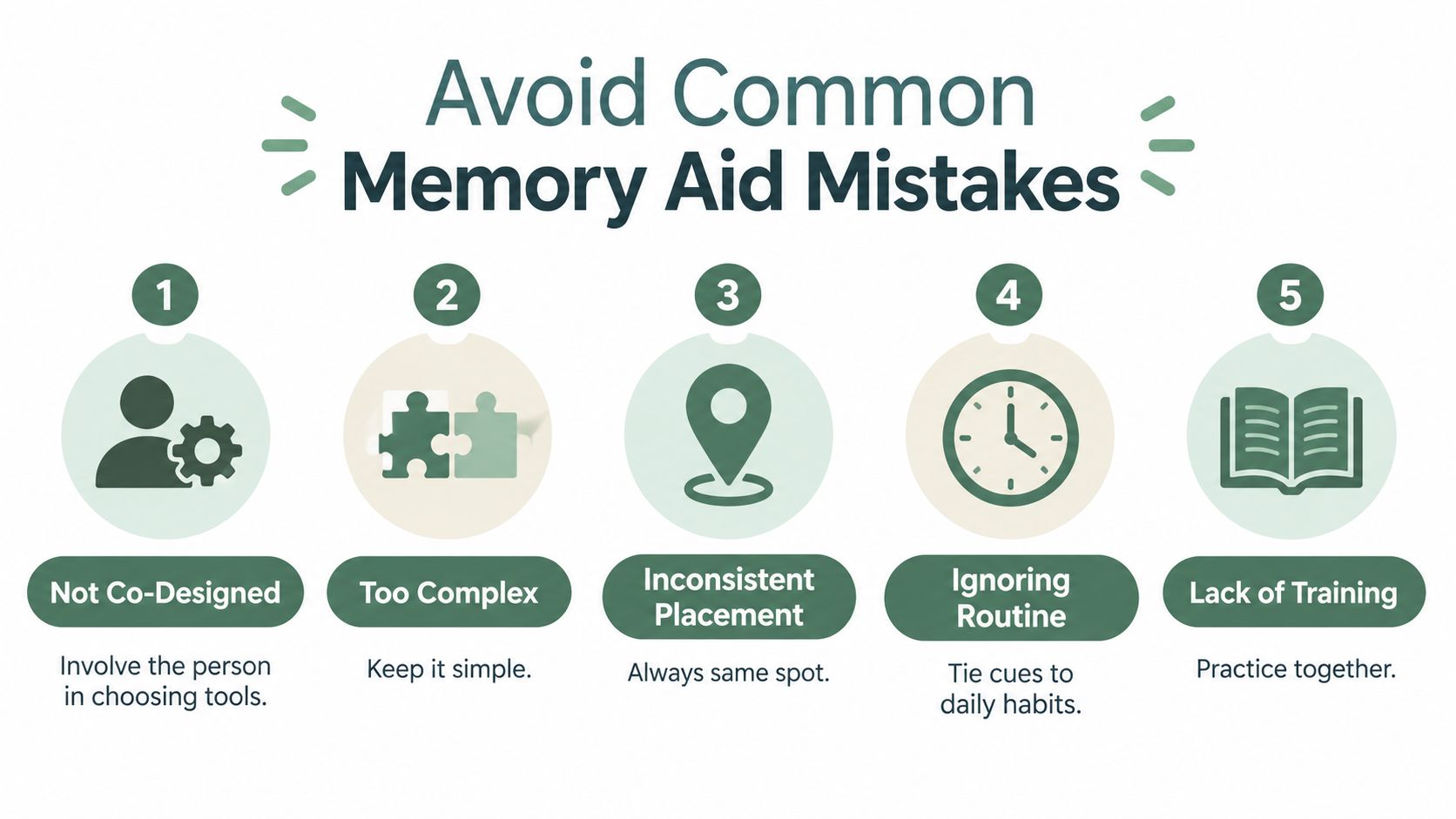
Five mistakes that matter most
Choosing for the person instead of with them. Even someone with memory loss often has clear preferences. A support they dislike won't stick.
Making the system too complicated. More features usually mean more steps.
Placing the aid in the wrong spot. A reminder belongs where the action happens, not where it looks tidy.
Ignoring the daily routine. An aid works better when attached to an existing habit like breakfast, teeth brushing, or sitting in a favorite chair.
Skipping practice. People need repetition. So do caregivers.
A labeled drawer system often succeeds where a digital organizer fails because it asks less of memory and attention. It meets the person in the task itself.
If a support only works when someone explains it every time, the support still needs redesign.
A simple adoption check
Before adding any new aid, ask:
Can the person understand what this is for right now
Is it easy to use in one step or two
Will it live in the same place every day
Has someone practiced it with them more than once
Will a caregiver review whether it's helping
That final review matters. What helps in one month may confuse in the next. The aid isn't a fixed solution. It's part of an ongoing care process.
Making Memory Aids Safe and Supportive at Home
A memory aid should never be separated from safety. If someone forgets where the spoons are, that's inconvenient. If they forget a burner is on, that's dangerous. The home needs to support both function and protection.
Set up the home so the next step is obvious
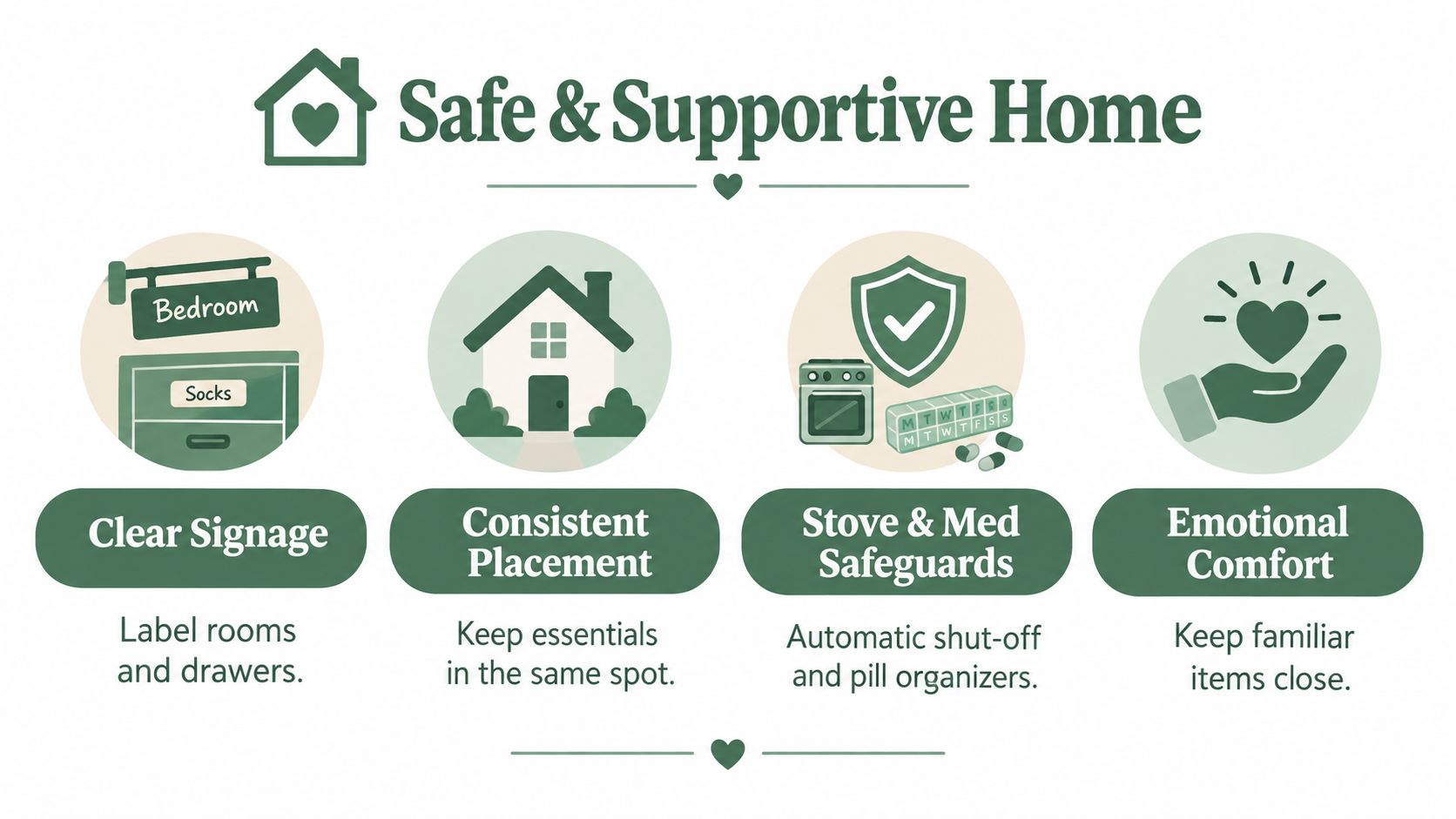
A supportive home gives instructions.
Try changes like these:
Label key spaces such as the bathroom, bedroom, or pantry
Keep essentials in one visible place such as glasses by the bedside or keys in one bowl
Reduce visual clutter on counters and tables so important items stand out
Use clear containers or open storage for daily-use objects
Place reminders at point of use such as a note near the door, not across the room
These changes reduce searching, confusion, and accidental mistakes.
Build safety into routines
Some tasks need more than a reminder. They need a safeguard.
Examples include:
Medication support with a pill organizer tied to a supervised routine
Kitchen protection through close observation, appliance choices, or limiting unsupervised stove use
Laundry and bathing cues using laid-out supplies and a predictable sequence
Nighttime support with a lamp, visible path to the bathroom, and familiar items nearby
A home safety plan should match the person's current abilities, not the way they managed the house years ago. Families often need practical prompts. These daily safety tips can help you think through the home room by room.
Emotional safety matters too
Repeated questions, agitation, and pacing aren't only “behavior issues.” They're often signs that the person feels lost, rushed, or unsure.
Helpful responses include:
Short reassurance instead of long explanations
Gentle orientation such as “It's Tuesday morning and we're at home”
Validation first when the person is upset
Familiar objects like family photos, a favorite blanket, or a well-known chair
“You don't have to correct every mistake. Sometimes the more helpful response is to reduce fear.”
For families supporting someone who lives alone
Check-ins work better when they follow anchors in the day. Morning, mealtime, and evening are usually easier than random timing.
Pay attention to changes such as:
More confusion than usual
Missed meals or unopened medication
Trouble walking or getting up safely
Increased anxiety about belongings, pets, or people
A home that suddenly looks less organized than usual
Those signs often tell you more than whether the calendar was used.
How Phone Based Programs Complement Everyday Memory Aids
A whiteboard can hold information. A phone call can help a person use it.
That's the difference many families discover over time. Physical tools are useful, but they often work best when a human being reinforces them. That's where phone-based support can fit into the larger system of memory aids for dementia.
Conversation can become a memory support
Structured conversation can cue recall, reinforce routine, and lower loneliness at the same time. This is especially relevant because reminiscence-based approaches remain a core part of dementia support. An abridged Cochrane review reported 22 studies involving 1,972 participants eligible for inclusion, with 16 studies and 1,749 participants in the meta-analysis, and more recent pooled evidence from 24 randomized controlled trials involving 1,963 patients found statistically significant gains in overall cognitive function, with stronger effects in interventions delivered 12 to 16 times in this reminiscence review summary. For families, the practical takeaway is simple. Familiar stories, names, photos, and repeated conversation prompts can be meaningful supports, not just pleasant extras.
What phone-based support adds
A phone-based program can complement home tools in a few distinct ways:
Routine reinforcement by checking in at consistent times
Orientation practice through day, date, place, and upcoming plans
Language and attention support through guided prompts and simple exercises
Practical monitoring around medications, appointments, and household concerns
Companionship that helps reduce long stretches of isolation
One example is Velma, a phone-based cognitive support program for older adults with early to mid-stage memory loss. It uses scheduled calls led by trained team members and includes reminiscence prompts, orientation, language and attention tasks, mood support, practical check-ins, and care-manager coordination.
Where this approach fits
Phone-based support doesn't replace medical care. It also doesn't replace hands-on help with bathing, meals, transfers, or direct supervision. Its strength is different. It helps hold the routine together between visits and gives families more visibility into day-to-day patterns.
Recent reviews also show why this area needs careful expectations. A 2025 review found that digital technologies for community-dwelling people with dementia include apps, smart homes, wearables, and support tools, but the evidence still needs more meaningful outcomes and stronger real-world validation. A 2026 review of dyadic interventions found that voice-reminder apps, remote platforms, and interactive agents are being tested, but studies remain heterogeneous and not yet definitive as described in this review. That's a reminder to judge support not only by alerts and features, but by whether it improves calmer days, steadier routines, and safer living.
Families looking at this option often start with the question, “Would my parent answer?” That's the right question. A phone-based layer works best when the person can still engage by phone and benefits from repeated structure. These daily check-in calls for seniors can make sense when the biggest gaps happen between in-person visits.
Putting Your Memory Aid Plan Into Action
Most families don't need more ideas. They need a starting point that feels manageable.
Begin with one hard part of the day. Pick the moment that causes the most confusion, stress, or safety risk. Then choose one support that makes that moment easier. Not smarter. Easier.
A practical plan for the next week
Try this:
Choose one target such as morning medication, finding the bathroom, or remembering today's plans
Add one aid that matches the task, like a pill organizer, door sign, or whiteboard
Place it where the action happens so it's seen at the right moment
Practice it together more than once, calmly and at the same time of day
Review after several days and ask what worked, what got ignored, and what caused frustration
That review step is where many plans improve. If the tool isn't being used, don't assume the person failed. The setup may be wrong.
Measure the right outcomes
Success doesn't only mean perfect recall. It can mean:
fewer repeated questions
less anxiety around daily tasks
smoother mornings
safer medication habits
more confidence for the person and less uncertainty for the family
Memory aids for dementia work best when they become part of ordinary life. A note on the mirror. A basket by the door. A call at the same time each week. Small supports, repeated well, often do more than dramatic changes.
Reassess whenever the person's abilities shift. What worked six months ago may now need simplifying. That isn't failure. It's good care.
Velma offers scheduled phone-based cognitive support for older adults with early to mid-stage memory loss, using structured conversation, orientation prompts, reminiscence, and routine check-ins that can complement home memory aids. If you want a layer of support between visits that helps families track daily patterns and reinforce safer routines, visit Velma.
Some mornings tell you exactly how much support is needed. Your dad is standing in the kitchen with a pill bottle in one hand, the toaster running, and yesterday's mail spread across the table. He knows he needs to do something next. He just can't sort out what comes first.
For many families, that's the moment the search begins. Not because memory has disappeared all at once, but because daily life has started to feel shaky. Medications get missed. Appointments slip by. Familiar tasks suddenly take too many steps.
Table of Contents
Introduction Why Memory Aids Matter More Than Memory Itself
Independence often depends on support
A layered plan works better than a single tool
Understanding How Memory Aids Support Daily Life
Four jobs memory aids do
Three families of support
Why consistency matters more than complexity
Choosing the Right Memory Aid by Dementia Stage
Start with the daily friction points
Matching Memory Aids to Dementia Stage and Daily Need
Don't introduce too much at once
Personal fit matters more than category
Common Memory Aid Mistakes and How to Avoid Them
Why good tools go unused
Five mistakes that matter most
A simple adoption check
Making Memory Aids Safe and Supportive at Home
Set up the home so the next step is obvious
Build safety into routines
Emotional safety matters too
For families supporting someone who lives alone
How Phone Based Programs Complement Everyday Memory Aids
Conversation can become a memory support
What phone-based support adds
Where this approach fits
Putting Your Memory Aid Plan Into Action
A practical plan for the next week
Measure the right outcomes
Introduction Why Memory Aids Matter More Than Memory Itself
When families hear the phrase memory aids for dementia, they often picture a gadget. A talking clock. A reminder app. A pill organizer with alarms. Those tools can help, but the job of a memory aid is bigger than remembering facts.
A good memory aid acts like external scaffolding for the brain. It supports the parts of daily life that have become harder to hold in mind. It can reduce the strain of having to remember every step, every object, every time, every place. That matters because people with dementia usually aren't just dealing with forgetfulness. They may also be dealing with confusion, anxiety, distraction, and loss of confidence.
Independence often depends on support
A calendar on the wall can help someone know what day it is. A label on a drawer can help them find socks without asking for help. A routine of taking medicine right after breakfast can work better than repeated verbal reminders all day long.
These are not small fixes. They protect dignity.
Practical rule: The best memory aid is the one that makes a hard moment easier, not the one with the most features.
Some memory supports are low-tech. Some are built into the home. Some come through structured conversation and cognitive exercises. Research on cognitive stimulation therapy helps explain why this matters. A 2023 Cochrane review identified 37 studies with 2,766 participants across 17 countries and five continents, and found that cognitive stimulation probably produced a small improvement in cognitive function for people with mild or moderate dementia in the review summary. That's one reason practical prompts, orientation cues, language tasks, and routine-based recall supports are used so often in day-to-day care.
A layered plan works better than a single tool
Families often ask, “What's the best memory aid?” The more useful question is, “What support does this person need at this point in the day?”
That shift changes everything. Instead of shopping for one perfect item, you start building a layered system. One part might be a whiteboard. Another might be labels in the bathroom. Another might be a phone-based check-in that reinforces routine and orientation.
That's how memory aids help daily life. Not as a gadget list, but as a support system.
Understanding How Memory Aids Support Daily Life
Think about glasses. Glasses don't cure poor vision. They help a person function better in the world they're already living in. Memory aids for dementia work in a similar way. They don't reverse dementia. They help the person do more with less strain.
Four jobs memory aids do
Most helpful supports do one or more of these jobs:
Cue action by reminding the person what to do next. A pill organizer by the coffee maker can cue morning medication.
Orient to time and place by showing where they are, what day it is, or what happens today. A large calendar and a simple “Today is Monday” board can lower confusion.
Simplify tasks by reducing choices or breaking tasks into steps. Laying out clothes in order can make dressing easier.
Reassure emotionally by making the day feel more predictable. Familiar photos, repeated routines, and calm prompts can reduce distress.
When readers get confused, it's often because they expect an aid to “fix memory.” That's too narrow. Many aids work because they reduce decision-making, support attention, and make the next step obvious.
Three families of support
It helps to sort tools into three broad groups.
Tangible tools
These are the physical objects people usually think of first.
Examples include:
Calendars and whiteboards for appointments and daily plans
Pill organizers for medication routines
Labeled drawers and cabinets for easier finding
Clocks showing day and date for orientation
Photo labels on doors, rooms, or storage bins
These tools work best when they're simple, visible, and used consistently.
Strategy-based aids
Some supports are less about objects and more about habits.
A few common ones:
Same-time routines for meals, medicine, bathing, and bedtime
Step-by-step verbal prompts instead of broad instructions like “get ready”
Short lists that focus on only the needed tasks
Repeated practice of one routine until it becomes familiar
If you're helping someone use written prompts, this guide to making a list that works is useful because it shows how a list becomes easier to follow when it's short, visible, and connected to real tasks.
Environmental supports
The environment often does more work than families realize.
A home can either demand memory or support it. Helpful changes include better lighting, less clutter, keeping essentials in one place, and placing needed objects exactly where the task happens. A toothbrush in plain sight helps more than a toothbrush hidden in a packed drawer.
A memory aid fails when it asks the person to remember to use the aid.
Why consistency matters more than complexity
A high-tech app won't help if the person forgets it exists. A handwritten note on the bathroom mirror might help every day.
That's why simple, repeated, familiar supports usually outperform complicated systems. The goal isn't to build a clever setup. The goal is to make the next step easier at the moment it's needed.
Choosing the Right Memory Aid by Dementia Stage
The right aid depends less on the diagnosis label and more on what the person can still do reliably. A person in the early stage may manage a phone reminder and a calendar. A person in the middle stage may need visual cues, simplified choices, and a caregiver practicing the routine with them. Later on, comfort, recognition, and safety tend to matter more than active self-management.
Start with the daily friction points
Don't begin with a shopping list. Begin with one question: Where is the day breaking down?
Common trouble spots include:
Morning routines such as dressing, toileting, or taking medicine
Time awareness such as not knowing the day, date, or next appointment
Finding items like keys, glasses, or the bathroom
Communication strain such as word-finding trouble or losing track in conversation
Evening confusion when fatigue makes multi-step tasks harder
When you identify the hard moment first, the tool choice gets easier.
Matching Memory Aids to Dementia Stage and Daily Need
Stage and Challenge | Best-Fit Aid Types | Example in Daily Life |
|---|---|---|
Early stage and forgetting appointments or tasks | Calendar, phone reminders, written checklist, notebook for names and plans | A large wall calendar by the kitchen table with one appointment written in clear, simple language |
Early stage and word-finding or conversation gaps | Photo albums, name lists, reminiscence prompts, familiar-topic conversation cards | Keeping labeled family photos nearby during visits to support names and stories |
Middle stage and trouble completing multi-step tasks | Step cards, laid-out materials, caregiver cueing, routine sequencing | Clothes placed in dressing order on the bed instead of asking the person to choose from a closet |
Middle stage and disorientation in the home | Door signs, drawer labels, day-date clock, simplified room setup | A bathroom sign on the door and towels stored in one visible basket |
Middle stage and medication inconsistency | Pill organizer, supervised routine, visible placement linked to meals | Medicine taken after breakfast at the same seat each day |
Later needs and distress or repeated questions | Familiar objects, reassurance cues, calm orientation, sensory comfort items | A short bedside card with the caregiver's name and a simple message such as “You are home and safe” |
A stage-matched care approach is easier to build when families think in layers rather than products. This overview of stage-matched interventions is a useful companion if you're trying to connect daily supports to changing abilities.
Don't introduce too much at once
Families often overcorrect. They buy a digital clock, a new app, a tracker, a smart speaker, labels for every drawer, and a whiteboard in one weekend. By Monday, everyone is overwhelmed.
Start with one or two high-impact aids. Pick the areas causing the most stress. If medication is being missed, solve that first. If the person gets lost in the kitchen, work on layout and labeling there first.
Choose the aid that removes the biggest daily obstacle, not the one that seems most impressive.
Personal fit matters more than category
Two people at the same stage may need completely different supports. One may respond well to written notes. Another may ignore paper but follow a habit tied to mealtime. One may enjoy looking through old family photos. Another may find that tiring but respond well to a short spoken cue.
A few questions help narrow the choice:
What still feels familiar to them
What do they already use without prompting
When are they most alert
What tends to trigger frustration
Who will help keep the aid in use
That last question matters more than families expect. A memory aid is rarely self-running. Someone usually needs to set it up, place it well, and notice when it stops working.
Common Memory Aid Mistakes and How to Avoid Them
Families often assume a tool failed because the person's memory got worse. Sometimes that's true. Just as often, the tool was never a good fit in the first place.
Why good tools go unused
A common example is the complex reminder app that looks promising, gets set up with care, and is abandoned almost immediately. Not because reminders are a bad idea, but because the person doesn't open the app, can't hear the alert, forgets what the alert means, or never learned the routine around it.
Research has pointed to this implementation gap. A pan-European consensus study and a systematic review of reviews emphasized co-design, affordability, accessibility, and support for use as central priorities, while also noting that digital assistive technologies still need more evaluation and more inclusive design in this review discussion. In plain language, many tools aren't built around real people living real days.
Five mistakes that matter most
Choosing for the person instead of with them. Even someone with memory loss often has clear preferences. A support they dislike won't stick.
Making the system too complicated. More features usually mean more steps.
Placing the aid in the wrong spot. A reminder belongs where the action happens, not where it looks tidy.
Ignoring the daily routine. An aid works better when attached to an existing habit like breakfast, teeth brushing, or sitting in a favorite chair.
Skipping practice. People need repetition. So do caregivers.
A labeled drawer system often succeeds where a digital organizer fails because it asks less of memory and attention. It meets the person in the task itself.
If a support only works when someone explains it every time, the support still needs redesign.
A simple adoption check
Before adding any new aid, ask:
Can the person understand what this is for right now
Is it easy to use in one step or two
Will it live in the same place every day
Has someone practiced it with them more than once
Will a caregiver review whether it's helping
That final review matters. What helps in one month may confuse in the next. The aid isn't a fixed solution. It's part of an ongoing care process.
Making Memory Aids Safe and Supportive at Home
A memory aid should never be separated from safety. If someone forgets where the spoons are, that's inconvenient. If they forget a burner is on, that's dangerous. The home needs to support both function and protection.
Set up the home so the next step is obvious
A supportive home gives instructions.
Try changes like these:
Label key spaces such as the bathroom, bedroom, or pantry
Keep essentials in one visible place such as glasses by the bedside or keys in one bowl
Reduce visual clutter on counters and tables so important items stand out
Use clear containers or open storage for daily-use objects
Place reminders at point of use such as a note near the door, not across the room
These changes reduce searching, confusion, and accidental mistakes.
Build safety into routines
Some tasks need more than a reminder. They need a safeguard.
Examples include:
Medication support with a pill organizer tied to a supervised routine
Kitchen protection through close observation, appliance choices, or limiting unsupervised stove use
Laundry and bathing cues using laid-out supplies and a predictable sequence
Nighttime support with a lamp, visible path to the bathroom, and familiar items nearby
A home safety plan should match the person's current abilities, not the way they managed the house years ago. Families often need practical prompts. These daily safety tips can help you think through the home room by room.
Emotional safety matters too
Repeated questions, agitation, and pacing aren't only “behavior issues.” They're often signs that the person feels lost, rushed, or unsure.
Helpful responses include:
Short reassurance instead of long explanations
Gentle orientation such as “It's Tuesday morning and we're at home”
Validation first when the person is upset
Familiar objects like family photos, a favorite blanket, or a well-known chair
“You don't have to correct every mistake. Sometimes the more helpful response is to reduce fear.”
For families supporting someone who lives alone
Check-ins work better when they follow anchors in the day. Morning, mealtime, and evening are usually easier than random timing.
Pay attention to changes such as:
More confusion than usual
Missed meals or unopened medication
Trouble walking or getting up safely
Increased anxiety about belongings, pets, or people
A home that suddenly looks less organized than usual
Those signs often tell you more than whether the calendar was used.
How Phone Based Programs Complement Everyday Memory Aids
A whiteboard can hold information. A phone call can help a person use it.
That's the difference many families discover over time. Physical tools are useful, but they often work best when a human being reinforces them. That's where phone-based support can fit into the larger system of memory aids for dementia.
Conversation can become a memory support
Structured conversation can cue recall, reinforce routine, and lower loneliness at the same time. This is especially relevant because reminiscence-based approaches remain a core part of dementia support. An abridged Cochrane review reported 22 studies involving 1,972 participants eligible for inclusion, with 16 studies and 1,749 participants in the meta-analysis, and more recent pooled evidence from 24 randomized controlled trials involving 1,963 patients found statistically significant gains in overall cognitive function, with stronger effects in interventions delivered 12 to 16 times in this reminiscence review summary. For families, the practical takeaway is simple. Familiar stories, names, photos, and repeated conversation prompts can be meaningful supports, not just pleasant extras.
What phone-based support adds
A phone-based program can complement home tools in a few distinct ways:
Routine reinforcement by checking in at consistent times
Orientation practice through day, date, place, and upcoming plans
Language and attention support through guided prompts and simple exercises
Practical monitoring around medications, appointments, and household concerns
Companionship that helps reduce long stretches of isolation
One example is Velma, a phone-based cognitive support program for older adults with early to mid-stage memory loss. It uses scheduled calls led by trained team members and includes reminiscence prompts, orientation, language and attention tasks, mood support, practical check-ins, and care-manager coordination.
Where this approach fits
Phone-based support doesn't replace medical care. It also doesn't replace hands-on help with bathing, meals, transfers, or direct supervision. Its strength is different. It helps hold the routine together between visits and gives families more visibility into day-to-day patterns.
Recent reviews also show why this area needs careful expectations. A 2025 review found that digital technologies for community-dwelling people with dementia include apps, smart homes, wearables, and support tools, but the evidence still needs more meaningful outcomes and stronger real-world validation. A 2026 review of dyadic interventions found that voice-reminder apps, remote platforms, and interactive agents are being tested, but studies remain heterogeneous and not yet definitive as described in this review. That's a reminder to judge support not only by alerts and features, but by whether it improves calmer days, steadier routines, and safer living.
Families looking at this option often start with the question, “Would my parent answer?” That's the right question. A phone-based layer works best when the person can still engage by phone and benefits from repeated structure. These daily check-in calls for seniors can make sense when the biggest gaps happen between in-person visits.
Putting Your Memory Aid Plan Into Action
Most families don't need more ideas. They need a starting point that feels manageable.
Begin with one hard part of the day. Pick the moment that causes the most confusion, stress, or safety risk. Then choose one support that makes that moment easier. Not smarter. Easier.
A practical plan for the next week
Try this:
Choose one target such as morning medication, finding the bathroom, or remembering today's plans
Add one aid that matches the task, like a pill organizer, door sign, or whiteboard
Place it where the action happens so it's seen at the right moment
Practice it together more than once, calmly and at the same time of day
Review after several days and ask what worked, what got ignored, and what caused frustration
That review step is where many plans improve. If the tool isn't being used, don't assume the person failed. The setup may be wrong.
Measure the right outcomes
Success doesn't only mean perfect recall. It can mean:
fewer repeated questions
less anxiety around daily tasks
smoother mornings
safer medication habits
more confidence for the person and less uncertainty for the family
Memory aids for dementia work best when they become part of ordinary life. A note on the mirror. A basket by the door. A call at the same time each week. Small supports, repeated well, often do more than dramatic changes.
Reassess whenever the person's abilities shift. What worked six months ago may now need simplifying. That isn't failure. It's good care.
Velma offers scheduled phone-based cognitive support for older adults with early to mid-stage memory loss, using structured conversation, orientation prompts, reminiscence, and routine check-ins that can complement home memory aids. If you want a layer of support between visits that helps families track daily patterns and reinforce safer routines, visit Velma.
Suggested Article: