Mood vs Affect Examples: A Clinical Guide

You're listening to an older adult say, “I'm fine,” but the voice is quiet, the pauses are unusually long, and the face barely changes. In the chart, should you write mood: fine, affect: flat, or both? The answer matters because these terms describe different clinical information. The patient's words give you access to mood, while the person's expression, tone, movement, and responsiveness give you access to affect.
The most useful mood vs affect examples don't stop at “subjective versus objective.” They show what to document when the two match, when they diverge, and when a brief phone call or dementia check-in reveals only part of the picture.
Table of Contents
Why Mood and Affect Often Get Confused
Two observations, not one label
What Mood and Affect Actually Mean in Clinical Practice
Duration separates the concepts
Observability supplies the second axis
Side by Side Mood and Affect at a Glance
Affect descriptors in practice
Clinical Mood Affect Pairings and What They Suggest
Five short clinical examples
Mood and Affect in Dementia and Phone Based Check Ins
What a phone call can and cannot show
When What a Patient Says Does Not Match What You See
A four-part documentation method
Two contrasting examples
Putting It Together for Caregivers and Care Teams
What to listen for
What to observe
Why Mood and Affect Often Get Confused
A third-year resident has about 90 seconds to summarize a teaching-clinic encounter. The resident writes, “Mood: depressed,” then tells the attending, “But the patient looks fine.” The attending asks a simple question: “What did the patient report, and what did you observe?”
That pause exposes the common error. The resident has combined the patient's internal report with the clinician's visual impression, even though those observations came from different sources. The patient said they felt depressed. The clinician noticed a calm posture, steady eye contact, and no obvious tearfulness. Both findings belong in the record, and neither cancels the other.
Two observations, not one label
Mood comes primarily from the patient's account. You ask, “How have you been feeling?” or “What has your overall mood been like?” The answer may be depressed, anxious, angry, numb, calm, or “fine.” Mood describes an internal emotional climate that can persist beyond the interview.
Affect comes from observation. You notice facial animation, voice quality, posture, gestures, eye contact, emotional reactivity, and whether the person's expression changes as the conversation changes. Affect describes the emotional expression available to you in that moment.
Charting shortcuts create confusion because everyday language uses “mood” and “affect” loosely. A caregiver may say someone “seems anxious,” while a clinician needs to determine whether the person reports anxiety, appears anxious, or shows both. Stress and anxiety also aren't interchangeable experiences, so readers who want a plain-language companion can review this explanation from Be Your Best Self Thrive Counseling PLLC.
Clinical rule: Quote or summarize the patient's stated mood, then describe the observed affect separately.
This separation becomes especially important in dementia care. A person may under-report distress, struggle to name an emotion, or show limited facial expression because of neurological or communication changes. During repeated contacts, caregivers need to record short-lived observable changes separately from the longer emotional pattern. Practical dementia communication strategies can help staff ask questions without turning every conversation into an interrogation.
The distinction isn't about assigning a diagnosis from one glance. It's about preserving two channels of information so the next clinician can interpret the presentation accurately.
What Mood and Affect Actually Mean in Clinical Practice
In clinical practice, mood is the patient's sustained, subjective emotional state. The examiner usually identifies it by asking direct questions and recording the patient's own description. A patient might report, “I've felt hopeless lately,” “I've been on edge,” or “My mood has been pretty good.”
Affect is the examiner's immediate observation of emotional expression. It includes how the patient looks, sounds, and moves during the encounter. Facial expression, vocal inflection, body language, eye contact, gestures, and emotional reactivity all contribute to the assessment. You can observe affect without asking the patient to name it.
Duration separates the concepts
Mood generally describes a broader emotional period. It may color the patient's experience across repeated contacts, even though the exact duration varies by presentation. Affect belongs to the current interaction and can shift as the topic, environment, or relationship changes.
The classic psychiatric framing describes affect as momentary or wave-like, while mood is prolonged and more durable. A patient can report several days of sadness while smiling briefly at a familiar joke. That smile doesn't automatically disprove the reported mood, just as a quiet interview doesn't prove the absence of depression.
Observability supplies the second axis
Mood is internal and depends heavily on self-report. Affect is external and depends on what the examiner can see or hear. The two often align, but they don't have to.
A major training survey found that 92.7% of mental health trainees correctly identified mood as a pervasive and sustained emotional tone, while 95.1% correctly rejected that description for affect (the survey and psychiatric framing). Those results show that the distinction is widely taught, yet the remaining gap matters in real documentation. Learners may know the definition and still write a vague phrase such as “appears depressed” without clarifying whether the finding came from the patient's words or the examiner's observation.
Documentation test: If another clinician can't tell what the patient said from what you saw, the note needs revision.
Affect also has its own vocabulary. Terms such as restricted, blunted, flat, labile, congruent, incongruent, and expansive add detail that a single mood label can't provide. Used carefully, they turn “looks off” into a reproducible description.
Side by Side Mood and Affect at a Glance
A quick comparison helps prevent category errors before they reach the chart.
Criterion | Mood | Affect |
|---|---|---|
Source | The patient's reported internal feeling state | The examiner's observed emotional expression |
Duration | More sustained and broader in time | Immediate and tied to the encounter |
Observability | Not directly visible without asking | Visible or audible through expression and behavior |
Clinical question | “How does the patient say they've been feeling?” | “How does the patient appear right now?” |
Documentation style | Use the patient's words, preferably in quotation marks | Use precise descriptive terms and behavioral examples |
Affect descriptors in practice
Full range means the person shows a broad and flexible range of emotion. The face, voice, and gestures change naturally with the conversation.
Restricted or constricted affect means the emotional range is narrower than expected, but some variation remains. The patient may smile briefly, show concern, and then return to a neutral expression.
Blunted affect indicates a marked reduction in emotional intensity. The patient responds, but the voice, face, and gestures carry little emotional force.
Flat affect describes minimal or nearly absent observable emotional expression. The face remains immobile, the voice is monotone, and gestures are scarce throughout the interview.
Congruent affect matches the reported mood and the subject matter. A patient who reports sadness while speaking softly, looking tearful, and showing reduced animation may have a depressed, congruent presentation.
Incongruent affect doesn't match the reported mood or the content being discussed. Laughing while describing a recent bereavement is one example, although the clinician should describe the behavior and context rather than infer a diagnosis from it alone.
Labile affect shifts rapidly or intensely. A patient may cry during a safety question, then laugh while discussing discharge, with changes that seem disproportionate or difficult to regulate.
Expansive affect appears unusually broad, intense, or outwardly expressive. The patient may use large gestures, speak with strong enthusiasm, and respond with heightened confidence.
A structured patientnotes.com mental health template can help learners keep mood and affect in separate documentation fields. The descriptors are tools, not signals that speak for themselves. Always pair a label with what you observed.
Clinical Mood Affect Pairings and What They Suggest
A mood-affect pairing becomes useful when it shows the relationship between self-report and observed presentation. It doesn't replace a full assessment, but it can narrow the clinical direction and identify a mismatch that deserves further questioning.
Reported Mood | Observed Affect | Likely Clinical Signal |
|---|---|---|
“Depressed” or deeply sad | Blunted, slowed, or constricted | May support a depressive presentation, including major depression |
“Euphoric” or unusually elevated | Expansive and possibly labile | May support mania, including a bipolar I presentation |
“Fine” or emotionally neutral | Flat, monotone, limited gesture | May be consistent with chronic negative-symptom presentations such as schizophrenia |
“Happy” while discussing frightening or painful material | Tearful or otherwise incongruent | May raise concern for psychosis, frontal dysfunction, or another cause of mismatch |
“Anxious” | Restricted, tense, and watchful, with more range as rapport develops | May support an anxiety-related presentation |
Five short clinical examples
The slowed depressive presentation. A patient says, “I've been sad and empty.” Their speech is soft, responses are delayed, movements are slowed, and facial expression is blunted. Document the reported depressed mood and the observed blunted or constricted affect, including the slowed speech and reduced animation. That combination can point toward major depressive disorder, but the assessment still needs risk questions, history, cognition, medical review, and functional context.
The expansive presentation. A patient reports feeling “fantastic” and says they've never been more capable. They speak rapidly, interrupt often, use broad gestures, and shift quickly from excitement to irritation. Euphoric mood with expansive, labile affect may suggest mania in a bipolar I presentation, while the clinician also evaluates sleep, thought process, judgment, psychosis, substance use, and safety.
The flat presentation. A patient with chronic schizophrenia answers questions in a monotone, uses few gestures, and maintains very limited facial movement. They report feeling “fine.” The note should preserve both facts: mood reported as “fine,” affect flat, with monotone speech and limited gesture. The observation may fit a chronic schizophrenia presentation, but it doesn't establish the cause by itself.
The incongruent presentation. A patient smiles and says, “Everything is wonderful,” while becoming tearful when discussing a threatening voice. The mismatch deserves clarification. Document the cheerful stated mood, tearful or incongruent affect, the exact topic that triggered the change, and the perceptual experience rather than writing “inappropriate.”
The anxious presentation. A patient reports persistent worry. Their shoulders are tense, speech is cautious, and affect is restricted at the beginning, then broadens when the clinician establishes rapport. That change is clinically meaningful. It suggests the person can still react emotionally in a supportive interaction, which is different from an expression that remains flat across topics.
Mood and Affect in Dementia and Phone Based Check Ins
During a morning call, a person with dementia says, “I'm okay.” Their replies are brief, their voice sounds shallow, and they show little interest in a familiar hobby. On another day, they use the same words but laugh at a familiar memory and ask questions. The report should preserve both the stated mood and the observed change in affect.
Dementia care makes this distinction more difficult because memory impairment can produce incomplete or repetitive answers. The care team combines self-report, behavior, and information from people who know the patient. One conversation cannot show whether a presentation is typical, temporary, or changing.
The Dementia Mood Assessment Scale, developed in 1988, contains 24 items. The first 17 items measure mood, while the remaining items address dementia severity (the dementia mood assessment literature). Its mood content includes enjoyment, self-esteem, sadness, anxiety, and anger. Direct-observation methods also examine pleasure, interest, contentment, sadness, worry, and anger.
What a phone call can and cannot show
A phone check-in gives better access to mood through the person's words. Affect must be estimated from vocal and conversational behavior:
Speech pace: Note responses that are unusually slow, rushed, or hesitant.
Pauses and latency: Record long gaps, word-searching, or a sudden change from baseline.
Prosody: Listen for monotone delivery, reduced energy, or brighter inflection.
Reactivity: Notice whether familiar topics, humor, or reassurance produce a change.
Distress signals: Record tears, agitation, fear, or repeated concern.
Research on dementia care describes substantial variation within the same person's self-reported well-being and informant-rated affect. Emotional presentation may therefore differ across calls or days. Repeated contacts provide a clearer pattern than one reassuring or difficult interaction.
Phone observation remains limited. The listener cannot see facial movement, posture, or gestures, so vocal changes should be documented as available evidence rather than treated as a complete mental status examination. A calm voice may coexist with distress, while a brighter tone may reflect engagement with one topic rather than a sustained change in mood.
Families can connect these observations with safety planning by reviewing dementia safety tips for families. Guidance on daily check-in calls for seniors can also help families set consistent timing, compare changes across calls, and identify when a concern needs escalation.
When What a Patient Says Does Not Match What You See
“I'm fine” is not a finding that ends the assessment. It's a reported mood that needs to sit beside the observed affect, especially when the person looks tense, emotionally muted, tearful, or unusually reactive.
A mismatch can occur for many reasons. An older adult may minimize depression, a person with dementia may have difficulty naming distress, and a guarded patient may not feel safe disclosing emotion. Neurological conditions, communication changes, cultural norms, medication effects, and longstanding personality style can also affect expression.
A four-part documentation method
Use a sequence that keeps observation separate from interpretation:
Name the stated mood. Record the patient's words, such as “fine,” “sad,” or “anxious.”
Describe the affect. Use a specific term, then add observable evidence, such as flat affect with monotone speech and minimal facial movement.
State the discrepancy. Write that affect appears incongruent with the reported mood when the two don't match.
Add context. Include the setting, time of contact, recent events, topics discussed, and whether the presentation changed with rapport.
Practical rule: Don't replace a discrepancy with a diagnosis. Preserve the discrepancy so the next clinician can investigate it.
Two contrasting examples
An older adult says, “I'm cheerful. Nothing is wrong,” but speaks softly, pauses before answers, and becomes tearful when asked about sleep and social contact. A useful entry might read: Mood reported as “cheerful.” Affect constricted and intermittently tearful, with reduced vocal energy and long pauses. Affect appears incongruent with stated mood. Presentation observed during a morning phone contact; further assessment of depressive symptoms and safety indicated.
A patient with schizophrenia says, “No, I'm not distressed,” while maintaining a monotone voice and almost no facial movement. The note could read: Mood reported as “not distressed.” Affect blunted, with monotone speech, limited gesture, and minimal reactivity throughout interview. No assumption is made that the patient feels no distress; continue assessment using direct questions and collateral information as clinically appropriate.
The wording gives downstream clinicians something actionable. “Patient fine” doesn't explain whether the patient was engaged, emotionally restricted, guarded, or having a calm day.
Putting It Together for Caregivers and Care Teams
Caregivers don't need to diagnose affect. They need to notice changes, describe them clearly, and share them with the people responsible for clinical decisions. A simple two-column record can separate what the person says from what the caregiver observes.
Mood report | Observed affect |
|---|---|
“I'm fine,” “I'm worried,” or “I feel sad” | Quiet voice, long pauses, tearfulness, flat expression, brighter response to familiar conversation |
Complaints about sleep, appetite, loneliness, or fear | Changes in energy, engagement, posture, speech rhythm, or emotional reactivity |
Statements suggesting hopelessness or a wish not to live | Immediate safety concern requiring direct escalation to the care team |
What to listen for
Ask an open question such as, “How has your overall mood been today?” Don't rely only on yes-or-no questions, because “fine” may mean calm, unwilling to discuss distress, unable to find the words, or ready to end the call.
Listen for changes in tone, pace, energy, content, and spontaneous conversation. If the person mentions hopelessness, wanting to disappear, self-harm, or harm to someone else, follow the established safety procedure and contact the appropriate clinician or emergency service. Don't treat a cheerful tone as proof that risk is absent.
What to observe
Affect during a call includes more than facial expression. Record vocal animation, response time, laughter, crying, irritability, interest in familiar subjects, and whether reassurance changes the presentation. For in-person contacts, add eye contact, posture, movement, gestures, and facial responsiveness.
The most actionable signal is often a change from the person's own baseline. A naturally quiet person may always have restricted expression. A new pattern of flatness, anxiety, tearfulness, withdrawal, or rapid shifts deserves attention, particularly when it appears across repeated contacts.
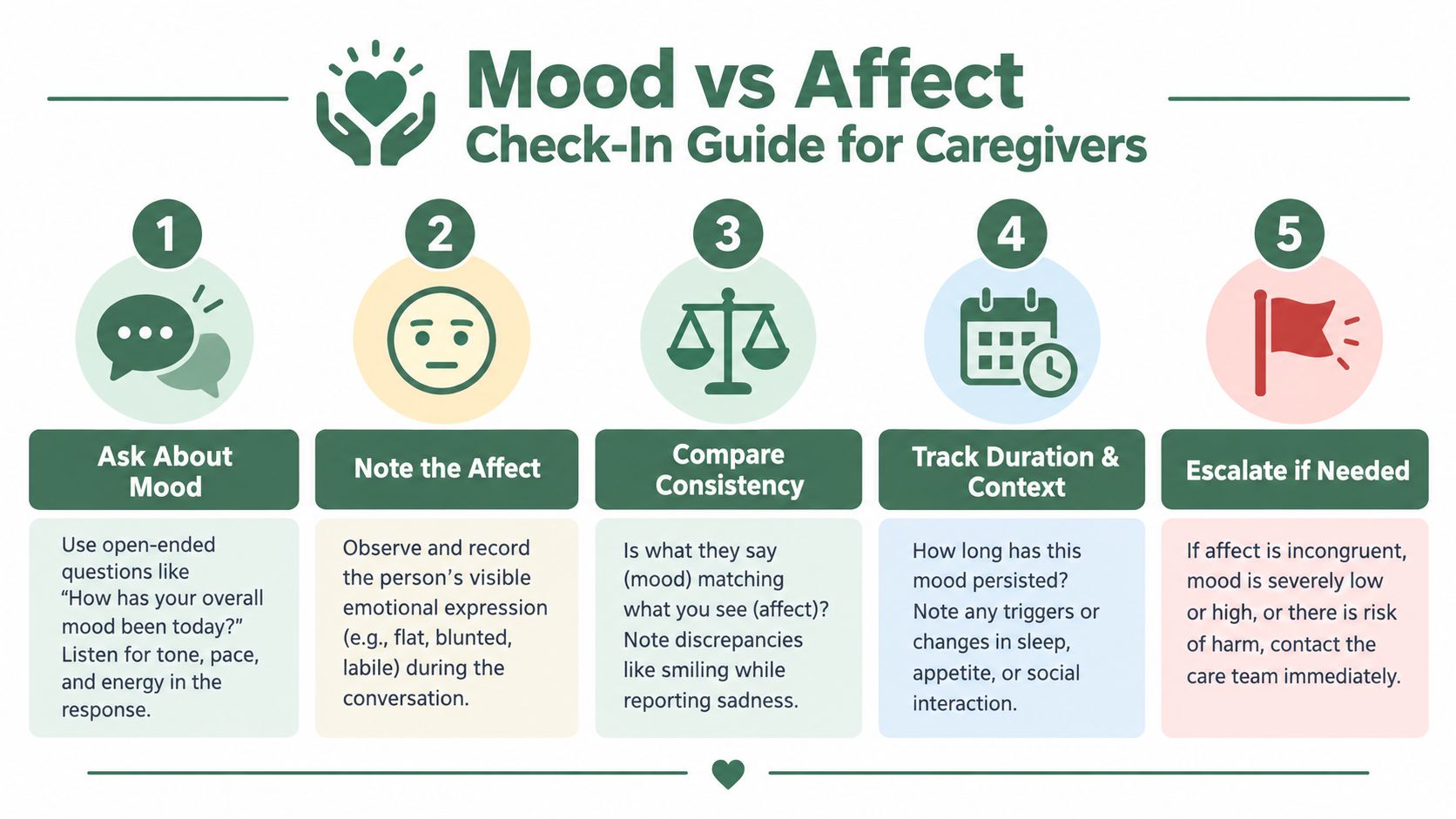
A coordinated record can make those patterns easier to share. A care coordination platform such as Velma's care coordination platform can support scheduled phone contact, structured cognitive and emotional check-ins, and communication with family or care managers. It should complement, not replace, clinical evaluation and in-person care.
Use the two-column log consistently, include the date and context, and send meaningful changes to the care team rather than waiting for a crisis. Velma offers scheduled phone calls with structured conversation, cognitive support activities, practical check-ins, and care manager coordination for older adults experiencing memory loss. Visit Velma to learn how recurring calls can help families track mood, affect, safety, and day-to-day changes between clinical visits.
You're listening to an older adult say, “I'm fine,” but the voice is quiet, the pauses are unusually long, and the face barely changes. In the chart, should you write mood: fine, affect: flat, or both? The answer matters because these terms describe different clinical information. The patient's words give you access to mood, while the person's expression, tone, movement, and responsiveness give you access to affect.
The most useful mood vs affect examples don't stop at “subjective versus objective.” They show what to document when the two match, when they diverge, and when a brief phone call or dementia check-in reveals only part of the picture.
Table of Contents
Why Mood and Affect Often Get Confused
Two observations, not one label
What Mood and Affect Actually Mean in Clinical Practice
Duration separates the concepts
Observability supplies the second axis
Side by Side Mood and Affect at a Glance
Affect descriptors in practice
Clinical Mood Affect Pairings and What They Suggest
Five short clinical examples
Mood and Affect in Dementia and Phone Based Check Ins
What a phone call can and cannot show
When What a Patient Says Does Not Match What You See
A four-part documentation method
Two contrasting examples
Putting It Together for Caregivers and Care Teams
What to listen for
What to observe
Why Mood and Affect Often Get Confused
A third-year resident has about 90 seconds to summarize a teaching-clinic encounter. The resident writes, “Mood: depressed,” then tells the attending, “But the patient looks fine.” The attending asks a simple question: “What did the patient report, and what did you observe?”
That pause exposes the common error. The resident has combined the patient's internal report with the clinician's visual impression, even though those observations came from different sources. The patient said they felt depressed. The clinician noticed a calm posture, steady eye contact, and no obvious tearfulness. Both findings belong in the record, and neither cancels the other.
Two observations, not one label
Mood comes primarily from the patient's account. You ask, “How have you been feeling?” or “What has your overall mood been like?” The answer may be depressed, anxious, angry, numb, calm, or “fine.” Mood describes an internal emotional climate that can persist beyond the interview.
Affect comes from observation. You notice facial animation, voice quality, posture, gestures, eye contact, emotional reactivity, and whether the person's expression changes as the conversation changes. Affect describes the emotional expression available to you in that moment.
Charting shortcuts create confusion because everyday language uses “mood” and “affect” loosely. A caregiver may say someone “seems anxious,” while a clinician needs to determine whether the person reports anxiety, appears anxious, or shows both. Stress and anxiety also aren't interchangeable experiences, so readers who want a plain-language companion can review this explanation from Be Your Best Self Thrive Counseling PLLC.
Clinical rule: Quote or summarize the patient's stated mood, then describe the observed affect separately.
This separation becomes especially important in dementia care. A person may under-report distress, struggle to name an emotion, or show limited facial expression because of neurological or communication changes. During repeated contacts, caregivers need to record short-lived observable changes separately from the longer emotional pattern. Practical dementia communication strategies can help staff ask questions without turning every conversation into an interrogation.
The distinction isn't about assigning a diagnosis from one glance. It's about preserving two channels of information so the next clinician can interpret the presentation accurately.
What Mood and Affect Actually Mean in Clinical Practice
In clinical practice, mood is the patient's sustained, subjective emotional state. The examiner usually identifies it by asking direct questions and recording the patient's own description. A patient might report, “I've felt hopeless lately,” “I've been on edge,” or “My mood has been pretty good.”
Affect is the examiner's immediate observation of emotional expression. It includes how the patient looks, sounds, and moves during the encounter. Facial expression, vocal inflection, body language, eye contact, gestures, and emotional reactivity all contribute to the assessment. You can observe affect without asking the patient to name it.
Duration separates the concepts
Mood generally describes a broader emotional period. It may color the patient's experience across repeated contacts, even though the exact duration varies by presentation. Affect belongs to the current interaction and can shift as the topic, environment, or relationship changes.
The classic psychiatric framing describes affect as momentary or wave-like, while mood is prolonged and more durable. A patient can report several days of sadness while smiling briefly at a familiar joke. That smile doesn't automatically disprove the reported mood, just as a quiet interview doesn't prove the absence of depression.
Observability supplies the second axis
Mood is internal and depends heavily on self-report. Affect is external and depends on what the examiner can see or hear. The two often align, but they don't have to.
A major training survey found that 92.7% of mental health trainees correctly identified mood as a pervasive and sustained emotional tone, while 95.1% correctly rejected that description for affect (the survey and psychiatric framing). Those results show that the distinction is widely taught, yet the remaining gap matters in real documentation. Learners may know the definition and still write a vague phrase such as “appears depressed” without clarifying whether the finding came from the patient's words or the examiner's observation.
Documentation test: If another clinician can't tell what the patient said from what you saw, the note needs revision.
Affect also has its own vocabulary. Terms such as restricted, blunted, flat, labile, congruent, incongruent, and expansive add detail that a single mood label can't provide. Used carefully, they turn “looks off” into a reproducible description.
Side by Side Mood and Affect at a Glance
A quick comparison helps prevent category errors before they reach the chart.
Criterion | Mood | Affect |
|---|---|---|
Source | The patient's reported internal feeling state | The examiner's observed emotional expression |
Duration | More sustained and broader in time | Immediate and tied to the encounter |
Observability | Not directly visible without asking | Visible or audible through expression and behavior |
Clinical question | “How does the patient say they've been feeling?” | “How does the patient appear right now?” |
Documentation style | Use the patient's words, preferably in quotation marks | Use precise descriptive terms and behavioral examples |
Affect descriptors in practice
Full range means the person shows a broad and flexible range of emotion. The face, voice, and gestures change naturally with the conversation.
Restricted or constricted affect means the emotional range is narrower than expected, but some variation remains. The patient may smile briefly, show concern, and then return to a neutral expression.
Blunted affect indicates a marked reduction in emotional intensity. The patient responds, but the voice, face, and gestures carry little emotional force.
Flat affect describes minimal or nearly absent observable emotional expression. The face remains immobile, the voice is monotone, and gestures are scarce throughout the interview.
Congruent affect matches the reported mood and the subject matter. A patient who reports sadness while speaking softly, looking tearful, and showing reduced animation may have a depressed, congruent presentation.
Incongruent affect doesn't match the reported mood or the content being discussed. Laughing while describing a recent bereavement is one example, although the clinician should describe the behavior and context rather than infer a diagnosis from it alone.
Labile affect shifts rapidly or intensely. A patient may cry during a safety question, then laugh while discussing discharge, with changes that seem disproportionate or difficult to regulate.
Expansive affect appears unusually broad, intense, or outwardly expressive. The patient may use large gestures, speak with strong enthusiasm, and respond with heightened confidence.
A structured patientnotes.com mental health template can help learners keep mood and affect in separate documentation fields. The descriptors are tools, not signals that speak for themselves. Always pair a label with what you observed.
Clinical Mood Affect Pairings and What They Suggest
A mood-affect pairing becomes useful when it shows the relationship between self-report and observed presentation. It doesn't replace a full assessment, but it can narrow the clinical direction and identify a mismatch that deserves further questioning.
Reported Mood | Observed Affect | Likely Clinical Signal |
|---|---|---|
“Depressed” or deeply sad | Blunted, slowed, or constricted | May support a depressive presentation, including major depression |
“Euphoric” or unusually elevated | Expansive and possibly labile | May support mania, including a bipolar I presentation |
“Fine” or emotionally neutral | Flat, monotone, limited gesture | May be consistent with chronic negative-symptom presentations such as schizophrenia |
“Happy” while discussing frightening or painful material | Tearful or otherwise incongruent | May raise concern for psychosis, frontal dysfunction, or another cause of mismatch |
“Anxious” | Restricted, tense, and watchful, with more range as rapport develops | May support an anxiety-related presentation |
Five short clinical examples
The slowed depressive presentation. A patient says, “I've been sad and empty.” Their speech is soft, responses are delayed, movements are slowed, and facial expression is blunted. Document the reported depressed mood and the observed blunted or constricted affect, including the slowed speech and reduced animation. That combination can point toward major depressive disorder, but the assessment still needs risk questions, history, cognition, medical review, and functional context.
The expansive presentation. A patient reports feeling “fantastic” and says they've never been more capable. They speak rapidly, interrupt often, use broad gestures, and shift quickly from excitement to irritation. Euphoric mood with expansive, labile affect may suggest mania in a bipolar I presentation, while the clinician also evaluates sleep, thought process, judgment, psychosis, substance use, and safety.
The flat presentation. A patient with chronic schizophrenia answers questions in a monotone, uses few gestures, and maintains very limited facial movement. They report feeling “fine.” The note should preserve both facts: mood reported as “fine,” affect flat, with monotone speech and limited gesture. The observation may fit a chronic schizophrenia presentation, but it doesn't establish the cause by itself.
The incongruent presentation. A patient smiles and says, “Everything is wonderful,” while becoming tearful when discussing a threatening voice. The mismatch deserves clarification. Document the cheerful stated mood, tearful or incongruent affect, the exact topic that triggered the change, and the perceptual experience rather than writing “inappropriate.”
The anxious presentation. A patient reports persistent worry. Their shoulders are tense, speech is cautious, and affect is restricted at the beginning, then broadens when the clinician establishes rapport. That change is clinically meaningful. It suggests the person can still react emotionally in a supportive interaction, which is different from an expression that remains flat across topics.
Mood and Affect in Dementia and Phone Based Check Ins
During a morning call, a person with dementia says, “I'm okay.” Their replies are brief, their voice sounds shallow, and they show little interest in a familiar hobby. On another day, they use the same words but laugh at a familiar memory and ask questions. The report should preserve both the stated mood and the observed change in affect.
Dementia care makes this distinction more difficult because memory impairment can produce incomplete or repetitive answers. The care team combines self-report, behavior, and information from people who know the patient. One conversation cannot show whether a presentation is typical, temporary, or changing.
The Dementia Mood Assessment Scale, developed in 1988, contains 24 items. The first 17 items measure mood, while the remaining items address dementia severity (the dementia mood assessment literature). Its mood content includes enjoyment, self-esteem, sadness, anxiety, and anger. Direct-observation methods also examine pleasure, interest, contentment, sadness, worry, and anger.
What a phone call can and cannot show
A phone check-in gives better access to mood through the person's words. Affect must be estimated from vocal and conversational behavior:
Speech pace: Note responses that are unusually slow, rushed, or hesitant.
Pauses and latency: Record long gaps, word-searching, or a sudden change from baseline.
Prosody: Listen for monotone delivery, reduced energy, or brighter inflection.
Reactivity: Notice whether familiar topics, humor, or reassurance produce a change.
Distress signals: Record tears, agitation, fear, or repeated concern.
Research on dementia care describes substantial variation within the same person's self-reported well-being and informant-rated affect. Emotional presentation may therefore differ across calls or days. Repeated contacts provide a clearer pattern than one reassuring or difficult interaction.
Phone observation remains limited. The listener cannot see facial movement, posture, or gestures, so vocal changes should be documented as available evidence rather than treated as a complete mental status examination. A calm voice may coexist with distress, while a brighter tone may reflect engagement with one topic rather than a sustained change in mood.
Families can connect these observations with safety planning by reviewing dementia safety tips for families. Guidance on daily check-in calls for seniors can also help families set consistent timing, compare changes across calls, and identify when a concern needs escalation.
When What a Patient Says Does Not Match What You See
“I'm fine” is not a finding that ends the assessment. It's a reported mood that needs to sit beside the observed affect, especially when the person looks tense, emotionally muted, tearful, or unusually reactive.
A mismatch can occur for many reasons. An older adult may minimize depression, a person with dementia may have difficulty naming distress, and a guarded patient may not feel safe disclosing emotion. Neurological conditions, communication changes, cultural norms, medication effects, and longstanding personality style can also affect expression.
A four-part documentation method
Use a sequence that keeps observation separate from interpretation:
Name the stated mood. Record the patient's words, such as “fine,” “sad,” or “anxious.”
Describe the affect. Use a specific term, then add observable evidence, such as flat affect with monotone speech and minimal facial movement.
State the discrepancy. Write that affect appears incongruent with the reported mood when the two don't match.
Add context. Include the setting, time of contact, recent events, topics discussed, and whether the presentation changed with rapport.
Practical rule: Don't replace a discrepancy with a diagnosis. Preserve the discrepancy so the next clinician can investigate it.
Two contrasting examples
An older adult says, “I'm cheerful. Nothing is wrong,” but speaks softly, pauses before answers, and becomes tearful when asked about sleep and social contact. A useful entry might read: Mood reported as “cheerful.” Affect constricted and intermittently tearful, with reduced vocal energy and long pauses. Affect appears incongruent with stated mood. Presentation observed during a morning phone contact; further assessment of depressive symptoms and safety indicated.
A patient with schizophrenia says, “No, I'm not distressed,” while maintaining a monotone voice and almost no facial movement. The note could read: Mood reported as “not distressed.” Affect blunted, with monotone speech, limited gesture, and minimal reactivity throughout interview. No assumption is made that the patient feels no distress; continue assessment using direct questions and collateral information as clinically appropriate.
The wording gives downstream clinicians something actionable. “Patient fine” doesn't explain whether the patient was engaged, emotionally restricted, guarded, or having a calm day.
Putting It Together for Caregivers and Care Teams
Caregivers don't need to diagnose affect. They need to notice changes, describe them clearly, and share them with the people responsible for clinical decisions. A simple two-column record can separate what the person says from what the caregiver observes.
Mood report | Observed affect |
|---|---|
“I'm fine,” “I'm worried,” or “I feel sad” | Quiet voice, long pauses, tearfulness, flat expression, brighter response to familiar conversation |
Complaints about sleep, appetite, loneliness, or fear | Changes in energy, engagement, posture, speech rhythm, or emotional reactivity |
Statements suggesting hopelessness or a wish not to live | Immediate safety concern requiring direct escalation to the care team |
What to listen for
Ask an open question such as, “How has your overall mood been today?” Don't rely only on yes-or-no questions, because “fine” may mean calm, unwilling to discuss distress, unable to find the words, or ready to end the call.
Listen for changes in tone, pace, energy, content, and spontaneous conversation. If the person mentions hopelessness, wanting to disappear, self-harm, or harm to someone else, follow the established safety procedure and contact the appropriate clinician or emergency service. Don't treat a cheerful tone as proof that risk is absent.
What to observe
Affect during a call includes more than facial expression. Record vocal animation, response time, laughter, crying, irritability, interest in familiar subjects, and whether reassurance changes the presentation. For in-person contacts, add eye contact, posture, movement, gestures, and facial responsiveness.
The most actionable signal is often a change from the person's own baseline. A naturally quiet person may always have restricted expression. A new pattern of flatness, anxiety, tearfulness, withdrawal, or rapid shifts deserves attention, particularly when it appears across repeated contacts.
A coordinated record can make those patterns easier to share. A care coordination platform such as Velma's care coordination platform can support scheduled phone contact, structured cognitive and emotional check-ins, and communication with family or care managers. It should complement, not replace, clinical evaluation and in-person care.
Use the two-column log consistently, include the date and context, and send meaningful changes to the care team rather than waiting for a crisis. Velma offers scheduled phone calls with structured conversation, cognitive support activities, practical check-ins, and care manager coordination for older adults experiencing memory loss. Visit Velma to learn how recurring calls can help families track mood, affect, safety, and day-to-day changes between clinical visits.
Suggested Article: